“Expatriation” Implies Leaving the U.S., But Many More Want to Come to the U.S.: Tax Consequences
U.S. citizens and long-term residents who are considering renouncing their citizenship or abandoning their lawful permanent residency (“LPR”) are increasingly undertaking more sophisticated life and tax planning before “taking the plunge”!
Many (in my experience – all) of these “expatriates” eventually want to be able to visit the U.S. and in some cases possibly come back to live permanently. Many simply apply for and obtain a B1/B2 visa.
To appreciate how many more persons want to immigrate to the U.S. compared to emmigrate from it, see an earlier post: The Number of Citizens Leaving (Renouncing) Versus Coming (Naturalizing) is Just a Speck
This is the other “side of the coin” so to speak, since individuals contemplating coming to the U.S. often should undertake pre-immigration tax planning. One means for non-U.S. citizens to become LPRs and eventually U.S. citizens, is through the EB-5 visa program.
Immigration attorney Ms. Teodora Purcell has written prior guest posts, including: When is the loss of US nationality effective? [Guest Post from Immigration Lawyer]
The next post on this site will be a complete article by Ms. Teodora Purcell explaining in more detail the EB-5 visa program and recent developments.
As to the tax implications of immigration to the U.S. (as opposed to emigration from it), I wrote the tax chapter in the latest edition of the American Immigration Lawyers Association (“AILA’s) treatise – Immigration Options for Investors & Entrepreneurs US$199.
That treatise is heavily focused on “EB-5 investors” and the tax discussion is titled: Key U.S. Tax Considerations for EB-5 (& Other) Visa Applicants.
Ms. Teodora Purcell’s contact information is set out below:
Teodora Purcell | Attorney at Law
FRAGOMAN
11238 El Camino Real, Suite 100, San Diego, CA 92130, USA
Direct: +1 (858) 793-1600 ext. 52424 | Fax: +1 (858) 793-1600
TPurcell@Fragomen.com
The Intersection of U.S. Federal Tax Law with Collection of International Information – Including other Federal Agencies
For decades, the IRS largely worked in a vacuum, relative to other government agencies.
Changes started in earnest in 2003 after September 11, 2001, when Congress past various anti-terrorism laws. For details of the history and how and when the IRS became responsible for these functions, the IRS Internal  Revenue Manual has a detailed explanation – Part 4, Chapter 26, Section 5. Bank Secrecy Act History and Law
In April 2003, the IRS became in charge of civil enforcement of foreign account information under Title 31. See IRM, Part 4, Chapter 26, Section 16. Report of Foreign Bank and Financial Accounts (FBAR).
The world has changed dramatically in these past few years and the IRS no longer works in such a vacuum. For a history of foreign bank and Congressional influences, see, How Congressional Hearings (Particularly In the Senate) Drive IRS and Justice Department Behavior
Today there are a host of governmental inter-agency activities along with foreign government exchanges of information; e.g., DHS, Department of State, ICE, USCIS, foreign government exchanges of information under FATCA IGAs, a plethora of federal “intelligence agencies” for “terrorism related requests” as identified in IRM pursuant to IRC Section 6103(i), foreign governments under tax treaty exchanges, among many others.
The law is not even clear as to which agencies qualify as “intelligence agencies” as they are not identified in the statute and many are presumably classified organizations.
- Who is an “intelligence agency” for purposes of the statute?
The following is a list of some of the intelligence agencies that are presumably included in the federal tax statute Section 6103(i)(7):
A less secret organization is the Social Security Administration which now increasingly intersect with the work of
the IRS. Also, the Department of State now provides warnings on its Passport applications about tax consequences and requirements of social security numbers (“SSN”s).
See also how in an Application for a U.S. Passport there are now specifically references IRC Section 6039E.
Finally, see also how on the last page (page 28) of currently issued U.S. Passport (“Book“) and paragraph D that explains generally the taxation obligations of citizenship.
–
Key Concepts of Senate Finance Chairman Hatch’s Proposal Re: “Non-Resident U.S. Citizens”
The complete report can be located at the Senate Finance Committee website at Comprehensive Tax Reform for 2015 and Beyond – Senate Republican Staff –
The crucial policy considerations are set out in the report. The key paragraph of the report is reproduced here:
The principle idea is to impose U.S. income taxation on U.S. sources only for U.S. citizens residing overseas. The report leaves many unanswered questions. One of those questions is how to integrate the “expatriation tax rules” into such a concept? There is one sentence addressing this point, which contemplates the “mark to market exit tax” will continue as part of the law, if such a proposal were to become law.
The report does not discuss how the U.S. transfer tax system (U.S. estate, gift and generation skipping transfer taxes) might be reformed. Current law, imposes worldwide U.S. estate, gift and generation skipping transfer taxes on the worldwide assets of a U.S. citizen.
Time will tell if such a proposal gets any political traction in Congress or at the White House.
Will Congress and the President Finally Act in 2015 to Repeal or Modify U.S. Citizenship Based Taxation?
U.S. citizenship based taxation has been the law since its origins from the U.S. civil war. See, The U.S. Civil War is the Origin of U.S. Citizenship Based Taxation on Worldwide Income for Persons Living Outside the U.S. ***Does it still make sense?
Throughout most of the last 100+/- years, there has never bee n a repeal of U.S. citizenship based taxation. Indeed, it is difficult to locate any legislative proposals from years past (if there were any) that proposed such a modification.
However, it is worth noting the following string of events over the last 18 months, which may indicate U.S. citizenship based tax reform could be possible:
- For the first time, both political parties and the President have identified issues with the current U.S. citizenship based taxation rules which they have proposed to modify;
This is the first time in my career, where both political parties and the President are at least talking about the possibility of tax reform in this area.
There is one key piece of the legislative puzzle missing from the above picture. The House has not weighed in on a proposal to modify substantially or repeal U.S. citizenship based taxation. See, former House Ways and Means Committee Chair Camp’s proposal to modify substantially international tax policy and rules (Making America A More Attractive Place To Hire and Invest: International Tax Reform). These House proposals do not include U.S. citizenship based taxation reform. In addition, I am not aware of any Democrats in the House who are pushing such a reform.
Even if there is approval in both the Senate and with the President (as there has been in other major legislative reform proposal, such as immigration), it is entirely possible the House will block any such U.S. citizenship based tax reform.
The Last Great Power of Nations – Sovereignty – Is the Power to Tax
The global world has created a world of global technology and commerce that has far surpassed the ability of governments to keep up or track effectively global markets, global finance, global commerce and even global movement of ideas through the internet.
Someone much smarter than I, with a dedicated career in tax policy with the federal government, recently pointed out that the last great power of governments as sovereigns, is the power to tax. In the case of the U.S., it’s the power to tax its citizens wherever they reside. That power was first exercised in the 19th Century during the U.S. Civil War. See, The U.S. Civil War is the Origin of U.S. Citizenship Based Taxation on Worldwide Income for Persons Living Outside the U.S. ***Does it still make sense?
Government tax authorities have in the past worked as silos of information, country by country and within each country. In contrast, global technology and global finance and commerce works as part of a world wide web of activity, information flow and business transactions.
The move afoot by governments to collect global financial information of individual and corporate taxpayers (via FATCA in the case of the U.S. – and the Common Reporting Standard for automatic exchange of tax information in the case of the OECD countries) is an attempt to move away from the country by country information silos of any particular country and reach into the world wide web of activity, specifically financial information and related commercial activity throughout the world. See, OECD’s Automatic Exchange of Information – Following the U.S. Lead of FATCA – for Better or for Worse
As governments protect their last great power as sovereigns, i.e., the power to tax, this move of collecting global financial and commercial information will continue to grow and expand for the foreseeable future.
How Congressional Hearings (Particularly In the Senate) Drive IRS and Justice Department Behavior
The separation of powers is often on full display when there are key Congressional hearings focused on the work (or lack thereof) undertaken by the key executive branch agencies responsible for tax enforcement:
1. Treasury/IRS, and
2. Justice Department.
There is an important reason why every day taxpayers should be interested in these hearings; particularly those who are considering renouncing United States Citizenship.
The actions and reactions of the IRS and Justice Department are often in response to Congressional hearings. This is very much the case with individual taxpayers with assets throughout the world.
A brief timeline of various hearings, and actions taken by the IRS and Justice Department (largely in response to such criticism) can be followed to demonstrate the influence of these hearings:
U.S. Senate Permanent Subcommittee on Investigations, published their report on August 1, 2006, entitled Tax Haven Abuses: The Enablers, The Tools & Secrecy.
Little direct action was taken by the IRS or Justice Department in this year. It was the year 2008, where the direct hearings lead to more direct action taken.
U.S. Senate Permanent Subcommittee on Investigations, headed by Chairman Carl Levin, published their report on July 16, 2008, entitled Tax Haven Banks and U.S. Tax Compliance –
November 2008, a U.S. federal grand jury indicted the Chairman and CEO of UBS Global Wealth Management and Business Banking.
U.S. Senate Permanent Subcommittee on Investigations, headed by Chairman Carl Levin, published their report on March 4, 2009 Tax Haven Banks and U. S. Tax Compliance – Obtaining the Names of U.S. Clients with Swiss Accounts
UBS agrees in February 2009 to pay a US$780M fine to the U.S. government and enter into a deferred prosecution agreement on charges of conspiring to defraud the United States by impeding the Internal Revenue Service.
IRS Implements first Offshore Voluntary Disclosure Program (“OVDP”) on March 26, 2009
Numerous taxpayers and several Swiss bankers were indicted and/or plead guilty to various tax crimes charges; mostly directly related to UBS. See, website of U.S. Department of Justice – Offshore Compliance Initiative.
Congress passes and the President signs into law, the Foreign Account Tax Compliance Act (“FATCA”) in 2010 as part of the Hiring Incentives to Restore Employment (HIRE) Act.
IRS Implements its second Offshore Voluntary Disclosure Initiative (“OVDI”) in 2011.
Numerous taxpayers and several Swiss financial advisors were indicted; and a HSBC Indian client was also indicted or plead guilty to various tax crimes charges; mostly directly related to UBS. See, website of U.S. Department of Justice – Offshore Compliance Initiative.
IRS creates an open ended OVDP program in 2012 that continues; with modifications made in 2014.
Several taxpayers were indicted; including those implicating an Israeli bank for various tax crimes charges. . See, website of U.S. Department of Justice – Offshore Compliance Initiative.
The Treasury Department obtains commitments from various countries to sign various FATCA, intergovernmental Agreements (“IGAs”) for automatic exchange of financial information; France, Germany, Italy, Spain, United Kingdom, Denmark and Mexico.
In January 2013, the U.S. Attorney’s Office in the Southern District of New York secured the guilty plea of Wegelin Bank, the oldest private bank in Switzerland and the first foreign bank to plead guilty to felony tax charges.
In August, 2013, the United States and Switzerland Issue Joint Statement Regarding Tax Evasion Investigations and ability of Swiss banks to enter into deferred prosecution agreements.
Several taxpayers were indicted and advisors; including multiple financial institutions outside of Switzerland for various tax crimes charges. See, website of U.S. Department of Justice – Offshore Compliance Initiative.
The Treasury Department obtains more commitments for signed FATCA IGAs with various countries for the automatic exchange of financial information;.
U.S. Senate Permanent Subcommittee on Investigations, headed by Chairman Carl Levin, published their report on February 26, 2014 Offshore Tax Evasion: The Effort to Collect Unpaid Taxes on Billions in Hidden Offshore Accounts
See prior post, Hearings – Permanent Subcommittee on Investigations – re: Offshore Tax Evasion: The Effort to Collect Unpaid Taxes on Billions in Hidden Offshore Accounts – February 26, 2014
Posted on February 26, 2014 Updated on March 2, 2014
IRS announces on June 18, 2014, IRS Makes Changes to Offshore Programs; Revisions Ease Burden and Help More Taxpayers Come into Compliance
See, “IRS Makes Changes to Offshore Programs; Revisions Ease Burden and Help More Taxpayers Come into Compliance” – How Will These Changes Affect USCs and LPRs Living Outside the U.S.?
See, More on the New 2014 “Streamlined” Process for USCs and LPRs Residing Overseas
The Treasury Department obtains numerous commitments for signed FATCA IGAs with various countries for the automatic exchange of financial information. See, HUGE NEWS – China has “Reached an Agreement in Substance” for a FATCA Intergovernmental Agreement (IGA) – its Affect on USCs and LPRs Living in China and Hong Kong
Will the IRS treat a USC or LPR residing outside the U.S. who purposefully refuses to file U.S. income tax returns and information returns the same as “tax protesters”?
What is a “tax protester”? What is the significance for USCs and LPRs residing overseas?
What if the U.S. tax and its applicability to USCs and LPRs living overseas, specifically including the tax on expatriation seems unfair, unjust, overreaching, burdensome, etc.? Is that a legal basis for defying the law’s application and reach?
The author has consistency argued, that from a tax policy perspective, U.S. citizenship based taxation of worldwide income for those who live outside the U.S. needs to be repealed as it is unique in the world, dates to the 19th Century Civil War and is inappropriate for the global world we live in. See, “Tax Simplification: The Need for Consistent Tax Treatment of All Individuals (Citizens, Lawful Permanent Residents and Non-Citizens Regardless of Immigration Status) Residing Overseas, Including the Repeal of U.S. Citizenship Based Taxation,” by Patrick W. Martin and Professor Reuven Avi-Yonah, 2013.
“Tax protesters” and their frivolous arguments generally assert, somehow the U.S. federal tax laws are against the U.S. Constitution; i.e., unconstitutional. The U.S. Supreme Court has already ruled that U.S. citizenship based taxation is indeed Constitutional when it upheld as Constitutional the concept of citizenship based taxation in 1924 in Cook v. Tait. In that case, the U.S. citizen resided permanently and was domiciled in Mexico City with his Mexican citizen wife. See, Supreme Court’s Decision in Cook vs. Tait and Notification Requirement of Section 7701(a)(50)
These Constitutional arguments are not looked well upon by any branch of the U.S. federal government. The IRS and Tax Division of the Department of Justice regularly prosecute these cases. The Courts regularly uphold the government’s position; and the Congress has passed increasingly harsh penalties, including as late as in 2007 (See IRC section 6702 – Frivolous Tax Submissions).
The term “tax protester” became somewhat taboo after Congress passed a law designed at protecting taxpayer’s rights. The current, more politically correct terminology comes from the National Tax Defier Initiative, also known as the “TAXDEF Initiative” which was launched by the Tax Division of the DOJ.
In short, the Courts, specifically including the U.S. Supreme Court have consistently rejected a range of arguments that the tax law is unconstitutional. Those individuals who advance such arguments, which have consistently been upheld as frivolous legal arguments, are commonly referred to as “tax defiers” or “tax protesters.”
A classic quote from the 7th Circuit is apropos – Coleman v. Commissioner, 791 F.2d 68, 69 (7th Cir. 1986) –
- Some people believe with great fervor preposterous things that just happen to coincide with their self-interest. “Tax protesters” have convinced themselves that wages are not income, that only gold is money, that the Sixteenth Amendment is unconstitutional, and so on. These beliefs all lead—so tax protesters think—to the elimination of their obligation to pay taxes.
Hoards of taxpayers have been found liable for civil penalties, civil fraud penalties and criminal liability (in the most egregious of cases – with prison sentences) over the years as they have asserted a range of arguments found to be frivolous.
Will the IRS or the Tax Division of the DOJ take a similar position against UCS or LPRs who have resided overseas who argue the U.S. tax law should not apply to them? See an earlier post, Tracking U.S. Citizens and LPRs in and Out of the Country – Tracking Taxpayers (Entry/Exit System)
Who in the government will test the limits of enforcement overseas? Will the long-arm of the U.S. federal government, and its enforcement, grow even longer? Will information collected by the IRS via FATCA enable the government to compile and pursue such cases? See, U.S. Enforcement/Collection of Taxes Overseas against USCs and LPRs – Legal Limitations
Read Wikipedia for a colorful overview of – Tax protester history in the United States
Part 1- Unintended Consequences of FATCA – for USCs and LPRs Living Outside the U.S.
As the Foreign Account Tax Compliance Act (“FATCA”) has gone into effect (1 January 2014), there are an increasing number of consequences to United States citizens (USCs) and lawful permanent residents (LPRs) residing overseas.
There are many intended consequences of the FATCA law, such as the following:
- Identifying non-U.S. financial, investment and company assets of USCs and LPRs;
- Identifying the foreign financial institution (“FFI”) where such assets are located;
- Identifying non-financial foreign entities (“NFFE”) owned by the USC or LPR;
- Generally bringing transparency to the assets, accounts and information of worldwide assets of USCs and LPRs.
See, FATCA Driven – New IRS Forms W-8BEN versus W-8BEN-E versus W-9 (etc. etc.) for USCs and LPRs Overseas – It’s All About Information and More Information
Ironically, I see a number of unintended consequences of FATCA; meaning consequences that were never contemplated by the U.S.  Congress or the President when the laws were passed. Nor were they intended consequences of the U.S. Treasury Department as the FATCA Intergovernmental Agreements (“IGA) were negotiated throughout the world with various countries. See, Complete List of IGA Countries to Date (Very Few Notable Absences)
This and other follow on posts will discuss these unintended consequences.
One of the most significant unintended consequence, is that the U.S. federal government (the IRS, the Treasury Department, or 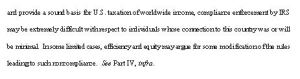 Congress) never initially even contemplated USCs and LPRs living overseas. In other words, the group targeted were U.S. resident individuals who were evading taxes through foreign financial institutions. I say this, based upon extensive conversations I have had with ex-government officials and some government officials who were involved in the original policy discussions.
The focus then was on U.S. resident taxpayers; even though the U.S. imposes U.S. income taxes on the worldwide income of USCs living anywhere in the world. See, “Tax Simplification: The Need for Consistent Tax Treatment of All Individuals (Citizens, Lawful Permanent Residents and Non-Citizens Regardless of Immigration Status) Residing Overseas, Including the Repeal of U.S. Citizenship Based Taxation,” by Patrick W. Martin and Professor Reuven Avi-Yonah, 2013.
In practice, the U.S. federal government has known for many years that it can be nearly impossible to collect a tax liability against USCs who live and have their assets outside of the U.S. Specifically, the Treasury Department noted back in 1998 that . . .
- Other factors also operate to limit both compliance measurement and improvement. Because the United States asserts taxing jurisdiction over those with little or no connection to the United States other than citizenship or status as a lawful permanent resident, in many cases overseas U.S. taxpayers are difficult to trace or contact. Moreover, even when valid tax assessments can be made against overseas taxpayers, IRS has limited enforcement recourse if the taxpayer’s assets are physically located outside of the United States.
See pages 13-15 of the Treasury report which can be found at the post, Sometimes Old is as Good as New – 1998 Treasury Department Report on Citizens and LPRs
Also, the original offshore voluntary disclosure initiative in 2009 never even contemplated any particular treatment for USCs or LPRs residing overseas. I submit, the USC and LPR living overseas was not even on the “radar” of the IRS at the time the first program was created. It was not until 2011, that a new category was created that imposed a 5% penalty for persons residing overseas, but who also had only US$10,000 of U.S. sourse income.
As time has gone on, the IRS has realized that numerous USCs and LPRs indeed live somewhere other than the U.S. (millions of them) and yet again modified the 2014 OVDP to provide for a “0%” penalty in certain circumstances for these individuals.
When FATCA was originally passed in 2010, USCs and LPRs living overseas was not the focus (and barely a thought). The heavy  compliance focus as of late was an unintended consequence.
Now even the Senate has started to focus on USCs living overseas. The Senate Permanent Subcommittee on Investigations focused extensively on Swiss accounts opened by USCs living overseas. The full report can be read REPORT: Offshore Tax Evasion:The Effort to Collect Unpaid Taxes on Billions in Hidden Offshore Accounts (February 26, 2014) –
In those reports, the Senate Permanent Subcommittee on Investigations focused extensively on USC owned Swiss accounts opened by USCs living outside the U.S. See, Key Take Aways from Senate Investigations re: Foreign Banks and “Offshore Tax Evasion”: U.S. Citizens Residing Overseas have Become a Focus of the Government.;
Read the Q&A format here.
Ausbürgerung – ???? – Expatriación – – ????????? – Expatrié – Ausgebürgerter – ?? – Espatri
Ausbürgerung – ???? – Expatriación – – ????????? – Expatrié – Ausgebürgerter – ?? – Espatri
Each of these terms can have a significantly different meaning, depending upon each country, different histories and distinct cultural experiences. The meaning of “expatriate” in the U.S. itself has now become a loaded word, meaning different things to different people.
Only recently has the term “expatriate” conjured up tax consequences, largely due to U.S. tax law and the attention it has gotten over the last 5-6 years around the world. The term “expatriate” or “expatriation” appeared sparingly in the U.S. tax law (less than a dozen times), until modifications made in 2008, which introduced no less than 46 news uses of the term “expatriate” or “expatriation” in Section 877A.
Different countries throughout history have had their own experiences with so-called “expatriates.” I will write a series of posts that touch upon the meaning of such terms throughout different societies, including in different points of time and history.
Ausbürgerung – ???? – Expatriación – – ????????? – Expatrié – Ausgebürgerter – ?? – Espatri
???????????????? ?Please click here to view the above in Chinese.?
Is the new government focus on U.S. citizens living outside the U.S. misguided or a glimpse at the new future?
Senators on the Permanent Subcommittee on Investigations have recently focused extensively on U.S. nationals living outside the U.S. who have Swiss accounts. The full report can be read REPORT: Offshore Tax Evasion:The Effort to Collect Unpaid Taxes on Billions in Hidden Offshore Accounts (February 26, 2014)
There are millions of U.S. citizens living in all parts of the world, many of whom I have identified as “Accidental Americans.” See the detailed tax article Accidental Americans” – Rush to Renounce U.S. Citizenship to Avoid the Ugly U.S. Tax Web” International Tax Journal,CCH Wolters Kluwer, Nov./Dec. 2012, Vol. 38 Issue 6, p45; Martin, P.
During the past century U.S. Citizens living permanently or nearly permanently outside the U.S. have been “de facto” non-residents for U.S. income tax purposes. Not because the law provided they were not residents, but simply because there was little awareness of the unique system of U.S. citizenship based taxation (or those cases where individuals purposefully chose not to comply with U.S. tax laws). The U.S. Supreme Court in Cook vs. Tait found it Constitutional nearly 100 years ago. See . “Tax Simplification: The Need for Consistent Tax Treatment of All Individuals (Citizens, Lawful Permanent Residents and Non-Citizens Regardless of Immigration Status) Residing Overseas, Including the Repeal of U.S. Citizenship Based Taxation,” by Patrick W. Martin and Professor Reuven Avi-Yonah, 2013.
This “de facto” non-residency for U.S. citizens is rapidly changing for several reasons:
First, the UBS scandal of U.S. citizens with undeclared accounts broke in 2008 and 2009.
Second the legal struggle between the U.S. Justice Department and the Swiss government and Swiss financial institutions during these past years.
Third, the adoption of FATCA by the Congress and President Obama in 2010.
Fourth, the current day technology which makes collecting, sending, sorting and identifying taxpayers and their assets through the worldwide financial sector now feasible.
Fifth, the implementation of FATCA by the U.S. in 2014 and the 20 plus FATCA Intergovernmental Agreements entered into with various countries.
Sixth, the OECD plan for a worldwide multilateral FATCA like system to be implemented shortly.
Seventh, the high profile IRS offshore voluntarily disclosure programs in 2009, 2011 and the current program launched in 2012.
Eighth, the on-going deferred prosecution agreements that have been entered into with more than 100 Swiss banks and the U.S. Justice Department.
Ninth, on-going criminal indictments by the U.S. Justice department of various taxpayers, foreign bankers, foreign lawyers and other so-called enablers for tax evasion, filing fraudulent documents and aiding and abetting the same.
Tenth, the Senate bi-partisan hearings that have and keep focusing and pushing these issues publicly at multiple levels.
Eleventh, the internet and current methods of communications and intern ational media that have brought worldwide awareness to all of the above. This awareness has arrived to many of the corners of the world about these efforts and the concept of U.S. citizenship based worldwide taxation.
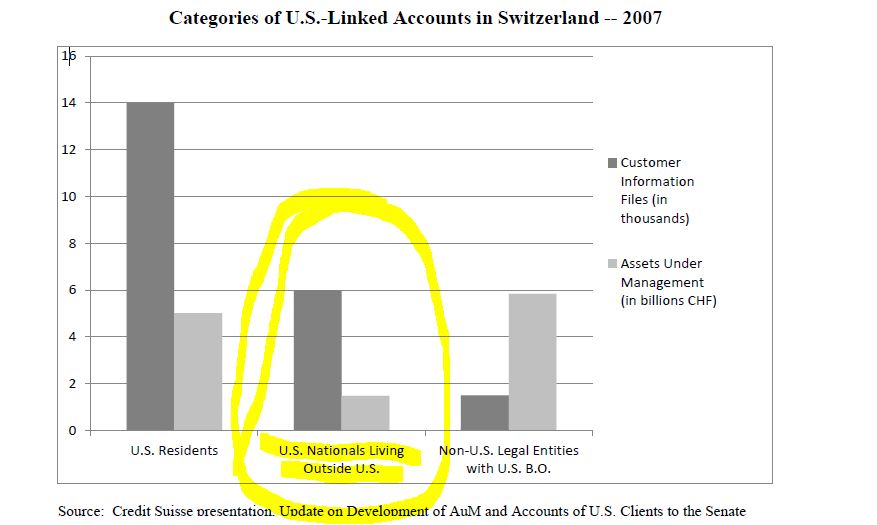
A large portion of the Senate committee report is dedicated to U.S. citizens who live outside the U.S. and are not compliant with U.S. tax laws. The following chart from the report highlights this focus as to the approximately 6,000 U.S. citizen accounts at Credit Suisse who were/do not live in the U.S:
For further observations on this topic, see an earlier post – Key Take Aways from Senate Investigations re: Foreign Banks and “Offshore Tax Evasion”: U.S. Citizens Residing Overseas have Become a Focus of the Government.; Posted on March 4, 2014
???????????????? ?Please click here to view the above in Chinese.?