What Is the IRS Non-Filer Program and How Does It Affect Americans Abroad?
U.S. Citizens and Green-Card Holders Abroad: The IRS Non-Filer Program Explained
On this page:
Read the full analysis here.
What is U.S. citizenship-based taxation, and who does it reach?
The U.S. taxes based on citizenship, not just on where a person lives. A U.S. citizen who has spent nearly all of their life outside the U.S. can still fall within the U.S. tax system. Lawful permanent residents (green-card holders, also called LPRs) residing outside the U.S. can be reached as well. Many people in both groups are shocked to learn how broad this scope is.
Why does the IRS focus so heavily on accounts and assets outside the U.S.?
In recent years the IRS and the Tax Division of the Department of Justice (DOJ) have aggressively pursued assets and accounts located outside the U.S. That pursuit has put a keen focus on the offshore holdings of U.S. citizens and green-card holders who live abroad.
What are the “New Filing Compliance Procedures for Non-Resident U.S. Taxpayers”?
In August the IRS articulated its position for U.S. citizens and lawful permanent residents residing outside the U.S. in a document titled “New Filing Compliance Procedures for Non-Resident U.S. Taxpayers.” It sets out how the IRS approaches the filing obligations of those taxpayers.
What is the IRS non-filer program?
The IRS has had, for years, a specific program aimed at “non-filers,” meaning persons who do not file U.S. income tax returns. The program is detailed in the Internal Revenue Manual (IRM), the IRS’s internal handbook of procedures. It can apply to U.S. citizens and green-card holders living overseas who have not filed.
What can happen if a U.S. citizen or green-card holder living abroad never files a U.S. return?
When a taxpayer does not file, the IRS may prepare a “substitute return” on that person’s behalf. A substitute return is a return the IRS files for the taxpayer, rather than one the taxpayer files. This can apply to U.S. citizens and lawful permanent residents residing overseas who are non-filers. Anyone facing this situation may want to consult an experienced attorney.
Where is the non-filer program actually written down?
The non-filer program is laid out in the Internal Revenue Manual at section 4.19.17, the Non-Filer Program. Its subsections cover the full process:
- 4.19.17.1 — Non-Filer Program
- 4.19.17.2 — Non-Filer Strategy
- 4.19.17.3 — Non-Filer Processing
- 4.19.17.4 — Non-Filer Penalties
- 4.19.17.5 — Undelivered Mail
- 4.19.17.6 — Taxpayer Replies
- 4.19.17.7 — Closures, Non-Examined
Read the full analysis here.
What Are the Risks of Using the IRS Streamlined Filing Program?
On this page:
Read the full analysis here.
The IRS announced a new “streamlined” filing program in June 2014 for US citizens and lawful permanent residents with unreported foreign accounts. Here is how the program works and where its legal risks lie.
What is the IRS “streamlined” program for offshore accounts?
The streamlined program is an administrative procedure the IRS announced in June 2014 for US citizens (USCs) and lawful permanent residents (LPRs, or green-card holders) who did not file US tax returns, information returns, or FBARs (FinCEN Form 114, the Foreign Bank Account Report) covering their foreign accounts. An earlier version was announced in June 2012 and has since been removed from the IRS website. The program asks the taxpayer to file under a certification, and for US residents to pay a “5% miscellaneous offshore penalty.” It is an administrative procedure, not a change in the underlying law.
Does the streamlined program give any legal protection or finality?
No. Legally speaking, this administrative procedure provides no legal protection or finality to the taxpayer. It does not protect against penalties for failure to file tax returns, failure to file information returns, or failure to file FBAR forms. It also does not protect against IRS audits of prior years while the statute of limitations is still open. The IRS or the Justice Department can still fully pursue a US citizen or green-card holder who did not properly file US income tax returns, information returns on foreign assets, or FBARs for prior years, as provided under the law.
What is the “5% miscellaneous offshore penalty”?
For US residents using the streamlined program, the “5% miscellaneous offshore penalty” is an amount equal to 5% of the relevant foreign assets that the taxpayer agrees to pay in order to participate. It is not a penalty that exists under the law in the first place, and it may have no correlation with any income taxes actually owing. As a result, a good-faith taxpayer who made an inadvertent mistake about complex tax provisions can end up paying a portion of their principal assets, not just tax.
Can the IRS be required to refund the 5% penalty if you change your mind?
No. Under the terms of the Certification, the government will never be required to refund the 5% miscellaneous offshore penalty. The taxpayer waives “all defenses against and restrictions on the assessment and collection of the [5%] miscellaneous offshore penalty.” It is a one-way street. Once the money is paid it does not come back, even though the penalty is not something contemplated under Title 26.
What does the streamlined certification require, and who wrote it?
The certification is a statement the taxpayer signs under penalties of perjury. It is not drafted in the taxpayer’s own words; it is drafted by the US federal government. By signing, an individual may expose themselves to greater liability if the government later wants to challenge the certification. The certification turns on terms like “negligence,” “inadvertence,” and a “mistake” that is a “good faith misunderstanding” of the law. It is entirely unclear how the government will interpret these terms in any particular case.
Can the government challenge your certification after you file?
Yes. The IRS’s limited resources mean the vast majority of streamlined cases likely will not be challenged. Even so, there are many ways a certification can be challenged against a particular taxpayer. For example, if a taxpayer threw away the monthly bank statements for a foreign account for the year 2012, that may breach the Certification, and the terms seem to provide that all bets are off against the taxpayer. Signing under penalties of perjury is what creates this exposure.
Could the government later decide you belonged in the OVDP instead?
Yes. Some practitioners expect the government to selectively pursue taxpayers who entered the streamlined process when it believes they should have gone in under the Offshore Voluntary Disclosure Program (OVDP) instead. That determination is made by the government, not the individual taxpayer, and it can put the taxpayer in further jeopardy after they have already filed under streamlined.
Why is the FBAR described as a “trap”?
The FBAR has been used as a trap for the taxpayer. If an individual did not check the right box on Schedule B, Part III of their tax return, the government may argue they were “willfully blind” of the FBAR filing requirements, even if they genuinely did not know about them. The FBAR regulations are extremely complex. Few tax experts anywhere could pass a basic exam on what counts as a “financial interest in” or “signature authority over” an account under these regulations, with many scoring only around 75%, a C or maybe D grade.
Does the streamlined program apply to green-card holders as well as US citizens?
Yes. The same exposure applies to both US citizens (USCs) and lawful permanent residents (LPRs, or green-card holders) who did not properly file US income tax returns, information returns on foreign assets such as IRS Form 8938, or FBARs. Both groups face the same lack of protection from penalties and audits. Both can be pursued by the IRS or the Justice Department for prior years.
A concrete example: why might the program produce an unjust result?
Consider Pierre, who moved from France to the US about 10 years ago. He was an accountant in France, his English is poor, and he relies on an English-only return preparer who never asked whether he held non-US assets. Pierre inherited Swiss and French accounts worth about US$3M, plus real estate outside Paris worth about US$2.5M that generates monthly rent. His preparer always checked the “No” boxes on Schedule B, Part III and never filed FBARs or IRS Form 8938. His sophisticated French advisers told him those European assets were taxable only in France and Switzerland. Foreign taxes withheld there exceed his US tax, so after the US foreign tax credit he owes less than US$1,000 of federal income tax. To join the streamlined program, he would pay about US$325,000, which is 5% of US$6.5M.
Why would a good-faith taxpayer pay $325,000 to settle a $1,000 tax bill?
This is the core unfairness of the program for US residents. A taxpayer like Pierre may owe less than US$1,000 in federal income tax, yet the 5% miscellaneous offshore penalty would require paying about US$325,000, a large portion of a family inheritance, for an inadvertent mistake about very complex rules. That US$325,000 is not contemplated under Title 26. There is no clear legal basis for requiring a good-faith taxpayer to hand over part of their principal to the government for an honest misunderstanding.
What are the choices if you do not enter the streamlined program?
A taxpayer in Pierre’s position faces two hard choices. The first is to comply under Title 26 by filing amended returns, and risk that the IRS and Justice Department pursue multiple-year 50% willfulness penalties by arguing he was “willfully blind,” as in the Zwerner case, even though the penalty for failing to file IRS Form 8938 is generally limited to 3 years at $10,000 per year. The second is to be forced into the streamlined procedure and pay a large portion of his European family inheritance to the US, simply because he did not file IRS Form 8938 or FBARs. Both paths carry real risk.
Read the full analysis here.
What Is the Difference Between Willful and Non-Willful FBAR Violations?
Table of contents
Read the full analysis here.
What do “willful” and “non-willful” mean for US citizens and green-card holders living abroad who have not filed?
“Willful” and “non-willful” describe how a failure to file is characterized. For any US citizen (USC) or lawful permanent resident (LPR, a green-card holder) living outside the US who has not been filing US income tax returns or FBARs (the Foreign Bank Account Report), the willfulness question is one of the most important to understand. The IRS “streamlined” procedure requires a taxpayer to certify that the conduct was non-willful. The distinction shapes the options a person has for correcting past filings.
Why does the willful or non-willful question matter for a US citizen or green-card holder overseas?
The willful or non-willful question matters because it shapes what steps a US citizen or green-card holder living abroad needs to take about filing US income tax returns. The answer affects how a person who has not been filing may approach cleaning up past returns and FBAR filings.
Can a green-card holder living in a tax-treaty country clean up past US tax filings?
A green-card holder who lives predominantly in a country that has a US income tax treaty may be in the best position to clean up past US tax filings and return positions. The US has 68 income tax treaties. Under the “tie-breaker provisions” of such a treaty, typically Article 4, the person’s facts may allow them to file as a non-resident, and those filings may apply to several prior years.
When is a green-card holder no longer treated as a lawful permanent resident for US tax purposes?
A green-card holder is no longer treated as a lawful permanent resident for US federal tax purposes under IRC Section 7701(b)(6) when three tests are met:
- the individual is treated as a resident of a foreign country under the provisions of a tax treaty;
- the individual does not waive the benefits of the treaty; and
- the individual notifies the Secretary of the commencement of such treatment.
When a green-card holder notifies the IRS that he or she is not a US resident under an applicable income tax treaty and files the treaty position accordingly, the issue of “expatriation” becomes front and center.
Can a green card be given up for tax purposes just by moving outside the US?
In some cases, yes. Since the 2008 tax law changes, lawful permanent resident status can be abandoned for tax purposes by merely leaving and moving outside the US.
Does giving up long-term green-card status trigger the US exit tax?
Giving up green-card status can trigger the US “exit tax” for a green-card holder treated as a “long-term resident.” A green-card holder who has held that status for 8 years or more is generally treated as a long-term resident and may be subject to the exit tax of IRC Sections 877 and 877A. A separate tax may also apply to future US persons who receive gifts or inheritances from such a former green-card holder under Section 2801.
What does the IRS streamlined procedure require taxpayers to certify?
The IRS “streamlined” procedure, announced on June 18, 2014, has specific requirements that obligate the taxpayer to certify “non-willful” behavior. That certification is made under penalty of perjury. Where a green-card holder’s past failure to file US income tax returns was not non-willful, difficult legal questions arise about the consequences.
Read the full analysis here.
What Is FATCA and Why Is My Foreign Bank Asking Me About My US Status?
If you received a letter from your foreign bank asking whether you are a US person, FATCA is why. FATCA (the Foreign Account Tax Compliance Act) is a US law requiring foreign banks to identify and report their American clients’ account information to the IRS. This post explains what those letters mean, what your bank is reporting, and what you should know if you are a US citizen or green card holder living abroad.
In this post
What is FATCA?
Why is my foreign bank sending me a letter about my US status?
What information does my foreign bank have to report to the IRS?
Who counts as a US person under FATCA?
What is a FATCA intergovernmental agreement?
What should I do if I receive a FATCA letter from my bank?
What is FATCA?
FATCA stands for the Foreign Account Tax Compliance Act. It added Chapter 4 to Subtitle A of the Internal Revenue Code, which is why your bank’s letter may use that formal legal phrase. In practice, it means one thing: foreign financial institutions are required by US law to collect information about clients who are US persons and report that information to the IRS.
If your bank’s letter references “Chapter 4 of Subtitle A of the US Internal Revenue Code,” it is simply their way of citing the statute behind their request.
Why is my foreign bank sending me a letter about my US status?
Your bank is required to ask. Under FATCA, foreign financial institutions must identify which of their clients are US persons and report those accounts to the IRS.
For many people, this letter is a surprise. A large number of US-born individuals who have lived most of their lives abroad find out for the first time, through a letter like this, that they are US income tax residents. Under the 14th Amendment of the US Constitution, being born in the United States makes you a US citizen and a US tax resident, regardless of where you have lived since.
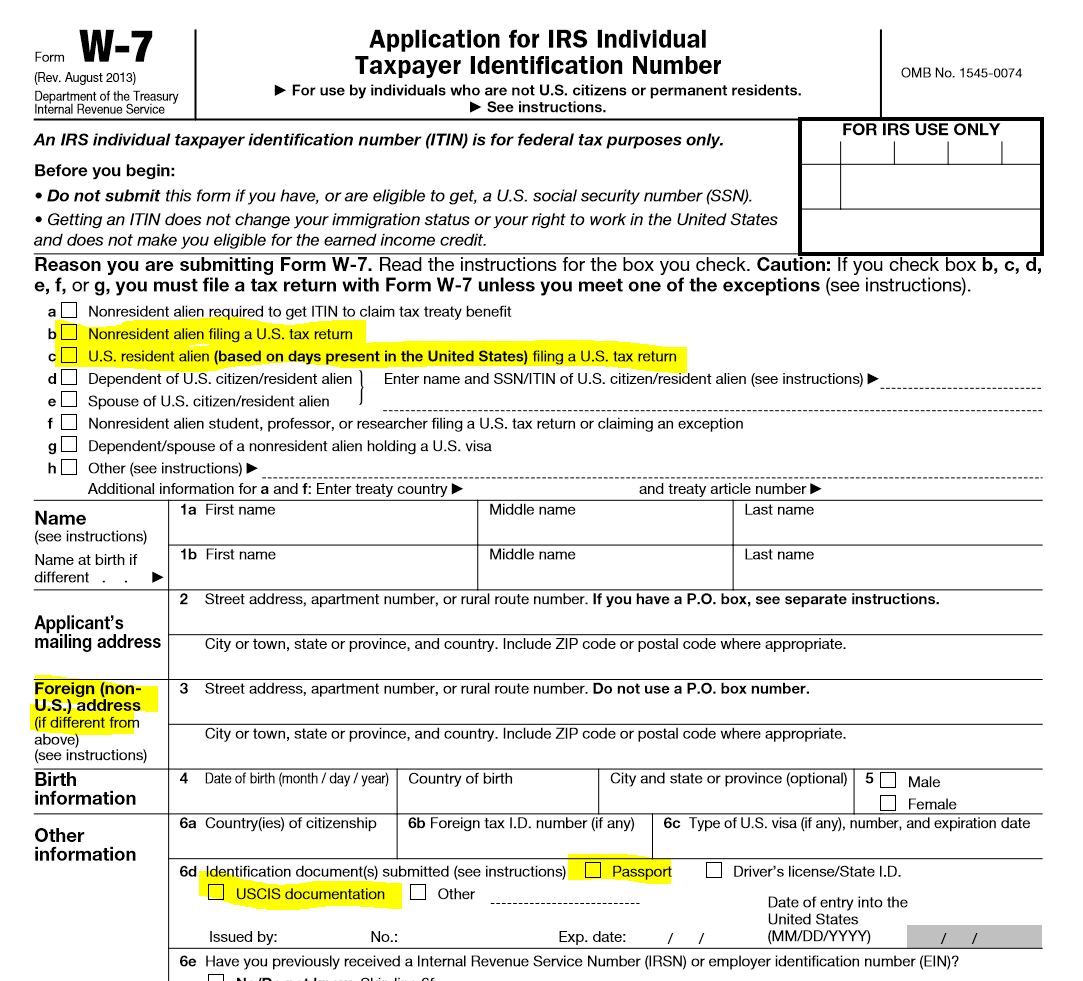
In many cases, people first learn about their US tax obligations when they open a new account and the foreign bank asks them to provide an IRS Form W-9 along with their Social Security number.
Under FATCA, your bank reports your name, your account number, your taxpayer identification number (such as your Social Security number), and income earned from your account. Some institutions are also reporting account balances, even where FATCA does not yet require it.
Your bank will ask you to certify under penalty of perjury whether you are a US person or not. That is a legally significant step, not a routine form.
Who counts as a US person under FATCA?
If you were born in the United States, you are a US person, unless one of two things is true:
- You were born to diplomatic parents who were on a formal diplomatic assignment in the US at the time of your birth, or
- You have formally renounced your US citizenship and received a Certificate of Loss of Nationality (CLN) from the US Department of State.
If neither exception applies to you, you are a US person under FATCA, regardless of how long you have lived outside the United States.
What is a FATCA intergovernmental agreement?
A FATCA intergovernmental agreement (IGA) is an agreement between the US Treasury and a foreign government to exchange financial information. These agreements work in both directions: your foreign bank reports your US accounts to the IRS, and US banks may report your accounts there to your local tax authority.
This means FATCA letters are not only going to Americans with accounts abroad. Citizens of other countries are also receiving notifications that information about their US-held accounts will be shared with their home country’s tax authority. For a deeper look at how these agreements operate in practice, see The Dirty Secret of US FATCA IGAs.
What should I do if I receive a FATCA letter from my bank?
A FATCA letter is not a tax bill or a penalty notice. It means your bank is complying with its legal obligations, and that the IRS may receive information about your account.
If you are a US citizen or green card holder living abroad and have not been filing US tax returns or FBARs (FinCEN Form 114, the Foreign Bank Account Report), receiving this letter is a signal to act. Consult an experienced international tax attorney about your options.
This post provides general information only and is not legal advice. Consult an experienced attorney for guidance specific to your situation.
Read the full analysis here.
2023: The Judiciary Takes Center Stage; Professor – Mindy Herzfeld’s article in Tax Notes International –
Professor Herzfeld has an excellent article posted the 18th of December 2023. You can access it here with a paid subscription – titled: 2023: The Judiciary Takes Center Stage. She has lots to cover regarding recent international tax law decisions by the U.S. federal courts (United States Tax Court, Federal District Courts & Court of Federal Claims).
Professor Mindy Herzfeld discusses our recent case Aroeste v United States – Order (Nov 2023), which I have discussed at some length in recent posts. See, Federal District Court Rules in Favor of Mexican Citizen – Aroeste vs. United States (LPR) – Tax Treaty Applies: Government’s Motion for Summary Judgment is Denied. It was a pleasure for me to represent Mr. Aroeste over several years and see the favorable outcome of the federal district court that obligates the government to respect the terms of substantive tax treaty law.
She covers Christensen v. United States, which is another tax treaty case regarding the ability to take a foreign tax credit against the Section 1411 tax on net investment income; authored by Judge Marion Blank Horn of the Court of Federal Claims. Judge Horn is no stranger to important international tax issues. She authored the 2002 decision of Estate of Jack vs. United States regarding “domicile” for U.S. estate tax purposes and the impact of the Canadian decedent’s visa status. More recently the Estate of Margaret J. Jones vs. the United States (2022) was a lengthy case of Judge Horn’s denying the Estate a refund. This Estate of Margaret J. Jones is also Canadian citizen (decedent) case; but addressed a very different issue – re: the 5% “miscellaneous offshore penalty” she paid that is identified by the IRS’ rules they created in the “Streamlined Domestic Offshore Procedures” instructions (it is not a treaty case).
- TCJA, U.S. Trade or Business – SCOTUS & Moore
The Professor also addresses Moore v. United States (which she has written about before) and Altria Group Inc. v. United States and the subpart F rules under the TCJA.
The recent U.S. Tax Court (USTC) case of YA Global Investments LP v. Commissioner, is discussed by Professor Herzfeld regarding U.S. trade or business activities. Of course, another key USTC case regarding Section 6038 penalties is reviewed which has been appealed by the government – Farhy v. Commissioner. See, Six Weeks, Three International Information Reporting Decisions –
The SCOTUS decision near and dear to my heart (as I personally worked on the ACTEC amicus brief) of Bittner v. United States, is also reviewed briefly by Professor Herzfeld. In that case the SCOTUS held penalties are limited to $10,000 per year for a non-willful violation of the statute (not $2.72 million as the government asserted based upon each account).
She reviews some important transfer pricing cases Coca-Cola Co. v. Commissioner and 3M Co. v. Commissioner.
Do read Professor Herzfeld’s article when you get a chance. More details about her background and how to follow her is set out below:
Mindy Herzfeld is professor of tax practice at University of Florida Levin College of Law, counsel at Potomac Law Group, and a contributor to Tax Notes International. Follow Mindy Herzfeld (@InternationlTax) on X, formerly known as Twitter.
Never in my 30 year career practicing international tax law have I seen the judiciary so active in international tax matters – particularly when you take into consideration various SCOTUS cases.
Is it too late to comply with the “965 Hammer” (aka the “Transition” or “Repatriation” Tax) for USCs Residing Overseas?
For more background on how Section 965 works, please see, The “965 Hammer” (aka the “Transition” or “Repatriation” Tax) for USCs Residing Overseas, which explains how U.S. citizens (USC) residing overseas may owe U.S. federal income tax on “phantom income”. 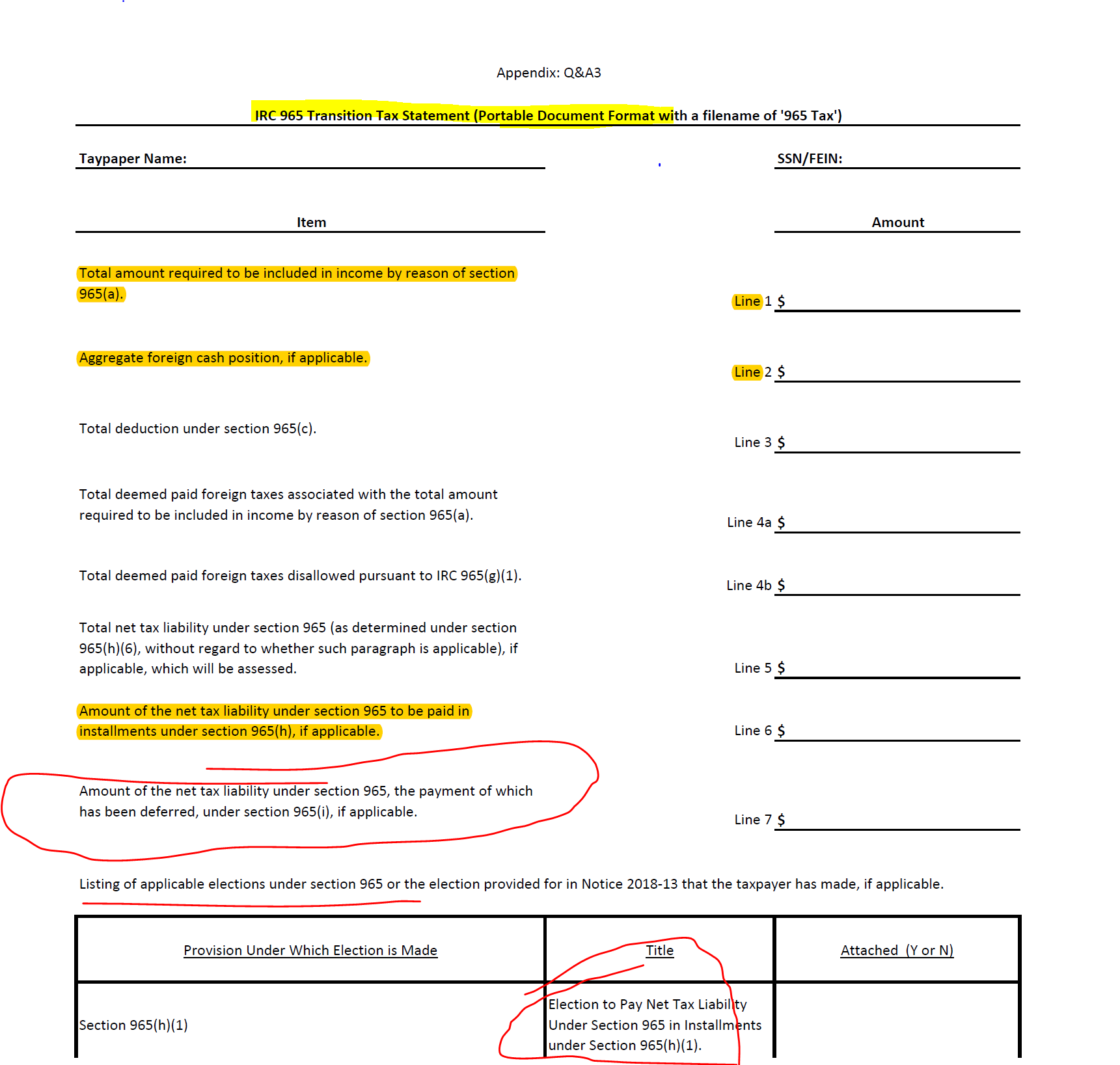 I call it phantom income as it does not need to be received (nor does the USC) need to have any right to it for it to be taxed.
The tax is calculated with reference to (1) the type of assets held in the USC’s foreign corporation (cash or not), and (2) the previously un-taxed earnings of the foreign corporation owned by the USC.
The IRS has a dedicated page on their website to the Section 965 Transition Tax that provides a basic overview. The rules are complex and the IRS addressed a set of Q&As to help taxpayers understand how they must report on their tax return; see, Questions and Answers about Reporting Related to Section 965 on 2017 Tax Returns
Normally, USCs combined with other “U.S. persons” need to have greater than 50% of the shares of the foreign corporation to be subject to the 965 Hammer/Repatriation tax. 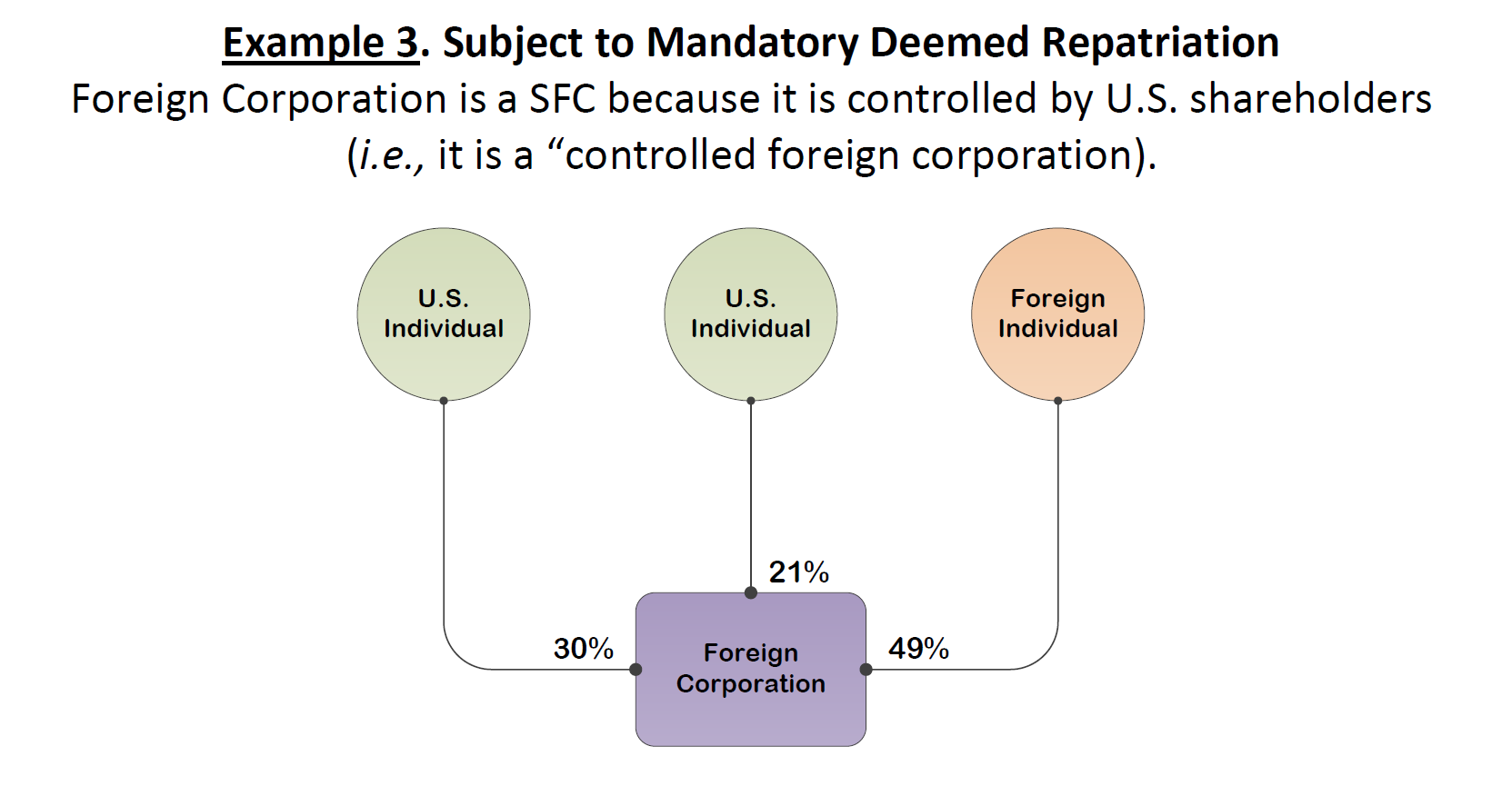 The following example shows how U.S. individuals combined to own 51% cause the foreign corporation to be a “controlled foreign corporation” (CFC) and therefore a “specified foreign corporation” (SFC) that causes the USCs to be subject to the tax on “phantom income” to the extent the company has previously un-taxed earnings.
In contrast, a USC that owns 10% (or 21% or 30%) should not be subject to this tax, as long as the foreign corporation is not a CFC and/or there is no U.S. corporate shareholder that owns 10% or more of the foreign corporation. The following example (Example 2) shows how a USC that owns 15% and another USC who owns 20% of a foreign corporation, will not be subject to the 965 Hammer, since it is neither a CFC or a SFC. 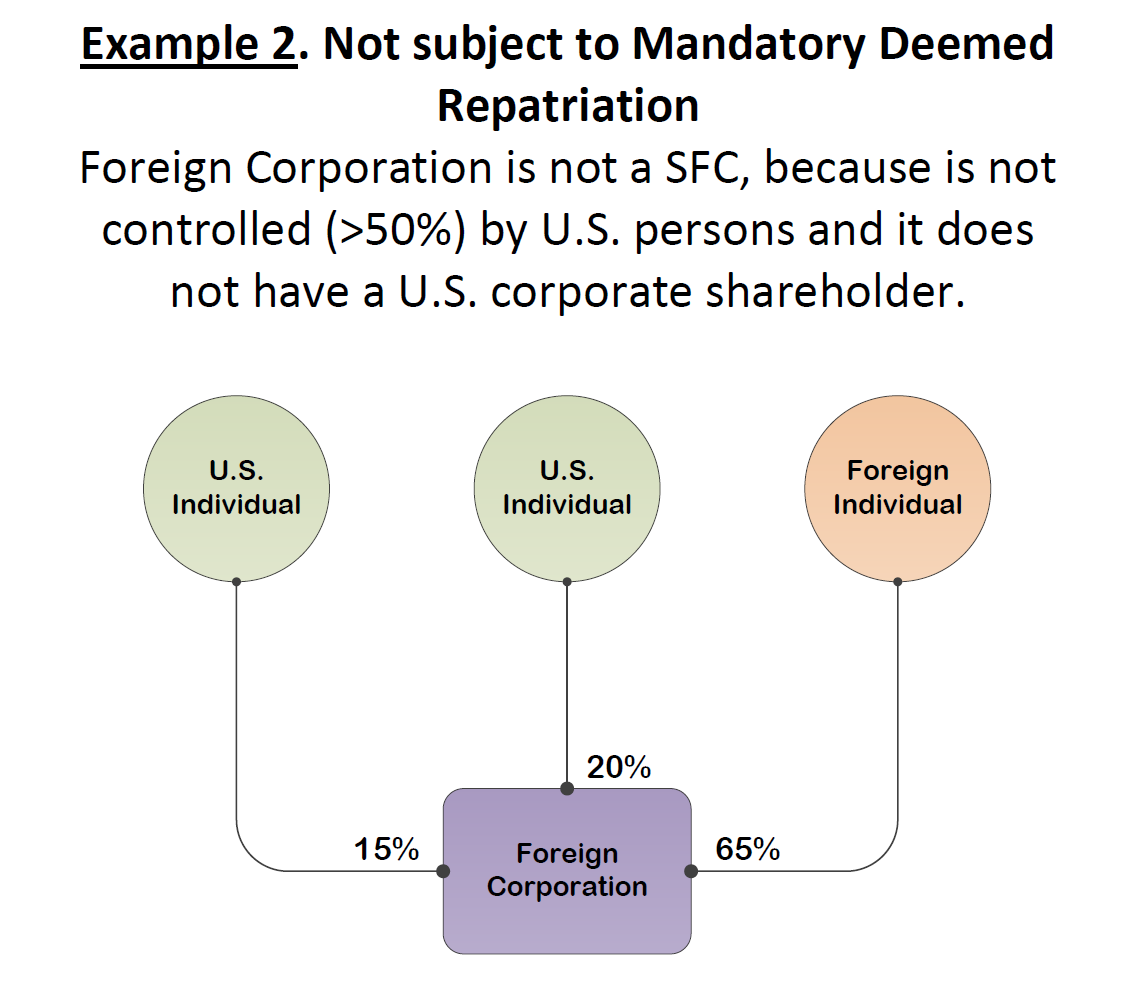
Compare that scenario to the following example (Example 1) that shows the somewhat “capricious” nature of how a USC that only owns 10% in a different fact pattern of ownership, can still be subject to the 965 Hammer repatriation tax. This is true, even when other U.S. owners have a mere 11% ownership (but in this case it is a U.S. corporate owner with >=10%), causing it to be a SFC and therefore triggering the 965 Hammer/repatriation tax: 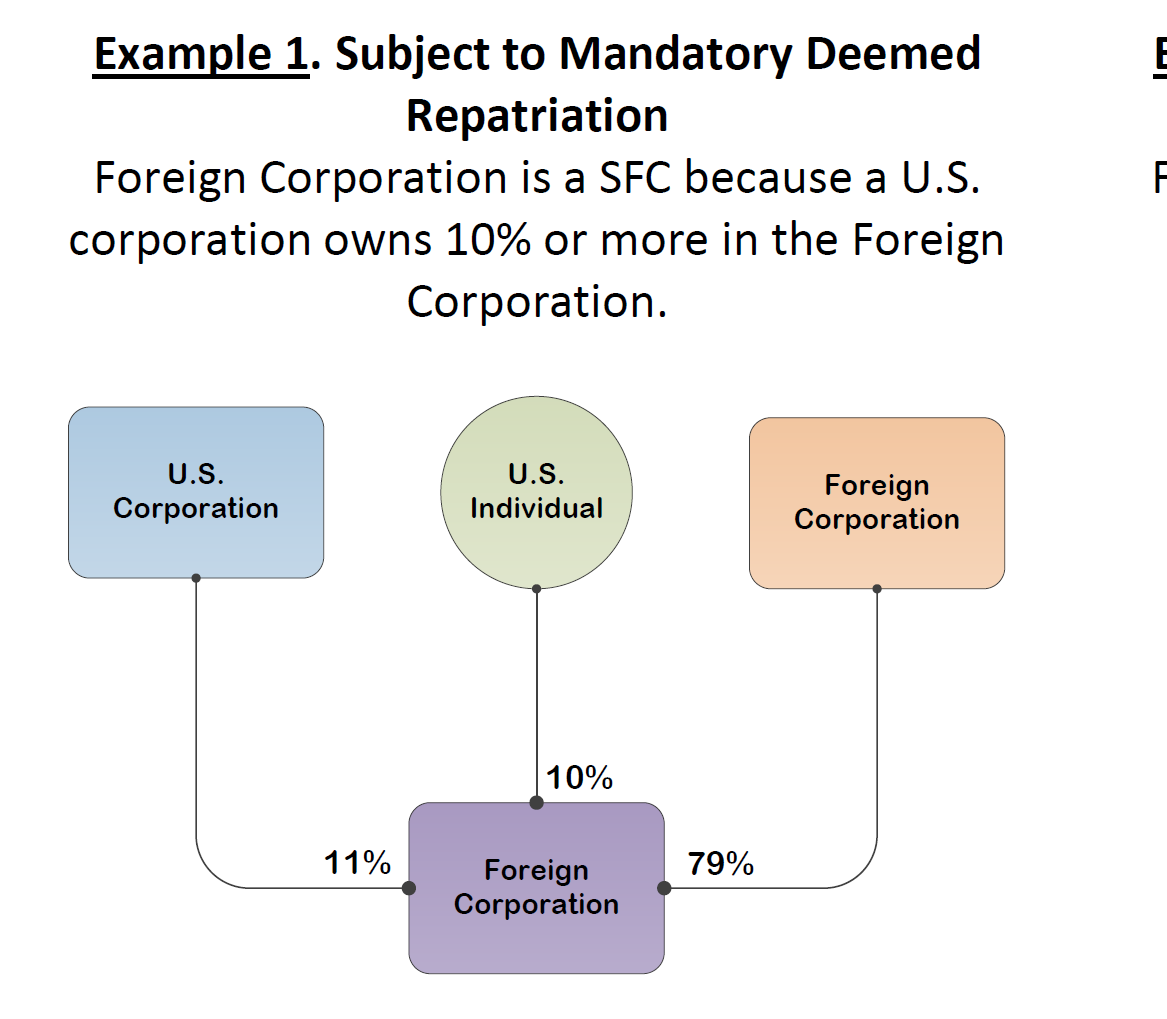
In this last example, the USC owns only 10% of the shares of the foreign corporation, but since a U.S. corporate shareholder owns at least 10% of the shares of the same foreign corporation, all U.S. shareholders are subject to the 965 Hammer/repatriation tax.
There are some silver linings to this tax.
First, the tax rate applicable (8% in the case of non-cash assets) can be much lower than the normal statutory rate on dividend distributions.
Second, since the tax is mandatory (hopefully at a lower rate as cash and cash equivalents carry out a 15.5% higher tax rate), it can provide an opportunity to restructure and/or repatriate profits of the foreign corporation. This can give liquidity in the hands of the USC shareholder who was otherwise deterred from making actual dividend distributions or investing in U.S. property (which is in itself normally deemed a dividend to the USC shareholder) for foreign corporations that are “CFCs.”
Maybe USCs residing overseas will want to restructure their business operations to obtain specific tax advantages from the federal tax reform (e.g., 21% or 13.25% corporate tax rates that can be applicable for U.S. corporate taxpayers)?
Third, the statute allows the taxpayer to make a timely election (under Section 965(h)(1)) to defer the payment of the tax over many an eight (8) year period as follows:
There are no circumstances where a USC would not want to defer the payment of the tax over time? Why pay for something today, when you can pay it tomorrow without an interest carrying charge?
For instance, if the total 965 Hammer/repatriation tax is US$200,000 for a USC, why would she not want to pay only 8% or US$16,000 in 2017/2018 and defer the rest of the US$200,000 tax payments over time?
The payments are “back-loaded” in later years and do not carry an interest charge.
Also, the IRS granted further relief for individuals who owe less than US$1M of 965 Hammer/repatriation tax. This relief allows the payment/deferral of the first installment otherwise due in 2017 until 2018 (and will not trigger the full amount immediately due), provided all of the following are satisfied:
- a timely election under Section 965(h)(1) needs to have been made, which is typically extends the return due date until October 15, 2018 (USCs residing outside the U.S., the extension due date was June 15th, 2018 and requires the filing of a specific automatic extension form (IRS Form 4868) by that date); and
- pays the first installment by the due date of of the 2017 tax return, without regard to extensions (which will typically be June 15th, 2018 provided the USC is residing overseas).
Bottom line: a USC who has timely filed an extension to file their IRS Form 1040 individual income tax return by June 15th, still has time to timely file the election under Section 965(h)(1) to defer the payment of the 965 Hammer/repatriation tax.
Incidentally, the Treasury published proposed regulations at the beginning of last month on Section 965 – Treasury Announces Guidance on One-Time Repatriation Tax on Foreign Earnings
Mr. Dewees gets Smacked! U.S. District Court Upholds Multiple $10,000 Penalties (US$120,000 – NO Forms 5471) for USC Residing in Canada
United States Citizens (“USCs”) and lawful permanent residents (“LPRs”) residing overseas should read the story of Mr. Dewees to learn what could happen if they go into the offshore voluntary disclosure program (“OVDP”); when he appears to have been a “good faith” taxpayer. The IRS issued a press release in March 2018 – IRS to end offshore voluntary disclosure program; Taxpayers with undisclosed foreign assets urged to come forward now The IRS explained that it will close the program next mont h on September 28, 2018. Take the story of the Dewees into consideration before rushing into the OVDP.
This is not a new case, as the U.S. District Court for the District of Columbia issued its opinion a year ago – Dewees v. United States, 2017 U.S. Dist. LEXIS 124989 (D.C. D.C. 2017). However, it is an important case if anyone is confused about whether they should go into the OVDP. See the story of the Dewees.
Mr. Dewees resided in Canada and did file U.S. income tax returns, but not all information returns. See a related previous post – Why Most U.S. Citizens Residing Overseas Haven’t a Clue about the Labyrinth of U.S. Taxation and Bank and Financial Reporting of Worldwide Income and Assets
He also did not initially pay information reporting penalties assessed by the IRS regarding his Canadian company. He resided in Canada where is business and company was located. The Court noted that he “. . . voluntarily disclosed [to the IRS] his failure to file the required informational returns . . . ” The Dewees were “rewarded” by their good faith efforts by the IRS which then turned around and ” . . . assessed a statutory penalty of $120,000, $10,000 for each year of non-compliance . . . “
The Canadian revenue authority would not refund his Canadian tax refund until the IRS penalty was paid in full. He eventually paid $120,000 of information penalties and brought a suit for refund in U.S. District Court.
The U.S. District Court first explained the obligations of USCs residing overseas with –
(i) controlling interests in foreign corporations (i.e., filing obligations under IRC  Section 6038 to file IRS Form 5471) – see an earlier related post Many Canadians have expressed frustration with U.S. tax policy of worldwide taxation of U.S. citizens., and
(ii) interests in foreign financial accounts (i.e., filing obligations of foreign bank account reports under Title 31) see a previous post, Nuances of FBAR – Foreign Bank Account Report Filings – for USCs and LPRs living outside the U.S.
The Court then dismissed the suit for refund on the grounds that Mr. Dewees failed to state a viable claim and the Court therefore lacked jurisdiction to hear his claims (which were “excessive fines”, “equal protection” and “due process” claims).
Here, the USC residing in Canada was apparently well intended, since the District Court said that Mr. “Dewees learned that he had failed to comply with these requirements . . . ” In another part of the opinion, the Court uses the word “neglected” to file information returns for over a decade.
“Learned” and “neglected” certainly does not sound intentional, which is probably why the IRS did not attempt to pursue Title 31 willfulness FBAR penalties.
The USC entered the OVDP on the advice of a tax specialist and then withdrew after the IRS was proposing to assess an “OVDP in-lieu of penalty” of US$185,862. 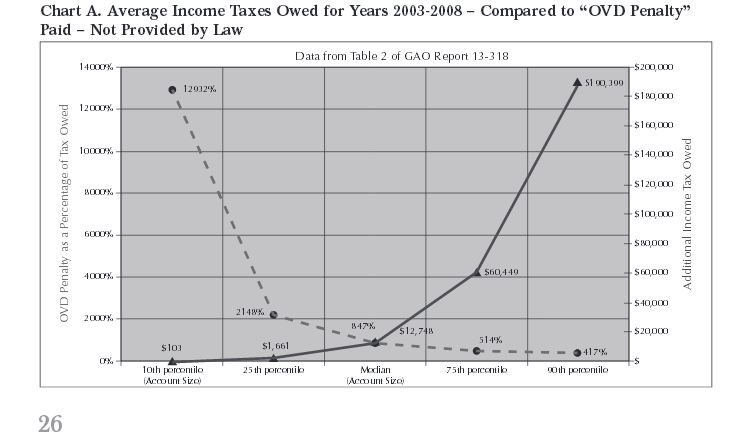
The IRS ultimately did not pursue any FBAR penalties in this case, not even the annual $10,000 per year penalty for failure to file the FBAR form.
Had Mr. Dewees lived in any other country (other than Canada) he probably would not have had the local taxman (i.e., the Canada Revenue Agency) step in to indirectly help the IRS collect the penalty amounts assessed. See an earlier post, U.S. Enforcement/Collection of Taxes Overseas against USCs and LPRs – Legal Limitations
The U.S.-Canada income tax treaty has a special “assistance in collection” provision, which provides in part as follows –
Article XXVI A
Assistance in Collection
1. The Contracting States [referring to the U.S. and Canada] undertake to lend assistance to each other in the collection of taxes
referred to in paragraph 9, together with interest, costs, additions to such taxes and civil penalties, referred to in this Article as a “revenue claim”.
I explained in an earlier post, how the “Revenue Rule” was a common law concept that generally prohibited the U.S. government from assisting in the collection of taxes of  another country. Hence, the U.S. Treasury renegotiated the treaties with five countries (including Canada) that now have a specific treaty provision such as XXVI A above:
As a result of these cases and the Revenue Rule, the U.S. and Canada modified their income tax treaty to (at least in theory) allow for the international enforcement of taxes. The U.S. now has five income treaties with “mutual assistance” provisions: Canada, Sweden, France, Denmark, and the Netherlands (with a clause in the newly negotiated, but yet to go into force, Swiss treaty).
In the Dewees case, we learned that the assistance in collection provision is not merely a theoretical tool that can be used in collecting taxes. The actions of both the Canadian (CRA) and U.S. governments (IRS and District Court Judge), made the provision effective. The US$120,000 penalty, that has nothing to do with any U.S. taxes, was collected by the IRS.
Questions to ponder in this case:
- Would the USC have been better off, by getting proper advice as to how to file on a going forward basis?
- Why did the USC ever go into the OVDP program in the first place under these facts?
- Did the USC know about the “streamlined” filing procedures of the IRS for U.S. Taxpayers Residing Outside the United States?
- In this case, the program did not exist at the time the taxpayers went into the OVDP in 2009.
- Why did Dewees not simply consider (assuming he had good faith facts) filing amended tax returns to include late filed IRS Form 5471 forms?
- Why did the IRS aggressively pursue these $120,000 in information penalties (presumably because he opted out of the OVDP program and they like to make examples out of those taxpayers that leave the program)?
- Would and will the IRS assess more $10,000 per year penalties for additional companies for a good faith failure to file IRS Form 5471 forms? In other words, what if the Dewees had four Canadian companies, would the IRS have assessed US$480,000 (US$10,000 per year X 4 – per company – X 12 – the number of years the form was not filed)?
- Will the IRS have success with any other country that does not have a similar tax treaty provision on the collection of taxes as the unique U.S.-Canada provision?
- What about Sweden, France, Denmark, and the Netherlands with specific provisions in the U.S. income tax treaties? See a discussion of the U.S. District Court case in Georgia involving a Danish citizen, Torben Dileng v. Commissioner as discussed by Keith Fogg in the Procedurally Taxing Blog –
- Will the aggressive actions of the IRS in this Dewee case to collect penalties backfire? Will USCs residing overseas be less likely to go into specific IRS programs for fear of being smacked down to the tune of US$120,000 (plus legal fees and costs) for merely neglecting to file information returns when no U.S. taxes are even owing?
Revocation or Denial of U.S. Passport: More on new section 7345 (Title 26/IRC) and USCs with “Seriously Delinquent Tax Debt”
New Section 7345 completely modifies how U.S. citizens (“USCs”) living and traveling around the world have to now consider very seriously actions taken by the Internal Revenue Service (“IRS”). It is the IRS which now holds the power under this new law that requires the U.S. Department of State (“DOS”) to revoke or deny to issue a U.S. passport in the first place.

New Section 7345(e) provides in relevant part as follows: “upon receiving a certification described in section 7345 of the Internal Revenue Code of 1986 from the Secretary of the Treasury, the Secretary of State shall not issue a passport to any individual who has a seriously delinquent tax debt described in such section. . . ” [emphasis added].
This new law mandates (not at the discretion of the DOS) that various U.S. passports be denied at the direction of the IRS. Once the IRS issues the certification of “seriously delinquent tax debt.”
All it takes, is for the IRS to claim tax or penalties are owing of at least US$50,000 through an assessment (plus start a lien or levy action).
Of course, US$50,000 sounds like a large sum for many modest USCs, until an individual understands that there are a host of international reporting requirements for taxpayers. Specifically, the IRS can impose a US$10,000 penalty for each violation of failing to complete and file various IRS information forms; EVEN IF NO income  taxes are owing. See IRS website – FAQs 5 and 8 regarding civil penalties (see also How is the offshore voluntary disclosure program really working? Not well for USCs and LPRs living overseas).
For a summary of these forms and filing requirements, see a prior post, Oct. 17, 2015, Part II: C’est la vie Ms. Lucienne D’Hotelle! Tax Timing Problems for Former U.S. Citizens is Nothing New – the IRS and the Courts Have Decided Similar Issues in the Past (Pre IRC Section 877A(g)(4))
Indeed, our office has seen and assisted numerous taxpayers around the world where the IRS has assessed tens of thousands, hundreds of thousands and in some cases in excess of US$1M (in proposed assessments) against an individual for failure to simply file information reporting forms. See, for instance, a prior post on Nov. 2, 2015, Why Most U.S. Citizens Residing Overseas Haven’t a Clue about the Labyrinth of U.S. Taxation and Bank and Financial Reporting of Worldwide Income and Assets
Also, we have seen several IRS assessments of income tax (not just penalties) against individuals of hundreds of thousands of dollars which are not supported by the law. For instance, it is not uncommon for the IRS to issue a “substitute for return” alleging income taxes owing. See, How the IRS Can file a “Substitute for Return” for those USCs and LPRs Residing Overseas, posted Nov. 8, 2015. We have a number of those cases pending, where the IRS has taken erroneous information and made such assessments against USCs residing and working outside the U.S. for much if not most of their professional lives.
New Section 7345 requires that USCs, wherever they might reside, take great care in knowing about any actions the IRS might be taking against them; as to tax and penalty assessments, whether or not they are supported under the law.
One basic method of learning more about the activities of the IRS is to make a transcript request directly to the IRS regarding the status of a USC’s federal tax status according to IRS records. See, IRM, Part 21. Customer Account Services . . . Section 3. Transcripts.
It is also possible for the USC to obtain additional tax information from the IRS through a Freedom of Information Act (“FOIA”) request.
U.S. Citizens Overseas are Often Ill Advised to go into the (1) OVDP and sometimes even the (2) the Streamlined Filing Procedure
There have been prior posts discussing what is referred to as the offshore voluntary disclosure program (“OVDP”) and what the IRS later created – the so-called “streamlined program” filing procedure.
For more background, see, GAO Yr2014 Report on Offshore Voluntary Disclosure Program Indicates Less Than 4% of Taxpayers Lived Outside the U.S., posted March 11, 2014.
Importantly, these OVDP and streamlined programs created by the IRS are not creatures of any statutory law, for instance Title 26 (the Internal Revenue Code) or Title 31 (the so-called Bank Secrecy Act); or any law for that matter. There are no court cases or Treasury Regulations that spell out the terms of these programs as part of any legal framework.
I like to say they are similar to the Hasbro rules of “Monopoly”; a game I was fond of as a child. The IRS is like Hasbro in that they can change the rules of the game as they wish, and often do in the form of publicized frequently asked questions (“FAQs”). The IRS submits these rules of their game and ask, encourage and in some cases (in my view) browbeat taxpayers, often times through their advisers, into participating. See some of the various rule changes below –
The above reflect just some of the modifications and rules the IRS has made, and keeps making to their rules of their proposed OVDP structure; which again, I repeat, is not part of the law.
Many taxpayers and their advisers, in my view have not thought carefully about the law and its application; but rather have focused on the “Monopoly” rules. They cite and read the FAQs if that is somehow the law! See How is the offshore voluntary disclosure program really working? Not well for USCs and LPRs living overseas posted May 10, 2014 and The 2013 GAO Report of the IRS Offshore Voluntary Disclosure Program, International Tax Journal, CCH Wolters Kluwer, January-February 2014. PDF version here.
Similarly, the streamlined filing procedures is not part of the law, and also has been modified several times by the IRS. Fortunately, the IRS realized that U.S. taxpayers residing outside the U.S. are not the same as those who reside in the U.S. when they created two separate programs last year in 2014.
See, U.S. Taxpayers Residing Outside the United States: The following streamlined procedures are referred to as the Streamlined Foreign Offshore Procedures. Eligibility for the Streamlined Foreign Offshore Procedures
The point of this post is that I have seen numerous cases where U.S. citizens residing around the world were ill advised to participate in the OVDP. In short, if an individual has no criminal tax liability, I think there is little purpose or reason for almost all USC overseas to participate into the OVDP. Analyzing thoughtfully the facts of each case and the law (not the Monopoly rules) is what is important for each individual.
Finally, a clear understanding of what are the Monopoly rules compared to the law is crucial when advising USCs residing overseas. Sometimes, filing through the streamlined procedure might be well advised for a particular taxpayer; e.g., if they would otherwise have substantial late payment and late filing penalties. However, there are plenty of cases where simply filing tax returns pursuant to the law will be preferable in a particular case. This is a process that needs to be thoughtfully considered in each case with a clear understanding of the law – not just the Monopoly rules.
For some related commentary on this topic, see the following posts:
Why Most U.S. Citizens Residing Overseas Haven’t a Clue about the Labyrinth of U.S. Taxation and Bank and Financial Reporting of Worldwide Income and Assets
This post is written simply because so many U.S. citizens residing overseas are reasonably confused about the complexity of U.S. tax law. The mere requirement to file U.S. income tax returns for those overseas often comes as a great surprise. My non-U.S. born wife is an exception (as she also lives outside the U.S.) simply because I have repeatedly told her for our 20 some years of marriage. 
Some in the IRS erroneously think U.S. citizens residing overseas do and should understand U.S. tax law. I posed one simple scenario to a very sophisticated IRS attorney not very long ago who specializes in the FATCA rules.
Her view is (hopefully was) that U.S. citizens throughout the world know or should know the U.S. tax laws because the instructions to IRS Form 1040 are clear.
This thought knocked me off my figurative chair onto the floor! Smack.
My surprise is based upon my own experience working with individuals and families throughout the world, in numerous countries. I have noticed a number of notions, based upon these andectodal experiences as follows:
- A minority of U.S. citizens (unless they lived most of their lives in the U.S. and recently moved overseas as an “expatriate”) have no real basic idea of how the U.S. federal tax laws work; let alone to their assets and income in their country of residence. See USCs and LPRs Living Outside the U.S. – Key Tax and BSA Forms
- There are indeed plenty of immigrant U.S. residents (certainly less than 50% by my own experience – especially when concepts of PFICs and foreign tax credits start being discussed) who even understand the basics of U.S. international tax law.
- If they reside in an English speaking country that has relatively strong family or historical ties to the U.S. (e.g., England, Ireland, Scotland, and Canada, etc.) they are likely to have a better idea of the U.S. federal tax laws, but still the majority don’t know key concepts. See, Nuances of FBAR – Foreign Bank Account Report Filings – for USCs and LPRs living outside the U.S.
- Even those in English speaking countries that have less historical or family ties to the U.S. have a lesser understanding (e.g., New Zealand, Australia, Kenya, South Africa, India, etc.).
- Those who do not speak English know even less about U.S. tax laws and how they apply to them.
- Many individuals who learn of these requirements overseas are sometimes driven to great despair. The message they receive is not a correct one under the law in my view: as they read IRS materials (for instance, see FAQs 5, 6 and and former 51.2 from the Offshore Voluntary Disclosure Program Frequently Asked Questions and Answers 2014) and come to the conclusion they will soon be going to jail, criminally prosecuted or otherwise be subject to tens of thousands of dollars worth of penalties for their failure to file a range of tax forms.
- Literally, sometimes as a tax lawyer I feel more like a psychologist, when these individuals come to me saying they can’t sleep, they can’t eat, they are seeing a cardiologist for high blood pressure, etc. and even in a most extreme case they thought suicide was a solution. See, How is the offshore voluntary disclosure program really working? Not well for USCs and LPRs living overseas.
- Individuals around the world (even tax professionals) and certainly laypeople, are not commonly reading TaxAnalysts (nor would they subscribe) or other tax professional publications that explain many of the intricacies of U.S. tax laws.
- Learning and understanding U.S. tax laws, including just the basics, requires a great deal of time, aptitude for nuances and details, literacy, patience and a level of aptitude for such matters that simply escape many people around the world (most I would say). see, “PFICs” – What is a PFIC – and their Complications for USCs and LPRs Living Outside the U.S. I can relate to this personally, as I am an international tax professional (indeed I even studied a post graduate law course outside the U.S. in a non-English language), have spent my entire professional career of more than 25 years in the area, and yet only generally have a very superficial understanding of tax laws throughout the countries where I am dealing with clients. I don’t try to understand the details of those laws.

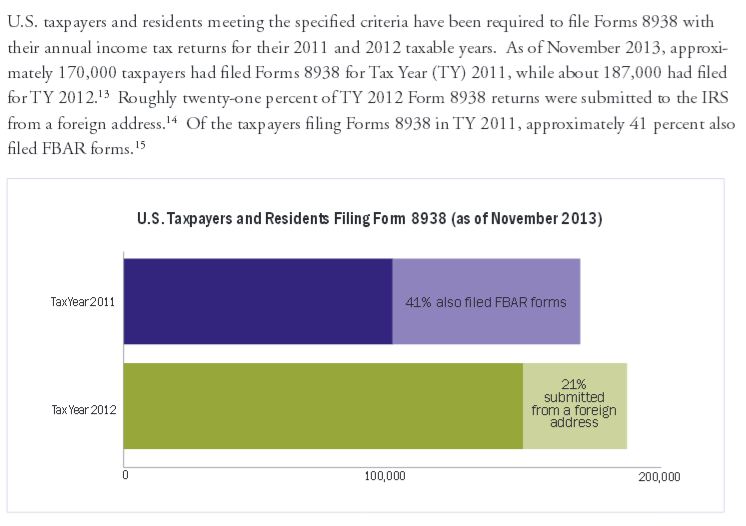
- Many people are angry and frustrated (justifiably so, in my view, in many cases) after learning they are subject to these rules. See comment above about being a psychologist. Plus, USCs and LPRs residing outside the U.S. – and IRS Form 8938. In addition, see, Taxpayer Advocate Report on Burdens of Benign Taxpayers who Make Mistakes
Back to the intelligent IRS tax attorney. My question to her was: “Why would you, as a U.S. born individual not be reviewing the tax laws, tax forms and tax instructions of the country where your parents were born prior to immigrating to the U.S.?” I asked: “Are you not reviewing those laws in the original language of your parents (not English, but the other language of your parent’s country) to understand what tax forms and returns you should be filing?”
The IRS attorney’s response was: “What: of course, I am not reviewing such tax forms or filing information or tax laws, as I would have no tax obligations in that foreign country where I have no income, no assets or no bank or financial accounts!”
My follow-up question was a simple one: “Don’t you realize that U.S. federal tax law (Title 26) and financial bank reporting laws (Title 31) do just that!”
“Hmm she paused: how can that be?” I don’t recall if she said this out loud, or just said it with her puzzled expression.
The answer of course is that through citizenship (including derivative citizenship through a U.S. parent even though the child never spent a single day of residence in the U.S., let alone received any income or assets); that same individual in the mirror position as that IRS attorney is subject to a host of U.S. federal tax and financial reporting laws. See, Sir Winston Churchill – Famous People. Did he become a U.S. citizen at birth via “derivative citizenship”? Did he file U.S. income tax returns?
Here is the big disconnect. It’s not just among the ill-informed or those lesser educated on the fine points of law. I had the pleasure this week along with my wife to host two educated, worldly and engaging individuals who have been married some 20 years together. They are well read and highly educated. Both are lawyers by training, one practices law that often pushes him fairly deeply into the tax law and his wife is a wonderful and experienced judge in the California state courts.
I asked them (as I like to ask people around the world) if they had ever heard or understood that the U.S. federal tax law imposes taxation and very detailed reporting on the worldwide income and assets of U.S. citizens who reside outside the U.S. I discussed  Cook v. Tait and the U.S. Civil War a bit. See both Supreme Court’s Decision in Cook vs. Tait and Notification Requirement of Section 7701(a)(50) and The U.S. Civil War is the Origin of U.S. Citizenship Based Taxation on Worldwide Income for Persons Living Outside the U.S. ***Does it still make sense?
All of it was a great surprise to them! They were in utter shock and both are residents in the U.S., highly educated in the law and are like the vast majority of the world, including U.S. citizens who reside outside the U.S.
This is the common response for many U.S. citizens residing overseas.