Instead of the government finding U.S. citizens living outside of the United States, as a low priority, the Senate Permanent Subcommittee on Investigations focused extensively on Swiss accounts opened by these individuals. The full report can be read REPORT: Offshore Tax Evasion:The Effort to Collect Unpaid Taxes on Billions in Hidden Offshore Accounts (February 26, 2014)
Some key excerpts of that report are as follows (at page 4):
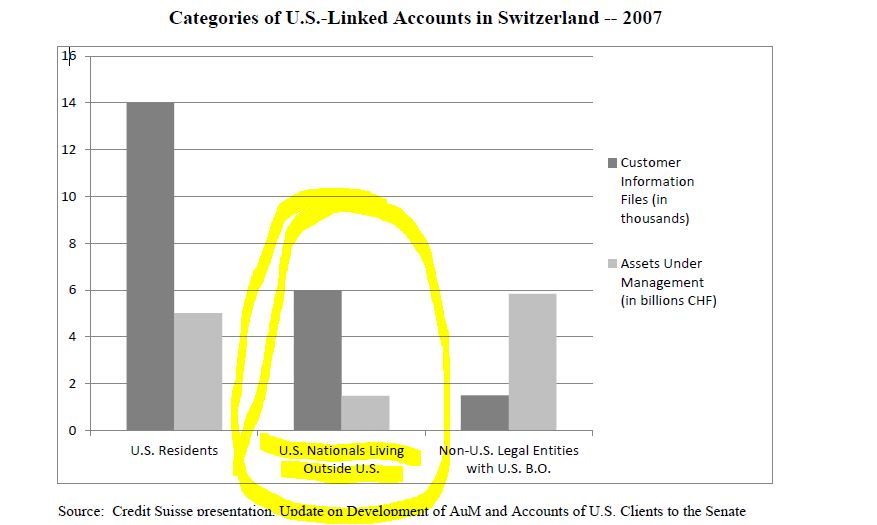
. . . focused primarily on Swiss accounts held by U.S. residents, ignoring the over 6,000 accounts opened by U.S. nationals living outside of the United States. . . . It was not until 2012, that the bank expanded the Exit Projects to include a review of the thousands of Swiss accounts opened by U.S. nationals living outside of the United States.. . .
In addition, the report is replete with statistical data of accounts held by U.S. nationals living outside the U.S., such as the following:
Instead of concluding that the complex U.S. laws are leading to non-compliance by U.S. citizens residing outside the U.S. (per the Taxpayer’s Advocate Report), it seems to conclude to the contrary and the report highlights the virtues of the OVD program in non-compliance as generally willful with millions of U.S. citizens living outside the U.S. who are not in compliance, per the following statement (at page 22):
“The OVDP continues to provide valuable information for the United States in its efforts
to combat offshore tax abuse, although it is far from clear that effective use is being made of the
information generated. For taxpayers, it continues to offer a useful alternative to report
undeclared offshore accounts that, potentially, number in the millions. According to the Taxpayer Advocate, “While 7.6 million U.S. citizens reside abroad and many more U.S. residents have FBAR filing requirements, the IRS received only 807,040 FBAR submissions in 2012,” signaling “significant information reporting noncompliance.”69 2013 Annual Report to Congress — Volume One, Taxpayer Advocate Service, “OFFSHORE VOLUNTARY DISCLOSURE: The IRS Offshore Voluntary Disclosure Program Disproportionately Burdens Those Who Made Honest Mistakes,” at 229.
This report seems to get off track by not distinguishing between normal U.S. citizens who are living out their lives in their country of residence, as opposed to U.S. nationals who are intentionally attempting to evade taxes, filing false documents, not filing returns, or otherwise intentionally violating U.S. law. All of these 7.6 million U.S. nationals living around the world are being lumped together by the government with U.S. resident citizens, irrespective of the facts of each individual and family.
The U.S. Foreign Account Tax Compliance Act seeks to co-opt foreign banks as long-arm enforcement agencies of the IRS.
This thoughtful article (found here) from an academic that previously appeared in the Wall Street Journal, is worth re-thinking in light of the OECD and G20 Action Plan – Base Erosion Plan.
It is worth reading “Myth vs. FATCA” by Robert Stack, Deputy Assistant Secretary (International Tax Affairs) at Treasury; to obtain a better understanding of the U.S. Treasury’s views of how it will impact Americans living outside the U.S. “Myth No. 3” is particularly relevant here: Myth No. 3: Some claim that Americans living abroad will give up their U.S. citizenship because of liabilities and burdens created by FATCA.
The argument made by Mr. Stack is that it is a myth that FATCA imposes no new obligations on U.S. citizens living abroad. This is indeed correct in a technical sense of how the tax law works; Title 26 applies to U.S. citizens who have spent most all of their lives in a country other than the U.S. This has been the law since the time of the U.S. Civil War in the 1800s. However, what is not mentioned, is that there are a host of international tax penalties that will apply to these individuals, even if no income taxes are owing. These information reporting requirements in the law are typically not understood among most U.S. tax professionals (U.S. tax lawyers, CPAs and enrolled agents) let alone the layperson taxpayer.
For instance, the “FBAR law” from the Bank Secrecy Act has been around since 1970, yet virtually no one in the private sector or the government had much of any understanding of that law until the last few years. Plus, Congress adopted various information reporting requirements in the 1980s, the 1990s and now during the last decade that are still not well understood.
The civil penalties for each failure by the U.S. citizen living abroad for these information reporting requirements is consistently US$10,000 per violation. If an individual inadvertently failed to file 3 information returns over a period of 5 years (e.g., regarding their accounts or companies in their home country of residence, e.g., they could be facing US$150,000 of civil penalties – 3x5xUS$10,000!). For a more detailed discussion of these penalties see pages 8 and 9 – http://www.procopio.com/userfiles/file/assets/files1/docs-1738595-v2-accidental-americans-and-the-push-to-renounce-us-citizenship-2448.pdf
Mr. Stack goes on to say “U.S. taxpayers, including U.S. citizens living abroad, are required to comply with U.S. tax laws?. Individuals that have used offshore accounts to evade tax obligations may rightly fear that FATCA will identify their illicit activities. Yet a decision to renounce U.S. citizenship would not relieve these individuals of prior U.S. tax obligations, and might well create additional U.S. tax obligations for certain citizens and long-term residents who give up citizenship or residency.”
This statement assumes that U.S. citizens residing overseas have somehow been using their normal individual, business or other investment accounts in their home country of residence to “evade tax obligations”! This is where there is a big disconnect in the understanding (or lack of understanding) of the U.S. Treasury Department and IRS of those millions of U.S. citizens who reside overseas. Undoubtedly, there are some U.S. citizens residing overseas who are taking steps to evade tax and not comply with the law. However, this author’s experience is that far far far more of the U.S. citizens residing overseas, simply do not have a complete understanding of a very complex U.S. tax law and bank secrecy reporting.
The “Myths” identified by the Treasury Department are set out below and can be read in their entirety at (Are they really “Myths”?)-
Myth vs. FATCA: The Truth About Treasury’s Effort To Combat Offshore Tax Evasion,
By: Robert Stack
9/20/2013
http://www.treasury.gov/connect/blog/pages/myth-vs-fatca.aspx
Myth No. 1: Some claim it’s overly costly and burdensome due to complex
regulations and difficult to meet reporting requirements.
Myth No. 2: Some claim that U.S. citizens living overseas will become
outcasts in the international financial world.
Myth No. 3: Some claim that Americans living abroad will give up their U.S.
citizenship because of liabilities and burdens created by FATCA.
Myth No. 4: Some claim that countries are opposed to FATCA, in part because
the legislation could force foreign banks to violate laws in their own
countries.
Myth No. 5: Some claim that FATCA will generate a backlash from foreign
governments who view this as an overreach of U.S. law.
Myth No. 6: Some claim that FATCA will unfairly expose FFIs to heavy
penalties before they have the necessary mechanisms in place to comply.
Myth No. 7: Some claim that FATCA aims to use foreign banks as an extension
of the IRS.
???????????????? ?Please click here to view the above in Chinese.?
See –
IV. NON-RESIDENT U.S. CITIZENS
1. Provide an election to citizens who are long-term nonresident citizens to be taxed as nonresident aliens if they meet certain conditions (Schneider, “The End of Taxation Without End: A New Tax Regime for U.S. Expatriates,” 2013; similar to the law in Canada)
a. Require a minimum period of residence abroad
b. Impose an exit tax on electing taxpayers where deemed to sell all assets at the time of election
This concept was proposed by By Patrick W. Martin and Professor Reuven Avi-Yonah . “Tax Simplification: The Need for Consistent Tax Treatment of All Individuals (Citizens, Lawful Permanent Residents and Non-Citizens Regardless of Immigration Status) Residing Overseas, Including the Repeal of U.S. Citizenship Based Taxation,” September 2013.
For complete summary see – http://www.finance.senate.gov/issue/?id=0587e4b4-9f98-4a70-85b0-0033c4f14883
This document is the fifth in a series of papers compiling tax reform options that Finance Committee members may wish to consider as they work towards reforming our nation’s tax system. This compilation is a joint product of the majority and minority staffs of the Finance Committee with input from Committee members’ staffs.
???????????????? ?Please click here to view the above in Chinese.?