International Tax · Citizenship Renunciation · LPR Abandonment
International Tax Shareholder
FAQs re: Tax Expatriation: Aroeste v. United States Impact – Frequently Asked Questions
The U.S. tax law is complicated generally. It gets really complex when you renounce your United States citizenship or you cease to be a “lawful permanent resident” as that term is technically defined in the U.S. federal tax law. The comments in Tax-Expatriation.com are designed to help demystify some of this complexity.
Hence, posts addressing various FAQs – for those who have or “had” a “green card” – please see the following:
IRS Removes Practice Unit from their Website – titled “Determining Tax Residency Status of Lawful Permanent Residents” – Post-Aroeste
The decision in Aroeste v. United States, continues to affect how U.S. tax treaty rules apply to green card holders. In Aroeste, the federal district court rejected important IRS-DOJ arguments concerning when a lawful permanent resident is not treated as a resident of the United States under an income tax treaty. I refer to the broader consequences of the case as the Aroeste Effect, which rears its head in proposed Treasury Regulations to be discussed for another day.
For years, the IRS Large Business and International Division (LB&I) published a Practice Unit titled Determining Tax Residency Status of Lawful Permanent Residents. Issued in 2013 and updated in 2014, it was used to help IRS personnel determine the U.S. tax residency of green card holders—the very subject litigated in Aroeste. That Practice Unit has now been removed from the IRS website.
The removal is notable because the IRS continues to publish other related international tax Practice Units. For example, its 2018 Practice Unit, remains available: Determining an Individual’s Residency for Treaty Purposes PDF This 2018 Practice Unit has not been updated to address Aroeste. Importantly, however, it does not repeat the government’s argument in Aroeste that a taxpayer can lose or waive treaty benefits by failing to timely “take” a treaty position. The district court rejected the government’s position on that issue.
The IRS has not publicly explained why it removed the Practice Unit specifically addressing lawful permanent residents. Nevertheless, its disappearance after Aroeste is significant. For green card holders living outside the United States, the practical issue is straightforward: holding a green card does not necessarily mean the individual must always be a “United States person” – i.e., a U.S. tax resident. An applicable tax treaty can change that result.
The intricacies of the law can be complex, depending upon the facts of each person. The IRS’s removal of its own Practice Unit on this subject is another noteworthy example of the Aroeste Effect.
Missed FBAR Filing? Penalties, Options, and What to Do Next (2026)
A missed FBAR filing can become a serious tax problem if the IRS views the violation as willful. After Reyes, reckless conduct may be enough for the government to argue willfulness. This guide explains how to evaluate your options, respond to the IRS, and protect your position from the start.
What is an FBAR?
The Foreign Bank Account Report (FBAR), officially known as FinCEN Form 114, is an annual reporting form used to report certain foreign financial accounts to the U.S. government. If you are a U.S. citizen or a green card holder and the combined value of your accounts at banks outside the United States exceeded $10,000 at any point during the year, the law generally requires you to tell the U.S. government about those accounts every year on this form. The FBAR goes to FinCEN, a bureau of the U. The FBAR is due April 15, with an automatic extension to October 15 that you do not have to request.S. Treasury Department, and the IRS is the agency that enforces it.
Who needs to file FBAR?
The filing requirement generally applies even if:
You are a United States citizen and live outside of the United States.
The accounts are in the country where you live.
The accounts earn no income.
You are a green card holder, even those who have not lived in the United States for years — unless your green card status has been formally terminated or a tax treaty position properly applies (this guide includes a legal analysis on this topic discussed below).
What are the penalties for not reporting FBAR?
It depends on whether your failure was “non-willful” or “willful.” Before diving into the details, this chart summarizes the civil and criminal FBAR penalties:
Type of violation
Civil penalty
Criminal penalty
Non-willful An honest mistake or genuine ignorance
Up to roughly $16,500 per unfiled form. Under Bittner v. United States, this is per form, not per account.
None
Willful
The greater of roughly $165,000 or half of the account balance, per account, per year.
Fines up to $250,000 and five years in prison per violation. Prosecution is extremely rare.
Willful, combined with other crimes
As above.
More than the amounts above.
Unpaid assessments
Interest, plus a mandatory 6% late-payment charge.
—
Civil and criminal FBAR penalties. Dollar figures are inflation-adjusted and change annually.
A warning: if any part of your situation could be called “willful,” be careful who you talk to first.
If there is any chance the government could paint your situation as deliberate or careless, the order of your conversations matters before anything else does. This is because only what you tell a lawyer is protected. Anything you tell an accountant can become the government’s evidence. See more in the section “Is there an accountant-client privilege in federal court?” below.
What is a non-willful FBAR violation?
A non-willful violation – an “honest mistake or genuine ignorance”— carries a civil penalty (31 U.S.C. § 5321) of up to roughly $16,500 (inflation-adjusted) per unfiled form. The law is complex about what the courts have said is non-willful. Please see the FBAR detailed technical report. The Supreme Court held in Bittner v. United States1 that it is per form, not per account — a taxpayer victory over the government’s per-account computation, urged in the friend-of-the-court brief filed by the American College of Trust and Estate Counsel (ACTEC) and co-authored by attorney Patrick W. Martin in his role as a Fellow of ACTEC.
What is a willful FBAR violation?
A willful violation is different in kind: the civil penalty is the greater of roughly $165,000 or half of the account balance, per account, per year, and truly willful cases can be prosecuted criminally (although extremely rare), with fines up to $250,000 and five years in prison per violation (more if combined with other crimes). Interest and a mandatory 6% late-payment charge apply to unpaid assessments. Because “willful” penalties can consume an entire account — and more — the fight in most cases is over that one word as was the case of Mrs. Jones.
Is my accountant protected by privilege?
No. Conversations with an accountant, bookkeeper, enrolled agent, tax-return preparer, or financial advisor are not protected in a case like this. Accountants have only a limited privilege under IRC § 7525, which does not apply in criminal matters. For decades, courts have allowed the government to demand those advisors’ files and put them on the witness stand.
On the other hand, conversations with a lawyer are protected by the attorney-client privilege: the government generally cannot force your lawyer to reveal them. If your case could become serious, talking to the wrong professional first may unintentionally create evidence the government can later use against you.
Can I still use the “I didn’t know” defense?
This depends on your specific facts. In January 2026, in United States v. Reyes2, a federal appeals court in New York joined nearly every other appeals court in holding that “willful” includes reckless conduct. Applying the Supreme Court’s standard in Safeco Insurance Co. v. Burr, the question is no longer just what you actually knew; it is what a reasonable person in your shoes should have known.
What counts as reckless disregard?
The government may argue you were reckless even if you sincerely believed you had no obligation, in situations such as these:
Your tax return asked about foreign accounts and you checked “No.”
Your preparer asked and you didn’t mention the accounts.
Your foreign bank held your mail, so nothing arrived in the U.S.
Margaret J. Jones v. United States: willful penalties after a voluntary disclosure
This is not a new government tactic that arrived with Reyes. Years earlier, in Margaret J. Jones v. United States3 — a case litigated by attorney Patrick W. Martin as principal lawyer — the IRS examiner pursued more than $1.5 million in willful penalties against Mrs. Jones (plus nearly $1.9 million against a related estate) on a “willfully blind” theory. The penalty was more than $3.4 million in total, even though the account holder had come forward voluntarily and IRS colleagues had recommended allowing an amended submission.
Whether your facts look “honestly ignorant” or “reckless” is a judgment call — one you should reach with a lawyer, in private, under privilege, not by narrating everything to an accountant, financial advisor, enrolled agent or tax return preparer, whose notes the government can later legally access and read.
Does the IRS have to give me a jury trial before assessing FBAR penalties?
In September 2025, United States v. Sagoo4 threw out more than $1 million in willful FBAR penalties because the IRS investigated the taxpayer, determined she was liable, and assessed the penalties itself— acting, in the court’s words, as “prosecutor, jury, and judge”—without a jury trial. The court relied on the Supreme Court’s 2024 decision in SEC v. Jarkesy, which held that the SEC could not impose civil penalties in-house without a jury.
If that ruling holds up on appeal, the government may have to persuade a jury before finalizing large willful penalties. That is potentially good news for taxpayers, but tax payers should still be cautious. Other courts have reached the opposite conclusion, so do not count on Sagoo protecting you. It is still important to understand what a jury trial actually means in practice.
What does a jury trial actually mean in practice?
One of the first willful FBAR penalty cases fully prepared to be tried to a federal jury was Margaret J. Jones v. United States, in which attorney Patrick W. Martin, the author, served as principal lawyer. The case was litigated to the eve of the scheduled jury trial, at which point the government conceded millions of dollars in FBAR penalties it had originally assessed.
But a jury trial is not necessarily the advantage many taxpayers imagine. If your case goes to a jury, everything you told your accountant, bookkeeper, and financial advisor can be admitted as evidence at trial. Only what you told your lawyer stays out — which is why trial-ready cases are built under privilege from the first conversation. Tax litigation through a trial can become very expensive.
Does FBAR apply to green card holders?
Almost certainly yes, and it complicates the situation. Holding a green card generally makes you a “U.S. person” for FBAR purposes, even if you live abroad full-time and you no longer travel to the United States.
However, that is not always the case. If you have formally abandoned your green card by filing Form I-407 (which carries its own exit-tax considerations), or if a tax treaty’s residency tie-breaker treats you as a resident of another country, different rules may apply. Whether a treaty position applies to you is a genuine legal question, as illustrated by Patrick W. Martin’s case, Aroeste v. United States.
I’m a green card holder. Can a tax treaty protect me from FBAR filing requirements?
Yes, in some circumstances. However, this issue is highly fact-specific, and the answer is not as simple as treating all green card holders the same as U.S. citizens. Many “expat tax” services use that shortcut, which can result in unnecessary filings, missed reporting obligations, or unexpected penalties.
This is an area where careful legal analysis matters. Patrick W. Martin litigated Aroeste v. United States5 , the leading case on this issue, and provides an in-depth analysis of its implications for green card holders here. For the broader set of issues facing green card holders abroad, see his series on the most important questions for lawful permanent residents.
Should I use a tax attorney or a CPA for an FBAR problem?
It depends on how your facts look:
If your facts are clean: you reported all your income, you simply never heard of the form, nothing looks like concealment, and you acted in good faith— an accountant can often handle a straightforward catch-up filing.
If there is any realistic possibility your facts could be portrayed as willful: a “No” on Schedule B, unreported income, accounts you never mentioned to your preparer, hold-mail service, large balances — see a licensed tax attorney before discussing details with any non-lawyer.
There are two reasons. First, only the attorney conversation is privileged.
Second, if accounting work is needed, your attorney can hire the accountant under what is called a Kovel arrangement (sometimes called a Kovel letter), which brings the accountant’s work inside the attorney’s privilege. Be wary if a lawyer tells you that you do not need a Kovel arrangement and he or she will prepare the tax returns and forms themselves to submit to the IRS. That protection only works going forward, as no lawyer can retroactively protect what you already told your CPA or bookkeeper, or financial advisor or enrolled agent, which is exactly why the order of conversations matters.
Which FBAR compliance procedure applies to me?
Three main paths exist today:
Path
When it applies
Delinquent FBAR Submission Procedures
If you reported all your income and only missed the forms, the Delinquent FBAR Submission Procedures let you file late FBARs with an explanation, typically with no penalty.
Streamlined Filing Compliance Procedures
If you also missed income but your conduct was non-willful, the Streamlined Filing Compliance Procedures let you file three years of returns and six years of FBARs with reduced or no penalties. You must certify on Form 14653, under penalty of perjury, that you were non-willful (see section “Why does my non-willfulness certification matter?” below).
IRS Voluntary Disclosure Practice
If your conduct may have been willful, the IRS Voluntary Disclosure Practice is designed for taxpayers who need to disclose that conduct and seek protection from criminal prosecution.
Why does my non-willfulness certification matter?
The Streamlined Filing Compliance Procedures are available only to taxpayers whose failure to report foreign financial assets or income was non-willful. The IRS describes these procedures as applying to taxpayers who “mistakenly failed to report foreign financial assets or pay taxes on those assets.”6 To use the program, you must certify under penalty of perjury that your conduct was non-willful. That certification is not just a filing requirement—it is a legal judgment about your knowledge, intent, and the facts surrounding your reporting failures. If the IRS later disagrees, the consequences can be significant.
What if the IRS disagrees with my non-willfulness certification?
If the IRS determines that your conduct was actually willful, it can challenge your eligibility for streamlined treatment and pursue willful FBAR penalties. This happened in Margaret J. Jones v. United States — litigated by attorney Patrick W. Martin as her principal lawyer.
After Mrs. Jones made a Streamlined disclosure, the IRS argued that she had been “willfully blind” and assessed more than $3.4 million in willful penalties against her and a related estate. The IRS took that position despite internal recommendations supporting an amended submission and a dispute over whether the estate could use Streamlined procedures in the first place.
The case was litigated to the eve of a federal jury trial before the government conceded millions of dollars of the assessed penalties—showing why these cases often require experienced legal advocacy, not just tax preparation. The IRS has also discussed modifying or ending the Streamlined program, so the options available today may not last forever.
Is doing nothing ever the right option?
This depends upon all of your facts and the applicable law, but sometimes your best option may be to do nothing! For example, a good faith failure to report gifts or inheritances from nonresidents must generally be reported on IRS Form 3520. However, the failure to do so (with good facts) might simply be an administrative problem that ultimately resolves itself with the running of the statute of limitations period against the IRS.
A late filing can create new problems
Compare that to what happened to Mr. Krzysztof Wrzesinski7 . Mr. Wrzesinski relied on an advisor who told him he did not need to report a gift from his Polish mother, who had won a Polish lottery. After a second advisor later recommended filing a late Form 3520, the IRS pursued penalties and the case continued until the eve of trial over the penalty amount.
What if the IRS has already contacted me?
That changes the stakes significantly. You may no longer qualify for the Streamlined program, and statements you make to the IRS or to non-attorney advisors (CPA, tax return preparer, enrolled agent, financial advisor, family member, etc.) may later be used against you. If you have potentially problematic facts, do not “explain things” to the IRS revenue agent or debrief your tax return preparer before speaking with a tax attorney.
What happens if I file a false or incomplete form?
Never file a false or incomplete form in the hope that it will make the problem go away. The opposite can happen. A return that omits foreign income, a perjured non-willfulness certification, or an FBAR that deliberately omits accounts can turn a civil penalty issue into potential criminal liability.
Why FBAR problems often require a tax attorney early
The law is moving in both directions at once:
Reyes made it easier for the government to call you willful.
Sagoo may eventually make it harder for the government to collect (although hiring a lawyer to defend you in a judicial proceeding can get expensive quickly).
The compliance programs that reduce or eliminate penalties that are currently available should be seriously considered depending upon your facts.
“I didn’t know” as a legal position can typically be harder to sustain.
You should consider coming forward before the government finds you, if it is in your best interest.
You should make that decision about how to come forward (or not) with a licensed attorney.
Treat the attorney-client privilege as what it is in these cases: not a formality, but the difference between analyzing your worst facts in private versus handing these facts and documents over to the other side (the government) in the event of an audit or further dispute.
Sources
Bittner v. United States, 598 U.S. 85 (2023). Amicus brief filed by the American College of Trust and Estate Counsel (ACTEC), co-authored by Patrick W. Martin as a Fellow of ACTEC. ↩︎
Jones v. United States (C.D. Cal. May 11, 2020). Willful penalties of $751,685 (2011) and $770,255 (2012) were assessed against Mrs. Jones, and $1,890,074 against a related estate. Patrick W. Martin served as principal lawyer. ↩︎
United States v. Sagoo (N.D. Tex. Sept. 19, 2025). The IRS had assessed $1,020,922.50 in willful FBAR penalties. The court relied on SEC v. Jarkesy, 603 U.S. 109 (2024). ↩︎
Tax Problems that Turn Serious – can Cause a Green Card Holder to become a “Covered Expatriate”
In Kawashima v. Holder (565 U.S. 478 (2012), the United States Supreme Court held that certain tax offenses committed by lawful permanent residents constitute crimes involving “fraud or deceit” for purposes of the Immigration and Nationality Act (“INA”). Specifically, the Court concluded that lawful permanent residents (a husband and wife from Japan) who were convicted of filing false tax returns resulting in a tax loss exceeding $10,000 had been convicted of an “aggravated felony” within the meaning of the INA.
As a consequence, a conviction for such an aggravated felony renders a lawful permanent resident removable (deportable) from the United States under the immigration laws. Importantly, however, the criminal conviction itself does not automatically terminate lawful permanent resident status. Rather, it provides the legal basis for the Department of Homeland Security to initiate removal proceedings, after which an Immigration Judge may enter a final order of removal.
Once a final order of removal becomes effective, the individual’s lawful permanent resident status is considered to have been revoked. For U.S. federal income tax purposes, this generally results in the termination of lawful permanent resident status under 26 U.S.C. § 7701(b)(6)(B), which provides that an individual ceases to be a lawful permanent resident when “such status has been revoked or has been administratively or judicially determined to have been abandoned.” Accordingly, following a final order of removal, the individual is no longer treated as a lawful permanent resident for purposes of the tax law as summarized below:
Stage
Legal Effect
1. Criminal conviction (including guilty plea)
If the offense qualifies as an “aggravated felony” under INA §101(a)(43), the individual becomes deportable under 8 U.S.C. §1227(a)(2)(A)(iii). A guilty plea counts as a conviction for immigration purposes if the statutory definition of “conviction” is satisfied.
2. DHS initiates removal proceedings
DHS serves a Notice to Appear (NTA) charging removability before an Immigration Judge under 8 U.S.C. §1229a.
3. Immigration Judge determines removability
DHS bears the burden of proving deportability by clear and convincing evidence, typically through the certified judgment of conviction.
4. Final order of removal
If removability is sustained and no relief is available, the Immigration Judge orders removal. After appeals are exhausted (or waived), the removal order becomes final, and the person’s LPR status ends.
The 2012 case involved Akio and Fusako Kawashima, Japanese citizens who had been lawful permanent residents since 1984. Mr. Kawashima pleaded guilty to willfully filing a false tax return under 26 U.S.C. § 7206(1), while Mrs. Kawashima pleaded guilty to aiding and assisting in the preparation of a false tax return under 26 U.S.C. § 7206(2). The immigration judge issued the order of removal. The Board of Immigration Appeals affirmed. Holding that convictions under 26 U. S. C. §§7206(1) and (2) in which the Government’s revenue loss exceeds $10,000 constituted aggravated felonies, the Ninth Circuit affirmed and ultimately so too did the SCOTUS in this decision.
The Supreme Court concluded that these tax offenses necessarily involve fraud or deceit and, because the tax loss exceeded the statutory $10,000 threshold, they constituted aggravated felonies under immigration law. The Supreme Court of the U.S. therefore upheld the government’s order (which had been upheld through the Ninth Circuit Court of Appeals) removing the Kawashimas to Japan.
This of course is important for U.S. “expatriation tax” purposes, since the “lawful permanent resident” status for tax purposes will necessarily terminate upon the final order of removal. Not before. Once LPR status terminates, the individuals will become covered expatriates, if they meet the time period under the statute to become “long term residents” as was the case for Mr. and Mrs. Kawashima and meet either of the three tests: the tax liability, net asset and certifications of compliance with the federal tax laws. See, Why a “long-term” LPR can NEVER avoid “Covered Expatriate” status under IRC Section 877A(g)(1)(B) if Asset or Tax Liability Test is Satisfied!
EB-5 Visa – a common Path to a “Green Card” and then USC
Pathways to United States Citizenship – (USC): Focus on the EB-5
Every individual who ultimately becomes a naturalized U.S. citizen must first qualify for lawful permanent resident (“LPR”) status unless a narrow statutory exception applies. Although public attention frequently focuses on the EB-5 immigrant investor program, with the idea they are those with greater assets and income (contemplating taxes) EB-5 investors represent only a very small percentage of all individuals who become lawful permanent residents. Understanding the relative size of each immigration pathway is essential because every pathway ultimately raises many of the same U.S. tax issues—including worldwide income taxation, estate and gift taxation, and the tax consequences of later abandoning lawful permanent resident status or renouncing U.S. citizenship.
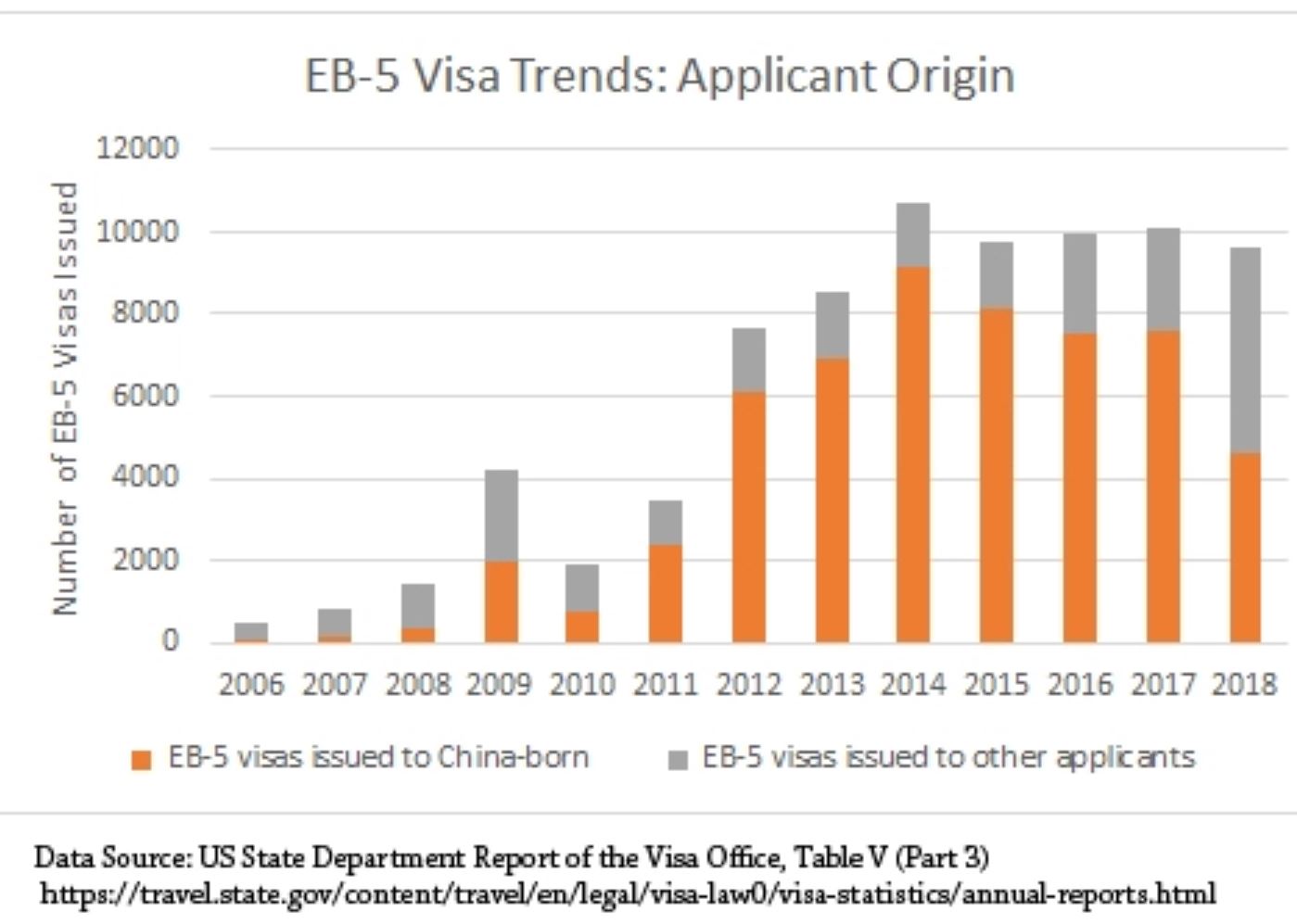
The EB-5 visa has been a fixture of U.S. law since the early 1990s. It was not until 2009 that a substantial number of EB-5 visas were issued in a given year, 4,218 to be exact. Statistically, the total EB-5 visa leading to LPR status is a fraction of the other categories as explained here. For an excellent overview of the law and categories, see the CRS report- Permanent Legal Immigration to the United States: Policy Overview (Updated November 4, 2024)
EB-5 Visa – to a “Green Card” then to United States Citizenship – (USC)
From the laws inception in 1992 through FY2004, there were only 6,024 EB-5 visas issued during that 12 year period. That is an annual average of only approximately 500 persons. See, the GAO Report on Immigrant Investors. As the program grew in popularity so too did the location of investors from around the world. It was not until 2009 when the total number of investors started growing substantially. Most significantly in 2009 when 4218 EB5 visas were issued, still less than 1/2 of the 10,000 allocated annually by the statute.
These numbers kept going at an annual pace especially starting in 2012, when 6,764 EB-5 visas were issued and then around 10K+/- annually for the last dozen years or so, up until the years that were impacted by a change in the law and a bit by COVID (2020 and 2021). There are important tax consequences that can have unintended outcomes for individuals who get a green card: See, Oops…Did I “Expatriate” and Never Know It: Lawful Permanent Residents Beware!International Tax Journal, CCH Wolters Kluwer, Jan.-Feb. 2014, Vol. 40 Issue 1, p9):
Chinese Investors Have Dominated the total Group of EB-5 Investors
The country-of-origin analysis is important because practitioners frequently advise clients from these jurisdictions regarding immigration planning, cross-border tax planning, and eventual expatriation planning with consequences in those countries.
I have compiled the total list of countries from which EB-5 visa investors came from as summarized in the Country of Origin global graphic for FYE 2024. There are over 100 countries from which these investors came from, but again, China is the dominant country, followed by Vietnam, India, Taiwan and then South Korea as the countries with the greatest number of investors. South Africa comes next, followed by Brazil and then Mexico, but each with less than 200 total investors, each country as follows:
China
9547
Vietnam
1533
India
1428
Taiwan
513
Korea, South
325
South Africa
158
Brazil
157
Mexico
128
Hong Kong S.A.R.
116
Venezuela
97
Canada
81
Great Britain & N. Ireland
63
Russia
58
Nigeria
52
Turkey
44
Colombia
44
France
38
United Arab Emirates
30
Germany
29
Japan
25
Singapore
23
Kazakhstan
21
Peru
20
Ukraine
17
Sweden
15
Argentina
15
Egypt
14
The importance of this analysis is to help individuals (and their advisors) who fit into these categories, e.g., who have a pathway to a green card and then on to become a naturalized U.S. citizen, understand the potential “tax expatriation” consequences of their decisions over the long-run.
What are the U.S. “tax expatriation” consequences to individuals who go down these pathways, including to their dependent children, or spouses or any future beneficiaries who are “United States person”?
What are the tax expatriation consequences if the individual later decides they do not want to be a green card holder or a U.S. citizen and later wishes to abandon their lawful permanent residency status or formally renounce their U.S. citizenship?
These and many other questions should be considered, especially for long-term family planning. Not just for the investor, but for their children and spouse, who may be eligible for the visa that can lead to LPR status and eventually to USC. Facilitating younger children (under 21 years of age) is a common driver for EB-5 investors for families who want the United States to be a pathway for their children’s’ future.
Why These Immigration Pathways Matter from a Tax Perspective
Every pathway leading to lawful permanent resident status almost always subjects the individual to the comprehensive U.S. federal income tax system. Depending upon the individual’s assets, family structure, treaty residence, and future living plans, obtaining a green card will also have significant implications for:
worldwide income taxation;
estate and gift taxation;
foreign trust reporting;
information reporting obligations under various laws;
controlled foreign corporation rules;
PFIC reporting;
exit tax planning; and
long-term succession planning.
Equally important, many lawful permanent residents eventually decide to return permanently to their country of origin or another foreign jurisdiction. Those individuals—and frequently their spouses and dependent children—must carefully consider the tax consequences of formally abandoning lawful permanent resident status or, after naturalization, renouncing U.S. citizenship. The sooner individuals and their advisors realize these consequences, the better they can plan for important life decisions.
Those tax consequences are collectively referred to as the U.S. tax expatriation rules, and they form the principal subject of this website.
The legal pathways towards lawful permanent residency status can be broken down into the following categories and the EB-5 category is a fraction (only about 1%) of the total pool leading to LPR status:
This category includes EB-1 through EB-5 categories that include individuals with extraordinary ability, certain professionals, other skilled workers. The chart I prepared here reflects the total number of EB-5 visas issued cumulative. This chart reflects the total number of cumulative EB-5 visas that have been issued through the FYE 2024 of approximately 131K. This does not take into consideration how many of these were issued to the principle investor versus spouses and children under twenty-one years of age. See, 8 U.S. Code § 1153(b).
EB-1, EB-2 and EB-3 represent the greatest group of individuals who obtained LPR status (e.g., approximately 5X, each category compared to the EB-5 category). See Yearbook of Immigration Statistics, Table 6.
For instance, annually the EB-1 through EB-3 categories are processing about 50K per year of each, and the EB-5 category is only 131K over most of its 25 year life (or about 10K per year – for more recent years). Approximately 16% of all green card holders come through these employment based preferences.
Table – Approximate Decade-Average Share by Category, FY2014–FY2023
Category
Approx. Share
Notes
Family-sponsored (total)
~64%
Immediate relatives + family preferences combined
— Immediate relatives
~46%
Spouses ~26%, parents ~14%, children ~6%
— Family preferences (F1–F4)
~18%
Numerically capped at 226,000
Employment-based (EB-1–EB-5)
~16%
Capped at 140,000; breached in COVID years
Refugees & asylees
~12%
Numerically unlimited; ceiling-driven volatility
Diversity
~4%
Statutory ceiling 55,000
All other / special
~4%
SIV, U/T victims, cancellation, registry, etc.
C. Diversity Immigrant Program
The annual diversity lottery, allocated by random selection, to natives of countries with historically low rates of immigration to the United States. See, 8 U.S. Code § 1153(c). The Attorney General plays a key role by statute in this determination. There is a statutory maximum of 55,000 and only represents about 4% of all LPRs compared to the larger pool. This program is on hold as of December 19, 2025 when the USCIS policy memorandum (PM-602-0193) directs officers to place an immediate hold on pending adjustment of status, ancillary benefits and associated waiver applications for individuals applying through the Diversity Immigrant Visa program. [1, 2]
D. Humanitarian and Special Pathways: Refugees/Asylees
Several routes proceed outside the preference system (the three categories above). Refugees and asylees adjust under a specific statutory regime; self-petitioning abused spouses and children proceed under other provisions; victims of qualifying crimes and of trafficking can adjust from U and T nonimmigrant status; and certain children subject to qualifying juvenile-court findings can qualify, among others. There are statutory limits placed on this group.
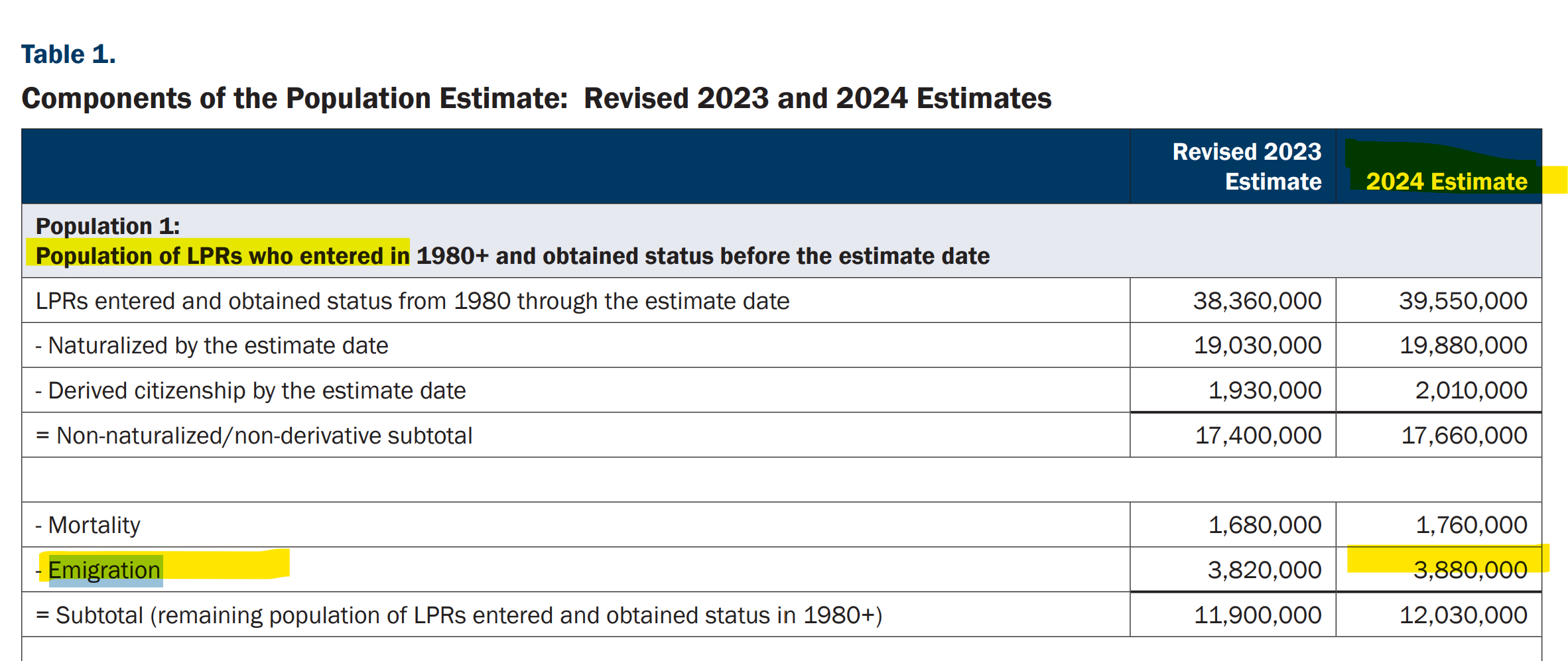
Whatever category one uses for LPR status, there will be important U.S. federal tax consequences to them and typically their family members. That’s the large part of the focus on this forum where the author has written about the subject of how it all ties to “tax expatriation”. As previously reported, there are 3.88 million “LPR” individuals who are living outside the U.S. – per the 2024 report by the U.S. federal government. Many of them live in a treaty country. See, Table 1 of the Homeland Security, Office of Immigration Statistics – Estimates of the Lawful Permanent Resident Population in the United States and the Subpopulation Eligible to Naturalize: 2024, and Revised 2023.
Part II of Part II: The Gold Card – The U.S. Tax Costs – “It’s like the green card, but better and more sophisticated.”
See Part I for the background discussion, which was published more than a year ago.
This article focuses on the tax consequences of the “Trump Gold Card” program and, in particular, the implications if participation ultimately leads to U.S. citizenship (“USC”).
The final version of the Gold Card program requires a $1 million contribution to the federal government, rather than the $5 million amount initially discussed in April 2025. See the government website, The Trump Gold Card is Here.
It is also important to note that President Trump established the Gold Card program through Executive Order 14351 in September 2025. Congress did not enact the program through legislation.
The Cost of a Trump Gold Card
For a $15,000 Department of Homeland Security processing fee and, following successful background review, a $1 million contribution to the federal government, an applicant may obtain U.S. permanent residence through the Gold Card program.
Why Would an Ultra-High-Net-Worth Individual Voluntarily Enter the U.S. Tax Net?
A fundamental question arises: Why would an ultra-high-net-worth (“UHNW”) individual contribute $1 million to obtain U.S. residence and potentially U.S. citizenship, thereby becoming subject to one of the world’s most expansive tax systems?
For many individuals, acquiring U.S. citizenship or lawful permanent resident (“LPR”) status can result in exposure to:
U.S. income taxation on worldwide income;
U.S. gift taxation on worldwide transfers of property; and
U.S. estate taxation on worldwide assets at rates that currently reach 40%.
U.S. Estate and Gift Taxation of Worldwide Assets
The United States generally imposes estate and gift taxes on the worldwide assets of U.S. citizens. In addition, lawful permanent residents who are domiciled in the United States may become subject to the same worldwide transfer tax regime.
Unlike many countries, the United States generally does not permit its citizens to escape worldwide taxation simply by relocating abroad. Most U.S. income tax treaties and estate and gift tax treaties contain a “savings clause” that preserves the right of the United States to tax its citizens notwithstanding treaty provisions.[1]
U.S. Estate and Gift Taxation of Worldwide Assets
As a result, the worldwide assets of a U.S. citizen may be included in the U.S. transfer tax system under IRC §§ 2001 and 2031 (estate tax) and IRC §§ 2501 and 2511 (gift tax).
Consider a U.S. citizen who owns:
a residence in Norway;
shares of a Mexican corporation;
a bank account in Singapore;
an interest in a Liechtenstein foundation (Stiftung);
a portfolio of securities held through a London financial institution; and
an apartment in Dubai.
Subject to applicable valuation and ownership rules, each of these assets generally forms part of the individual’s worldwide taxable estate for U.S. estate tax purposes.
By contrast, a non-U.S. citizen who is not domiciled in the United States generally would not be subject to U.S. estate tax on any of these assets, unless they include U.S.-situs property such as stock issued by U.S. corporations.
The difference can be dramatic: no U.S. estate tax exposure versus potential exposure to a 40% U.S. estate tax on worldwide assets.
U.S. Income Taxation of Worldwide Income
The contrast is equally significant in the income tax context.
A nonresident generally is subject to U.S. income taxation only on limited categories of U.S.-source income and income effectively connected with a U.S. trade or business.
A U.S. citizen, however, remains subject to U.S. federal income taxation on worldwide income regardless of where the individual resides.
Consequently, a foreign entrepreneur, investor, or family office principal who acquires U.S. citizenship will find that income earned from businesses, investments, trusts, partnerships, and financial accounts throughout the world generally becomes reportable to the Internal Revenue Service and subject o U.S. income taxation.
That result raises an obvious question: if the program is available, why have so few ultra-high-net-worth individuals pursued it successfully?
The most obvious explanation is that the long-term U.S. tax consequences may outweigh the perceived immigration benefits for many globally mobile individuals.
Comparison to the EB-5 Program
Different applicants may have different motivations.
The traditional EB-5 immigrant investor program generally requires a qualifying investment that, if successful, may ultimately be recovered. The program also requires satisfaction of statutory requirements, including job creation. Approximately 200,000+/- individuals have obtained a green card through the EB-5 program. There are important unintended tax consequences that can befall individuals here: see, Oops…Did I “Expatriate” and Never Know It: Lawful Permanent Residents Beware!International Tax Journal, CCH Wolters Kluwer, Jan.-Feb. 2014, Vol. 40 Issue 1, p9).
EB-5 Visa Applicants by Country
By contrast, the Gold Card program requires a direct contribution to the federal government.
In either case, the successful applicant receives lawful permanent resident status. However, if the Gold Card ultimately serves as a pathway to naturalized U.S. citizenship, the applicant may become subject to the unique worldwide taxation regime applicable to U.S. citizens.
The Expatriation Problem
If Gold Card holders ultimately naturalize as U.S. citizens, future departure from the U.S. tax system will necessarily become significantly more complicated.
Individuals who later seek to relinquish U.S. citizenship will necessarily face the expatriation rules of IRC § 877A and be tainted with “covered expatriate” status.
As discussed in earlier posts, covered expatriate status can have substantial long-term tax consequences for both the expatriating individual and future recipients of gifts and inheritances.
Legal Questions Surrounding the Program
The Gold Card program also raises constitutional and statutory questions.
Unlike the EB-5 program, which was enacted by Congress, the Gold Card program was created through executive action. Congress did not amend Title 8 of the United States Code to establish a new immigrant category.
Whether the Executive Branch possesses sufficient statutory authority to create such a program remains an open legal question (I am doubtful it will be sustained – if challenged) and will likely be the subject of continued litigation and judicial review.
The outcome of pending litigation involving other immigration-related executive actions may provide useful guidance regarding the scope of presidential authority in this area. We await the outcome of the latest case litigated through the courts. See, Supreme Court appears likely to side against Trump on birthright citizenship which was also issued by an executive order.
Who Truly Benefits?
Who is the ideal candidate for a Trump Gold Card? Only one person thus far has one.
For almost all HNW individuals, the immigration benefits, travel flexibility, business opportunities, and potential pathway to U.S. citizenship would rarely justify the cost. Someone with assets below US$20M might find it attractive.
For almost all others—particularly those with substantial foreign businesses, investment portfolios, trusts, and family wealth located outside the United States—the long-term consequences of worldwide U.S. income, estate, and gift taxation will almost always substantially outweigh the advantages.
As a result, any prospective applicant for a Trump Gold Card should carefully evaluate not only the immigration benefits of the program (+ the uncertainty in the law), but particularly the tax consequences that will follow for decades thereafter.
World Cup & Playing in the United States: Green Card Holders, the Treaty Tiebreaker, and the Global Athlete or Entertainer
As the world’s athletes have arrived to perform on U.S. soil, the U.S. tax system is a broad net. The 2026 FIFA World Cup—hosted across the United States, Mexico, and Canada—is a useful occasion to revisit a question that recurs every time a global athlete or entertainer steps onto a U.S. field, stage, or court: what does the United States get to tax, what forms govern the answer, and when does a visiting performer or athlete cross the line from nonresident into resident – including if they hold a lawful permanent resident card?
This blog is dedicated to issues of “tax expatriation” which crosses into different professions and global lifestyles. See, for instance the following prior blogs:
There are of course many famous athletes who were not U.S. citizens and then became green card holders and oftentimes then became naturalized U.S. citizens. Since the Knicks just won the NBA championship after 53 years, one of their greatest, Patrick (mi tocayo) Ewing left Jamaica as a boy, became a green card holder and then a naturalized citizen. A 1985 New York Times article, A Favorite Son Goes Home, describes his first return to the island since a boy.
Soccer players, have moved all over the world and Alejandro Zendejas is a current U.S. World Cup player born in Ciudad Juarez, Chihuahua, Mexico, at the border who later obtained lawful permanent residency and also became a naturalized citizen. That means (as a result of his naturalized U.S. citizenship) if he were ever to renounce his U.S. citizenship, he would necessarily become a “covered expatriate” as defined in the tax statute.
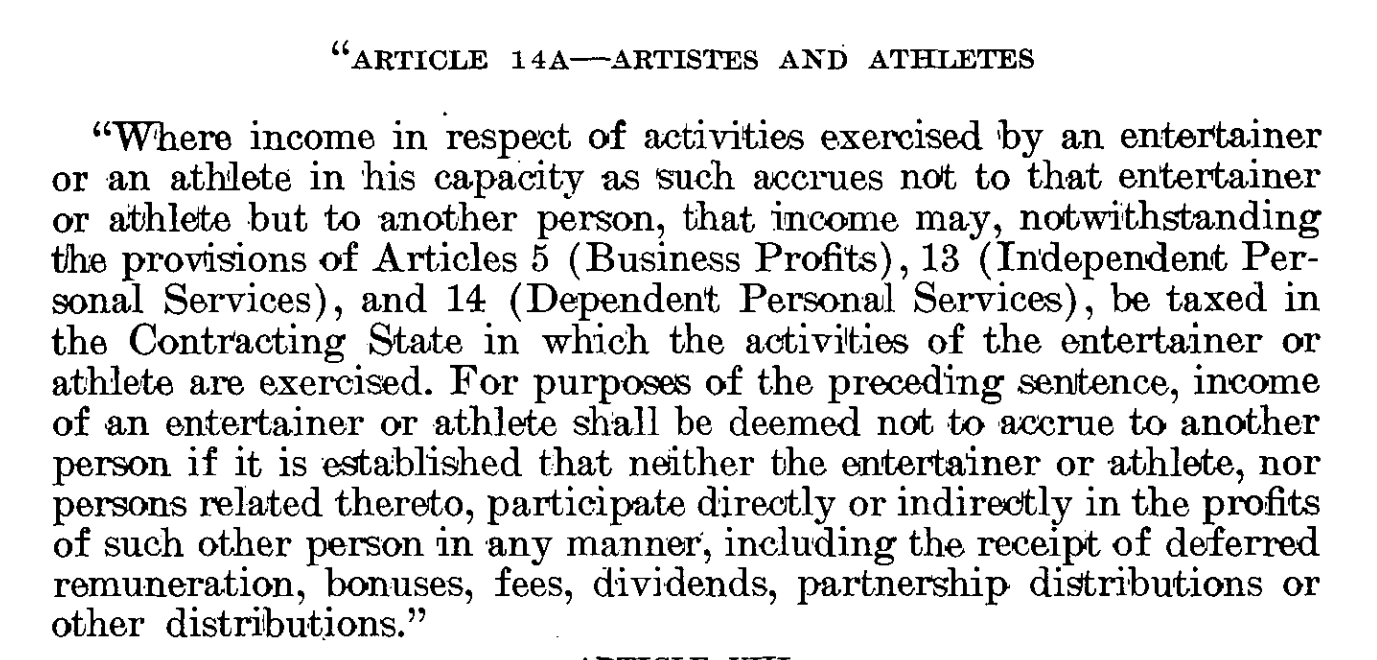
Athletes and entertainers are specially taxed in the U.S. in the sense they typically receive few benefits from the U.S. income tax treaty network. For instance, a world famous Norwegian soccer player such as Erling Haaland who has already equaled the Norwegian record (in just his first match) for most World Cup goals, previously belonging to midfielder Kjetil Rekdal is presumably subject to the U.S.-Norway treaty. The U.S.-Norwegian Income Tax Treaty is one of the very old tax treaties (1971) still on the books and has an “old fashioned” artist/entertainer/athlete provisions imbedded in the independent services provision that allows each government to specially tax artists and athletes if they earn over US$3,000.
A protocol to the treaty adopted in 1980 has a “new” article 14A specific to artists and athletes as reflected here in its entirety allowing the government to tax athletes and entertainers when they perform in the country (overriding other protective provisions of the treaty – e.g., Business Profits Art. 5, Independent Personal Services Art. 13 and Dependent Personal Services Art. 14):
The IRS also adopted a specific program, called the Central Withholding Agreement (“CWA”) program created by Revenue Procedure 89-47 specific to artists and athletes. I personally think it is a program that is not authorized by the statute and often applied by the IRS in a manner that violates the withholding tax regime we have in Chapter 3 of our statutory tax law, Subtitle A. In practice, third parties are subject to the 30% withholding tax on certain gross proceeds paid to companies other than the artist or athlete, if the athlete or artist doe not participate with the IRS in their CWA.
Mexico
In the case of global soccer players, even one with a “lawful permanent resident” card (i.e., a “green card”) they may be subject to the Chapter 3 withholding tax rules if the athlete is like Mr. Aroeste (Aroeste v. United States (Case No. 22-cv-00682-AJB-KSC)) holding a green card in his pocket, but not a U.S. income tax resident by application of the residency rules set forth in an income tax treaty. Will the soccer player become a “covered expatriate” and not even know it (oops)?! It can get tricky quickly. There are important unintended tax consequences that can befall individuals here: see, Oops…Did I “Expatriate” and Never Know It: Lawful Permanent Residents Beware!International Tax Journal, CCH Wolters Kluwer, Jan.-Feb. 2014, Vol. 40 Issue 1, p9).
Meanwhile, Mexico and the U.S. have both advanced to the knockout round.
Canada plays Switzerland and presumably has a 99% chance of advancing to the Round of 23.
What Tax Forms Do US Citizens and Green Card Holders Living Abroad Need?
Living outside the United States does not eliminate your US tax obligations. US citizens and green card holders abroad must file a US tax return every year and may also need to file additional reports on foreign assets and accounts. Here is an overview of the key forms, what they cover, and how they interact.
Is my foreign income automatically exempt from US reporting?
No. A common misconception is that foreign income is exempt because it can be excluded. Foreign earned income is not exempt. You must report it on a US tax return, and you must be a qualifying individual to elect the exclusion.
What types of income qualify for the exclusion on Form 2555?
The exclusion is available only for “earned” income. It cannot be used for passive investment income such as dividends, interest, or capital gains.
Foreign Tax Credits (FTC)
How does a Foreign Tax Credit work?
A Foreign Tax Credit provides a dollar-for-dollar reduction, subject to limitations, of your US federal tax burden for income taxes you paid to another country on income sourced there. It is claimed on Form 1116.
Can I claim both the FEIE and the Foreign Tax Credit?
No. Once you choose to exclude foreign earned income or housing costs, you cannot take a foreign tax credit on that same income. If you do take the credit, your previous choice to exclude that income may be treated as revoked.
Are there different forms for lawful permanent residents (LPRs)?
US citizens and LPRs generally use Form 1040. However, LPRs residing in a country with a US income tax treaty may be eligible to file Form 1040NR as a non-resident.
Information Reporting and FBAR
What is Form 8938?
Form 8938 (Statement of Specified Foreign Financial Assets) is used to report specified foreign financial assets. It often overlaps with FBAR reporting and must be attached to your annual income tax return when filed with the IRS.
Who must file an FBAR (Form 114)?
US citizens and LPRs with a financial interest in or signature authority over foreign accounts must file a Foreign Bank Account Report (FBAR). The definitions of “ownership interest” and “signature authority” are interpreted very broadly under the regulations.
Where is the FBAR filed?
Unlike other tax forms, the FBAR is not filed with the IRS. You must file it electronically with FinCEN (the Financial Crimes Enforcement Network) through the BSA E-Filing System on Form 114.
What are the penalties for FBAR non-compliance?
The statutory penalty for failing to file, or filing late, is $10,000 per failure. If the failure to file was intentional, the penalty can increase to 50% of the account balances.
There are important unintended tax consequences that can befall individuals who have a green card depending upon their factual circumstances: see, Oops…Did I “Expatriate” and Never Know It: Lawful Permanent Residents Beware!International Tax Journal, CCH Wolters Kluwer, Jan.-Feb. 2014, Vol. 40 Issue 1, p9).
Tax Preparation Software
Can I use standard tax software for these international forms?
Often, no. Most tax preparation software does not support Form 8938 or other forms related to non-US assets. These forms frequently require manual completion using an Adobe Acrobat version of the form.
Form W-8 or W-9? Why the Wrong Choice Could Cost Green Card Holders Abroad
The choice between Form W-8 and Form W-9 comes down to one thing: your U.S. tax residency status, not your immigration status. Green card holders living abroad may be able to sign Form W-8 under a U.S. income tax treaty, but picking the wrong form means signing a false statement under penalty of perjury. And claiming treaty benefits carries a risk that many people never see coming. Consulting an experienced attorney before signing anything is essential.
What is the difference between Form W-8 and Form W-9?
Both forms tell your bank or financial institution whether you are a U.S. tax resident or not. Form W-9 is for U.S. residents, who must pay U.S. taxes on income they earn anywhere in the world. Form W-8BEN is for non-residents, who generally only pay U.S. taxes on certain types of income that come from U.S. sources. The form you sign has real legal consequences, not just administrative ones.
What happens if you sign the wrong form?
Signing either form is a certification made under penalties of perjury. If you are a U.S. tax resident and you sign Form W-8, you are making a false statement, and serious legal consequences may follow.
Why is this more complicated for green card holders living abroad?
U.S. citizens always sign Form W-9, with no exceptions. For everyone else, it depends on tax residency status. Green card holders are generally treated as U.S. tax residents even while living in another country, which would normally mean they sign Form W-9. But there is an important exception: if the country where they live has an income tax treaty with the United States, they may be able to claim non-resident status under that treaty and sign Form W-8 instead. There are important unintended tax consequences that can befall individuals here: see, Oops…Did I “Expatriate” and Never Know It: Lawful Permanent Residents Beware!International Tax Journal, CCH Wolters Kluwer, Jan.-Feb. 2014, Vol. 40 Issue 1, p9).
The United States has 58 income tax treaties that together cover 66 countries. That includes the 1973 U.S. and U.S.S.R. income tax treaty, which still applies today to nine former Soviet republics: Armenia, Azerbaijan, Belarus, Georgia, Kyrgyzstan, Moldova, Tajikistan, Turkmenistan, and Uzbekistan.
What did the court decide in Aroeste v. United States, and why does it matter?
Aroeste v. United States (Case No. 22-cv-00682-AJB-KSC) is a federal court decision that established a 5-step analysis for green card holders who have not formally given up their green card but are living abroad. The key question the court addresses is whether a green card holder qualifies to be treated as a resident of a foreign country under an applicable U.S. income tax treaty. This ruling matters for the more than 3 million LPRs who are living outside the United States.
What are the benefits of successfully claiming non-resident status under a treaty?
If a green card holder qualifies as a non-resident under a tax treaty, they may be able to stop filing U.S. federal income tax returns on their worldwide income. They may also no longer be required to file the Foreign Bank Account Report, known as the FBAR, which would help them avoid the significant penalties that come with missing that filing. The court in Aroeste laid out the specific steps required to make this claim correctly.
One important note: if you claim non-resident status under a treaty but fail to report that treaty position to the IRS on time, you face a separate penalty under IRC Section 6712(a) of $1,000 for each failure to timely file. Claiming treaty status correctly and reporting it on time are both required.
What is the risk on the other side?
Claiming treaty-based non-resident status may also legally end your U.S. tax residency. Under IRC Section 7701(b)(6), this shift may cause you to cease to be a lawful permanent resident of the United States. That change may trigger the U.S. expatriation tax rules under IRC Section 877A(g)(3), which could classify you as a covered expatriate. The Aroeste court did not address these consequences because they were not part of that case, but they are real and potentially serious.
What does covered expatriate status mean for your family?
Covered expatriate status does not only affect you. If your family members or friends in the United States later receive gifts or an inheritance from you, they may owe U.S. tax on those transfers under the covered gift and covered bequest rules. This may affect children, spouses, and anyone else who would receive something from you.
Do you need an attorney before making this decision?
The answer depends on which country you live in, which treaty applies, the value of your assets, and your long-term plans. Getting it wrong may trigger exit taxes, affect your family’s inheritance, and have consequences that cannot easily be undone. This post explains the framework but is not a substitute for legal advice specific to your situation.
Green Card Holders (Abandonment) – so Many More than U.S. Citizens who Renounce: The Topsnik Problem(s)!
I have previously written (pre-Aroeste v. United States) about the thorny issues that LPRs face when spending substantial time outside the United States. See an earlier post titled:
I highlighted some key concepts about why it matters if you become a “long-term” resident as that term is defined in the tax law and now the case law in Aroeste makes these risks clear as confirmed in the landmark case.
A LPR can reside for substantially shorter periods in the U.S. (shorter than the apparent 7 or 8 years identified in the statute), and still be a “long-term resident” per IRC Section 877 (e)(2) depending upon the facts of any particular case.
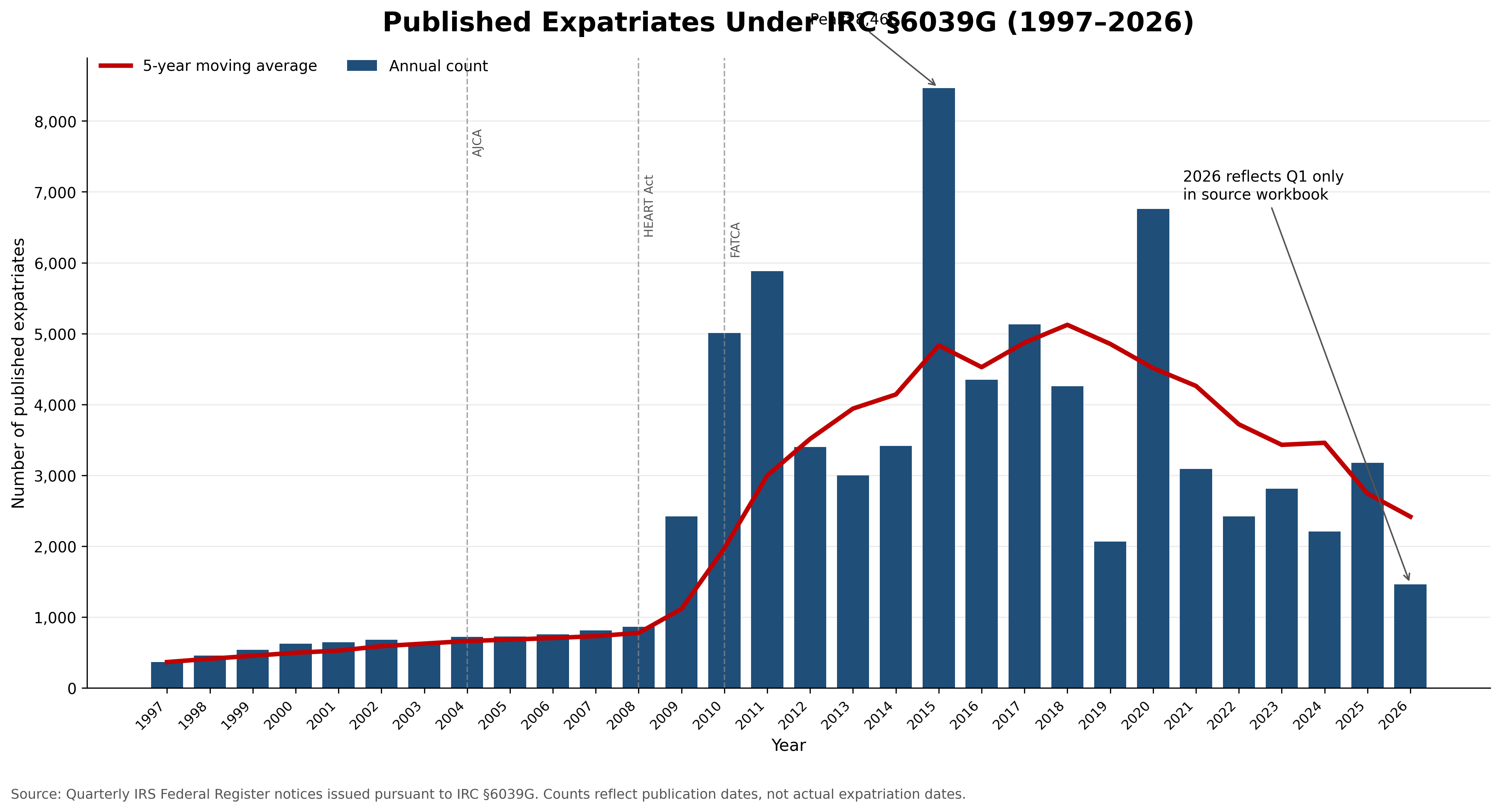
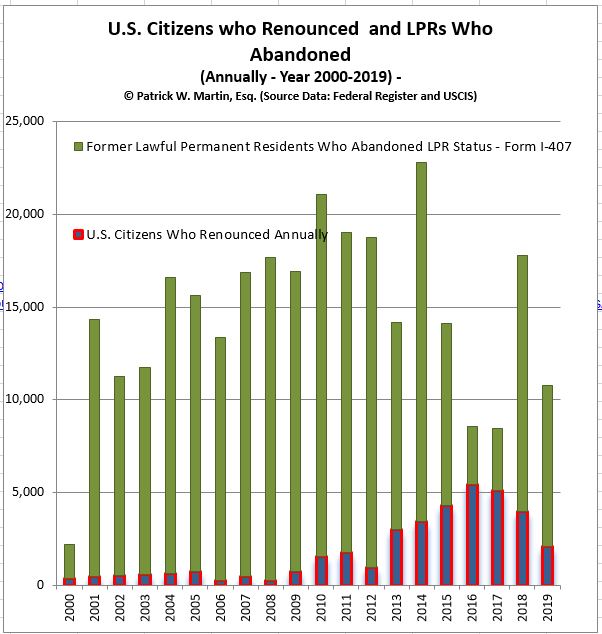
There are far more LPRs who abandon their status (formally) than U.S. citizens who formally take the oath of renunciation. See the table above reflecting those who have formally renounced U.S. citizenship versus those who have formally abandoned their LPR status.
Plenty of LPRs informally abandon their LPR status for immigration purposes by moving and living permanently outside the U.S.
There are plenty of timing issues for LPRs surrounding how and when they have “abandoned” their LPR status for purposes of IRC Section 877 (e)(2). See –
* More Green Card Holders Abandon Status Than Citizens Renounce Citizenship
A frequently overlooked fact is that:
Formal Abandonment of LPR Status Is More Common Than Citizenship Renunciation
Each year, substantially more lawful permanent residents formally abandon their green cards than U.S. citizens formally renounce citizenship. The focus in the press and media is typically U.S. citizens who formally renounce. Here is my most recently compiled graph, the total number of U.S. citizens renouncing is typically in the thousands (few) each year. It has trended downward post-COVID.
However, with LPRs, formal recognition of abandonment by filing Form I-407 (not including informal abandonments which are multiple times greater) is multiple times greater.
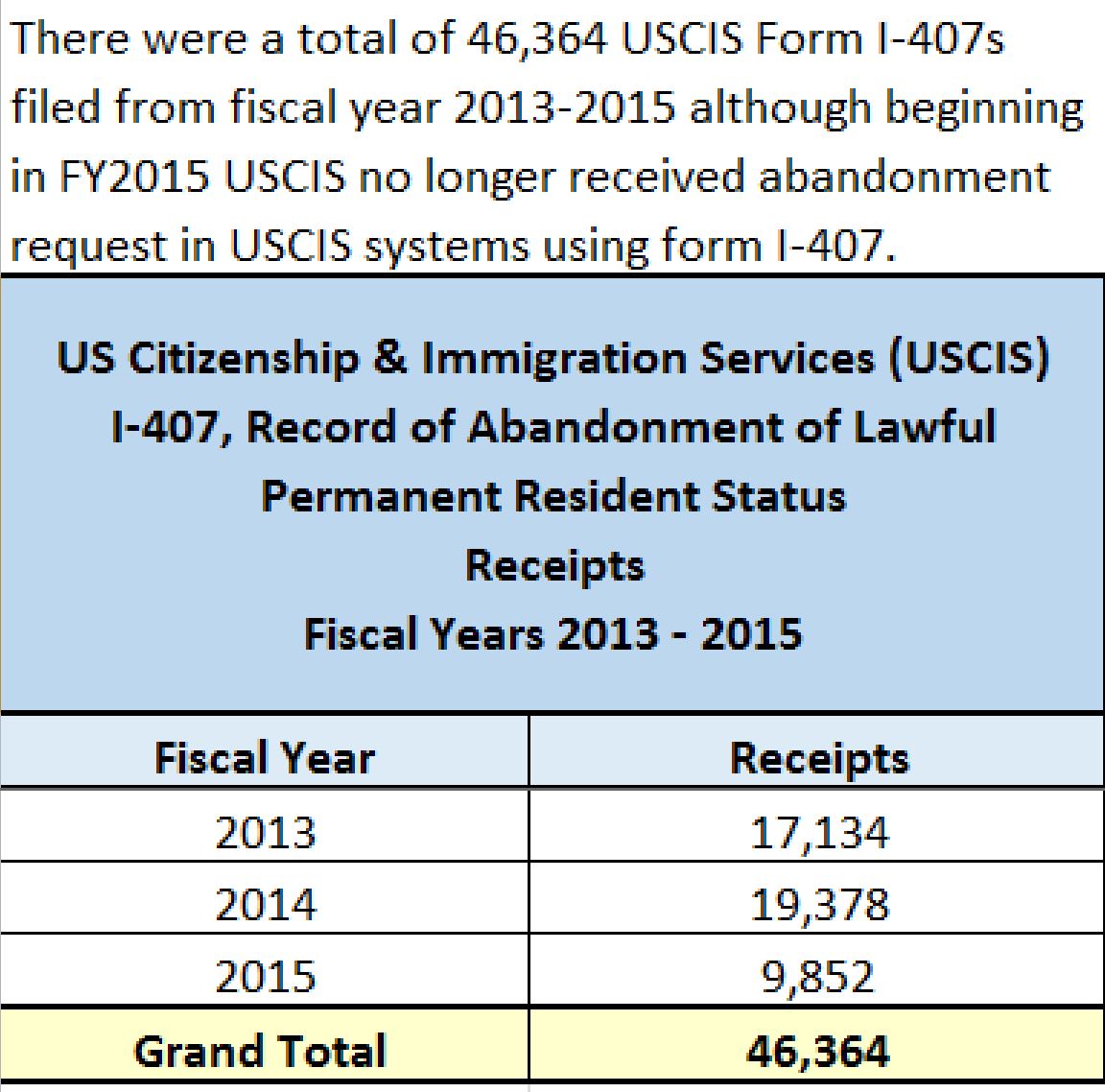
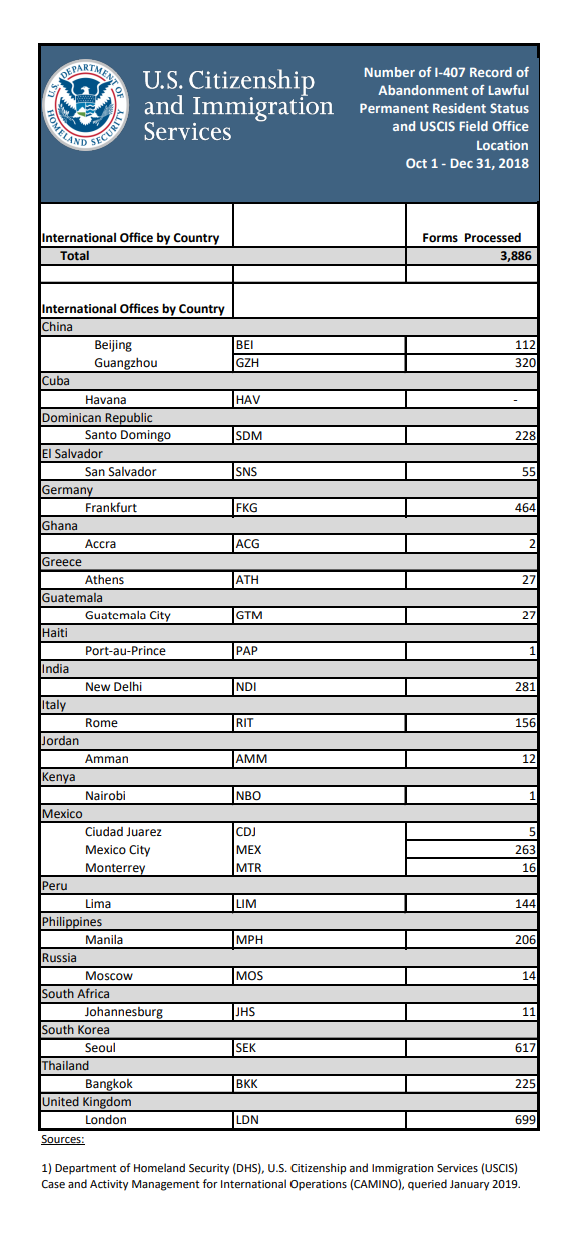
The graph I created several years ago, shows that formal LPR abandonments are mlutiple times greater than citizenship renunciation. I made a FOIA request with the government to request information about the number USCIS Forms I-407 that are filed with the government. See, also quarterly statistics of the USCIS – Form I-407, Record of Abandonment of Lawful Permanent Resident Status (partial information for years 2016-2019).
I have made a new FOIA request for more recent records, since this data is no longer public after the year 2019 year.
The statistics reflected above demonstrate that:
Formal green card abandonment significantly exceeds formal citizenship renunciations.
The population potentially affected by the expatriation rules is therefore much larger than many individuals around the world appreciate.
Lack of Control Over the Timing of Termination
One of the greatest risks for green card holders is that they often do not control the legal date on which their LPR status terminates, especially if they reside in a tax treaty country, per the analysis in the landmark case:
If abandonment is later determined by tax treaty law, effectively an CPB officer, the Executive Office for Immigration Review (EOIR) immigration court, the Board of Immigration Appeals (BIA)or a even a Federal District Court:
The taxpayer may not control the effective date of termination – “expatriation”.
If they are a “covered expatriate” or not.
The tax consequences may arise unexpectedly.
The timing can directly impact whether the tax expatriation rules apply and all of the potential consequences.
These timing issues become important when the IRS challenges tax positions taken on tax returns filed (or filed late) as was the case in Topsnik v. Commissioner (143 T.C. 240 (2014) – “Topsnik I”) and the subsequent case of Topsnik v. Commissioner (146 T.C. No. 1, 2016) – “Topsnik II”). In Topsnik II, Judge Kerrigan agreed with the IRS and ” . . . determined that P [taxpayer] was a “covered expatriate” who expatriated in 2010 and must recognize gain on the deemed sale of his installment obligation on the day before his expatriation under I.R.C. sec. 877A.” The U.S. Tax Court cited IRS Notice 2009-85 and explained it was not legally binding as follows:
We are not bound by Notice 2009-85, supra, see Compaq Computer Corp. v. Commissioner, 113 T.C. 363, 372 (1999), but it is an official statement of the Commissioner’s position and we may let it persuade us, see Nationalist Movement v. Commissioner, 102 T.C. 558, 583 (1994), aff’d, 37 F.3d 216 (5th Cir.1994).
The Tax Court went on to conclude these facts caused the court to conclude and uphold the IRS assessment of the “exit tax” on the German citizen Mr. Topsnik as a “covered expatriate” quoted as follows:
Notice 2009-85, sec. 8, 2009-45 I.R.B. at 611, explains that for purposes of certifying tax compliance for the five years before expatriation pursuant to section 877(a)(2)(C):
All U.S. citizens who relinquish their U.S. citizenship and all long-term residents who cease to be lawful permanent residents of the United States (within the meaning of section 7701(b)(6)) must file Form 8854 in order to certify, under penalties of perjury, that they have been in compliance with all federal tax laws during the five years preceding the year of expatriation. Individuals who fail to make such certification will be treated as covered expatriates within the meaning of section 877A(g) * * *
For the year of his expatriation petitioner failed to complete and file a Form 8854 certifying under penalties of perjury that he has complied with all of his U.S. Federal tax obligations for the five taxable years preceding the taxable year that includes his expatriation date. Respondent [IRS] has provided evidence that petitioner did not file all of his U.S. income tax returns before expatriatingand was not in payment compliance for taxes owed for the five years before expatriation in taxable year 2010. Thus petitioner could not have certified under penalties of perjury on a Form 8854 that he had been in tax compliance for the five years before expatriation. Consequently, because petitioner failed to certify tax compliance for the five years before expatriation, he is a “covered expatriate” as defined by section 877A(g)(1)(A).
Importantly, the court in Aroeste concluded IRS Form 8854 was not required to be filed (even though the DOJ attorney argued it was required – as set forth in the instructions to the form) as explained below:
C. Whether Aroeste Was Required to File Form 8854
The Government next argues that even if the IRS had accepted Aroeste’s amended
returns, neither amended return would have properly notified the IRS of a commencement of treaty benefits because both failed to attach Form 8854, as required by IRS Notice 2009- 85.(Doc. No. 76-1 at 4–5.) The Government concedes Aroeste attached Form 8833 to both
amended forms. (Id.)
Aroeste responds that Notice 2009-85 is not binding authority as it fails to comply
with the Administrative Procedures Act (“APA”). (Doc. No. 78-1 at 8 (citing Green Valley
Investors, LLC v. Comm’r of Internal Revenue, 159 T.C. No. 5, at *4 (Nov. 9, 2022)) (under
the APA, agencies must follow a three-step procedure for “notice-and-comment”
rulemaking, but this requirement does not apply to “interpretive rules, general statements
of policy, or rules of agency organization, procedure, or practice.”).) The Court agrees. In
Mann Construction, Inc. v. United States, 27 F.4th 1138 (6th Cir. 2022), the court found
that Notice 2007-83 failed to comply with the APA’s notice-and-comment procedure.
Similarly here, because Notice 2009-85 has not been subject to a notice-and-comment procedure, it does not comply with the APA and thus is not binding. As such, Aroeste was not required to file Form 8854 with his amended returns.
Both the Green Valley Investors LLC case and Mann Construction were 2022 cases, some 6 years after Topsnik II.
My law firm, Chamberlain Hrdlicka, successfully represented the taxpayers in Green Valley and of course in Aroeste.
Practical Lessons for Green Card Holders
The combined lessons from Aroeste, Topsnik I, and Topsnik II are significant.
Before Obtaining a Green Card
Individuals should understand:
The long-term resident rules and their U.S. tax obligations and reporting obligations;
The expatriation tax provisions and how they generally apply;
The “covered expatriate” tax regime and what steps to take;
The impact of income tax treaties with countries in the United States.
Before Formally Reporting the Abandonment (or Informally Abandoning) a Green Card
Individuals should carefully evaluate:
The date expatriation may occur;
Whether Form I-407 should be filed;
Tax compliance under U.S. tax laws (and what that means), including for the preceding five years to abandonment;
What notifications should be provided and when (not necessarily formal tax form filings);
Potential exit tax exposure – depending upon total assets, liabilities, type of assets and anticipated future income and gains;
Treaty residency positions and the particular facts of each case;
Reporting obligations, and which ones are mandatory or not – including IRS Forms 8833 and 8854.
Most Important Takeaway?
A green card holder does not necessarily need to spend seven or eight years physically living in the United States before becoming subject to the long-term resident and expatriation tax rules. The interaction of immigration law, tax law, treaty provisions, and reporting requirements can produce unexpected results. The recent landmark decision in Aroeste that I handled, confirms that these issues are not merely theoretical—they are increasingly becoming the subject of significant litigation and judicial scrutiny.