Wowzers! Consular Fees for Processing U.S. Citizenship Renunciations Decreased to US$450 Fee – ($320 – inflation adjusted)!
More than a dozen years ago, I wrote a blog when the State Department jacked up the fee to US$ 2,350.

As of September 2026, the U.S. Department of State has reduced the U.S. citizenship renunciation fee from $2,350 to $450. Adjusted for inflation since the 2014 increase, $450 today is equivalent to approximately $320 in 2014 dollars — the lowest real-terms cost for renunciation in more than a decade.
This is what the updated government website provides regarding renunciation:
Overview
Relinquishment of U.S. citizenship by performing certain statutory expatriating acts, including taking the oath of renunciation, voluntarily and with the intent of relinquishing U.S. citizenship, is a personal right that cannot be exercised on a person’s behalf. For example, a person’s parent(s) or legal guardian may not take the oath of renunciation for that person. A Certificate of Loss of Nationality (CLN) approved by the Department of State is the final agency determination of loss of U.S. nationality.
NOTE: STEPS 1-4 below outline the process for requesting a CLN based on taking an oath of renunciation before a U.S. diplomatic or consular officer abroad under Immigration and Nationality Act (INA) Section 349(a)(5), 8 USC 1481(a)(5). For information on the parallel process to request a Certificate of Loss of Nationality (CLN) on the basis of the commission of another potentially expatriating act under INA 349(a)(1)-(4), 8 USC 1481(a)(1)-(4), please contact your location by selecting it below.
Oath of Renunciation of U.S. Nationality
Embassy, consulate, or office providing consular services process requests to take the oath of renunciation of U.S. citizenship. Minors, individuals who do not read or write English, individuals with mental health or cognitive disability or impairment and/or guardianship, and those for whom loss of U.S. nationality would result in statelessness are invited to contact your location to discuss taking the oath of renunciation.
Taking an oath to renounce U.S. nationality before a U.S. diplomatic or consular officer overseas is a serious and irrevocable act. Therefore, you should carefully consider and fully understand the consequences and ramifications of this act prior to your decision to begin the process.
Steps to Take
STEP 1: Review the legal requirements and consequences/ramifications of taking the oath of renunciation of U.S. citizenship.
Please read the information provided by the embassy, consulate, or office providing consular services and available online at the Department of State and Internal Revenue Service links below regarding the legal requirements for taking the oath of renunciation before beginning this process. Loss of U.S. nationality is irrevocable, and you should fully understand the consequences and ramifications before beginning this process.
For questions related to possible U.S. tax implications, please contact the Internal Revenue Service and/or review the Joint Foreign Account Tax Compliance Act (FATCA) FAQ .
For questions related to Social Security Administration (SSA) or other federal benefits, please contact your location.
Department of State and Internal Revenue Service links:
STEP 2: Email your location to initiate the process and receive instructions. Gather and submit scanned copies of the required documents and schedule your first interview.
To schedule an initial interview, which will be conducted by telephone or in-person at the embassy, consulate, or office providing consular services, please send an email to your location. Canada, Bern, Berlin, Amsterdam, Australia (Sydney and Melbourne), Singapore, Brussels, and Paris provide electronic first interviews
Applicants should personally review all documents and prepare all forms provided by the embassy, consulate, or office providing consular services in accordance with the instructions. DO NOT SIGN ANY FORMS BEFORE YOUR FINAL INTERVIEW.
STEP 3: Schedule and attend the final interview at the embassy, consulate, or office providing consular services with all required original documents and pay the fee.
Schedule your final interview appointment according to embassy, consulate, or office providing consular services instructions. On the day of your final interview appointment, you must bring all of the original documents you previously submitted by email. You will be asked to reschedule if you do not have the required documents at the time of your final interview appointment.
Your Consular Report of Birth Abroad, and Certificate of Naturalization or Citizenship, if applicable, generally will be retained by the embassy, consulate, or office providing consular services during the remainder of the process and then returned to you. Your U.S. passport also will be retained and, if your Certificate of Loss of Nationality is approved by the Department of State, it will be canceled before it is returned to you upon your request. If you need to travel to the United States on your U.S. passport after the second interview but before the Certificate of Loss of Nationality has been approved, please so advise the embassy, consulate, or office providing consular services at the second interview.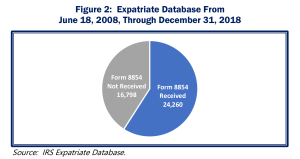
You will meet with a consular officer for your second interview and you will be given another opportunity to review the documents that you have already filled out (but not signed) Form DS-4079, Questionnaire; Loss of United States Nationality; Attestations prior to signing them and taking the oath of renunciation.
Fee: Immediately after taking the oath of renunciation, you must pay the non-refundable current fee of US $450 for administrative processing of a request for a Certificate of Loss of Nationality. The fee is not waivable, nor is it refundable if your request for a Certificate of Loss of Nationality is denied.
Step 4: Receive the Certificate of Loss of Nationality if approved by the Department of State
The Department of State will review each request for a Certificate of Loss of Nationality to determine whether there is a legal basis to approve it. This step may take several months or more. The embassy, consulate, or office providing consular services may contact you for further information before the Department of State decides your case. The embassy, consulate, or office providing consular services will email you if and when your request has been approved. If your request is denied, the embassy, consulate, or office providing consular services will send you an email attaching a denial letter.
NOTE: STEPS 1-4 above outline the process for requesting a CLN based on taking an oath of renunciation before a U.S. diplomatic or consular officer abroad under Immigration and Nationality Act (INA) Section 349(a)(5), 8 USC 1481(a)(5). For information on the parallel process to request a Certificate of Loss of Nationality (CLN) on the basis of the commission of another potentially expatriating act under INA 349(a)(1)-(4), 8 USC 1481(a)(1)-(4), please contact your location for inquiries.
Fees (Prices in U.S. Dollars)
Non-refundable fee of $450 USD at the time of the appointment.
What the Fee Reduction Does Not Change
The $450 consular fee covers only the State Department’s administrative processing of the renunciation appointment. It has no effect on the U.S. tax consequences of renunciation, which are governed entirely by separate federal tax law.
A U.S. citizen who renounces citizenship in 2026 still faces the same IRS obligations as before the fee change. Form 8854, the Initial and Annual Expatriation Information Statement, must still be filed. The five-year tax compliance certification is still required. If the renouncing individual qualifies as a covered expatriate under the three IRS tests — net worth, average annual tax liability, and compliance certification — the Section 877A mark-to-market exit tax still applies in full.
The fee reduction makes the administrative step of renouncing less expensive. It does not reduce the tax cost.
Is the $450 Fee the Only Cost of Renouncing?
No. The consular fee is the smallest cost most people encounter. The substantive costs of renunciation depend entirely on the individual’s financial situation and filing history. For individuals who are covered expatriates, the Section 877A exit tax can represent a significant liability. For individuals with unfiled FBARs or unreported foreign accounts, FBAR penalties may apply separately.
Attorney fees for proper pre-renunciation planning, tax preparation for Form 8854, and any exit tax liability are the costs that vary significantly from person to person. The $450 appointment fee is the one cost that is the same for everyone.
When Did the Fee Change Take Effect?
The State Department updated its fee schedule in September 2026, reducing the U.S. citizenship renunciation fee from $2,350 to $450 effective immediately. The $2,350 fee had been in place since September 2014, when it was increased by more than 500 percent from the prior $450 level. In real terms, adjusted for inflation since 2014, the current $450 fee is equivalent to approximately $320 in 2014 dollars.
What Is the Difference Between Relinquishing and Renouncing US Citizenship?
Table of contents
Read the full analysis here.
Is there a legal difference between “relinquishing” and “renouncing” U.S. citizenship for tax purposes?
For U.S. federal tax purposes, “relinquish” and “renounce” are in effect interchangeable. Many people assume the two words carry an important legal distinction. For federal tax purposes, they generally do not. This question was first taken up in an earlier post dated June 21, 2014. The expatriation tax statute, IRC Sections 877 and 877A (the U.S. tax rules that apply when a person gives up U.S. citizenship), uses both terms in the same breath. What drives the tax result is not which word applies but the “expatriation date.”
What date actually matters under the U.S. expatriation tax rules?
The key time reference is the “expatriation date.” Under IRC Sections 877 and 877A (the U.S. expatriation tax rules), this date is defined in Section 877A(g)(3). It focuses on specific dates tied to meetings or events with the U.S. Department of State. Because the tax outcome turns on this date, the choice between the words “relinquish” and “renounce” does not, by itself, change it.
Why don’t the words “relinquish” and “renounce” change the tax outcome?
Both words point to the same thing under the tax law. The expatriation tax statute, IRC Sections 877 and 877A, uses “renounce” and “relinquish” in the same breath. The result instead depends on the “expatriation date” defined in Section 877A(g)(3), which is tied to specific meetings or events with the U.S. Department of State. So the terminology a person uses does not, on its own, change the federal tax treatment.
Consult an experienced attorney about how these rules apply to a specific situation.
Read the full analysis here.
Can You Lose Your Green Card for Tax Purposes Just by Moving Abroad?
On this page:
Read the full analysis here.
Can you keep your green card and still “expatriate” for US tax purposes?
Yes. Many lawful permanent residents (LPRs, or green card holders) assume they have not “expatriated” for US tax purposes as long as they have not handed their green card back to US Citizenship and Immigration Services (USCIS). That assumption can lead to a rude awakening. Under IRC Section 7701(b)(6), a green card holder can cease to be treated as a lawful permanent resident for federal tax purposes without ever formally abandoning the card with USCIS. See, an article written by Patrick W. Martin on this subject a dozen years ago: See, Oops…Did I “Expatriate” and Never Know It: Lawful Permanent Residents Beware! International Tax Journal, CCH Wolters Kluwer, Jan.-Feb. 2014, Vol. 40 Issue 1, p9).
What is IRC Section 7701(b)(6)?
IRC Section 7701(b)(6) is a provision Congress added in 2008 that says when a green card holder stops being treated as a lawful permanent resident for federal tax purposes. The relevant part provides that an individual shall cease to be treated as a lawful permanent resident if the individual commences to be treated as a resident of a foreign country under a tax treaty between the United States and that country, does not waive the benefits of the treaty applicable to residents of the foreign country, and notifies the Secretary of the commencement of such treatment.
What are the three tests for losing LPR status under Section 7701(b)(6)?
The statutory language sets out three tests. A green card holder is no longer an LPR for federal tax purposes when all three are met:
- The individual is treated as a resident of a foreign country under the provisions of a tax treaty;
- The individual does not waive the benefits of that treaty; and
- The individual notifies the Secretary of the commencement of such treatment.
It can get more complicated than this too – depending upon the interpretation of the laws in various tax treaties.
It can. Each of the three tests under Section 7701(b)(6) appears to be satisfied by a green card holder who files IRS Form 1040NR as a non-resident while living in a country that has a US income tax treaty. In that situation the individual may be treated as having ceased to be a lawful permanent resident for federal tax purposes, even though the green card itself was never returned to USCIS.
What happens once you stop being a lawful permanent resident under the tax law?
There can be a host of unintended consequences for an individual who ceases to be a lawful permanent resident under the federal tax law. The expatriation provisions of Section 877A and Section 2801, among others, can be implicated, along with many other provisions of the law. For background, see “Accidental Americans” – Rush to Renounce U.S. Citizenship to Avoid the Ugly U.S. Tax Web,” International Tax Journal, CCH Wolters Kluwer, Nov./Dec. 2012, Vol. 38 Issue 6, p45.
For those who wish to formally abandon their lawful permanent resident status, there is a specific DHS/USCIS form used for that purpose: Form I-407. Filing this form is the route to formally relinquishing the green card with the immigration authorities, which is separate from the tax-law treatment described above under Section 7701(b)(6).
Read the full analysis here.
Why Covered Expatriate Status Affects You Even If You Have No Assets
On this page:
Read the full analysis here.
Does “covered expatriate” status only matter for wealthy people?
No. It is easy to assume the US expatriation tax rules only reach the rich, the wealthy, and the private-jet set. The press usually features wealthy renouncers like Tina Turner and Eduardo Saverin, the co-founder of Facebook, which fuels that assumption. But wealth is not the trigger. The rules can reach the poorest former US citizen, and certain long-term green card holders, wherever they live, if they fail the certification requirement in IRC Section 877(a)(2)(C).
What are the net worth and income tax tests people usually focus on?
Most coverage of expatriation focuses on two dollar thresholds. The first is the net worth test of US$2 million. The second is the income tax liability test of roughly US$125,000 of average annual net income tax. A “covered expatriate” is a former US citizen, or long-term green card holder, who on giving up that status either crosses one of those dollar thresholds or fails to certify tax compliance under Section 877(a)(2)(C). Because the headlines fixate on the dollar tests, the certification path is the one people miss.
Can you be a covered expatriate if you have no assets?
Yes. The certification requirement under Section 877(a)(2)(C) applies regardless of wealth. A former US citizen, or certain long-term green card holder, who cannot certify compliance becomes a “covered expatriate” even with almost nothing to their name. This is why the rules can reach so-called Accidental Americans who have spent little or no time in the US. The dollar thresholds are only one way in; failing to certify is another.
Does US expatriation tax apply to green card holders too?
Yes. The expatriation tax rules reach certain long-term lawful permanent residents (green card holders), not only US citizens. When a long-term LPR relinquishes or abandons their green card, the same certification requirement under Section 877(a)(2)(C) applies. A long-term LPR who cannot certify compliance becomes a covered expatriate on the same terms as a citizen who renounces.
If you have no assets, do you owe US income tax when you expatriate?
No. The expatriation income tax runs through a “mark-to-market” regime, which taxes unrealized gains as if you sold everything the day before you leave. With no assets, there are no unrealized gains, no tax base, and so no exit income tax. Even cash produces none. US dollars carry a tax basis equal to their face amount, so there is no unrealized gain on cash to tax.
What are the two points where expatriation can trigger US tax?
There are two. The first is the moment a US citizen or green card holder expatriates, that is, leaves the US tax system. This is the exit tax on unrealized gains, and it produces nothing for a person with no unrealized gains. The second arrives later, when a US person receives a covered gift or bequest from the covered expatriate under IRC Section 2801. That second point can land decades after the expatriation event.
What is the Section 2801 tax on covered gifts and bequests?
IRC Section 2801, enacted in 2008, taxes the US person who receives a gift or bequest from a covered expatriate. The recipient pays effectively 40% of the fair market value of the property received. There are virtually no deductions or exemptions, so the 40% applies to the full value. The gift or bequest can be direct or indirect, for example through a trust. Treasury has a proposed-regulation project underway under Section 2801.
Can someone with significant assets still owe no exit income tax?
Yes. Unrealized gains, not wealth, drive the exit income tax. Compare USC “A” with US$5,000 in total assets and USC “B” with US$15 million of cash in the bank and nothing else. Both owe the same exit income tax: US$0. Cash carries a tax basis equal to its amount, so neither has any unrealized gain to tax. And if neither can satisfy the certification requirement under Section 877(a)(2)(C), both are covered expatriates just the same.
Why would a covered expatriate with no assets ever create a future tax bill?
Because the Section 2801 tax can land long after expatriation, on assets you do not have yet. Two things change over time. You may grow or inherit assets after expatriating, while no longer a US citizen, ending up with far more than you hold today. And people in your life, family or friends, may become US residents even if none are today. Either shift can set up a future covered gift or bequest from you to a US person.
How much tax could a modest future inheritance trigger?
Take USC “A,” who renounces and, 40 years later, leaves a US$120,000 bequest to a daughter who has since moved to the US. Under Section 2801, the daughter would owe more than US$40,000 in tax on that inheritance, roughly 40%, with virtually no deductions or exemptions. That is a heavy burden on a relatively modest inheritance. It is one of several scenarios that show how covered expatriate status can matter over the long run.
How realistic is it that a future heir becomes a US person?
It is common. One family member moves to the US temporarily for work or graduate school, gets married, and decides to stay, even for a while. Often they have children, who are US citizens by birth in the US. A US person is now part of the family tree. A future gift or bequest from a covered expatriate to that person can fall under Section 2801, decades after the expatriation itself.
Read the full analysis here.
What Is the 5-Year Tax Compliance Requirement for Renouncing US Citizenship?
Form 8854 and the Section 877(a)(2)(C) Certification: Must Your Tax Compliance Come Before You Renounce?
On this page:
Read the full analysis here.
What is the certification requirement under Section 877(a)(2)(C)?
A former U.S. citizen or long-term green card holder (a lawful permanent resident, or LPR) becomes a “covered expatriate” under Section 877(a)(2)(C) if they fail to certify, under penalty of perjury, that they have met their federal tax requirements for the 5 preceding taxable years. The statute treats a person as covered if “(C) such individual fails to certify under penalty of perjury that he has met the requirements of this title for the 5 preceding taxable years or fails to submit such evidence of such compliance as the Secretary may require.” A “covered expatriate” is a person who triggers the U.S. exit tax rules on giving up citizenship or LPR status.
What makes someone a “covered expatriate”?
If you expatriated after June 16, 2008, the expatriation rules apply if any one of these statements is true:
- Your average annual net income tax liability for the 5 tax years ending before the date of your expatriation is more than the listed amount.
- Your net worth is $2 million or more on the date of your expatriation.
- You fail to certify on Form 8854 that you have complied with all of your federal tax obligations for the 5 tax years preceding the date of your expatriation.
The third test is the certification requirement, and it is the one tied to the timing question below.
Does an IRS form or its instructions carry the “force of law”?
An IRS form and its conditions may not carry the “force of law.” Treasury and the IRS cannot create law by publishing a substantive rule in a form. The statute is what binds. This matters because a form instruction can state a condition that the statute itself does not, and anyone citing a form will want to keep that distinction in mind.
Do the Form 8854 instructions require tax compliance before the expatriation date?
The instructions read that way. The Form 8854 instructions state that the certification must reflect that you have “complied with all of your federal tax obligations for the 5 tax years preceding the date of your expatriation.” Taken literally, that language points to compliance completed before the expatriation or renunciation date. The statute, Section 877(a)(2)(C), does not specify whether the certification has to be made before or after the date of loss of nationality.
Can you come into compliance after renouncing and still avoid covered expatriate status?
This is the open question the form instructions raise. If the instructions are correct, a person could not satisfy the rule by attempting to comply with all federal tax obligations after renouncing. Under that reading, coming into compliance for 5 years and then filing Form 8854, all after taking the oath of renunciation, would not let the person avoid “covered expatriate” status. The statute itself does not say the certification must come before the date of loss of nationality, so whether the instructions can impose that timing is unsettled.
Are there Treasury regulations that settle this question?
No. Treasury has issued no regulations on this point to date. There are only a few notices. One of them is IRS Notice 2009-85 on expatriation, and its own “force of law” is itself open to question. Without regulations, a form instruction is not the same as binding law.
Could the IRS still challenge someone who complies after renouncing?
Yes. Even where a form instruction may not carry the force of law, the IRS may still challenge a former U.S. citizen or LPR who does not also meet the condition set out in the IRS’s own instructions. The agency could argue that the person failed the certification requirement of Section 877(a)(2)(C) by not satisfying tax compliance before the expatriation date.
Why does this matter before taking the oath of renunciation?
The timing of tax compliance is a detail a former U.S. citizen or green card holder may want to weigh carefully before renouncing. The statute is silent on whether the certification must come before the date of loss of nationality, while the form instructions point to compliance before that date, so the literal-statute reading and the form-instruction reading can diverge. Consult an experienced attorney before rushing off to take the oath of renunciation.
Read the full analysis here.
Why You Need to Plan Before Renouncing US Citizenship
Giving up U.S. citizenship or a green card can trigger an immediate income tax bill, and the IRS may be able to collect it indefinitely, no matter where you live. The rules can also reach your friends and family. This post explains why tax planning generally comes before the paperwork, who the expatriation rules can affect, what the U.S. Department of State forms are, and how hard the tax may be to collect once you live abroad. Consulting an experienced attorney before taking any of these steps is essential.
Table of contents:
Read the full analysis here.
Why does tax planning usually come before giving up U.S. citizenship or a green card?
U.S. international tax law is complex. Without planning, people can create very adverse tax consequences for themselves and for their friends and family, often without understanding the full implications of the law. This is especially true for tax expatriation, which is when a U.S. citizen (USC) renounces citizenship or a long-term lawful permanent resident (LPR), meaning a green card holder, abandons that status. Several features of the law make planning ahead important.
What is the general income tax rule when someone expatriates?
The general rule is that an immediate income tax is payable under the “mark to market” taxation rules on unrealized gains. Mark to market means that unrealized gains, the increase in value of assets that have not actually been sold, are treated as if the assets were sold and are taxed right away. This can produce an income tax bill at the time of expatriation, even though nothing has actually been sold.
Can the IRS collect the expatriation tax from someone living outside the United States?
Yes. Once a tax is recognized under U.S. tax law, the only way to discharge the liability with the U.S. federal government is to pay the tax owing. The IRS generally can collect an income tax owing against a taxpayer who lives outside the U.S. indefinitely. The normal 10 year collection statute does not apply while the individual is outside the United States for a continuous period of at least six months, under IRC Section 6503(c). In effect, the IRS can “forever” pursue collection of the expatriation tax against U.S. citizens and lawful permanent residents living outside the U.S.
Can someone become a covered expatriate even with no assets?
Yes. It is easy to fall into the general rule of expatriation, even for a taxpayer who would not otherwise be subject to income taxation. A person who falls into these rules is called a “covered expatriate.” Because covered expatriate status can attach even to someone with no assets, it is sometimes described as a “Forever Taint.”
Can your friends and family be taxed because of your expatriation?
Yes. The friends and family of a covered expatriate, meaning a former U.S. citizen or long-term lawful permanent resident who fell into these rules, can be subject to U.S. taxation during their lifetimes, even if they also live outside the United States. This consequence comes from Section 2801, sometimes called the “Hidden Tax” of expatriation and another part of its “Forever Taint.”
Renouncing U.S. citizenship involves going to the U.S. Department of State and taking the oath of renunciation. Two forms are completed and filed at that time:
- Form DS-4080, Oath of Renunciation of the Nationality of the United States.
- Form DS-4081, Statement of Understanding Concerning the Consequences and Ramifications of Relinquishment or Renunciation of U.S. Citizenship.
The reason planning generally comes first is that these are the steps that formally complete the renunciation, after the tax consequences are already in motion.
If you live abroad with no U.S. assets, can the IRS still collect?
It may be difficult. If the individual lives outside the U.S., does not travel to and from the U.S., and has no assets in the U.S., it may be practically very difficult for the IRS to collect on the tax judgment owing. Even so, there are legal means and steps the IRS can take in an attempt to collect U.S. taxes on assets held overseas.
Why is planning important before renouncing citizenship or abandoning a green card?
Ideally, a former U.S. citizen or long-term lawful permanent resident will want to avoid these potential tax and collection issues by engaging in thoughtful and strategic planning before renouncing U.S. citizenship or abandoning lawful permanent residency. Because expatriation can trigger an immediate tax, long-term collection exposure, and tax consequences for family members, the planning generally comes before the renunciation paperwork. Consulting an experienced attorney before taking any of these steps is essential.
Read the full analysis here.
What Happens If You Become a Covered Expatriate?
Not everyone who renounces US citizenship faces the same tax consequences. People who qualify as “covered expatriates” face significant additional obligations. Here is what that means and how even modest individuals can end up in this category.
Table of contents:
The trap for the unwary: Section 877(a)(2)(C)
What are the three tests for covered expatriate status?
What happens at the embassy or consulate?
The trap for the unwary: Section 877(a)(2)(C)
One of the greatest risks for anyone who wants to give up US citizenship is Section 877(a)(2)(C). Even the most economically modest individual, with little assets or income, can fall into this trap. No one at the US Department of State will provide tax advice or interpret Section 877(a)(2)(C) for you. The renunciation appointment itself is straightforward. The tax consequences are not.
What are the three tests for covered expatriate status?
Under Section 877(a)(2), you are a covered expatriate if any one of the following is true:
(A) Your average annual net income tax liability is greater than $124,000;
(B) Your net worth is $2,000,000 or more as of your expatriation date; or
(C) You fail to certify under penalty of perjury that you have met all US tax requirements for the 5 preceding taxable years, or fail to submit the required evidence of compliance.
Any individual who meets any one of these tests will be a covered expatriate and subject to the taxation and reporting requirements under Sections 877, 877A, and 2801.
What happens at the embassy or consulate?
When you take the renunciation oath at a US embassy or consulate, the Foreign Affairs Manual provides only standard overview language about “special tax consequences.” The consular officer will not explain the specific rules of Section 877(a)(2)(C) or tell you whether you will be a covered expatriate. This is worth understanding well before going to take the oath.
This post provides general information only and is not legal advice. Consult an experienced attorney for guidance specific to your situation.
Read the full analysis here.
Why Long-Term Green Card Holders Cannot Escape the Exit Tax Rules
When long-term green card holders give up their green card, they face the same exit tax rules as US citizens who renounce citizenship. There is one exception in the law that allows certain dual citizens by birth to avoid covered expatriate status even if they meet the income or asset tests. Long-term green card holders cannot use it. Here is why.
Table of contents:
What makes someone a covered expatriate?
Is there an exception to the income and asset tests?
Who can use this exception?
Why green card holders cannot use it
What this means if you are a long-term green card holder
What makes someone a covered expatriate?
When you give up your green card (or renounce US citizenship), the law determines whether you are a covered expatriate. You are a covered expatriate if you meet any one of three tests: an average annual income tax liability above an inflation-adjusted threshold, a net worth of $2 million or more on the date of expatriation, or a failure to certify 5 years of US tax compliance – where it is commonly certified on IRS Form 8854.
Meeting even one of these three tests makes you a covered expatriate. All three tests apply equally to US citizens who renounce and to long-term lawful permanent residents (LPRs) who give up their green card.
Is there an exception to the income and asset tests?
Yes, for some people. Under IRC Section 877A(g)(1)(B), certain individuals are exempt from the income and asset tests. If this exception applies to you, you can avoid covered expatriate status even if your net worth exceeds $2 million or your income exceeds the threshold. The certification requirement under Section 877(a)(2)(C) still applies to everyone, including those who qualify for this exception.
Who can use this exception?
The exception is narrow. Under the statute, it applies only to an individual who: became a citizen of the United States and a citizen of another country at birth; as of the date of expatriation, continues to be a citizen of and is taxed as a resident of that other country; and has been a US resident for no more than 10 taxable years during the 15-year period ending with the taxable year of expatriation. Only someone who acquired US citizenship automatically at birth, while also holding citizenship of another country from birth, can potentially qualify.
Why green card holders cannot use it
Lawful permanent residents are not US citizens. They hold a green card, which is a grant of permanent resident status, not citizenship. Because the exception in Section 877A(g)(1)(B) applies only to individuals who became US citizens at birth, long-term LPRs cannot satisfy this requirement by definition. The exception is simply not available to them.
What this means if you are a long-term green card holder
A long-term LPR who meets either the $2 million asset test or the income tax liability test will become a covered expatriate, even if they fully satisfy the 5-year certification requirement. Satisfying the certification requirement is necessary for everyone, but for long-term LPRs it is not sufficient on its own. If you also meet the income or asset test, you are a covered expatriate regardless.
The consequences include the mark-to-market exit tax on unrealized gains and the Section 2801 tax on covered gifts and bequests to US persons. These consequences can affect your US family members for decades. Understanding them well before you give up your green card, not after, is the only way to plan for them.
There are important unintended tax consequences that can befall individuals who have a green card depending upon their factual circumstances: see, Oops…Did I “Expatriate” and Never Know It: Lawful Permanent Residents Beware! International Tax Journal, CCH Wolters Kluwer, Jan.-Feb. 2014, Vol. 40 Issue 1, p9):
This post provides general information only and is not legal advice. Consult an experienced attorney for guidance specific to your situation.
Read the full analysis here.
Form W-8 or W-9? Why the Wrong Choice Could Cost Green Card Holders Abroad
The choice between Form W-8 and Form W-9 comes down to one thing: your U.S. tax residency status, not your immigration status. Green card holders living abroad may be able to sign Form W-8 under a U.S. income tax treaty, but picking the wrong form means signing a false statement under penalty of perjury. And claiming treaty benefits carries a risk that many people never see coming. Consulting an experienced attorney before signing anything is essential.
Table of contents:
Both forms tell your bank or financial institution whether you are a U.S. tax resident or not. Form W-9 is for U.S. residents, who must pay U.S. taxes on income they earn anywhere in the world. Form W-8BEN is for non-residents, who generally only pay U.S. taxes on certain types of income that come from U.S. sources. The form you sign has real legal consequences, not just administrative ones.
Signing either form is a certification made under penalties of perjury. If you are a U.S. tax resident and you sign Form W-8, you are making a false statement, and serious legal consequences may follow.
Why is this more complicated for green card holders living abroad?
U.S. citizens always sign Form W-9, with no exceptions. For everyone else, it depends on tax residency status. Green card holders are generally treated as U.S. tax residents even while living in another country, which would normally mean they sign Form W-9. But there is an important exception: if the country where they live has an income tax treaty with the United States, they may be able to claim non-resident status under that treaty and sign Form W-8 instead. There are important unintended tax consequences that can befall individuals here: see, Oops…Did I “Expatriate” and Never Know It: Lawful Permanent Residents Beware! International Tax Journal, CCH Wolters Kluwer, Jan.-Feb. 2014, Vol. 40 Issue 1, p9).
The United States has 58 income tax treaties that together cover 66 countries. That includes the 1973 U.S. and U.S.S.R. income tax treaty, which still applies today to nine former Soviet republics: Armenia, Azerbaijan, Belarus, Georgia, Kyrgyzstan, Moldova, Tajikistan, Turkmenistan, and Uzbekistan.
What did the court decide in Aroeste v. United States, and why does it matter?
Aroeste v. United States (Case No. 22-cv-00682-AJB-KSC) is a federal court decision that established a 5-step analysis for green card holders who have not formally given up their green card but are living abroad. The key question the court addresses is whether a green card holder qualifies to be treated as a resident of a foreign country under an applicable U.S. income tax treaty. This ruling matters for the more than 3 million LPRs who are living outside the United States.
(Patrick W. Martin of Chamberlain Hrdlicka served as lead counsel for the taxpayer in this case. Read his full analysis of Aroeste v. United States here.)
What are the benefits of successfully claiming non-resident status under a treaty?
If a green card holder qualifies as a non-resident under a tax treaty, they may be able to stop filing U.S. federal income tax returns on their worldwide income. They may also no longer be required to file the Foreign Bank Account Report, known as the FBAR, which would help them avoid the significant penalties that come with missing that filing. The court in Aroeste laid out the specific steps required to make this claim correctly.
One important note: if you claim non-resident status under a treaty but fail to report that treaty position to the IRS on time, you face a separate penalty under IRC Section 6712(a) of $1,000 for each failure to timely file. Claiming treaty status correctly and reporting it on time are both required.
What is the risk on the other side?
Claiming treaty-based non-resident status may also legally end your U.S. tax residency. Under IRC Section 7701(b)(6), this shift may cause you to cease to be a lawful permanent resident of the United States. That change may trigger the U.S. expatriation tax rules under IRC Section 877A(g)(3), which could classify you as a covered expatriate. The Aroeste court did not address these consequences because they were not part of that case, but they are real and potentially serious.
What does covered expatriate status mean for your family?
Covered expatriate status does not only affect you. If your family members or friends in the United States later receive gifts or an inheritance from you, they may owe U.S. tax on those transfers under the covered gift and covered bequest rules. This may affect children, spouses, and anyone else who would receive something from you.
Do you need an attorney before making this decision?
The answer depends on which country you live in, which treaty applies, the value of your assets, and your long-term plans. Getting it wrong may trigger exit taxes, affect your family’s inheritance, and have consequences that cannot easily be undone. This post explains the framework but is not a substitute for legal advice specific to your situation.
If you are an attorney, read this post instead.
Green Card Holders (Abandonment) – so Many More than U.S. Citizens who Renounce: The Topsnik Problem(s)!
I have previously written (pre-Aroeste v. United States) about the thorny issues that LPRs face when spending substantial time outside the United States. See an earlier post titled:
Posted on August 19, 2014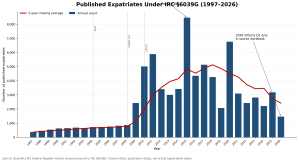
I highlighted some key concepts about why it matters if you become a “long-term” resident as that term is defined in the tax law and now the case law in Aroeste makes these risks clear as confirmed in the landmark case.
- A LPR can reside for substantially shorter periods in the U.S. (shorter than the apparent 7 or 8 years identified in the statute), and still be a “long-term resident” per IRC Section 877 (e)(2) depending upon the facts of any particular case.
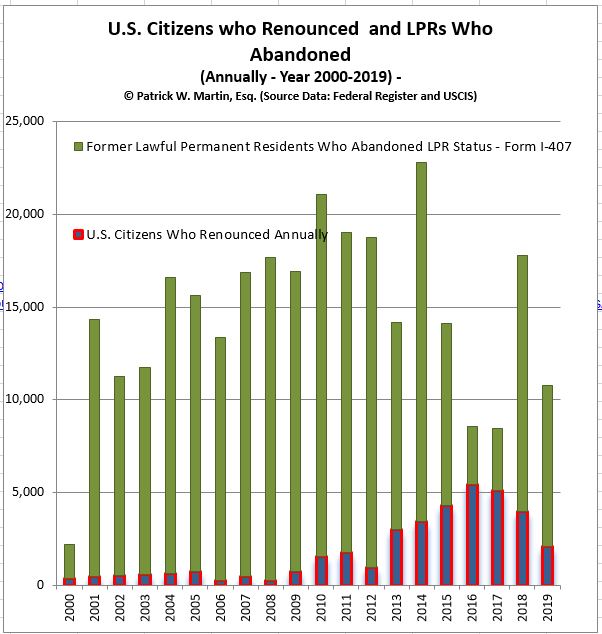
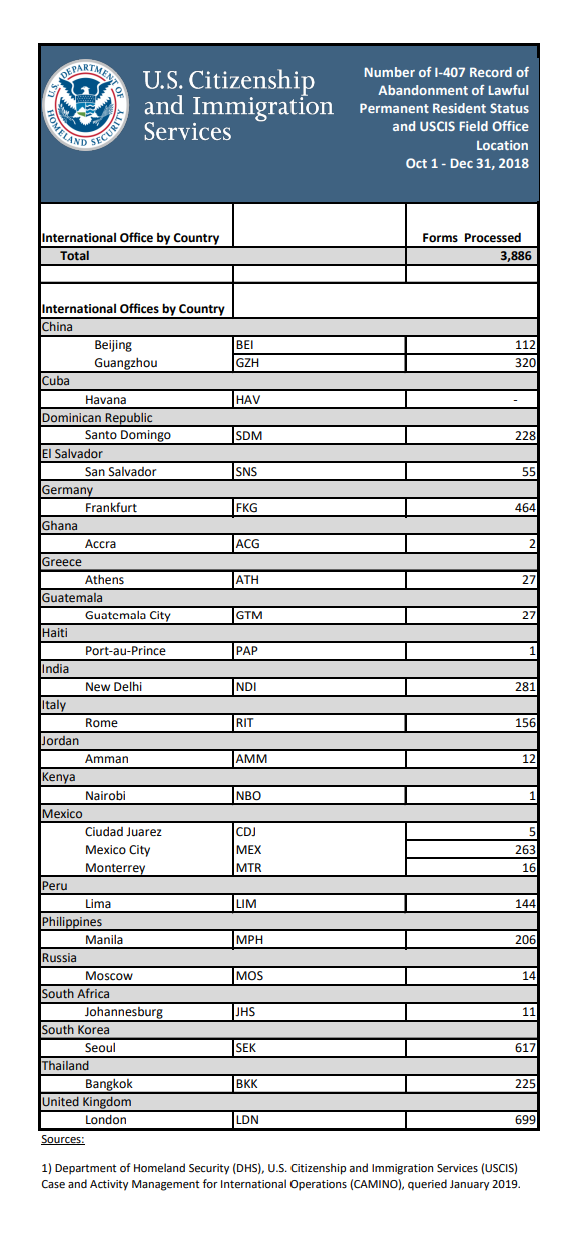
- There are far more LPRs who abandon their status (formally) than U.S. citizens who formally take the oath of renunciation. See the table above reflecting those who have formally renounced U.S. citizenship versus those who have formally abandoned their LPR status.
- Plenty of LPRs informally abandon their LPR status for immigration purposes by moving and living permanently outside the U.S.
- There are plenty of timing issues for LPRs surrounding how and when they have “abandoned” their LPR status for purposes of IRC Section 877 (e)(2). See –
Timing Issues for Lawful Permanent Residents (“LPR”) Who Never “Formally Abandoned” Their Green Card, Posted on August 15, 2015
* More Green Card Holders Abandon Status Than Citizens Renounce Citizenship
A frequently overlooked fact is that:
Formal Abandonment of LPR Status Is More Common Than Citizenship Renunciation
- Each year, substantially more lawful permanent residents formally abandon their green cards than U.S. citizens
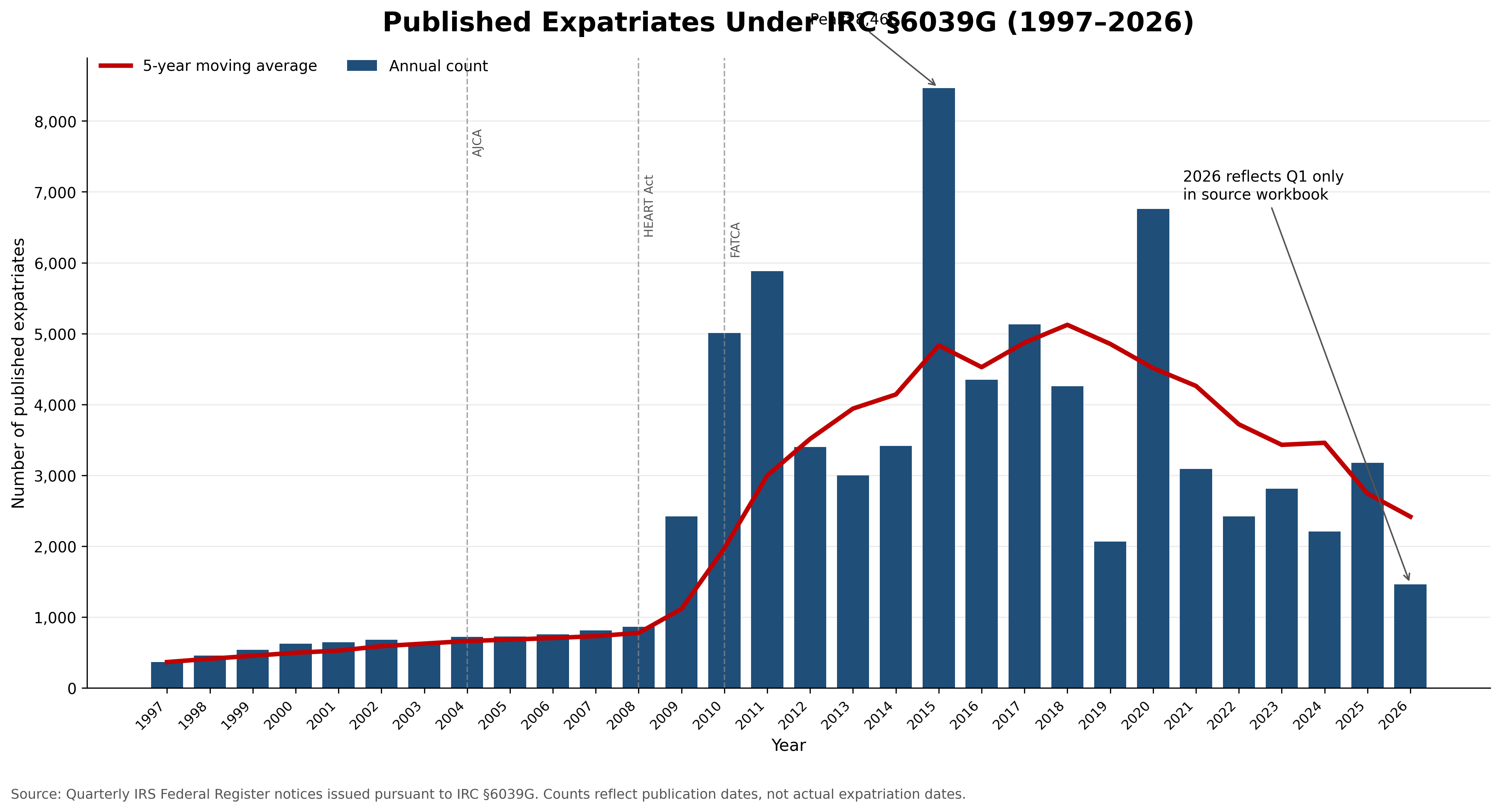
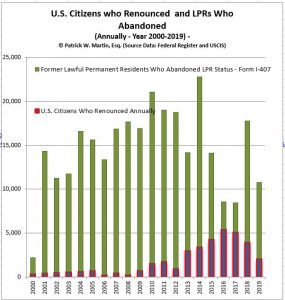 formally renounce citizenship. The focus in the press and media is typically U.S. citizens who formally renounce. Here is my most recently compiled graph, the total number of U.S. citizens renouncing is typically in the thousands (few) each year. It has trended downward post-COVID.
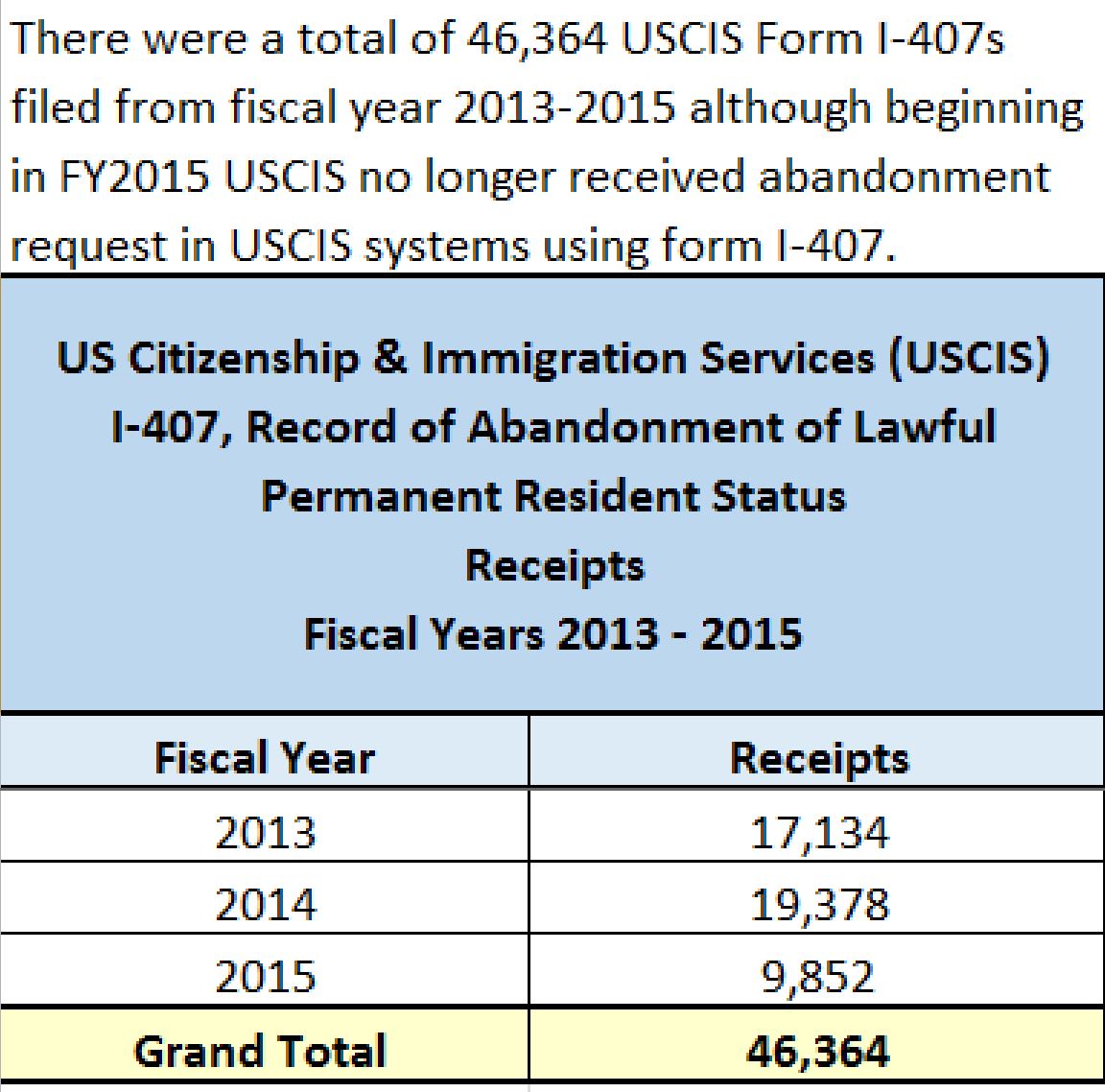
- However, with LPRs, formal recognition of abandonment by filing Form I-407 (not including informal abandonments which are multiple times greater) is multiple times greater.
- The graph I created several years ago, shows that formal LPR abandonments are mlutiple times greater than citizenship renunciation. I made a FOIA request with the government to request information about the number USCIS Forms I-407 that are filed with the government. See, also quarterly statistics of the USCIS – Form I-407, Record of Abandonment of Lawful Permanent Resident Status (partial information for years 2016-2019).
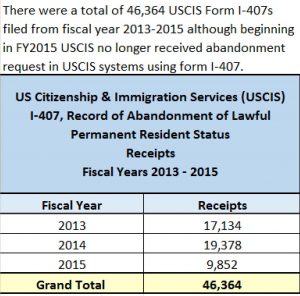
- I have made a new FOIA request for more recent records, since this data is no longer public after the year 2019 year.
- The statistics reflected above demonstrate that:
- Formal green card abandonment significantly exceeds formal citizenship renunciations.
- The population potentially affected by the expatriation rules is therefore much larger than many individuals around the world appreciate.
Lack of Control Over the Timing of Termination
One of the greatest risks for green card holders is that they often do not control the legal date on which their LPR status terminates, especially if they reside in a tax treaty country, per the analysis in the landmark case:
W hy This Matters
If abandonment is later determined by tax treaty law, effectively an CPB officer, the Executive Office for Immigration Review (EOIR) immigration court, the Board of Immigration Appeals (BIA)or a even a Federal District Court:
- The taxpayer may not control the effective date of termination – “expatriation”.
- If they are a “covered expatriate” or not.
- The tax consequences may arise unexpectedly.
- The timing can directly impact whether the tax expatriation rules apply and all of the potential consequences.
There are important unintended tax consequences that can befall individuals here: see, Oops…Did I “Expatriate” and Never Know It: Lawful Permanent Residents Beware! International Tax Journal, CCH Wolters Kluwer, Jan.-Feb. 2014, Vol. 40 Issue 1, p9).
-
-
Topsnik – Why Should I Care?
These timing issues become important when the IRS challenges tax positions taken on tax returns filed (or filed late) as was the case in Topsnik v. Commissioner (143 T.C. 240 (2014) – “Topsnik I”) and the subsequent case of Topsnik v. Commissioner (146 T.C. No. 1, 2016) – “Topsnik II”). In Topsnik II, Judge Kerrigan agreed with the IRS and ” . . . determined that P [taxpayer] was a “covered expatriate” who expatriated in 2010 and must recognize gain on the deemed sale of his installment obligation on the day before his expatriation under I.R.C. sec. 877A.” The U.S. Tax Court cited IRS Notice 2009-85 and explained it was not legally binding as follows:
We are not bound by Notice 2009-85, supra, see Compaq Computer Corp. v. Commissioner, 113 T.C. 363, 372 (1999), but it is an official statement of the Commissioner’s position and we may let it persuade us, see Nationalist Movement v. Commissioner, 102 T.C. 558, 583 (1994), aff’d, 37 F.3d 216 (5th Cir.1994).
The Tax Court went on to conclude these facts caused the court to conclude and uphold the IRS assessment of the “exit tax” on the German citizen Mr. Topsnik as a “covered expatriate” quoted as follows:
Notice 2009-85, sec. 8, 2009-45 I.R.B. at 611, explains that for purposes of certifying tax compliance for the five years before expatriation pursuant to section 877(a)(2)(C):
All U.S. citizens who relinquish their U.S. citizenship and all long-term residents who cease to be lawful permanent residents of the United States (within the meaning of section 7701(b)(6)) must file Form 8854 in order to certify, under penalties of perjury, that they have been in compliance with all federal tax laws during the five years preceding the year of expatriation. Individuals who fail to make such certification will be treated as covered expatriates within the meaning of section 877A(g) * * *
For the year of his expatriation petitioner failed to complete and file a Form 8854 certifying under penalties of perjury that he has complied with all of his U.S. Federal tax obligations for the five taxable years preceding the taxable year that includes his expatriation date. Respondent [IRS] has provided evidence that petitioner did not file all of his U.S. income tax returns before expatriatingand was not in payment compliance for taxes owed for the five years before expatriation in taxable year 2010. Thus petitioner could not have certified under penalties of perjury on a Form 8854 that he had been in tax compliance for the five years before expatriation. Consequently, because petitioner failed to certify tax compliance for the five years before expatriation, he is a “covered expatriate” as defined by section 877A(g)(1)(A).
Importantly, the court in Aroeste concluded IRS Form 8854 was not required to be filed (even though the DOJ attorney argued it was required – as set forth in the instructions to the form) as explained below:
C. Whether Aroeste Was Required to File Form 8854
The Government next argues that even if the IRS had accepted Aroeste’s amended
returns, neither amended return would have properly notified the IRS of a commencement
of treaty benefits because both failed to attach Form 8854, as required by IRS Notice 2009-
85.(Doc. No. 76-1 at 4–5.) The Government concedes Aroeste attached Form 8833 to both
amended forms. (Id.)
Aroeste responds that Notice 2009-85 is not binding authority as it fails to comply
with the Administrative Procedures Act (“APA”). (Doc. No. 78-1 at 8 (citing Green Valley
Investors, LLC v. Comm’r of Internal Revenue, 159 T.C. No. 5, at *4 (Nov. 9, 2022)) (under
the APA, agencies must follow a three-step procedure for “notice-and-comment”
rulemaking, but this requirement does not apply to “interpretive rules, general statements
of policy, or rules of agency organization, procedure, or practice.”).) The Court agrees. In
Mann Construction, Inc. v. United States, 27 F.4th 1138 (6th Cir. 2022), the court found
that Notice 2007-83 failed to comply with the APA’s notice-and-comment procedure.
Similarly here, because Notice 2009-85 has not been subject to a notice-and-comment
procedure, it does not comply with the APA and thus is not binding. As such, Aroeste was
not required to file Form 8854 with his amended returns.
Both the Green Valley Investors LLC case and Mann Construction were 2022 cases, some 6 years after Topsnik II.
My law firm, Chamberlain Hrdlicka, successfully represented the taxpayers in Green Valley and of course in Aroeste.