There have been multiple posts explaining the importance of the certification requirement of Section 877(a)(2)(C).
See for instance, Certification Requirement of Section 877(a)(2)(C) – (5 Years of Tax Compliance) and Important Timing Considerations per the Statute, also see Can the Certification Requirement of Section 877(a)(2)(C) be Satisfied “After the Fact”?
This specific act of “certifying” is a requirement under the law, that requires all individuals (whether U.S. citizens or LPRs) to satisfy the elements of the certification, in order to avoid “covered expatriate” status.
Also, there is an important exception to “covered expatriate” status set forth in IRC Section 877A(g)(1)(B). Only certain individuals may be able to satisfy this important requirement, which provides as follows:
(B) Exceptions
An individual shall not be treated as meeting the requirements of subparagraph (A) or (B) of section 877 (a)(2) if—
(i) the individual—
(I) became at birth a citizen of the United States and a citizen of another country and, as of the expatriation date, continues to be a citizen of, and is taxed as a resident of, such other country, and
(II) has been a resident of the United States (as defined in section 7701 (b)(1)(A)(ii)) for not more than 10 taxable years during the 15-taxable year period ending with the taxable year during which the expatriation date occurs, or . . .
***
Importantly, the elements of the statute apply only to persons who “became at birth a citizen of the United States”; and in the case of lawful permanent residents (LPRs), they be definition will not have become at birth a citizen of the United States.
***
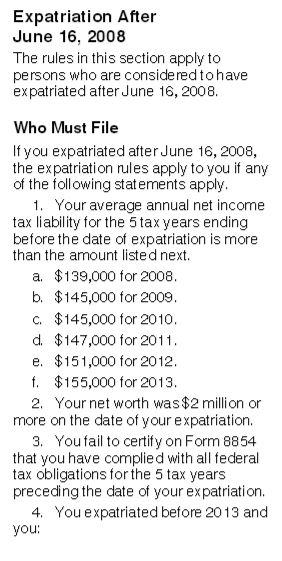
Accordingly, a “long term” LPR who meets either the US$2M asset test, or average income tax liability test (currently

US$157,000 for the year 2014), will necessarily become a “covered expatriate” even if they can satisfy the
Certification Requirement of Section 877(a)(2)(C).
**
**
**
Accordingly, it is important for each “long-term” LPR to understand clearly the current and future U.S. tax consequences to (i) them – the “mark-to market” tax, and (2) tax on “covered gifts” and “covered bequests” to U.S. persons. Importantly, understanding these consequences should be long before the LPR ceases to be a LPR for tax purposes; irrespective of the immigration law consequences.

 US$157,000 for the year 2014), will necessarily become a “covered expatriate” even if they can satisfy the Certification Requirement of Section 877(a)(2)(C).