Author: International Tax Advisor
Part II: U.S. Department of State has Allowed (Starting in at least 2013) USCs to Keep their U.S. Passports After Oath and Prior to Receiving CLN
See the first post on this topic: U.S. Department of State has Allowed (Starting in at least 2013) USCs to Keep their U.S. Passports After Oath and Prior to Receiving CLN, Posted on March 17, 2015
A U.S. citizen is required to have a U.S. passport to enter the U.S., according to the immigration law regulations 22 CFR § 53.1 require that a U.S. citizen have a U.S. passport to enter or depart the United States.  The relevant part of the regulations is § 53.1(a) which provides as follows:
Passport requirement; definitions.
The U.S. Department of State does not always provide any specific document, e.g., a certified copy of any of the following documents, after you take the oath of renunciation:
Form DS-4080, Oath of Renunciation of the Nationality of the United States.
Not having a U.S. passport can of course be problematic if the individual needs to travel in or out of the U.S. for a period of time after taking the oath, but before receiving the CLN. See, The Importance of a Certificate of Loss of Nationality (“CLN”) and FATCA – Foreign Account Tax Compliance Act, Posted on June 1, 2014
Fortunately, I have been told by several Chiefs of American Citizen Services in different U.S. Consulates and U.S. Embassies that they have been advised from Washington that they are NOT required to physically take the U.S. passport, until after the issuance of the CLN. This now seems to be consistent practice throughout the world, and most all Chiefs of American Citizen Services use this approach, based upon my personal experience with different clients.
Timing Issues for Lawful Permanent Residents (“LPR”) Who Never “Formally Abandoned” Their Green Card
The “tax expatriation” statutory provisions are fraught with ambiguity and incomplete answers for those individuals who have cases that span different time periods. This is because the law has been changed numerous times over the last several years and ad hoc concepts added, including the technical concept of “long-term residents” for the first time in 1996. As has been previously explained, the first “expatriation tax” law was not adopted until 1966 as part of the The Foreign Investors Tax Act of 1966 (“FITA”) – The Origin of U.S. Tax Expatriation Law (Posted on April 6, 2014).
Next, 1996 amendments kept the basic regime but added a number of key concepts, including “long-term residents”. The changes in the law in 2004 made significant changes and in 2008 the first “mark to market” regime was adopted. Each time, the concept of “long-term residents” was maintained, but without clear thought as to the meaning and timing of “expatriation” in various cases. See, Timeline Summary of Changes in Tax Expatriation Provisions Since 1996, (Posted on April 9, 2014)
Unfortunately, none of these amendments to the law over the years carefully incorporated transition and timing rules for cases where the individual has lived in (or had U.S. citizenship or LPR) during one more of these time periods:
- 1966-1996
- 1996-2004
- 2004-2008
- 2008-present
There are many inconsistent concepts among the law and one clear example is demonstrated by an individual who became a lawful permanent resident prior to 1996 and prior to amendments in the definition of a “resident alien” which was adopted generally in the federal tax in the law in 1984. This 1984 definition was not part of any specific “expatriation tax” provisions.
Remember, the technical definition of who is a “resident alien” is the basic definition of who is generally subject to U.S. income taxation on their worldwide income. See, Co-author. “Tax Simplification: The Need for Consistent Tax Treatment of All Individuals (Citizens, Lawful Permanent Residents and Non-Citizens Regardless of Immigration Status) Residing Overseas, Including the Repeal of U.S. Citizenship Based Taxation,” by Patrick W. Martin and Professor Reuven Avi-Yonah, September 2013.
Prior to 1984, a LPR was not necessarily an income tax resident of the U.S. This concept of LPR (i.e., a “green card”) driving U.S. income tax residency was adopted in 1984, long before Congress became obsessed with U.S. individual tax expatriation. For background in the law, see the 1985 Penn State Law Review Article – Internal Revenue Code 7701(b): A More Certain Definition of Resident
The Joint Committee on Taxation report on the 1984 changes in the tax law (“General explanation of the revenue provisions of the Deficit Reduction Act of 1984 : (H.R. 4170, 98th Congress; Public Law 98-369)“) addressing the tax residency test of “lawful permanent residency” rules provides the following language:
. . . The Act defines “lawful permanent resident” to mean an individual who has the status of having been lawfully accorded the privilege of residing permanently in the United States as an immigrant in accordance with the immigration laws, if such status has not been revoked or administratively or judicially determined to have been abandoned. Therefore, an alien who comes to the United States so infrequently that, on scrutiny, he or she is no longer legally entitled to permanent resident status, but who has not officially lost or abandoned that status, will be a resident for tax purposes. The purpose for this requirement of revocation or determination is to prevent aliens from attempting to retain an apparent right to enter or remain in the United States while attempting to avoid the tax responsibility that accompanies that right.
The logic of the LPR test is clear based upon this explanation. If one has the right to live in the U.S., they cannot avoid the tax responsibility that accompanies that right. However, as immigration lawyers will explain, there is no right to enter the U.S. after you have abandoned your LPR status and moved outside the U.S. on a permanent basis.
At the same time, there is other discussion in the report that would support the position that these provisions only apply for the years 1985 and thereafter (long after many individuals obtained LPR status, but who moved out of the country – e.g., in cases where individuals obtained LPR in the 1970s and left before 1985). Specifically, the explanation in the Joint Committee of Taxation is as follows:
. . . The purpose of this effective date rule is to delay tax resident status for only new green cardholders for a short time. Congress understood further that an alien may acquire lawful permanent resident status for immigration purposes before U.S. presence. Congress sought to impose tax resident status on all lawful permanent residents once they arrive in the United States. The Act does not affect the determination of residence, even for green card holders, for taxable years beginning before January 1, 1985.
Of course, the report by the Joint Committee on Taxation (“JCT”) is not the law and does not bind the IRS or the taxpayer. However, the JCT usually get their explanations of the law right.
Why is all of this important for LPRs who never formally abandoned their “green card”? The IRS might well try to argue they never terminated their U.S. federal income tax residency for purposes of the “tax expatriation provisions”, as later versions of the statute impose an obligation to notify the IRS. If the individual never notified the IRS, the government might ar
See, for instance Section 7701(b)(6) with specific rules for LPR individuals who live in a country with a U.S. income tax treaty. Importantly, the definition of a lawful permanent resident for tax purposes (as defined in Section 7701(b) ) is not identical to the definition for immigration law purposes as the legislative history to the 1984 amendments to the law explains.
See, Oops…Did I “Expatriate” and Never Know It: Lawful Permanent Residents Beware! International Tax Journal, CCH Wolters Kluwer, Jan.-Feb. 2014, Vol. 40 Issue 1, p9.
Finally, the information required as part of the process of formal abandonment is much more extensive than in the past.
A prior post discussed the published USCIS immigration form I-407 for LPRs who must now use it when formally abandoning LPR status. See, More Information and More Information: USCIS Creates New Form for Abandonment of Lawful Permanent Residency
See, new I-407 Form requires that much more information and is 2 pages in length.
Will 2015 Be a Record Year for Citizenship Renunciations?
The First Quarter of 2015 saw a large number of published names of former U.S. citizens: 1,335 total for the first quarter.
In addition, the second quarter saw a total of 460, for a  cumulative total for the year (mid way through the year of 1,795). At this pace, the year 2015 could be a slight record of U.S. citizenship renunciations compared to the record year of 2014.
See, New Record of U.S. Citizens Renouncing – The New Normal
The names of each citizen can be located in the list published in the Federal Register.
There are a number of key considerations and strategic decisions that most all U.S. citizens need to consider prior to renouncing citizenship. See, for instance –
The “Hidden Tax” of Expatriation – Section 2801 and its “Forever Taint.”
Can the U.S. Federal Government Bar Entry into the U.S. to a U.S. Citizen without a U.S. Passport?
Global Entry, SENTRI and NEXUS after Renouncing – the “Trusted Traveler Programs” – SAFE TRAVELS!
Coming Back to the U.S. as a Permanent Resident (“Repatriating”)?
As discussed in the last post, this post addresses immigration law exclusively by a guest post writer, Ms. Teodora Purcell. She provides a good overview of EB-5 visas and the current law and likely changes in the near future.
***************************
The Pros and Cons of the EB-5 Immigrant Investor Program
The EB-5 Immigrant Investor program was created by the Immigration and Nationality Act (“INA”) of 1990 to stimulate the US economy through capital investments made by foreign investors to create jobs. It attracts capital by facilitating US permanent resident status (aka “green card”) for foreigners who make a $1 million USD (or in some cases, $500,000 USD) investment in an eligible business that results in at least ten US jobs and benefits the US economy.[1]
The pros of the EB-5 program to the US are evident from the numbers. In FY 2014, 10,928 EB-5 petitions were filed with the United States Citizenship and Immigration Services (“USCIS”), 5,115 approved, and 12,453 pending, which translates into over $2.5 billion approved for investment and an additional $6.2 billion in capital awaiting federal adjudication, and the creation of thousands of US jobs.[2] EB-5 capital is also an attractive low cost funding tool for project developers in the US, while it offers the foreign investor a path to permanent residency that is not visa backlogged and does not require sponsorship by a US employer or relative. But is the EB-5 an easy and quick way “to purchase your green card”?
Basic EB-5 Requirements
The EB-5 program includes two separate avenues: (1) Direct EB-5 investment – where the investor invests in an enterprise and plays a role in management or policy making, which will directly create ten jobs, or (2) Regional Center based EB-5 investment – where the investor invests in a USCIS approved regional center and plays a more passive role by having policy making authority. Both require: (1) the investment to be made in a for-profit, new commercial enterprise;[3] (2) a contribution of capital at risk in the amount of $1,000,000 USD, or $500,000 USD[4] if the business is in a targeted employment area (i.e. high unemployment or rural area), aka “TEA”;[5] (3) the investment to be used for creation of at least ten full time jobs for US workers;[6] and (4) the investor to establish the path and the lawful source of the investment.
Pros and Cons of Direct and Regional Center EB-5 Investments
The Regional Center (“RC”) is an entity designated and regulated by USCIS, which pools EB-5 capital from multiple foreign investors in job-creating economic development projects within a defined geographic region and designated industries.[7] USCIS has approved approximately 600 RCs[8] and 95% of the EB-5 petitions are based on a RC investment. Notably, EB-5 RC investment funds are subject to U.S. securities and anti-fraud laws and regulations,[9] and the Securities Exchange Commission (SEC) and USCIS are raising awareness of how the EB-5 program can be misused and of the importance of proper due diligence to be conducted by foreign investors.[10]
The direct EB-5 program is permanent, whereas the RC EB-5 program sunsets on September 30, 2015, but is expected to be reauthorized by Congress for another five years, and there is proposed legislation to make it permanent.[11] The most recent bipartisan bill on the RC EB-5 program, The American Job Creation and Investment Promotion Reform Act, was introduced on June 3, 2015, known as The Leahy-Grassley Bill.[12] The proposed legislation would reauthorize the EB-5 RC program until September 30, 2020, rather than make it permanent, and will provide an overhaul of reforms to improve the program’s integrity, including raise the requirement investment amount to $800,000/ $1,200,000, respectfully.[13]
With the direct EB-5 investment, the foreign national accomplishes not only an immigration purpose but also a purpose of investing in a business that he or she runs and that may provide significant return, whereas with the RC EB-5 investment, the rate of return is typically 0.5-2% and the investor plays a more passive role. However, the direct EB-5 investor must prove direct employment of ten U.S. workers, whereas, with RC EB-5 investment, the job creation is shown by a combination of direct, indirect and induced employment using reasonable economic methodologies. Most (but not all) RCs are located in $500,000 TEAs but there can be direct EB-5 investments that also qualify for the reduced capital. Both EB-5 options require the investor to be engaged in the “management” of the enterprise, which can be satisfied if the investor is a limited partner with the rights, powers and duties normally granted to limited partners under the Uniform Limited Partnership Act.[14] Which EB-5 option to choose requires an individualized analysis of the investor’s circumstances and goals.
No Fast Track EB-5 Process and No Guaranteed US Permanent Residence
The EB-5 investors are not guaranteed a green card because of the lengthy process and possibility that the project in which they invest could fail or undergo material changes, and there is no expedite processing of EB-5 petitions. The process starts with the filing of an I-526 immigrant entrepreneur petition with USCIS, in which the investor must establish the lawful source of funds, document the path of the required investment, and show that the ten US jobs will be created within two years,[15] or that the jobs have already been created as a result of the investment.
The filing of an I-526 petition alone does not give the investor the right to stay or work in the US. Current I-526 average processing time is approximately 14 months and the I-526 approval does not give the investor permanent residence. Rather, after the approval, if the investor is outside the US, he or she and dependent family members will apply for their immigrant visas at the US Consulate in their home country, which requires additional documentation, security checks and adds another 6-12 months to the process. If the investor is in the US in valid nonimmigrant status, he or she will adjust status to permanent resident in the US, which takes about six months.[16] So after 2-3 years (provided no visa retrogression), the investor receives a green card that is conditional and valid for only two years.
Within 90 days of the conditional green card expiration (i.e. between the 21 to 24 month after the green card approval), the investor must file an I-829 application to remove the condition on permanent residence with USCIS[17], and prove that the investment has been sustained and that the requisite jobs have been created or will be created within a “reasonable time.”[18] The current average I-829 processing time is 10 months and if unsuccessful, the EB-5 investor may not only lose the green card but end up in removal proceedings. If the I-829 is approved, the EB-5 investor receives his or her permanent green card. During this process, the EB-5 investment must remain in the enterprise until the condition is removed (i.e. for 4-5 years), whereas in all other employment based green card categories, the result is a permanent green card and no such significant financial commitment is required.
The EB-5 program accounts for less than 1% of the immigrant visas issued annually by the US and throughout the process, investors are subject to the same background checks as applicants in any other visa category, and their ability to eventually apply for citizenship is the same as others. The INA allocates 10,000 EB-5 immigrant visas, of which 3,000 are reserved for the RC program, and no more than 7 percent of the visas can be allocated to any one country.[19] Since close to 85% of the investors are from China, for the first time in September 2014, the EB-5 visas became unavailable for Chinese nationals, and EB-5 visa backlog for Chinese investors may be expected in 2015. There are more significant immigrant visa quota backlogs in other categories of family and employment-based immigration, which is why the EB-5 still remains attractive.
EB-5 and Other Green Card Options
Despite the challenges investors may face in tracing the invested funds or in the job creation, and the possibility of visa backlog for some, the EB-5 is still a good option, although it is not the panacea for all foreign nationals seeking permanent residence in the US. There are other employment based visa options that may be available for the investor and these alternatives, if successful, lead to a permanent green card, do not require placement of a $1,000,000 investment at risk, and there are minimal concerns about visa availability. For the foreign nationals who choose the EB-5 green card avenue, it is important to put together a competent team that includes an immigration counsel, as well as business, tax, and securities counsels, to advise on the multiple complex issues that go into determining whether the EB5 green card path is the right choice for the client.
Immigrant investors and entrepreneurs bring substantial value to the United States, not only through the capital they deploy or the jobs they create, but also with the knowledge and experience they bring to US businesses, and working with such clients is very rewarding.
[1] The immigration EB-5 laws can be found at INA§203(b)(5); 8 CFR§204.6 and 8 CFR§216.6.
[2] https://iiusa.org/blog/government-affairs/uscis-government-affairs/citizenship-immigration-services-uscis-adjudication-data-i526-i829-petitions-reveal-unprecedented-growth-eb5-program-fiscal-year-2014/ /
[3] 8 CFR §§204.6(e) & (h).
[4] There is a proposed legislation to increase the investment amount to $1,200,000 USD and $800,000 USD, respectively. See S.1501, The American Job Creation and Investment Promotion Reform Act, available at https://www.congress.gov/bill/114th-congress/senate-bill/1501/text
[5] 8 CFR §§204.6(e) & (f)(2).
[6] 8 CFR §§204.6(e) & (j)(4). The USCIS deems the two year period to commence six months after the adjudication of the I-526 petition. See USCIS Policy Memorandum (May 30, 2013)
[7] 8 CFR §204.6(e).
[8] http://www.uscis.gov/working-united-states/permanent-workers/employment-based-immigration-fifth-preference-eb-5/immigrant-investor-regional-centers
[9] The interest being offered and sold in an EB-5 offering by regional centers constitute securities. See Securities Act of 1933; Securities Exchange Act of 1934.).
[10] For more information, see http://www.sec.gov/investor/alerts/ia_immigrant.htm
[11] S.744, H.R. 2131, H.$. 4178, and H.R. 4659 in the 113th Congress
[12] S.1501, The American Job Creation and Investment Promotion Reform Act, available at https://www.congress.gov/bill/114th-congress/senate-bill/1501/text. Also see http://www.leahy.senate.gov/imo/media/doc/The%20American%20Job%20Creation%20and%20Investment%20Promotion%20Reform%20Act.pdf
[13]If implemented, the Leahy-Grassley legislation will have a significant impact on Regional Centers and investors alike, some of the most notable changes proposed to the EB-5 Program include: (1) Raise the minimum investment amount for all EB-5 investors to $800,000 for TEAs and $1,200,000, respectively; (2) Establish an “EB-5 Integrity Fund” to cover the costs associated with audits and site visits to detect fraud in the United States and abroad; (3) Increased oversight of TEA designation; (4) Expanded USCIS authority to terminate Regional Center designation; (5) Establish a premium processing option to expedite USCIS adjudication of EB-5 petitions at an additional filing fee.
[14] 8 CFR §204.6(j)(5).
[15] The USCIS requires that the I-526 petition be accompanied by a detailed and credible business plan compliant with the requirements in the precedent decision of Matter of Ho, 22 I&N Dec. 206 (INS Assoc. Comm’r, Examinations, 1998).
[16] https://egov.uscis.gov/cris/processingTimesDisplay.do;jsessionid=dbcqHwZ-eEZPOcoHaz5Ru.
[17] 8 CFR §216.6
[18] 8 CFR §216.6(a)(4)(iv) . In its May 30, 2013 Policy Memorandum, USCIS has interpreted “reasonable time” to mean one year, starting at the end of the conditional residence period.
[19] INA §203(a) ; INA §204(1) & INA§202(a)(2).
Teodora Purcell | Attorney at Law
FRAGOMAN
11238 El Camino Real, Suite 100, San Diego, CA 92130, USA
Direct: +1 (858) 793-1600 ext. 52424 | Fax: +1 (858) 793-1600
TPurcell@Fragomen.com
“Expatriation” Implies Leaving the U.S., But Many More Want to Come to the U.S.: Tax Consequences
U.S. citizens and long-term residents who are considering renouncing their citizenship or abandoning their lawful permanent residency (“LPR”) are increasingly undertaking more sophisticated life and tax planning before “taking the plunge”!
Many (in my experience – all) of these “expatriates” eventually want to be able to visit the U.S. and in some cases possibly come back to live permanently. Many simply apply for and obtain a B1/B2 visa.
To appreciate how many more persons want to immigrate to the U.S. compared to emmigrate from it, see an earlier post: The Number of Citizens Leaving (Renouncing) Versus Coming (Naturalizing) is Just a Speck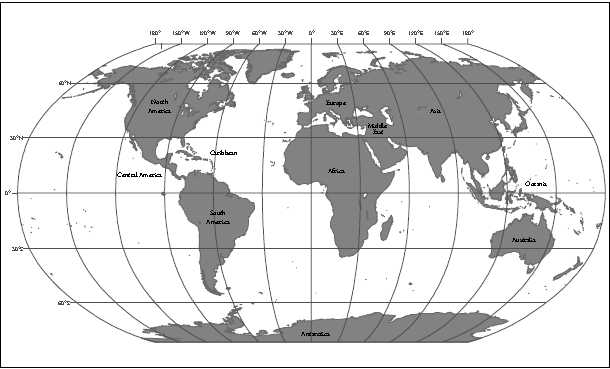
This is the other “side of the coin” so to speak, since individuals contemplating coming to the U.S. often should undertake pre-immigration tax planning. One means for non-U.S. citizens to become LPRs and eventually U.S. citizens, is through the EB-5 visa program.
Immigration attorney Ms. Teodora Purcell has written prior guest posts, including: When is the loss of US nationality effective? [Guest Post from Immigration Lawyer]
The next post on this site will be a complete article by Ms. Teodora Purcell explaining in more detail the EB-5 visa program and recent developments.
As to the tax implications of immigration to the U.S. (as opposed to emigration from it), I wrote the tax chapter in the latest edition of the American Immigration Lawyers Association (“AILA’s) treatise – Immigration Options for Investors & Entrepreneurs US$199.
That treatise is heavily focused on “EB-5 investors” and the tax discussion is titled: Key U.S. Tax Considerations for EB-5 (& Other) Visa Applicants.
Ms. Teodora Purcell’s contact information is set out below:
Teodora Purcell | Attorney at Law
FRAGOMAN
11238 El Camino Real, Suite 100, San Diego, CA 92130, USA
Direct: +1 (858) 793-1600 ext. 52424 | Fax: +1 (858) 793-1600
TPurcell@Fragomen.com
The Intersection of U.S. Federal Tax Law with Collection of International Information – Including other Federal Agencies
For decades, the IRS largely worked in a vacuum, relative to other government agencies.
Changes started in earnest in 2003 after September 11, 2001, when Congress past various anti-terrorism laws. For details of the history and how and when the IRS became responsible for these functions, the IRS Internal  Revenue Manual has a detailed explanation – Part 4, Chapter 26, Section 5. Bank Secrecy Act History and Law
In April 2003, the IRS became in charge of civil enforcement of foreign account information under Title 31. See IRM, Part 4, Chapter 26, Section 16. Report of Foreign Bank and Financial Accounts (FBAR).
The world has changed dramatically in these past few years and the IRS no longer works in such a vacuum. For a history of foreign bank and Congressional influences, see, How Congressional Hearings (Particularly In the Senate) Drive IRS and Justice Department Behavior
Today there are a host of governmental inter-agency activities along with foreign government exchanges of information; e.g., DHS, Department of State, ICE, USCIS, foreign government exchanges of information under FATCA IGAs, a plethora of federal “intelligence agencies” for “terrorism related requests” as identified in IRM pursuant to IRC Section 6103(i), foreign governments under tax treaty exchanges, among many others.
The law is not even clear as to which agencies qualify as “intelligence agencies” as they are not identified in the statute and many are presumably classified organizations.
- Who is an “intelligence agency” for purposes of the statute?
The following is a list of some of the intelligence agencies that are presumably included in the federal tax statute Section 6103(i)(7):
National |
|
| United States Intelligence Community Director of National Intelligence National Intelligence Council [NIC] National Counterterrorism Center (NCTC) National Counterintelligence Executive [NCIX] |
Official Official Official Official Official |
| Central Intelligence Agency | Official |
| National Security Agency | Official |
| National Reconnaissance Office | Official |
| National Geospatial-Intelligence Agency | Official |
| Defense Intelligence Agency | Official |
| Federal Bureau of Investigation | Official |
| Department of Homeland Security Office of Intelligence and Analysis | Official |
Other Defense Department |
|
| Assistant to the Secretary for Intelligence Oversight | Official |
| Under Secretary of Defense for Intelligence Under Secretary of Defense for Policy |
Official Official |
| Assistant Secretary of Defense for Networks and Information Integration | Official |
| Defense Information Systems Agency | Official |
| Defense Advanced Research Projects Agency | Official |
| Defense Protective Service | Official |
| Defense Security Service | Official |
| US Special Operations Command | Official |
| Army Army Deputy Chief of Staff for Intelligence Intelligence and Security Command |
Official Official Official |
| Navy Office of Naval Intelligence Naval Security Group Command Naval Criminal Investigative Service |
Official Official Official Official |
| Marine Corps | Official |
| Air Force Air Force Technical Applications Center Air Intelligence Agency |
Official Official Official |
Other Federal Agencies |
|
| National Security Council President’s Foreign Intelligence Advisory Board Office of National Drug Control Policy |
Official Official Official |
| Energy Department Office of Intelligence |
Official Official |
| Justice Department Justice Intelligence Coordinating Council OIG – Office of the Inspector General DEA – Drug Enforcement Administration NDIC – National Drug Intelligence Center USNCB – U.S. National Central Bureau |
Official Official Official Official Official Official Official |
| State Department INR – Bureau of Intelligence & Research INL – Bureau for International Narcotics and Law Enforcement Affairs CT – Counterterrorism Office DS – Bureau of Diplomatic Security |
Official Official Official Official Official |
| Treasury Department Office of Intelligence Support Office of the Under Secretary (Enforcement) FINCEN – Financial Crimes Enforcement FLETC – Federal Law Enforcement Training Center |
Official Official Official Official Official |
| National Archives and Records Administration Information Security Oversight Office |
Official Official |
A less secret organization is the Social Security Administration which now increasingly intersect with the work of
the IRS. Also, the Department of State now provides warnings on its Passport applications about tax consequences and requirements of social security numbers (“SSN”s).
See also how in an Application for a U.S. Passport there are now specifically references IRC Section 6039E.
Finally, see also how on the last page (page 28) of currently issued U.S. Passport (“Book“) and paragraph D that explains generally the taxation obligations of citizenship.
–
Important Correction: Passports Required to Enter and Leave U.S. – but SSNs May be Optional

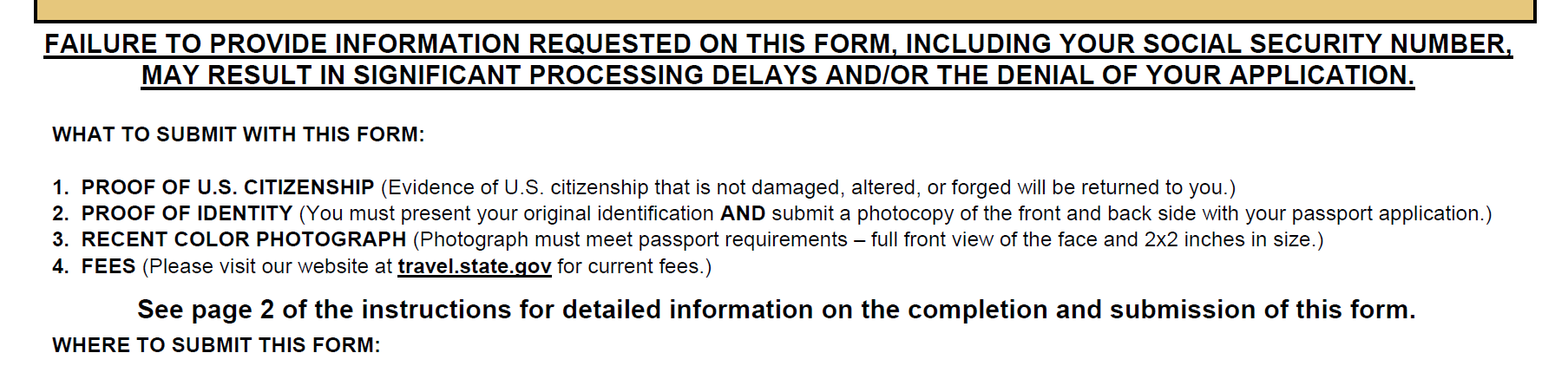




 The prior post noted that both a social security number (“SSN”) and a U.S. passport is required to enter the U.S. for U.S. citizens (“USCs”).
Please note that the current application for passports include the following language and provisions throughout the application (which have been partially reproduced below):
International tax lawyer, Roy Berg at Moody’s in Calgary, Alberta, Canada brought my attention to several key issues regarding this assertion:
- Senate Finance Chairman Hatch’s amendment to the trade bill that recently passed the Senate with a favorable vote of 79:21, S.1269 – Trade Facilitation and Trade Enforcement Act of 2015 provides the following:
(e) Revocation Or Denial Of Passport In Case Of Individual Without Social Security Account Number.—
(1) DENIAL.—
(A) IN GENERAL.—Except as provided under subparagraph (B), upon receiving an application for a passport from an individual that either—
(i) does not include the social security account number issued to that individual, or
(ii) includes an incorrect or invalid social security number willfully, intentionally, negligently, or recklessly provided by such individual, the Secretary of State is authorized to deny such application and is authorized to not issue a passport to the individual.
(B) EMERGENCY AND HUMANITARIAN SITUATIONS.—Notwithstanding subparagraph (A), the Secretary of State may issue a passport, in emergency circumstances or for humanitarian reasons, to an individual described in subparagraph (A).
(2) REVOCATION.—
(A) IN GENERAL.—The Secretary of State may revoke a passport previously issued to any individual described in paragraph (1)(A).
(B) LIMITATION FOR RETURN TO UNITED STATES.—If the Secretary of State decides to revoke a passport under subparagraph (A), the Secretary of State, before revocation, may—
(i) limit a previously issued passport only for return travel to the United States; or
(ii) issue a limited passport that only permits return travel to the United States.
(f) Effective Date.—The provisions of, and amendments made by, this section shall take effect on January 1, 2016.
Finally, Mr. Berg also noted that there is a procedure for USCs without SSNs, at least currently, to apply for U.S. passports; albeit subject to the US$500 money penalty described above. See, proposed Form 13997 by the U.S. Treasury Department and the comments:
The purpose of this form,and the necessity to collect information, is to obtain a valid SSN, TIN, a written statement of reasonable cause, or an explanation from the individual as to why they don’t have a SSN or TIN.
USCs without a Social Security Number (and a Passport) Cannot Travel to the U.S.
Recent posts have focused on the dilemma facing U.S. citizens (USCs) who have no social security number (“SSN”). See an older post (23 July 2014) – Why do I have to get a Social Security Number to file a U.S. income tax return (USCs)?
These problems are quickly coming to the surface, now that financial institutions (“FFIs”) around the world and private companies and trusts (e.g., non-financial foreign entities -NFFEs) must have their owners and clients certify they are not U.S. citizens; OR report the accounts of such U.S. citizens to the IRS under FATCA and the intergovernmental agreements (“IGAs”).
The intricacies of this problem are highlighted in a technical paper I recently drafted and presented to the U.S. Treasury Department and the Joint Committee of Taxation, among other federal government groups. Some key excerpts of that paper titled URGENT NEED FOR U.S. CITIZENS RESIDING OUTSIDE THE U.S. TO BE ABLE TO OBTAIN A TAXPAYER IDENTIFICATION NUMBER (“TIN”) OTHER THAN A SOCIAL SECURITY NUMBER are set out below in this section:
The U.S. tax law imposing taxation on the worldwide income of USCs[1] residing overseas has created a dilemma that prejudices these USCs without a SSN. This strict SSN/TIN regulatory rule undermines the basic tax administration system and discourages tax compliance for those USCs who never obtained a SSN. This dilemma affects numerous USCs throughout the world, which is now compounded by the certification and reporting requirements of USCs and third parties, such as FFIs and NFFEs[ under the Foreign Account Tax Compliance Act (“FATCA”).
In short, USCs without a SSN, necessarily cannot be in compliance with U.S. federal tax law. As I point out in my paper, such –
“A law that cannot be complied with is surely a bad law, the same as a “ . . .law that cannot be enforced is a bad law.”[a]
[a] See, The Case Against Taxing Citizens, Reuven S. Avi-Yonah (March 31, 2010), University of Michigan School of Law, Law & Economics Working Papers.
The paper referenced above explains how difficult it is for USCs residing overseas to ever obtain a SSN. Specifically, it explains how difficult it is to have an in-person interview at only 18 different locations around the world with a U.S. Department of State employee. See, 12 Year Old (and Older) U.S. Citizens Residing Outside the U.S. Must Have An “In-Person” Interview in a U.S. Embassy or Consulate for SSN Application in 1 of Just 17 Posts Worldwide
As a USC residing somewhere around the world, you might decide to simply spend the time, money and resources to travel internationally to arrive in the U.S. to apply for a SSN directly with the Social Security Administration within the U.S. Unfortunately, any USC is now legally prohibited from traveling in or out of the U.S. without a U.S. passport. There are few exceptions to this general rule, none of which contemplate U.S. federal tax compliance. See, the relevant excerpts from the white paper:
C. Travel to the U.S. is Also Not An Option for a USC without a SSN, Due to 22 CFR § 53.1 Requiring a U.S. Passport
A possible solution to this TIN/SSN dilemma may appear to be a trip to the U.S. by the USC to apply for a SSN in the U.S. Unfortunately, this simply creates another dilemma, since the USC must have a U.S. passport to travel to the U.S. The immigration law regulations 22 CFR § 53.1 require that a U.S. citizen have a U.S. passport to enter or depart the United States. The relevant part of the regulations is § 53.1(a) which provides as follows:
Passport requirement; definitions.
(a) It is unlawful for a citizen of the United States, unless excepted under 22 CFR 53.2,[2] to enter or depart, or attempt to enter or depart, the United States, without a valid U.S. passport.
These regulations were first published in 2006 and unfortunately, simply create another dilemma for the USC residing overseas without a SSN. This additional dilemma is that an application[3] for a U.S. passport requires the individual have a SSN; a vicious circle back to the inability to obtain a SSN.
At the end of the day, the restrictions imposed on USCs make it legally impossible for a USC without a passport to travel to the U.S. (even if they wish they could) to obtain a SSN.
[1] See, IRC § 61 and Treas. Reg. §§ 1.1?1(b) and 1.1?1(a)(1)..
[2] The exceptions set forth in this regulation would not generally be applicable in the case of USCs residing overseas without a SSN.
[3] Application for a U.S. Passport – http://www.state.gov/documents/organization/212239.pdf.
12 Year Old (and Older) U.S. Citizens Residing Outside the U.S. Must Have An “In-Person” Interview in a U.S. Embassy or Consulate for SSN Application in 1 of Just 17 Posts Worldwide
As previous posts have mentioned, U.S. citizens (USCs) residing overseas can only comply with U.S. tax law and FATCA certifications if they have a social security number (SSN). See, U.S. Citizens Overseas who Wish to Renounce without a Social Security Number will Necessarily be a “Covered Expatriate”
See key excerpts of the paper titled URGENT NEED FOR U.S. CITIZENS RESIDING OUTSIDE THE U.S. TO BE ABLE TO OBTAIN A TAXPAYER IDENTIFICATION NUMBER (“TIN”) OTHER THAN A SOCIAL SECURITY NUMBER that explains this dilemma:
This dilemma affects numerous USCs throughout the world, which is now compounded by the certification and reporting requirements of USCs and third parties, such as FFIs and NFFEs[2] under the Foreign Account Tax Compliance Act (“FATCA”).
* * *
The regulations provide the specific rule that all USCs must have a SSN[1] as their TIN. There are no general exceptions in the regulations to the requirement that a USC must have a SSN as their TIN.
This regulatory requirement specifically directs the USC to the forms that must be completed and filed with the SSA, in order to obtain a SSN, as follows:[2]
(1) Social security number. Any individual required to furnish a social security number pursuant to paragraph (b) of this section shall apply for one, if he has not done so previously, on Form SS-5, which may be obtained from any Social Security Administration or Internal Revenue Service office. He shall make such application far enough in advance of the first required use of such number to permit issuance of the number in time for compliance with such requirement. The form, together with any supplementary statement, shall be prepared and filed in accordance with the form, instructions, and regulations applicable thereto, and shall set forth fully and clearly the data therein called for. Individuals who are ineligible for or do not wish to participate in the benefits of the social security program shall nevertheless obtain a social security number if they are required to furnish such a number pursuant to paragraph (b) of this section. [emphasis added]
These Title 26 regulations discuss individuals requesting forms from “any Social Security Administration or Internal Revenue Service office” which clearly implies that the SSA and the IRS have offices overseas.
Unfortunately, this is not the case, as the IRS recently announced it is closing its full-time walk-in offices in London, Frankfurt and Paris, as the office in Beijing, China was closed in 2014.[3] Similarly, the SSA has no overseas offices, but does have limited field office operations in Canada, the British Virgin Islands and Samoa.[4]
Therefore, it is clear that the above regulations are speaking to individuals who reside and live in the U.S., and not USCs residing overseas when it requires USCs to “ . . . make such application far enough in advance of the first required use of such number to permit issuance of the number in time for compliance with such requirement. [5]
These Title 26 regulations require the application be made well in advance of any tax filing requirements are not realistic for USCs residing overseas as is explained herein. This author has seen the issuance of SSNs take more than 6 months, even when the USC could have an interview in their country of residence.
More importantly, there are very few countries (only 17) where in-person interviews can even be held. See, discussion below.
USCs who have lived most, if not all of their lives outside the U.S., commonly do not have a SSN. The procedural requirements imposed by the SSA to obtain a SSN in these cases are complicated and unrealistic for USCs living overseas.[6] This author has seen cases where USCs residing overseas have even spent the money and resources and time to travel to the U.S. to apply for a SSN, yet were turned away by the SSA, due to various procedural requirements which were not satisfied.
Often times obtaining a SSN overseas is nearly impossible, depending upon which country and where within that country the USC resides.
A. Obtaining a SSN Outside the US by a USC – Much More than Just Filing SSA Form SS-5
The SSA does not have offices outside the U.S. although they have a so-called “Office of International Operations.”[7] The focus of OIO is the administration of social security benefits, not obtaining SSNs for USCs residing overseas. Since the SSA is assisted by the U.S. Department of State (who are not SSN experts), USCs have to rely upon various U.S. embassies and consulate offices around the world, as they try to obtain a SSN.
B. Tax Return Filing Requirements – Minimum Gross Income
Any USC individual is obligated under the U.S. federal tax law to file a federal income tax return IRS Form 1040 if they meet minimum thresholds of income. For the tax year 2015, the thresholds are low, and are reached once the gross income is at least the sum of (i) the “exemption” amount (currently $4,000) and (ii) the “standard deduction” amount (currently $6,300 for single and married filing jointly and $12,600 for married couples filing jointly).[8]
This is true, even if all of the income is earned income and eligible for the foreign earned income exclusion, which is $100,800 for the tax year 2015. [9]
Additionally, USCs living overseas necessarily have a U.S. tax return filing requirement, when they meet these low thresholds of gross income. In these cases, tax returns that are not filed by the 15th of June are not considered timely filed.[10]
II. The Social Security Administration Rules Make it Nearly Impossible for Many USCs Overseas to Reasonably Obtain a SSN
The policy and procedures of the SSA regarding issuing SSNs have changed significantly over the years.[11] The Social Security Administration (SSA) provides a detailed chronology of the major changes in policy and procedures regarding filing for and obtaining a SSN.[12] One of the most significant revisions in the last decade came from The Intelligence Reform and Terrorism Prevention Act of 2004 (P.L. 108-458), which imposes various standards for the verification of documents or records submitted by an individual.
A. Only a Few Countries Around the World have Personnel at U.S. Embassies or Consulate Offices that Can Process SSN Applications – SSA Form SS-5-FS
Applying for SSNs overseas is severely restricted compared to an application in the U.S.
According to the U.S. Department of State, Foreign Affairs Manual (“FAM”), only certain “Claims-Taking Posts” in specific countries “may” include “processing applications for Social Security Numbers.” [13]
These 17 countries (and a city in the case of Jerusalem) with Claims-Taking Posts include:
“Austria, Argentina, Costa Rica, Dominican Republic, France, Germany, Greece, Ireland, Italy, Japan, Jerusalem, Mexico, Norway, Philippines, Poland, Portugal, Spain, and the United Kingdom.”
Noticeably absent are many Western European countries, virtually all of Latin America, virtually all of Asia, virtually all of Eastern Europe, all of the Middle East (except Jerusalem), all of the African continent, all of the Australian continent and surrounding island countries and Russia, among many other significant countries, including OECD member countries.[14]
Nothing in the FAM requires any of these “Claims-Taking Posts” to actually process applications for a SSN. Plus, there are of course hundreds of other countries throughout the world, not listed above, which do not have such a U.S. Department of State Post. For these reasons, USCs in countries such as China must travel to a U.S. Department of State Post (e.g., the Philippines) which is able to process applications for SSNs.
B. In Person Interview Required for Individuals Older than 11 Years Old
Individuals who are older than 11 years old must personally go to the U.S. Embassy or Consulate with a Claims-Taking Post. See 7 FAM 530, pages 7, 12, 13 and 7 FAM EXHIBIT 530(D) Mandatory In-Person Interview Worksheet SSN Applicant Age 12 or Older – Original SSN * * *
All of these rules makes you wonder whether foreign born individuals, such as actress Kim Cattrall from Sex & the City fame would have ever obtained a social security number overseas while she lived in Canada or the UK.
[1] See, Treas. Reg. § 301.6109-1(a)(1)(ii)(A).
[2] See, Treas. Reg. § 301.6109-1(d)(1).
[3] See, Bloomberg article, 14 January 2015 by Kocieniewski, IRS Will Shut Last Overseas Taxpayer-Assistance Centers: “After budget reductions over the last four consecutive years, the IRS is forced to make tough choices during this period of fiscal austerity and these closures have relatively little impact on taxpayers and treaty partners,” said Julianne Breitbeil, an IRS spokeswoman. Also, see IRS website that still reflects the London and Paris offices as open http://www.irs.gov/uac/Contact-My-Local-Office-Internationally.
[4] See, SSA website, Service Around the World, http://www.ssa.gov/foreign/
[5] See, Treas. Reg. § 301.6109-1(d)(1).
[6] See discussion below, regarding requirements to obtain a SSN. I.II, I.I,The Social Security Administration Rules Make it Nearly Impossible for Many USCs Overseas to Reasonably Obtain a SSN
[7] See SSA website, “Office of International Operations” – http://www.ssa.gov/foreign/ “Service Around the World – Welcome to SSA’s Office of International Operations (OIO) home page. The purpose of this site is to assist Social Security customers who are outside the U.S. or planning to leave the U.S. OIO is responsible for administering the Social Security program outside the U.S. and for the implementation of the benefit provisions of international agreements. Since SSA has no offices outside the U.S., OIO is assisted by the Department of State’s embassies and consulates throughout the world.”
[8] See, IR-2014-104, Oct. 30, 2014 and IRS Publication 501.
[9] See, IRC § 911 and IRS Publication 54.
[10] See, Treas. Reg. § 1.6081-5.
[11] See, SSA website, The Story of the Social Security Number, by Carolyn Puckett, Social Security Bulletin, Vol. 69 NO. 2, 2009 (http://ssa.gov/policy/docs/ssb/v69n2/v69n2p55.html.
[12] See, SSA website, Significant Milestones in Social Security Number Policy. A detailed chronology of the major changes in policy and procedures. http://www.ssa.gov/history/ssn/ssnchron.html.
[13] See 7 FAM 530, page 2 of 64.
[14] In contrast to these 17 countries (and one city – Jerusalem) where a USC residing overseas must travel to apply for a SSN, the Treasury Department has announced it has around 100 countries that have signed, or “have reached agreements in substance” a FATCA IGA. USCs throughout the world are required by the Foreign Account Tax Compliance Act (“FACTA”) to provide their U.S. TIN to financial institutions throughout the world (on IRS Form W-9, or its equivalent), which under current law necessarily must be a SSN. Of course, if they have no SSN, they cannot sign IRS Form W-9 which provides in Part II: “Under penalties of perjury, I certify that: 1. The number shown on this form is my correct taxpayer identification number . . .”
[15] See, 7 FAM 534.3 e.
Inflation Adjusted Exclusion Amounts Since Inception of 2008 “Mark to Market” Expatriation Tax Law: Example
The current “expatriation” “exit tax” forces a “covered expatriate” to pay U.S. income taxation on their unrealized gains (the “mark to market” concept) as if they sold their worldwide assets.
An “unrealized gain” is the amount of gain “built into” the property or other investment of the individual, which has yet to be sold or otherwise disposed of by the him or her. For instance, the  diagram below reflects various assets held by a “Covered Expatriate” which includes Mexican real estate with a tax basis of US$200,000 but a current fair market value of US$1.1M. This means the unrealized gain in that Mexican real property is US$900,000 (US$1.1M – US$200K).
Who is a “covered expatriate” is a very important legal analysis that needs to be considered for each U.S. citizen who wishes to renounce or “long-term resident.” See, The dangers of becoming a “covered expatriate” by not complying with Section 877(a)(2)(C) (9 March 2014).
Importantly, the law provides for an exclusion from taxation on the former (a) U.S. citizen’s (“USC”) or (b) long-term resident’s unrealized gains. (See, Who is a “long-term” lawful permanent resident (“LPR”) and why does it matter? – 19 Aug. 2014). In other words, no U.S. income tax is due and payable by a “covered expatriate” if they did not have assets with unrealize d gains greater than a certain threshold amount.
That threshold amount has been changing annually, since the initial US$600,000 that was originally adopted into the law in 2008. It is changing due to annual inflation adjustments.
The current 2015 exclusion amount adjusted for inflation is US$690,000. See, The “Phantom” Gain Exclusion from the “Mark to Market” Tax – Increases to US$690,000 for the Year 2015 (15 November 2014).
Hence, in this case, if the only asset owned by the “covered expatriate” (assuming she became one in 2015) was the real estate in the above example with unrealized gain of US$900,000, only US$210,000 would be subject to the “mark to market” tax on expatriation (i.e., the exit tax). This is because $690,000 of the total US$900,000 unrealized gain will be excluded from taxation (US$900K – US$690K).
The Mark to Market tax regime imposes taxation on this amount, even though the real estate is never sold. This means, the “covered expatriate” must come “out of pocket” to find the cash and means necessary to pay the tax imposed under the law.
There is no economic benefit obtained from this annual inflation adjustment if a U.S. citizen or long-term resident waits to become at a later time a covered expatriate; unless they consume, deplete or lose their assets in the interim. But at least, there is an inflation adjustment, so the taxpayer is not subject to an increasing amount of gain subject to tax as time progresses and inflation eats away at the true economic value and economic growth of the individual’s assets.