U.S. District Court Flatly Denies Claims of Injury under FATCA and Title 31-FBAR Reporting Requirements: Upholds FATCA, IGAs and the FBAR Requirements to Encourage Tax Compliance and “Combat Tax Evasion”
There has been a case floating around since a complaint was filed this summer by Senator Rand Paul (current Presidential candidate) and various other current and former U.S. citizens including a Mr. Kisch who is resident in Toronto, Canada and a Mr. Crawford who lives in Albania; along with other individuals. Crawford v. United States Dep’t of the Treasury, 2015 U.S. Dist. The complaint asked for declaratory and injunctive relief.
The District Court granted neither and dismissed the case in favor of the government in a bold fashion upholding FATCA and FBAR/Title 31 reporting and information requirements. Importantly, the Court concluded by saying ” . . . The FATCA statute, the IGAs, and the FBAR requirements encourage compliance with tax laws, combat tax evasion, and deter the use of foreign accounts to engage in criminal activity. A preliminary injunction would harm these efforts and intrude upon the province of Congress and the President to determine how best to achieve these policy goals.”
See a prior post regarding how FATCA affects United States citizens (USCs) and lawful permanent residents (LPRs) residing outside the U.S.; as was the case of many of the complainants in the case, Part 1- Unintended Consequences of FATCA – for USCs and LPRs Living Outside the U.S., posted August 13, 2014.
Also, the tax publication/resource, Tax Analysts summarized the original complaint (which can be read in its entirety here) as follows:
The FATCA suit makes the following claims:
- the IGAs are unconstitutional sole executive agreements because they exceed the scope of the president’s independent constitutional powers, and because they override FATCA;
- the heightened reporting requirements for foreign financial accounts deny U.S. citizens living abroad the equal protection of the laws;
- the FATCA FFI penalty, passthrough penalty, and willfulness penalty are all unconstitutional under the excessive fines clause;
- FATCA’s information reporting requirements are unconstitutional under the Fourth Amendment; and
- the IGAs’ information reporting requirements are also unconstitutional under the Fourth Amendment.
See, complete Tax Note’s article of July 15, 2015: Sen. Paul Files Lawsuit Challenging FATCA, by William R. Davis and Andrew Velarde.
Not unsurprisingly, the District Court ruled in favor of the government and dismissed the majority of the claims by a finding that the parties lacked standing to bring the suit and that ” . . . The FATCA statute, the IGAs, and the FBAR requirements encourage compliance with tax laws . . .”
Some highlights of the Court’s opinion [with my emphasis added] are set out below:
* * *
- Background
A. FATCA Statute and Regulations
Congress passed the Foreign Accounts Tax Compliance Act (FATCA) in 2010 to improve compliance with tax laws by U.S. taxpayers holding foreign accounts. FATCA accomplishes this through two forms of reporting: (1) by foreign financial institutions (FFIs) about financial accounts held by U.S. taxpayers or foreign entities in which U.S. taxpayers hold a substantial ownership interest, 26 U.S.C. § 1471; and, (2) by U.S. taxpayers about their interests in certain foreign financial accounts and offshore assets. 26 U.S.C. § 6038D.
- FATCA
President Obama signed FATCA into law on March 18, 2010. Senator Carl Levin, a co-sponsor of the FATCA legislation, declared that “offshore tax abuses [targeted by FATCA] cost the federal treasury an estimated $100 billion in lost tax revenues annually” 156 Cong. Rec. 5 S1745-01 (2010). FATCA became law as the IRS began its Offshore Voluntary Disclosure Program (OVDP), which since 2009 has allowed U.S. taxpayers with undisclosed overseas assets to disclose them and pay reduced penalties. By 2014, the OVDP collected $6.5 billion through voluntary disclosures from 45,000 participants. “IRS Makes Changes to Offshore Programs; Revisions Ease Burden and Help More Taxpayers Come into Compliance,” http://www.irs.gov/uac/Newsroom/IRS-Makes-Changes-to-Offshore-Programs;-Revisions-Ease-Burden-and-Help-More-Taxpayers-Come-into-Compliance (last visited Sept. 15, 2015). The success of the voluntary program has likely been enhanced by the existence of FATCA.
* * *
C. Report of Foreign Bank and Financial Account
The third body of law at issue in this case pertains to the Report of Foreign Bank and Financial Account (FBAR) requirements. U.S. persons who hold a financial account in a foreign country that exceeds $10,000 in aggregate value must file an FBAR with the Treasury Department reporting the account. See 31 U.S.C. § 5314; 31 C.F.R. § 1010.350; 31 C.F.R. § 1010.306(c). The current FBAR form is FinCEN Form 114. The form has been due by June 30 of each year regarding accounts held during the previous calendar year. § 1010.306(c). Beginning with the 2016 tax year, the due date of the form will be April 15. Pub. L. No. 114-41, § 2006(b)(11). A person who fails to file a required FBAR may be assessed a civil monetary penalty. 31 U.S.C. § 5321(a)(5)(A). The amount of the penalty is capped at $10,000 unless the failure was willful. See 5321(a)(5)(B)(i), (C). A willful failure to file increases the maximum penalty to $100,000 or half the value in the account at the time of the violation, whichever is greater. § 5321(a)(5)(C). In either case, whether to impose the penalty and the amount of the penalty are committed to the Secretary’s discretion. See § 5321(a)(5)(A) (“The Secretary of the Treasury may impose a civil money penalty[.]”) & § 5321(a)(5)(B) (“[T]he amount of any civil penalty . . . shall not exceed” the statutory ceiling). Plaintiffs seek to enjoin enforcement of the willful FBAR penalty under § 5321(a)(5). Prayer for Relief, part Q. They also ask for an injunction against “the FBAR account-balance reporting requirement” of FinCen Form 114. Prayer for Relief, part W.
The Government asserts that the information in the FBAR assists law enforcement and the IRS in identifying unreported taxable income of U.S. taxpayers that is held in foreign accounts as well as investigating money laundering and terrorism.
* * *
Mark Crawford decries his bank’s policy against taking U.S. citizens as clients and claims the denial of his application for a brokerage account may have “impacted Mark financially,” ¶ 21, any such harm is not fairly traceable to an action by Defendants, which are not responsible for decisions that foreign banks make about whom to accept as clients. Crawford cannot establish standing indirectly when third parties are the causes of his alleged injuries. See Shearson, 725 F.3d at 592. Moreover, his discomfort with complying with the disclosures required by FATCA, see ¶23, does not establish the concrete, particularized harm that confers standing to sue. See, e.g., Lujan, 504 U.S. at 561 (requiring “concrete and particularized” and “actual or imminent” injury). Even if Crawford fears “unconstitutionally excessive fines imposed by 31 U.S.C. § 5321 if he willfully fails to file an FBAR,” ¶ 24, there is no allegation that he failed to file any FBAR that may have been required, much less that the Government has assessed an “excessive” FBAR penalty against him. Any harm that may come his way from imagined future events is speculative and cannot form the foundation for his lawsuit.
* * *
None of the allegations states that Kuettel is presently being harmed by FATCA or the Swiss IGA, and neither FATCA nor the IGA apply to him as a non-U.S. citizen. See ¶¶ 51-58. His assertion of past harm because he was “mostly unsuccessful” in refinancing his mortgage due to FATCA does not convey standing. If that was a harm, it was due to actions of third-party foreign banks not those of Defendants. Regardless, having now renounced his American citizenship and obtained refinancing on terms he found acceptable, any past harm is not redressable here. See Adarand Constructors, Inc. v. Pena, 515 U.S. 200, 210-11 (1995) (“[T]he fact of past injury . . . does nothing to establish a real and immediate threat that he would again suffer similar injury in the future.” (quotation omitted)). This leaves Kuettel’s claims concerning the FBAR requirement, in Counts 3 and 6, for which the Government concedes Kuettel has standing. Response, ECF 16, at 15, PAGEID 216.
* * *
Donna-Lane Nelson is a citizen of Switzerland who has also renounced her U.S. citizenship. ¶ 59. She alleges that her Swiss bank “notified her that she would not be able to open a new account if she ever closed her existing one because she was an American. Fearing that she would eventually not be able to bank in the country where she lived, she decided to relinquish her U.S. citizenship.” ¶ 65. After she renounced, a Swiss bank “offered investment opportunities that were not available to her as an American.” Id. She “resents having to provide” “explanations” to Swiss banks that have requested information on her past U.S. citizenship and payments to her daughter, who lives in the United States, and she sees “threats implied by these requests which appear to be prompted by FATCA.” ¶ 68. Like other Plaintiffs, Nelson does not want to disclose financial information to the Government, and she fears willful FBAR penalties, even though no such penalty has been imposed or threatened against her. ¶¶ 69, 70. Unlike the preceding Plaintiffs, however, she adds that she fears the 30% withholding tax may be imposed against her “if her business partner,” who is now her husband, and with whom she has joint accounts, “opts to become a recalcitrant account holder.” ¶
* * *
L. Marc Zell states that he is a practicing attorney and a citizen of both the United States and Israel who lives in Israel. He alleges that: (1) he and his firm have been required by Israeli banking institutions to complete IRS withholding forms for individuals whose funds his firm holds in trust, regardless of whether the forms are legally required, causing certain clients to leave his firm, ¶¶ 79 & 81; (2) Israeli banks have required his firm to close accounts, refused to open others, and requested conduct contrary to banking regulations, ¶¶ 79-80; and, (3) the compelled disclosure of his fiduciary relationship with clients impinges on the attorney-client relationship, ¶ 82. On request of clients, who claim their rights are violated by FATCA, Zell “has decided not to comply with the FATCA disclosure requirements whenever that alternative exists.” ¶ 83. He fears that the FATCA 30% withholding tax on pass-through payments to recalcitrant account holders could be imposed due to his refusal to provide identifying information about a client to an Israeli bank. ¶ He also has refused to provide information to his own bank and “fears that he will be classified as a recalcitrant account holder,” ¶ 85. Like the other Plaintiffs, he does not want his financial information disclosed, ¶ 86, and fears an FBAR penalty if the IRS determines that he willfully failed to file an FBAR, ¶ 87.
The majority of Zell’s allegations concern conduct of Israeli banks and his belief that the actions have been unfair to him or his clients. But conduct of third parties (even if related to the banks’ compliance with FATCA) does not confer standing to bring suit against Defendants. See, e.g., Ammex Inc. v. United States, 367 F.3d 530, 533 (6th Cir. 2004). Nor may Zell seek redress on behalf of third parties who have allegedly suffered harm, including unidentified clients. See Warth v. Seldin, 422 U.S. 490, 499 (1975). The third parties who have allegedly suffered harm are not plaintiffs, thus, alleged harm to them does not provide a basis for Zell to maintain this suit. The contention that disclosure of the identity of clients for whom Zell holds funds in trust violates the attorney-client privilege is also without merit. He gives no example of harm that has occurred or how he was harmed by disclosure of clients’ identities. He cannot raise the attorney-client privilege on his clients’ behalf, nor is the fact of representation privileged. See In re Special Sept. 1978 Grand Jury (II), 640 F.2d 49, 62 (7th Cir. 1980) (“[A]ttorney-client privilege belongs to the client alone[.]”); United States v. Robinson, 121 F.3d 971, 976 (5th Cir. 1997) (“The fact of representation . . . is generally not within the privilege.”). It is the fiduciary relationship, not the attorney-client relationship, that is the basis for the reporting requirement.
* * *
“We begin, of course, with the presumption that the challenged statute”—FATCA—“is valid. Its wisdom is not the concern of the courts; if a challenged action does not violate the Constitution, it must be sustained[.]” INS v. Chadha, 426 U.S. 919, 944 (1983); see also National Federation of Independent Business v. Sebelius 132 S. Ct. 2566, 2594 (2012) (“‘[E]very reasonable construction must be resorted to, in order to save a statute from unconstitutionality.’” (quoting Hooper v. California, 155 U.S. 648, 657 (1895))).
* * *
Plaintiffs decry that U.S. citizens living in foreign countries are in this manner treated differently than U.S. citizens living in the United States. According to Plaintiffs, the federal government has no legitimate interest in knowing the amount of any income, gain, loss, deduction, or credit recognized on a foreign account, whether a foreign account was opened or closed during the year, or the balance of a foreign account.
Plaintiffs contend that the “heightened reporting requirements” imposed by FATCA, the FBAR information-reporting requirements, and the Canadian, Swiss, Czech, and Israeli IGAs, violate the Fifth Amendment rights of “U.S. citizens living in a foreign country” and should be enjoined. See Complaint ¶¶ 124-130
* * *
Plaintiffs’ equal protection claims fail because the statutes, regulations, and executive agreements that they challenge simply do not make the classification they assert. None of the challenged provisions single out U.S. citizens living abroad. Instead, all Americans with specified foreign bank accounts or assets are subject to reporting requirements, no matter where they happen to live. The provisions Plaintiffs contend discriminate against “U.S. citizens living abroad” actually apply to all U.S. taxpayers, no matter their residence.
* * *
The distinction that the regulations do make is rationally related to a legitimate government interest. The U.S. tax system is based in large part on voluntary compliance: taxpayers are expected to disclose their sources of income annually on their federal tax returns. The information reporting required by FATCA is intended to address the use of offshore accounts to facilitate tax evasion, and to strengthen the integrity of the voluntary compliance system by placing U.S. taxpayers that have access to offshore investment opportunities in an equal position with U.S. taxpayers that invest within the United States. Third party information reporting is an important tool used by the IRS to close the tax gap between taxes due and taxes paid. The knowledge that financial institutions will also be disclosing information about an account encourages individuals to properly disclose their income on their tax returns. See Leandra Lederman, Statutory Speed Bumps: The Roles Third Parties Play in Tax Compliance, 60 STAN. L. REV. 695, 711 (2007).
Unlike most countries, U.S. taxpayers are subject to tax on their worldwide income, and their investments have become increasingly global in scope. Absent the FATCA reporting by FFIs, some U.S. taxpayers may attempt to evade U.S. tax by hiding money in offshore accounts where, prior to FATCA, they were not subject to automatic reporting to the IRS by FFIs. The information required to be reported, including payments made or credited to the account and the balance or value of the account is to assist the IRS in determining previously unreported income and the value of such information is based on experience from the DOJ prosecution of offshore tax evasion. See Senate Permanent Subcommittee on Investigations bipartisan report on “Offshore Tax Evasion: The Effort to Collect Unpaid Taxes on Billions in Hidden Offshore Accounts,” February 26, 2014; see also Cal. Bankers Ass’n v. Shultz, 416 U.S. 21, 29 (1974) (“when law enforcement personnel are confronted with the secret foreign bank account or the secret foreign financial institution they are placed in an impossible situation…they must subject themselves to time consuming and often times fruitless foreign legal process.”).
The FBAR reporting requirements, likewise, have a rational basis. As the Supreme Court noted in California Bankers, when Congress enacted the Bank Secrecy Act (which provides the statutory basis for the FBAR), it “recognized that the use of financial institutions, both domestic and foreign, in furtherance of activities designed to evade the regulatory mechanism of the United States, had markedly increased.” Id. at 38. The Government has a legitimate interest in collecting information about foreign accounts, including account balances held by U.S. citizens, for the same reason that it requires reporting of information on U.S.-based accounts. The information assists law enforcement and the IRS, among other things, in identifying unreported taxable income of U.S. taxpayers that is held in foreign accounts. Without FBAR reporting, the Government’s efforts to track financial crime and tax evasion would be hampered.
* * *
In Count Six, Plaintiffs contend that the FBAR “Willfullness Penalty” is unconstitutional under the Excessive Fines Clause. Plaintiffs decry that 26 U.S.C. § 5321 imposes a penalty of up to $100,000 or 50% of the balance of the account at the time of the violation, whichever is greater, for failures to file an FBAR as required by 26 U.S.C. § 5314 (the FBAR “Willfulness Penalty”). 31 U.S.C. § 5321(b)(5)(C)(i). 31
Plaintiffs allege the Willfulness Penalty is designed to punish and is therefore subject to the Excessive Fines Clause. Plaintiffs further allege the Willfulness Penalty is grossly disproportionate to the gravity of the offense.
Plaintiffs’ Eighth Amendment claims, however, are not ripe for adjudication because no withholding or FBAR penalty has been imposed against any Plaintiff . . .
* * *
IV. Conclusion
Plaintiffs have failed to establish that they are entitled to a preliminary injunction . . . The FATCA statute, the IGAs, and the FBAR requirements encourage compliance with tax laws, combat tax evasion,37 and deter the use of foreign accounts to engage in criminal activity. A preliminary injunction would harm these efforts and intrude upon the province of Congress and the President to determine how best to achieve these policy goals. Thus, Plaintiffs’ Motion for Preliminary Injunction, ECF 8, is DENIED.
DONE and ORDERED in Dayton, Ohio, this Tuesday, September 29, 2015.
* * *
Crawford v. U.S. Department of Treasury, 15-cv-00250, U.S. District Court, Southern District of Ohio (Dayton).
For those U.S. citizens and lawful permanent residents residing outside the U.S. who expected the Courts to be sympathetic to their legal arguments somehow invalidating Chapter 4/FATCA and the FBAR filing requirements under Title 31, they will surely be disappointed by the result.
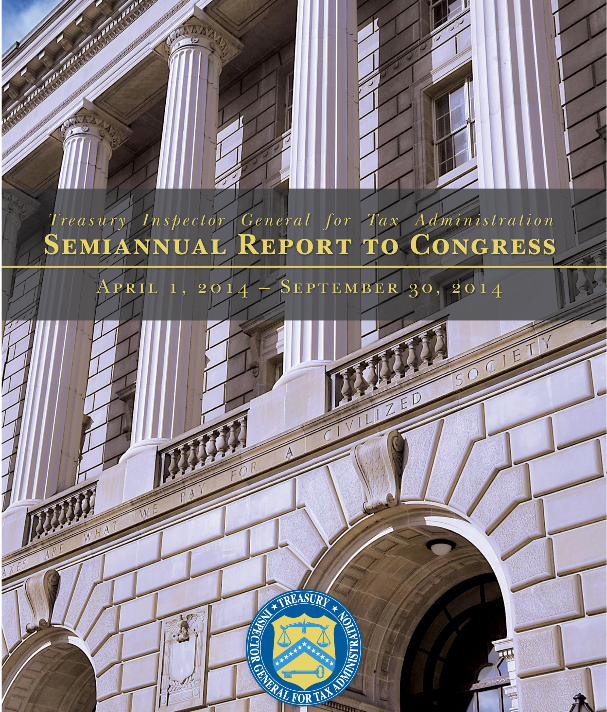
Part I: New TIGTA Report to Congress (Sept 30) Has International Emphasis on Collecting Taxes Owed by “International Taxpayers”: Treasury Inspector General for Tax Administration (TIGTA)
TIGTA’s Semiannual Reports – Today’s Report with International Considerations – Part I
The Internal Revenue Service and U.S. Department of Justice (Tax Division) are the “soldiers” on the ground used to enforce U.S. federal tax law. They interpret the law, in no small part based upon the expertise and input of the myriad of experts in the U.S. Treasury, IRS and DOJ.
However, there are outside forces which oftentimes seem to have an “over-sized” influence on how, when and what priorities are identified in the IRS and DOJ. One of those powers of course is the Administration which makes up the Treasury Department and the very Department of Justice. The green book proposals of the Treasury and different policy proposals are an example. The other organization, within the Executive Branch is the Treasury Inspector General for Tax Administration (TIGTA).
TIGTA is the sort of “watch dog” over the IRS that independently reviews the work undertaken and often times questions that work and the IRS’ efforts. Per its own website it describes itself as:
The Treasury Inspector General for Tax Administration (TIGTA) was established in January 1999 in accordance with the Internal Revenue Service Restructuring and Reform Act of 1998 (RRA 98) to provide independent oversight of Internal Revenue Service (IRS) activities. As mandated by RRA 98, TIGTA assumed most of the responsibilities of the IRS’ former Inspection Service.
TIGTA is separate and apart from the Taxpayer Advocate Service (“TAS”). See, excerpts of TAS reports here.
Another important influence is the Congress. See a prior post from September 2014 on this topic: How Congressional Hearings (Particularly In the Senate) Drive IRS and Justice Department Behavior
*
The Internal Revenue Service Needs to Enhance Its International Collection
Efforts
*
International tax noncompliance remains a significant area of concern for the IRS. The IRS’s collection efforts need to be enhanced to ensure that delinquent international taxpayers become compliant with their U.S. tax obligations. Our review found that the IRS has not provided effective management oversight to international collection, contributing to several control weaknesses in the program. Most notably, international
collection does not have:
*
• Adequate policies and procedures, position descriptions,or the training needed to ensure that international revenue officers can properly work international collection cases;
*
• A specific inventory selection process that ensures that the international collection cases with the highest risk are worked;
*
• Performance measures and enforcement results reported separately from domestic collection; and
*
• A process to measure the effectiveness of the Customs Hold as an enforcement tool.
*
Customs Hold: A notification to the Department of Homeland Security that, according to IRS records, a taxpayer owes Federal taxes. If the taxpayer should return to the United States or Commonwealth Territories without having paid the total amount due, he or she could be interviewed by a Customs and Border Protection Officer at the time of entry. The IRS will then be advised of the taxpayer’s arrival and will be provided with information enabling it to contact the taxpayer regarding payment of his or her outstanding tax liability.
*
Tax Expatriation: The Numbers Affected Are Far Greater for Lawful Permanent Residents vs. Citizens
The last post discusses a scenario where an individual can be forced into “tax expatriation” by a third-party; i.e., the government, if a criminal tax investigation were to be pursued successfully. See, Unplanned Expatriation: Lawful Permanent Residents’ Deportation Risks for Filing U.S. Federal False Tax Returns
We can call this “forced expatriation”; when the government takes investigative action to deport a lawful permanent resident (“LPR); i.e., cause a forced tax expatriation where an individual files a false return, provides false information or otherwise submits a false document to the government.
Other posts have discussed the role of U.S. income tax treaties in accidental “expatriation” for lawful permanent residents. See, Countries with U.S. Income Tax Treaties & Lawful Permanent Residents (“Oops – Did I Expatriate”?), posted April 29,. 2014 and The dangers of becoming a “covered expatriate” by not complying with Section 877(a)(2)(C), posted March 9, 2014.
We can call this “inadvertent expatriation”; when the individual themselves who is a LPR inadvertently causes a tax expatriation by operation of law.
There are other data points and relevant government operations of importance to LPRs. For instance, see, Does the IRS have access to the USCIS immigration data for former lawful permanent residents (LPRs)?, posted April 11, 2015. See, More Inforation and More Information: USCIS Creates New Form for Abandonment of Lawful Permanent Residency
The point of this post is to highlight a point previously made:
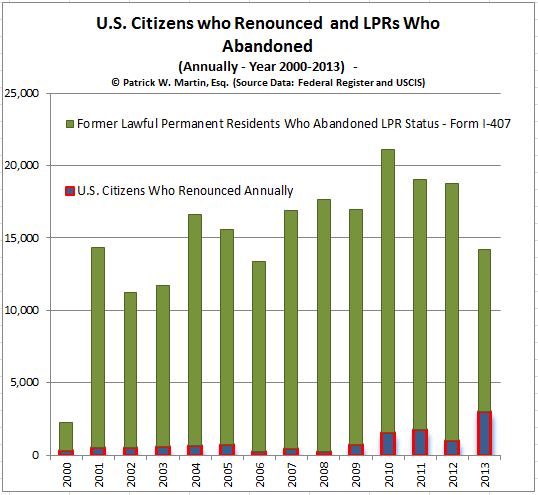
While citizens are often the focus of the public press and Congress regarding “expatriation taxation”; the statute also wraps in so-called “long-term residents.” These are individuals who had or continue to have “lawful permanent residency status.” There are numerous technical considerations in this area, but needless to say, the number of former lawful permanent residents who have simply filed Form I-407 – Abandonment is far in excess of those U.S. citizens who have filed for and received a Certificate of Loss of Nationality (“CLN”) – Form DS-4083 (CLN). The graph reflects the enormous difference.
See, earlier post The Number of LPRs “Leaving” the U.S. is 16X Greater than the Number of U.S. Citizens Renouncing Citizenship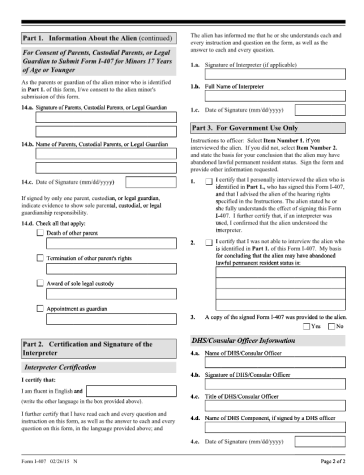
On a related post, the question was raised –What are the Number of LPRs who Leave U.S. Annually without filing Form I-407 – Abandonment?
This is important, since many LPR individuals will have “expatriated” without actually having filed USCIS Form I-407. See, Oops…Did I “Expatriate” and Never Know It: Lawful Permanent Residents Beware! International Tax Journal, CCH Wolters Kluwer, Jan.-Feb. 2014, Vol. 40 Issue 1, p9
See, The Information in DHS/USCIS Database (A-Files, EMDS, CIS, PII, eCISCOR, PCQS, Midas, etc.) on Individuals is Extensive and Can be Shared with Internal Revenue Service, Posted on April 4, 2015
A prior post discussed the new USCIS Form I-407 that must be filed by a lawful permanent resident (LPR) who wishes to formally create a record of their abandonment of LPR status. See, More Information and More Information: USCIS Creates New Form for Abandonment of Lawful Permanent Residency
Page 1 of 2 of this form is replicated here.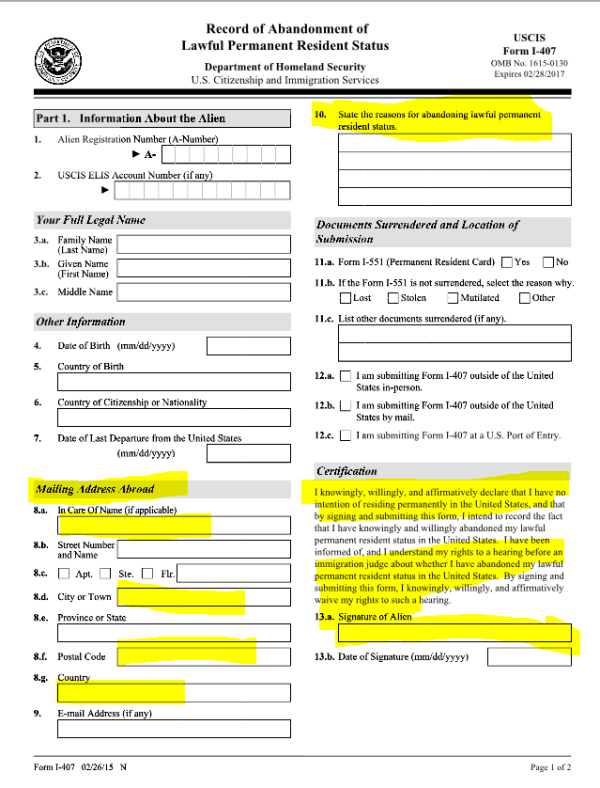
This raises many questions regarding how information maintained by the Department of Homeland Security (DHS) and the United States Customs and Immigration Service (USCIS) can be shared with
and provided to the IRS.
Former “long-term residents” have extensive U.S. tax compliance obligations, including certification requirements under Section 877(a)(2)(C) to avoid “covered expatriate” status and the various adverse tax consequences.
Importantly many LPR individuals will have “expatriated” without actually having filed USCIS Form I-407. See, Oops…Did I “Expatriate” and Never Know It: Lawful Permanent Residents Beware! International Tax Journal, CCH Wolters Kluwer, Jan.-Feb. 2014, Vol. 40 Issue 1, p9
Some of the important records that are maintained by DHS/USCIS, include the following, much of which can be helpful in the enforcement of U.S. federal tax obligations.
System location:
Alien Files (A-Files) are maintained in electronic and paper format throughout DHS. Digitized A-Files are located in the Enterprise Document Management System (EDMS). The Central Index System (CIS) maintains an index of the key personally identifiable information (PII) in the A-File, which can be used to retrieve additional information through such applications as Enterprise Citizenship and Immigrations Services Centralized Operational Repository (eCISCOR), the Person Centric Query Service (PCQS) and the Microfilm Digitization Application System (MiDAS). The National File Tracking System (NFTS) provides a tracking system of where the A-Files are physically located, including whether the file has been digitized.
The databases maintaining the above information are located within the DHS data center in the Washington, DC metropolitan area as well as throughout the country. Computer terminals providing electronic access are located at U.S. Citizenship and Immigration Services (USCIS) sites at Headquarters and in the Field throughout the United States and at appropriate facilities under the jurisdiction of the U.S. Department of Homeland Security (DHS) and other locations at which officers of DHS component agencies may be posted or operate to facilitate DHS’s mission of homeland security.
* * *
- Receipt file number(s);
- Full name and any aliases used;
- Physical and mailing addresses;
- Phone numbers and email addresses;
- Social Security Number (SSN);
- Date of birth;
- Place of birth (city, state, and country);
- Countries of citizenship;
- Gender;
- Physical characteristics (height, weight, race, eye and hair color, photographs, fingerprints);
- Government-issued identification information (i.e., passport, driver’s license):
More Information and More Information: USCIS Creates New Form for Abandonment of Lawful Permanent Residency, Posted on April 3, 2015
The U.S. Customs and Immigration Service (USCIS) announced on 23 March 2015, that a new Form I-407 is available and is to be used, per the USCIS website announcement,
Unplanned Expatriation: Lawful Permanent Residents’ Deportation Risks for Filing U.S. Federal False Tax Returns
One sure way to “get expatriated” as a lawful permanent resident (even if that was not the plan) is to file a false federal tax return, statement or provide false information to the government. U.S. citizens cannot be deported for filing false tax returns, due to Constitutional rights.
Kawashima vs. Holder, (2012), is a story of a Japanese family that lived legally in the U.S. with lawful permanent residency status. According to the L.A. Times,
“Akio and Fukado Kawashima came to Southern California in 1984 as lawful Japanese immigrants determined to succeed in business. They operated popular sushi restaurants in Thousand Oaks and Tarzana and recently opened a new eatery in Encino.
But after they underreported their business income in 1991, they paid a hefty price. The Internal Revenue Service hit them with $245,000 in taxes and penalties. The couple pleaded guilty and paid in full. A decade later, the Immigration and Naturalization Service decided to deport them. . . “
The crucial mistake was the filing of a false return as defined under IRC Section 7206(1):
“(1) Declaration under penalties of perjury . . . Willfully makes and subscribes any return, statement, or other document . . . made under the penalties of perjury, and which he does not believe to be true and correct as to every material matter . . . “
The Supreme Court ruled in this case that the false return that generated a revenue loss of at least US$10,000 for the government was properly classified by the government as an “aggravated felony.” In other words, the tax returns were materially false (which the taxpayers had plead to previously) and created an unpaid tax liability of at least US$10,000. The Supreme Court cited the immigration law (Title 8) and found such an offense to be a violation of Section 1227(a)(2)(A)(iii) as an:
“(iii) Aggravated felony
Any alien who is convicted of an aggravated felony at any time after admission is deportable.
The false tax return which created a tax liability of a relatively low threshold of US$10,000 therefore carries potentially sever consequences.
See a prior post that briefly discusses IRC Section 7206(1), see, What could be the focal point of IRS Criminal Investigations of Former U.S. Citizens and Lawful Permanent Residents?
While most USCs residing overseas will never be concerned about deportation (which should generally not be available to the government, due to constitutional rights of the U.S. citizen) LPRs filing tax returns will indeed want to consider carefully the implications of ” . . . any [and all tax and other] return[s], statement[s], or other document[s] . . . ” submitted to the federal government.
Also, prior posts discussed the law and risks associated with filing or sending false documents, information or returns to the Internal Revenue Service (“IRS”) –
See,Take Caution when Completing a “Tax Organizer” Provided by Your Tax Return Preparer, posted July 19, 2014;
*Is the new government focus on U.S. citizens living outside the U.S. misguided or a glimpse at the new future?* posted March 6, 2014, Will the Justice Department and Criminal Investigation Division of the IRS Turn Their Sights on USCs or LPRs living Overseas? posted March 19, 2014,
The relevance of the Kawashima case to readers of this blog, is how a “long-term resident” may inadvertently find they will trigger the “mark-to-market” tax on their worldwide assets and later cause their U.S. beneficiaries to be subject to what is currently a 40% tax on the receipt of certain gifts and inheritances. See, prior posts on LPR status – Who is a “long-term” lawful permanent resident (“LPR”) and why does it matter?, posted August 19, 2014.
Some prior news coverage of the Kawashima v. Holder case here:
Legal immigrants face deportation for filing false tax return
The Supreme Court rules against a couple who pleaded guilty and paid in full, saying the crime was an ‘aggravated felony’ subject to automatic deportation. Tax lawyers say the decision is ominous.
February 26, 2012|By David Savage and Catherine Saillant, Los Angeles Times
Taxpayer’s Burden of Proving the Impossible (?) – Chapter 3 and Chapter 4 (FATCA) Withholding Taxes Paid by Third Parties
The IRS has issued a Notice (Notice 2015-10) this year announcing its intention to modify the Treasury Regulations regarding tax refunds. This new series of rules, Guidance on Refunds and Credits Under Chapter 3, Chapter 4, and Related Withholding Provisions will complicate the lives of taxpayers significantly. 
Indeed, I have already seen and handled cases where the IRS asserts the taxpayer is not entitled to a tax refund, unless and until they can prove the third party who withheld and paid over the tax (issuing IRS Forms 1042 to all parties, including the IRS and the taxpayer) actually issued and deposited those payments.
These cases are like “proving a negative” since the withholding agent (typically a bank) who made and paid over the deposit, almost never makes single identifying payments for each amount of tax withheld. Typically, there are multiple taxpayers where the withholding tax was made and a single deposit made to the IRS. Those are indeed the specific rules set forth by the IRS. See, IRS Publication 515, withholding of tax on nonresidents
It gets even worse in Qualified Intermediary (“QI”) cases, where a large pool of withholding taxes are made. Typically, I have found the financial institution keeps detailed records of the payments and deposits (along with IRS Forms 1042s), but never has a payment specific to a particular taxpayer, as the deposit payments correspond to multiple taxpayers at once. Indeed, the IRS has acknowledged this treatment in this notice when it states:
Under the existing information reporting, withholding, and deposit procedures, a withholding agent does not indicate to which beneficial owner the deposit of tax relates, and such information is not reported on Form 1042 or 1042-S. Under the existing procedures, therefore, an amount deducted by the withholding agent with respect to a payment to the beneficial owner cannot be matched with an amount of tax deposited in the withholding agent’s Form 1042 account.
See page 5 of (Notice 2015-10).
There is a huge incentive for withholding agents to timely pay and deposit the taxes. There are harsh penalties levied against the withholding agent if they do not timely deposit and pay over the taxes, as follows:
Penalty rate. If the deposit is:
- 1 to 5 days late, the penalty is 2% of the underpayment,
- 6 to 15 days late, the penalty is 5%, or
- 16 or more days late, the penalty is 10%.
However, if the deposit is not made within 10 days after the IRS issues the first notice demanding payment, the penalty is 15%.
In short, the proposal in the form of modifying the regulations puts the burden on the nonresident taxpayer to prove the tax was withheld, before he or she will be entitled to a refund.
This is a new development in a series of developments where the IRS and Treasury simply issue regulations in areas of the law they do not seem to like. Further, it puts an unrealistic burden on nonresident taxpayers who are relying upon the third party withholding agent who makes the payment of taxes.
The long term affect of this rule, will be to force more taxpayers to file suits for refund in the Court of Federal Claims or U.S. District Court, which is necessarily complicated and costly.
More posts to come on this Notice 2015-10 and amendments to the Chapter 3 and Chapter 4 (FATCA) withholding tax regulations.
Finally – Proposed Regulations for “Covered Gifts” and “Covered Bequests” Issued by Treasury Last Week (Be Careful What You Ask For!)
The U.S. Treasury department has issued proposed regulations implementing the tax on “covered gifts” and “covered bequests.” There have been numerous posts about this tax that was first created in 2008 by new IRC Section 2801 (which has it’s own chapter in Title 26 – aka the Internal Revenue Code or “IRC”: Chapter 15, Gifts and Bequests from Expatriates). The regulations can be reviewed here – Guidance under Section 2801 Regarding the Imposition of Tax on Certain Gifts and Bequests from Covered Expatriates
See prior posts, When does “Covered Expatriate” Status -NOT- matter?, (May 2015); See, The “Hidden Tax” of Expatriation – Section 2801 and its “Forever Taint.” (April 2014) and Proposal to U.S. Treasury and IRS: awaits Final Regulations on “Covered Gifts” and “Covered Bequests” (December 2014).
The tax is levied currently at 40% and can be a big surprise to U.S. beneficiaries who receive so-called “covered gifts” and “covered bequests.” The actual implementation of the tax and its enforcement was suspended until Treasury issued regulations. That day has now come and final regulations will follow shortly.
The proposed regulations create an ingenious mechanism by which assets that are received from foreign trusts (which make an election to be taxed as domestic trusts) cannot escape the 40% taxation. Specifically, there was concern expressed to me by Treasury officials drafting the regulations, when I had submitted a proposal to the U.S. Treasury on the subject in May of 2014. See, COVERED GIFTS & BEQUESTS: THE NEED FOR GUIDANCE (5+ YEARS OUT)
* * *
There was concern by the U.S. Treasury that U.S. persons could escape the tax when assets are received by foreign trusts which elect to be taxed as domestic trusts. In those cases, the statute imposes the tax liability on the trust and not the U.S. beneficiary. Hence, the concern expressed by some of the key drafters at U.S. Treasury of the regulations, was that a foreign trust would make the election and purposefully NOT pay the tax imposed by the statute, since the trustee would be outside the U.S. and largely outside the jurisdiction of the IRS.
The proposed regulations create a mechanism by which the trustee cannot slip away so easily, as they will NOT be treated as a domestic trust (versus a foreign trust) in such circumstances where the tax is not actually paid. In those cases, the U.S. beneficiary will be liable for the tax.
It also has some unique concepts that are not necessarily intuitive under the law. For instance, those individuals who are not U.S. citizens, yet live in the U.S. on a nearly full time basis, might still be able to avoid the application of the tax (at least in certain circumstances) if they are not “domiciled” in the U.S. The term “domicile” is a key estate and gift tax term of tax residency, that is not tied to the number of days an individual spend in the U.S. Rather, it is tied to the subjective intention of whether they expect to spend the rest of their lives in the U.S. See, Section 28.2801-2(b) of the proposed regulations which defines residents as those under “Chapter 11” and “Chapter 12”; which are the rules of “domicile” for transfer tax purposes. These are different from the rules of income tax residency found in IRC Section 7701.
The operative definition is found in (b)(1) of the Regulations: 26 CFR 20.0-1 – Introduction.:
“A person acquires a domicile in a place by living there, for even a brief period of time, with no definite present intention of later removing therefrom. Residence without the requisite intention to remain indefinitely will not suffice to constitute domicile, nor will intention to change domicile effect such a change unless accompanied by actual removal.”
Notice, there is no reference to the number of days physically spent in the U.S.
More to be discussed on the proposed regulations in later posts.
CORRECTION TO A PRIOR POST – How Many of the 5,211 Former U.S. Citizens (who Renounced in 2014 and 2015) are Still U.S. Taxpayers?
My goal is to provide useful information on U.S. federal tax law provisions for U.S. citizens who renounce. As this blog provides, it does not provide legal advice specific to any individual circumstances.
A prior post (How Many of the 5,211 Former U.S. Citizens (who Renounced in 2014 and 2015) are Still U.S. Taxpayers?) erroneously indicated that many of these individuals continue to be U.S. persons for federal income tax purposes.
This is not necessarily the case, depending upon when the U.S. citizenship terminated; i.e., when was the “expatriation date” as provided for in the statute. It is very possible that individuals who have renounced citizenship and did not certify under Section 877(a)(2)(C) are “covered expatriates” with all of the adverse tax consequences that befall that status (including to any future U.S. beneficiaries).
They will not necessarily continue to be “U.S. persons” for other purposes of Title 26.
I will run a series of posts over the next month or so that will discuss some of the vexing timing issues in the statute in this regard.
Tax Foundation’s – Here’s How Much Taxes on the Rich Rose in 2013
Tax Foundation: Here’s How Much Taxes on the Rich Rose in 2013
This recent report is worth reading to better understand what has happened to U.S. individual taxpayers since the tax rates were modified.
A nice graph is included, which shows how once taxpayers reach US$500,000 of income or above, their effective tax rates increased, compared to taxpayers with incomes below these amounts. This, of course, is to be expected and was part of the planned tax increases in the federal law (including the 3.8% tax on net investment income).
Once the incomes reached US$1M, the effective tax rate increased more substantially, per the excerpts from the report:
” . . . Americans making between $1 million and $2 million saw their effective income tax rates rise from 24.2 percent to 28.6 percent between 2013 and 2014; on average, these taxpayers paid $53,050 more in taxes.
For the highest-income taxpayers, rates spiked by even greater amounts. Taxpayers with over $10 million of income saw their average rates rise from 19.8 percent to 26.1 percent, equivalent to an average tax hike of $1.52 million. . . “
Ironically, the super wealthy (those earning over US$10M) had a substantially lower effective tax rate than those earning between US$1M and US$10M.
Many policy makers are of the view that only these wealthy individuals (e.g., those earning US$500,00 or more) are those who are renouncing U.S. citizenship.
The author’s experience is that many individuals without significant incomes and assets are choosing to renounce U.S. citizenship for the various complications they experience in their lives. They include the following for U.S. citizens who reside outside the U.S.:
- Incurring the costs and time required to comply with U.S. tax law requirements – even if no U.S. income taxes are owing (i.e., FBAR filings annually, IRS Forms 5471, 3520, 8864, 8858, etc.).
- Being forced to close their bank accounts in their home country of residency, since the financial institution no longer accepts U.S. citizens as customers.
- Risking violating their residency country laws (sometimes with severe consequences) that prohibit dual nationalities as a matter of law.
While some of the negative consequences of U.S. citizenship have probably been exaggerated by those who gain to benefit from the exaggerations, there are indeed real world consequences to many in their day to day lives.
Letter from Your Non-U.S. Bank Regarding Chapter 4 of Subtitle A of the U.S. Internal Revenue Code – aka – “FATCA”
Financial institutions, outside the U.S. have been taking numerous steps to advise their U.S. born clients and U.S. resident clients about the reporting of their account information to the U.S. Internal Revenue Service.
These letters take various forms, depending upon the institution. In short, they normally say that as a result of the “Foreign Account Tax Compliance Act” (aka – FATCA, which comes from the newly created Chapter 4 of Subtitle A of the Internal Revenue Code, Title 26) they will be providing various account information to the U.S. Internal Revenue Service.
Some institutions are accelerating the information provided to include the account number, account holders/owners, balances and income from all sources. FATCA does not require all of this information until it is fully phased in over the next couple of years.
Many U.S. born individuals who have resided virtually all of their lives outside the U.S., often find out for the first time they are U.S. income tax residents by virtue of their birth and the 14th amendment of the U.S. Constitution. See, Co-author. “Tax Simplification: The Need for Consistent Tax Treatment of All Individuals (Citizens, Lawful Permanent Residents and Non-Citizens Regardless of Immigration Status) Residing Overseas, Including the Repeal of U.S. Citizenship Based Taxation,” by Patrick W. Martin and Professor Reuven Avi-Yonah, September 2013.
In many cases, I have seen and advised individuals who are first learning of these obligations when they open new accounts and the financial institution outside the U.S. requests an IRS Form W-9 with a U.S. taxpayer identification number, i.e., the social security number for U.S. citizens. See an older post (23 July 2014) – Why do I have to get a Social Security Number to file a U.S. income tax return (USCs)?
The financial institution will have them certify under penalty of perjury their status as a U.S. person or not. If the individual was born in the U.S., they will necessarily be a U.S. person unless (i) they were born to diplomatic parents who were on diplomatic assignment in the U.S., or (ii) they renounced their U.S. citizenship and obtained a Certificate of Loss of Nationality from the U.S. Department of State. See, The Importance of a Certificate of Loss of Nationality (“CLN”) and FATCA – Foreign Account Tax Compliance Act
These FATCA letters are no longer just for U.S. taxpayers with non-U.S. accounts. Countries throughout the world are using the exchange of information agreements between the U.S. Treasury and other countries, the Intergovernmental Agreements to notify their taxpayers that soon information about their U.S. accounts will be made available to their tax authorities. See, recent Mexican articles released including August 26, 2015, in the El Siglo de Torreón, titled Preparan SAT y EU auditorías: ”
“El Servicio de Administración Tributaria (SAT) realizará el primer intercambio de información con Estados Unidos en septiembre para las primeras auditorías de personas con cuentas bancarias en Estados Unidos a partir del próximo año, aseguró Aristóteles Núñez, jefe del fisco.
“Vamos a poder conocer quiénes tienen cuentas en Estados Unidos y con ello empezar a revisar quién ha pagado sus impuestos y si no lo ha hecho habrá auditorías.”
FATCA Driven (Even More . . . ) – New IRS Forms W-8BEN versus W-8BEN-E versus W-9 (etc. etc.) for USCs and LPRs Overseas – It’s All About Information and More Information (Part III)
Information and more information is the mantra of revised IRS Forms as a result of FATCA. See, FATCA Driven – New IRS Forms W-8BEN versus W-8BEN-E versus W-9 (etc. etc.) for USCs and LPRs Overseas – It’s All About Information and More Information
U.S. citizens residing outside the U.S. along with lawful permanent residents (“LPRs”) are not the only persons who need to understand the IRS forms referenced above. Indeed, all entities and institutions, whether they are small privately held companies or large and traditional financial institutions are required to complete and have signed a range of IRS forms.
The forms can be either the actual IRS form, or a satisfactory substitute form. Many individuals are of the erroneous view that if they are not financial institutions, they do not need to concern themselves with these classifications.
Unfortunately, that is not the case. Also, these classification rules apply to the surprise of many, if there are (or are not) U.S. persons involved.
In addition to a basic understanding of U.S. laws, it is also crucial that the parties see if their country has entered into an IGA. For instance, if we examine the tiny little country of Liechtenstein which has a relatively large financial sector, it is necessary to first classify the type of entity.
All of this is necessary in order to properly determine which IRS form is to be required to be completed (e.g., IRS Form W-8BEN-E o W-8BEN o W-9 or W-8IMY or W-8EXP, etc.). In addition, each of these classifications will help determine how to complete such forms.
For instance, if it is a Liechtenstein Stiftung, it will probably (but not necessary) be a trust and not a corporation. See the IRS Memorandum from 2009 that provides that a Liechtenstein Stiftung will be classified as a trust, if its primary purpose is to protect or conserve the property transferred to the Stiftung for the Stiftung’s beneficiaries and is usually not established primarily for actively carrying on business activities.[1]
[1] See Memorandum Number: AM2009-012, dated October 16, 2009, issued by the Office of Chief Counsel, Internal Revenue Service.
Next, in this example, with a Liechtenstein Stiftung, the country of Liechtenstein has entered into an Intergovernmental Agreement (“IGA”).
Hence, the terms of the IGA are most important. Under the IGA, as is the case generally for FATCA, the entity has to be either an Foreign Financial Institution (“FFI” or “FI”) or a Non-Financial Foreign Entity (“NFFE”).
1) Definition of Financial Institution (“FI”)
A financial institution is any entity that:
- Accepts deposits in the ordinary course of a banking or similar business (“Depository Institution”);[1]
- Holds, as a substantial portion of its business financial assets for the benefit of one or more other persons (“Custodial Institution”);[2]
- Is an investment entity; or
- Is an specified insurance company or holding company that is a member of an expanded group;[3]
[1] See Article 1(i), IGA.
[2] See Article 1(h), IGA.
[3] See Article 1(k), IGA.
Generally a private Liechtenstein Stiftung would not satisfy any of these requirements (although it could conceivably be the case that one could be an “investment entity”). Hence, it would generally be an NFFE and not an FI.
NFFEs can be passive or active. The kind of compliance obligations varies depending on the type of NFFE (passive or active).
- Passive NFFEs
A passive NFFE is an NFFE which is not an active NFFE or a withholding foreign partnership or withholding foreign trust.[1]
There are several criteria under which a NFFE can be classified as an active NFFE. The following explain the most relevant criteria.
- Active NFFEs
Among the criteria that the IGA establishes, under which a NFFE can be considered as an Active NFFE, are the following:
1) If less than 50% of the NFFE’s gross income is passive income and less than 50% of the assets held by the NFFE are assets that produce or are held for the production of passive income during the preceding calendar year. A
2) Substantially all of the activities of the NFFE consist of holding (in whole or in part) the outstanding stock of, or providing financing and businesses other than the business of a Financial Institution.
Sometimes trusts or Stiftungs will also participate in or hold interests in companies, some of which may engage in active trades or businesses or simply hold passive investments. On the contrary, the companies/subsidiaries only hold other assets from which they derived passive income (e.g., dividends, interests, rents, royalties, etc.).[2]
This will determine if a Stiftung will be classified as a Passive NFFE or not under FATCA regulations and the IGA.
[1] It also can make a difference if the trust (or Stiftung in this example) is a so-called “withholding” foreign trust; which generally requires an agreement with the IRS.
[2] Treas. Reg. § 1.1472-1.
Not surprisingly, the above analysis is complex, because the rules are complex. Accordingly, it has been the author’s experience, that many institutions around the world which request one or more of the above IRS Forms have great difficulty in even implementing these rules. Most of their employees seem to have little understanding of what is a very complex area of law, even when their resident country has issued extensive regulations or guidance about how the terms of the IGA are to be implemented.