Form 1040-NR
Does IRS Notice 2009-85 regarding expatriation have the “force of law”?
The above statement may sound quite provocative, until one explores in more detail some of the basic principles identified by the U.S. Supreme Court.
IRS Notice 2009-85 is the guidance issued by the IRS after Section 877A was adopted in 2008 and attempts to address a number of issues regarding the mark to market rules. This IRS Notice is a type of so-called “IRB” guidance (Internal Revenue Bulletin). Other IRS guidance that falls into this “IRB” guidance category includes revenue rulings and revenue procedures.
Two key Supreme Court cases, Mayo Clinic and Home Concrete and the 3rd Circuit Cohen decision, among many others, help articulate when such IRS authority is valid, and when it can be successfully challenged by taxpayers. A thoughtful law review article by Kristin Hickman, Unpacking the Force of Law, articulates in much detail the law in this regard and when IRS guidance, specifically including IRS Notices are subject to other U.S. laws, including the Administrative Procedures Act (“APA”).
Below is a list of some of the provisions of IRS Notice 2009-85 that seem to fall outside the language of the statute:
- A covered expatriate who is required to file Form 8854 for such taxable year will be considered to have timely filed Form 8854 if it is filed by the due date of the original Form 1040NR or Form 1040 (including extensions) for such taxable year. Covered expatriates who are U.S. citizens or long-term residents for only part of the taxable year that includes the day before the expatriation date must file a dual-status return.
-
D. Interaction with treaties
Section 877A(f)(4)(B) provides that a covered expatriate shall be treated as having waived any right to claim any reduction under any treaty with the United States in withholding on any distribution to which section 877A(f)(1)(A) applies unless the covered expatriate agrees to such other treatment as the Secretary determines appropriate.
What are the consequences if a former USC or LPR does not comply with one or more of the above requirements that are only set forth in a Notice and not the statute?
Can the IRS make a determination that the taxpayer is a “covered expatriate”, even if they otherwise do not meet the asset or tax liability thresholds?
There is no “timely filed” requirement in the statute or even an inference in it, as to the time and effective nature of notifying the IRS?
Can the IRS successfully argue that the certification requirement of Section 877(a)(2)(C) has not been satisfied and the individual is a “covered expatriate” if IRS Form 8854 is not “timely filed” as defined by the IRS in the Notice?
Must a taxpayer necessarily agree to “such other treatment as the Secretary determines” appropriate, even if such determination is contrary to the terms of an applicable income tax treaty? Can the Secretary unilaterally override the terms of an income tax treaty negotiated between two countries?
These and other questions remain as a result of IRS Notice 2009-85.
???????????????? ?Please click here to view the above in Chinese.?
USCs and LPRs Living Outside the U.S. – Key Tax and BSA Forms
U.S. citizens and Lawful permanent residents living outside the U.S. generally have additional tax and financial account (from the Bank Secrecy Act – “BSA”) reporting requirements. These filings are unique for persons who reside in their home country compared to those who reside in the U.S.
The forms and basic concepts that may be applicable are as follows:
A) Foreign Earned Income Exclusion –
The IRS explains the confusion that commonly exists from this form, which is only available from so-called “earned” income (not passive investment type income):
In addition to filing a U.S. tax return, the taxpayer must meet the residency tests and file IRS Form 2555, Foreign Earned Income
A credit is a “dollar for dollar” (subject to various limitations) reduction in the federal tax burden for taxes paid in another country for income sourced in that country.
Importantly, as the government explains, ” . . . Once you choose to exclude either foreign earned income or foreign housing costs, you cannot take a foreign tax credit for taxes on income you can exclude. If you do take the credit, one or both of the choices may be considered revoked. . . ”
In addition to filing a U.S. tax return, the taxpayer must meet various conditions for eligibility for the foreign tax credit. The calculation is complex and is ultimately reported on IRS Form 1116 and must be attached to the income tax return, which will always be IRS Form Form 1040 for U.S. citizens and LPRs who reside in a country with no U.S. income tax treaty; and could be IRS Form 1040NR for certain LPRs residing in a country with a U.S. income tax treaty.
C) Information Reporting Requirements
There can be multiple reporting requirements, depending upon the type of transaction, foreign asset, etc.
A summary of these reporting requirements is set forth towards the end of the article “Accidental Americans” – Rush to Renounce U.S. Citizenship to Avoid the Ugly U.S. Tax Web” International Tax Journal,CCH Wolters  Kluwer, Nov./Dec. 2012, Vol. 38 Issue 6, p45.
In addition to the forms reflected in the article, IRS Form 8938 Statement of Specified Foreign Financial Assets became part of the law for 2011 tax year filings in 2012. There is often overlap of reporting on this form and the FBAR referred to below.
This form 8938, along with most other forms must be attached to your income tax return (e.g., IRS form 1040) when filed with the IRS. It is common for most types of tax preparation software NOT to have support for this and other particular forms that must be filed regarding non-U.S. assets. Accordingly, the forms often times need to be completed manually by using an Adobe Acrobat version.
D) Foreign Bank Account Reports (“FBAR”)
The definition of “ownership interest in” or “signature authority over” is very broad under the FBAR regulations. See, FOREIGN BANK ACCOUNT REPORTS – 2011 REGULATIONS EXTEND RULES TO MANY UNAWARE PERSONS
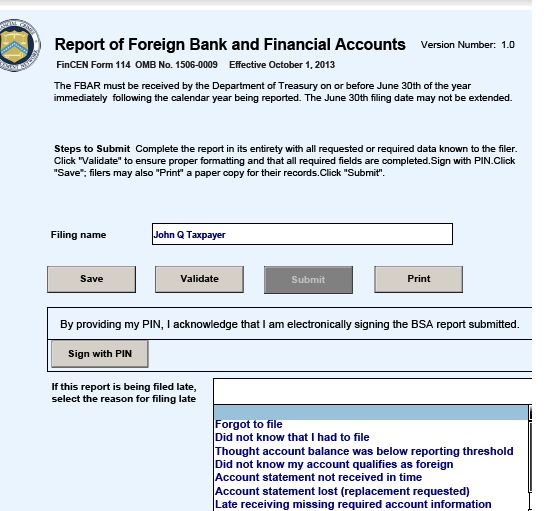 The filing of the FBAR form is not with the IRS, but rather with FinCEN. It must now be filed electronically on Form 114, Report of Foreign Bank and Financial Accounts through the BSA E-Filing System website. The electronic form supersedes TD F 90-22.1 (the FBAR form that was used in prior years).
The penalties for not filing or even filing late are by statute $10,000 for each failure to file (or up to 50% of the account balances when intentionally not filed by the person with the requirement to file).
* Simply More Compliance Obligations for Persons Residing Outside the U.S.
At the end of the day, a USC or LPR residing outside the U.S. necessarily has a much greater burden of tax compliance and filings of these forms, compared to someone living in the U.S. without foreign bank accounts, foreign assets, foreign income, etc.
???????????????? ?Please click here to view the above in Chinese.?
- ← Previous
- 1
- 2