Does “covered expatriate” status only matter for wealthy people?
No. It is easy to assume the US expatriation tax rules only reach the rich, the wealthy, and the private-jet set. The press usually features wealthy renouncers like Tina Turner and Eduardo Saverin, the co-founder of Facebook, which fuels that assumption. But wealth is not the trigger. The rules can reach the poorest former US citizen, and certain long-term green card holders, wherever they live, if they fail the certification requirement in IRC Section 877(a)(2)(C).
What are the net worth and income tax tests people usually focus on?
Most coverage of expatriation focuses on two dollar thresholds. The first is the net worth test of US$2 million. The second is the income tax liability test of roughly US$125,000 of average annual net income tax. A “covered expatriate” is a former US citizen, or long-term green card holder, who on giving up that status either crosses one of those dollar thresholds or fails to certify tax compliance under Section 877(a)(2)(C). Because the headlines fixate on the dollar tests, the certification path is the one people miss.
Can you be a covered expatriate if you have no assets?
Yes. The certification requirement under Section 877(a)(2)(C) applies regardless of wealth. A former US citizen, or certain long-term green card holder, who cannot certify compliance becomes a “covered expatriate” even with almost nothing to their name. This is why the rules can reach so-called Accidental Americans who have spent little or no time in the US. The dollar thresholds are only one way in; failing to certify is another.
Does US expatriation tax apply to green card holders too?
Yes. The expatriation tax rules reach certain long-term lawful permanent residents (green card holders), not only US citizens. When a long-term LPR relinquishes or abandons their green card, the same certification requirement under Section 877(a)(2)(C) applies. A long-term LPR who cannot certify compliance becomes a covered expatriate on the same terms as a citizen who renounces.
If you have no assets, do you owe US income tax when you expatriate?
No. The expatriation income tax runs through a “mark-to-market” regime, which taxes unrealized gains as if you sold everything the day before you leave. With no assets, there are no unrealized gains, no tax base, and so no exit income tax. Even cash produces none. US dollars carry a tax basis equal to their face amount, so there is no unrealized gain on cash to tax.
What are the two points where expatriation can trigger US tax?
There are two. The first is the moment a US citizen or green card holder expatriates, that is, leaves the US tax system. This is the exit tax on unrealized gains, and it produces nothing for a person with no unrealized gains. The second arrives later, when a US person receives a covered gift or bequest from the covered expatriate under IRC Section 2801. That second point can land decades after the expatriation event.
What is the Section 2801 tax on covered gifts and bequests?
IRC Section 2801, enacted in 2008, taxes the US person who receives a gift or bequest from a covered expatriate. The recipient pays effectively 40% of the fair market value of the property received. There are virtually no deductions or exemptions, so the 40% applies to the full value. The gift or bequest can be direct or indirect, for example through a trust. Treasury has a proposed-regulation project underway under Section 2801.
Can someone with significant assets still owe no exit income tax?
Yes. Unrealized gains, not wealth, drive the exit income tax. Compare USC “A” with US$5,000 in total assets and USC “B” with US$15 million of cash in the bank and nothing else. Both owe the same exit income tax: US$0. Cash carries a tax basis equal to its amount, so neither has any unrealized gain to tax. And if neither can satisfy the certification requirement under Section 877(a)(2)(C), both are covered expatriates just the same.
Why would a covered expatriate with no assets ever create a future tax bill?
Because the Section 2801 tax can land long after expatriation, on assets you do not have yet. Two things change over time. You may grow or inherit assets after expatriating, while no longer a US citizen, ending up with far more than you hold today. And people in your life, family or friends, may become US residents even if none are today. Either shift can set up a future covered gift or bequest from you to a US person.
How much tax could a modest future inheritance trigger?
Take USC “A,” who renounces and, 40 years later, leaves a US$120,000 bequest to a daughter who has since moved to the US. Under Section 2801, the daughter would owe more than US$40,000 in tax on that inheritance, roughly 40%, with virtually no deductions or exemptions. That is a heavy burden on a relatively modest inheritance. It is one of several scenarios that show how covered expatriate status can matter over the long run.
How realistic is it that a future heir becomes a US person?
It is common. One family member moves to the US temporarily for work or graduate school, gets married, and decides to stay, even for a while. Often they have children, who are US citizens by birth in the US. A US person is now part of the family tree. A future gift or bequest from a covered expatriate to that person can fall under Section 2801, decades after the expatriation itself.
Why Long-Term Green Card Holders Cannot Escape the Exit Tax Rules
When long-term green card holders give up their green card, they face the same exit tax rules as US citizens who renounce citizenship. There is one exception in the law that allows certain dual citizens by birth to avoid covered expatriate status even if they meet the income or asset tests. Long-term green card holders cannot use it. Here is why.
When you give up your green card (or renounce US citizenship), the law determines whether you are a covered expatriate. You are a covered expatriate if you meet any one of three tests: an average annual income tax liability above an inflation-adjusted threshold, a net worth of $2 million or more on the date of expatriation, or a failure to certify 5 years of US tax compliance – where it is commonly certified on IRS Form 8854.
Meeting even one of these three tests makes you a covered expatriate. All three tests apply equally to US citizens who renounce and to long-term lawful permanent residents (LPRs) who give up their green card.
Is there an exception to the income and asset tests?
Yes, for some people. Under IRC Section 877A(g)(1)(B), certain individuals are exempt from the income and asset tests. If this exception applies to you, you can avoid covered expatriate status even if your net worth exceeds $2 million or your income exceeds the threshold. The certification requirement under Section 877(a)(2)(C) still applies to everyone, including those who qualify for this exception.
Who can use this exception?
The exception is narrow. Under the statute, it applies only to an individual who: became a citizen of the United States and a citizen of another country at birth; as of the date of expatriation, continues to be a citizen of and is taxed as a resident of that other country; and has been a US resident for no more than 10 taxable years during the 15-year period ending with the taxable year of expatriation. Only someone who acquired US citizenship automatically at birth, while also holding citizenship of another country from birth, can potentially qualify.
Why green card holders cannot use it
Lawful permanent residents are not US citizens. They hold a green card, which is a grant of permanent resident status, not citizenship. Because the exception in Section 877A(g)(1)(B) applies only to individuals who became US citizens at birth, long-term LPRs cannot satisfy this requirement by definition. The exception is simply not available to them.
What this means if you are a long-term green card holder
A long-term LPR who meets either the $2 million asset test or the income tax liability test will become a covered expatriate, even if they fully satisfy the 5-year certification requirement. Satisfying the certification requirement is necessary for everyone, but for long-term LPRs it is not sufficient on its own. If you also meet the income or asset test, you are a covered expatriate regardless.
The consequences include the mark-to-market exit tax on unrealized gains and the Section 2801 tax on covered gifts and bequests to US persons. These consequences can affect your US family members for decades. Understanding them well before you give up your green card, not after, is the only way to plan for them.
There are important unintended tax consequences that can befall individuals who have a green card depending upon their factual circumstances: see, Oops…Did I “Expatriate” and Never Know It: Lawful Permanent Residents Beware!International Tax Journal, CCH Wolters Kluwer, Jan.-Feb. 2014, Vol. 40 Issue 1, p9):
This post provides general information only and is not legal advice. Consult an experienced attorney for guidance specific to your situation.
How Many Lawful Permanent Residents does the U.S. Receive (Per Year: 1820-2022)
There is an idea that only recently has permanent resident US immigration status into the United States grown substantially. The peak years were in the early 1990s as to absolute numbers. However, the greatest number of permanent residents as a relative percentage of the population was in the early 1900s; by far. See the chart below that I created from DHS immigration statistics data.
There were more LPRs admitted, in absolute terms in 1905 (1,026,499) than in 2022 (1,018,349).
[arm_restrict_content plan=”2,” type=”show”]
In percentage terms the total number of LPRs in 1905 compared to the total population was more than four times (4X) greater than in 2022 when it was (about 3/10th of 1 percent or 0.306%; versus a total population of 333 million) . In 1905 the total population was about 84 million, with newly admitted LPRs representing 1.225 percent of the entire resident population (1.225%; is greater than 4X the 2022 relative percentage).
The “Mark to Market” Tax that did NOT Exist in 1820, 1913, 1966 (Not Until 1996)
The US tax expatriation laws now impose a “mark to market” tax on so-called “long-term residents” who become “covered expatriates.” Such a concept in the tax law never existed in the early part of the 20th century, and indeed only became law in 1996. See an earlier post, The Foreign Investors Tax Act of 1966 (“FITA”) – The Origin of US Tax Expatriation law
This so-called Mark to Market tax is based upon a legal fiction, as if the individuals sold their worldwide assets on the “expatriation date.” It applies, even though there’s no current sale of assets, no disposition, transfer, change of ownership, change of title, or other “realization” event. The term “realization” is very significant in US tax law, including as recently discussed by the United States Supreme Court. See below and Moore v. the United States (2024) .
Below is a table of LPRs who were admitted to that status, per year, over the last 200+ years starting in 1820:
Are you or any of your family members one of these millions (more than 88 million) of LPR individuals represented in the above graph over the last 200+ years?
Is the “Mark to Market” Expatriation Tax Unconstitutional? – through the Prism of Moore
No Court in the land has explicitly ruled on whether the “mark to market” tax under Section 877A is unconstitutional. However, many international tax minds (myself included) have doubted the ability of Congress to levy a tax on unrealized wealth in light of Eisner v. Macomber, 252 U.S. 189 (1920) and the language of the amendment ratified in 1913 to the Constitution.
The Congress shall have power to lay and collect taxes on incomes, from whatever source derived, without apportionment among the several States, and without regard to any census or enumeration.
16th Amendment of the Constitution [emphasis added]:
One of the exceptional international tax minds, Professor Reuven S. Avi-Yonah has been writing a lot about this issue after submitting an amicus brief along with Professor Bret Wells to the U.S. Supreme Court (SCOTUS) in the Moore case which was decided last week. Moore v. United States, No. 22-800 (06/20/2024). Moore was not about “expatriation taxes” but rather a “mandatory repatriation tax” (“MRT”) under Section 965.
Moore argued some of the fundamental issues that lie at the core, in my view, of whether Congress has the legal authority to impose taxation (as an income tax) based upon the increased value of assets as of the date, the individual becomes a “covered expatriate”. How does the individual have any income (see, Eisner v. Macomber) by merely holding and having the same assets on the day prior to “expatriation” as the day after? No sales, no exchanges, no dispositions, no transfers, no gifting, etc. – and yet 26 U. S. C. § 877A imposes taxation on “income.”
How Many LPRs are Living in Tax Treaty Countries like Aroeste (Now including Chile)? What are the Legal-Tax Consequences? (Part I of II)
No, not talking about Texas-Style Chili as reported in the – NYT Cooking Recipe.
Chile, the country in South America and the newest country to have an income tax treaty go into force with the United States. The U.S.-Chile Tax Treaty (in the works for more than a decade) went into force at the end of 2023, on 19 December 2023.
The question is how many “LPRs” are residing in a tax treaty country that are impacted favorably (presumably all of them) by the federal district court decisions we successfully handled against the IRS and DOJ, Tax Division: Aroeste v United States, 22-cv-00682-AJB-KSC (20 Nov. 2023)?
As previously explained, the Aroeste decision will affect potentially millions of “Green Card” holders (a subset of the 3.89M estimated by the government) living outside the U.S. Those who have not formally abandoned their lawful permanent residency status. See, “LPR Tax Limbo” – Formal Abandonment of LPR (Form I-407) – (2020). This “LPR Tax Limbo” is no longer the case after the Aroeste decision.
These individuals who are living in tax treaty countries are not in “LPR Tax Limbo” any more since the Court clarified when the individual is not a United States tax resident. The Court explained, that filing a “late” tax treaty position, does not cause the non-U.S. citizen to have waived the benefits of the income tax treaty. It is the tax treaty with each of the 66 countreis that has the potential of unlocking the “escape hatch” described by the Court.
The Court agrees with Aroeste. Although Aroeste gave untimely notice of his treaty position, the Court finds this does not waive the benefits of the Treaty as asserted by the Government. Rather, I.R.C. § 6712 provides the consequences for failure to comply with I.R.C. § 6114, namely a penalty of $1,000 for each failure to meet § 6114’s requirements of disclosing a treaty position.
The court in Aroeste outlined a 5-step analysis that becomes crucial for the 3.89 million LPRs residing abroad in one of the 66 tax treaty countries, in determining whether they are “United States persons” under the law. This will be covered in Part II.
Millions of LPR Individuals Living in 66 Different Countries Could Be Impacted by Aroeste vs. U.S.
The United States has a total of 58 income tax treaties that covers 66 countries. See, Countries with U.S. Income Tax Treaties & Lawful Permanent Residents (“Oops – Did I Expatriate”?) (2014); ironically reflecting the same tax treaties in force in November 2023 as of 2014 (until the Chile treaty came into effect). The 1973 U.S. – U.S.S.R. income tax treaty applies to Armenia, Azerbaijan, Belarus, Georgia, Kyrgyzstan, Moldova, Tajikistan, Turkmenistan, and Uzbekistan.
Importantly, anyone in these circumstances would be remiss, if they did not consider carefully the “mark to market” tax implications to them if they were to become a “covered expatriate” as defined in the law. These “mark to market” tax consequences can have potentially devastating consequences, including to U.S. beneficiaries in the future if not properly planned and considered.
Short Window of Wait Times for CLN: One Month to 6 Weeks?
The wait times for the State Department to issue a Certificate of Loss of Nationality (“CLNs”) used to be quite long, based upon the author’s experience with various clients. That has all changed since about the beginning of this year 2023. The author has seen cases that are taking less than 6 weeks from the date of the meeting to take the oath of renunciation before a consular officer.
The Number of LPRs Declined in the Corona-virus Pandemic
Not surprisingly, the number of new LPRs into the U.S. dropped substantially in correlation with the Corona-virus pandemic. See, the Office of Immigration Statistics, 28 Sept. 2021: Fiscal Year 2021 U.S. Lawful Permanent Residents Annual Flow Report. The Figure 1 (highlighted by me) and that report notes:
Just over 700 thousand persons became LPRs in 2020, as reduced international travel during the COVID-19 pandemic and policy changes brought new LPR admissions in 2020 to their lowest
level since 2003. The majority of these LPRs (62 percent) were already present in the United States when they were granted lawful permanent residence. A little under two-thirds (63 percent) were granted LPR status based on a family relationship with a U.S. citizen or current LPR. The leading countries of birth of new LPRs were Mexico, India, and People’s Republic of China (China). In 2020, there was a 31 percent reduction in U.S. grants of LPR status compared to 2019.
Largely due to the COVID-19 pandemic, LPR flows in 2020 were not representative of typical trends (Figure 1). Travel restrictions and processing slowdowns generally resulted in fewer inflows, while foreign-born residents within the United States also confronted immigration status-specific COVID-19 vulnerabilities.5
The key tax question for LPRs who no longer live in the U.S. (or who are planning to leave the U.S. to live in another country) is: Are they (or will they become) a so-called “long-term resident” as defined in the federal “expatriation” tax law?
IRC Section 877(e)(1) and (2) define a “long-term resident” and these paragraphs are included below in their entirety:
(1) In general
Any long-term resident of the United States who ceases to be a lawful permanent resident of the United States (within the meaning of section 7701(b)(6)) shall be treated for purposes of this section and sections 2107, 2501, and 6039G in the same manner as if such resident were a citizen of the United States who lost United States citizenship on the date of such cessation or commencement.
(2) Long-term resident
For purposes of this subsection, the term “long-term resident” means any individual (other than a citizen of the United States) who is a lawful permanent resident of the United States in at least 8 taxable years during the period of 15 taxable years ending with the taxable year during which the event described in paragraph (1) occurs. For purposes of the preceding sentence, an individual shall not be treated as a lawful permanent resident for any taxable year if such individual is treated as a resident of a foreign country for the taxable year under the provisions of a tax treaty between the United States and the foreign country and does not waive the benefits of such treaty applicable to residents of the foreign country.
The Next Post on this topic will break down the elements of –
(1) who will necessarily be a “long-term resident”?
(2) who may be “long-term resident”?
(3) what steps can be taken to necessarily avoid “long-term resident” status?
Finally, a discussion will be had in the last post in this series of some of the potential adverse tax consequences to “long-term residents” depending upon different factual scenarios.
Russian Citizen who Expatriated from U.S. – Pleads Guilty to Tax Fraud – US$500M Penalty
I previously wrote about how this blog (with few posts on my part over the last couple of years) is not unlike Kipling’s observation –
” . . .Oh, East is East, and West is West, and never the twain shall meet. . . ”
. . . in that it addresses principally civil federal tax law [the East] but sometimes (not never 🙂 ) crosses over from civil to criminal [the West]. In that May 2020 post, I covered the indictment in the Northern District of California of a Russian citizen who had become a naturalized U.S. citizen (“NUSC”). As a NUSC he necessarily was a “covered expatriate” upon renunciation as has been explained here in other posts. See, When does “Covered Expatriate” Status -NOT- matter?
Mr. Oleg Tinkov was indicted in May 2020 under 26 U.S.C. § 7206(1) – for Making and Subscribing A False Tax Return, Statement, and Document (Two Counts). The Indictment was originally filed under seal and the docket can be reviewed here. His sentencing is set for October 29, 2021.
As explained therein, he renounced his U.S. citizenship many years prior to the indictment – nearly 7 years before he was even criminally indicted:
11. On or about October 28, 2013, TINKOV expatriated from the United States by renouncing his U.S. citizenship before a diplomatic and consular officer of the United States.
As a very wealthy individual, the value and accuracy of his assets reflected on his Form 8854 would have been significant factually in this case. Particularly, since as a NUSC he would necessarily have been a “covered expatriate” and hence subject to the “mark-to-market” tax on his worldwide income upon his expatriation. The amount of the tax is calculated upon the amount and fair market value of the assets on the ” . . . day before the expatriation date. . . ” 26 U.S. Code § 877A(a)(1).
* Filing False Expatriation Tax Form – IRS Form 8854
Filing a false IRS Form 8854 and therefore necessarily a false tax return, becomes problematic quickly for any individual who carelessly discloses inaccurate asset information (or no asset information at all). See, the 2016 indictment of a NY business professor discussed previously here: Expatriation Tax Form 8854 is Part of Criminal Tax Case
Importantly, this is true even when a naturalized citizen decides to go back to her home country and leave the U.S. – including on a permanent basis; even when the taxpayer’s assets are located outside the U.S. This was the case with Mr. Tinkov per the indictment and the DOJ press release. See the harsh words in the DOJ press release of the guilty plea yesterday, October 1, 2021 – Founder of Russian Bank Pleads Guilty to Tax Fraud
“Tinkov renounced his U.S. Citizenship shortly after receiving millions of dollars,” said Acting Special Agent in Charge Darrell J. Waldon of the IRS-CI Washington D.C. Field Office. “Despite his knowledge of U.S. tax reporting requirements, he substantially understated his wealth on filings with the IRS. International tax cheats remain a priority for my office and our agency; and as such, the International Tax and Financial Crimes D.C.-based group will continue to aggressively pursue those committing international tax crimes.”
If you are a tax professional assisting in the preparation of tax returns and IRS Form 8854 Initial and Annual Expatriation Statement what duty to inquire do you have as to the accuracy and information provided to you by your client? What duty do tax professionals have to reasonably inquire as to “knowledge of client’s omission” – “information to be furnished” and “diligence as to accuracy”? Must the tax professional make reasonable inquiries if any information furnished to you appears to be incorrect, incomplete or inconsistent with other facts or assumptions of the taxpayer or her circumstances? Treasury Circular No. 230 §10.20, §10.21, §10.22, §10.34(d).
Can and will the U.S. federal government deny the ability of Mr. Tinkov to ever return to the United States pursuant to Title 8, U.S.C. Section 1101(a)(43) for being convicted of an aggravated felony? This is probably all moot considering it has been reported that Mr. Tinkoff was diagnosed with leukemia in March 2020 and has changed his life focus. Arrested Billionaire Banker Tinkov Switches Focus to Cancer Foundation
The federal tax law has a very transparent system of reporting and identifying former U.S. citizens who have renounced their citizenship. The data with the names of each individual are published quarterly on the federal government’s website as Required by Section 6039G. The complete set of lists including thousands of names of former U.S. citizens going back to the mid-1990s can be reviewed here. Quarterly Publications. Quarterly Publication of Individuals, Who Have Chosen to Expatriate.
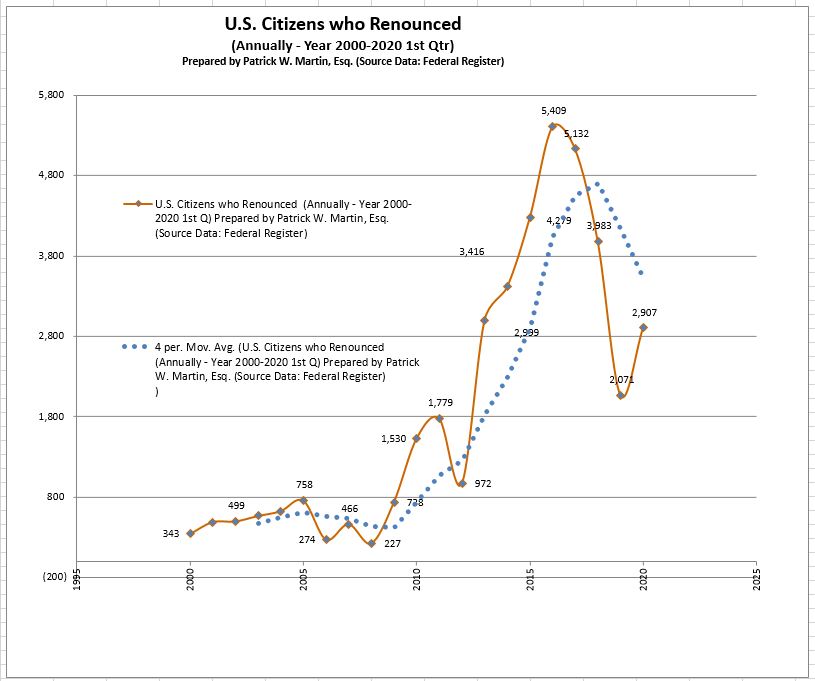
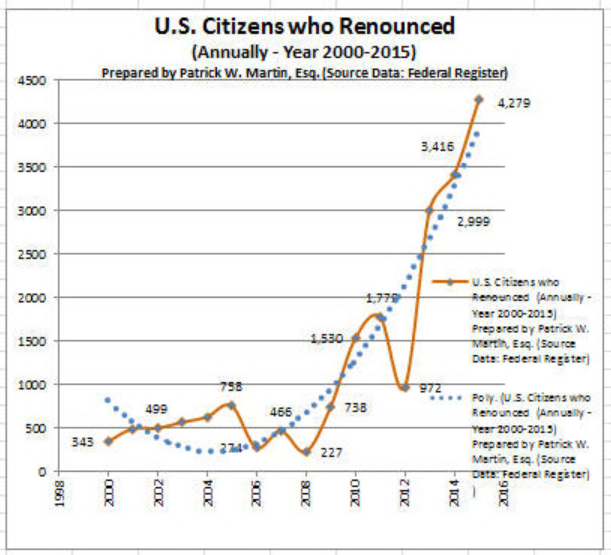
See previous posts regarding the numbers of USCs who were renouncing at an increasingly rapid pace starting at just around and just before the year 2010. The FATCA transparency laws were passed in 2010 and so too were more international information reporting requirements (IRC 6038D) and strong enforcement efforts overseas by the IRS and DOJ Tax Division; which could be part of a cause and effect consequence? See, CHAPTER 4—TAXES TO ENFORCE REPORTING ON CERTAIN FOREIGN ACCOUNTS (§§ 1471 – 1474)
Posted on : The current renunciations and now steep decline starting in 2018 may be temporary or part of a trend?
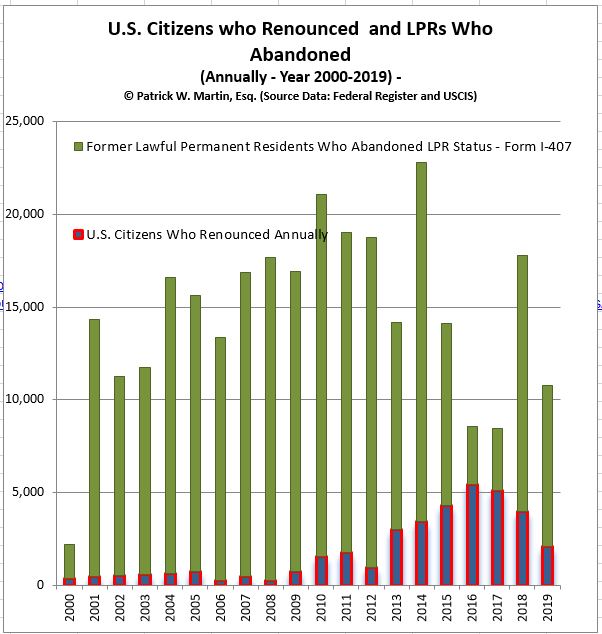
Subsequent posts will discuss the new trend of how relatively fewer lawful permanent residents (“LPRs”) are formally abandoning their status compared to USCs who formally renounce. This is true even though the number of USCs renouncing is in decline.
Like Canada’s “Deemed Acquisition” Rules: IRC Section 877A(h)(2)
The Canadian income tax system has a sensible rule that treats immigrants into the country “as if” they had sold their non-Canadian assets just prior to becoming a Canadian income tax resident.
If you owned certain properties, other than taxable Canadian properties, while you were a non-resident of Canada, we consider you to have sold the properties and to have immediately reacquired them at a cost equal to their fair market value on the date you became a resident of Canada. This is called a deemed acquisition.
Usually, the fair market value is the highest dollar value you can get for your property in a normal business transaction.
You should keep a record of the fair market value of your properties on the date you arrived in Canada. The fair market value will be your cost when you calculate your gain or loss from selling the property in the future.
The U.S. does not have such a rule generally for immigrants coming to America. Instead, the non-U.S. citizen will typically have their historic tax basis (by applying U.S. tax principles) in the property they own prior to coming to the U.S. For instance, an immigrant from the South American continent who owns real estate in their country of citizenship, may have a large “unrealized gain” in that property for U.S. federal income tax purposes.
This means that if the South American sells the real estate, while being a U.S. income tax resident (after immigrating to the U.S.), the gain in the South American real estate will be subject to taxation in the U.S. This is very different from the sensible Canadian rule, which exempts the appreciation in the property of the immigrant while living outside of the North American continent.
This can be a very bad result for the uninformed immigrant, since the example above can get worse, when the immigrant to the U.S. has received properties in the form of gifts (e.g., from their family members) which could have very low tax bases per U.S. tax law. Assume a gift of South American real estate received by the immigrant prior to moving to the U.S. with a low historic basis of US$500K. Assume further it is sold for US$3.3M while the immigrant is residing in the U.S. If the property was worth US$3.2M when she immigrated to the U.S., only US$100K of appreciation occurred while residing in the U.S. Nevertheless, under U.S. law, the entire US$2.8M gain (US$2.7M of which occurred while living outside the U.S.) will generally be subject to U.S. federal income tax.
This comes as quite a surprise to many.
An immigrant to Canada in the same case, would only have US$100K of taxable gain, with the US$2.7M gain being free from taxation under Canada’s “deemed acquisition” rules.
There is one exception in the U.S. tax law. Unfortunately, it applies to “covered expatriates” who readers of this site understand, that the U.S. tax regimes are typically quite undesirable. They are as follows:
The statutory provision under IRC Section 877A(h)(2) provides relief from the first tax; for purposes of calculating the “mark to market” tax. It provides in relevant part that the “covered expatriate” –
. . . shall be treated as having a basis on such date [the date of immigration to the U.S. in the first place] of not less than the fair market value of such property on such date . . .”
Accordingly, the appreciation of the property owned by the immigrant (see, US$2.7M example above – who is in the process of emigrating out of the U.S. -by way of “covered expatriate” status) will generally escape income taxation under IRC Section 877A(h)(2) on the unrealized gain in the property that arises prior to moving to the U.S. in the first place. This limited rule is similar to the sensible Canadian “deemed acquisition” rules.
Unfortunately, there is no such rule as this “deemed acquisition” concept that could reduce the future tax payable by U.S. beneficiaries of “covered gifts” and “covered bequests.”