International Tax · Citizenship Renunciation · LPR Abandonment
International Tax Shareholder
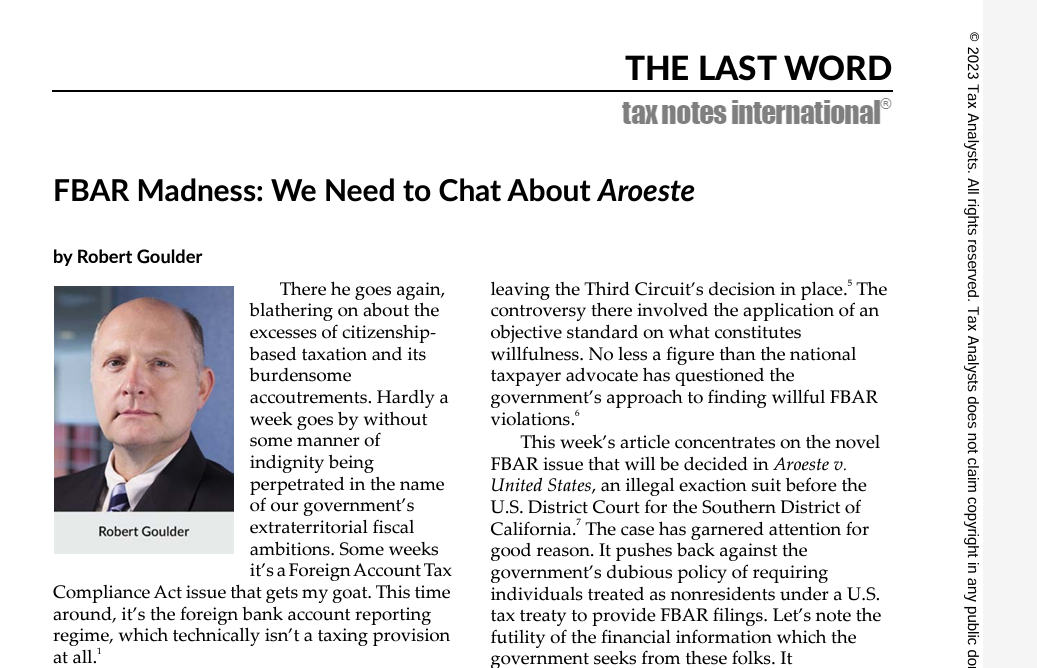
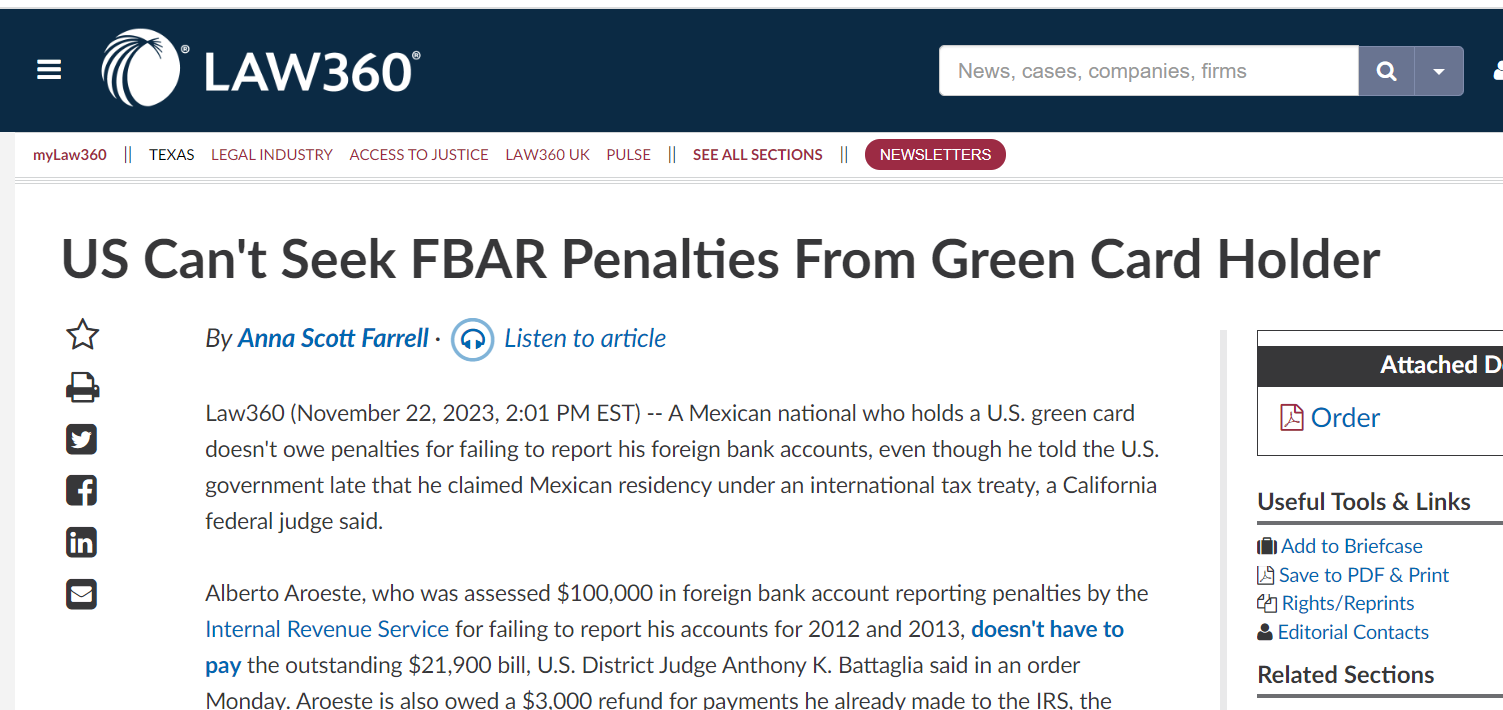
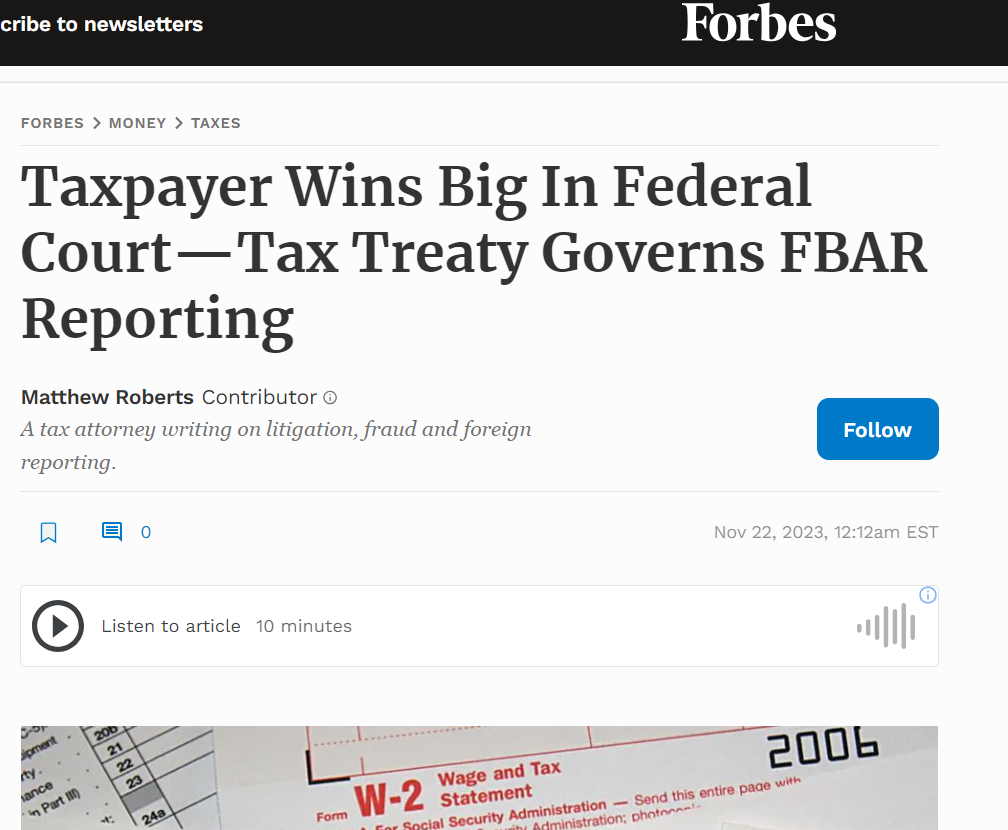
Invalid IRS Notices – the APA – and the 6th Circuit (+Southern District of California, Federal Court in Aroeste v. United States)
The 6th circuit found in 2022 that IRS Notice 2007-83 was not valid. In Mann Construction, Inc. v. United States, 27 F.4th 1138 (6th Cir. 2022), the court concluded that the Notice failed to comply with the APA’s notice-and-comment procedure. Specifically, the Court stated:
Several taxpayers complain about the Internal Revenue Service’s enforcement of an administrative regulation that requires them to report transactions involving cash-value life insurance policies connected to employee-benefit plans. The taxpayers claim that the IRS failed to meet a reporting requirement of its own by skipping the notice-and-comment process before promulgating this legislative rule. If individuals “must turn square corners when they deal with the government,” the taxpayers insist, “it cannot be too much to expect the government to turn square corners when it deals with them.” Niz-Chavez v. Garland , ––– U.S. ––––, 141 S. Ct. 1474, 1486, 209 L.Ed.2d 433 (2021). We agree with the taxpayers and reverse the district court’s contrary decision.
Mann Constr., Inc. v. United States, 27 F.4th 1138 (6th Cir. 2022)
When the Internal Revenue Service levied tax penalties against Mann Construction and its owners under one of its regulations, technically a Notice, the taxpayers replied that the IRS violated the Administrative Procedure Act. In a prior opinion, we held that the Notice violated the APA. The IRS voluntarily refunded the penalties to the plaintiffs and agreed not to apply the Notice to the taxpayers in the future. Even so, the district court on remand proceeded to invalidate the regulation nationwide. Because the dispute is moot, we vacate the district court’s decision.
Importantly, in the Mann decision – The IRS refunded the past penalties with interest, abated the unpaid penalties, and agreed not to apply the Notice to these taxpayers or anyone else within the Sixth Circuit. See I.R.S. Announcement 2022-28, 2022-52 I.R.B. 659 (Dec. 27, 2022).
How the IRS will respond to the Notice issue in Aroeste remains to be written:
Recent Articles re: Aroeste v. United States (Tax Treaty – Nonresident; Lawful Permanent Resident) – IRS Notice 2009-85 Lacks Authority
There have been numerous articles being written about the key case of the author (Patrick W. Martin) who has represented Mr. and Mrs. Aroeste for nearly 8 years.
Federal Court Determines IRS “Guidance for Expatriates Under Section 877A” – IRS Notice 2009-85: “Is Not Binding Authority”
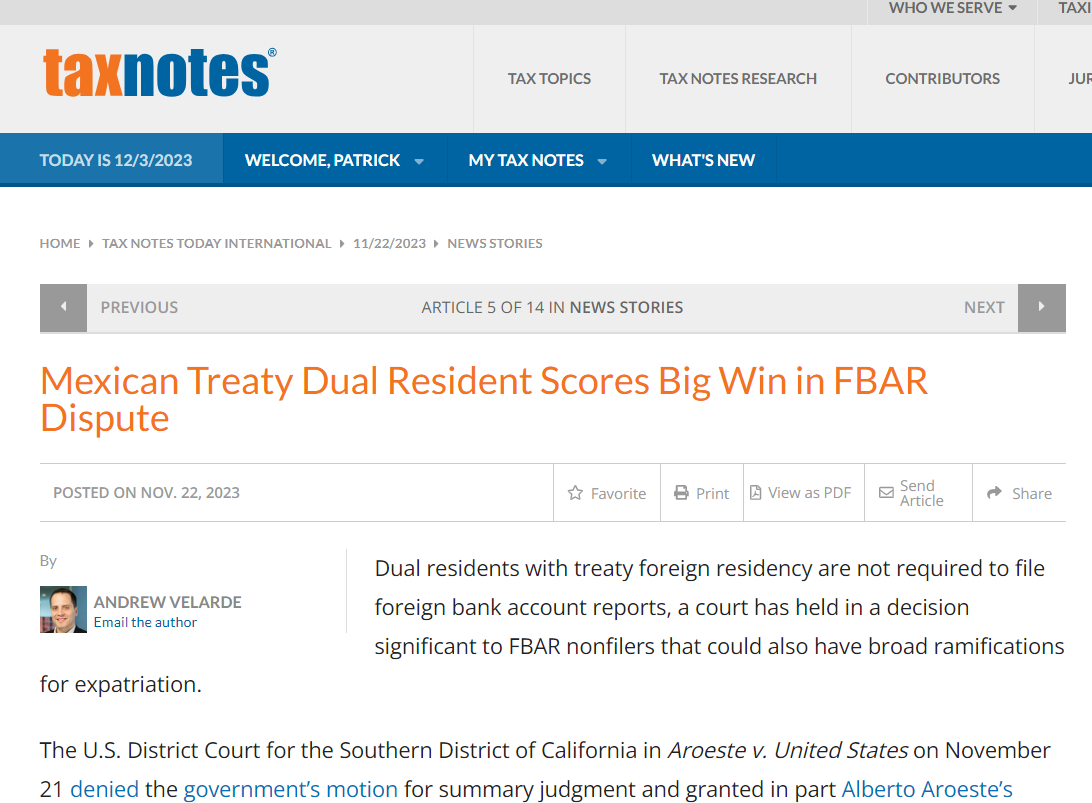
The Federal District Court made numerous key legal findings in its Order on November 20, 2023; in Aroeste v. United States, Case No. 22-cv-00682-AJB-KSC. One of the more significant findings was that IRS Notice 2009-85 is not binding authority. This blog is dedicated to tax expatriation related matters under U.S. law.
IRS Notice 2009-85 is Not Binding Authority per the Court
expatriation.com has represented him for several years throughout the IRS audits and the on-going U.S. Tax Court cases along with his wife.
While many may consider this case to be a Title 31/FBAR case (which it is), it has greater ramifications under the tax expatriation laws in the author’s view. The finding by this Court regarding IRS Notice 2009-85 is significant with far reaching implications. The IRS Notice 2009-85 is broad in its scope and is more than 60 pages in length. It notes that, “Section 877A(i) provides that the Secretary shall prescribe such regulations as may be necessary or appropriate to carry out the purposes of section 877A.” (p.4)
No Treasury Regulations Ever Issued – After 15 Years of IRS Notice 2009-85
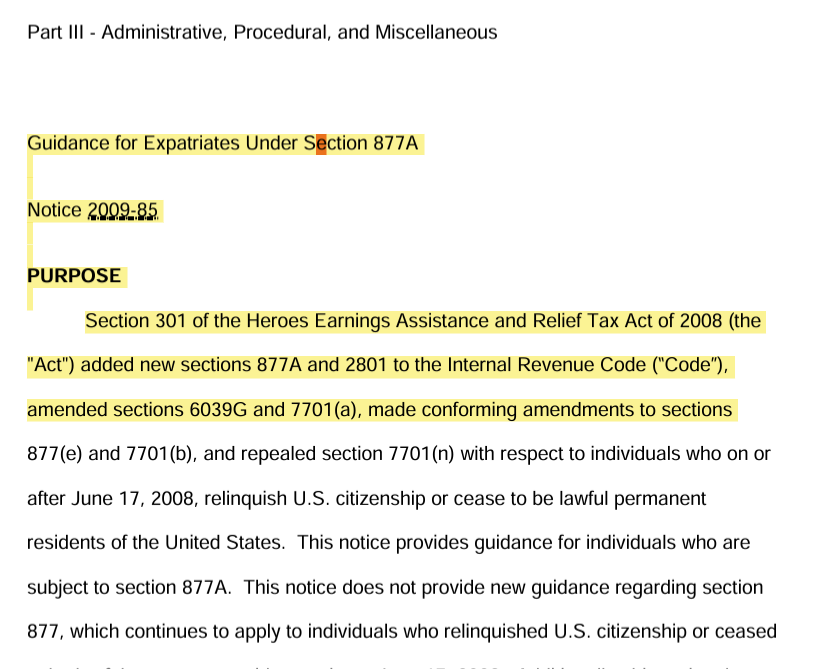
The Treasury Department never issued regulations under 877A, which is now 15 years old. The notice provides the historical background as follows:
Notice 2009-85 PURPOSE Section 301 of the Heroes Earnings Assistance and Relief Tax Act of 2008 (the “Act”) added new sections 877A and 2801 to the Internal Revenue Code (“Code”), amended sections 6039G and 7701(a), made conforming amendments to sections 877(e) and 7701(b), and repealed section 7701(n) with respect to individuals who on or after June 17, 2008, relinquish U.S. citizenship or cease to be lawful permanent residents of the United States. This notice provides guidance for individuals who are subject to section 877A.
The Court in Aroeste concluded that Mr. Aroeste ceased to be a lawful permanent resident.
Specifically, the Court finds Aroeste . . . ceased to be treated as a lawful permanent resident of the United States because he commenced to be treated as a resident of Mexico under the Treaty, did not waive the benefits of such Treaty, and notified the Secretary of the commencement of such treatment.
Many practitioners have questioned the accuracy and validity of many of the conclusions asserted in the 2009 notice; such as the timing of when someone becomes a “covered expatriate”. How and why they become a “covered expatriate” by the concepts introduced in the 2009 notice. The multiple examples presented, reflecting various tax outcomes according to the IRS, were never commented on by the public.
Another question many have raised is the effectiveness of IRS Form 8854? Throughout the notice, the IRS uses the word “must” some 88 times regarding the individual who ceased to be a U.S. citizen or a “lawful permanent resident” (or in some instances references to third parties). Does the IRS imply that if any of these “must”/conditions imposed under the notice are not satisfied, the individual is necessarily a “covered expatriate” with the adverse tax consequences that might follow?
Are their other adverse tax consequences that might follow? For instance, can the IRS repeatedly assert international information penalties regarding the individual’s
companies in her own country,
beneficiary rights of a trust or an estate in her own country, or
other investment assets or financial accounts in her country of residence that might be deemed a “specified foreign financial asset” if the individual is a United States person”?
For instance, the 2009 notice provides that a “covered expatriate” must file a “dual status return” and file a Form 1040NR with a 1040 attached as a schedule for the “year of expatriation”. See, IRS Notice 2009-85, p. 49.
The IRS goes on to say in that notice that individuals “must file Form 8854 in order to certify, under penalties of perjury, that they have been in compliance with all federal tax laws during the five years preceding the year of expatriation.” Id., p. 50. The government asserts that if this condition is not satisfied, the individual will necessarily be treated as ” . . . covered expatriates within the meaning of section 877A(g) whether or not they also meet the tax liability test or the net worth test.“
These would be pretty damning consequences to an individual, if they otherwise met the statutory test of certifying compliance with the tax laws for the preceding five years.
Importantly, the Court in Aroeste v. United States concluded as a matter of law that 2009-85 is not binding authority as it fails to comply with the Administrative Procedures Act (“APA”). It concluded Mr. Aroeste did not need to file Form 8854 with his amended returns. He had filed Form 8833 – treaty based reporting.
The court cited to ” . . . Green Valley Investors, LLC v. Comm’r of Internal Revenue, 159 T.C. No. 5, at *4 (Nov. 9, 2022)) (under the APA, agencies must follow a three-step procedure for “notice-and-comment” rulemaking, but this requirement does not apply to “interpretive rules, general statements of policy, or rules of agency organization, procedure, or practice.”).) The Court agrees. In Mann Construction, Inc. v. United States, 27 F.4th 1138 (6th Cir. 2022), the court found that Notice 2007-83 failed to comply with the APA’s notice-and-comment procedure. Similarly here, because Notice 2009-85 has not been subject to a notice-and-comment procedure, it does not comply with the APA and thus is not binding. As such, Aroeste was not required to file Form 8854 with his amended returns.”
None of these comments represent legal advice. Complex laws applied to specific facts require a legal expert to opine on the consequences and recommended courses of action. It is worth noting that individuals who have a “green card” and who have not previously articulated the application of a U.S. income tax treaty, should consider taking proactive steps to protect their rights under the law. Also, United States citizens who formally renounced their citizenship, who may never have taken specific tax reporting positions should consider taking proactive steps to help avoid the risk the IRS might assert substantial penalties or conclude the individual became a “covered expatriate”.
Federal District Court Rules in Favor of Mexican Citizen – Aroeste vs. United States (LPR) – Tax Treaty Applies: Government’s Motion for Summary Judgment is Denied
Last week (Nov. 20, 2023), Judge Battaglia in the Southern District of California (San Diego) ruled in favor of our client Mr. Alberto Aroeste regarding the application of the U.S.-Mexico Tax Treaty. The DOJ, Tax Division arguments on behalf of the Internal Revenue Service in the case (and their Motion for Summary Judgment – MSJ) were largely rejected by the Court.
A thorough read of the Order from the Court is recommended to understand the substantial legal findings and legal analysis made by the Court relevant to those who possess a “green card” referred to as “lawfully admitted for permanent residence” in Title 8, § 1101(a)(13) [Immigration and Nationality Act]. Key to this case, Title 26, § 7701(b)(6) [Federal Tax Code] then rather contorts the concept by saying an individual is a “lawful permanent resident” in accordance with immigration laws; but then goes on to put conditions on who apparently is a “lawful permanent resident” for federal tax purposes. While immigration law requires the individual be ” . . . accorded the privilege of residing permanently in the United States as an immigrant in accordance with the immigration laws, such status not having changed”; the tax definition seems to ignore that status (i.e., has it changed and is the personal no longer accorded the privilege of residing permanently in the U.S.?).
The Board of Immigration Appeals (the “Board”), has long recognized that an alien’s status may change by operation of law, such that an alien may abandon his LPR status without a finding of removability (or, formerly, deportability or excludability) after a formal adjudicatory process. See United States v. Yakou, 428 F.3d 241, 247 (D.C. Cir. 2005); at 247-51 (discussing case law regarding abandonment and holding that an alien may abandon LPR status without formal administrative action); see also Matter of Quijencio, 15 I. & N. Dec. 95 (B.I.A. 1974); Matter of Kane, 15 I. & N. Dec. 258 (B.I.A. 1975); Matter of Muller, 16 I. & N. Dec. 637 (B.I.A. 1978); Matter of Abdoulin, 17 I. & N. Dec. 458, 460 (B.I.A. 1980); Matter of Huang, 19 I. & N. Dec. 749 (B.I.A. 1988).
The Court did not need to get into the nuances of immigration law to rule against the government in this case.
Some of the substantial takeaways from the decision are:
Waiver of the Tax Treaty: The government cannot assert an individual waived the treaty law because she initially filed the wrong IRS forms (1040) instead of the non-resident form (1040NR) and IRS Form 8833.
The Court agrees with Aroeste. Although Aroeste gave untimely notice of his treaty position, the Court finds this does not waive the benefits of the Treaty as asserted by the Government. Rather, I.R.C. § 6712 provides the consequences for failure to comply with I.R.C. § 6114, namely a penalty of $1,000 for each failure to meet § 6114’s requirements of disclosing a treaty position.
Aroeste v United States – Order 20 Nov 2023 (p. 17)
Expatriation Tax form – IRS Form 8854: Validity and its Failure to Comply with the Administrative Procedure Act (“APA”)
C. Whether Aroeste Was Required to File Form 8854 The Government next argues that even if the IRS had accepted Aroeste’s amended returns, neither amended return would have properly notified the IRS of a commencement of treaty benefits because both failed to attach Form 8854, as required by IRS Notice 2009-85. (Doc. No. 76-1 at 4–5.) The Government concedes Aroeste attached Form 8833 to both amended forms. (Id.) Aroeste responds that Notice 2009-85 is not binding authority as it fails to comply with the Administrative Procedures Act (“APA”). (Doc. No. 78-1 at 8 (citing Green Valley Investors, LLC v. Comm’r of Internal Revenue, 159 T.C. No. 5, at *4 (Nov. 9, 2022)) (under the APA, agencies must follow a three-step procedure for “notice-and-comment” rulemaking, but this requirement does
not apply to “interpretive rules, general statements of policy, or rules of agency organization, procedure, or practice.”).) The Court agrees. In Mann Construction, Inc. v. United States, 27 F.4th 1138 (6th Cir. 2022), the court found that Notice 2007-83 failed to comply with the APA’s notice-and-comment procedure. Similarly here, because Notice 2009-85 has not been subject to a notice-and-comment procedure, it does not comply with the APA and thus is not binding. As such, Aroeste was not required to file Form 8854 with his amended returns.
Aroeste v United States – Order 20 Nov 2023 (p. 11)
Tax Treaty Law Applies – Article 4 Regarding Tax Residency
Various detailed analysis and discussions from the Court –
Aroeste v United States – Order 20 Nov 2023 (p. 11-14)
The Preamble to the FBAR Regulations is Not the Law –
. . . the Government points to the preamble to the 31 C.F.R. Part 1010 regulations, providing that “[a] legal permanent resident who elects under a tax treaty to be treated as a non-resident for tax purposes must still file the FBAR.” Amendment to the Bank Secrecy Act Regulations—Reports of Foreign Financial Accounts, 76 Fed. Reg. 10234-01 (Feb. 24, 2011). The Court finds this unavailing. The Government’s argument does not refute the plain language of the FBAR regulations, which explicitly invoke provisions of Title 26, including the provision that requires consideration of an individual’s status under an applicable tax treaty for the purpose of determining whether an individual is a “United States person” subject to FBAR filing. Specifically, Title 31 C.F.R. § 1010.350, which governs reporting of FBARs, subsection (b)(2) states that a “resident of the United States is an individual who is a resident alien under 26 U.S.C. 7701(b) and the regulations thereunder . . . .” The Government fails to cite to any case law or statue indicating otherwise, and the Court finds none. As such, because the Court finds the Treaty applicable to Aroeste, then the residence provisions of the Treaty, or the “tie breaker rules” dictates whether Aroeste may be treated as a nonresident alien.
Aroeste v United States – Order 20 Nov 2023 (p. 14)
This is the third court case (the other two were in U.S. Tax Court) I have had over the last several years where the IRS tried to assess substantial penalties and taxes against LPRs who resided substantially outside the United States. The other two cases were conceded by the IRS prior to going to trial. One case had over US$40M at stake as assessed by the IRS. This case, in federal district court, was pushed all the way to this favorable (to Mr. Aroeste and those around the world in similar circumstances) outcome by the government. We were successful with all of these non-U.S. citizen cases (two brothers from Mexico and an individual from Germany).
The DOS asserts that it has to receive a new certification from the Internal Revenue Service (IRS) that the United States Citizen (USC) has “satisfied the seriously delinquent tax debt” before it can process the passport application or renewal. This sample letter from a specific case, provides the USC with 90 days to resolve the issue with the IRS in order for his name to be removed from the certified list.
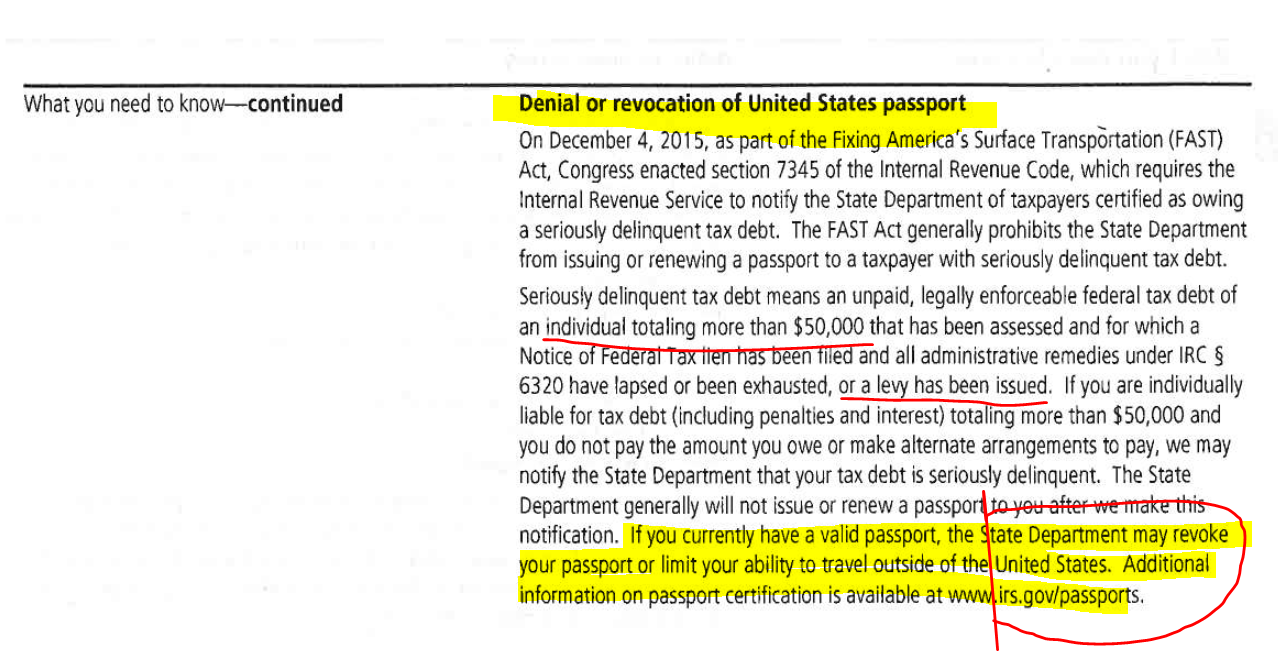
The U.S. Department of State generally will not renew your passport or issue a new passport to you after receiving this certification from the IRS, and they may revoke or place limitations on your current passport.
The last FAQ set forth in this summary is as follows:
I’m a U.S. citizen living overseas and have plans to return to the U.S. Will I be able to return?
Yes. Under Internal Revenue Code Section 2714(e)(2)(B), if the U.S. Department of State decides to revoke your passport, they may either limit your passport only for return travel to the U.S., or issue you a limited passport that only permits return travel.
Taxpayer’s Advocate (TAS) and Passport Revocations – Unconstitutional Restriction on Right to Travel Internationally?
As the State Department starts rolling out more letters denying U.S. passport renewals and initial applications on the backs of IRS Notices CP 508C to U.S. citizens (USCs); USC taxpayers are highly motivated to address their “seriously delinquent tax debts.” What rights do USCs have vis-a-vis these government allegations in their tax certifications?
For a deep dive into a range of issues that USCs need to consider, if they find themselves on the side of an unfortunate IRS Notices CP 508C – see the TAS’s excellent Interim Guidance Memorandum dated April 26, 2018. One key point made by the TAS memo is:
The right to travel internationally is a fundamental right, protected by the Due Process Clause of the Constitution. Under the Universal Declaration of Human Rights, adopted in 1948 by the United Nations after a unanimous vote (including the United States) “[e]veryone has the right to leave any country, including his own, and to return to his country.” The National Taxpayer Advocate expressed concerns that the IRS’s implementation of the passport program fails to protect taxpayers’ right to travel as well as their rights promised under the Taxpayer Bill of Rights. See the National Taxpayer Advocate’s blog and the Fiscal Year 2018 Objectives Report to Congress.
The U.S. Supreme Court, in an opinion penned by retired Justice Souter in Sosa v. Alvarez-Machain (2004), has some interesting observations about the Universal Declaration of Human Rights (which is cited above by the Taxpayer Advocate) limiting its application in the Alvarez-Machain case. This is a fascinating case to read, as it arises out of the tragic torture and murder of a DEA agent, Enrique Camarena-Salazar in 1985 in Mexico. Physician Alvarez-Machain was subsequently indicted in the U.S. as part of the torture and murder scheme and the DEA hired private Mexican nationals to seize Alvarez and bring him to the United States in a private plane to stand trial.
Alvarez-Machain was ultimately granted motion for a judgement of acquittal on the criminal charges.
In response, Alvarez-Machain then sued the federal government under the Federal Tort Claims Act and the Alien Tort Statute.
The Supreme Court opined (on these tort action claims and the application of international law as to U.S. federal tort statutes) as follows:
. . . To begin with, Alvarez cites two well-known international agreements that, despite their moral authority, have little utility under the standard set out in this opinion. He says that his abduction by Sosa was an “arbitrary arrest” within the meaning of the Universal Declaration of Human Rights (Declaration), G. A. Res. 217A (III), U. N. Doc. A/810 (1948). And he traces the rule against arbitrary arrest not only to the Declaration, but also to article nine of the International Covenant on Civil and Political Rights (Covenant), Dec. 19, 1996, 999 U. N. T. S. 171,22 to which the United States is a party, and to various other conventions to which it is not. But the Declaration does not of its own force impose obligations as a matter of international law. See Humphrey, The UN Charter and the Universal Declaration of Human Rights, in The International Protection of Human Rights 39, 50 (E. Luard ed. 1967) (quoting Eleanor Roosevelt calling the Declaration “ ‘a statement of principles … setting up a common standard of achievement for all peoples and all nations’ ” and “ ‘not a treaty or international agreement … impos[ing] legal obligations’ ”).23 And, although the Covenant does bind the United States as a matter of international law, the United States ratified the Covenant on the express understanding that it was not self-executing and so did not itself create obligations enforceable in the federal courts. . . [emphasis added]
Section 7345(e) provides for judicial review of the IRS’s certifications of “seriously delinquent tax debts” as follows:
(e)Judicial review of certification
(1)In general
After the Commissioner notifies an individual under subsection (d), the taxpayer may bring a civil action against the United States in a district court of the United States or the Tax Court to determine whether the certification was erroneous or whether the Commissioner has failed to reverse the certification.
(2)Determination
If the court determines that such certification was erroneous, then the court may order the Secretary to notify the Secretary of State that such certification was erroneous.
Surely, the U.S. Tax Court and Federal District Courts will have much more to say about the rights of USCs who have their U.S. passports revoked or renewals denied by application of 26 U.S.C. 7345. Will the Universal Declaration of Human Rights be meaningful to the Courts applying Section 7345?
How many errors will the IRS make in issuing certifications of “seriously delinquent tax debts” to USCs around the world?
22. Article nine provides that “[n]o one shall be subjected to arbitrary arrest or detention,” that “[n]o one shall be deprived of his liberty except on such grounds and in accordance with such procedure as are established by law,” and that “[a]nyone who has been the victim of unlawful arrest or detention shall have an enforceable right to compensation.” 999 U. N. T. S., at 175—176.
23. It has nevertheless had substantial indirect effect on international law. See Brownlie, supra, at 535 (calling the Declaration a “good example of an informal prescription given legal significance by the actions of authoritative decision-makers”).
Part II: Example of United States Department of State – Letter Denying Passport Renewal – The Time has Really Come: Revocation or Denial of U.S. Passports as IRS Begins Issuing Notices to U.S. citizens
Earlier posts have addressed Section 7345 of Title 26 and how the U.S. Department of State (DOS) will deny the renewal of passports.
The IRS has purportedly issued tens of thousands of IRS Notices CP 508C to U.S. citizen (USC) taxpayers during the first part of this year, 2018.
We have now started seeing examples of the letters issued by the DOS. They are harsh and direct.
See here such a letter, with identifying information redacted.
The letter from the DOS says it is obliged to comply with the letter from the Department of Treasury’s Internal Revenue Service (IRS) certifying the USC has a “seriously delinquent tax debt.” The letter goes on to say that it has no actual information concerning the “seriously delinquent tax debt” and it is the IRS who must be contacted.
The DOS essentially “washes its hands” of this legal issue, by simply saying the USC taxpayer must resolve the issue within ninety days directly with the IRS.
Only after “”these arrangements” have been made with the IRS, can the USC taxpayer contact the National Passport Information Center according to the letter.
There are a host of legal issues and practical problems that USC taxpayers face in these circumstances. Many of these will be covered in later posts.
At the time, it was clear that the IRS and the Department of Justice was going to take a substantial amount of time to actually implement what is a major change in the law. In short, the IRS has the power and obligation to notify the Secretary of State to (i) deny a U.S. citizen (the “Taxpayer”) a U.S. passport, or (ii) revoke or not renew a U.S. passport of the Taxpayer. The law is not clear as to what steps the Department of State will necessarily take in response to the notification.
Now the administrative machine is in full force as the IRS has begun issuing special notices to restrict or ban a U.S. passport of the Taxpayer. See, IRS Notice – Notice 2018–01 and a dedicated portion of the IRS website that focuses on Section 7345 titled Revocation or Denial of Passport in Case of Certain Unpaid Taxes.
The IRS has begun issuing notices required under the law for those Taxpayers who the IRS asserts have “seriously delinquent tax debt” as defined in the law – Taxpayer Notification –Notices CP 508C.
The Department of State’s website uses mandatory language regarding revoking, issuing or renewing a U.S. passport of U.S. citizens (“USCs”) once they have received certification from the Secretary of the Treasury –
If you have been certified to the Department of State by the Secretary of the Treasury as having a seriously delinquent tax debt, you cannot be issued a U.S. passport and your current U.S. passport may be revoked.
If you are overseas you may be eligible for a limited passport good for direct return to the United States.
We would suggest that if you have seriously delinquent tax debt, you contact the IRS to resolve your debt before applying for a passport. If you do not resolve your tax issues before applying for a passport, your application will be delayed or denied.
Indeed, a key representative from the IRS personally told me in Washington D.C. this May that the first batch of Notices CP 508C were issued as sort of a test batch of notices. Surely, Taxpayers will be forced to litigate and challenge the validity of these.
For those of us who have dedicated our professional lives to these issues, we see that probably more often than not, IRS notices of amount of taxes owing are erroneous. The IRS will use their own determinations of amount of taxes, penalties and interest owing, as in this example of a USC residing overseas:
There are two different judicial remedies a Taxpayer who is a USC can choose; file a suit in either U.S. Tax Court or a U.S. District Court to determine the validity or erroneous nature of any particular Notice CP 508C.
In addition, the IRS is now warning Taxpayers they may lose their passport in Notices of Intent to Levy. The following is sample text from a recent Notice from the IRS to a USC residing outside the U.S.
It has been reported that tens of thousands of IRS Notices CP 508C have been issued to Taxpayers during 2018. It remains to be seen the actual numbers of U.S. passports that will be revoked or denied by the Department of State upon receiving notice from the Secretary of Treasury (which notice is certified by the Commissioner of the Internal Revenue Service).
Generally, it will be the IRS Chief Counsel lawyers who litigate these issues before the U.S. Tax Court and the Department of Justice, Tax Division lawyers who litigate before the U.S. District Courts.
U.S. Citizens Overseas who Wish to Renounce without a Social Security Number will Necessarily be a “Covered Expatriate”
U.S. Citizens Overseas who Wish to Renounce without a Social Security Number (“SSN”) will Necessarily be a “Covered Expatriate”
The Dilemma of SSNs, TINs and USCs Residing Overseas
The prior post discussed some of the complications of United States Citizens (“USCs”) who reside outside the U.S. and do not have a social security number (“SSN”) . This dilemma exists, even though USCs are not generally required to file for or obtain a SSN (e.g., at birth – See, SSA Publication – “Social Security Numbers For Children” page 2, It is not obligatory to file for a SSN at birth. “Must my child have a Social Security number? No. Getting a Social Security number for your newborn is voluntary. But, it is a good idea to get a number when your child is born. . . . ).
. . . the IRS’ increased focus on international tax compliance has made clear that USCs residing overseas have U.S. tax return filing obligations, even if they have no assets, no income, or no real personal connections in or with the U.S. See IRS notice from 2011 which addresses numerous aspects of tax compliance for USCs overseas, including various penalties under the law[1]:
. . . U.S. Citizens or Dual Citizens Residing Outside the U.S. . . .
The IRS is aware that some taxpayers who are dual citizens of the United States and a foreign country may have failed to timely file United States federal income tax returns or Reports of Foreign Bank and Financial Accounts (FBARs), despite being required to do so. . . .2. Penalties imposed for failure to file income tax returns or to pay tax . . . 3. Possible additional penalties that may apply in particular cases . . . 6. Possible penalties for failure to file FBAR . . . 7. New reporting requirement for foreign financial assets . . . [emphases added]
USCs residing overseas are subject to the range of tax penalties that apply to all individual taxpayers (e.g., negligence penalties, failure to file penalties, late payment or failure to pay penalties, etc.).[2] Additionally, USCs residing overseas are subject to other, typically much harsher penalties for not timely filing U.S. federal information returns regarding assets located outside the U.S.[3]; alluded to above in the IRS 2011 notice.[4]
These civil penalties typically are a minimum of US$10,000 per statutory violation. USCs who live outside the U.S. necessarily have assets, such as financial accounts in their country of residence. These Title 26 information reporting requirements[5] are referred to herein as “International Information Returns.”
The IRS will not process federal tax returns and International Information Returns without a valid TIN.[6] Plus, the law does not provide for an exception for USCs overseas who do not file returns, if they do not have a SSN. Late filed, or incomplete International Information Returns and tax returns (e.g., lacking a SSN) will typically subject USCs to these penalties even in those cases when the taxpayer has no federal income tax liability.[7]
[1]See, IRS FS-2011-13, December 2011, updated February, 2014.
[2]See, IRS FS-2011-13 and as a sample of some of the many statutory penalties that could typically apply, IRC §§ 6048, 6652(f), 6677, 6654, 6655, 6698, 6699, 6166, 6653, 6675, 6715, 6715A, 6717, 6718, 6719, 6720A, 6725, et. seq.
[7]See, IRC §§ 911 (foreign earned income exclusion) and 901 (foreign tax credit), et. seq. A USC residing overseas may have no actual federal income tax liability (for various reasons), typically due to the foreign earned income exclusion and/or foreign tax credit calculation.
The above explains fairly clearly the dilemma facing USCs residing overseas.
The complexity of getting a SSN and the requirements are covered in more detail in the paper. Some key points are:
I. The Social Security Administration Rules Make it Nearly Impossible for Many USCs Overseas to Reasonably Obtain a SSN
The policy and procedures of the SSA regarding issuing SSNs have changed significantly over the years.[1] The Social Security Administration (SSA) provides a detailed chronology of the major changes in policy and procedures regarding filing for and obtaining a SSN.[2] One of the most significant revisions in the last decade came from The Intelligence Reform and Terrorism Prevention Act of 2004 (P.L. 108-458), which imposes various standards for the verification of documents or records submitted by an individual.
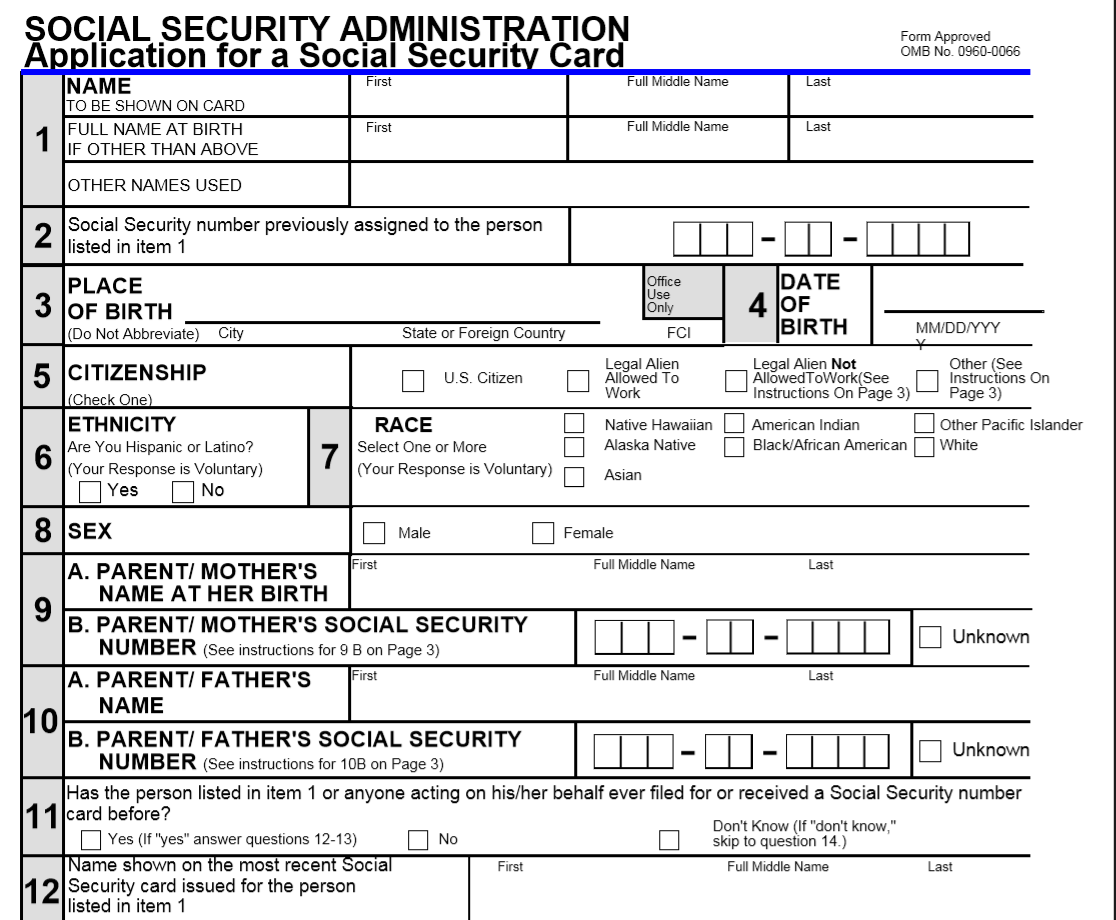
A. Only a Few Countries Around the World have Personnel at U.S. Embassies or Consulate Offices that Can Process SSN Applications – SSA Form SS-5-FS
Applying for SSNs overseas is severely restricted compared to an application in the U.S.
According to the U.S. Department of State, Foreign Affairs Manual (“FAM”), only certain “Claims-Taking Posts” in specific countries “may” include “processing applications for Social Security Numbers.” [3]
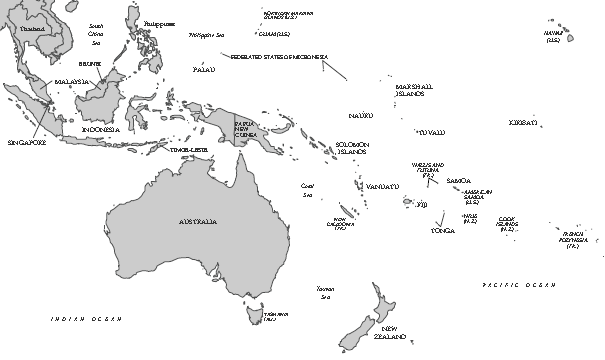
These 17 countries (and a city in the case of Jerusalem) with Claims-Taking Posts include:
“Austria, Argentina, Costa Rica, Dominican Republic, France, Germany, Greece, Ireland, Italy, Japan, Jerusalem, Mexico, Norway, Philippines, Poland, Portugal, Spain, and the United Kingdom.”
Noticeably absent are many Western European countries, virtually all of Latin America, virtually all of Asia, virtually all of Eastern Europe, all of the Middle East (except Jerusalem), all of the African continent, all of the Australian continent and surrounding island countries and Russia, among many other significant countries, including OECD member countries.[4]
Nothing in the FAM requires any of these “Claims-Taking Posts” to actually process applications for a SSN. Plus, there are of course hundreds of other countries throughout the world, not listed above, which do not have such a U.S. Department of State Post. For these reasons, USCs in countries such as China must travel to a U.S. Department of State Post (e.g., the Philippines) which is able to process applications for SSNs.
[2]See, SSA website, Significant Milestones in Social Security Number Policy. A detailed chronology of the major changes in policy and procedures. http://www.ssa.gov/history/ssn/ssnchron.html.
[4] In contrast to these 17 countries (and one city – Jerusalem) where a USC residing overseas must travel to apply for a SSN, the Treasury Department has announced it has around 100 countries that have signed, or “have reached agreements in substance” a FATCA IGA. USCs throughout the world are required by the Foreign Account Tax Compliance Act (“FACTA”) to provide their U.S. TIN to financial institutions throughout the world (on IRS Form W-9, or its equivalent), which under current law necessarily must be a SSN. Of course, if they have no SSN, they cannot sign IRS Form W-9 which provides in Part II: “Under penalties of perjury, I certify that: 1. The number shown on this form is my correct taxpayer identification number . . .”
The Necessary “Covered Expatriate Status” of a USC without a SSN
If a USC has no SSN, they by definition will never be able to comply with the Certification Requirement of Section 877(a)(2)(C) since they will not be able to comply with IRC § 6109(a) and Treas. Reg. § 301.6109-1. As the SSN/TIN paper explains:
All United States citizens (“USCs”) must have a social security number (“SSN”) under current law as their TIN to file a federal income tax return.[1]
[1] See, IRC § 6109(a) and Treas. Reg. § 301.6109-1.
The IRS will not process federal tax returns and “International Information Returns”, as defined below, without a valid TIN[1]; which currently must be a SSN for a USC.
These numbers of I-407 forms filed annually were obtained through a freedom of Information Act (“FOIA”) request and provided by the USCIS. See tabl:
Of course, this statistic does NOT identify the number of the approximate 13.3+ million LPRs who leave the U.S. to live elsewhere in another country without completing Form I-407 and formally abandoning. The estimated number of LPRs was 13.3 million for the year 2012 as reported by the Office of Statistics of the DHS. See, Estimates of the Legal Permanent Resident Population in 2012.
Maybe the number of individuals who fall into this latter category (i.e., moving out of the U.S. without filing Form I-407) is several hundred of thousands of individuals annually?
Importantly, from a taxation perspective, anyone who moves and lives in a country with a U.S. income tax treaty (the list of these countries is set out below – from the IRS website), needs to be careful not to be deemed to be a “covered expatriate” due to the application of IRS Form 7701(b)(6). See, IRS Notice 2009-85.








 address their “seriously delinquent tax debts.” What rights do USCs have vis-a-vis these government allegations in their tax certifications?
 Alvarez and bring him to the United States in a private plane to stand trial.
 At the time, it was clear that the IRS and the Department of Justice was going to take a substantial amount of time to actually implement what is a major change in the law. In short, the IRS has the power and obligation to notify the Secretary of State to (i) deny a U.S. citizen (the “Taxpayer”) a U.S. passport, or (ii) revoke or not renew a U.S. passport of the Taxpayer. The law is not clear as to what steps the Department of State will necessarily take in response to the notification.