The Information in DHS/USCIS Database (A-Files, EMDS, CIS, PII, eCISCOR, PCQS, Midas, etc.) on Individuals is Extensive and Can be Shared with Internal Revenue Service
A prior post discussed the new USCIS Form I-407 that must be filed by a lawful permanent resident (LPR) who wishes to formally create a record of their abandonment of LPR status. See, More Information and More Information: USCIS Creates New Form for Abandonment of Lawful Permanent Residency
Page 1 of 2 of this form is replicated here.
This raises many questions regarding how information maintained by the Department of Homeland Security (DHS) and the United States Customs and Immigration Service (USCIS) can be shared with
and provided to the IRS.
Former “long-term residents” have extensive U.S. tax compliance obligations, including certification requirements under Section 877(a)(2)(C) to avoid “covered expatriate” status and the various adverse tax consequences.
Importantly many LPR individuals will have “expatriated” without actually having filed USCIS Form I-407. See, Oops…Did I “Expatriate” and Never Know It: Lawful Permanent Residents Beware! International Tax Journal, CCH Wolters Kluwer, Jan.-Feb. 2014, Vol. 40 Issue 1, p9
Some of the important records that are maintained by DHS/USCIS, include the following, much of which can be helpful in the enforcement of U.S. federal tax obligations.
System location:
Alien Files (A-Files) are maintained in electronic and paper format throughout DHS. Digitized A-Files are located in the Enterprise Document Management System (EDMS). The Central Index System (CIS) maintains an index of the key personally identifiable information (PII) in the A-File, which can be used to retrieve additional information through such applications as Enterprise Citizenship and Immigrations Services Centralized Operational Repository (eCISCOR), the Person Centric Query Service (PCQS) and the Microfilm Digitization Application System (MiDAS). The National File Tracking System (NFTS) provides a tracking system of where the A-Files are physically located, including whether the file has been digitized.
The databases maintaining the above information are located within the DHS data center in the Washington, DC metropolitan area as well as throughout the country. Computer terminals providing electronic access are located at U.S. Citizenship and Immigration Services (USCIS) sites at Headquarters and in the Field throughout the United States and at appropriate facilities under the jurisdiction of the U.S. Department of Homeland Security (DHS) and other locations at which officers of DHS component agencies may be posted or operate to facilitate DHS’s mission of homeland security.
* * *
Categories of records in this system include:
A. The hardcopy paper A-File, which contains the official record material about each individual for whom DHS has created a record under the INA such as: naturalization certificates; various documents and attachments (e.g., birth and marriage certificates); applications and petitions for benefits under the immigration and nationality laws; reports of arrests and investigations; statements; other reports; records of proceedings before or filings made with the U.S. immigration courts and any administrative or federal district court or court of appeal; correspondence; and memoranda. Specific data elements may include:
- Alien Registration Number(s) (A-Numbers);
- Receipt file number(s);
- Full name and any aliases used;
- Physical and mailing addresses;
- Phone numbers and email addresses;
- Social Security Number (SSN);
- Date of birth;
- Place of birth (city, state, and country);
- Countries of citizenship;
- Gender;
- Physical characteristics (height, weight, race, eye and hair color, photographs, fingerprints);
- Government-issued identification information (i.e., passport, driver’s license):
? Document type,
? issuing organization,
? document number, and
? expiration date;
- Military membership;
- Arrival/Departure information (record number, expiration date, class of admission, etc.);
- Federal Bureau of Investigation (FBI) Identification Number;
- Fingerprint Identification Number;
- Immigration enforcement history, including arrests and charges, immigration proceedings and appeals, and dispositions including removals or voluntary departures;
- Immigration status;
- Family history;
- Travel history;
- Education history;
- Employment history;
- Criminal history;
- Professional accreditation information;
- Medical information relevant to an individual’s application for benefits under the INA before DHS or the immigration court, an individual’s removability from and/or admissibility to the United States, or an individual’s competency before the immigration court;
- Specific benefit eligibility information as required by the benefit being sought; and
- Video or transcript of immigration interview
Subsequent posts will discuss how and when the law allows the IRS to access these records.
More Information and More Information: USCIS Creates New Form for Abandonment of Lawful Permanent Residency
The U.S. Customs and Immigration Service (USCIS) just announced on 23 March 2015, that a new Form I-407 is available and is to be used, per the USCIS website announcement, which announcment provides in part as follows:
New Version of Form I-407 Now Available
USCIS has published a new edition of USCIS Form I-407, Record of Abandonment of Lawful Permanent Status (OMB No. 1615-0130). You can download the form on our website.
You may begin using the revised Form I-407, Record of Abandonment of Lawful Permanent Resident Status today. The current edition is dated 02/26/2015, and we will not accept previous form editions
The new form has additional information compared to the prior form. Specifically, the Alien Registration Number and USCIS ELIS Account Number is required to be included.
Now, the individual is required to state the reasons for abandoning lawful permanent residency status.
Responses to  each of these questions will have important legal consequences, including potential tax implications under IRC Sections 877, 877A, et. seq. See, for instance a prior post: What could be the focal point of IRS Criminal Investigations of Former U.S. Citizens and Lawful Permanent Residents?
One of the important enforcement and practical questions raised, is: Will the IRS be able to better track former “long-term residents” (certain former lawful permanent residents) for purposes of the “expatriation tax” under the new reporting form and system?
As has been explained, if an individual fails to certify under the tax law, they will necessarily be a “covered expatriate”; even if they do not meet the asset or income tax liability thresholds. See a prior post, Certification Requirement of Section 877(a)(2)(C) – (5 Years of Tax Compliance) and Important Timing Considerations per the Statute.
The Problem with PFICs! “Avoid PFICs Like the Plague”
There are typically numerous tax issues that USCs and LPRs need to consider prior to renouncing their citizenship; or abandoning th eir lawful permanent residency status.
One of the most confusing comes from the complex rules of a so-called “PFIC” – the acronym for a “passive foreign investment company.” A prior post in March 2014 discussed the basics of these U.S. tax creatures – “PFICs” – What is a PFIC – and their Complications for USCs and LPRs Living Outside the U.S.
Most USCs and LPRs with basic mutual fund investments in their country of residence have PFICs and probably don’t even know it.
The IRS and Treasury have recently spent much attention and resources to the regulation of PFICs. In January of 2014, temporary regulations were issued regarding PFICs. See, Regulations §1.1291–0T, et. seq.
One of the many new requirements of these regulations are annual information filing requirements. This means that a U.S. taxpayer (e.g., U.S. citizen or LPR) residing outside the U.S., must file an annual report on IRS Form 8621.
- When Might You have a PFIC?
Taxpayers who have simple passive investments in mutual funds based outside the U.S.. e.g., in their country of residence, almost always have PFICs. There is no percentage ownership threshold in the foreign entity that triggers PFIC tax consequences. An ownership interest of 0.000001% triggers the consequences if either the “income test” or “asset test” are satisfied. Other type of investment funds in the form of a legal entity also typically qualify as a PFIC.
Specifically, a PFIC is a foreign corporation in which a U.S. person has some ownership in (without any percentage threshold requirement) if (i) at least 75% of its gross income is passive income (the “income test”), or (ii) at least 50% of its assets produce passive income (the “asset test”). See IRC § 1297(a).
Also, many retirement funds in various countries (including both private and many government run retirement plans) typically fall into the category of a PFIC. For instance, the Singapore retirement fund system, Central Provident Fund (“CPF”), is actually created by the government, but Singapore taxpayers who are obligated to contribute to the retirement fund will select various mutual funds to invest in through the CPF. Hence, these mutual fund investments are PFICs. See also the technical paper regarding Mexican retirement funds that argues, WHY MEXICAN RETIREMENT FUNDS SHOULD NOT BE SUBJECT TO THE NEW REPORTING REQUIREMENTS UNDER IRC SECTION 1298(f).
- Ugly Tax Consequences of a PFIC
PFICs are taxed to the U.S. taxpayer in a very complicated manner compared to taxation of U.S. based mutual funds or other U.S. based investments. In short, the income earned from PFICs, under the default regime, are taxed at the ordinary income rates, and for past years are typically taxed at the highest marginal ordinary income tax rate is 39.6% (even if the income would otherwise qualify for qualified dividend or long-term capital gains rates – which are taxed at no more than 20%).
There are three alternative regimes for how a U.S. investor is taxed in a PFIC: (i) the “excess distribution” regime (which is the default regime); (ii) the qualified electing fund (“QEF”) regime and (iii) the market-to-market (“MTM”) regime. Each of these regimes will be discussed in later posts.
One key point to know is that most foreign investment funds do not keep records and account for income and expenses in a manner that even allows a U.S. taxpayer to report accurately under the QEF or MTM regime, even if such treatment provides a lower overall U.S. tax.
More on how PFICs are taxed in a later post.
- Even Uglier Tax Reporting – Compliance Consequences of PFICs Driven by FATCA
Finally, the 2010 FATCA legislation has led to the new regulations that now require annual reporting of PFICs. This is done on IRS Form 8621. It is a laborious form and requires extensive and detailed information.
The consequences of not reporting can lead to disastrous tax results. See a prior post from March 2014, When the U.S. Tax Law has no Statute of Limitations against the IRS; i.e., for the U.S. citizen and LPR residing outside the U.S.
- Why You Don’t Want to Die with a PFIC or Gift a PFIC Away (even to Your Favorite Charity or Spouse).
Lastly, a later post will explain in more detail why a USC or LPR generally wants to avoid PFICs if at all possible. Many countries require their residents to contribute on a mandatory basis to retirement funds that invest in mutual funds, which may not allow a USC to avoid PFICs. One of the principle reasons to avoid PFICs is the income tax that arises and is owed by the U.S. person, even if he or she tries to give the PFIC away. A gift of a PFIC will typically cause an income tax to the donor in addition to the estate/gift tax rules. This is true for gifts to charity and even to your own spouse.
- Why You Should Avoid PFICs Like the Plague
At the end of the day, the above complications, mean that most USCs and LPRs residing overseas should “avoid PFICs like the plague”.
In the context of USCs who wish to renounce their U.S. citizenship, they will not be able to avoid “covered expatriate” status if they have not complied with these PFIC rules, as they will not be able to “certify under penalty of perjury that he has met the requirements of this title for the 5 preceding taxable years or fails to submit such evidence of such compliance as the Secretary may require.”
The ugly consequences of PFICs can be summarized as follows:
- Higher income tax rate than U.S. based investments on the earnings of the investment, at least under the default method;
- Practically impossible to report the earnings on a more favorable MTM or QEF method;
- Extensive information reporting requirements annually;
- Open ended statute of limitations in favor of the IRS to audit all items on the tax return, for failure to properly file IRS Form 8621;
- Paying a U.S. income tax, even if you gift away the PFIC to charity or to your spouse;
- Trying to even explain effectively the consequences of a PFIC to your tax return preparer; and
- Being subject to the “forever taint” of being a “covered expatriate” for failure to comply with the PFIC rules. See, The “Hidden Tax” of Expatriation – Section 2801 and its “Forever Taint.”
U.S. Tax and Expatriation Tax Laws – They Are What They Are . . .
The point of this post is a fairly simple one. The law is complex, it has evolved significantly over the years and continues to evolve; if for no other reason how the IRS enforces it. Some people might not like the law.
As those who have read and followed Tax-Expatriation.com know; it is not a place to seek legal advice. It provides lots of information – a comprehensive source of information. See, limitations. It also does not attempt to contemplate every scenario when a particular point is made; e.g., as the IRS modifies how they interpret rules or how they enforce them.
For instance, for a fairly comprehensive article about how the law works, see Accidental Americans” – Rush to Renounce U.S. Citizenship to Avoid the Ugly U.S. Tax Web” International Tax Journal,CCH Wolters Kluwer, Nov./Dec. 2012, Vol. 38 Issue 6. The net worth threshold (US$2M) and income tax thresholds (US$124,000, indexed for inflation) are spelled out in that article. It does not have the indexed inflation amounts. See, The “Average Annual Net Income Tax” Amounts for “Covered Expatriate Status” – Increases to US$160,000 for the Year 2015
Every individual who renounces their U.S. citizenship is taking, in what is my view, a very important decision. Many individuals do not like U.S. tax laws; nor the expatriation tax laws. Many individuals around the world do not like their home country tax laws; nor other laws.
This blog is not intended to be a policy blog debating whether the U.S. tax laws are good laws or bad laws. It’s designed to provide information about the law and important developments and relevant information.
Finally, the “blogosphere” is full of people who attempt to write about the law as if they understand it; particularly the complexity of Title 26, the regulations and a host of case law that spans almost 100 years. These opinions are a dime a dozen. Many get it terribly wrong – particularly in this politically charged topic – and will make statements and provide information that sounds attractive to the uninformed. The following is the type of decision that is made every day.
Path 1: If someone tells USC, Mr. X (or if he reads) the following, he might find it quite attractive: “You will have no U.S. tax liabilities if you simply do “steps Y and Z.” Plus, the U.S. federal government will never know and/or they will never be able to collect the taxes from you anyhow. Simple. Would you rather pay $0 or a bunch of money to the U.S. federal government?”
Path 2: On the other hand, if a qualified legal adviser accurately advises USC, Mr. X of the following, he may not find the answer so attractive: “Sorry, given your factual circumstances, you will have US$ 100,00X of immediate income tax liabilities if you simply do steps “Y and Z.” Plus, by doing so, if you ever bequeath or gift your U.S. citizen children, they will have to pay 40% (under current law) of the value of such inheritance or gift in U.S. taxes. This latter tax obligation will not be your obligation, but rather your U.S. citizen children.”
Not surprisingly, Mr. X may well want to take Path 1, because it is the answer he prefers. If Mr. X does steps “Y and Z”, he will now live with the U.S. legal consequences. He well might not like those legal consequences and think they are unfair, unjust or borderline immoral for any government to impose, but that is how laws often work.
U.S. Tax and Expatriation Tax Laws – They Are What They Are . . .
The President’s Proposal is NOT the Same as Current Law – Section 877A(g)(1)(B)
Some individuals are mistaken that the Obama proposal to exempt certain U.S. citizens from taxation (including the “mark to market” exit tax), is the same as the exception in IRC Section 877A(g)(1)(B).
It’s not. They are not the same, although they have some similar requirements (e.g., 5 years of certification of U.S. tax law compliance under penalty of perjury).
For a brief discussion on the President’s proposal, see –The Proposal by the President to Exempt Certain U.S. Citizens from Worldwide Taxation: – Very Small, Select Group
–

There are important differences. Most importantly, the I
RC Section 877A(g)(1)(B) exception requires the individual not only have been a dual citizen (of at least two or more countries) at birth, along with U.S. citizenship; but also continue to reside and be a tax resident of that country, i.e., the country of which they were also a citizen at the time of their birth. This tax residency/dual citizenship rule is necessarily required by I
RC Section 877A(g)(1)(B). If the person has moved to another country, they will not be eligible for this treatment and will be subject to the mark to market “exit tax” if they renounce their U.S. citizenship. Their U.S. heirs and beneficiaries will also be subject to the 40% (current tax rate) tax on “covered gifts” and “covered bequests.”
–
The President’s proposal (if it ever becomes law) will also apparently exempt all qualifying individuals from any type of U.S. taxation; other than tax that would apply to a “non-resident alien” (which would be no U.S. tax – if the individual had no U.S. source income). Not only would no “exit tax” apply, but so too would no U.S. income tax on their income from their country of residence or any other country outside the U.S. The President’s proposal would also exempt them from all U.S. tax filing requirements (other than the 5 years) and from FBAR filing requirements. See,
Nuances of FBAR – Foreign Bank Account Report Filings – for USCs and LPRs living outside the U.S.–
–
Obama Budget Proposal to “Provide Relief for Accidental Americans”? Will the Proposal to Modify the Expatriation Rules Become Law?
[See follow-on post: The Proposal by the President to Exempt Certain U.S. Citizens from Worldwide Taxation: – Very Small, Select Group– published 18 Feb. 2015]
Every year, the President of the United States, releases his proposed budget. The budget is prepared by his team of advisers at the Treasury Department and is known as the “green book“.
For a complete copy of the proposal, that was released on February 2, 2015, see, General Explanations of the Administration’s Fiscal Year 2016 Revenue Proposals (Released February 2015)
Buried deep into the proposal of the US$3.99 trillion fiscal year 2016 expenditure plan, is a provision to “provide relief for certain accidental dual citizens.” See pages 282 and 283 of the proposal.
It appears someone is listening in the Administration at Treasury; at least a little bit? Will Congress similarly be interested in such proposals? See, Will Congress Intervene to make USC based Tax Laws More User Friendly to USCs and LPRs Residing Outside the U.S.?
The proposal would not adopt residency based taxation for all U.S. citizens, as exists in the rest of the world, but would exclude certain U.S. citizens from the “mark to market” tax on expatriation (i.e., the “exit tax”). See, “Tax Simplification: The Need for Consistent Tax Treatment of All Individuals (Citizens, Lawful Permanent Residents and Non-Citizens Regardless of Immigration Status) Residing Overseas, Including the Repeal of U.S. Citizenship Based Taxation,” by Patrick W. Martin and Professor Reuven Avi-Yonah, 2013.
Those excluded from the exit tax and the tax to their U.S. heirs or beneficiaries who receive gifts or inheritances (See, The “Hidden Tax” of Expatriation – Section 2801 and its “Forever Taint.”) are those individuals who:
- became at birth a citizen of the United States and a citizen of another country,
- at all times, up to and including the individual’s expatriation date, has been a citizen of a country other than the United States,
- has not been a resident of the United States (as defined in section 7701(b)) since attaining age 18½,
- has never held a U.S. passport or has held a U.S. passport for the sole purpose of departing from the United States in compliance with 22 CFR §53.1,
- relinquishes his or her U.S. citizenship within two years after the later of January 1, 2016, or the date on which the individual learns that he or she is a U.S. citizen, and
- certifies under penalty of perjury his or her compliance with all U.S. Federal tax obligations that would have applied during the five years preceding the year of expatriation if the individual had been a nonresident alien during that period.
This would be a significant change from current law. However, the no passport requirement will narrow significantly the number of individuals who may be eligible for this relief; if it becomes law?
Most interesting about the proposal, is that it seems to say these U.S. citizen individuals (who meet all 6 criteria) will not be subject to any U.S. tax as a U.S. citizen. In other words, it seems to say they will be taxed the same as a non-resident alien, which in effect is residency based income taxation for this narrow class of U.S. citizens. The word tax is used generically, to presumably also exclude them from U.S. estate, gift and generation skipping transfer taxes.
The proposal has a window of opportunity that starts to close with time and then shuts in January 1, 2018; i.e., the 2 year period after January 1, 2016. This will mean that those future “Accidental Dual Citizens/Americans” who later learn of their U.S. citizenship, will only have 2 years from the moment they became aware of their U.S. citizenship status. One thing is to know you are a U.S. citizen as you live wherever you may around the world; another is to know and understand the U.S. taxes that are imposed upon you on your worldwide assets.
Proposal to U.S. Treasury and IRS: awaits Final Regulations on “Covered Gifts” and “Covered Bequests”
When people write about the taxes from expatriation, the focus seems to be on the income tax provisions. Maybe that is normal, since an income tax can be immediately triggered with reference to the “expatriation date” as defined in the law.
However, the most costly tax will often be the tax on “Covered Gifts” and “Covered Bequests” which went into effect in 2008, but is awaiting Treasury regulations for publication.
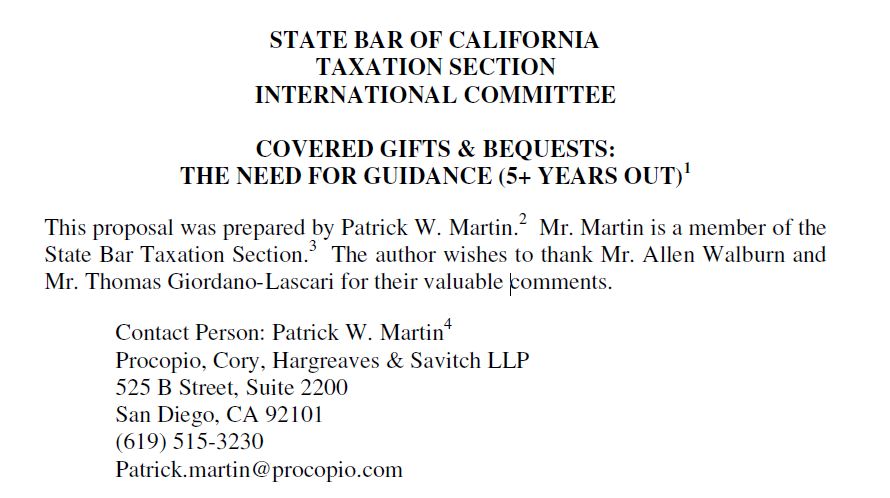
Proposed regulations are in the works and presumably were going to be released before the end of the year. In May of this year, I presented a set of formal recommendations to the U.S. Treasury and IRS on this topic in a paper entitled:
***
COVERED GIFTS & BEQUESTS: THE NEED FOR GUIDANCE (5+ YEARS OUT)
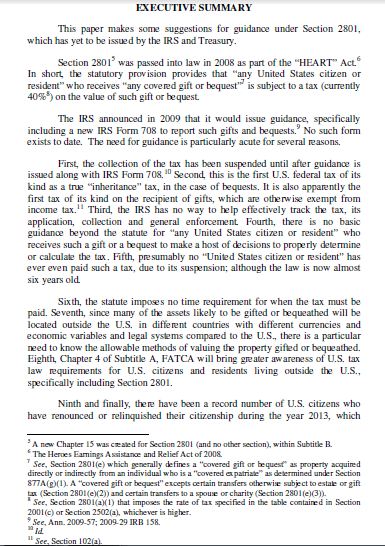
This proposal can be read in its entirety here, and the executive summary is set out below: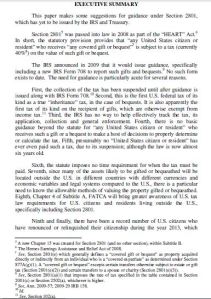
The reason these regulations are so important, is due to the tax cost of taxes upon U.S. beneficiaries. See, The “Hidden Tax” of Expatriation – Section 2801 and its “Forever Taint.”
The tax is currently levied at a 40% rate on basically the full vale of the asset upon the gift or bequest. It also continues on for potentially generations into the future; e.g., if U.S. beneficiaries receive property held in trust that was funded by a “covered expatriate.” For instance, to demonstrate the consequences, we can assume a former U.S. citizen who is a “covered expatriate” (e.g., for failure to properly certify under Section 877(a)(2)(C) and file IRS Form 8854, even though the income tax or asset tests are not satisfied) funds a trust in a foreign country for her grandchildren and great grandchildren. See, How many former U.S. citizens and long-term lawful permanent residents have filed (or will file) IRS Form 8854?
Over time, the value of those trust assets grow substantially and 30 years after her death (e.g., the year 2055), the trust starts distributing US$100,000 annually to several U.S. citizen grandchildren and grandchildren. Under the current law, each time the distribution is received, a 40% tax should be levied on each distribution. The law leaves many unanswered questions, until the proposed regulations are issued.
Part II: Common Myths about the U.S. Tax and Legal Consequences Surrounding “Expatriation”
· More Myths – about Renouncing U.S. Citizenship
There are many misunderstandings of how the law works when someone renounces U.S. citizenship. See, Part I: Common Myths about the U.S. Tax and Legal Consequences Surrounding “Expatriation”
The author regularly hears a range of myths that will befall an “Accidental American” when and if, they renounce. These “myths” include the following:
- Myth 5: There is no requirement to file U.S. income tax returns if the individual has few assets, little income or has otherwise lived outside the U.S. for almost all of their lives.
- Myth 6: There is somehow some “magical difference” under the law, for those who “renounce” citizenship (currently) versus those who “relinquished” citizenship (some time in the past) and the U.S. Department of State should recognize this “magical difference”. Such a difference will create a different U.S. tax result.
- Fact: The tax law nor immigration law makes such a distinction, even though this seems to be a common myth frequently spread throughout the Internet.
- Myth 7 : Former U.S. citizens who are “covered expatriates” can gift assets to their U.S. citizen children and friends without U.S. tax costs to them.
- Fact: This is true, i.e., there is no restriction or tax that is levied against the former U.S. citizen who makes the gift. The problem is for the recipient U.S. citizen or other “U.S. person” children or friends who will become subject to tax upon such gifts at the highest estate and gift ta rate (currently 40%).
- Myth 8: Former U.S. citizens should not worry about the IRS and its ability to collect taxes owing for the “mark-to-market” gains tax on expatriation (or on covered gifts and covered bequests) against assets located outside the U.S.?
These are just some of the myths commonly floated. There are yet more myths which will be discussed in a later post.
What are the Number of LPRs who Leave U.S. Annually without filing Form I-407 – Abandonment?
A prior post identified the number of lawful permanent residents (LPRs) who file Form I-407 to formally abandon their lawful permanent residency. See, The Number of LPRs “Leaving” the U.S. is 16X Greater than the Number of U.S. Citizens Renouncing Citizenship
These numbers of I-407 forms filed annually were obtained through a freedom of Information Act (“FOIA”) request and provided by the USCIS. See tabl:
Of course, this statistic does NOT identify the number of the approximate 13.3+ million LPRs who leave the U.S. to live elsewhere in another country without completing Form I-407 and formally abandoning. The estimated number of LPRs was 13.3 million for the year 2012 as reported by the Office of Statistics of the DHS. See, Estimates of the Legal Permanent Resident Population in 2012.
Maybe the number of individuals who fall into this latter category (i.e., moving out of the U.S. without filing Form I-407) is several hundred of thousands of individuals annually?
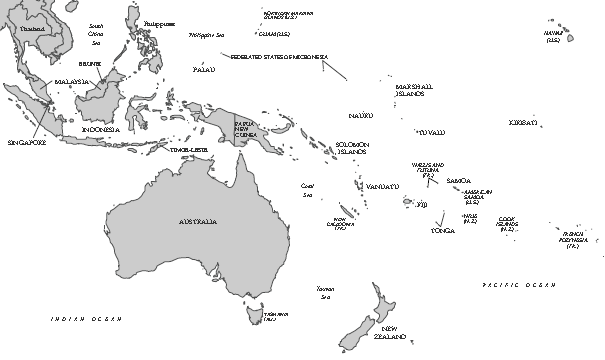
Importantly, from a taxation perspective, anyone who moves and lives in a country with a U.S. income tax treaty (the list of these countries is set out below – from the IRS website), needs to be careful not to be deemed to be a “covered expatriate” due to the application of IRS Form 7701(b)(6). See, IRS Notice 2009-85.
See, the following posts with further explanation of the tax law for LPRs who move and live in one of the countries listed below. Countries with U.S. Income Tax Treaties & Lawful Permanent Residents (“Oops – Did I Expatriate”?)
See also, Who is a “long-term” lawful permanent resident (“LPR”) and why does it matter?
Becoming a “covered expatriate” has U.S. tax consequences not just to the “former long-term LPR”, but also to their family and friends who are “U.S. persons” (as defined under Section 7701. See, The “Hidden Tax” of Expatriation – Section 2801 and its “Forever Taint.”
A
Armenia
Australia
Austria
Azerbaijan
B
Bangladesh
Barbados
Belarus
Belgium
Bulgaria
C
Canada
China
Cyprus
Czech Republic
D
Denmark

E
Egypt
Estonia
F
Finland
France
G
Georgia
Germany
Greece
H
Hungary
I
Iceland
India
Indonesia
Ireland
Israel
Italy
J
Jamaica
Japan
K
Kazakhstan
Korea
Kyrgyzstan
L
Latvia
Lithuania
Luxembourg
M
Malta
Mexico
Moldova
Morocco
N
Netherlands
New Zealand
Norway
O
P
Pakistan
Philippines
Poland
Portugal
Q
R
Romania
Russia
S
Slovak Republic
Slovenia
South Africa
Spain
Sri Lanka
Sweden
Switzerland
T
Tajikistan
Thailand
Trinidad
Tunisia
Turkey
Turkmenistan
U
Ukraine
Union of Soviet Socialist Republics (USSR)
United Kingdom
United States Model
Uzbekistan
V
Venezuela
“Covered Expatriate” Status is a “Scarlet Letter”
Throughout Tax-Expatriation, I have tried to emphasize the importance of avoiding “covered expatriate” status, if at all possible – and at all costs. It is a technical term defined in the tax law.
“Covered Expatriate” status is a “Scarlet Letter”.
There is much misunderstanding about how the tax expatriation provisions of the law apply. Many people think they only apply to wealthy individuals. This is not the case.
See various posts explaining the importance of the Certification Requirement of Section 877(a)(2)(C):
Why “covered expat” (“covered expatriate”) status matters, even if you have no assets! The “Forever Taint”!
Certification Requirement of Section 877(a)(2)(C) – (5 Years of Tax Compliance) and Important Timing Considerations per the Statute
Avoiding the Lobster Pot: Why becoming a Naturalized Citizen or LPR can be the proverbial “Lobster [Tax] Pot”
Why a Naturalized Citizen cannot avoid “Covered Expatriate” status under IRC Section 877A(g)(1)(B)
Can the Certification Requirement of Section 877(a)(2)(C) be Satisfied “After the Fact”?
As explained throughout, there are many ways for individuals to fall into the “covered expatriate” category. I liken it here to the “Scarlet Letter”. The fictional protagonist in Nathaniel Hawthorne book, could never shed herself of the consequences of her infidelity and wore the Scarlet Letter for life. It had devastating consequences to her, her loved ones around her and especially her daughter.
This is also true for “covered expatriate” status; but it is not fictional. Covered expatriate status can never be shed and can have disastrous consequences not only for the former USC or LPR; but also to the friends and family of the individual who carries around the “covered expatriate” status for life. See, The dangers of becoming a “covered expatriate” by not complying with Section 877(a)(2)(C).
Revisiting the consequences of becoming a “covered expatriate” for failing to comply with Section 877(a)(2)(C).
In the book, the protagonist took the Scarlet Letter to her grave and had it on her tombstone. “Covered expatriate” status extends beyond the grave and beyond the tombstone. Any loved one who is a U.S. person of a “covered expatriate” who receives a gift or inheritance, will be subject to a tax; even if the inheritance occurs many years after the death of the covered expatriate. In this case, the Scarlet Letter transfers to the loved one who receives property in the future and continues on for another generation. At least in Nathaniel Hawthorne’s book, the daughter Pearl received an inheritance not tainted by the Scarlet Letter.