The Importance of Planning – PRIOR to Renouncing, Relinquishing or Abandoning
International tax law experts who specialize in a particular area of the law, have a fairly good understanding of the importance of tax planning. The reason is simple. The law is complex and without planning,  laypeople can often cause very adverse tax consequences to themselves and their friends and family members (in the case of tax expatriation) without understanding the full implications of the law.
“Tax expatriation” in the U.S. is particular complex for several reasons:
1. The general rule is that there is an immediate income tax payable from the “mark to market” taxation rules on unrealized gains. See, Part I: Common Myths about the U.S. Tax and Legal Consequences Surrounding “Expatriation”
2. If a tax is recognized under the U.S. tax law, the only way to discharge the liability with the U.S. federal government is to pay the tax owing. The IRS generally can collect an income tax owing against a taxpayer who lives outside the U.S. indefinitely, as the 10 year collection statute does not apply when the individual outside the United States for a continuous period of at least six months. See, IRC Section 6503(c). More on this topic in another post. In other words, the IRS can “forever” pursue the collection of the “expatriation tax” against USCs and LPRs living outside the U.S.
3. It is easy to fall into the general rule of expatriation, even if the taxpayer would not otherwise be subject to income taxation. See, Why “covered expat” (“covered expatriate”) status matters, even if you have no assets! The “Forever Taint”!
4. The friends and family of the “covered expatriate” – i.e., the former U.S. citizen and long-term lawful permanent resident can be subject to U.S. taxation during their lifetimes, even if they also live outside the U.S. See also, some of the consequences of being a “covered expatriate” – The “Hidden Tax” of Expatriation – Section 2801 and its “Forever Taint.”
Each of these points help demonstrate the need for planning prior to running to the U.S. Department of State and completing and filing the following forms when you take the oath of renunciation:
Form DS-4081, Statement of Understanding Concerning the Consequences and Ramifications of Relinquishment or Renunciation of U.S. Citizenship.
See, Documents to Request the Consular Officer When Renouncing U.S. Citizenship
At the end of the day, if the individual lives outside the U.S. and does not travel to and from the U.S., it may be very difficult (at least practically speaking) for the IRS to collect on the tax judgment owing, if the individual has no assets in the U.S. There are legal means and steps the IRS can take in an attempt to try to collect U.S. taxes on overseas assets.
For a further discussion on collection of taxes overseas:
See, U.S. Enforcement/Collection of Taxes Overseas against USCs and LPRs – Legal Limitations, and
Part II: U.S. Enforcement/Collection of Taxes Overseas against USCs and LPRs – Pasquantino – Wire Fraud and Mail Fraud
Ideally, a former U.S. citizen or long-term lawful permanent resident will wish to avoid all of the potential tax and collection issues, by engaging in thoughtful and strategic planning prior to their renunciation of U.S. citizenship or abandonment of lawful permanent residency.
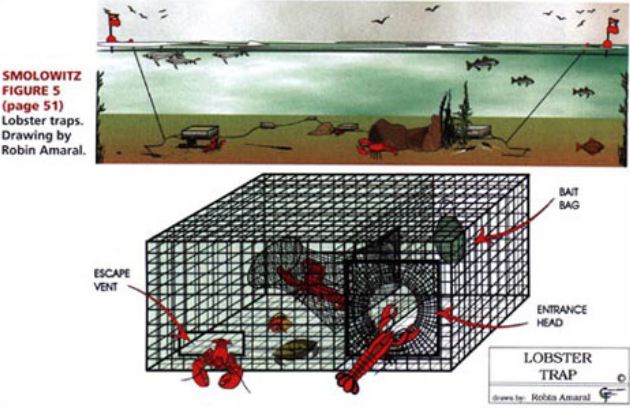
Avoiding the Lobster Pot: Why becoming a Naturalized Citizen or LPR can be the proverbial “Lobster [Tax] Pot”
Two famous tax professors coined a wonderful analogy that can largely be applicable to any non-U.S. citizen who is considering either becoming a (1) lawful permanent resident (LPR), or (2) a naturalized citizen.
Tax professors Boris I. Bittker (Yale) and James S. Eustice (NYU), both of whom are now deceased, wrote –
- “[Under the tax laws] a corporation is like a lobster pot: it is easy to enter, difficult to live in, and painful to get out of.”
I think the same analogy is very much appropriate to a non-U.S. citizen who becomes a LPR or a naturalized citizen, without fully understanding the U.S. federal tax consequences of such a decision. The word “corporation” merely should be changed with “lawful permanent resident” or “naturalized citizen” in the quote from Bittker and Eustice when considering the potential long-term application of the “expatriation tax” rules.
The analogy is particularly applicable for two reasons. First, individuals are usually less sophisticated and, often times, simply unaware of complex tax laws. Corporate taxpayers often can have a better understanding of complex U.S. tax laws – i.e., the “lobster trap” via sophisticated tax advisers.
Second, some lobster traps have an “escape vent” for small lobsters. Similarly, the tax laws on expatriation can treat individuals with smaller amounts of assets or U.S. tax liabilities, very differently and more favorably under the law. See, Certification Requirement of Section 877(a)(2)(C) – (5 Years of Tax Compliance) and Important Timing Considerations per the Statute,
Non-U.S. citizens who are not certain they will spend the rest of their lives in the U.S., should carefully consider if they indeed wish to obtain LPR or become a naturalized citizen. This is because of the long-term tax consequences of Sections 877, 877A, 2801, etc. for those who later abandon their LPR status or renounce their U.S. citizenship.
Of course, this blog, is dedicated to shedding light on the income tax, estate and gift tax, and “covered gift” and “covered” inheritance tax consequences to those who enter the “lobster trap.”
Many more may wish to simply shy far away from the lobster trap to begin with.
Why a Naturalized Citizen cannot avoid “Covered Expatriate” status under IRC Section 877A(g)(1)(B)
A previous post explained why lawful permanent residents (LPRs) can never satisfy this exception in the law to avoid “covered expatriate status.” See, Why a “long-term” LPR can NEVER avoid “Covered Expatriate” status under IRC Section 877A(g)(1)(B) if Asset or Tax Liability Test is Satisfied!
For the same reasons, a naturalized citizen cannot satisfy the statutory requirement since they will never be able to meet the IRC Section 877A(g)(1)(B)(i)(I) requirement of becoming ” . . . at birth a citizen of the United States . . . ”
See the relevant provisions of the statute as follows:
(B) Exceptions
An individual shall not be treated as meeting the requirements of subparagraph (A) or (B) of section 877 (a)(2) if—
(I) became at birth a citizen of the United States and a citizen of another country and, as of the expatriation date, continues to be a citizen of, and is taxed as a resident of, such other country, and
(II) has been a resident of the United States (as defined in section 7701 (b)(1)(A)(ii)) for not more than 10 taxable years during the 15-taxable year period ending with the taxable year during which the expatriation date occurs, . . .
Of course a naturalized United States citizen by definition was not a citizen at birth and only became one upon completing the lengthy legal requirements of naturalization. See, USCIS website – Citizenship Through Naturalization
529 College Plans – Funded by Former USCs and LPRs (“Long-Term” LPRs)
There is a basic tax planning opportunity for U.S. taxpayers who wish to fund the costs of higher education for family or friends. These are referred to as “529 Plans” with reference to the tax code section – IRC Section 529. In short, a 529 trust is established and funded with contributions for the benefit of named beneficiaries.
The principle benefit of a 529 plan, is that the income earned from the investments inside the 529 trust fund are exempt from U.S. income taxation.
There are multiple plans that are operated by various institutions, principally in conjunction with various States in the United States. Qualifying higher education expenses also apply to about 350 non-U.S. institutions that currently qualify for distributions out of a 529 Plan; e.g., University of Cambridge, University of Dublin Trinity College, University of Edinburgh, University of Oslo, The University of York, University of Wollongong, etc.
Unfortunately, non-U.S. citizens who are not resident in the U.S. generally are not eligible to establish and form a new 529 plan.
These “529 Plans” fall expressly into the category of a “specified tax deferred account” under the law. See, IRC Section 877A(e)(2).
In short, the law causes the entire amount in the 529 Plan to be treated as distributed to the “covered expatriate” the day before the expatriation date, although no early distribution tax will apply. If a 529 Plan has $500,000, that will represent taxable income to the “covered expatriate” to the extent of the tax-free growth in the plan. For instance, if the individual funded $200,000 into this plan, in this example, and he or she is subject to the 39.6% tax rate upon “expatriation”, this means there will be US$118,800 less to pay for college and universities (i.e., $500,000 less the $200,000 invested; leaving $300,000 X 39.6% = US$118,800 of tax).
This is yet another example, of how and why it is so important to avoid “covered expatriate” status; if permitted by the law in any particular circumstances. See, Certification Requirement of Section 877(a)(2)(C) – (5 Years of Tax Compliance) and Important Timing Considerations per the Statute, also see Can the Certification Requirement of Section 877(a)(2)(C) be Satisfied “After the Fact”?
Careful thought should be taken for the range of considerations and U.S. tax consequences that can befall a former USC or long-term LPR.
Ineligibeility for a SSN after Taking Oath of Renunciation – TINs, ITINs, EINs, etc.
USCs and LPRs residing outside the U.S. have been increasingly renouncing their citizenship and abandoning their lawful permanently residency status, respectively. In some cases, individuals who have lived virtually all (or all) of their lives in a country other than the U.S. are a lmost making a “knee jerk” decision to renounce.
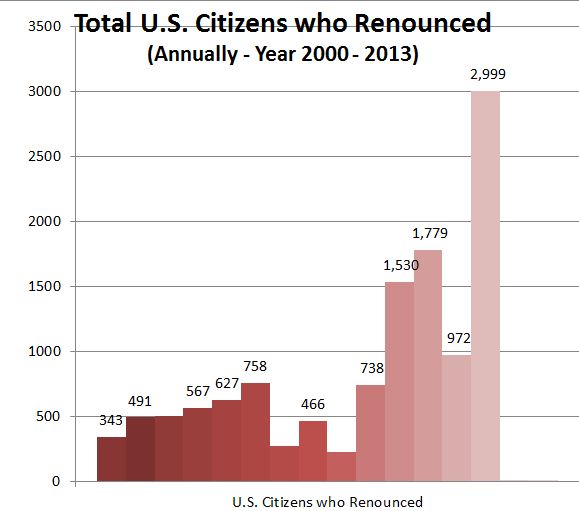
The statistics as to the absolute number and relative increases are astonishing. See, Wow, the number of 2,999 U.S. citizens who renounced in the year 2013 shattered the prior record set in 2011 of 1,782 renunciations. Why so many renunciations?
There is a practical problem for an individual who has renounced his or her U.S. citizenship prior to obtaining a Social Security Number (“SSN”). The individual will NOT be able to obtain a SSN once they have taken the oath of renunciation. See, *Why the Oath of Renunciation is Not the Opposite of the Oath of Allegiance
Of course, as prior posts have explained, an individual must have a “taxpayer identifying number” which must be a SSN for a U.S. citizen. However, the Social Security Administration will not allow an individual who has taken the oath of renunciation to apply for a SSN. See, The Catch 22 of Opening a Bank Account in Your Own Country – for USCs and LPRs
Also, see, Why do I have to get a Social Security Number to file a U.S. income tax return (USCs)?
The only way an individual can avoid becoming a “covered expatriate” is by filing U.S. federal income tax returns and being able to satisfy the certification requirement of Section 877(a)(2)(C). Accordingly, if a SSN is not available, the former citizen will need to file for an ITIN, as explained in previous posts.
IRA Distributions – (Counter-intuitive Results) U.S. Tax Consequences to Former USCs and Long Term Residents (LPRs)
IRA Distributions – (Counter-intuitive Results) U.S. Tax Consequences to Former USCs and Long Term Residents (LPRs)
Those USCs who have renounced citizenship (or who are contemplating renunciation) and those LPRs who (were/are/will) fall into the category of “long-term residents” who have qualified retirement accounts, known as “Individual Retirement Arrangement” (“IRAs”) have special considerations to consider under IRC Sections 877, et. seq. For more details on how IRAs work and the deduction limits, see the IRS website explanation.
In short, if an individual is a “covered expatriate” upon renunciation (or LPR abandonment), they will generally be subject to U.S. income taxation on the entire amount of the IRA (along with all other assets with unrealized gains), reduced by the exemption amount (currently US$680,000 for the year 2014).
Unfortunately, it is fairly easy to become a “covered expatriate” even if the asset or tax liability tests are not satisfied, simply if the individual fails to satisfy the certification requirement under Section 877(a)(2)(C). There are multiple posts that address this important certification requirement of Section 877(a)(2)(C), irrespective of how poor or how few of assets might be held by the individual. See, Certification Requirement of Section 877(a)(2)(C) – (5 Years of Tax Compliance) and Important Timing Considerations per the Statute, also see Can the Certification Requirement of Section 877(a)(2)(C) be Satisfied “After the Fact”?
Plus, the topic is covered yet further in More on “PFICs” and their Complications for USCs and LPRs Living Outside the U.S. -(What if there are No Records?)
Generally “covered expatriate” status is to be avoided, give the various adverse tax consequences. See, for instance, Why “covered expat” (“covered expatriate”) status matters, even if you have no assets! The “Forever Taint”!
However, since the U.S. tax law is complex and oftentimes full of unintended consequences, there may be times when “covered expatriate” status is desirable in any particular circumstance. I have seen and advised on several; including scenarios, where some planning steps can help get a much better U.S. tax result in various cases.
Assume a former USC does not meet the certification requirement (e.g., since they neglected to properly file a complete and accurate IRS Form 8854, or they otherwise did not comply with Title 26 for one or more of the five years preceding the renunciation/abandonment). Further, let us assume, she has an IRA with a total value of US$1.4M and all of her other assets have no unrealized gain (e.g., Euros in a bank in Europe and an apartment she purchased in her country of residence in Europe that continues to have depressed real estate prices). These other assets, the apartment and Euros are US$500,000 in value; hence, less than the US$2M net worth threshold. However, we will assume she did not timely comply with the certification requirements under the law.
In such an “unfortunate” case, she would have to accelerate all of the income (gain) from her IRA in the year she has her “date of expatriation”. This would cause a U.S. federal income tax liability of about US$260,000 that would become immediately due and payable. This amount is calculated as follows: US$1.4M total IRA, less the $680,000 exclusion amount, for a total taxable income of about $720,000 (which will generate an approximate US$260,000 income tax for someone who is not married filing jointly. This represents an effective tax rate of approximately 36% on the taxable income portion (US$260,000/US$720,000). Remember, however, $680,000 escapes taxation under the exclusion amount. Hence, the effective tax rate on the entire IRA portion is actually only about 18.6% in this case. This amount is calculated as total IRA income of US$1.4M against tax of US$260,000 (i.e., $260,000/$1.4M= 18.6%).
An 18.6% tax rate is generally a very “attractive” U.S. individual income tax rate for those who have high amounts of income, as is this case with US$1.4M.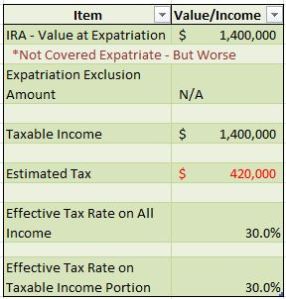
If instead, she is not a “covered expatriate” at the time she renounces her citizenship in 2014 (as she did comply with the certification requirements and otherwise would not meet the $2M net worth and her average annual net income tax liability for the preceding 5 years did not exceed $157,000) she would have a very different tax result. In short, she would not have to accelerate the entire tax liability. That sounds like good news, until one considers the U.S. tax rate on future IRA distributions to her after she ceases to be a U.S. citizen. Absent, an income tax treaty, she would have a 30% tax withheld at source (i.e., by the U.S. payer – trustee of the IRA) on each distribution made. If all US$1.4M is distributed out in one lump sum, there will be a tax of US$420,00 (US$1.4M X 30%); much more than the $260,000 for the “covered expatriate” scenario above. See calculations in this table:
Also, if she prefers to defer the IRA distributions (e.g., to make 14 annual distributions of US$100,000), she will have the same 30% tax withheld on each payment; hence, a total tax of US$420,00.
Obviously, a 30% tax is much worse than an 18.6% tax. Accordingly, this is a scenario where an individual may prefer to be a “covered expatriate” as opposed to avoiding such status. A bunch of factual analysis and strategic considerations would need to be considered in her case (e..g, where are her future heirs, what other income might she receive, will she receive any future gifts of inheritances herself, etc. etc.?).
Indeed, in this particular case, I can imagine a scenario (if accompanied by some focused tax planning), she could pay no more than a total effective tax rate of 12.2% on her income. Of course, 12.2% is better than 18.6% and 30%.
Finally, there is one more important wrinkle that can modify these results yet further; a particular income tax treaty with the U.S. that has a specific tax result that is better than the statutory 30% rate on distributions from an IRA to a non-resident alien. The U.S. has numerous income tax treaties with numerous countries, almost all of which have different terms and conditions. See, Countries with U.S. Income Tax Treaties & Lawful Permanent Residents (“Oops – Did I Expatriate”?)
Li Lianjie – Famous Former U.S. Citizens – Born in Beijing, China (“Jet Li”)
The Chinese actor Li Lianjie, who is better known by his stage name Jet Li, was born in Beijing. He was born in 1963 and his father died when he was just 2 years old and he “. . . was from a very poor family and . . . didn’t have enough money for a good school, so sports-school was good . . . ”
He is a huge star in China and throughout Asia and became famous in Hollywood.
As a teenager he became a master at Wushu, the full-contact sport from Chinese martial arts. His martial arts fame led to acting, first in China and also in the United States. His film debut Shaolin Temple (1982), helped make him a star.
He apparently became a naturalized citizen of the United States while working in Hollywood.
He apparently has also become a naturalized citizen of Singapore.
He is often highlighted by government officials of China as a model citizen and success story. 
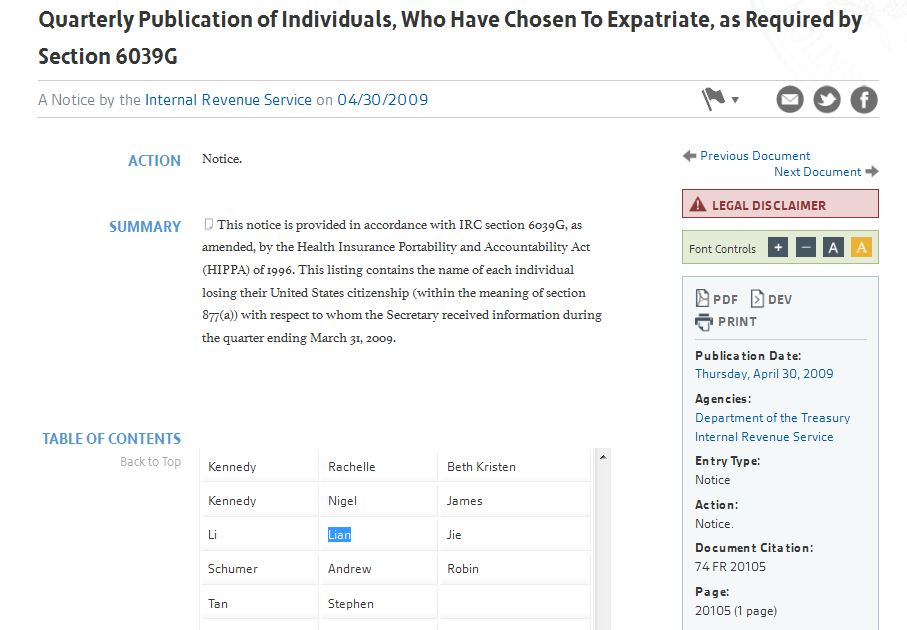
By the year 2009 he renounced his U.S. citizenship as listed in the U.S. federal government’s “Quarterly Publications of Individuals, Who Have Chosen to Expatriate, as Required by Section 6039G“
See here the list for the first quarter of 2009, where Li Lianjie is in the 2009 first quarter list of expatriates.
Presumably, Jet Li solicited timely and filed for a Certificate of Loss of Nationality (“CLN”) timely so he was not subject to the rules of 7701(a)(50) that went into effect in 2008 – See, Why Section 7701(a)(50) is so important for those who “relinquished” citizenship years ago (without a CLN). . .
Finally, the certification requirement that is available to those individuals who are born with dual national citizenship to avoid “covered expatriate” status, was presumably not available for Li Lianjie, since he was not born a U.S. citizen. Presumably, he could not satisfy each of the requirements of IRC Section 877A(g)(1)(B).
More on “PFICs” and their Complications for USCs and LPRs Living Outside the U.S. -(What if there are No Records?)
More on “PFICs” and their Complications for USCs and LPRs Living Outside the U.S. – -(What if there are No Records?)
The statutory rules of PFICs are set forth in 26 U.S. Code § 1297 – Passive foreign investment company. The U.S. Treasury and IRS also published new regulations in January 2014 on PFICs.
For an overview, see “PFICs” – What is a PFIC – and their Complications for USCs and LPRs Living Outside the U.S.
United States Citizens living overseas, whether or not they are “Accidental Americans”, as well as lawful permanent  residents (LPRs) living outside the U.S. generally have the burden of proof under U.S. tax law to show they complied with U.S. law. Indeed, when the Internal Revenue Service (IRS – the U.S. revenue authority) makes a tax assessment against an individual, the law generally carries with it a “presumption of correctness” in favor of the IRS.
This presumption of correctness was confirmed by the U.S. Supreme Court and therefore imposes the burden on the taxpayer of proving that the assessment made by the IRS is erroneous. During my career, I have seen plenty of erroneous assessments made by the IRS, and an increasing number of assessments made against taxpayers residing in countries throughout the world, be it France, Australia, Canada, Russia, Germany, Mexico, Thailand, Japan, Hong Kong, etc.
Why is this presumption of correctness relevant, when PFICs are explained and discussed here? The law of PFICs is complex, to the point that very few IRS revenue agents really have any detailed understanding of how PFICs work, when they apply and how taxpayers are to report their investments in PFICs. Very few U.S. tax practitioners understand PFICs.
Accordingly, I regularly see errors made by the IRS in proposed tax assessments, including PFIC calculations. Unfortunately for the individual taxpayer, they must prove the IRS is wrong in its tax assessment.
PFICs create a real burden on individual taxpayers who have shares in a PFIC in different locations around the world, since it is rare that foreign companies, investment funds, mutual funds and the like ever provide any detailed accounting of (a) asset, or (b) income information (per U.S. tax rules) that are required to be reported by PFIC investors who are USCs or LPRs.
Unlike a controlled foreign corporation (CFC), a PFIC has no ownership threshold. If a USC owns just 1,000 shares/units out of 20M issued shares in a foreign mutual fund, the U.S. citizen will nevertheless need to report this 1,000 share/unit interest (even though this is only 0.0005% of the fund) on his or her individual income tax return if the foreign mutual fund meets – the income test or asset test. Virtually all mutual and investments funds will satisfy these tests, since by definition the funds are making investments in other companies or other passive income items, such as bonds, stocks, futures, ETFs, etc.
The income test is met when at least 75% of the income is passive income as defined under the law. The asset test is satisfied when at least 50% of the foreign corporation’s average assets produce such passive income.
The practical problem arises when the individual taxpayer needs information from the fund (or other foreign entity) that reflects information such as –
- the pro-rata share of the “ordinary” earnings (in the example above, just 1,000 share/20M shares – 0.0005% of the fund);
- the pro-rata share of the “net capital gain”;
- the total cash or property distributed;
- the total cash or property “deemed” distributed (which means there was actually no distribution – but the law “deems” there to have been a distribution); and
- many other complex calculations that require basic information to be provided by the PFIC in the first place.
What foreign fund or investment company around the world (located in whatever country – catering to customers commonly in their own country) even tracks or accounts for income and gains for U.S. tax law purposes; i.e. “ordinary” earnings versus “capital gains” – specifically including the netting of “capital gains” and “capital losses” as required by U.S. law? I certainly do not see such accounting records provided in the marketplace of investment funds, hedge funds and companies that cater to persons residing outside the U.S.
Most foreign companies around the world (unless they are controlled and managed by USCs who are aware of these U.S. tax obligations) never maintain such accounting records or the detailed information necessary to even provide it to their USC or LPR investors. Hence, USCs/LPR investors may never be able to accurate make these PFIC calculations.
Also, the ownership of shares/units of the fund might always be changing throughout the year. In other words, even if the “ordinary income” and “net capital gain” is available for a particular fund/PFIC, the total number of outstanding shares/units has to be stable or known for the USC or LPR to calculate their pro-rata share. In the above example, if there are 20M outstanding shares/units at the beginning of the year, but by the end of the year there are 22M outstanding shares/units, how is the USC or LPR investor ever going to be able to calculate their pro-rata share, assuming they have the “ordinary” earnings and “capital gains” amounts for the entire calendar year? Its not simply the “ordinary” earnings and “capital gains” multiplied by 0.0005%.
The only “good news” in this explanation of PFICs, is that there is not an automatic US$10,000 penalty for failure to file their investments in a PFIC on IRS Form 8621, Information Return by a Shareholder of a Passive Foreign Investment Company or Qualified Electing Fund.
This is a departure from the normal rule of a minimum US$10,000 penalty for failure to file information returns regarding international (i.e., non-U.S. assets and investments). See, USCs and LPRs Living Outside the U.S. – Key Tax and BSA Forms.
All of these tax compliance rules begs a very important question for a USC who is considering renouncing their U.S. citizenship. The issue arises if they have had investments in PFICs during the last five years. If the USC has not been complying with IRC Section 1297 regarding PFICs, how can the taxpayer ever certify under penalty of perjury ” . . . that he has met the requirements of this title for the 5 preceding taxable years. . . [for purposes of Section 877(a)(2)(C)]”?
See, Certification Requirement of Section 877(a)(2)(C) – (5 Years of Tax Compliance) and Important Timing Considerations per the Statute
More details about PFICs to come in later posts.
IRS Sting Operation and Criminal Tax Indictments of Canadian Citizens – Investigations Overseas – Enabling U.S. Taxpayers with Offshore Accounts
The U.S. Department of Justice reported that two Canadian citizens along with a U.S. citizen were indicted for enabling tax evasion with offshore accounts. The press release from three months ago, 24 March 2014, can be reviewed here. Some highlights of the press release are below:
- According to the indictment, . . . Poulin, an attorney at a law firm based in Turks and Caicos, worked and resided in Canada and in the Turks and Caicos. His clientele also included numerous U.S. citizens.
- According to the indictment, Vandyk, St-Cyr and Poulin solicited U.S. citizens to use their services to hide assets from the U.S. government. Vandyk and St-Cyr directed the undercover agents posing as U.S. clients to create offshore foundations with the assistance of Poulin and others because they and the investment firm did not want to appear to deal with U.S. clients. Vandyk and St-Cyr used the offshore entities to move money into the Cayman Islands and used foreign attorneys as intermediaries for such transactions.
- According to the indictment, Poulin established an offshore foundation for the undercover agents posing as U.S. clients and served as a nominal board member in lieu of the clients.
The facts of this case will be interesting to cover, to see how and to what extent the IRS and Justice Department will be focusing on U.S. citizens residing overseas and their reporting (or failure to report) their “foreign” accounts; i.e., their financial accounts in their home countries of residence.
Since the withholding tax provisions under the Foreign Account Tax Compliance Act (“FATCA”) come into effect in a matter of days, it will be interesting to see if the government has more indictments along these lines planned for the summer of 2014.
U.S. citizens who are in the process of renouncing citizenship should be aware of each of the steps required as part of the process; both under U.S. federal tax law and immigration law.
See, The Importance of a Certificate of Loss of Nationality (“CLN”) and FATCA – Foreign Account Tax Compliance Act.
Also, see Revisiting the consequences of becoming a “covered expatriate” for failing to comply with Section 877(a)(2)(C).
Certification Requirement of Section 877(a)(2)(C) – (5 Years of Tax Compliance) and Important Timing Considerations per the Statute
People who cite to IRS forms, should have an appreciation that neither the form or its conditions may have the “force of law.” This is particularly important, when the statute itself, regarding the Certification Requirement of Section 877(a)(2)(C) does not specific whether the certification has to be made “prior to” (or after) the date of loss of nationality? See the relevant provision of the statute below – Section 877(a)(2)(C), which causes an individual to be a “covered expatriate” if::
- (C) such individual fails to certify under penalty of perjury that he has met the requirements of this title for the 5 preceding taxable years or fails to submit such evidence of such compliance as the Secretary may require.
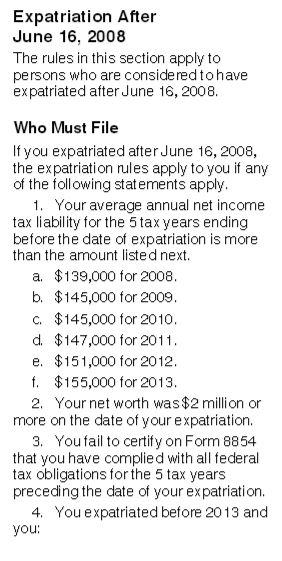
Consider the language of the instructions of IRS Form 8854, however, which expressly states that the certification must reflect you have ” . . . complied with all of your federal tax obligations for the 5 tax years preceding the date of your expatriation.”
Does this mean the IRS requires the compliance to have been satisfied prior to the expatriation/renunciation date? That is what the instructions say.
See the bottom of page 2 of the Form 8854 instructions –
“If you expatriated after June 16, 2008, the expatriation rules apply to you if any of the following statements apply.
1. Your average annual net income tax liability for the 5 tax years ending before the date of your expatriation is more than the amount listed next . . .
2. Your net worth is $2 million or more on the date of your expatriation.
3. You fail to certify on Form 8854 that you have complied with all of your federal tax obligations for the 5 tax years preceding the date of your expatriation.”
In this case, the instructions to the form, say the former USC or LPR must ” . . . have complied with all of your federal tax obligations preceding the date of your expatriation. . . ”
If this statement were true, a taxpayer could not satisfy the rule by attempting to comply with all federal tax obligations after they have renounced their U.S. citizenship?
In other words, if such were true, attempting to comply with all provisions of the U.S. federal tax law for 5 years and then filing 8854, all after taking the oath of renunciation, would prohibit someone from avoiding “covered expatriate” status?
Importantly, the Treasury/IRS cannot create law by merely publishing a substantive rule in an IRS Form. Indeed, there are no regulations to date; that have been issued by the Treasury; only a few notices. See prior post, Does IRS Notice 2009-85 regarding expatriation have the “force of law”?
Of course, this does not mean the IRS will not challenge any former USC as not complying with Certification Requirement of Section 877(a)(2)(C) by not also complying with the condition set forth in the IRS own instructions?
This is an example of an important detail that any former USC will want to carefully consider prior to rushing off to take the oath of renunciation.
As always, see Limitations.
Read the Q&A format here.

 laypeople can often cause very adverse tax consequences to themselves and their friends and family members (in the case of tax expatriation) without understanding the full implications of the law.