Part I of III: Tracking Travelers’ Entries and Exits – Guest Immigration Law Post by Atty Mr. Jan Bejar
Tracking Travelers’ Entries and Exits
Part I of III: Tracking Travelers’ Entries and Exits – Guest Immigration Law Post by Atty Jan Bejar
This immigration law guest post is related to prior posts: Global Entry, SENTRI and NEXUS after Renouncing – the “Trusted Traveler Programs” – SAFE TRAVELS!
See also, Tracking U.S. Citizens and LPRs in and Out of the Country – Tracking Taxpayers (Entry/Exit System)
For many years, since even before the 9/11 attack, the United States government has been trying to develop a comprehensive biometric system for tracking both entries to and exits from the United States. Although the government has a variety of mechanisms for tracking travelers’ entries into the U.S., tracking exits has proven to be a more difficult task.
For non-U.S. citizens, collecting data about a planned trip to the U.S. may begin even before an individual enters the U.S. For non-U.S. citizens who must first apply for a nonimmigrant visa to enter the U.S., the Department of State’s nonimmigrant visa application (Form DS-160) asks the applicant if he has made travel plans, and if so, for the details. Answering the question is optional, and obviously once the visa is issued, the Department of State does not track future travel plans. Additionally, the nonimmigrant visa application process requires an applicant to provide the Department of State with biographic and biometric data, which it stores in the Consular Consolidated Database (CCD). This database then links to some of the Department of Homeland Security (DHS) databases described below. The CCD has been in the news for the last month because it has been experiencing “system performance issues,” causing delays for thousands of U.S. passport and visa applicants.[1]
For non-U.S. citizens from the currently 38 Visa Waiver Program countries planning to travel to the U.S. for up to 90 days without a visa,[2] travelers must first submit biographic information and respond to eligibility questions through an online application, the Electronic System for Travel Authorization (ESTA). Customs and Border Protection (CBP), an agency within DHS, uses ESTA to screen applicants against terrorist, national security, and criminal watchlists.[3] The ESTA application requests information about travel plans, but providing travel details is optional.
For U.S. citizen and non-U.S. citizens alike traveling to the U.S. on commercial airlines, private aircraft, and commercial vessels such as cruise ships, CBP maintains the Advance Passenger Information System (APIS), an electronic data interchange system. Airlines and vessel carriers are required by law to provide CBP in advance with certain biographic information on all passengers and crew onboard all international departures and arrivals via APIS. The information transmitted to CBP includes biographic information, such as name, date of birth, gender, etc., and travel itinerary information. CBP also collects data from bus and rail carries on a voluntarily basis through APIS.
CBP sends the APIS data regarding non-U.S. citizens to the Arrival and Departure Information System (ADIS) to store and hold for matching against departure records.[4] DHS uses ADIS to store arrival and departure records, biographic data, and each traveler’s unique Fingerprint Identification Number System (FINS) identifier, which facilitates cross-referencing between ADIS and the Automated Biometric Identification System (IDENT) database, which is DHS’ primary biometric database. ADIS also aggregates records from a number of other DHS databases, including the CBP Nonimmigrant Information System (NIIS), the CBP Border Crossing Information System (BCI), the CBP TECS platform, the U.S. Immigration and Customs Enforcement (ICE) Student Exchange Visitor Information System (SEVIS), and the U.S. Citizenship and Immigration Services (USCIS) Computer Linked Information Management System (CLAIMS 3) among others, some of which will be discussed below.[5] ADIS stores this data for all non-U.S. citizens, including information on lawful permanent residents (“green card” holders), refugees, asylees, and nonimmigrants. There is a risk that ADIS might inadvertently retain data about U.S. citizens or retain data longer than permitted for travelers who subsequently become U.S. citizens.[6]
For commercial air travel, in addition to APIS, the Secure Flight Program requires domestic and international airlines to provide DHS with certain passenger manifest information at least 72 hours before flight time for all flights into or over the continental U.S.
For all travelers, including U.S. citizens, who either pass through preclearance inspections at certain foreign airports or through primary inspection at all U.S. ports of entry, CBP officers interview arriving travelers and check their travel documents. CBP collects basic biographic information, such as name, travel document number, and the date and location of arrival, for all travelers, including U.S. citizens. It captures the information and screens arriving travelers in TECS, CBP’s principal information-sharing platform for immigration screening and admissibility determinations. TECS is not only an information-sharing platform that allows inspectors to access different databases such as APIS, but also “a data repository to support law enforcement ‘lookouts,’ border screening, and reporting for CBP’s primary and secondary inspection processes.”[7] IRS officers can request that DHS add or delete travelers from lookout lists in TECS.[8] “CBP officers use TECS to check travelers against law enforcement and national security watchlists and to record and report on primary and secondary inspection results.”[9] Records of border crossings for all travelers, including U.S. citizens, are then stored in the BCI, and records for nonimmigrant visa holders are stored in the NIIS.
Several land ports of entry on both the northern and southern borders maintain dedicated “ready lanes” for travelers with radio frequency identification (RFID)-enabled travel documents, such as the U.S. passport card, the enhanced driver license, the newer enhanced permanent resident card, and the enhanced border crossing card. RFID-enabled documents allow CBP inspectors to quickly query TECS and create a record of the crossing.
Land ports of entry additionally utilize license plate readers in vehicle lanes to determine the plate number and issuing agency of vehicles passing through inspection, and that information is also used to query TECS. CBP denies maintaining a database of vehicle locations but will share license plate information in a law enforcement capacity, including with the National Insurance Crime Bureau and car insurance companies. License plate data is maintained for two years, unless it is moved to and maintained in another system with a different destruction schedule.
Also, most non-U.S. citizens arriving at air and sea ports are required to provide biometric data (fingerprints and digital photographs). The biometric data is added to IDENT, which is DHS’ primary biometric database, and vetted against additional biometric databases.[10] The Office of Biometric Identity Management (OBIM) maintains IDENT and provides DHS with biometric identification technological services, including storing, managing and analyzing the biometric data. OBIM is part of DHS’ National Protection and Programs Directorate, and it replaced DHS’ US-VISIT program in March 2013.
[More to follow . . . ]
[1] See http://travel.state.gov/content/travel/english/news/ccd-performance-issues.html, last updated August 4, 2014.
[2] See http://travel.state.gov/content/visas/english/visit/visa-waiver-program.html for more information on the Visa Waiver Program.
[3] See “Border Security: Immigration Inspections at Port of Entry,” Seghetti, Lisa, Section Research Manager, Congressional Research Service, January 9, 2014, last viewed at http://trac.syr.edu/immigration/library/P8498.pdf.
[4] See “Written testimony of U.S. Customs and Border Protection and U.S. Immigration and Customs Enforcement for a House Committee on Homeland Security, Subcommittee on Border and Maritime Security hearing titled ‘Fulfilling A Key 9/11 Commission Recommendation: Implementing Biometric Exit,’” released September 26, 2013, last viewed at http://www.dhs.gov/news/2013/09/26/written-testimony-cbp-and-ice-house-homeland-security-subcommittee-border-and.
[5] See “Privacy Impact Assessment Update for the Arrival and Departure Information System – Information Sharing Update,” March 7, 2014, last viewed at http://www.dhs.gov/sites/default/files/publications/privacy-pia-cpb-adis-update-20140305.pdf.
[6] See id.
[7] See “Privacy Impact Assessment for the TECS System: CBP Primary and Secondary Processing,” Department of Homeland Security, December 22, 2010, last viewed at http://www.dhs.gov/xlibrary/assets/privacy/privacy-pia-cbp-tecs.pdf.
[8] See https://tax-expatriation.com/2014/07/22/does-the-irs-investigate-united-states-citizens-uscs-and-lawful-permanent-residents-lprs-residing-overseas/
[9] See supra at fn. 3.
Jan Joseph Bejar, Esq.
(For: JAN JOSEPH BEJAR, APC)
Tel: (619) 291-1112
Fax:(619) 291-1102
E-mail: jbejar@immigrationlawclinic.com
Website: www.immigrationlawclinic.com
Avoiding the Lobster Pot: Why becoming a Naturalized Citizen or LPR can be the proverbial “Lobster [Tax] Pot”
Two famous tax professors coined a wonderful analogy that can largely be applicable to any non-U.S. citizen who is considering either becoming a (1) lawful permanent resident (LPR), or (2) a naturalized citizen.
Tax professors Boris I. Bittker (Yale) and James S. Eustice (NYU), both of whom are now deceased, wrote –
- “[Under the tax laws] a corporation is like a lobster pot: it is easy to enter, difficult to live in, and painful to get out of.”
I think the same analogy is very much appropriate to a non-U.S. citizen who becomes a LPR or a naturalized citizen, without fully understanding the U.S. federal tax consequences of such a decision. The word “corporation” merely should be changed with “lawful permanent resident” or “naturalized citizen” in the quote from Bittker and Eustice when considering the potential long-term application of the “expatriation tax” rules.
The analogy is particularly applicable for two reasons. First, individuals are usually less sophisticated and, often times, simply unaware of complex tax laws. Corporate taxpayers often can have a better understanding of complex U.S. tax laws – i.e., the “lobster trap” via sophisticated tax advisers.
Second, some lobster traps have an “escape vent” for small lobsters. Similarly, the tax laws on expatriation can treat individuals with smaller amounts of assets or U.S. tax liabilities, very differently and more favorably under the law. See, Certification Requirement of Section 877(a)(2)(C) – (5 Years of Tax Compliance) and Important Timing Considerations per the Statute,
Non-U.S. citizens who are not certain they will spend the rest of their lives in the U.S., should carefully consider if they indeed wish to obtain LPR or become a naturalized citizen. This is because of the long-term tax consequences of Sections 877, 877A, 2801, etc. for those who later abandon their LPR status or renounce their U.S. citizenship.
Of course, this blog, is dedicated to shedding light on the income tax, estate and gift tax, and “covered gift” and “covered” inheritance tax consequences to those who enter the “lobster trap.”
Many more may wish to simply shy far away from the lobster trap to begin with.
Why a Naturalized Citizen cannot avoid “Covered Expatriate” status under IRC Section 877A(g)(1)(B)
A previous post explained why lawful permanent residents (LPRs) can never satisfy this exception in the law to avoid “covered expatriate status.” See, Why a “long-term” LPR can NEVER avoid “Covered Expatriate” status under IRC Section 877A(g)(1)(B) if Asset or Tax Liability Test is Satisfied!
For the same reasons, a naturalized citizen cannot satisfy the statutory requirement since they will never be able to meet the IRC Section 877A(g)(1)(B)(i)(I) requirement of becoming ” . . . at birth a citizen of the United States . . . ”
See the relevant provisions of the statute as follows:
(B) Exceptions
An individual shall not be treated as meeting the requirements of subparagraph (A) or (B) of section 877 (a)(2) if—
(I) became at birth a citizen of the United States and a citizen of another country and, as of the expatriation date, continues to be a citizen of, and is taxed as a resident of, such other country, and
(II) has been a resident of the United States (as defined in section 7701 (b)(1)(A)(ii)) for not more than 10 taxable years during the 15-taxable year period ending with the taxable year during which the expatriation date occurs, . . .
Of course a naturalized United States citizen by definition was not a citizen at birth and only became one upon completing the lengthy legal requirements of naturalization. See, USCIS website – Citizenship Through Naturalization
Wowzers! Consular Fees for Processing U.S. Citizenship Renunciations Increased More than 500% (US$2,350 Fee)
Wowzers! Consular Fees for Processing U.S. Citizenship Renunciations Increased More than 500%
The recent U.S. Department of State announcement of new fees for renouncing U.S. citizenship have been increased significantly. The costs of the “Hotel California” have gone up to US$ 2,350 from US$450.
This information comes on the heals of distressing news that in some Consulate offices throughout the world, U.S. citizens are not able to get meetings for renunciations until the year 2015.
| Type of Service |
Previous Fee |
New Fee |
| Renunciation of Citizenship |
$450 |
$2,350 |
Fees for Consular Services to Change on September 12, 2014
Mexico City, August 28, 2014 – Effective September 12, 2014, the Department of State will adjust processing fees for some services. The fees for most categories of immigrant visas will change, while fees for nonimmigrant visas largely remain the same. The fee for processing an application for Renunciation of U.S. Citizenship is increasing to reflect the true cost of providing this service.
The Department seeks to recover, as far as possible, the cost of providing consular services through the collection of consular fees. The Department regularly reviews these costs and adjusts fees as necessary to reflect the cost of service.
Although most categories of nonimmigrant visa processing fees will remain the same, the fee for E visas (treaty-traders and treaty-investors) will decrease and the fee for K visas (for fiancé(e)s of U.S. citizens) will increase. The fee charged for Border Crossing Cards for Mexican citizen minor applicants under the age of 15 will increase by $1.
For immigrant visa processing, the fee for family-sponsored immigrant visas will increase, as will the fee for domestic review of an Affidavit of Support. All other immigrant and special visa processing fees that are changing will decrease.
Documenting a U.S. citizen’s renunciation of citizenship is extremely costly, requiring U.S. consular officers overseas to spend substantial amounts of time to accept, process, and adjudicate cases. The fee for processing renunciation of citizenship, which had previously been subsidized, is now reflective of the true cost.
Nonimmigrant Visa Processing Fees
| Type of Visa |
Previous Fee |
New Fee |
| Treaty Investor and Trader visas (E) |
$270 |
$205 |
| Fiancé(e) visas (K) |
$240 |
$265 |
| Border Crossing Card (under age 15) |
$15 |
$16 |
Immigrant Visa Processing Fees
| Type of Visa |
Previous Fee |
New Fee |
| Immediate Relative and Family Preference Applications |
$230 |
$325 |
| Employment-Based Applications |
$405 |
$345 |
| Other Immigrant Visa Applications |
$220 |
$205 |
| Determining Returning Resident Status |
$275 |
$180 |
| Waiver of Two-Year Residency Requirement |
$215 |
$120 |
| Affidavit of Support Review (only when reviewed domestically) |
$88 |
$120 |
Citizens’ and Administrative Services
| Type of Service |
Previous Fee |
New Fee |
| Renunciation of Citizenship |
$450 |
$2,350 |
| Charge for Consular Time (for fee services performed outside of normal business hours or away from the office) |
$231 |
$135 |
The proposed fees were published in the Federal Register today, and will take effect in 15 days. To view the interim final rule, visit www.regulations.gov. Comments will be accepted until 60 days after publication. At that time, the Department will consider the public comments, and the published final rule will include the Department’s response to any comments received.
Fee information may also be found on the Bureau of Consular Affairs website, travel.state.gov, and on the websites of U.S. embassies and consulates.
Read the Q&A format here.
Tracking U.S. Citizens and LPRs in and Out of the Country – Tracking Taxpayers (Entry/Exit System)
The U.S. federal government, led by the Department of Homeland Security (“DHS”) has taken great efforts and incurred great cost to develop technology and systems to track individuals as they come into the U.S. There are also programs afoot, specifically the Entry/Exit system with Canada, that helps track individuals as they leave the U.S. For more details, see the Wilson Center and its review of the Entry-Exit Systems in North America.
This tracking is very specific and part of the TECS database that is operated and managed by the DHS. The TECS database has been discussed in prior posts, including Does the IRS investigate United States Citizens (USCs) and Lawful Permanent Residents (LPRs) residing overseas?
See also, an earlier post that discusses the TECS database and its usage by the Internal Revenue Service in U.S. Enforcement/Collection of Taxes Overseas against USCs and LPRs – Legal Limitations
This topic will become even more relevant starting in 2015 as the IRS collects financial and account information via FATCA of USCs and LPRs residing in various countries throughout the world.
A series of posts dedicated to this topic will be made, including by guest immigration lawyers, discussing various legal implications of the tracking of U.S. citizens and LPRs.
U.S. Tax Court Rules Against Lawful Permanent Resident (LPR) in Abrahamsen
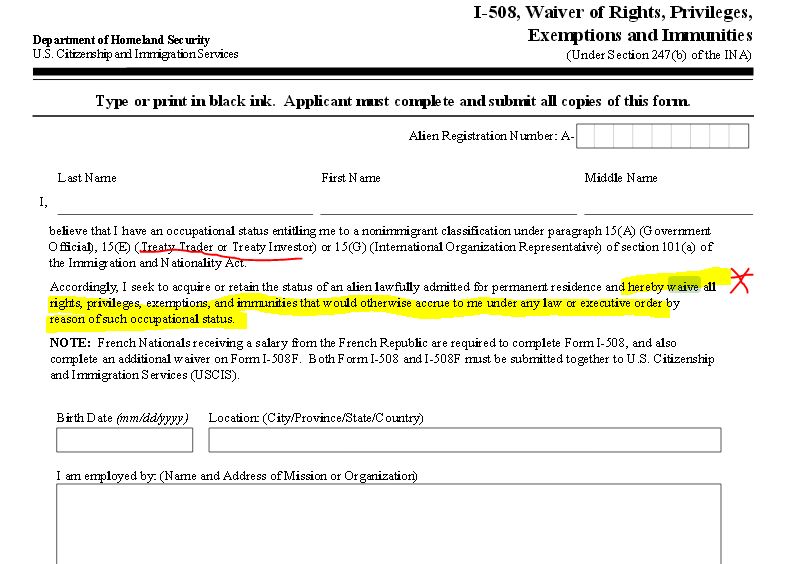
The U.S. Tax Court, in an opinion written by Judge Lauber (Abrahamsen v. Commissioner) placed much legal tax significance on the immigration form I-508 that Ms. Abrahamsen signed. 
The Court noted this form, I-508, Waiver of Rights, Privileges, Exemptions and Immunities (Under Section 247(b) of the INA) specifically provides that the non-U.S. citizen “waive all rights, privileges, exemptions and immunities which would otherwise accrue to [her] under any law or executive order by reason of [her] occupational status.”
In that case, the individual was a Finnish citizen who eventually applied for lawful permanent residency. The immigration forms were not related to any specific tax form, such as the new IRS Forms W-8BEN; see, IRS Releases New IRS Form W8-BEN. * U.S. citizens and LPRs beware of completing such form at the request of a third party.
The takeaway from this opinion, is that individuals need to be aware of how signing a particular form (that is not a tax form) can have adverse tax consequences. In this case, the Court ruled that she had waived her benefits to IRC Section 893 by signing immigration Form I-508. The opinion of the Tax Court raises an interesting legal question about how signing a form (I-508) can seem to override the statutory protection granted which provides protection to a qualifying “. . . employee [who] is not a citizen of the United States . . . “
Signing various tax forms can cause even greater risks for non-citizen taxpayers; e.g., IRS Form W-9 versus W-8BEN. See, FATCA Driven – New IRS Forms W-8BEN versus W-8BEN-E versus W-9 (etc. etc.) for USCs and LPRs Overseas – It’s All About Information and More Information*
Fortunately for the taxpayer in the Abrahamsen case, she was not subject to the Section 6662 accuracy related penalty (“negligence” penalty) assessed by the IRS.
A subsequent post will analyze some potential U.S. tax consequences for individuals who sign immigration Form I-485, Application to Register Permanent Residence or Adjust Status
Supreme Court’s Decision in Cook vs. Tait and Notification Requirement of Section 7701(a)(50)
The U.S. Supreme Court upheld as Constitutional the concept of citizenship based taxation in 1924 in Cook v. Tait. In that case, the U.S. citizen resided permanently and was domiciled in Mexico City with his Mexican citizen wife.
In those years, the Revenue Act of 1921 imposed a top income tax rate of 8%. The IRS made a demand against Mr. Cook to pay his tax. Mr. Cook paid it and sued for refund of the US$1,193 paid. That amount represents about  US$16,893 in 2014 inflation adjusted dollars. Neither amounts are significant in current actions taken by the IRS.
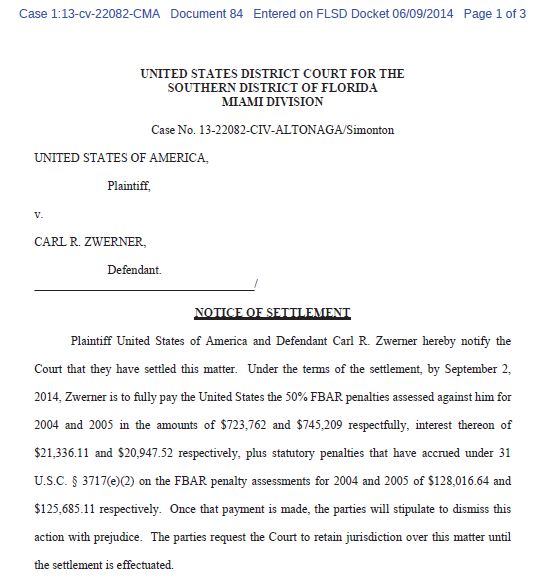
As a point of reference, Mr. Zwerner was alleged to owe US$3,630,119 (on an account with a maximum value during the years at issue of apparently no more than US$1.69M) and ultimately paid about US$ 1.75M (more than he even had in his account?) per the Notice of Settlement filed with the Court referenced here:
Even in 1922 dollars when Mr. Cook was living in Mexico City, the payment by Zwerner of about US$ 1.75M in current dollars, would represent about $123,581 in those dollars. See, Why the Zwerner FBAR Case is Probably a Pyrrhic Victory for the Government – for USCs and LPRs Living Outside the U.S. (Part II)
There was no Foreign Account Tax Compliance Act (“FATCA”) in the days of Cook in Mexico City, so it would be interesting to know how and why the audit and tax assessment collection was commenced. This was long before e-mails and internet, and there was a very different system of international travel. Communication and technology in 2014 is quite different from technology nearly 100 years ago when the first transcontinental (not transnational) telephone call was made in 1915 a few years before the tax issue arose in the case of Mr. Cook.
Now to the key point of this post. The Supreme Court in Cook vs. Tait framed the question before the Court as follows:
- The question in the case . . . as expressed by plaintiff [Mr. Cook], whether Congress has power to impose a tax upon income received by a native citizen of the United States who, at the time the income was received, was permanently resident and domiciled in the city of Mexico, the income being from real and personal property located in Mexico.
Can the United States impose worldwide taxation on U.S. citizens who permanently live overseas and who only have income from property or services outside the U.S.? Of course, the Supreme Court, said, that such a citizenship based rule was Constitutional. The rationale of the Court was explained in the opinion as follows, specific to the rights of citizenship:
- . . . the scope and extent of the sovereign power of the United States as a nation and its relations to its citizens and their relation to it.’ And that power in its scope and extent, it was decided, is based on the presumption that government by its very nature benefits the citizen and his property wherever found, and that opposition to it holds on to citizenship while it ‘belittles and destroys its advantages and blessings by denying the possession by government of an essential power required to make citizenship completely beneficial.’ In other words, the principle was declared that the government, by its very nature, benefits the citizen and his property wherever found, and therefore has the power to make the benefit complete. Or, to express it another way, the basis of the power to tax was not and cannot be made dependent upon the situs of the property in all cases, it being in or out of the United States, nor was not and cannot be made dependent upon the domicile of the citizen, that being in or out of the United States, but upon his relation as citizen to the United States and the relation of the latter to him as citizen. [emphasis added]
The Supreme Court emphasizes at several points that it is because of the benefits of citizenship and the rights conferred to the citizen of the United States, that the United States government has the Constitutional power to impose worldwide taxation.
What is the difference, if someone is NOT a U.S. citizen? How can the U.S. federal government impose worldwide taxation on property outside the U..S. when the individual is not a citizen, has no right to even enter the United States and generally has no benefits or protections afforded to a U.S. citizen? Indeed, a recent interpretation of the U.S. government in a Justice Department memo spells out the rights of certain U.S. citizens. See New York Times recent article, Court Releases Large Parts of Memo Approving Killing of American in Yemen Targeting Anwar al-Awlaki Was Legal, Justice Department Said
Back on topic, the rationale in Cook v. Tait did not extend to someone who was not a citizen. For example, the Internal Revenue in the 1920s was of course not attempting to impose taxation on Mr. Cook’s Mexican national wife who lived exclusively in Mexico.
Herein, is a most interesting problematic and possibly (maybe – probably?) unconstitutional aspect of current law under the provisions off IRC Section 7701(a)(5)(if the loss of nationality is retroactive to a date long ago in the past but the tax code/IRS is not recognizing that past date as the expatriation date.
See, Why Section 7701(a)(50) is so important for those who “relinquished” citizenship years ago (without a CLN)
If someone has lost all rights to U.S. citizenship years or decades ago, how can the U.S. federal government continue to impose worldwide income taxation for all of the intervening years?
How can the tax law impose a “Constitutional fiction” that a person continues to be “. . . treated as a United States citizen . . . ” simply because they did not file a paper notification with the U.S. federal government. See, Section 7701(a)(50) was adopted and has a very clear timing rule about when a person “. . . cease[s] to be treated as a United States citizen. . . ” It is not the same as for immigration law purposes. It’s a fiction in the tax law as to when one ““. . . cease[s] to be . . . a United States citizen. . . ”
The statute says ” . . . An individual shall not cease to be treated as a United States citizen before the date on which the individual’s citizenship is treated as relinquished under section 877A (g)(4). . .”
How can the U.S. federal government continue to impose U.S. worldwide income taxation on former U.S. citizens because of the provisions under Section 7701(a)(50) and 877A (g)(4)?
The U.S. Supreme Court in Cook vs. Tait found the U.S. citizenship based taxation system as Constitutional since ” . . . government by its very nature benefits the citizen and his property wherever found . . .” and because of “ . . . his relation as citizen to the United States and the relation of the latter to him as citizen. . . . ” [emphasis added]
A person who is not a citizen, obviously does not receive these benefits from the government as does a United States citizen.
In practice, the only body that can determine whether a law is Constitutional or not, is the U.S. Supreme Court. It’s not likely that this question will reach the Supreme Court any time soon; if ever. Meanwhile, the IRS generally has the duty to enforce the law as currently written.
Obtaining a U.S. Visa after Renouncing U.S. Citizenship – The Cloud of the Still Living “Reed Amendment”
To state the obvious, every non-U.S. citizen must have a visa (or participate in the visa waiver program as a citizen or national of one of the 38 countries such as Chile, Hungary, Estonia, Spain, Monaco, etc.) to enter into the U.S. There are numerous visas all with different immigration law requirements and restrictions and many which have specific U.S. federal income tax consequences.
A future post with immigration counsel will discuss the type of visas available for entry into the U.S.
To date, I have yet to see any clients not be able to obtain a visa for re-entry back into the U.S.; after renouncing U.S. citizenship.
Importantly, the Attorney General still has the statutory authority to make a determination that a former U.S. citizen is inadmissible under the so-called “Reed Amendment” that was passed into the law in 1996 into the immigration law, Title 8 ((8 U.S.C. § 1182(a)(10)(E)) as part of the so-called Illegal Immigration Reform and Immigrant Responsibility Act of 1996. That provision, which should be obsolete based upon intervening changes in the tax law, nevertheless provides as follows:
- (E) Former citizens who renounced citizenship to avoid taxation
- Any alien who is a former citizen of the United States who officially renounces United States citizenship and who is determined by the Attorney General to have renounced United States citizenship for the purpose of avoiding taxation by the United States is inadmissible.
There are no regulations or administrative guidelines implemented by the US Government agencies to enforce this provision and no former US citizens have ever been found to fall under this category to date. More posts to follow on this important topic, including federal government reports on its applicability.
Please see also, The 1996 Reed Amendment – The Immigration Law with “No Teeth” and “No Bite”
Can the Attorney General make this provision have “teeth”? Will it ever be invoked by the government to make a former U.S. citizen inadmissible into the U.S.?
Wide Window of Wait Times for CLN: One Month to 9 Months (or More?)
The Certificate of Loss of Nationality (“CLN”) is a most crucial part of the steps and process for renouncing U.S. citizenship. 
See, Why Section 7701(a)(50) is so important for those who “relinquished” citizenship years ago (without a CLN)
The formal acknowledgement/approval by the Department of State (DOS) is manifested by the issuance of a Certificate of Loss of Nationality of the United States, Form DS-4083 (CLN). See sample form in this post.
For U.S. federal income tax purposes, the actual receipt of the CLN by the individual is necessary for numerous reasons too. See, The Importance of a Certificate of Loss of Nationality (“CLN”) and FATCA – Foreign Account Tax Compliance Act.
See, also, Who makes the loss of US nationality determination? [Guest Post from Immigration Lawyer], Posted on May 19, 2014
You should be aware that the wait times to receive the CLN can vary wildly depending upon where (which Embassy or Consulate office) and when one goes to take the oath of renunciation. I have seen some issued as soon as 30 days. More commonly, 4 months is a fairly common time frame; but I have also seen cases where it took more than 9 months.
The Semantically Driven Vortex of “Relinquishing” vs. “Renouncing”
Guest Post from Immigration Lawyer – Mr. Jan Bejar – The Semantically Driven Vortex of “Relinquishing” vs. “Renouncing”
“Relinquishing” citizenship means to give up U.S. citizenship voluntarily by committing any of the expatriating acts described in INA § 349(a), 8 U.S.C. § 1481(a). One of the expatriating acts described in INA § 349(a)/8 U.S.C. § 1481(a) is “renouncing” or as it says in the statute, “… (5) making a formal renunciation of nationality before a diplomatic or consular officer of the United States in a foreign state, in such form as may be prescribed by the Secretary of State.”
Renouncing citizenship is a way to relinquish it, so when discussing this form of relinquishment, the two words can be used interchangeably.
For immigration purposes, the distinction between renunciation and the other forms of relinquishment may become meaningful when a former citizen is appealing or challenging the loss of nationality because establishing a lack of intent or duress during a formal renunciation is much more difficult than establishing a lack of intent when performing one of the other expatriating acts. See 7 FAM 1211 (h).
Jan Joseph Bejar, Esq.
(For: JAN JOSEPH BEJAR, APC)
Tel: (619) 291-1112
Fax:(619) 291-1102
E-mail: jbejar@immigrationlawclinic.com
Website: www.immigrationlawclinic.com