USCs without a Social Security Number (and a Passport) Cannot Travel to the U.S.
Recent posts have focused on the dilemma facing U.S. citizens (USCs) who have no social security number (“SSN”). See an older post (23 July 2014) – Why do I have to get a Social Security Number to file a U.S. income tax return (USCs)?
These problems are quickly coming to the surface, now that financial institutions  (“FFIs”) around the world and private companies and trusts (e.g., non-financial foreign entities -NFFEs) must have their owners and clients certify they are not U.S. citizens; OR report the accounts of such U.S. citizens to the IRS under FATCA and the intergovernmental agreements (“IGAs”).
See, U.S. Citizens Overseas who Wish to Renounce without a Social Security Number will Necessarily be a “Covered Expatriate”
The intricacies of this problem are highlighted in a technical paper I recently drafted and presented to the U.S. Treasury Department and the Joint Committee of Taxation, among other federal government groups. Some key excerpts of that paper titled URGENT NEED FOR U.S. CITIZENS RESIDING OUTSIDE THE U.S. TO BE ABLE TO OBTAIN A TAXPAYER IDENTIFICATION NUMBER (“TIN”) OTHER THAN A SOCIAL SECURITY NUMBER are set out below in this section:
The U.S. tax law imposing taxation on the worldwide income of USCs[1] residing overseas has created a dilemma that prejudices these USCs without a SSN. This strict SSN/TIN regulatory rule undermines the basic tax administration system and discourages tax compliance for those USCs who never obtained a SSN. This dilemma affects numerous USCs throughout the world, which is now compounded by the certification and reporting requirements of USCs and third parties, such as FFIs and NFFEs[ under the Foreign Account Tax Compliance Act (“FATCA”).
In short, USCs without a SSN, necessarily cannot be in compliance with U.S. federal tax law. As I point out in my paper, such –
“A law that cannot be complied with is surely a bad law, the same as a “ . . .law that cannot be enforced is a bad law.”[a]
[a] See, The Case Against Taxing Citizens, Reuven S. Avi-Yonah (March 31, 2010), University of Michigan School of Law, Law & Economics Working Papers.
The paper referenced above explains how difficult it is for USCs residing overseas to ever obtain a SSN. Specifically, it explains how difficult it is to have an in-person interview at only 18 different locations around the world with a U.S. Department of State employee. See, 12 Year Old (and Older) U.S. Citizens Residing Outside the U.S. Must Have An “In-Person” Interview in a U.S. Embassy or Consulate for SSN Application in 1 of Just 17 Posts Worldwide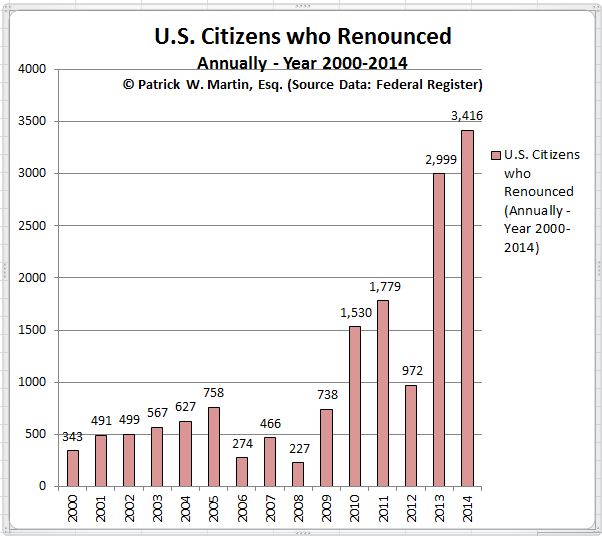
As a USC residing somewhere around the world, you might decide to simply spend the time, money and resources to travel internationally to arrive in the U.S. to apply for a SSN directly with the Social Security Administration within the U.S. Unfortunately, any USC is now legally prohibited from traveling in or out of the U.S. without a U.S. passport. There are few exceptions to this general rule, none of which contemplate U.S. federal tax compliance. See, the relevant excerpts from the white paper:
C. Travel to the U.S. is Also Not An Option for a USC without a SSN, Due to 22 CFR § 53.1 Requiring a U.S. Passport
A possible solution to this TIN/SSN dilemma may appear to be a trip to the U.S. by the USC to apply for a SSN in the U.S. Unfortunately, this simply creates another dilemma, since the USC must have a U.S. passport to travel to the U.S. The immigration law regulations 22 CFR § 53.1 require that a U.S. citizen have a U.S. passport to enter or depart the United States. The relevant part of the regulations is § 53.1(a) which provides as follows:
Passport requirement; definitions.
(a) It is unlawful for a citizen of the United States, unless excepted under 22 CFR 53.2,[2] to enter or depart, or attempt to enter or depart, the United States, without a valid U.S. passport.
These regulations were first published in 2006 and unfortunately, simply create another dilemma for the USC residing overseas without a SSN. This additional dilemma is that an application[3] for a U.S. passport requires the individual have a SSN; a vicious circle back to the inability to obtain a SSN.
At the end of the day, the restrictions imposed on USCs make it legally impossible for a USC without a passport to travel to the U.S. (even if they wish they could) to obtain a SSN.
[1] See, IRC § 61 and Treas. Reg. §§ 1.1?1(b) and 1.1?1(a)(1)..
[2] The exceptions set forth in this regulation would not generally be applicable in the case of USCs residing overseas without a SSN.
[3] Application for a U.S. Passport – http://www.state.gov/documents/organization/212239.pdf.
Does the IRS have access to the USCIS immigration data for former lawful permanent residents (LPRs)?
Information about former LPRs, such as the individuals names, is not published under the statute, IRC Section 6039G, which only covers former U.S. citizens. 
This raises the question of whether the Department of Homeland Security tracks former LPRs – names and addresses overseas and provides that information to the Internal Revenue Service?
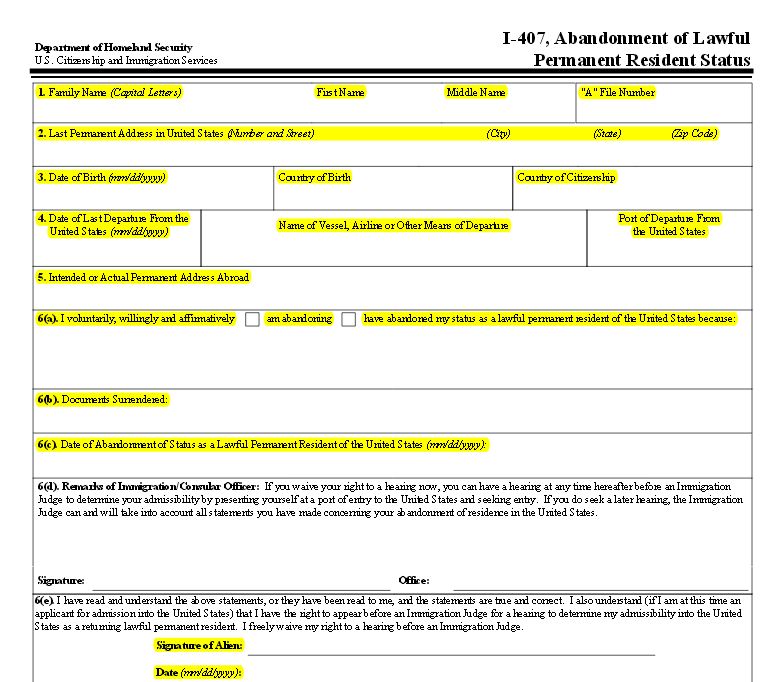
A prior post discussed the newly published USCIS immigration form I-407 for LPRs who must now use it when formally abandoning LPR status. See, More Information and More Information: USCIS Creates New Form for Abandonment of Lawful Permanent Residency
The new I-407 Form requires much more information and is 2 pages in length. The old form had only 6 lines and was less than 1/2 of a page in length. These forms  are set forth here. The new form requires the address overseas of the individual.
As readers here know, the names of former U.S. citizens are published quarterly by the U.S. federal government for the world to see. See a prior post, The 2014 Third Quarter Renunciations Is probably the New Norm –
The complete set of lists going back to the mid-1990s can be reviewed here. Quarterly Publications.
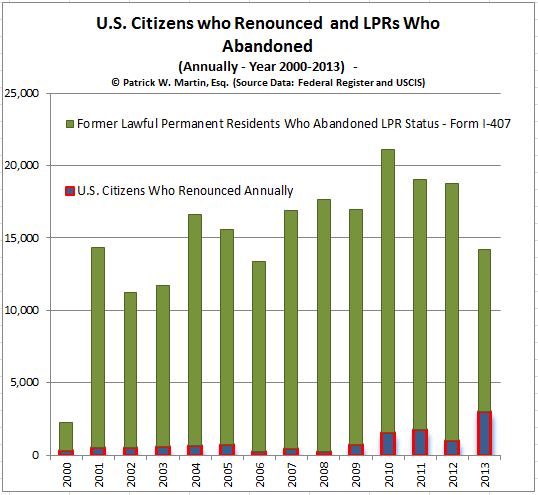
Of course, the IRS can easily select and identify individuals for audit, by simply drawing from the published names of former U.S. citizens, which is currently tracking at an average of about 850 former USCs quarterly. In contrast, the number of former LPRs who have filed USCIS Form I-407 is tracking at an average of about 4,000 to 5,000 individuals quarterly. 
While citizens are often the focus of the public press and Congress regarding “expatriation taxation”; the statute also wraps in so-called “long-term residents.” These are individuals who had or continue to have “lawful permanent residency status.” There are numerous technical considerations in this area, but needless to say, the number of former lawful permanent residents who have simply filed Form I-407 – Abandonment is far in excess of those U.S. citizens who have filed for and received a Certificate of Loss of Nationality (“CLN”) – Form DS-4083 (CLN). The graph reflects the enormous difference.
See, earlier post The Number of LPRs “Leaving” the U.S. is 16X Greater than the Number of U.S. Citizens Renouncing Citizenship
On a related post, the question was raised –What are the Number of LPRs who Leave U.S. Annually without filing Form I-407 – Abandonment?
This is important, since many LPR individuals will have “expatriated” without actually having filed USCIS Form I-407. See, Oops…Did I “Expatriate” and Never Know It: Lawful Permanent Residents Beware! International Tax Journal, CCH Wolters Kluwer, Jan.-Feb. 2014, Vol. 40 Issue 1, p9 
While the IRS has specific information about U.S. citizens, it is not clear whether the Department of Homeland Security via the USCIS provides data to the IRS regarding lawful permanent residents who have filed Form I-407? If such an individual becomes a “covered expatriate” under the U.S. tax law, the range of adverse tax consequences can follow them and their future beneficiaries and heirs, including as follows:
- “mark to market” taxation on their worldwide assets,
- 40% inheritance tax to U.S. beneficiaries,
- 40% tax on gifts to U.S. beneficiaries,
- etc.
It seems fairly easy, from a legal perspective, that the IRS can request the names, addresses (and indeed the newly completed form) from the USCIS of all individuals who have filed USCIS Form I-407. From the USCIS records, the IRS will be able to determine if the individual was a “long term resident” based upon the number of years the individual had such status.
Assuming the IRS determines the individual is a long term resident, they can then simply check to see if the they have received IRS Form 8854 from the former LPR; in order to determine if she or he satisfied the certification requirement of Section 877(a)(2)(C). If not, the IRS will necessarily know the individual is a “covered expatriate.”
More Information and More Information: USCIS Creates New Form for Abandonment of Lawful Permanent Residency
The U.S. Customs and Immigration Service (USCIS) just announced on 23 March 2015, that a new Form I-407 is available and is to be used, per the USCIS website announcement, which announcment provides in part as follows:
New Version of Form I-407 Now Available
USCIS has published a new edition of USCIS Form I-407, Record of Abandonment of Lawful Permanent Status (OMB No. 1615-0130). You can download the form on our website.
You may begin using the revised Form I-407, Record of Abandonment of Lawful Permanent Resident Status today. The current edition is dated 02/26/2015, and we will not accept previous form editions
The new form has additional information compared to the prior form. Specifically, the Alien Registration Number and USCIS ELIS Account Number is required to be included.
Now, the individual is required to state the reasons for abandoning lawful permanent residency status.
Responses to  each of these questions will have important legal consequences, including potential tax implications under IRC Sections 877, 877A, et. seq. See, for instance a prior post: What could be the focal point of IRS Criminal Investigations of Former U.S. Citizens and Lawful Permanent Residents?
One of the important enforcement and practical questions raised, is: Will the IRS be able to better track former “long-term residents” (certain former lawful permanent residents) for purposes of the “expatriation tax” under the new reporting form and system?
As has been explained, if an individual fails to certify under the tax law, they will necessarily be a “covered expatriate”; even if they do not meet the asset or income tax liability thresholds. See a prior post, Certification Requirement of Section 877(a)(2)(C) – (5 Years of Tax Compliance) and Important Timing Considerations per the Statute.
U.S. Department of State has Allowed (Starting in at least 2013) USCs to Keep their U.S. Passports After Oath and Prior to Receiving CLN
 Washington Post journalist, Ms. Colby Itkowitz had an interesting article on March 3, 2015, titled Yes, the State Department can jump on a problem and fix it in record time.
The focus of the article was that the U.S. Department of State can indeed fix a problem (in this case how and when U.S. passports are taken from U.S. citizens who take the oath of renunciation).
The article was a bit of a surprise to me, as I have had experience with several clients where the Consulate offices have indeed allowed the U.S. citizen to physically maintain their U.S. passport after taking the Oath of Renunciation (Form DS-4080, Oath of Renunciation of the Nationality of the United States) but prior to actually receiving the “Certificate of Loss of Nationality” (“CLN”).
After a U.S. citizen has formally renounced (or relinquished) their U.S. citizenship, the U.S. Department of State provides a CLN. This form can be located here at – Certificate of Loss of Nationality of the United States, Form DS-4083 (CLN)
You can go to the page “U.S. Department of State” under “Resources” for further U.S. Department of State Documents related to loss of nationality.
Sometimes, the U.S. Department of State will take several months to process the file in Washington D.C., before they actually issue the CLN. I have had cases (worst case scenarios) that take upwards of 9-10 months. See, The IRS does not give a “Certificate of Expatriation” or similar tax document . . .
However, my experience on several cases is that consular officer will generally allow t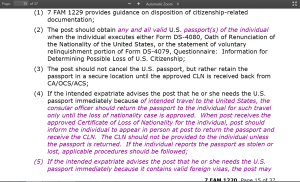 he individual to physically keep the U.S. passport until the CLN is actually issued and received by the individual in exchange for their passport. This has been the case for some 2 +/- years.
This procedure has been formalized in the Foreign Affairs Manual which added the additional key language in paragraph (4) regarding U.S. citizens who need their passport for travel to the U.S.
The President’s Proposal is NOT the Same as Current Law – Section 877A(g)(1)(B)
Some individuals are mistaken that the Obama proposal to exempt certain U.S. citizens from taxation (including the “mark to market” exit tax), is the same as the exception in IRC Section 877A(g)(1)(B).
It’s not. They are not the same, although they have some similar requirements (e.g., 5 years of certification of U.S. tax law compliance under penalty of perjury).
For a brief discussion on the President’s proposal, see –The Proposal by the President to Exempt Certain U.S. Citizens from Worldwide Taxation: – Very Small, Select Group
–
There are important differences. Most importantly, the I
RC Section 877A(g)(1)(B) exception requires the individual not only have been a dual citizen (of at least two or more countries) at birth, along with U.S. citizenship; but also continue to reside and be a tax resident of that country, i.e., the country of which they were also a citizen at the time of their birth. This tax residency/dual citizenship rule is necessarily required by I
RC Section 877A(g)(1)(B). If the person has moved to another country, they will not be eligible for this treatment and will be subject to the mark to market “exit tax” if they renounce their U.S. citizenship. Their U.S. heirs and beneficiaries will also be subject to the 40% (current tax rate) tax on “covered gifts” and “covered bequests.”
–
The President’s proposal (if it ever becomes law) will also apparently exempt all qualifying individuals from any type of U.S. taxation; other than tax that would apply to a “non-resident alien” (which would be no U.S. tax – if the individual had no U.S. source income). Not only would no “exit tax” apply, but so too would no U.S. income tax on their income from their country of residence or any other country outside the U.S. The President’s proposal would also exempt them from all U.S. tax filing requirements (other than the 5 years) and from FBAR filing requirements. See,
Nuances of FBAR – Foreign Bank Account Report Filings – for USCs and LPRs living outside the U.S.–
–
The Proposal by the President to Exempt Certain U.S. Citizens from Worldwide Taxation: – Very Small, Select Group
A prior post explained the green book proposal published earlier in February: Obama Budget Proposal to “Provide Relief for Accidental Americans”? Will the Proposal to Modify the Expatriation Rules Become Law?
The unique consequence of such a proposal, would be to eliminate U.S. citizenship based taxation for a very small, select group of U.S. citizens. See, Co-author. “Tax Simplification: The Need for Consistent Tax Treatment of All Individuals (Citizens, Lawful Permanent Residents and Non-Citizens Regardless of Immigration Status) Residing Overseas, Including the Repeal of U.S. Citizenship Based Taxation,” by Patrick W. Martin and Professor Reuven Avi-Yonah, September 2013.
The group affected would indeed be very small. Most importantly, the requirements that would limit the number of eligible persons to a very small class of individuals are the following:
- [those who] have never held a U.S. passport or . . . held a U.S. passport for the sole purpose of departing from the United States in compliance with 22 CFR §53.1,
- [those who] relinquish . . . his or her U.S. citizenship within two years after the later of January 1, 2016, or the date on which the individual learns that he or she is a U.S. citizen.
The immigration law regulations 22 CFR § 53.1 require that a U.S. citizen have a U.S. passport to enter or depart the United States. The relevant part of the regulations is § 53.1(a) which provides as follows:
Passport requirement; definitions.
(a) It is unlawful for a citizen of the United States, unless excepted under 22 CFR 53.2, to enter or depart, or attempt to enter or depart, the United States, without a valid U.S. passport.
*
These regulations were
first published in 2006, and rely in part on a Presidential Executive Order made by President Bush (Jr.).
*
*
Assuming an individual was aware of such regulatory rule, they could not qualify for this proposed exception, if they ever lived in the U.S. since becoming 18 1/2 years old. This means that only those individuals with U.S. passports who (i) obtained a U.S. passport as a child (presumably through their parents) while (ii) living in the U.S. and (iii) did so in order to comply with this regulation 22 CFR § 53.1 would be eligible. Since the regulations were just passed in 2006, anyone who obtained a U.S. passport, for instance in 2002 (even if they never lived in the U.S.) would presumably be disqualified from this tax treatment.
Also, if they did not get a passport when they were in the U.S., leaving the country after the 2006 passport regulations were adopted, would have been a violation of the law.
Bottom line, it seems nearly impossible that anyone who ever had a U.S. passport would ever qualify for this exception.
*
Further, the two year rule, would seem to exclude most all other foreign resident USCs (of course, virtually none of whom could ever have had a U.S. passport). Once an individual becomes aware they are a U.S. citizen (even if they are unaware of any U.S. tax or bank reporting requirements), the two year window starts ticking. If they do not renounce their U.S. citizenship within that time frame, they too would also not qualify for such an exception.
*
Finally, it is worth noting that it often takes several months to get an appointment with the U.S. Consulate or Embassy to even renounce in the first place.
*
Therefore, in conclusion, even if the Obama proposal were to make its way into the law, those who could actually obtain relief would be a rare group of individuals. In short, U.S. citizenship based taxation on worldwide income, will continue to be the law of the land.
The Number of LPRs “Leaving” the U.S. is 16X Greater than the Number of U.S. Citizens Renouncing Citizenship
The focus of Tax-Expatriation is to discuss legal matters of U.S. citizenship renunciation-relinquishment and lawful permanent residency abandonment.
There have been a great deal of resources discussing the number of USCs residing outside the U.S. and those who ultimately renounce citizenship.
See prior posts related to this topic –
The 2014 Third Quarter Renunciations Is probably the New Norm –
Wow, the number of 2,999 U.S. citizens who renounced in the year 2013 shattered the prior record set in 2011 of 1,782 renunciations. Why so many renunciations?
The List is Out – and Its 1,001 Former U.S. Citizens for the 1st Quarter 2014
There has not been any detailed discussion of the number of LPRs who leave the U.S. annually. The data provided by the U.S. Citizenship and Immigration Services reflects about 16 times more LPRs formally abandon their lawful permanent residency status by filing Form I-407 compared to U.S. citizens who renounce. The chart here shows a comparison for the years 2000 through 2013 of the total (i) USCs who have renounced compared to (ii) LPRs who have formally abandoned that status.
Note that for the year 2013, it is only through May 2013, so the total abandoned for the entire calendar year 2013 could well exceed 20,000.
Of course, this statistic does NOT identify the number of total current 13.3+ million LPRs who leave the U.S. to live elsewhere in another country without completing Form I-407 and formally abandoning. The estimated number of LPRs was 13.3 million for the year 2012 as reported by the Office of Statistics of the DHS. See, Estimates of the Legal Permanent Resident Population in 2012
See also The Foreign-Born Population of the United States: Multi-National Families and “Tax Expatriation”
Why the terms “Relinquish” and “Renounce” are Not Legally Distinguishable for Immigration or Tax “Expatriation” Law Purposes
The topic of “relinquish” versus “renounce” has already been touched upon in an earlier post. See, The Semantically Driven Vortex of “Relinquishing” vs. “Renouncing”
Posted on June 21, 2014
Guest Post from Immigration Lawyer – Mr. Jan Bejar –
***
It seems that many individuals think there is an important distinction, legally speaking for U.S. federal tax purposes.
In sum, I am of the view that both terms are in effect interchangeable for federal tax purposes.
The important time reference under the law of IRC Sections 877 and 877A is the “expatriation date” as defined in Section 877A(g)(3) – which focuses on specific dates tied to meetings or events with the U.S. Department of State.
Indeed the tax statute uses the terms “renounce” and “relinquish” in the same breath.
The key terms of the statute are set out below:
(3) Expatriation date
**
The term “expatriation date” means—
**
(A) the date an individual relinquishes United States citizenship, or
**
(B) in the case of a long-term resident of the United States, the date on which the individual ceases to be a lawful permanent resident of the United States (within the meaning of section 7701 (b)(6)).
**
(4) Relinquishment of citizenship
**
A citizen shall be treated as relinquishing his United States citizenship on the earliest of—
**
(A) the date the individual renounces his United States nationality before a diplomatic or consular officer of the United States pursuant to paragraph (5) of section 349(a) of the Immigration and Nationality Act (8 U.S.C. 1481 (a)(5)),
**
(B) the date the individual furnishes to the United States Department of State a signed statement of voluntary relinquishment of United States nationality confirming the performance of an act of expatriation specified in paragraph (1), (2), (3), or (4) of section 349(a) of the Immigration and Nationality Act (8 U.S.C. 1481 (a)(1)–(4)) . . .
As Mr. Jan Bejar said in his guest blog, renouncing citizenship is a way to relinquish it, so when discussing this form of relinquishment, the two words can be used interchangeably.
Read the Q&A format here.
Part III of III: Tracking Travelers’ Entries and Exits – Guest Immigration Law Post by Atty Mr. Jan Bejar
Part III of III: Tracking Travelers’ Entries and Exits –
Guest Immigration Law Post by Atty Mr. Jan Bejar
This post is a continuation of Part I and II of III: Tracking Travelers’ Entries and Exits – Guest Immigration Law Post by Atty Mr. Jan Bejar
. . .
For travel between Canada and the U.S., DHS and the Canada Border Services Agency (CBSA) have partnered in the “Beyond the Border” initiative to jointly track entries and exits. The idea of the program is that an entry into one country serves as a record of exit from the other. The initiative was planned to roll-out in four phases.
During Phase I, which began September 30, 2012, and lasted through January 15, 2013, DHS and CBSA exchanged biographic data regarding third country nationals, permanent residents of Canada who are not U.S. citizens, and permanent residents of the U.S. who are not citizens of Canada, at four land ports of entry.
During Phase II, which began on June 30, 2013, the biographic data about the same population was exchanged for crossings at all automated land ports of entry.
Phases III and IV were supposed to begin June 30, 2014, and would have expanded the initiative to virtually all travelers, including U.S. and Canadian citizens, and to air travel, but apparently these phases have been delayed.
Finally, for nonimmigrants issued paper I-94 and I-94W records (either in the past or presently at land ports of entry), submission of those records at a port of entry or to the airlines upon departure ideally should create, or should have created, an exit record. Presently, for nonimmigrants who arrive by air or sea and do not have a paper I-94, but who then depart by land, such that APIS does not record the departure, CBP instructs travelers to keep proof of the departure. Nonimmigrants issued a paper I-94, either in the past at any port of entry or currently at a land port of entry, who did not submit them upon departure, can mail them to a designated address with proof of the departure to create a departure record in the NIIS.
In sum, regardless of your immigration status, the U.S. government likely knows when you arrive but may not know when you leave, particularly if you depart along a land port of entry on the southern border.
Part II of III: Tracking Travelers’ Entries and Exits – Guest Immigration Law Post by Atty Mr. Jan Bejar
Part II of III: Tracking Travelers’ Entries and Exits –
Guest Immigration Law Post by Atty Mr. Jan Bejar
This post is a continuation of Part I of III: Tracking Travelers’ Entries and Exits – Guest Immigration Law Post by Atty Mr. Jan Bejar
. . .
For certain classes of nonimmigrants at air and sea ports of entry, electronic I-94 and I-94W records are generated using APIS data and stored in the NIIS. As of April 30, 2013, CBP stopped issuing paper I-94 records at air and sea ports of entry. Currently, CBP still issues paper I-94 records at land ports of entry, which are then entered into the NIIS.
Trusted traveler programs are another method of tracking and recording entries into the U.S. Trusted traveler programs include Global Entry, NEXUS on the northern border, and SENTRI on the southern border, among others. Travelers voluntarily provide detailed biometric and biographic data to CBP in exchange for expedited admission at ports of entry. Members use their machine-readable identification documents and/or RFID cards when entering the U.S., and their entries are accordingly recorded and stored.
Even today, despite the high inspection rates and various technologies, it is occasionally possible that an entry into the U.S. at a land port of entry would not be recorded. For example, if an inspector at a land port of entry simply looks at a U.S. passport or other travel document that is not RFID-enabled and does not “swipe” it to use its machine-readable capabilities, then the traveler’s entry may not be recorded. Along the same lines, a minor under 16 years old entering the U.S. at a land port of entry with a birth certificate may not have the entry recorded.
The U.S does not have a history of tracking departing travelers, and therefore comprehensively tracking exits has proved more elusive, particularly for land departures. Various pilot programs have been tested and later discontinued. Presently, at certain land ports of entry on the southern border, travelers may be subjected to screening and inspection upon departure. CBP’s mandate in conducting these inspections is to address violence in Mexico and to interrupt transnational criminal organizations’ activities. Outbound screening tends to happen in short-term surges, followed by periods of reduced inspection.[1] Simply passing through the screening, however, does not create a record of the departure.
For travelers departing the U.S. by air and sea, as mentioned above, CBP uses APIS to collect commercial passenger and crew manifests for all outbound international departures. Compliance by carriers is near 100%. CBP then transfers this data for non-U.S. citizens to ADIS, which matches arrivals to and departures from the U.S. Anecdotally, this system for tracking exits from the U.S. is not foolproof.
For example, just a few months ago, a lawful permanent resident client who had applied for naturalization purchased a ticket to depart the U.S. while her naturalization application was pending (which is entirely permissible). Ultimately, however, she opted not to travel abroad and postponed her flight. At her recent naturalization interview, when the USCIS officer asked about her trips outside the U.S. during the past five years, he asked about her departure on the date of the canceled flight. He had presumably accessed APIS and/or ADIS, and presumably the airline carrier had shared her name as a passenger with CBP, even though she had not boarded the plane. She honestly denied departing the U.S. that day. Fortunately, the officer believed her and moved on, but the error could have been difficult and time-consuming to correct had it been necessary to do so. Further, if she had been a nonimmigrant with authorization only to remain in the U.S. until the day of her scheduled flight, the system may not have detected her overstay.
As another example along the same lines, the American Immigration Lawyers Association (AILA) just reported that USCIS has recently denied in error multiple applications for changes of status (to a different nonimmigrant status) and for adjustment of status (to permanent resident status) where the applicants had purchased, but not used, airline tickets to depart the U.S.[2]
These applications, in contrast to a naturalization application, typically require that the applicant remain in the U.S. until receiving a decision. The sole reason that USCIS cited in these denials was the applicants’ alleged departures from the U.S. and constructive abandonment of the applications. Presumably these officers accessed APIS, the NIIS, and/or ADIS but did not click through the electronic records deep enough to see that the applicants had not actually used the international plane tickets. USCIS is supposedly aware of this training issue, but these denials underscore the difficulty in tracking exits from the U.S.
[1] See, supra, at fn. 3.
[2] See “CBP Practice Alert: ‘Implied Departure’ and Denial of USCIS Benefits, AILA InfoNet Doc. No. 14090243 (posted Sep. 2, 2014); see also “Minutes from AILA CBP Liaison Committee Teleconference with Suzanne Shepherd, ESTA Director regarding I-94 web portal and travel history information,” August 6, 2014, AILA InfoNet Doc. No. 14082042 (posted August 20, 2014).
Jan Joseph Bejar, Esq.
(For: JAN JOSEPH BEJAR, APC)
Tel: (619) 291-1112
Fax:(619) 291-1102
E-mail: jbejar@immigrationlawclinic.com
Website: www.immigrationlawclinic.com