There is an idea that only recently has permanent resident US immigration status into the United States grown substantially. The peak years were in the early 1990s as to absolute numbers. However, the greatest number of permanent residents as a relative percentage of the population was in the early 1900s; by far. See the chart below that I created from DHS immigration statistics data.
There were more LPRs admitted, in absolute terms in 1905 (1,026,499) than in 2022 (1,018,349).
[arm_restrict_content plan=”2,” type=”show”]
In percentage terms the total number of LPRs in 1905 compared to the total population was more than four times (4X) greater than in 2022 when it was (about 3/10th of 1 percent or 0.306%; versus a total population of 333 million) . In 1905 the total population was about 84 million, with newly admitted LPRs representing 1.225 percent of the entire resident population (1.225%; is greater than 4X the 2022 relative percentage).
The “Mark to Market” Tax that did NOT Exist in 1820, 1913, 1966 (Not Until 1996)
The US tax expatriation laws now impose a “mark to market” tax on so-called “long-term residents” who become “covered expatriates.” Such a concept in the tax law never existed in the early part of the 20th century, and indeed only became law in 1996. See an earlier post, The Foreign Investors Tax Act of 1966 (“FITA”) – The Origin of US Tax Expatriation law
This so-called Mark to Market tax is based upon a legal fiction, as if the individuals sold their worldwide assets on the “expatriation date.” It applies, even though there’s no current sale of assets, no disposition, transfer, change of ownership, change of title, or other “realization” event. The term “realization” is very significant in US tax law, including as recently discussed by the United States Supreme Court. See below and Moore v. the United States (2024) .
Below is a table of LPRs who were admitted to that status, per year, over the last 200+ years starting in 1820:
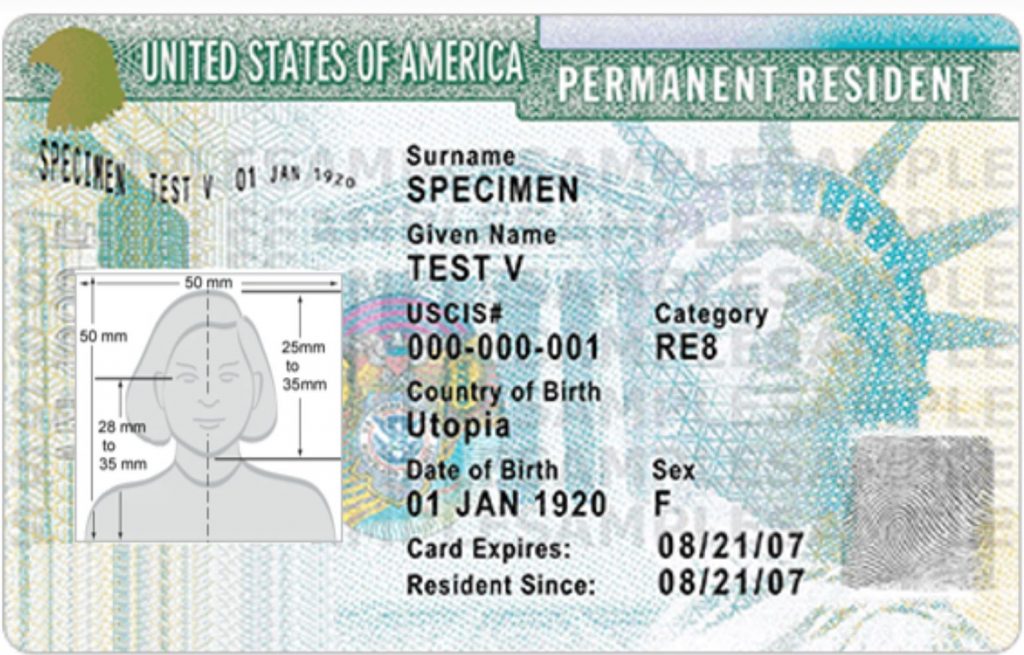
Are you or any of your family members one of these millions (more than 88 million) of LPR individuals represented in the above graph over the last 200+ years?
These regulations are extensive and provide an explanation of the purpose of these rules.
II. Purpose of Foreign Gift and Trust Provisions
During the mid- to late-1990s, abusive tax schemes, including offshore schemes involving foreign trusts, reemerged in the United States after reaching their last peak in the 1980s. GAO, Efforts to Identify and Combat Abusive Tax Schemes Have increased, but challenges remain, GAO–02–733 (Washington, DC: May 22, 2002). In these schemes, foreign trusts were used to transfer large amounts of assets abroad, where it was much more difficult for the IRS to identify whether U.S. persons owned a trust.
interest in such trusts, and whether such persons were reporting and paying the required taxes on their income from such trusts. Many of the foreign trusts were established in tax haven jurisdictions with bank secrecy laws. Before the 1996 Act amended sections 6048 and 6677, there was no Form 3520-A), which was limited to five percent of the transfer or corpus of the trust, as applicable, not to exceed $1,000. In light of this, it was difficult for the IRS to obtain information about income earned by U.S.-owned foreign trusts and distributions to U.S. beneficiaries from foreign trusts, and Sections 6048 and 6677 were generally ineffective in ensuring that U.S. persons provided this information. information. The result was “rampant tax evasion.” 141 Cong. Rec. S13859 (daily edition of September 19, 1995) (comments by Senator Moynihan). Requirement for U.S. Persons to Report Distributions from Foreign Trusts and the Penalty for Failure to Report Transfers to a Foreign Trust or an Annual Foreign Trust Information Statement (in Federal Register/Vol. 89, No. 90/Wednesday, May 8 of 2024/Proposed Rules and 141 Cong. Rec. S13859 (daily edition of September 19, 1995) (comments by Senator Moynihan).
The U.S. tax law is complex, including when an individual (i) becomes and (ii) ceases to be, a U.S. income tax resident (USITR). USITR is not a technical term used under the tax law. The U.S. tax and information reporting requirements are very different depending the status of an individual. Anyone who is not a United States citizen, is either a –
“Resident alien“, or a
“Nonresident alien” as the tax law defines both of these categories.
You can’t be both.
“Resident aliens” are generally also “United States persons” (both technical terms in the federal tax law).
“Non-resident aliens” as defined are necessarily not “United States persons.”
Being one versus the other has huge U.S. tax and reporting consequences.
An individual who is a “lawful permanent resident” as referenced in the tax law (Section 7701(b)(6)) cross-references the U.S. immigration law. The first requirement of that statutory tax rule in § 7701(b)(6)(A)) is that “(A) such individual has the status of having been lawfully accorded the privilege of residing permanently in the United States as an immigrant in accordance with the immigration laws [such status not having changed]. . .[emphasis added]” This means the tax definition is dependent upon the immigration laws, which are found in Title 8, Immigration and Nationality Act. Importantly, the last part of that sentence (i.e., [such status not having changed] is a requirement in the immigration law (Title 8), but does not appear in the tax definition.
The term “lawful permanent resident” cannot be found in Title 8 as a noun or object (i.e., the individual). Instead, the immigration law defines the status of a person in 8 U.S. Code § 1101(a) as follows:- “. . . (20) The term “lawfully admitted for permanent residence” means the status of having been lawfully accorded the privilege of residing permanently in the United States as an immigrant in accordance with the immigration laws, such status not having changed.“
This analysis is fundamental to be able to determine whether an individual who holds a “green card” in their pocket even has the status of being “lawfully admitted for permanent residence. . . such status not having changed.” It’s a fundamental legal question under immigration law that must be answered first, to then be able to answer the tax question.
Each form an individual files or does not file (e.g., IRS tax form 1040 v. 1040NR; 8833, 5471, 8854, 8621, 3520, 8864, 8858 and FinCEN forms 114; and immigration forms, e.g., I-485, I-407, etc.) can have a potential impact on the tax residency status of an individual.
The immigration law and when forms, such as Form I-485, Application to Register Permanent Residence or Adjust Status are submitted to the U.S. federal government can have an impact on this determination. The government can use it against the individual as they did unsuccessfully in Aroeste (see below – Pages 9 and 11 of 17); asserting that Mr. Aroeste waived the treaty by not submitting certain forms.
The entire case from the Federal District Court can be read here: Aroeste v. United States, 22-cv-00682-AJB-KSC (20 Nov. 2023):
The tax residency analysis for those who have kept their “green card” in their pocket, can be even more complex as was analyzed by the Court. There are additional provisions of the law that must be considered including old Treasury Regulations that pre-date many provisions of various U.S. income tax treaties.
For instance, each of the following federal tax statutory rules, which will be considered in more detail in later posts (II and III):
Additional posts will review the impact of these provisions in the law and how various immigration forms (including I-485 and I-407, Record of Abandonment of Lawful Permanent Resident Status) and tax forms (including 1040 v. 1040NR; 8833, 5471, 8854, 8621, 3520, 8864, 8858) and FinCEN form 114, can impact the determination of whether someone who has a “green card” in their pocket is or is not a United States person.
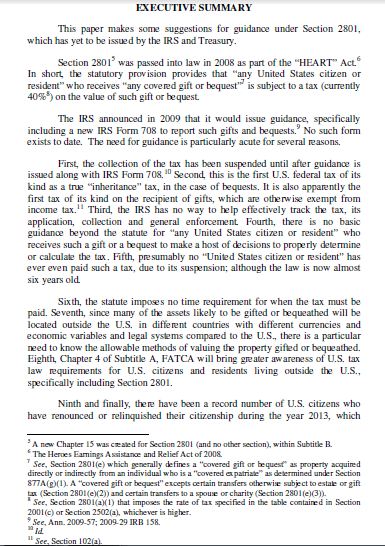
The tax is levied currently at 40% and can be a big surprise to U.S. beneficiaries who receive so-called “covered gifts” and “covered bequests.” The actual implementation of the tax and its enforcement was suspended until Treasury issued regulations. That day has now come and final regulations will follow shortly.
The proposed regulations create an ingenious mechanism by which assets that are received from foreign trusts (which make an election to be taxed as domestic trusts) cannot escape the 40% taxation. Specifically, there was concern expressed to me by Treasury officials drafting the regulations, when I had submitted a proposal to the U.S. Treasury on the subject in May of 2014. See, COVERED GIFTS & BEQUESTS: THE NEED FOR GUIDANCE (5+ YEARS OUT)
* * *
There was concern by the U.S. Treasury that U.S. persons could escape the tax when assets are received by foreign trusts which elect to be taxed as domestic trusts. In those cases, the statute imposes the tax liability on the trust and not the U.S. beneficiary. Hence, the concern expressed by some of the key drafters at U.S. Treasury of the regulations, was that a foreign trust would make the election and purposefully NOT pay the tax imposed by the statute, since the trustee would be outside the U.S. and largely outside the jurisdiction of the IRS.
The proposed regulations create a mechanism by which the trustee cannot slip away so easily, as they will NOT be treated as a domestic trust (versus a foreign trust) in such circumstances where the tax is not actually paid. In those cases, the U.S. beneficiary will be liable for the tax.
It also has some unique concepts that are not necessarily intuitive under the law. For instance, those individuals who are not U.S. citizens, yet live in the U.S. on a nearly full time basis, might still be able to avoid the application of the tax (at least in certain circumstances) if they are not “domiciled” in the U.S. The term “domicile” is a key estate and gift tax term of tax residency, that is not tied to the number of days an individual spend in the U.S. Rather, it is tied to the subjective intention of whether they expect to spend the rest of their lives in the U.S. See, Section 28.2801-2(b) of the proposed regulations which defines residents as those under “Chapter 11” and “Chapter 12”; which are the rules of “domicile” for transfer tax purposes. These are different from the rules of income tax residency found in IRC Section 7701.
“A person acquires a domicile in a place by living there, for even a brief period of time, with no definite present intention of later removing therefrom. Residence without the requisite intention to remain indefinitely will not suffice to constitute domicile, nor will intention to change domicile effect such a change unless accompanied by actual removal.”
Notice, there is no reference to the number of days physically spent in the U.S.
More to be discussed on the proposed regulations in later posts.
When people write about the taxes from expatriation, the focus seems to be on the income tax provisions. Maybe that is normal, since an income tax can be immediately triggered with reference to the “expatriation date” as defined in the law.
However, the most costly tax will often be the tax on “Covered Gifts” and “Covered Bequests” which went into effect in 2008, but is awaiting Treasury regulations for publication.
Proposed regulations are in the works and presumably were going to be released before the end of the year. In May of this year, I presented a set of formal recommendations to the U.S. Treasury and IRS on this topic in a paper entitled:
The tax is currently levied at a 40% rate on basically the full vale of the asset upon the gift or bequest. It also continues on for potentially generations into the future; e.g., if U.S. beneficiaries receive property held in trust that was funded by a “covered expatriate.” For instance, to demonstrate the consequences, we can assume a former U.S. citizen who is a “covered expatriate” (e.g., for failure to properly certify under Section 877(a)(2)(C) and file IRS Form 8854, even though the income tax or asset tests are not satisfied) funds a trust in a foreign country for her grandchildren and great grandchildren. See, How many former U.S. citizens and long-term lawful permanent residents have filed (or will file) IRS Form 8854?
Over time, the value of those trust assets grow substantially and 30 years after her death (e.g., the year 2055), the trust starts distributing US$100,000 annually to several U.S. citizen grandchildren and grandchildren. Under the current law, each time the distribution is received, a 40% tax should be levied on each distribution. The law leaves many unanswered questions, until the proposed regulations are issued.