Where the IRS will Likely Look in Latin America: Country Specific Tax Returns filed by U.S. Individual Taxpayers – Latin America (Excluding Mexico)
The prior post asked the “question”: Where the IRS will likely look overseas: USCs are Millions Yet U.S. Tax Returns are Just a Few Hundred Thousand [?]
As a continuation of the prior post, some further analysis by geographical region is provided here. This post is focused on Latin American countries  where U.S. citizens, lawful permanent residents (“LPRs”) or other individuals who may be U.S. tax residents (e.g., those individuals who make an election to be treated as a “U.S. person” for federal income tax purposes) are or are not filing U.S. tax returns. For an important discussion of LPRs, see, Who is a “long-term” lawful permanent resident (“LPR”) and why does it matter?
The IRS provides detailed statistical information on tax returns filed; how many, and in various groupings and from various locations. One such grouping by the IRS office of statistics, is by those individuals who filed tax returns which contained the “foreign earned income exclusion” which is reported on Form 2555: Foreign-Earned Income Exclusion, Housing Exclusion, and Housing Deduction.
See, The Foreign Earned Income Exclusion is Only Available If a U.S. Income Tax Return is File
The IRS reports that less than 15,000 tax returns were filed from all of of Latin/South America (excluding Mexico); for the year 2011, the last year they reported these statistics reflecting the foreign earned income exclusion. One of the more surprising statistics is that according to the U.S. Department of State, some 120,000 U.S. citizens reside in Costa Rica alone, yet only about 2,100 U.S. income tax returns were filed from Costa Rica with the foreign earned income exclusion.
Indeed, according to the U.S. federal government’s own numbers, there are approximately more than 8 times the number of U.S. citizens, simply living in Costa Rica (approx. 120,000) compared to the total number of U.S. tax returns (14,732) filed from all of the Latin/South American countries (excluding Mexico) that had the foreign earned income exclusion.
Similarly, Panama according to the U.S. Department of State, has ” . . . About 25,000 American citizens reside in Panama, many retirees from the Panama Canal Commission and individuals who hold dual nationality. There is also a rapidly growing enclave of American retirees in the Chiriqui Province in western Panama.” However, only about 1,200 U.S. income tax returns were filed from Panama with the foreign earned income exclusion.
Each Latin/South America country from which the number of U.S. tax returns were filed in 2011, with the foreign earned income exclusion is set out below:
| Latin/South America, total | 14,732 |
| Argentina | 986 |
| Brazil | 3,351 |
| Chile | 1,383 |
| Colombia | 1,524 |
| Costa Rica | 2,147 |
| Panama | 1,187 |
| Peru | 1,098 |
| Venezuela | 778 |
| Other Latin and South American countries | 2,280 |
This analysis is surely the type of analysis being conducted by the IRS which will be supplemented with information as they start receiving financial account and income information from countries and their financial institutions around the world (not just Latin America) from FATCA and the IGAs. See, Part 1- Unintended Consequences of FATCA – for USCs and LPRs Living Outside the U.S.
Three key observations about the above analysis.
First, there are many U.S. citizens residing overseas who have (a) income below certain thresholds, (b) are simply retired or unemployed – and have no foreign earned income, and/or (c) are not aware of how they can benefit from the foreign income exclusions; and therefore are not filing U.S. tax returns with the foreign earned income exclusion. However, the disproportionate number of U.S. citizens living throughout Latin America compared with the tax returns that are filed in this category is a strong indicator of low compliance by these taxpayers. The IRS will surely take note of this key consideration.
Second, the above numbers do not try to identify the number of LPRs who are residing in these Latin American countries who are also not filing U.S. income tax returns. There are some 13-14 million LPRs. See, What are the Number of LPRs who Leave U.S. Annually without filing Form I-407 – Abandonment?
Third, Latin America has the largest percentage of the population throughout the world where more U.S. citizens reside. See, a 2012 proposal I prepared for the State Bar of California, Taxation Section: Proposed Expansion of Category of Registered Deemed-Compliant FFI: “The Good Faith Local FFI” and the Accidental American along with Liliana Menzie that describes the high concentration of U.S. citizens throughout the region. “Latin America, as a prime example, has a high concentration of U.S. citizens residing in various countries pursuant to the State Department data, in some cases representing a large percentage of the population (e.g., nearly one half of a percent -0.4%- of the total population of the Americas consisted of U.S. citizen[s] . . .”
Where the IRS will likely look overseas: USCs are Millions Yet U.S. Tax Returns are Just a Few Hundred Thousand
The IRS has key tax return filing information in their current records; pre-FATCA flow of financial information. Various reports indicate there are probably around 6-7 million U.S. citizens residing overseas, although there is no certainty in these numbers. See, Taxpayer’s Advocate Annual Report of 2012 – that 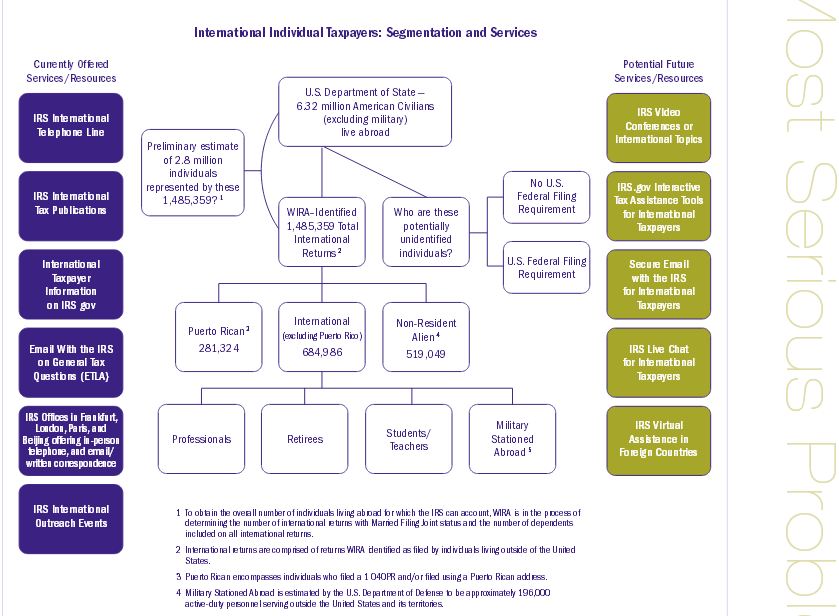 discussed both the number and type of individuals overseas, and potentially unidentified individuals.
The IRS tracks and keep information on U.S. income tax returns filed by U.S. individual taxpayers overseas.
The information is not only the number of tax returns (head count), but also the amount of income reported. For instance, TAS reported about 700,000 returns were filed in 2010 by U.S. taxpayers abroad, while estimating about 6.32 million U.S. citizens reside abroad. See, p. 37 of the Taxpayer’s Advocate Annual Report of 2012 –
These numbers do not even try to quantify the number of lawful permanent residents (“green card holders”) who reside around the world, who are not filing U.S. income tax returns. In 2012, the estimated number of LPRs was 13.3 million as reported by the Office of Statistics of the DHS. See, Estimates of the Legal Permanent Resident Population in 2012
How many of these LPRs are living outside the U.S. and not filing or reporting their worldwide income on U.S. income tax returns?
In addition, for the tax year 2011, the IRS Tax Statistics (“SOI”) in the “SOI Tax Stats – International Individual Tax Statistics” reported that only about 450,000 returns were filed with the foreign earned income exclusion. See, The Foreign Earned Income Exclusion is Only Available If a U.S. Income Tax Return is Filed
A detailed report of these statistics commissioned by the IRS and prepared by Scott Hollenbeck and Maureen Keenan Kahr titled Individual Foreign-Earned Income and Foreign Tax Credit, 2011 provides numerous insights about the likely under reporting and non-filers of U.S. income tax returns .
.
This report provides the following information reflecting the UK as the number one country with foreign earned income (Section 911) followed by Canada. Ironically Afghanistan (presumably due to the U.S. citizens working in that country as a result of the war?) is the country in the 4th location, ahead of Hong Kong and Japan.
Noticeably absent from that graph is Mexico, which reportedly has the largest number of U.S. citizens residing in any particular country. Canada is the second most populated country with U.S. citizens according to numerous reports.
Only about 46,000 returns were filed by Canadian residents claiming the foreign earned income exclusion, and even more surprising are the mere 7,000 returns from Mexican based U.S. taxpayers. See Table 2 of the report – Individual Foreign-Earned Income and Foreign Tax Credit, 2011
These are the two most populated countries with U.S. citizens.
As the IRS receives information around the world from governments and financial institutions via FATCA, of U.S. citizens and their bank accounts, it will be fairly easy for them to start targeting certain countries and commence tax audits against residents in those countries.
IRS Closing Overseas Offices – IRS Disconnect Between Civil versus Criminal International Tax Enforcement
The IRS announced a few days ago that it will close various “civil-side enforcement” overseas offices.
The IRS Statement is set out in part below:
The IRS is planning to close civil-side enforcement offices in Frankfurt, London and Paris this budget year. This is in addition to the closure of the Beijing office earlier this fiscal year. After budget reductions over the last 4 consecutive years, the IRS is forced to make tough choices during this period of fiscal austerity and these closures have relatively little impact on taxpayers and treaty partners. Considering our global mission, technological advances, and budgetary constraints, the Internal Revenue Service is realigning many functions and
positions from foreign-based to US-based.
. . .
IRS remains committed, however, to servicing our expatriate community and meeting our international obligations. We believe these services can be provided by other methods.
IRS will also continue to interact and collaborate with foreign tax authorities directly and through participation in many international forums and organizations, and through bilateral or group projects. This collaboration remains essential in
meeting the challenges of tax administration in a global economy.
This announcement comes on the heals of further comments in December from senior Tax Division/Department of Justice attorneys that offshore tax evasion remains among the highest priority areas for criminal enforcement in 2015.
The closing of IRS offices in important world centers that serve “normal” international taxpayers, while at the same time another part of the government (Department of Justice) continues to beat the “international tax evasion” drum, continues to send a bit of a mixed message.
In an article I wrote and published back in Jan-Feb 2012 in the International Tax Journal titled Unsettled Future for U.S. Taxpayers Residing Overseas: Mixed Messages from IRS Commissioner vs. Ambassador—Part I, I quoted then Commissioner Shulman from December 15, 2011, and his prepared remarks to the IRS/GWU 24th Annual Institute on Current Issues in International Taxation:
What is the 10 year “Collection Statute” and Why is it Suspended for USCs and LPRs Overseas?
There are different periods of time the federal tax law sets forth to protect both the taxpayer and the government. In short, after a certain period of time (assuming numerous conditions are satisfied), neither (i) the government can take action to assess or recover taxes, or (ii) the taxpayer can demand a tax refund.
This concept is known as the “statute of limitations” and is a concept deeply imbedded throughout U.S. law, not just taxation law.
There are two key aspects for how and when taxes are levied by the IRS. First, there is the “assessment” part, which helps determine a tax is owing in the first place. There have been chapters of tax treatises written on how and when an assessment is valid. A tax return is a “self-assessment”. See, for instance, the CCH® Expert Treatise Library: Tax Practice and Procedure, and its chapter on Assessment and Collection.
The IRS can also make an assessment through a so-called “substitute return.” See, How the IRS Can file a “Substitute Return” for those USCs and LPRs Residing Overseas.
The focus of this post, is on the second aspect; the “collection” part of how the IRS collects upon a final tax assessment.
There is a 10 year collection statute of limitations imposed upon the IRS. See IRC Section 6502.
The general rule, is that the IRS cannot wait forever to collect against a taxpayer for the amount of taxes owing. If the taxes are not collected within this 10 year period, the general rule is that the IRS cannot continue to attempt to collect the taxes.
However, there is a huge exception in the 10 year collection statutory law, which does not apply when the individual is physically outside the United States for a continuous period of at least six months. See, IRC Section 6503(c). This means that any USC or LPR residing predominantly outside the U.S. will have this 10 year collection statute suspended in favor of the government.
In other words, the IRS will be able to indefinitely use its collection efforts to lien and levy assets of the taxpayer, when she is living outside the U.S. The only way to “re-start” the collection statute, is for the individual to travel to the U.S. and not stay outside the U.S. for more than a six month period. Obviously, for those who live outside the U.S., this will typically be impractical, if not impossible, to live several month continuous periods within the U.S.
Finally, traveling to the U.S., can raise additional issues for the overseas USC or LPR who has taxes owing to the IRS. See, Should IRS use Department of Homeland Security to Track Taxpayers Overseas Re: Civil (not Criminal) Tax Matters? The IRS works with Department of Homeland Security with TECs Database to Track Movement of Taxpayers
See also, U.S. Enforcement/Collection of Taxes Overseas against USCs and LPRs – Legal Limitations
The Importance of Planning – PRIOR to Renouncing, Relinquishing or Abandoning
International tax law experts who specialize in a particular area of the law, have a fairly good understanding of the importance of tax planning. The reason is simple. The law is complex and without planning,  laypeople can often cause very adverse tax consequences to themselves and their friends and family members (in the case of tax expatriation) without understanding the full implications of the law.
“Tax expatriation” in the U.S. is particular complex for several reasons:
1. The general rule is that there is an immediate income tax payable from the “mark to market” taxation rules on unrealized gains. See, Part I: Common Myths about the U.S. Tax and Legal Consequences Surrounding “Expatriation”
2. If a tax is recognized under the U.S. tax law, the only way to discharge the liability with the U.S. federal government is to pay the tax owing. The IRS generally can collect an income tax owing against a taxpayer who lives outside the U.S. indefinitely, as the 10 year collection statute does not apply when the individual outside the United States for a continuous period of at least six months. See, IRC Section 6503(c). More on this topic in another post. In other words, the IRS can “forever” pursue the collection of the “expatriation tax” against USCs and LPRs living outside the U.S.
3. It is easy to fall into the general rule of expatriation, even if the taxpayer would not otherwise be subject to income taxation. See, Why “covered expat” (“covered expatriate”) status matters, even if you have no assets! The “Forever Taint”!
4. The friends and family of the “covered expatriate” – i.e., the former U.S. citizen and long-term lawful permanent resident can be subject to U.S. taxation during their lifetimes, even if they also live outside the U.S. See also, some of the consequences of being a “covered expatriate” – The “Hidden Tax” of Expatriation – Section 2801 and its “Forever Taint.”
Each of these points help demonstrate the need for planning prior to running to the U.S. Department of State and completing and filing the following forms when you take the oath of renunciation:

See, Documents to Request the Consular Officer When Renouncing U.S. Citizenship
At the end of the day, if the individual lives outside the U.S. and does not travel to and from the U.S., it may be practically very difficult for the IRS to collect on the tax judgment owing if the individual has no assets in the U.S. There are legal means and steps the IRS can take in an attempt to try to collect U.S. taxes on overseas assets.
For a further discussion on collection of taxes overseas:
See, U.S. Enforcement/Collection of Taxes Overseas against USCs and LPRs – Legal Limitations, and
Ideally, a former U.S. citizen or long-term lawful permanent resident will wish to avoid all of the potential tax and collection issues, by engaging in thoughtful and strategic planning prior to their renunciation of U.S. citizenship or abandonment of lawful permanent residency.
IRS Warns of Breach of Individual Financial Information – Bank Account Details and other FATCA Related Account Data
This is not new news; indeed it is somewhat old and stale. It has become more relevant, however, as the exchange of financial information under FATCA is to commence in a few months in 2015.
The IRS issued a warning in September that reads in relevant part as follows:
IRS Warns Financial Institutions of Scams Designed to Steal FATCA-Related Account Data
WASHINGTON — The Internal Revenue Service today issued a fraud alert for international financial institutions complying with the Foreign Account Tax Compliance Act (FATCA). Scam artists posing as the IRS have fraudulently solicited financial institutions seeking account holder identity and financial account information.
The IRS does not require financial institutions to provide specific account holder identity information or financial account information over the phone or by fax or email. Further, the IRS does not solicit FATCA registration passwords or similar confidential account access information.
This statement may be a bit misleading, since the FATCA law does require specific individual account holder information be provided to the government. It is detailed in its scope of information required; including account numbers, names of account owners, addresses of account owners, income from such accounts, taxpayer identification numbers (which means Social Security Numbers for U.S. citizens), etc.
Time will tell, how effective governments will be in maintaining their taxpayers’ information confidential; as opposed to private institutions, such as JP Morgan. See, JPMorgan data breach entry point identified: NYT
What is the burden of proof for civil willful FBAR penalties? Government says – mere “preponderance of the evidence”?
A prior post took part of the government’s brief in the Zwerner case. See, FBAR Penalties for USCs and LPRs Residing Overseas – Can the Taxpayer have no knowledge of the law and still be liable for the willfulness penalty? See government memorandum.
A portion of the post and brief is set out below:
. . . another perplexing aspect of this case is that the government continues to persist in its argument that a mere preponderance of the evidence is the proof standard required. That will be left for another post and another discussion.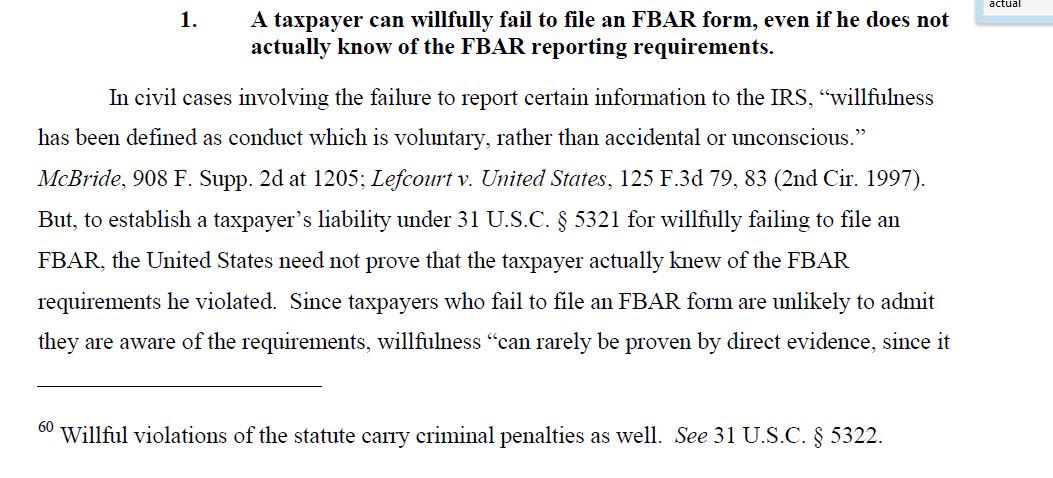
Here is that other post.
The reason this issue is so important for U.S. citizens and lawful permanent residents (LPRs) residing outside the U.S., is that few have historically filed FBARs. Few may have had little knowledge or understanding of what is an FBAR in years past. For more background on FBARs and how the government has assessed penalties as of late, see, Why the Zwerner FBAR Case is Probably a Pyrrhic Victory for the Government – for USCs and LPRs Living Outside the U.S. (Part II)
Also, see a prior post entitled – Nuances of FBAR – Foreign Bank Account Report Filings – for USCs and LPRs living outside the U.S
Back to the point at hand: can the government truly take the position that “. . . But to establish a taxpayer’s liability under 31 U.S.C. Section 5321 for willfully failing to file an FBAR, the United States need not prove that the taxpayer actually knew of the FBAR requirements he violated. . . “?
This is a truly low bar and a low level of proof the government has, IF this is the law, particularly when the amounts of the penalties can exceed the value of the individual’s accounts in their country of residency. To date, no appeals court has ruled on the question.
The current state of the law, leaves taxpayers at a terrible disadvantage when the IRS assesses FBAR penalties which seem to have little correlation with their failure to file the form.
The position taken by the Tax Division, Department of Justice in the Zwerner case is also seems contrary to the Internal Revenue Service’s own Internal Revenue Manual, which provides as follows (with highlights in bold):
- The test for willfulness is whether there was a voluntary, intentional violation of a known legal duty.
- A finding of willfulness under the BSA must be supported by evidence of willfulness.
- The burden of establishing willfulness is on the Service.
- If it is determined that the violation was due to reasonable cause, the willfulness penalty should not be asserted.
- Willfulness is shown by the person’s knowledge of the reporting requirements and the person’s conscious choice not to comply with the requirements. In the FBAR situation, the only thing that a person need know is that he has a reporting requirement. If a person has that knowledge, the only intent needed to constitute a willful violation of the requirement is a conscious choice not to file the FBAR.
- Under the concept of “willful blindness” , willfulness may be attributed to a person who has made a conscious effort to avoid learning about the FBAR reporting and recordkeeping requirements. An example that might involve willful blindness would be a person who admits knowledge of and fails to answer a question concerning signature authority at foreign banks on Schedule B of his income tax return. This section of the return refers taxpayers to the instructions for Schedule B that provide further guidance on their responsibilities for reporting foreign bank accounts and discusses the duty to file Form 90-22.1. These resources indicate that the person could have learned of the filing and recordkeeping requirements quite easily. It is reasonable to assume that a person who has foreign bank accounts should read the information specified by the government in tax forms. The failure to follow-up on this knowledge and learn of the further reporting requirement as suggested on Schedule B may provide some evidence of willful blindness on the part of the person. For example, the failure to learn of the filing requirements coupled with other factors, such as the efforts taken to conceal the existence of the accounts and the amounts involved may lead to a conclusion that the violation was due to willful blindness. The mere fact that a person checked the wrong box, or no box, on a Schedule B is not sufficient, by itself, to establish that the FBAR violation was attributable to willful blindness.
Proposal to U.S. Treasury and IRS: awaits Final Regulations on “Covered Gifts” and “Covered Bequests”
When people write about the taxes from expatriation, the focus seems to be on the income tax provisions. Maybe that is normal, since an income tax can be immediately triggered with reference to the “expatriation date” as defined in the law.
However, the most costly tax will often be the tax on “Covered Gifts” and “Covered Bequests” which went into effect in 2008, but is awaiting Treasury regulations for publication.
Proposed regulations are in the works and presumably were going to be released before the end of the year. In May of this year, I presented a set of formal recommendations to the U.S. Treasury and IRS on this topic in a paper entitled:
***
COVERED GIFTS & BEQUESTS: THE NEED FOR GUIDANCE (5+ YEARS OUT)
This proposal can be read in its entirety here, and the executive summary is set out below: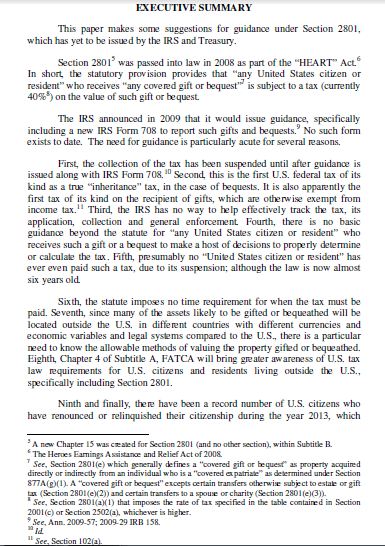
The reason these regulations are so important, is due to the tax cost of taxes upon U.S. beneficiaries. See, The “Hidden Tax” of Expatriation – Section 2801 and its “Forever Taint.”
The tax is currently levied at a 40% rate on basically the full vale of the asset upon the gift or bequest. It also continues on for potentially generations into the future; e.g., if U.S. beneficiaries receive property held in trust that was funded by a “covered expatriate.” For instance, to demonstrate the consequences, we can assume a former U.S. citizen who is a “covered expatriate” (e.g., for failure to properly certify under Section 877(a)(2)(C) and file IRS Form 8854, even though the income tax or asset tests are not satisfied) funds a trust in a foreign country for her grandchildren and great grandchildren. See, How many former U.S. citizens and long-term lawful permanent residents have filed (or will file) IRS Form 8854?
Over time, the value of those trust assets grow substantially and 30 years after her death (e.g., the year 2055), the trust starts distributing US$100,000 annually to several U.S. citizen grandchildren and grandchildren. Under the current law, each time the distribution is received, a 40% tax should be levied on each distribution. The law leaves many unanswered questions, until the proposed regulations are issued.
Part II: Common Myths about the U.S. Tax and Legal Consequences Surrounding “Expatriation”
· More Myths – about Renouncing U.S. Citizenship
There are many misunderstandings of how the law works when someone renounces U.S. citizenship. See, Part I: Common Myths about the U.S. Tax and Legal Consequences Surrounding “Expatriation”
The author regularly hears a range of myths that will befall an “Accidental American” when and if, they renounce. These “myths” include the following:
- Myth 5: There is no requirement to file U.S. income tax returns if the individual has few assets, little income or has otherwise lived outside the U.S. for almost all of their lives.
- Fact: The old tax law from 1996 and the modifications in 2004 had a 10 year period of taxation concept after “expatriation.” There is no longer such a 10 year period of taxation for those persons who renounce on or after June 17, 2008. However, any former U.S. citizen will necessarily be a “covered expatriate” if they cannot meet the certification requirement of Section 877(a)(2)(C); one of which includes 5 years of compliance with the U.S. tax law. See prior posts explain in more detail – Certification Requirement of Section 877(a)(2)(C) – (5 Years of Tax Compliance) and Important Timing Considerations per the StatuteSee also, some of the consequences of being a “covered expatriate” – The “Hidden Tax” of Expatriation – Section 2801 and its “Forever Taint.”
- Myth 6: There is somehow some “magical difference” under the law, for those who “renounce” citizenship (currently) versus those who “relinquished” citizenship (some time in the past) and the U.S. Department of State should recognize this “magical difference”. Such a difference will create a different U.S. tax result.
- Fact: The tax law nor immigration law makes such a distinction, even though this seems to be a common myth frequently spread throughout the Internet.
- Myth 7 : Former U.S. citizens who are “covered expatriates” can gift assets to their U.S. citizen children and friends without U.S. tax costs to them.
- Fact: This is true, i.e., there is no restriction or tax that is levied against the former U.S. citizen who makes the gift. The problem is for the recipient U.S. citizen or other “U.S. person” children or friends who will become subject to tax upon such gifts at the highest estate and gift ta rate (currently 40%).
- Myth 8: Former U.S. citizens should not worry about the IRS and its ability to collect taxes owing for the “mark-to-market” gains tax on expatriation (or on covered gifts and covered bequests) against assets located outside the U.S.?
- Fact: This depends on the particularl factual circumstances of each former U.S. citizen. Where are their assets? Do they (or will they) travel to and from the U.S.? In what country do they regularly reside? See, U.S. Enforcement/Collection of Taxes Overseas against USCs and LPRs – Legal Limitations and How will the IRS collect tax and penalty assessments against former USCs and LPRs who live exclusively outside the U.S.?
These are just some of the myths commonly floated. There are yet more myths which will be discussed in a later post.