Will the IRS treat a USC or LPR residing outside the U.S. who purposefully refuses to file U.S. income tax returns and information returns the same as “tax protesters”?
What is a “tax protester”? What is the significance for USCs and LPRs residing overseas?
What if the U.S. tax and its applicability to USCs and LPRs living overseas, specifically including the tax on expatriation seems unfair, unjust, overreaching, burdensome, etc.? Is that a legal basis for defying the law’s application and reach?
The author has consistency argued, that from a tax policy perspective, U.S. citizenship based taxation of worldwide income for those who live outside the U.S. needs to be repealed as it is unique in the world, dates to the 19th Century Civil War and is inappropriate for the global world we live in. See, “Tax Simplification: The Need for Consistent Tax Treatment of All Individuals (Citizens, Lawful Permanent Residents and Non-Citizens Regardless of Immigration Status) Residing Overseas, Including the Repeal of U.S. Citizenship Based Taxation,” by Patrick W. Martin and Professor Reuven Avi-Yonah, 2013.
“Tax protesters” and their frivolous arguments generally assert, somehow the U.S. federal tax laws are against the U.S. Constitution; i.e., unconstitutional. The U.S. Supreme Court has already ruled that U.S. citizenship based taxation is indeed Constitutional when it upheld as Constitutional the concept of citizenship based taxation in 1924 in Cook v. Tait. In that case, the U.S. citizen resided permanently and was domiciled in Mexico City with his Mexican citizen wife. See, Supreme Court’s Decision in Cook vs. Tait and Notification Requirement of Section 7701(a)(50)
These Constitutional arguments are not looked well upon by any branch of the U.S. federal government. The IRS and Tax Division of the Department of Justice regularly prosecute these cases. The Courts regularly uphold the government’s position; and the Congress has passed increasingly harsh penalties, including as late as in 2007 (See IRC section 6702 – Frivolous Tax Submissions).
The term “tax protester” became somewhat taboo after Congress passed a law designed at protecting taxpayer’s rights. The current, more politically correct terminology comes from the National Tax Defier Initiative, also known as the “TAXDEF Initiative” which was launched by the Tax Division of the DOJ.
In short, the Courts, specifically including the U.S. Supreme Court have consistently rejected a range of arguments that the tax law is unconstitutional. Those individuals who advance such arguments, which have consistently been upheld as frivolous legal arguments, are commonly referred to as “tax defiers” or “tax protesters.”
A classic quote from the 7th Circuit is apropos – Coleman v. Commissioner, 791 F.2d 68, 69 (7th Cir. 1986) –
- Some people believe with great fervor preposterous things that just happen to coincide with their self-interest. “Tax protesters” have convinced themselves that wages are not income, that only gold is money, that the Sixteenth Amendment is unconstitutional, and so on. These beliefs all lead—so tax protesters think—to the elimination of their obligation to pay taxes.
Hoards of taxpayers have been found liable for civil penalties, civil fraud penalties and criminal liability (in the most egregious of cases – with prison sentences) over the years as they have asserted a range of arguments found to be frivolous.
Will the IRS or the Tax Division of the DOJ take a similar position against UCS or LPRs who have resided overseas who argue the U.S. tax law should not apply to them? See an earlier post, Tracking U.S. Citizens and LPRs in and Out of the Country – Tracking Taxpayers (Entry/Exit System)
Who in the government will test the limits of enforcement overseas? Will the long-arm of the U.S. federal government, and its enforcement, grow even longer? Will information collected by the IRS via FATCA enable the government to compile and pursue such cases? See, U.S. Enforcement/Collection of Taxes Overseas against USCs and LPRs – Legal Limitations
Read Wikipedia for a colorful overview of – Tax protester history in the United States
Tracking U.S. Citizens and LPRs in and Out of the Country – Tracking Taxpayers (Entry/Exit System)
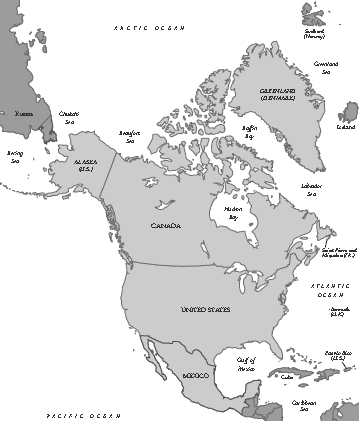
The U.S. federal government, led by the Department of Homeland Security (“DHS”) has taken great efforts and incurred great cost to develop technology and systems to track individuals as they come into the U.S. There are also programs afoot, specifically the Entry/Exit system with Canada, that helps track individuals as they leave the U.S. For more details, see the Wilson Center and its review of the Entry-Exit Systems in North America.
This tracking is very specific and part of the TECS database that is operated and managed by the DHS. The TECS database has been discussed in prior posts, including Does the IRS investigate United States Citizens (USCs) and Lawful Permanent Residents (LPRs) residing overseas?
See also, an earlier post that discusses the TECS database and its usage by the Internal Revenue Service in U.S. Enforcement/Collection of Taxes Overseas against USCs and LPRs – Legal Limitations
This topic will become even more relevant starting in 2015 as the IRS collects financial and account information via FATCA of USCs and LPRs residing in various countries throughout the world.
A series of posts dedicated to this topic will be made, including by guest immigration lawyers, discussing various legal implications of the tracking of U.S. citizens and LPRs.
The Risks to USCs and LPRs – Filing Late U.S. Income Tax Returns via the so-called “Streamlined” process
I previously posted a note about the so-called “Streamlined” process the IRS [which are now gone and removed from the IRS website] had announced in June 2012, Why the so-called “Streamlined” Process is “Much Ado About Nothing” – Legally Speaking. I explained that legally speaking, there is no legal protection to the taxpayer provided by this administrative procedure.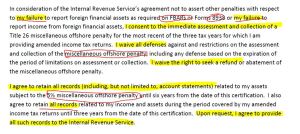
The new “streamlined” procedure from June 2014 does not provide any additional legal protection or finality. To be blunt, the government has used the FBAR as a “trap” for the taxpayer. See, Why the Zwerner FBAR Case is Probably a Pyrrhic Victory for the Government – for USCs and LPRs Living Outside the U.S. (Part II).
If the individual did not check the right box on Schedule B, Part III, therefore the government may well argue they were “willfully blind” of the requirements of filing FBARs, even if they did not know of the filing requirements. The FBAR regulations are extremely complex and I am confident few tax experts anywhere in the world could take a basic exam of what is a “financial interest in” and “signature authority over” such accounts according to these regulations and get more than about 75% (a “C” or maybe “D” grade) of these questions rights. See, Take Caution when Completing a “Tax Organizer” Provided by Your Tax Return Preparer.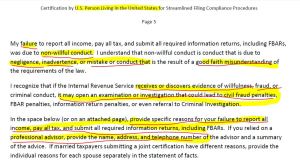
The problem with this streamlined process is there is no protection from penalties for failure to file tax returns, failure to file information returns, failure to file FBAR forms; nor from IRS audits of prior years (when the statute of limitations is still open), etc. In short, the IRS (or the Justice Department) can always fully pursue a USC or LPR who has not properly filed U.S. income tax returns, information returns on foreign assets or FBARs for prior years, as provided under the law.
In the meantime, the government will never be required to refund the so-called “5% miscellaneous offshore penalty” (which of course is not a penalty under the law in the first place), pursuant to the very terms of the Certification. The taxpayer waives ” . . . all defenses against and restrictions on the assessment and collection of the [5%] miscellaneous offshore penalty.” It is a one way street.
In addition, the individual is now subjecting themselves to potential greater liability in the event the government ever wants to challenge the certification made under penalties of perjury. Indeed, the certification is not drafted in the words of the taxpayer, but rather the U.S. federal government. Many practitioners have been analyzing and parsing the meaning of “negligence” and “inadvertence” and “mistake” that is a “good faith misunderstanding” of the requirements of the law. It’s entirely unclear how these terms will be interpreted by the government in any particular case. Certainly the vast majority of these cases that are entered into this system will not be challenged; if for no other reason the limited resources of the IRS.
However, there are so many ways they can be challenged against any particular taxpayer. What if a taxpayer threw away the monthly bank statements for the year 2012 regarding a foreign account? Will that be a breach of the Certification? Will all bets be off against the taxpayer? The terms of the certification seem to provide such a result.
I suspect we will see cases where the government will go after (selectively) some taxpayers who enter into the streamlined process. They cases they will select are the ones they think the taxpayer should have gone in under the OVDP. That will be the determination of the government, not the individual taxpayer; and hence can put the taxpayer in further jeopardy.
Finally, the most troubling issue of this program for U.S. residents, is they are agreeing to pay something that does not exist under the law and may have no correlation with any income taxes owing; i.e., the so-called “5% miscellaneous offshore penalty.” Why should a “good faith” taxpayer be paying any portion of their principal to the government, if they made an inadvertent mistake of what are typically very complex provisions in the tax law?
A basic example can demonstrate the injustice of this approach. Taxpayer Pierre, moves from France to the U.S. some 10 years ago. He was an accounting major in France and practiced as an accountant before becoming a business and property manager. His English is horrible and he relies upon a tax return preparer at “J&Q Blockhead Return Preparers” who only speaks English. His return preparer has never asked good questions, about if he has any non-U.S. assets, as he meets with him for 60 minutes each year after taking his W-2 and 1099 forms to the office as requested.
Pierre inherited from his non-U.S. citizen parents accounts in Switzerland and France with a value of US$3M and some real estate outside Paris worth approximately US$2.5M that generates rents monthly. His return preparer always sent his returns with the “No” boxes checked on Schedule B, Part III and never filed FBARs or IRS Form 8938. See, USCs and LPRs residing outside the U.S. – and IRS Form 8938. Pierre was told by his French tax advisers, who are very sophisticated, that the U.S. should not levy tax on his European assets; but rather he should only pay tax in France and Switzerland on these assets. Assume the taxes withheld at source in Europe are greater than the U.S. income tax that would be generated on this income; hence he can fully credit (with the U.S. foreign tax credit) the U.S. federal income tax, except about $700.
Pierre reads the news release on a French news website of the new “streamlined” program announced by the IRS in June 2014. He asks his return preparer about it – who has no idea what he is talking about.
What is Pierre to do? Why should Pierre pay approximately US$325,000 (5% of US$6.5M) to participate in this program when he owes less than US$1,000 of federal income tax?
When Pierre discusses this press release with the manager at “J&Q Blockhead Return Preparers”; the manager says all customers are given a (1) a package of documents and a pamphlet that says “Do you have any foreign assets?” on page 37, paragraph 3; and (2) a free coffee mug with “J&Q Blockhead Return Preparers” prominently displayed. The manager at “J&Q Blockhead Return Preparers” tells Pierre – “you are not going to pin this one on me!”
How is the payment of US$325,000 that is not contemplated under Title 26, a correct result under the law?
If Pierre does not go into the streamlined program and files amended tax returns, will the IRS and Justice Department try to “Zwerner” him (assess multiple year 50% willfulness penalties – arguing he was “willfully blind”)? What if they start an audit and investigation and ask the return preparers at “J&Q Blockhead Return Preparers” about the case with the response being “We tell all our customers they have to report their foreign assets and have it in writing. See our pamphlets and website.”
That is the risk Pierre will have to take; (1) comply with the law under Title 26 as amended returns are contemplated and risk the government will pursue him for 50% willfulness penalties (as the failure to file IRS Form 8938 – should be only for 3 years at $10,000 per year) or (2) be forced into a “streamlined” procedure that will make him pay a large portion of his family inheritance from Europe to the U.S. since he did not file IRS Form 8938 or FBARs.
Read the Q&A format here.
U.S. Enforcement/Collection of Taxes Overseas against USCs and LPRs – Legal Limitations
Maybe its a natural response for USCs and LPRs living overseas to ask: “What is the chance I will get audited by the IRS?” Sometimes, those individuals who either have less good faith (or are simply ignorant about how U.S. tax law functions) will also ask: “How will the U.S. government ever know of my assets or income in my home country?”
A follow-up question is how does the U.S. federal government enforce tax obligations overseas? This question often comes, of course, from individuals who reside in different countries outside the U.S. and typically have most (if not all) of their assets located in their country of residence.
A USC or LPR residing in Costa Rica, for instance, might have almost all of his business assets in Costa Rica and maybe financial investment assets in nearby regions such as Panama. Similarly, a Chinese born dual national USC may have companies and business assets in both mainland China and Hong Kong. If neither of these individuals have assets in the U.S., how can the U.S. federal government enforce tax liens, levies and the like against these individuals?
These questions are getting asked more and more now that FATCA has gone into force and financial information around the world is being collected regarding USC accounts in virtually all countries and financial institutions. See, FATCA Driven – New IRS Forms W-8BEN versus W-8BEN-E versus W-9 (etc. etc.) for USCs and LPRs Overseas – It’s All About Information and More Information
An excellent layman’s term summary of FATCA can be located on HSBC’s website here.
This overseas asset and income information will eventually be delivered, pursuant to the FATCA rules, to the U.S. Internal Revenue Service (IRS – revenue authority).
Hence, the collection of information under FATCA will be extensive. This, at least in part, answers the question of: “How will they ever know of my assets or income in my home country?” Admittedly, the complete answer to this question is far more complicated, when one considers the intricacies of FATCA and its regulations and other guidance from the IRS/Treasury.
However, that is a different question, than how that financial and income information will be used by the IRS to (a) make tax assessments, (b) assess and collect foreign bank account report (FBAR) penalties (See, Section 16 of the IRM), and (c) generally enforce and collect such tax assessments and penalties against USCs and LPRs residing outside the U.S.
1. INFORMATION – The collection of asset and financial information under FATCA has a very “long arm” around the world. Indeed, the image of the Uncle Sam octopus published in the June 28, 2014 article in the The Economist entitled Taxing America’s diaspora: FATCA’s flaws captures well the idea of the reach of FATCA.
2. INFORMATION VS COLLECTION – However, enforcing tax assessments and penalties and collecting against assets located outside the U.S. is a very different legal question, without such a “long arm”; simply because the reach and jurisdiction of U.S. law is necessarily limited and regularly in conflict with local laws of different countries.
To say it another way, Uncle Sam can indeed enforce the collection of financial and asset information under FATCA, due to the economic costs and ramifications to financial institutions and their investors if they did not comply with the automatic information exchange. However, Uncle Same cannot simply enforce the collection of U.S. taxes and penalties through the worldwide financial institutional network, the same way it can in the U.S.
The U.S. has broad lien, levy and seizure powers under U.S. tax law. The IRS can simply seize assets from U.S. bank accounts without going to a judge or court for final (or jeopardy) tax assessments provided they comply with various provisions of the law. This is not a typical concept in the law for other creditors (other than the IRS) who must generally first take steps through the courts to get some type of judicial action (e.g., a court order) before simply seizing and taking assets from an individual.
The IRS’s broad lien and levy powers against assets, however, has significant limitations overseas. See the 1998 Treasury Report – Sometimes Old is as Good as New – 1998 Treasury Department Report on Citizens and LPRs, I hav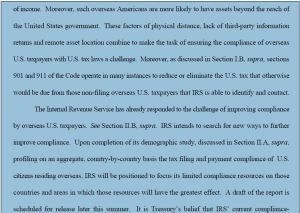 e worked with IRS Revenue Officers who specialize in international collection matters who argue and assert they can merely exercise this lien and levy power overseas against foreign financial institutions. However, this is where the power of the IRS comes to a screeching halt (or at least a major slowdown); when the collection of overseas assets is at stake.
The IRS is not without remedies to collect foreign assets, but it is not a simple process; if it can be done at all in any particular circumstance.
The IRS has no specific enforcement provisions negotiated in international treaties that will necessarily enable them to enforce and collect U.S. income taxes overseas with foreign government assistance. The cornerstone 9th Circuit case of Her Majesty held in 1979 that the Canadian tax authorities could not enforce a tax judgment against U.S. taxpayers within the U.S. –
The basic facts were these, as reported in the case:
British Columbia then served a “Notice of Intention to Enforce Payment” on the defendants in the United States, and filed a certificate of assessment in the Vancouver Registry of the Supreme Court of British Columbia. This certificate was for $195,929.50 (a penalty and interest were included), and under the laws of British Columbia its filing gave it the same effect as a judgment of the court. British Columbia then instituted the present action in the United States. It was dismissed because the court below concluded that the Oregon courts would follow the “revenue rule.” Stated simply, the revenue rule merely provides that the courts of one jurisdiction do not recognize the revenue laws of another jurisdiction.1
The U.S. 9th Circuit Court went on to say:
Although the Supreme Court has never had occasion to address the question of whether the revenue rule would prevent a foreign country from enforcing its tax judgment in the courts of the United States, the indications are strong that the Court would reach the same result as we reach in the present case. Both the majority and the dissenting opinion in Banco Nacional de Cuba v. Sabbatino, 376 U.S. 398, 84 S.Ct. 923, 11 L.Ed.2d 804 (1964), discussed the rule in a spirit which indicates a continued recognition of the revenue rule in the international sphere.10
This Majesty case specifically cited a Canadian Supreme Court case (Harden) which also applied the revenue rule in not enforcing a tax judgement in the U.S. courts for taxes against a Canadian resident:
Reciprocity would itself be a sufficient basis for denying British Columbia’s claim. The courts of British Columbia, relying upon the revenue rule, have refused to recognize the judgment of a United States court for taxes. United States v. Harden, 1963 Canada Law Reports 366 (Sup.Ct. of Canada, 1963, Affirming Court of Appeal for British Columbia).12
CONCLUSION: The revenue rule has been with us for centuries and as such has become firmly embedded in the law. There were sound reasons which supported its original adoption, and there remain sound reasons supporting its continued validity. When and if the rule is changed, it is a more proper function of the policy-making branches of our government to make such a change.
As a result of these cases and the Revenue Rule, the U.S. and Canada modified their income tax treaty to (at least in theory) allow for the international enforcement of taxes. The U.S. now has five income treaties with “mutual assistance” provisions: Canada, Sweden, France, Denmark, and the Netherlands (with a clause in the newly negotiated, but yet to go into force, Swiss treaty).
The U.S. tax and international tax world has changed dramatically since 1979 and the 9th Circuit case of Her Majesty particularly with the advent of FATCA. Nevertheless, there are serious legal limitations imposed on t he IRS in collecting assets for U.S. tax liabilities and penalties owed by USCs and LPRs residing overseas. Indeed, this is surely one of the principle reasons the IRS revised OVDP terms in June 2014 impose a 0% penalty against USCs and LPRs who participate in the so-called “streamlined process”. See, More on the New 2014 “Streamlined” Process for USCs and LPRs Residing Overseas.
The follow-on post will discuss the very limited provisions that have been recently negotiated with these five different countries and explain in more detail the limits on the U.S. federal government on the collection of taxes. It will also discuss the important differences of civil U.S. international tax enforcement/collection versus criminal tax enforcement; which are two very different beasts.
Finally, a dedicated post on the topic will discuss the steps the U.S. federal government is taking through the Department of Homeland Security and a database of information (TECS) to track and monitor people and their assets. The government describes TECS as follows: “The Treasury Enforcement Communications System (TECS) is a database maintained by the Department of Homeland Security (DHS), and it is used extensively by the law enforcement community. It contains information about individuals and businesses suspected of, or involved in, violations of federal law.”
Why the so-called “Streamlined” Process is “Much Ado About Nothing” – Legally Speaking
At the end of 2012, the IRS announced a New Filing Compliance Procedures for Non-Resident U.S. Taxpayers.
This announcement is now talked about among many tax return preparers as if it creates some sort of special rights or benefits to a particular type of U.S. citizen residing overseas. The IRS announcement is neither the law, nor purports to be the law. It also does not modify the statute of limitations period or otherwise bar the IRS from commencing an audit against a USC residing overseas who has never filed U.S. income tax returns. See, When the U.S. Tax Law has no Statute of Limitations against the IRS; i.e., for the U.S. citizen and LPR residing outside the U.S. (Posted on March 24, 2014)
The “new filing compliance procedures” is simply a statement of what has always been the practice of the IRS. U.S. income tax returns that are filed are examined under whatever procedure the IRS chooses as part of its audit and review practices. Income tax returns with modest assets, modest income or little to no U.S. income tax liability garner less attention and resources of the IRS than those with lots of assets, lots of income, etc. See, IRS summary of IRS audits.
Some of the key concepts in the 2012 announcement are set out below:
- Compliance risk determination:
- The IRS will determine the level of compliance risk presented by the submission based on certain information provided on the returns filed, and based on certain additional information that will be required as part of the submission. Low risk will be predicated on simple returns with little or no U.S. tax due. Absent high risk factors, if the submitted returns and application show less than $1,500 in tax due in each of the years, they will be treated as low risk. In general, the risk level will rise as the income and assets of the taxpayer rise, if there are indications of sophisticated tax planning or avoidance, or if there is material economic activity in the United States.
* * *
- How taxpayers will be able to take advantage of the new procedure:
- Taxpayers wishing to use the new procedure will be required to submit: (1) delinquent tax returns, with appropriate related information returns, for the past three years, (2) delinquent FBARs for the past six years, and (3) any additional information regarding compliance risk factors required by future instructions. Payment of any federal tax and interest due must accompany the submission. More information about the application process including where submissions should be sent, will be provided prior to the effective date.
- Any taxpayer claiming reasonable cause for failure to file tax returns, information returns, or FBARs will be required to submit a dated statement, signed under penalties of perjury, explaining why there is reasonable cause for previous failures to file. See IRS Fact Sheet FS-2011-13 (December 2011) for examples of reasonable cause.
Does any of the above protect the USC residing outside the U.S. from an audit for any year a U.S. federal income tax return was not filed? The short answer is – NO!
Does any of the above statements in the IRS announcement mean that a USC residing overseas could not be subject to late payment or late filing penalties for not previously filing U.S. tax returns. The short answer is – NO!
Does any provision in the IRS announcement mean the FBAR penalties could not apply for failure to file. The short answer is – NO! See, When does the Statute of Limitations Run Against the U.S. Government Regarding FBAR Filings?
Does any of the above statements in the IRS announcement mean that a USC residing overseas can never be subject to penalties for not filing information returns regarding their non-U.S. international assets and “specified foreign financial assets”? The short answer is – NO! See, USCs and LPRs residing outside the U.S. – and IRS Form 8938
Why then, did the IRS issue such an announcement? Was it an attempt to present a softer message than the IRS announcement in 2011 ( IRS Fact Sheet FS-2011-13 – which enumerates various penalty concepts such as –2. Penalties imposed for failure to file income tax returns or to pay tax; 3. Possible additional penalties that may apply in particular cases; 6. Possible penalties for failure to file FBAR; etc.)?
This is another mixed message from the IRS, which is nothing more than how tax returns have been processed by the IRS over the decades; i.e., a taxpayer files a late tax return and it gets processed by the IRS (and the IRS may elect to audit any particular return, late filed or otherwise).
When the U.S. Tax Law has no Statute of Limitations against the IRS; i.e., for the U.S. citizen and LPR residing outside the U.S.
There are basically three ways a U.S. citizen living outside the U.S. will have no protection of a statute of limitations vis–à–vis the IRS.
The statute of limitations is the time frame in which the government has to conduct an audit against a U.S. taxpayer. This is important, since once that time frame lapses (i.e., the statute of limitations period is over) the IRS cannot commence tax audits or assess taxes or tax penalties against the USC or LPR living overseas.
The three basic scenarios of when there is no statute of limitations for federal tax matters are as follows:
1. The USC or LPR does not file a U.S. income tax return. IRC Section 6501(c)(3).
2. There is fraud on the part of the taxpayer (e.g., the taxpayer intentionally does not report income). IRC Sections 6501(c)(1), (c)(2).
3. The USC or LPR fails to report certain foreign transactions. IRC Section 6501(c)(8). This rule was only recently adopted as part of the “HIRE Act” which also created FATCA. The following types of transactions and forms that give rise to an “open” statute of limitations period is set out below:

For an excellent overview of the statute of limitations periods, see the presentation – “Starting the Race Against the Tax Authority in the International Tax World – Statute of Limitations & Lack of Filings” by John C. McDougal, Special Trial Attorney – IRS, Jon P. Schimmer and Eric D. Swenson of Procopio.
One of the basic points to takeaway from the law, is that a USC or LPR is almost always better off by filing tax returns (complete and accurate), even when no tax is owing. This will help assure him or her of a fixed time frame during which the U.S. federal government can conduct tax audits and other related tax investigations.
???????????????? ?Please click here to view the above in Chinese.?
Read the Q&A format here.
The Big Gap ? – How U.S. Citizens and LPRs Residing in the U.S. versus those Living Outside the U.S. File U.S. Tax Returns.
The U.S. worldwide taxation system of U.S. citizens and LPRs causes much confusion. It is unique in the world as most all other countries only impose worldwide taxation on their residents. See, . “Tax Simplification: The Need for Consistent Tax Treatment of All Individuals (Citizens, Lawful Permanent Residents and Non-Citizens Regardless of Immigration Status) Residing Overseas, Including the Repeal of U.S. Citizenship Based Taxation,” by Patrick W. Martin and Professor Reuven Avi-Yonah, 2013.
These U.S. citizens and LPRs living outside the U.S. have (at least prior to FATCA) little third party reporting of income directly to the IRS. There are numerous government reports that demonstrate that when third parties (e.g., banks, tenants, securities brokers, credit card companies, real estate sales transactions, etc.) report the income of a particular transaction to the government, the voluntary compliance of taxpayers increases significantly. See, OECD FORUM ON TAX ADMINISTRATION: COMPLIANCE SUB GROUP
and the U.S. GAO-12-342SP: General government: 44. Internal Revenue Service Enforcement Efforts which highlights that the ” . . . where IRS can improve its programs which can help it collect billions in tax revenue, facilitate voluntary compliance, or reduce IRS’s costs. These include pursuing stronger enforcement through increasing third-party information reporting . . . Expanding third-party information reporting improves taxpayer compliance and enhances IRS’s enforcement capabilities. The tax gap is due predominantly to taxpayer underreporting and underpayment of taxes owed. At the same time, taxpayers are much more likely to report their income accurately when the income is also reported to IRS by a third party. By matching information received from third-party payers with what payees report on their tax returns, IRS can detect income underreporting, including the failure to file a tax return.”
The current trend of worldwide reporting of assets and income via FATCA and the OECD programs is designed to accomplish just this; increase information reporting by third party payers (e.g., principally from foreign financial institutions) directly to the IRS and tax revenue authorities around the world to deter U.S. citizens and LPRs living outside the U.S. from under-reporting or not reporting at all their income on their U.S. income tax returns.
Traditionally, there were limits on the law and the jurisdictional authority the U.S. government had to require non-U.S. institutions to report non-U.S. source income directly to the IRS. This has changed significantly now with FATCA, which started in earnest this year, in 1 January 2014. See,
Here is where there appears to be a “Big Gap”? Not necessarily a gap in the amount of tax dollars collected among USC and LPR living in the U.S. versus those living outside the U.S.; but at least an apparent gap in the number of tax returns filed by overseas residents. The level of over-all tax compliance by U.S. citizens and LPRs residing overseas is not clear, since only 334,851 total individual tax returns were filed in 2006 which incorporated the foreign earned income exclusion (IRS Form 2555) by non-resident U.S. taxpayers.27 If there are approximately 5-7 million U.S. citizens residing overseas28 (not even including LPRs who reside overseas) and 142 million total individual income tax returns filed annually29 such a small number (i.e., 334,851) indicates that only a fraction of the total returns filed are filed by persons residing overseas; i.e., only about 2 tenths of one percent (0.24%) of the total income tax returns filed were by those residing overseas with the foreign earned income exclusion.
Will the government see this as a tax gap?
These numbers for the year 2006 are even more interesting when one analyzes the foreign earned income exclusion taken.
Canada had 30,067 returns filed versus Mexico with only 6,112 for the year 2006. It seems that Mexico should at a minimum have more returns filed than Canada – or at least about the same, since the State Department estimates that more U.S. citizens (approximately 1+/- million live in that country). Both seem very low, if it is true that there are probably close to 1.5 to 2 million total U.S. citizens living in these two countries.
28. See, p. 130 and footnote 11 of Taxpayer Advocate Report referenced in footnote 29 above – “Cf. IRS website, Reaching Out to Americans Abroad (Apr. 2009), and W&I Research Study Report, Understanding the International Taxpayer Experience: Service Awareness, Use, Preferences, and Filing Behaviors (Feb. 2010) (citing U.S. Department of State data). This number does not include U.S. troops stationed abroad.”
In 2006, there were a total of 138 million total individual income tax returns filed.
Sometimes Old is as Good as New – 1998 Treasury Department Report on Citizens and LPRs
The IRS, U.S. Treasury and Congress have been troubled for a very long time by tax issues regarding U.S. citizens and LPRs who reside outside the U.S. In 1998, an excellent U.S. Treasury report explains well the state of the tax law at that time and can be read here: Income Tax Compliance by U.S. Citizens and U.S. Lawful Permanent Residents Residing Outside the United States and Related Issues.
 The tax law discussed in that report is largely the same today, except for the expatriation provisions (IRC Sections 877, 877A, 2801 and 7701(b)(6)).
What has changed is the sharing and exchange of information within the government and among foreign governments.
The report which is now over 15 years old, portended the future we have today with FATCA and the multi-prong efforts to ensure that U.S. citizens and LPRs residing overseas comply with U.S. tax law –
???????????????? ?Please click here to view the above in Chinese.?
Is the new government focus on U.S. citizens living outside the U.S. misguided or a glimpse at the new future?
Senators on the Permanent Subcommittee on Investigations have recently focused extensively on U.S. nationals living outside the U.S. who have Swiss accounts. The full report can be read REPORT: Offshore Tax Evasion:The Effort to Collect Unpaid Taxes on Billions in Hidden Offshore Accounts (February 26, 2014)
There are millions of U.S. citizens living in all parts of the world, many of whom I have identified as “Accidental Americans.” See the detailed tax article Accidental Americans” – Rush to Renounce U.S. Citizenship to Avoid the Ugly U.S. Tax Web” International Tax Journal,CCH Wolters Kluwer, Nov./Dec. 2012, Vol. 38 Issue 6, p45; Martin, P.
During the past century U.S. Citizens living permanently or nearly permanently outside the U.S. have been “de facto” non-residents for U.S. income tax purposes. Not because the law provided they were not residents, but simply because there was little awareness of the unique system of U.S. citizenship based taxation (or those cases where individuals purposefully chose not to comply with U.S. tax laws). The U.S. Supreme Court in Cook vs. Tait found it Constitutional nearly 100 years ago. See . “Tax Simplification: The Need for Consistent Tax Treatment of All Individuals (Citizens, Lawful Permanent Residents and Non-Citizens Regardless of Immigration Status) Residing Overseas, Including the Repeal of U.S. Citizenship Based Taxation,” by Patrick W. Martin and Professor Reuven Avi-Yonah, 2013.
This “de facto” non-residency for U.S. citizens is rapidly changing for several reasons:
First, the UBS scandal of U.S. citizens with undeclared accounts broke in 2008 and 2009.
Second the legal struggle between the U.S. Justice Department and the Swiss government and Swiss financial institutions during these past years.
Third, the adoption of FATCA by the Congress and President Obama in 2010.
Fourth, the current day technology which makes collecting, sending, sorting and identifying taxpayers and their assets through the worldwide financial sector now feasible.
Fifth, the implementation of FATCA by the U.S. in 2014 and the 20 plus FATCA Intergovernmental Agreements entered into with various countries.
Sixth, the OECD plan for a worldwide multilateral FATCA like system to be implemented shortly.
Seventh, the high profile IRS offshore voluntarily disclosure programs in 2009, 2011 and the current program launched in 2012.
Eighth, the on-going deferred prosecution agreements that have been entered into with more than 100 Swiss banks and the U.S. Justice Department.
Ninth, on-going criminal indictments by the U.S. Justice department of various taxpayers, foreign bankers, foreign lawyers and other so-called enablers for tax evasion, filing fraudulent documents and aiding and abetting the same.
Tenth, the Senate bi-partisan hearings that have and keep focusing and pushing these issues publicly at multiple levels.
Eleventh, the internet and current methods of communications and intern ational media that have brought worldwide awareness to all of the above. This awareness has arrived to many of the corners of the world about these efforts and the concept of U.S. citizenship based worldwide taxation.
A large portion of the Senate committee report is dedicated to U.S. citizens who live outside the U.S. and are not compliant with U.S. tax laws. The following chart from the report highlights this focus as to the approximately 6,000 U.S. citizen accounts at Credit Suisse who were/do not live in the U.S:
For further observations on this topic, see an earlier post – Key Take Aways from Senate Investigations re: Foreign Banks and “Offshore Tax Evasion”: U.S. Citizens Residing Overseas have Become a Focus of the Government.; Posted on March 4, 2014
???????????????? ?Please click here to view the above in Chinese.?
What could be the focal point of IRS Criminal Investigations of Former U.S. Citizens and Lawful Permanent Residents?
Below is a fairly detailed summary of the type of tax crimes that are commonly investigated by IRS Criminal Investigation (“CI”) agents.
As has already been noted, TaxAnalysts reporter Jaime Arora reported in the 3 March 2014, Worldwide Tax Daily certain comments made by Mr. Jeffrey Cooper, who is the deputy director of the IRS Criminal Investigation division’s international operations. It was reported that IRS CI is looking into why people are making the choice to shed their U.S. citizenship; whether it is related to any particular laws. Cooper was quoted at the Federal Bar Association’s Section on Taxation’s 38th Annual Tax Law Conference held on February 28, 2014.
TaxAnalysts journalist Arora quoted Cooper as identifying why people are making the choice and “If we find something, we do; if not, we just move on,” he said.
It is common policy for the IRS CI not to provide information on how they commence taxpayer investigations, including how they obtain U.S. citizenship renunciation referrals or documents. There could be a number of ways these investigations are commenced. It may be as simple as taking the list from the Quarterly Publication of Individuals, Who Have Chosen to Expatriate – Quarterly Publication of Individuals, Who Have Chosen To Expatriate, as Required by Section 6039G and start reviewing their tax return files (IRS Forms 1040, 8854, etc.) along with FBAR filings.
IRS CI tax investigations generally focus on false documents or false statements, evasion of taxation, aiding and abetting of the above along with other related tax and Bank secrecy (Title 31) crimes.
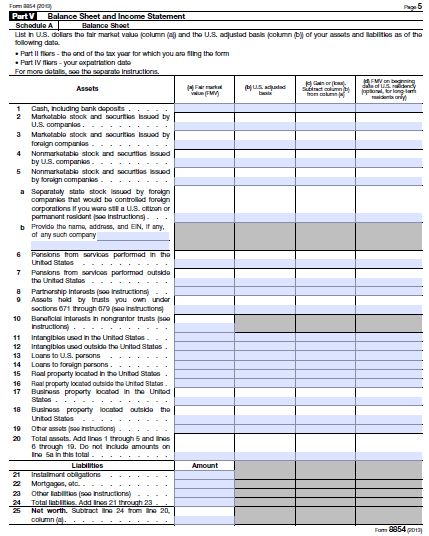
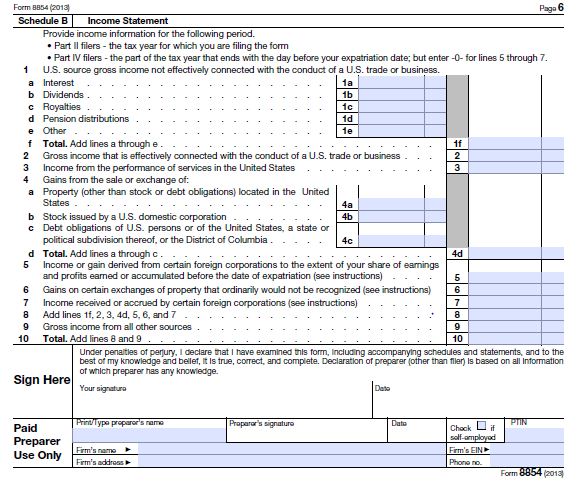
The tax reporting process for expatriates is extensive, including the basic requirement of signing IRS Form 8854 under penalty of perjury, which provides as follows on the last page of the form: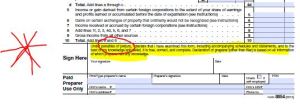
There are a host of reporting requirements and factual information that must be provided under Sections 877 and 877A, for all persons (including those with little to no assets), specifically including filing IRS Form 8854 which asks for a “boat load” of asset, income, liability and tax information. A former U.S. citizen or LPR always needs to be careful that the information provided is true, accurate and complete. See Part V of the form.
A summary of these crimes is set out below:
1. Criminal Offenses under Title 26 (Federal Tax Law)
a. Tax Evasion (IRC Section 7201)
b. Filing a False Return or Other Document – Perjury (IRC Section 7206(1) )
(i) Aiding or assisting in the perpetration of a false or fraudulent document (26 U.S.C. § 7206(2))
(ii) Removal or concealment with intent to defraud, commonly related to untaxed liquor (26 U.S.C. § 7206(4))
(iii) Compromises and closing agreements involving fraud or concealment (26 U.S.C. § 7206(5))
c. Failure to File Return, Supply Information, or Pay Tax – (IRC § 7203 – Misdemeanor – up to 12 months imprisonment)
d. Fraudulent Returns, Statements, or Other Documents (IRC § 7207)
e. “Structuring” Transactions to Evade Cash Reporting (IRC § 6050I)
In addition to these tax specific crimes, other key crimes commonly used by IRS CI agents in tax cases, particularly international cases, include:
2. Tax Related Criminal Offenses under Titles 18 and 31 (Not Tax Law Specific)
a. Conspiracy (Section 371 of Title 18)
(i) Elements of the Offense
(ii) Penalties and Statute of Limitations
b. False Statements (Title 18 U.S.C. § 1001)
(i) Penalties and Statute of Limitations
c. Perjury
d. Mail fraud
e. Principals and those Who Aid and Abet (Title 18)
f. Accessory After the Fact
Finally, it is worth noting that the government regularly collects information from internet resources, such as blogs and e-mails as they build a case for criminal prosecution. A former head of the Tax Division at the U.S. Department of Justice once told me that “e-mails and internet communications was God’s gift to prosecutors”.
???????????????? ?Please click here to view the above in Chinese.?