SCOTUS
Is the “Mark to Market” Expatriation Tax Unconstitutional? – through the Prism of Moore
No Court in the land has explicitly ruled on whether the “mark to market” tax under Section 877A is unconstitutional. However, many international tax minds (myself included) have doubted the ability of Congress to levy a tax on unrealized wealth in light of Eisner v. Macomber, 252 U.S. 189 (1920) and the language of the amendment ratified in 1913 to the Constitution.

The Congress shall have power to lay and collect taxes on incomes, from whatever source derived, without apportionment among the several States, and without regard to any census or enumeration.
16th Amendment of the Constitution [emphasis added]:
One of the exceptional international tax minds, Professor Reuven S. Avi-Yonah has been writing a lot about this issue after submitting an amicus brief along with Professor Bret Wells to the U.S. Supreme Court (SCOTUS) in the Moore case which was decided last week. Moore v. United States, No. 22-800 (06/20/2024). Moore was not about “expatriation taxes” but rather a “mandatory repatriation tax” (“MRT”) under Section 965.
Moore argued some of the fundamental issues that lie at the core, in my view, of whether Congress has the legal authority to impose taxation (as an income tax) based upon the increased value of assets as of the date, the individual becomes a “covered expatriate”. How does the individual have any income (see, Eisner v. Macomber) by merely holding and having the same assets on the day prior to “expatriation” as the day after? No sales, no exchanges, no dispositions, no transfers, no gifting, etc. – and yet 26 U. S. C. § 877A imposes taxation on “income.”
2023: The Judiciary Takes Center Stage; Professor – Mindy Herzfeld’s article in Tax Notes International –
Professor Herzfeld has an excellent article posted the 18th of December 2023. You can access it here with a paid subscription – titled: 2023: The Judiciary Takes Center Stage. She has lots to cover regarding recent international tax law decisions by the U.S. federal courts (United States Tax Court, Federal District Courts & Court of Federal Claims).

- Tax Treaties
Professor Mindy Herzfeld discusses our recent case Aroeste v United States – Order (Nov 2023), which I have discussed at some length in recent posts. See, Federal District Court Rules in Favor of Mexican Citizen – Aroeste vs. United States (LPR) – Tax Treaty Applies: Government’s Motion for Summary Judgment is Denied. It was a pleasure for me to represent Mr. Aroeste over several years and see the favorable outcome of the federal district court that obligates the government to respect the terms of substantive tax treaty law.
She covers Christensen v. United States, which is another tax treaty case regarding the ability to take a foreign tax credit against the Section 1411 tax on net investment income; authored by Judge Marion Blank Horn of the Court of Federal Claims. Judge Horn is no stranger to important international tax issues. She authored the 2002 decision of Estate of Jack vs. United States regarding “domicile” for U.S. estate tax purposes and the impact of the Canadian decedent’s visa status. More recently the Estate of Margaret J. Jones vs. the United States (2022) was a lengthy case of Judge Horn’s denying the Estate a refund. This Estate of Margaret J. Jones is also Canadian citizen (decedent) case; but addressed a very different issue – re: the 5% “miscellaneous offshore penalty” she paid that is identified by the IRS’ rules they created in the “Streamlined Domestic Offshore Procedures” instructions (it is not a treaty case).
- TCJA, U.S. Trade or Business – SCOTUS & Moore
The Professor also addresses Moore v. United States (which she has written about before) and Altria Group Inc. v. United States and the subpart F rules under the TCJA.
The recent U.S. Tax Court (USTC) case of YA Global Investments LP v. Commissioner, is discussed by Professor Herzfeld regarding U.S. trade or business activities. Of course, another key USTC case regarding Section 6038 penalties is reviewed which has been appealed by the government – Farhy v. Commissioner. See, Six Weeks, Three International Information Reporting Decisions –
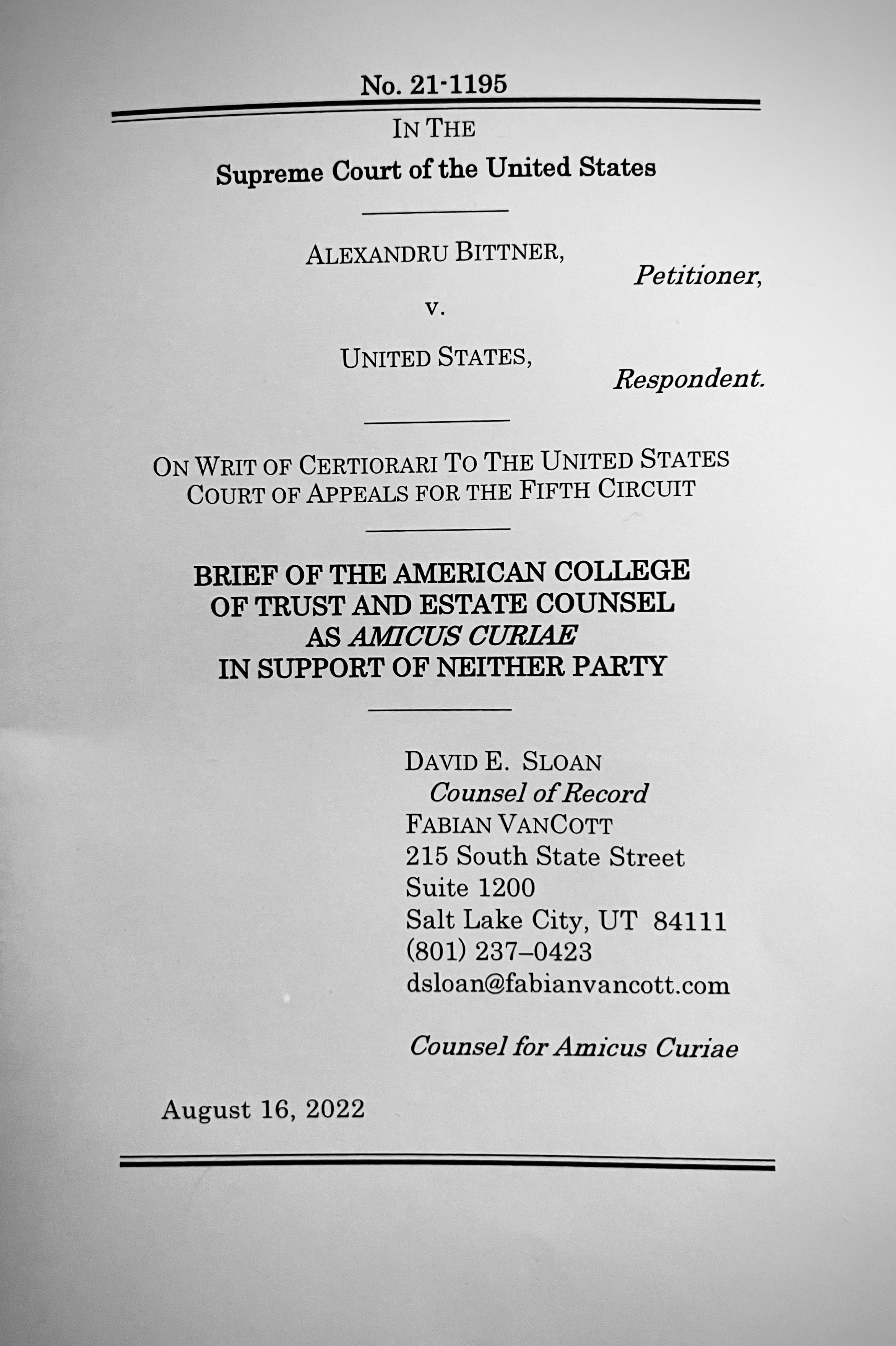
The SCOTUS decision near and dear to my heart (as I personally worked on the ACTEC amicus brief) of Bittner v. United States, is also reviewed briefly by Professor Herzfeld. In that case the SCOTUS held penalties are limited to $10,000 per year for a non-willful violation of the statute (not $2.72 million as the government asserted based upon each account).
She reviews some important transfer pricing cases Coca-Cola Co. v. Commissioner and 3M Co. v. Commissioner.
Do read Professor Herzfeld’s article when you get a chance. More details about her background and how to follow her is set out below:
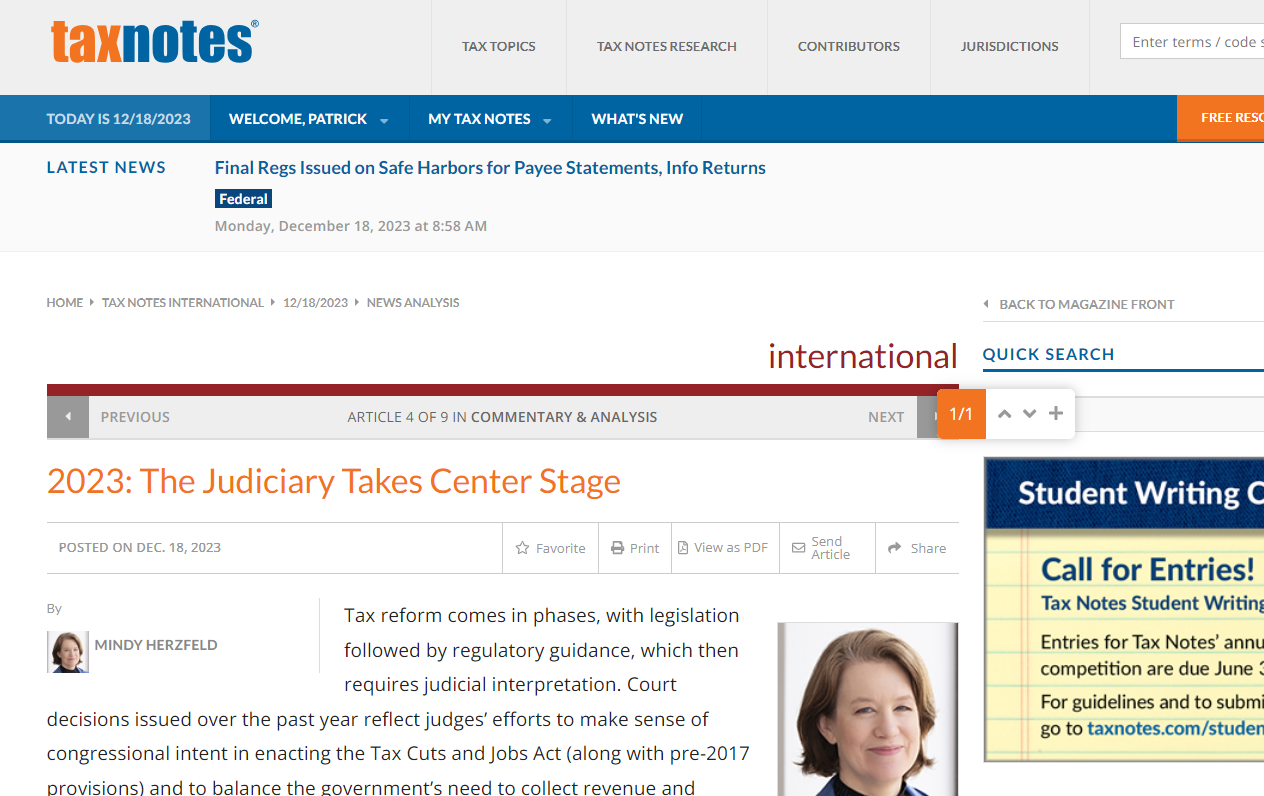
Mindy Herzfeld is professor of tax practice at University of Florida Levin College of Law, counsel at Potomac Law Group, and a contributor to Tax Notes International. Follow Mindy Herzfeld (@InternationlTax) on X, formerly known as Twitter.
Never in my 30 year career practicing international tax law have I seen the judiciary so active in international tax matters – particularly when you take into consideration various SCOTUS cases.