Aroeste v. United States is a November 2023 federal court decision on how U.S. income tax treaties apply to green card holders who live abroad. Patrick W. Martin, the author of this blog, was lead counsel for the taxpayer. The answers below explain the court’s decision and what it means for tax residency, FBAR filing, Form 8854, and the U.S. exit tax.
About the Aroeste Case
Aroeste v. United States is a federal tax case decided on November 20, 2023, by Judge Battaglia of the U.S. District Court for the Southern District of California (Case No. 22-cv-00682-AJB-KSC). The court ruled in favor of Alberto Aroeste, a Mexican citizen and U.S. green card holder, on how the U.S. and Mexico income tax treaty applies to him.
The government had moved for summary judgment, and the court largely rejected its arguments. Mr. Martin of Chamberlain Hrdlicka represented Mr. Aroeste as lead counsel.

Read more: Read Mr. Martin’s analysis of the ruling
Why does the Aroeste decision matter for green card holders?
Aroeste is a federal court ruling that the residence tie-breaker rules of a U.S. income tax treaty decide whether a green card holder may be treated as a nonresident alien, and that several IRS positions used to deny that treatment are not binding. It directly affects green card holders who live in a country with an income tax treaty with the United States.
The case drew coverage in Tax Notes International because it involved FBAR reporting, treaty elections, and Form 8854 at the same time.
Does filing a treaty disclosure late, waive tax treaty benefits?
No, according to the court in Aroeste. The government argued that filing the wrong return, Form 1040 instead of Form 1040NR with Form 8833, waived the treaty. The court found that untimely notice of a treaty position does not waive treaty benefits.
Instead, the consequence of failing to disclose a treaty position under IRC Section 6114 is the penalty in IRC Section 6712, which is $1,000 for each failure. But the government has to affirmatively assess the penalty. Ironically, after years battling Mr. Aroeste, the government was not able to even collect this $1,000 penalty (or the millions of dollars of penalties they assessed for other items).
Was Mr. Aroeste required to file Form 8854?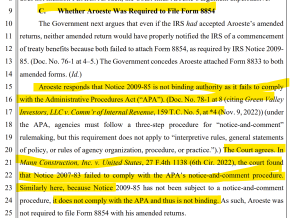
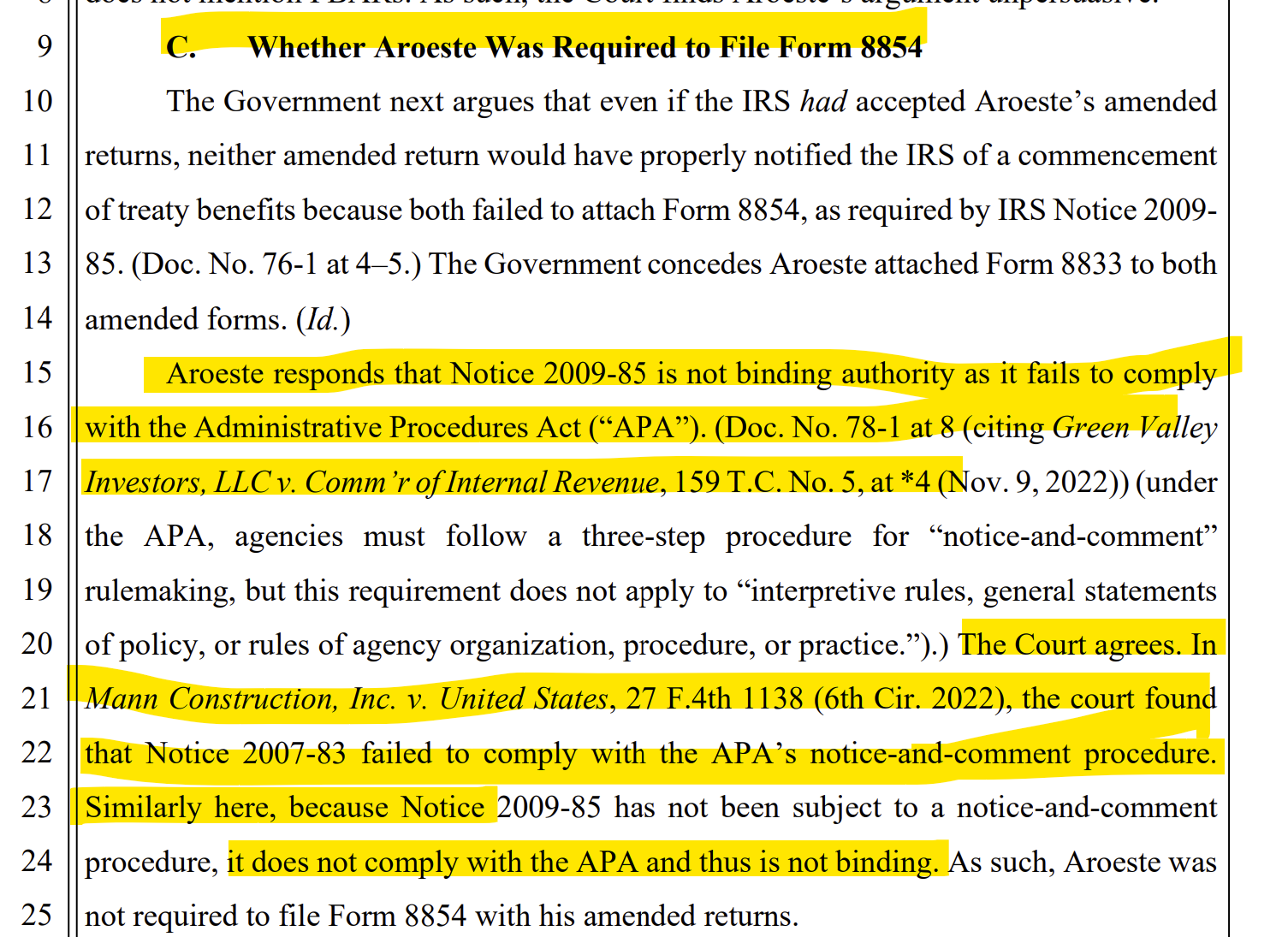
No. The court held that Mr. Aroeste was not required to attach Form 8854 to his amended returns. The IRS argued during the judicial proceedings that he needed to and should have adverse “tax expatriation” consequences.
The IRS and DOJ argued that IRS Notice 2009-85 required Form 8854 to notify the IRS that treaty benefits had begun. The court found that Notice 2009-85 never went through the notice and comment process required by the Administrative Procedure Act, so it is not binding. The government conceded that Form 8833 was attached to both amended returns.
Read more: Form 8854 filing and the compliance gap
Does a green card holder treated as a treaty nonresident still have to file an FBAR?
Not necessarily. The government relied on the preamble to the 2011 FBAR regulations, which says a green card holder who elects treaty nonresident treatment must still file an FBAR. The court found that the preamble is not the law.
The FBAR regulations at 31 C.F.R. § 1010.350(b)(2) define a U.S. resident by reference to IRC Section 7701(b). Because the treaty applied to Mr. Aroeste, the treaty’s tie breaker rules decide whether he may be treated as a nonresident alien for FBAR purposes.
Read more: FBAR penalties explained
What happened after the Aroeste decision?
The government filed a notice of appeal to the Ninth Circuit in early 2024 and then filed a motion to dismiss its own appeal in May 2024.
Read more: Read about the motion to dismiss the appeal
Where can I read the Aroeste decision?
The full November 2023 order is available as a PDF on this site. Mr. Martin recommends reading the entire order, since its analysis of tax treaties, Section 7701(b)(6), the tax expatriation consequences of “mark-to-market” taxation and covered gifts and covered bequests, and the FBAR rules goes well beyond the summary on this page.
Read more: Aroeste v. United States, Order, November 2023 (PDF)
Green card holders and U.S. tax residency

Can you keep your green card and still expatriate for U.S. tax purposes?
Yes. Under IRC Section 7701(b)(6), a green card holder can stop being treated as a lawful permanent resident for federal tax purposes without ever surrendering the card to USCIS.
Many green card holders assume nothing changes for tax purposes until they formally give up the card, and that assumption can lead to unexpected consequences. Mr. Martin addressed this in “Oops… Did I Expatriate and Never Know It: Lawful Permanent Residents Beware!”, International Tax Journal, January and February 2014.
Read more: Can you lose your green card for tax purposes just by moving abroad?
What is IRC Section 7701(b)(6)?
Section 7701(b)(6) is the provision Congress added in 2008 that defines when a green card holder stops being treated as a lawful permanent resident for federal tax purposes. It applies when the individual begins to be treated as a resident of a foreign country under a tax treaty, does not waive the treaty benefits, and notifies the IRS that this treatment has begun. Read more: Full analysis of Section 7701(b)(6) It might have other applicability too, given the factual circumstances of every individual. Be careful here as the law can get complex quickly.
What are the three tests for losing lawful permanent resident status under Section 7701(b)(6)?
A green card holder stops being a lawful permanent resident for federal tax purposes when all three of these tests are met:
- The individual is treated as a resident of a foreign country under a tax treaty.
- The individual does not waive the benefits of that treaty.
- The individual notifies the IRS that this treatment has begun.
How each test applies can vary depending on the wording of the specific tax treaty, the facts of each individual and whether the government argues notification (and how notification is made) is required? Another word of caution here; be careful as the law can get complex quickly.
Can filing Form 1040NR end your green card status for tax purposes?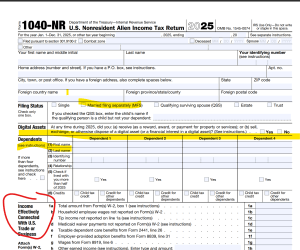

It can. A green card holder who lives in a treaty country and files Form 1040NR as a nonresident, identifying the treaty benefits, appears to satisfy all three tests in the flush language of Section 7701(b)(6).
The individual may then be treated as no longer a lawful permanent resident for federal tax purposes, even though the green card was never returned to USCIS. The treaty position is disclosed on Form 8833, but can be disclosed in a number of other ways under the law (e.g., a mere statement attached to the 1040-NR tax return).
Because this filing can have lasting tax consequences, including under the expatriation rules, it is a decision to make with a qualified U.S. international tax lawyer before filing rather than after.
Is ending tax residency the same as abandoning a green card for immigration law purposes?
No. Tax treatment under Section 7701(b)(6) is separate from immigration status. To formally abandon lawful permanent resident status with immigration authorities, a green card holder files USCIS Form I-407. Abandonment can occur as a matter of law under title 8 – See, Khodagholian v. Ashcroft, 335 F.3d 1003 (9th Cir. 2003) and Matter of Huang, 19 I&N Dec. 749 (BIA 1988), including: length of absence from the United States [See, Singh v. Reno, 113 F.3d 1512 (9th Cir. 1997). See Shyiak v. Bureau of Citizenship and Immigration Services, 579 F. Supp. 2d 900, 907 (W.D. Mich. 2008) (infrequent and short stays in the United States are insufficient as a matter of law to support retention of permanent resident status).
The exit tax and covered expatriates
What happens once you stop being a lawful permanent resident for tax purposes?
The expatriation rules can apply. Depending on how long the individual held a green card, ceasing to be a lawful permanent resident for tax purposes can trigger the exit tax under IRC Section 877A and the tax on gifts and inheritances under IRC Section 2801, along with other provisions.
Who is a long-term resident for exit tax purposes?
A long-term resident is a green card holder who was a lawful permanent resident in at least 8 of the 15 fiscal years ending with the year residency ends. Only long-term residents are subject to the expatriation rules when they stop being lawful permanent residents. The timing and calculation of these periods gets tricky and complicated under the law. Someone living in the U.S. for just six years and two days can meet the eight year rule!
Read more: Why a long-term resident cannot avoid covered expatriate status
Do green card holders pay the exit tax?
Yes, if they are long-term residents and covered expatriates when their residency ends. The rules are especially complex for green card holders living in countries that have an income tax treaty with the United States, which is the situation addressed in Aroeste, and the government initially wanted to assess the “expatriation tax” against Mr. Aroeste, but was unsuccessful.
Read more: US exit tax: the basic 2026 guide
What makes someone a covered expatriate?
A person is a covered expatriate, generally if they meet any one of three tests on the day before expatriating:
- Net worth test: net worth of $2 million or more.
- Tax liability test: average annual net income tax liability for the prior five years above $211,000 (2026 figure, adjusted annually for inflation).
- Certification test: failure to certify, under penalty of perjury, compliance with all federal tax obligations for the prior five years.
The certification test is often the most important, because people who do not pass the first two tests frequently fail the certification test.
Read more: The five year tax compliance requirement
Read more: What happens if you become a covered expatriate?
How much is the exit tax?
The exit tax is income tax on the gain from a deemed sale of a covered expatriate’s worldwide assets at fair market value on the day before expatriation. For 2026, the first $910,000 of gain is excluded.
For example, stock worth $2,000,000 that cost $500,000 has a $1,500,000 gain. After the $910,000 exclusion, $590,000 is subject to federal income tax. This is a simplified illustration. An actual calculation depends on the types of assets, their tax basis, and any treaty position, and retirement accounts such as IRAs follow special rules.
Read more: US exit tax: the basic 2026 guide
What is the Section 2801 tax on gifts and inheritances?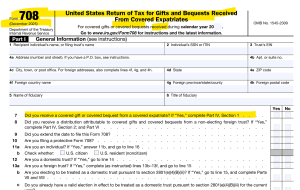
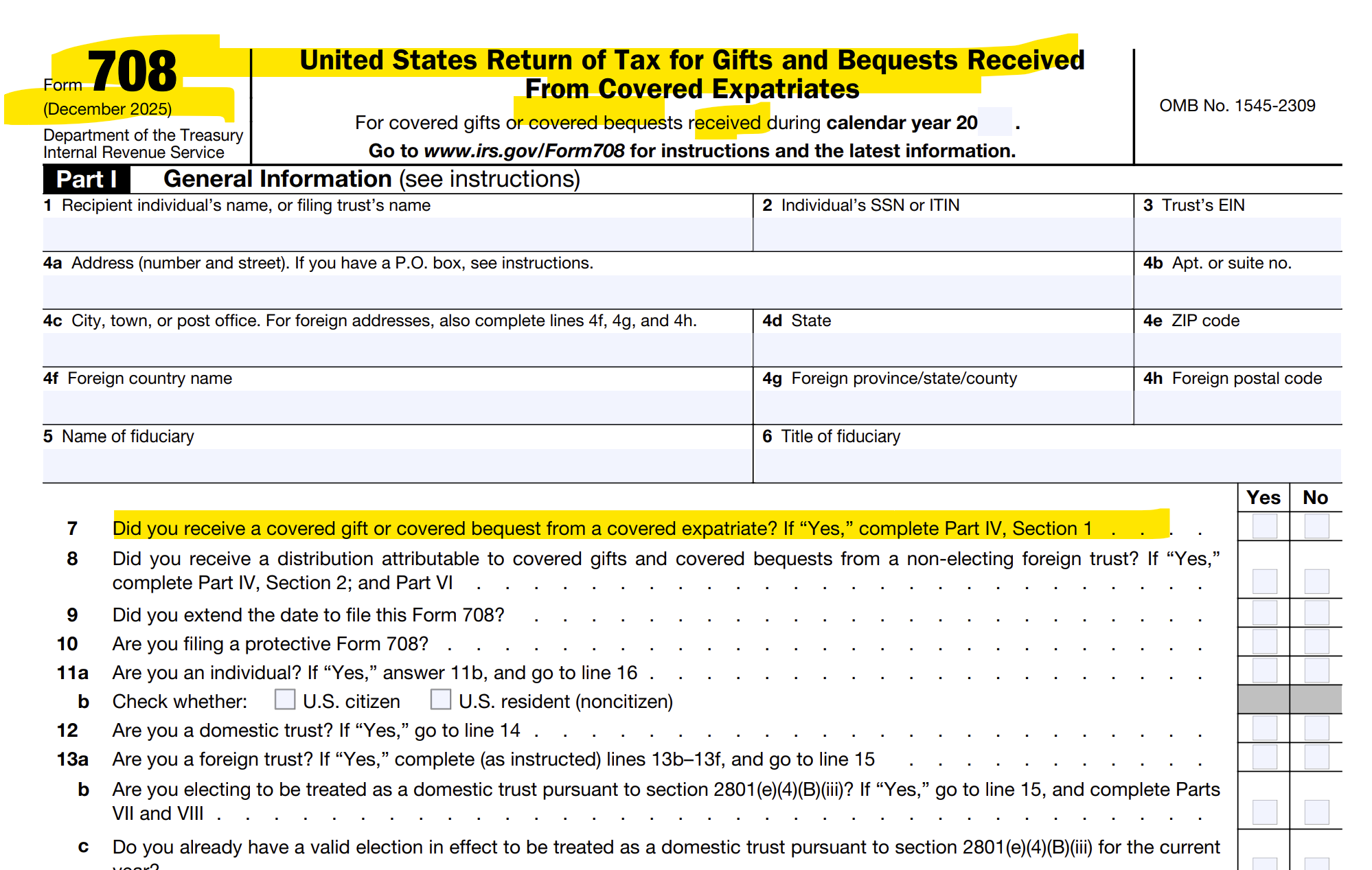
Section 2801 imposes a 40% tax on gifts and inheritances that U.S. citizens and residents receive from a covered expatriate, with no time limit. The recipient, not the covered expatriate, pays the tax and reports it on a new IRS Form 708.
For example, if a covered expatriate gives $1,019,000 to a U.S. person, the $19,000 annual exclusion is subtracted and the recipient owes 40% of the remaining $1,000,000, or $400,000.
Read more: Section 2801 and its forever taint
Can a tax treaty help a green card holder?
A tax treaty can end U.S. tax residency for a green card holder, but for a long-term resident that can itself be an expatriation event with the same consequences as renouncing U.S. citizenship. Whether a treaty position helps or hurts depends on the specific treaty and the individual’s facts, which makes this one of the areas where individual legal advice matters most.
Read more: Countries with U.S. income tax treaties
Getting advice on your situation
Does the Aroeste ruling apply to my situation?
It may or may not. Aroeste was decided by one federal district court on Mr. Aroeste’s own facts and the U.S. and Mexico tax treaty. Other courts are not bound by it, tax treaties differ from country to country, and the IRS may take different positions in other cases.
Whether the reasoning helps in a particular situation depends on residency history, past filings, the treaty involved, and the assets at stake. That is a question for a qualified U.S. international tax lawyer who can review the full picture.
Is this FAQ legal advice?
No. This page explains a court decision and related U.S. tax rules in general terms for educational purposes. It does not take anyone’s specific facts into account, and reading it does not create an attorney client relationship.
It is meant to help readers understand the issues and prepare better questions for a lawyer, not to replace one.
When should a green card holder living abroad speak with a lawyer?

Ideally before taking any step that could change U.S. tax residency, such as filing Form 1040NR, claiming treaty benefits on Form 8833, filing Form I-407, or moving abroad for the long term.
It is also worth speaking with a lawyer if past returns were filed without considering these rules, or if an IRS notice or FBAR penalty has been received. Problems are often easier to address when they are reviewed early.
How can I contact Mr. Martin?
Mr. Martin is an international tax shareholder at Chamberlain Hrdlicka and has advised on the tax consequences of renouncing U.S. citizenship and abandoning lawful permanent residency for more than 33 years. His contact details are on the About page.
Readers who already work with a tax adviser may find it useful to share this page and the court’s order with them.
Read more: About Mr. Martin and how to reach him
Read more: Mr. Martin at Chamberlain Hrdlicka