
The U.S. Tax Court, in an opinion written by Judge Lauber (Abrahamsen v. Commissioner) placed much legal tax significance on the immigration form I-508 that Ms. Abrahamsen signed. 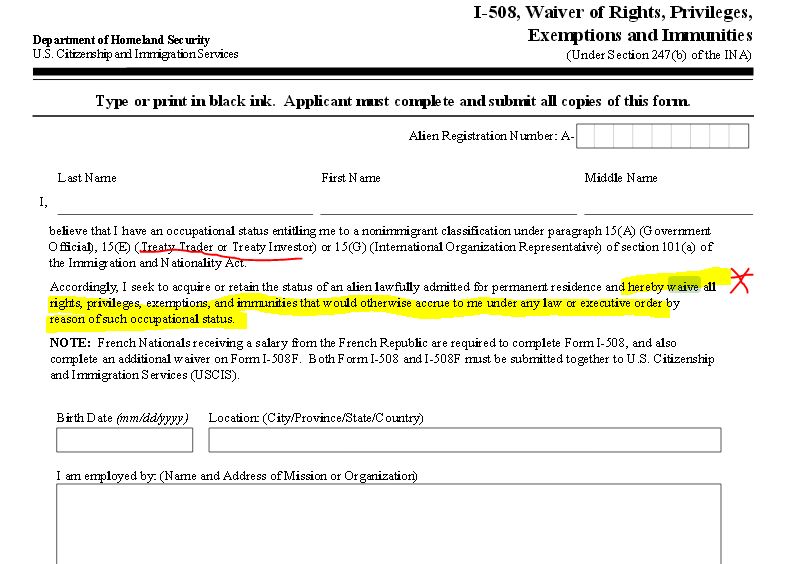
The Court noted this form, I-508, Waiver of Rights, Privileges, Exemptions and Immunities (Under Section 247(b) of the INA) specifically provides that the non-U.S. citizen “waive all rights, privileges, exemptions and immunities which would otherwise accrue to [her] under any law or executive order by reason of [her] occupational status.”
In that case, the individual was a Finnish citizen who eventually applied for lawful permanent residency. The immigration forms were not related to any specific tax form, such as the new IRS Forms W-8BEN; see, IRS Releases New IRS Form W8-BEN. * U.S. citizens and LPRs beware of completing such form at the request of a third party.
The takeaway from this opinion, is that individuals need to be aware of how signing a particular form (that is not a tax form) can have adverse tax consequences. In this case, the Court ruled that she had waived her benefits to IRC Section 893 by signing immigration Form I-508. The opinion of the Tax Court raises an interesting legal question about how signing a form (I-508) can seem to override the statutory protection granted which provides protection to a qualifying “. . . employee [who] is not a citizen of the United States . . . “
Signing various tax forms can cause even greater risks for non-citizen taxpayers; e.g., IRS Form W-9 versus W-8BEN. See, FATCA Driven – New IRS Forms W-8BEN versus W-8BEN-E versus W-9 (etc. etc.) for USCs and LPRs Overseas – It’s All About Information and More Information*
Fortunately for the taxpayer in the Abrahamsen case, she was not subject to the Section 6662 accuracy related penalty (“negligence” penalty) assessed by the IRS.
A subsequent post will analyze some potential U.S. tax consequences for individuals who sign immigration Form I-485, Application to Register Permanent Residence or Adjust Status