The federal tax law has a very transparent system of reporting and identifying former U.S. citizens who have renounced their citizenship. The data with the names of each individual are published quarterly on the federal government’s website as Required by Section 6039G. The complete set of lists including thousands of names of former U.S. citizens going back to the mid-1990s can be reviewed here. Quarterly Publications. Quarterly Publication of Individuals, Who Have Chosen to Expatriate.
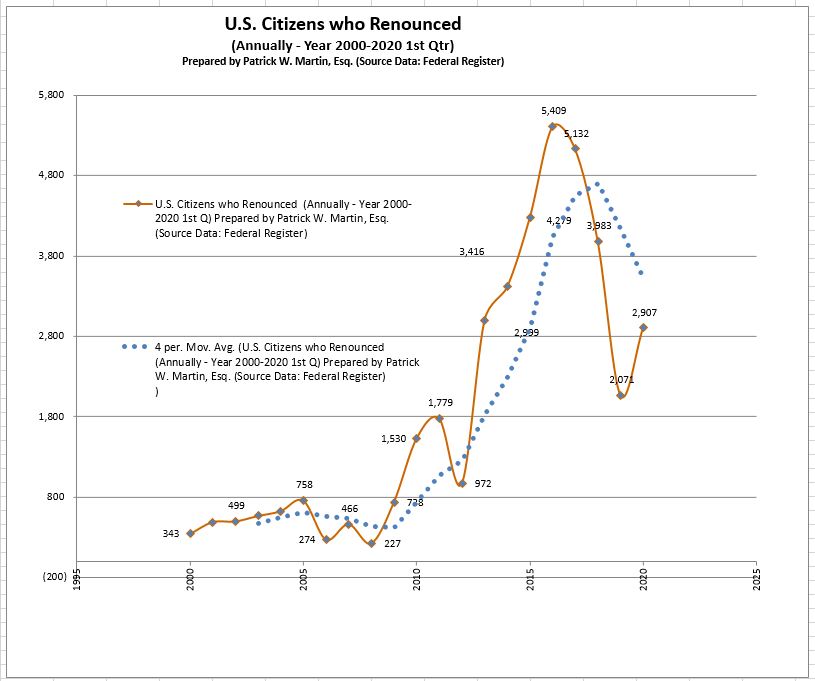
See previous posts regarding the numbers of USCs who were renouncing at an increasingly rapid pace starting at just around and just before the year 2010. The FATCA transparency laws were passed in 2010 and so too were more international information reporting requirements (IRC 6038D) and strong enforcement efforts overseas by the IRS and DOJ Tax Division; which could be part of a cause and effect consequence? See, CHAPTER 4—TAXES TO ENFORCE REPORTING ON CERTAIN FOREIGN ACCOUNTS (§§ 1471 – 1474)
Posted on : The current renunciations and now steep decline starting in 2018 may be temporary or part of a trend?
Subsequent posts will discuss the new trend of how relatively fewer lawful permanent residents (“LPRs”) are formally abandoning their status compared to USCs who formally renounce. This is true even though the number of USCs renouncing is in decline.
“LPR Tax Limbo” – Formal Abandonment of LPR (Form I-407) – BIG GAP with Actual Emigration of LPRs
Millions of lawful permanent residents (LPRs) who have left the U.S. and not “formally abandoned” their LPR status (by filing Form I-407, Record of Abandonment of Lawful Permanent Resident) typically remain in some kind of “LPR U.S. tax limbo.” How many individuals worldwide are in this LPR U.S. tax limbo?
Why are these numbers important for the tax-expatriation analysis? See, a recent post, Why Most LPRs Residing Overseas Haven’t a Clue about the Labyrinth of U.S. Taxation and Bank and Financial Reporting of Worldwide Income and Assets (Part I). Indeed, most individuals probably do not think they are a U.S. federal income tax resident when they leave the U.S. to reside overseas back to their home country. Why would they? There is no tax training manual provided to LPRs who leave the U.S. and no tax advisories – reflected on the card itself (unlike the last page of the U.S. passport, paragraph D). More precisely, most are probably not giving much, if any thought, to the complex U.S. federal tax residency rules and their extraterritorial application.
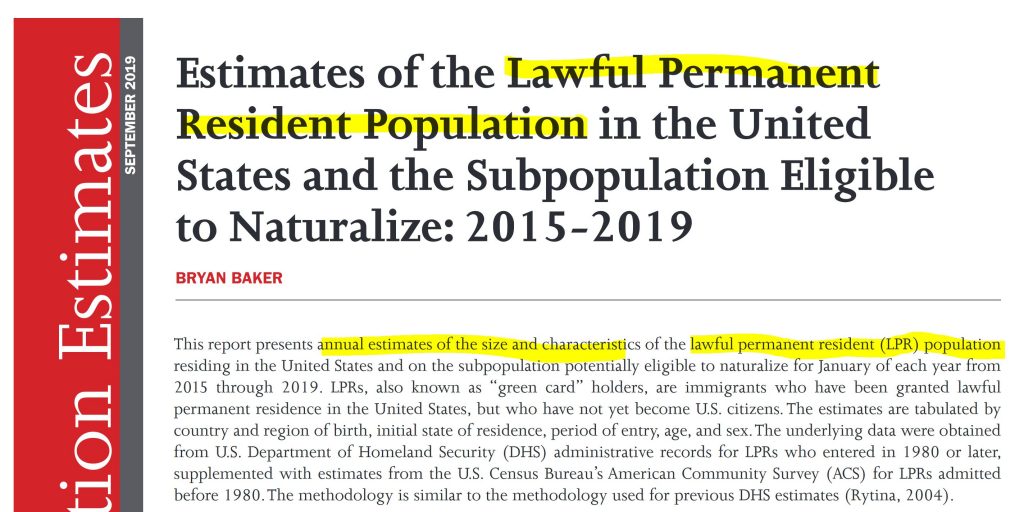
The “big gap” referred to above can be identified from the the Office of Immigration Statistics (OIS) report titled: Estimates of the Lawful Permanent Resident Population in the United States and the Subpopulation Eligible to Naturalize: 2015-2019. According to the report, more than 1 million individuals become LPRs each year. Between naturalization, mortality and emigration the report shows that the LPR population, year over year, has remained stable. In 2019 the total number of LPRs per this report was 13.6 million, up from just 13.0 million in 2015.
The “gap” is the difference between the numbers of LPRs who have left-emigrated the U.S. (some 3+ million) compared to something like an annual average of 15-19 thousand who have filed Form I-407. The gap is in the millions of persons who are in LPR U.S. tax limbo.
Mexico
The report is also worth reading if you want to understand the demographics of the LPR population. Mexico has about 2.5 million (which is by far the greatest number) of the total 13+ million LPR population.
As the report points out there is no reliable direct measurements of LPR emigration. They do not exist. This lack of information is what drove me to file a FOIA request with the government to request information about the number USCIS Forms I-407 that are filed with the government. See, also quarterly statistics of the USCIS – Form I-407, Record of Abandonment of Lawful Permanent Resident Status (partial information for years 2016-2019).
The information I obtained in the FOIA response was surprising, since the government had records showing only 46,364 Forms I-407 were filed in the years 2013 through 2015, as follows:
SOURCE: Federal Government Response to FOIA Request: Office of Performance and Quality (OPQ), Performance Analysis and External Reporting (PAER), JJ
This represents an average of only 15,455 individuals who formally abandoned their LPR status. Contrasted with more than 3.6 million estimated to have emigrated in 2019 per the DHS report leaves a massive gap of well over 3 million persons who held a “green card” and have left. They are now in LPR U.S. tax limbo.
What about the tax consequences? How many of these LPRs who left the U.S. know, understand or have any idea whatsoever of the federal tax filing obligations regarding their status?
What is the takeaway from the DHS report and LPR – I-407 information provided to me by the FOIA response? There is a discrepancy in the millions of people. Millions of individuals who actually leave or have left the U.S. to reside somewhere else around the world; compared to only some tens of thousands of individuals who have formally filed Form I-407, Record of Abandonment of Lawful Permanent Resident.
What can these individuals do to get out of the LPR U.S. tax limbo?
Why Most LPRs Residing Overseas Haven’t a Clue about the Labyrinth of U.S. Taxation and Bank and Financial Reporting of Worldwide Income and Assets (Part I)
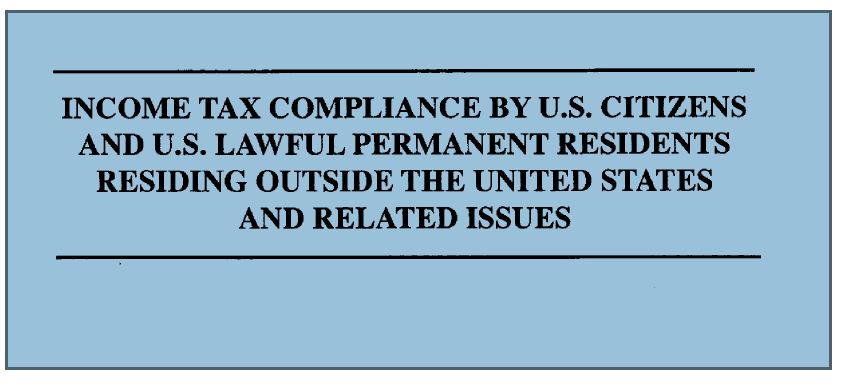
1998 Report from Department of Treasury to Chairman of House Committee on Ways and Means
Whether you have a “foreign bank account” for instance, is not intuitive, if you reside principally in a country outside the U.S. In other words, the accounts one may have in their country of tax residency (e.g., Germany, Canada, U.K., India, the U.S., Denmark, Mexico, etc.) will not seem like a “foreign bank account” at all. Rather, it is an account in a financial institution in their country of residency, i.e. a “domestic account.” Similarly, a U.S. bank account for an LPR residing outside the U.S. will intuitively seem like a “foreign bank account.” This is just one counter-intuitive example. Others will be explored in subsequent posts – e.g., “foreign corporations” and “foreign partnerships” among others.
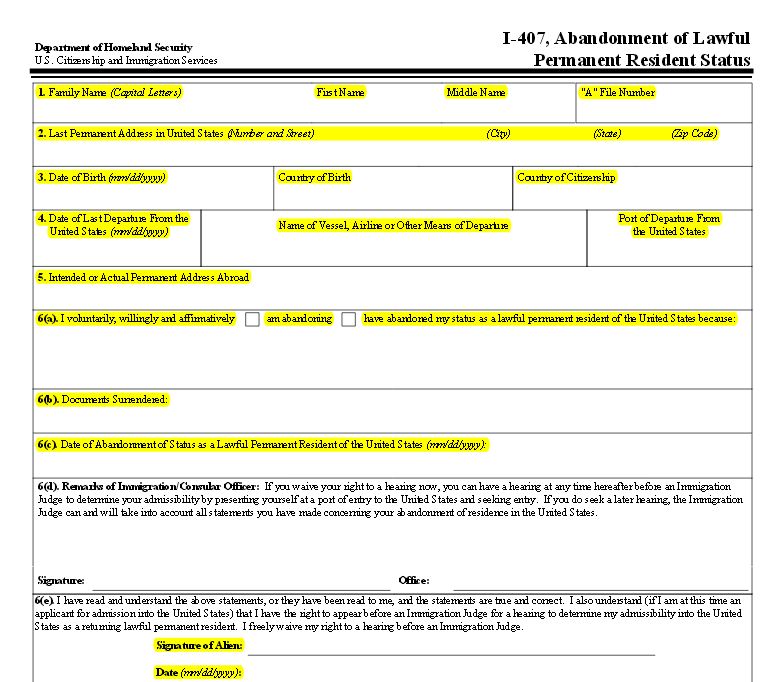
There is a particularly formal way of abandoning LPR status, which is by filing Form I-407, Record of Abandonment of Lawful Permanent Resident. The very instructions to the form imply that it is not the only way to abandon – as the form ” . . . is designed to provide a simple procedure to record an individual’s abandonment . . . “
To complicate the law further, Treasury regulations provide for the so-called “green card test” – but do not contemplate the application of an income tax treaty for which we have nearly 70 with various countries:
(1) Green card test. An alien is a resident alien with respect to a calendar year if the individual is a lawful permanent resident at any time during the calendar year. A lawful permanent resident is an individual who has been lawfully granted the privilege of residing permanently in the United States as an immigrant in accordance with the immigration laws. Resident status is deemed to continue unless it is rescinded or administratively or judicially determined to have been abandoned.
Treas. Reg. § 301.7701(b)-1(b).
To review the nearly 70 income tax treaties with different countries, they can be reviewed on the IRS website – United States Income Tax Treaties – A to Z – The application of these treaties to LPRs will be explored in later posts. Incidentally, no where on the actual “green card” is there express reference to tax obligations as exists on the back page of a U.S. passport.
I will leave you with an excerpt from the 1998 report referred to above starting on page 14:
” . . . Other factors also operate to limit both compliance measurement and improvement. Because the United States asserts taxing jurisdiction over those with little or no connection to the United States other than citizenship or status as a lawful permanent resident, in many cases overseas U.S.taxpayers are difficult to trace or contact. Moreover, even when valid tax assessments can be made against overseas taxpayers, IRS has limited enforcement recourse if the taxpayer’s assets are physically located outside of the United States. In addition, persons may be unaware of their status as U.S. taxpayers with an obligation to file a U.S. tax return. As described in Section II.B, supra, IRS has undertaken various taxpayer education initiatives to increase awareness of filing and payment obligations. In some cases, however,education may not be sufficient. For example, an individual who was born outside the United States and has never even visited the country may, nevertheless, be a U.S. citizen by reason of his parents’ U.S. citizenship. Such a person may not even know that he is a U.S. citizen and thus likely will not know of his obligation to file a U.S. tax return. Similarly, the United States imposes tax on greencard holders who no longer reside in the United States but who have not surrendered their greencards. Although the immigration laws may no longer recognize the validity of the green card if the holder attempted to reenter the country, and the individual may no longer consider himself entitled to lawful permanent resident status, the individual [generally] remains subject to U.S. tax under the Code.[emphasis added along with clarifying language in brackets]
Importantly, no where throughout all of this extensive 1998 report is there even a mention of the foreign bank account reporting obligations. Imagine, the Treasury never once in their report explained how and to what extent FBAR reporting applied to these taxpayers – even-though the ” . . . report responds to section 513 of the Health Insurance Portability and Accountability Act, Pub. L. 104-191, which directs the Secretary of the Treasury to prepare a report that describes income tax compliance by U.S. citizens and lawful permanent residents residing outside the United States . . . “
The next few posts will explain the significance of key immigration law concepts for LPRs (e.g., filing Form I-407, Record of Abandonment of Lawful Permanent Resident to formally abandon LPR status). They discuss formal administrative or judicial abandonment of LPR status and the specific relationship to U.S. tax law requirements.
MILLIONS HAVE LEFT – YET FEW HAVE FORMALLY ABANDONED – NO FORM I-407: Apparently a few million LPR individuals have emigrated from the U.S. with their green card in their pocket/purse and most are probably still deemed “United States persons” for federal income tax purposes. This conclusion comes from comparing (i) federal government data indicating the number of LPRs who have emigrated (3.6 million LPRs through 2019) contrasted with (ii) those who have filed Form I-407. The next few posts explore the important tax/legal distinctions of LPRs who formally abandon and those who simply leave the U.S. ignorantly blissful of the complex U.S. tax laws.
A LPR is a so-called “resident alien” by application of the U.S. federal tax law if she or he satisfies the statutory requirements of IRC Section 7701(b)(6), without application of an applicable income tax treaty. Tax treaties can change everything. A “resident alien” includes those who have LPR status who have not formally abandonment that status. See, the Treasury regulations that provide for the so-called “green card test” –
(1) Green card test. An alien is a resident alien with respect to a calendar year if the individual is a lawful permanent resident at any time during the calendar year. A lawful permanent resident is an individual who has been lawfully granted the privilege of residing permanently in the United States as an immigrant in accordance with the immigration laws. Resident status is deemed to continue unless it is rescinded or administratively or judicially determined to have been abandoned.
The number of LPRs emigrating exceed 3 million starting in 2015. These numbers bear no correlation to the formal abandonment numbers registered with the government, which require filing Form I-407, Record of Abandonment of Lawful Permanent Resident.
Emigration. Estimating emigration accurately is difficult.The U.S. government has not collected official statistics since 1957. Most observers agree that emigration of the LPR population from the U.S. is substantial. Between 1900-90, an estimated one-quarter to one-third of LPRs emigrated from the U.S. (see Warren and Kraly, 1985; Ahmed and Robinson, 1994; Mulder, et al., 2002).
DHS: Estimates of the Legal Permanent Resident Population and Population Eligible to Naturalize in 2002 (May 2014)
This apparent lack of information is what drove me to file a Freedom of Information Act (FOIA) request with the government to ask for the number of USCIS Forms I-407 that are filed with the government.
The information I obtained in the FOIA response was surprisingly low, since the government had record of only 46,364 Forms I-407 filed in the years 2013 through 2015, as follows:
SOURCE: Federal Government Response to FOIA Request: Office of Performance and Quality (OPQ), Performance Analysis and External Reporting (PAER), JJ
This represents an average of 15,455 individuals annually who formally abandoned their LPR status. Contrast this relatively small number with the more than 3.6 million LPRs estimated to have emigrated up to and through the year 2019 per the DHS report. This leaves a massive gap of some millions (assuming about 15,000 per year file Form I-407) of LPRs who have left-emigrated from the U.S. yet never formally abandoned by filing Forms I-407.
What about the tax consequences? How many of them know, understand or have any idea whatsoever of their federal tax filing obligations regarding their continued status? Subsequent posts will explore these consequences.
What is the takeaway from (i) the Office of Immigration Statistics reporting and (ii) the LPR – I-407 information provided by the government’s response to my FOIA request? There is a discrepancy in the millions of individuals. Millions of LPRs where most of them are simply not aware of how the U.S. federal tax law continues to impact their lives after they have left the country.
The successive posts will discuss the language and definition of a “lawful permanent resident” for purposes of the tax law and what it means for individuals residing outside the U.S. that still hold their green card in their purse/pocket:
(6) Lawful permanent resident. . . . an individual is a lawful permanent resident of the United States at any time if—
(A) such individual has the status of having been lawfully accorded the privilege of residing permanently in the United States as an immigrant in accordance with the immigration laws, and
(B) such status has not been revoked (and has not been administratively or judicially determined to have been abandoned). [emphasis added]
New Treasury Regulations Can Effect Some Long-Term Residents (“Green Card” Holders)
There have been numerous posts about how Lawful Permanent Residents (“LPRs”) who have not formally abandoned their green card might have adverse U.S. tax consequences as part of the U.S. “expatriation tax.”
The U.S. Treasury issued new Regulations that can impact LPRs who have previously filed U.S. 1040NR tax returns under an applicable income tax treaty. On December 13, 2016, the these final regulations require foreign-owned, single-member U.S. limited liability companies (“SM-LLCs”) that are treated as disregarded entities for U.S. tax purposes to file an information return to report certain transactions. These Treasury Regulations, 26 CFR § 1.6038A-1(c) require these foreign-owned SM LLCs to be treated as if they are a separate domestic “C” corporation specifically for reporting purposes.
Treasury Regulations, 26 CFR § 1.6038A-1(c) require foreign-owned SM LLCs to be treated as if they are a domestic “C” corporation for reporting purposes (Form 5472)
An individual who is a LPR can fall into this category in certain circumstances; namely where they cease to be a “U.S. person” under IRC Section 7701(b)(6). See, IRS Form 5472 directly here –
See WSJ = World/Expats – For an Excellent Overview of U.S. Taxation for U.S. Citizen Individuals in Plain English
For an excellent overview (without penalty hype or exaggeration of the U.S. tax law), read the following article from Eric Scali of H&R Block’s expat-focused service titled –Puncturing 7 Common Myths about U.S. Expat Tax Rules, Nov. 15, 2015, WSJ = Globe, EXPAT, For global nomads everywhere
Myth #1: Individuals living outside of the U.S. and filing tax returns with a foreign government don’t have to file annual U.S. tax returns.
Myth #2: Expats only need to report their U.S. income on their U.S. tax return.
Myth #3: If their foreign income is below the Foreign Earned Income Exclusion (FEIE), expats don’t need to file a U.S. tax return.
Myth #4: Work performed by an expat within the U.S. but paid by an expat’s foreign employer is foreign income because it’s paid by the foreign employer and not issued on a W-2.
Myth #5: Expats’ non-U.S.-based pension plans have the same tax treatment in the U.S. as they do in their country of residence.
Myth #6:When expats receive certain items of income, they’re only taxable in their country of residence under the rules provided for in the income tax treaty the foreign country has with the U.S.
Myth #7: An expat’s foreign investments are treated the same as they are in the foreign country.
Unfortunately, I have heard all of these and more (many times over) during my professional career as an international tax lawyer (and an accountant in the late 1980s) from both individuals and their tax advisers both inside the U.S. and outside the U.S. As someone who lives with their family outside the U.S., I have a good understanding about the difficulty of finding good U.S. tax resources that accurately and simply explain these very complex laws.
We can call this “forced expatriation”; when the government takes investigative action to deport a lawful permanent resident (“LPR); i.e., cause a forced tax expatriation where an individual files a false return, provides false information or otherwise submits a false document to the government.
The point of this post is to highlight a point previously made:
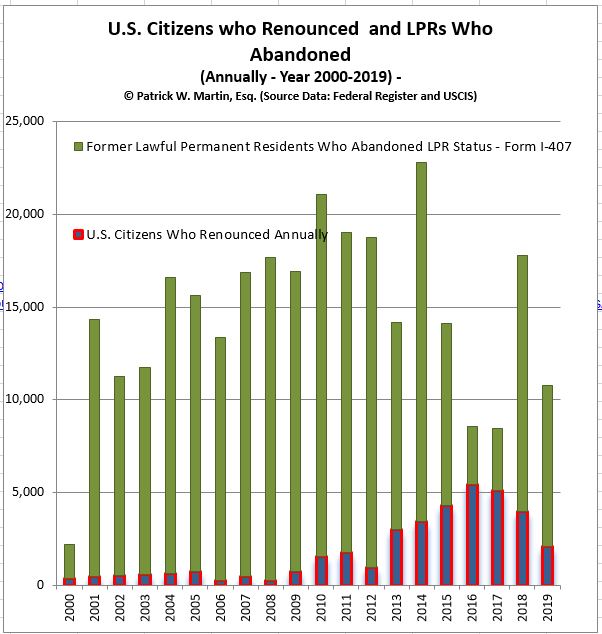
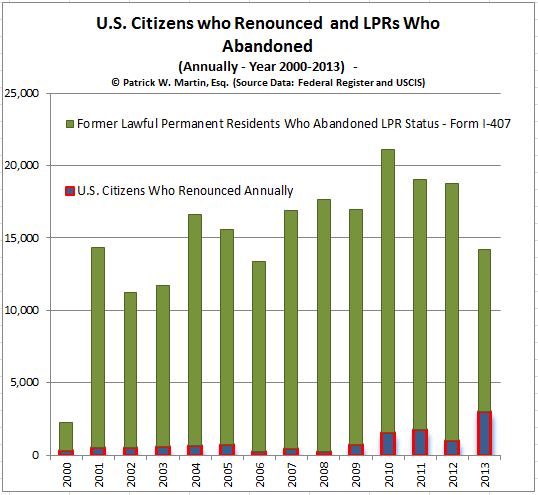
While citizens are often the focus of the public press and Congress regarding “expatriation taxation”; the statute also wraps in so-called “long-term residents.” These are individuals who had or continue to have “lawful permanent residency status.” There are numerous technical considerations in this area, but needless to say, the number of former lawful permanent residents who have simply filed Form I-407 – Abandonment is far in excess of those U.S. citizens who have filed for and received a Certificate of Loss of Nationality (“CLN”) – Form DS-4083 (CLN). The graph reflects the enormous difference.
This raises many questions regarding how information maintained by the Department of Homeland Security (DHS) and the United States Customs and Immigration Service (USCIS) can be shared with and provided to the IRS.
Former “long-term residents” have extensive U.S. tax compliance obligations, including certification requirements under Section 877(a)(2)(C) to avoid “covered expatriate” status and the various adverse tax consequences.
Alien Files (A-Files) are maintained in electronic and paper format throughout DHS. Digitized A-Files are located in the Enterprise Document Management System (EDMS). The Central Index System (CIS) maintains an index of the key personally identifiable information (PII) in the A-File, which can be used to retrieve additional information through such applications as Enterprise Citizenship and Immigrations Services Centralized Operational Repository (eCISCOR), the Person Centric Query Service (PCQS) and the Microfilm Digitization Application System (MiDAS). The National File Tracking System (NFTS) provides a tracking system of where the A-Files are physically located, including whether the file has been digitized.
The databases maintaining the above information are located within the DHS data center in the Washington, DC metropolitan area as well as throughout the country. Computer terminals providing electronic access are located at U.S. Citizenship and Immigration Services (USCIS) sites at Headquarters and in the Field throughout the United States and at appropriate facilities under the jurisdiction of the U.S. Department of Homeland Security (DHS) and other locations at which officers of DHS component agencies may be posted or operate to facilitate DHS’s mission of homeland security.
The U.S. Customs and Immigration Service (USCIS) announced on 23 March 2015, that a new Form I-407 is available and is to be used, per the USCIS website announcement,
Timing Issues for Lawful Permanent Residents (“LPR”) Who Never “Formally Abandoned” Their Green Card
The “tax expatriation” statutory provisions are fraught with ambiguity and incomplete answers for those individuals who have cases that span different time periods. This is because the law has been changed numerous times over the last several years and ad hoc concepts added, including the technical concept of “long-term residents” for the first time in 1996. As has been previously explained, the first “expatriation tax” law was not adopted until 1966 as part of the The Foreign Investors Tax Act of 1966 (“FITA”) – The Origin of U.S. Tax Expatriation Law (Posted on April 6, 2014).
Next, 1996 amendments kept the basic regime but added a number of key concepts, including “long-term residents”. The changes in the law in 2004 made significant changes and in 2008 the first “mark to market” regime was adopted. Each time, the concept of “long-term residents” was maintained, but without clear thought as to the meaning and timing of “expatriation” in various cases. See, Timeline Summary of Changes in Tax Expatriation Provisions Since 1996, (Posted on April 9, 2014)
Unfortunately, none of these amendments to the law over the years carefully incorporated transition and timing rules for cases where the individual has lived in (or had U.S. citizenship or LPR) during one more of these time periods:
1966-1996
1996-2004
2004-2008
2008-present
There are many inconsistent concepts among the law and one clear example is demonstrated by an individual who became a lawful permanent resident prior to 1996 and prior to amendments in the definition of a “resident alien” which was adopted generally in the federal tax in the law in 1984. This 1984 definition was not part of any specific “expatriation tax” provisions.
Prior to 1984, a LPR was not necessarily an income tax resident of the U.S. This concept of LPR (i.e., a “green card”) driving U.S. income tax residency was adopted in 1984, long before Congress became obsessed with U.S. individual tax expatriation. For background in the law, see the 1985 Penn State Law Review Article – Internal Revenue Code 7701(b): A More Certain Definition of Resident
. . . The Act defines “lawful permanent resident” to mean an individual who has the status of having been lawfully accorded the privilege of residing permanently in the United States as an immigrant in accordance with the immigration laws, if such status has not been revoked or administratively or judicially determined to have been abandoned. Therefore, an alien who comes to the United States so infrequently that, on scrutiny, he or she is no longer legally entitled to permanent resident status, but who has not officially lost or abandoned that status, will be a resident for tax purposes. The purpose for this requirement of revocation or determination is to prevent aliens from attempting to retain an apparent right to enter or remain in the United States while attempting to avoid the tax responsibility that accompanies that right.
The logic of the LPR test is clear based upon this explanation. If one has the right to live in the U.S., they cannot avoid the tax responsibility that accompanies that right. However, as immigration lawyers will explain, there is no right to enter the U.S. after you have abandoned your LPR status and moved outside the U.S. on a permanent basis.
At the same time, there is other discussion in the report that would support the position that these provisions only apply for the years 1985 and thereafter (long after many individuals obtained LPR status, but who moved out of the country – e.g., in cases where individuals obtained LPR in the 1970s and left before 1985). Specifically, the explanation in the Joint Committee of Taxation is as follows:
. . . The purpose of this effective date rule is to delay tax resident status for only new green cardholders for a short time. Congress understood further that an alien may acquire lawful permanent resident status for immigration purposes before U.S. presence. Congress sought to impose tax resident status on all lawful permanent residents once they arrive in the United States. The Act does not affect the determination of residence, even for green card holders, for taxable years beginning before January 1, 1985.
Of course, the report by the Joint Committee on Taxation (“JCT”) is not the law and does not bind the IRS or the taxpayer. However, the JCT usually get their explanations of the law right.
Why is all of this important for LPRs who never formally abandoned their “green card”? The IRS might well try to argue they never terminated their U.S. federal income tax residency for purposes of the “tax expatriation provisions”, as later versions of the statute impose an obligation to notify the IRS. If the individual never notified the IRS, the government might ar
See, for instance Section 7701(b)(6) with specific rules for LPR individuals who live in a country with a U.S. income tax treaty. Importantly, the definition of a lawful permanent resident for tax purposes (as defined in Section 7701(b) ) is not identical to the definition for immigration law purposes as the legislative history to the 1984 amendments to the law explains.
Does the IRS have access to the USCIS immigration data for former lawful permanent residents (LPRs)?
Information about former LPRs, such as the individuals names, is not published under the statute, IRC Section 6039G, which only covers former U.S. citizens.
This raises the question of whether the Department of Homeland Security tracks former LPRs – names and addresses overseas and provides that information to the Internal Revenue Service?
The new I-407 Form requires much more information and is 2 pages in length. The old form had only 6 lines and was less than 1/2 of a page in length. These forms are set forth here. The new form requires the address overseas of the individual.
The complete set of lists going back to the mid-1990s can be reviewed here. Quarterly Publications.
Of course, the IRS can easily select and identify individuals for audit, by simply drawing from the published names of former U.S. citizens, which is currently tracking at an average of about 850 former USCs quarterly. In contrast, the number of former LPRs who have filed USCIS Form I-407 is tracking at an average of about 4,000 to 5,000 individuals quarterly.
While citizens are often the focus of the public press and Congress regarding “expatriation taxation”; the statute also wraps in so-called “long-term residents.” These are individuals who had or continue to have “lawful permanent residency status.” There are numerous technical considerations in this area, but needless to say, the number of former lawful permanent residents who have simply filed Form I-407 – Abandonment is far in excess of those U.S. citizens who have filed for and received a Certificate of Loss of Nationality (“CLN”) – Form DS-4083 (CLN). The graph reflects the enormous difference.
While the IRS has specific information about U.S. citizens, it is not clear whether the Department of Homeland Security via the USCIS provides data to the IRS regarding lawful permanent residents who have filed Form I-407? If such an individual becomes a “covered expatriate” under the U.S. tax law, the range of adverse tax consequences can follow them and their future beneficiaries and heirs, including as follows:
“mark to market” taxation on their worldwide assets,
40% inheritance tax to U.S. beneficiaries,
40% tax on gifts to U.S. beneficiaries,
etc.
It seems fairly easy, from a legal perspective, that the IRS can request the names, addresses (and indeed the newly completed form) from the USCIS of all individuals who have filed USCIS Form I-407. From the USCIS records, the IRS will be able to determine if the individual was a “long term resident” based upon the number of years the individual had such status.
Assuming the IRS determines the individual is a long term resident, they can then simply check to see if the they have received IRS Form 8854 from the former LPR; in order to determine if she or he satisfied the certification requirement of Section 877(a)(2)(C). If not, the IRS will necessarily know the individual is a “covered expatriate.”
The Information in DHS/USCIS Database (A-Files, EMDS, CIS, PII, eCISCOR, PCQS, Midas, etc.) on Individuals is Extensive and Can be Shared with Internal Revenue Service
This raises many questions regarding how information maintained by the Department of Homeland Security (DHS) and the United States Customs and Immigration Service (USCIS) can be shared with and provided to the IRS.
Former “long-term residents” have extensive U.S. tax compliance obligations, including certification requirements under Section 877(a)(2)(C) to avoid “covered expatriate” status and the various adverse tax consequences.
Alien Files (A-Files) are maintained in electronic and paper format throughout DHS. Digitized A-Files are located in the Enterprise Document Management System (EDMS). The Central Index System (CIS) maintains an index of the key personally identifiable information (PII) in the A-File, which can be used to retrieve additional information through such applications as Enterprise Citizenship and Immigrations Services Centralized Operational Repository (eCISCOR), the Person Centric Query Service (PCQS) and the Microfilm Digitization Application System (MiDAS). The National File Tracking System (NFTS) provides a tracking system of where the A-Files are physically located, including whether the file has been digitized.
The databases maintaining the above information are located within the DHS data center in the Washington, DC metropolitan area as well as throughout the country. Computer terminals providing electronic access are located at U.S. Citizenship and Immigration Services (USCIS) sites at Headquarters and in the Field throughout the United States and at appropriate facilities under the jurisdiction of the U.S. Department of Homeland Security (DHS) and other locations at which officers of DHS component agencies may be posted or operate to facilitate DHS’s mission of homeland security.
* * *
Categories of records in this system include:
A. The hardcopy paper A-File, which contains the official record material about each individual for whom DHS has created a record under the INA such as: naturalization certificates; various documents and attachments (e.g., birth and marriage certificates); applications and petitions for benefits under the immigration and nationality laws; reports of arrests and investigations; statements; other reports; records of proceedings before or filings made with the U.S. immigration courts and any administrative or federal district court or court of appeal; correspondence; and memoranda. Specific data elements may include:
Government-issued identification information (i.e., passport, driver’s license):
? Document type,
? issuing organization,
? document number, and
? expiration date;
Military membership;
Arrival/Departure information (record number, expiration date, class of admission, etc.);
Federal Bureau of Investigation (FBI) Identification Number;
Fingerprint Identification Number;
Immigration enforcement history, including arrests and charges, immigration proceedings and appeals, and dispositions including removals or voluntary departures;
Immigration status;
Family history;
Travel history;
Education history;
Employment history;
Criminal history;
Professional accreditation information;
Medical information relevant to an individual’s application for benefits under the INA before DHS or the immigration court, an individual’s removability from and/or admissibility to the United States, or an individual’s competency before the immigration court;
Specific benefit eligibility information as required by the benefit being sought; and
Video or transcript of immigration interview
Subsequent posts will discuss how and when the law allows the IRS to access these records.