International Tax · Citizenship Renunciation · LPR Abandonment
International Tax Shareholder
Tax Notes International: Article by Robert Goulder: FBAR Madness: We need to Chat About Aroeste
On Monday 11 Sept 2023, Robert Goulder wrote a detailed article about the implications of what he calls “The Green Card From Hell”! His article can be reviewed in its entirety through the subscription service provided by Tax Notes International – FBAR Madness: We Need to Chat About Aroeste.
Goulder made some key observations that are worth repeating for anyone who has been a green card holder for basically more than seven years. That can trigger the “expatriation” tax provisions – the focus of this blog.
The facts of the case of Mr. Alberto Aroeste are covered extensively and accurately in Goulder’s article.
He noted:
This week’s article concentrates on the novel FBAR issue that will be decided in Aroeste v. United States, an illegal exaction suit before the U.S. District Court for the Southern District of California.7 The case has garnered attention for good reason. It pushes back against the government’s dubious policy of requiring individuals treated as nonresidents under a U.S. tax treaty to provide FBAR filings. Let’s note the futility of the financial information which the government seeks from these folks. It concurrently exempts treaty nonresidents from the need to file IRS Form 8938 (“Statement of Specified Foreign Financial Assets”), the tax code’s counterpart to the FBAR.8 It remains problematic that the government should demand reporting from treaty nonresidents as if they were residents.9
The one issue not explained well relates to how and when lawful permanent residency (i.e. a “green card”) under Title 8 is even valid in the first place. Goulder’s article explains some of the rights of lawful permanent residency status, but also addresses some key areas of the immigration law the same as most tax law experts cover a different area of the law. See, SCOTUS’ observations of the law in this context: Unplanned Expatriation: Lawful Permanent Residents’ Deportation Risks for Filing U.S. Federal False Tax Returns
For instance, Goulder claims green card holders cannot be deported as long as the immigration status remains valid. True – but what is not explained is how easy it is to cease to have a valid one in the first place. What he doesn’t explain is how and when an individual can “abandon” or “relinquish” the status as a green card holder (as a matter of law) by not residing permanently in the United States. See, Fundamentals of Immigration Law, written by Charles A. Wiegand, III, Former Immigration Judge, Oakdale, Louisiana. The law is complex as described by Wiegand.
Goulder does not seem to find the government’s arguments persuasive (“ain’t buying it“!):
For Aroeste, there seems to be little doubt his closer personal and economic ties are with Mexico. The IRS knows this. An analysis conducted by an IRS agent concluded that he spent no more than 67 days in the United States during 2012 and 57 days in the United States in 2013, with three-quarters of the remaining time spent in Mexico.
Goulder –
The IRS doesn’t care where Aroeste had closer personal and economic ties. That’s because it doesn’t care about the tiebreaker. As the government sees it, the treaty is a distraction that has no meaningful role to play in this litigation. The plaintiff’s immigration status is conclusive, end of story. His green card settles the matter, such that all further inquiries are superfluous and should cease.
Id.
What bothers me about that argument is how the government’s position selectively wishes away the existence of the U.S. tax treaty network — but only for application of the FBAR regime. The Mexico treaty would still mean something in another context, but not on the pivotal issue of Aroeste’s status as a U.S. person for FBAR purposes. Sorry, I ain’t buying it.
Id.
The government argues the treaty is only relevant for income and excise tax purposes, and what we have here are penalties based on violations of the Bank Secrecy Act — not the Internal Revenue Code. As the government sees it, no plaintiff can successfully challenge penalties authorized by Title 31 with legal remedies based on Title 26. I’m still not buying it.
Id, Goulder
I would recommend you take a read through his article that also addresses a discussion on how the government prefers to keep internal memoranda from the eyes of the public. He discusses at some length – Tax Analysts and Coastal States. How the Court in Aroeste took an approach different from the D.C. Circuit in articulating 9th Circuit law regarding attorney client privileged documents in the possession of the government.
Three Precedent Setting Cases in International Information Reporting (“IIR”) in 6 Weeks: * Aroeste, * Bittner, and * Farhy: all Interconnected via Title 26, Title 31 and U.S. Income Tax Treaties
In just over six weeks, there have been three key judicial precedents favorable to international individuals. These cases have helped clarify the requirements of individuals and the limitations on the powers of the IRS in assessing IIR penalties. Please see the full article on tax notes. These IIR decisions relate to:
Title 31 penalties for Foreign Bank Account Reports (“FBARs”),
How these two federal statutory regimes of Title 31 and 26 crossover into international law as set forth in U.S. income tax treaties negotiated with different countries around the world.
Each of these three cases are interconnected and have significant impact to individuals with global lives, global assets, multi-national family members and those who have businesses or accounts in different parts of the world.
Aroeste v. United States
First, on February 13th, 2023, the Southern District of California District Court (the “District Court”) made a key determination in a Joint Discovery Motion decision in Aroeste.[2] The District Court concluded in Aroeste that the IRS/DOJ[3] could not ignore the U.S.-Mexico income tax treaty (“Treaty”) and its application to a Mexican national who has resided almost all of his life in Mexico City and has maintained a “green card” for immigration purposes in the United States. It is a non-willful FBAR case. The District Court applied the interconnected statutes and regulations of Titles 31 and 26 to help determine who qualifies as a “United States person”; specifically with reference to international law and obligations set forth in the Treaty. The key question in that case that remains to be answered is who (specifically Mr. Aroeste and by extension to a pool of millions of green card individuals residing outside the United States who are not citizens[4]) must file FBARs?
Second, on February 28th, 2023, the Supreme Court of the United States (“SCOTUS”) resolved in Bittner[5], that the applicable non-willful FBAR penalty is not measured by every foreign account of the individual as the Service has argued for years. That case also dealt with non-willful filing of FBARs and the SCOTUS concluded the IRS cannot impose penalties of $10,000 on each and every account held; but rather the penalty is “per report” that was not correctly filed. Hence, the total maximum penalty per year is $10,000. A maximum penalty of $50,000 (x5 years) applied per the SCOTUS versus the IRS determined amount of US$2.7M+.
Farhy v. Commissioner
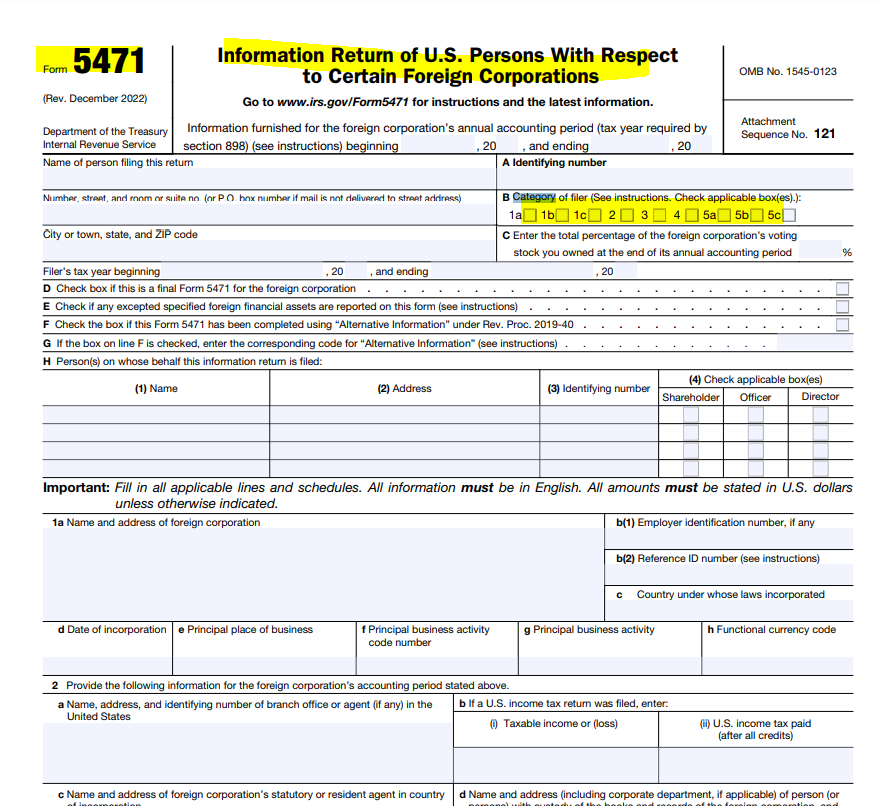
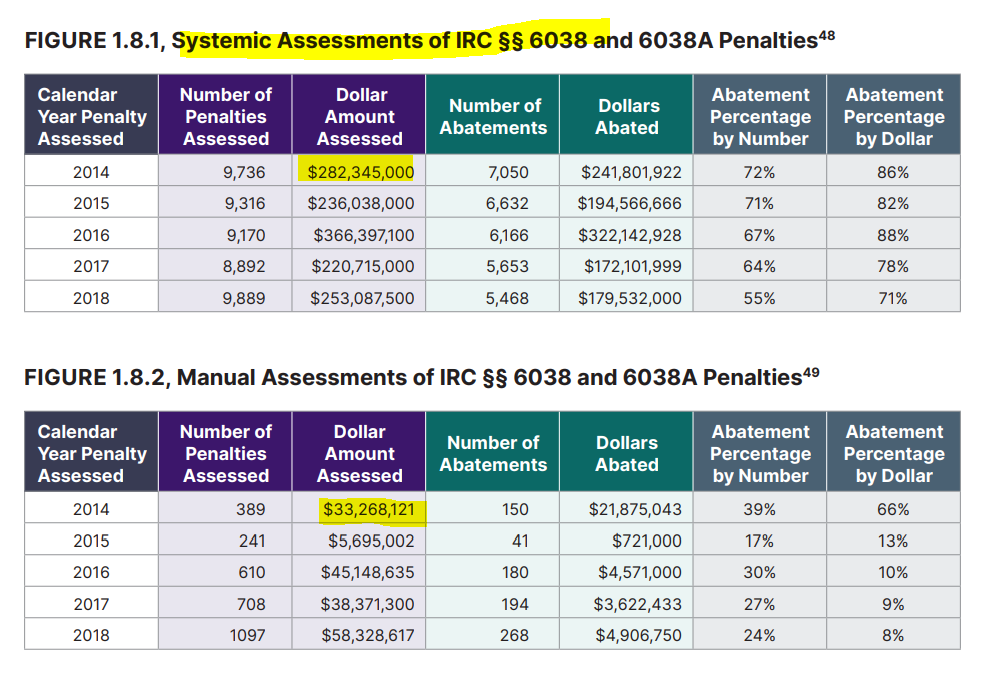
Lastly, on April 3rd, 2023, the United States Tax Court (the “Tax Court”) issued a decision in Farhy,[6] stating that the IRS does not have statutory authority to assess IIR penalties under section 6038(b). The IIR that is required by this statute is IRS Form 5471, which includes multiple filing categories. This has far reaching implications about how the government will be able to collect the IIR penalties the Service administratively determines are owed.[7] The Taxpayer Advocate previously issued a report on point titled: The IRS’s Assessment of International Penalties Under IRC §§ 6038 and 6038A Is Not Supported by Statute, and Systemic Assessments Burden Both Taxpayers and the IRS[8] In that report, the Taxpayer Advocate identified more than $310M of penalties just for the tax year 2014 the IRS “assessed” under Sections 6038 and 6038A.[9] We now know these “assessments” were invalid.
[1] See, footnote 19 regarding United States Tax Court’s Order in the case of Alberto Aroeste & Estela Aroeste vs. Commissioner.
[3] The “IRS” or the “Service” are used as shorthand for the Internal Revenue Service; and the Department of Justice; Tax Division is referred to as the “DOJ.”
[4] See, the Homeland Security, Office of Immigration Statistics – Estimates of the Lawful Permanent Resident Population in the United States and the Subpopulation Eligible to Naturalize: 2015-2019. According to the report, more than 1 million individuals become LPRs each year and 4.8 million are estimated to have died and/or emigrated. The authors have extrapolated from these estimates in the report to conclude that more than 3 million of these individuals have emigrated and left the United States. The millions of individuals do not reside in the U.S. of which Mr. Aroeste is one of these individuals; although a tax treaty must exist in the country of residence for the analysis of the District Court in Aroeste v. United States to be applicable.
[5] No. 31—1195 (U.S. Feb. 28, 2023); 598 U. S. ____ (2023); The majority opinion by Justice Gorsuch cited to the ACTEC amicus brief (where Patrick W. Martin, the author of tax-expatriation.com and a fellow of ACTEC worked on the drafting of the brief) and concluded:
“Best read, the BSA treats the failure to file a legally compliant report as one violation carrying a maximum penalty of $10,000, not a cascade of such penalties calculated on a per-account basis.” The ACTEC brief was cited by the majority opinion- “ We see evidence, too, that the point of these reports is to supply the government with information potentially relevant to various kinds of investigations, criminal and civil alike. But what we do not see is any indication that Congress sought to maximize penalties for every nonwillful mistake (whether a late filing, a transposed account number, or an out-of-date bank address). See Brief for American College of Trust and Estate Counsel as Amicus Curiae 5–7.”
[7]See, Patrick W. Martin, Megan L. Brackney, Robert Horowitz, and Javier Diaz de Leon Galarza: Problems Facing Taxpayers with Foreign Information Return Penalties, November 12, 2020.
IRS Chief Counsel Concedes Tax Treaty Residency Position for LPR German Taxpayer in Tax Court
Those who have their “lawful permanent resident” status and live largely outside the U.S. (or plan on moving to do so in the future) should be keenly aware of the definition of a “long-term” resident. See, IRC Section 877 (e)(2).
Importantly, the U.S. Tax Court just entered a Decision for a case involving a German citizen who had been a lawful permanent resident for many years (U.S. Tax Court Docket 18451-19). In that case the IRS revenue agent took the position the German citizen was a “United States person” and therefore subject to U.S. taxation on his worldwide income and subject to “international information reporting requirements.”
As is increasingly common in IRS tax audits of international individual matters, information penalties become a cudgel to impose greater
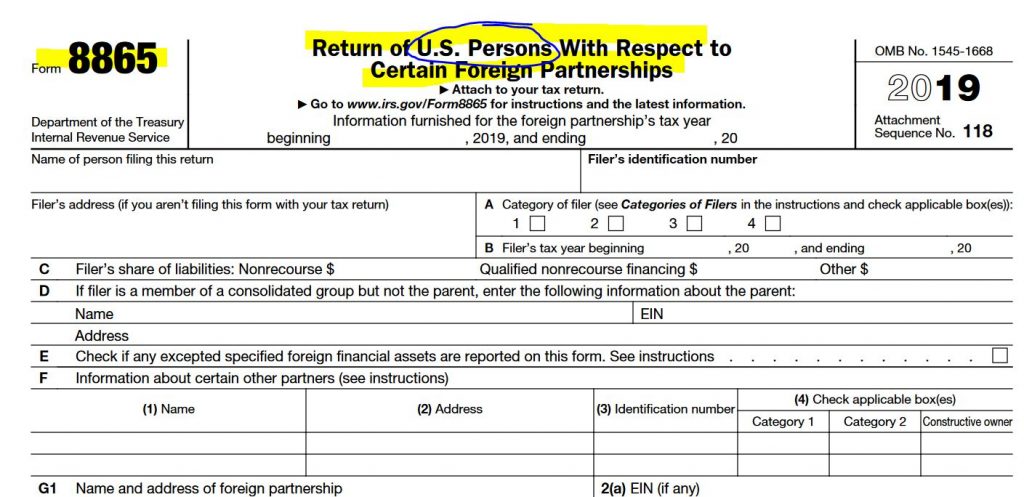
economic pressure (when the income tax determinations are relatively modest) to pursue cross border cases. In the recent U.S. Tax Court case (U.S. Tax Court Docket 18451-19), the IRS had assessed substantial penalties for more than 10 tax years for failure to file IRS Form 8865.
What was striking about the German citizen case who had been a lawful permanent resident for many years (U.S. Tax Court Docket 18451-19) is that the IRS conceded the case as part of a “qualified offer” procedure (Section 7430) where the taxpayer offered what was less than 1% of the total tax, penalty and statutory interest amounts determined by the IRS. Plus, there was both a statutory notice of deficiency (90/150 day letter) on income tax and negligence penalties plus a separate direct assessment of information penalties under IRC Section 6038(b) for not filing IRS Form 8865.
The importance of an international information penalty assessment, is that the U.S. Tax Court will often times not have jurisdiction to address the issue; at least not on first blush. See, Flume v. Commissioner, T.C. Memo 2017-21, Judge Goeke addressing 5471 penalties and IRC Sections 6330(c)(2)(B) and 6330(c)(4)(A). For an excellent discussion on these issues, see two outstanding tax authors –
Why Most LPRs Residing Overseas Haven’t a Clue about the Labyrinth of U.S. Taxation and Bank and Financial Reporting of Worldwide Income and Assets (Part I)
1998 Report from Department of Treasury to Chairman of House Committee on Ways and Means
Whether you have a “foreign bank account” for instance, is not intuitive, if you reside principally in a country outside the U.S. In other words, the accounts one may have in their country of tax residency (e.g., Germany, Canada, U.K., India, the U.S., Denmark, Mexico, etc.) will not seem like a “foreign bank account” at all. Rather, it is an account in a financial institution in their country of residency, i.e. a “domestic account.” Similarly, a U.S. bank account for an LPR residing outside the U.S. will intuitively seem like a “foreign bank account.” This is just one counter-intuitive example. Others will be explored in subsequent posts – e.g., “foreign corporations” and “foreign partnerships” among others.
There is a particularly formal way of abandoning LPR status, which is by filing Form I-407, Record of Abandonment of Lawful Permanent Resident. The very instructions to the form imply that it is not the only way to abandon – as the form ” . . . is designed to provide a simple procedure to record an individual’s abandonment . . . “
To complicate the law further, Treasury regulations provide for the so-called “green card test” – but do not contemplate the application of an income tax treaty for which we have nearly 70 with various countries:
(1) Green card test. An alien is a resident alien with respect to a calendar year if the individual is a lawful permanent resident at any time during the calendar year. A lawful permanent resident is an individual who has been lawfully granted the privilege of residing permanently in the United States as an immigrant in accordance with the immigration laws. Resident status is deemed to continue unless it is rescinded or administratively or judicially determined to have been abandoned.
Treas. Reg. § 301.7701(b)-1(b).
To review the nearly 70 income tax treaties with different countries, they can be reviewed on the IRS website – United States Income Tax Treaties – A to Z – The application of these treaties to LPRs will be explored in later posts. Incidentally, no where on the actual “green card” is there express reference to tax obligations as exists on the back page of a U.S. passport.
I will leave you with an excerpt from the 1998 report referred to above starting on page 14:
” . . . Other factors also operate to limit both compliance measurement and improvement. Because the United States asserts taxing jurisdiction over those with little or no connection to the United States other than citizenship or status as a lawful permanent resident, in many cases overseas U.S.taxpayers are difficult to trace or contact. Moreover, even when valid tax assessments can be made against overseas taxpayers, IRS has limited enforcement recourse if the taxpayer’s assets are physically located outside of the United States. In addition, persons may be unaware of their status as U.S. taxpayers with an obligation to file a U.S. tax return. As described in Section II.B, supra, IRS has undertaken various taxpayer education initiatives to increase awareness of filing and payment obligations. In some cases, however,education may not be sufficient. For example, an individual who was born outside the United States and has never even visited the country may, nevertheless, be a U.S. citizen by reason of his parents’ U.S. citizenship. Such a person may not even know that he is a U.S. citizen and thus likely will not know of his obligation to file a U.S. tax return. Similarly, the United States imposes tax on greencard holders who no longer reside in the United States but who have not surrendered their greencards. Although the immigration laws may no longer recognize the validity of the green card if the holder attempted to reenter the country, and the individual may no longer consider himself entitled to lawful permanent resident status, the individual [generally] remains subject to U.S. tax under the Code.[emphasis added along with clarifying language in brackets]
Importantly, no where throughout all of this extensive 1998 report is there even a mention of the foreign bank account reporting obligations. Imagine, the Treasury never once in their report explained how and to what extent FBAR reporting applied to these taxpayers – even-though the ” . . . report responds to section 513 of the Health Insurance Portability and Accountability Act, Pub. L. 104-191, which directs the Secretary of the Treasury to prepare a report that describes income tax compliance by U.S. citizens and lawful permanent residents residing outside the United States . . . “
Importantly, the website provides the following comforting statement:
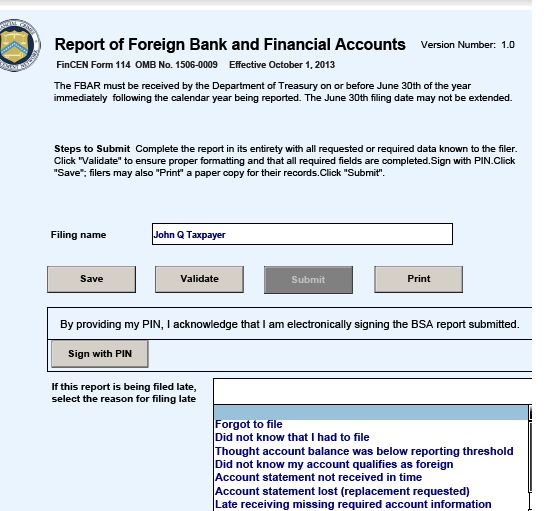
The IRS will not impose a penaltyfor the failure to file the delinquent FBARs if you properly reported on your U.S. tax returns, and paid all tax on, the income from the foreign financial accounts reported on the delinquent FBARs, and you have not previously been contacted regarding an income tax examination or a request for delinquent returns for the years for which the delinquent FBARs are submitted.
The question is the following:
Is the IRS bound by their own statement on their website as a matter of law?
In other words, can they go ahead and assess FBAR penalties notwithstanding the statement set forth above on their website?
Assuming you do have an FBAR filing requirement, e.g., residing in your country of residence with financial accounts in your own country or in other financial institutions outside the U.S.; can the IRS assess a penalty against you for a delinquently filed FBAR? What if you have properly reported on your U.S. tax returns, and paid all tax on, the income from the foreign financial accounts reported on the delinquent FBARs?
The answer may surprise you. It will be addressed in a subsequent post.
Incidentally, to date, there have been more than 200 FBAR civil penalty cases filed in U.S. federal courts. The Federal District Courts have seen approximately 200+ civil penalty cases and the Court of Federal Claims, much less popular venue, has seen 5 cases thus far.
A “Resident” is a “Resident” is a “Resident” – or Not?
Who is a “resident”? What is a “resident”? This sounds like such a basic question. It is not so simple for tax purposes; nor for other provisions of the law.
There is the colloquial meaning of resident. For instance, if Mr. Smith says, “I have been a resident of Montana on my ranch for 30 years”; to what does he refer? What if Mr. Smith has a house in California (which he has owned for 15 years) and another ranch in Alberta, Canada that he has owned for 45 years. Is he also a “resident” of Canada and California?
What if he is not a U.S. citizen but holds a particular type of visa, such as lawful permanent residency (an immigrant visa)? What if he has a non-immigrant visa, such as an E-2 visa? What if he only spends 4 months a year on his ranch in Montana, of where is he a “resident”?
Is he a “resident” in some or all of these scenarios? Why is this important in the context of “U.S. expatriation taxation”?
There are three sources of federal law where it becomes very important, which will be discussed in later posts:
In addition, various states, such as California, Texas and Washington D.C. (actually not a state; but all places I happen to be licensed to practice law) have their own definitions of who are “residents” for income tax and other purposes.
Subsequent posts will discuss the importance of understanding who is a “resident” and the implications under these various laws.
Laymen regularly have an idea of where they are “resident” – but that idea is often very different from definitions of “resident” under federal Titles 31, 26 and 8 and state laws (e.g., Texas, D.C., Florida, California, New York, etc.).
Mr. Dewees gets Smacked! U.S. District Court Upholds Multiple $10,000 Penalties (US$120,000 – NO Forms 5471) for USC Residing in Canada
United States Citizens (“USCs”) and lawful permanent residents (“LPRs”) residing overseas should read the story of Mr. Dewees to learn what could happen if they go into the offshore voluntary disclosure program (“OVDP”); when he appears to have been a “good faith” taxpayer. The IRS issued a press release in March 2018 – IRS to end offshore voluntary disclosure program; Taxpayers with undisclosed foreign assets urged to come forward now The IRS explained that it will close the program next month on September 28, 2018. Take the story of the Dewees into consideration before rushing into the OVDP.
This is not a new case, as the U.S. District Court for the District of Columbia issued its opinion a year ago – Dewees v. United States, 2017 U.S. Dist. LEXIS 124989 (D.C. D.C. 2017). However, it is an important case if anyone is confused about whether they should go into the OVDP. See the story of the Dewees.
He also did not initially pay information reporting penalties assessed by the IRS regarding his Canadian company. He resided in Canada where is business and company was located. The Court noted that he “. . . voluntarily disclosed [to the IRS] his failure to file the required informational returns . . . ” The Dewees were “rewarded” by their good faith efforts by the IRS which then turned around and ” . . . assessed a statutory penalty of $120,000, $10,000 for each year of non-compliance . . . “
The Canadian revenue authority would not refund his Canadian tax refund until the IRS penalty was paid in full. He eventually paid $120,000 of information penalties and brought a suit for refund in U.S. District Court.
The U.S. District Court first explained the obligations of USCs residing overseas with –
The Court then dismissed the suit for refund on the grounds that Mr. Dewees failed to state a viable claim and the Court therefore lacked jurisdiction to hear his claims (which were “excessive fines”, “equal protection” and “due process” claims).
Here, the USC residing in Canada was apparently well intended, since the District Court said that Mr. “Dewees learned that he had failed to comply with these requirements . . . ” In another part of the opinion, the Court uses the word “neglected” to file information returns for over a decade.
“Learned” and “neglected” certainly does not sound intentional, which is probably why the IRS did not attempt to pursue Title 31 willfulness FBAR penalties.
The USC entered the OVDP on the advice of a tax specialist and then withdrew after the IRS was proposing to assess an “OVDP in-lieu of penalty” of US$185,862.
The IRS ultimately did not pursue any FBAR penalties in this case, not even the annual $10,000 per year penalty for failure to file the FBAR form.
The U.S.-Canada income tax treaty has a special “assistance in collection” provision, which provides in part as follows –
Article XXVI A Assistance in Collection 1. The Contracting States [referring to the U.S. and Canada] undertake to lend assistance to each other in the collection of taxes referred to in paragraph 9, together with interest, costs, additions to such taxes and civil penalties, referred to in this Article as a “revenue claim”.
I explained in an earlier post, how the “Revenue Rule” was a common law concept that generally prohibited the U.S. government from assisting in the collection of taxes of another country. Hence, the U.S. Treasury renegotiated the treaties with five countries (including Canada) that now have a specific treaty provision such as XXVI A above:
As a result of these cases and the Revenue Rule, the U.S. and Canada modified their income tax treaty to (at least in theory) allow for the international enforcement of taxes. The U.S. now has five income treaties with “mutual assistance” provisions: Canada, Sweden, France, Denmark, and the Netherlands (with a clause in the newly negotiated, but yet to go into force, Swiss treaty).
In the Dewees case, we learned that the assistance in collection provision is not merely a theoretical tool that can be used in collecting taxes. The actions of both the Canadian (CRA) and U.S. governments (IRS and District Court Judge), made the provision effective. The US$120,000 penalty, that has nothing to do with any U.S. taxes, was collected by the IRS.
Questions to ponder in this case:
Would the USC have been better off, by getting proper advice as to how to file on a going forward basis?
Why did the USC ever go into the OVDP program in the first place under these facts?
In this case, the program did not exist at the time the taxpayers went into the OVDP in 2009.
Why did Dewees not simply consider (assuming he had good faith facts) filing amended tax returns to include late filed IRS Form 5471 forms?
Why did the IRS aggressively pursue these $120,000 in information penalties (presumably because he opted out of the OVDP program and they like to make examples out of those taxpayers that leave the program)?
Would and will the IRS assess more $10,000 per year penalties for additional companies for a good faith failure to file IRS Form 5471 forms? In other words, what if the Dewees had four Canadian companies, would the IRS have assessed US$480,000 (US$10,000 per year X 4 – per company – X 12 – the number of years the form was not filed)?
Will the IRS have success with any other country that does not have a similar tax treaty provision on the collection of taxes as the unique U.S.-Canada provision?
What about Sweden, France, Denmark, and the Netherlands with specific provisions in the U.S. income tax treaties? See a discussion of the U.S. District Court case in Georgia involving a Danish citizen, Torben Dileng v. Commissioner as discussed by Keith Fogg in the Procedurally Taxing Blog –
Will the aggressive actions of the IRS in this Dewee case to collect penalties backfire? Will USCs residing overseas be less likely to go into specific IRS programs for fear of being smacked down to the tune of US$120,000 (plus legal fees and costs) for merely neglecting to file information returns when no U.S. taxes are even owing?
A Rochester, New York emeritus professor of business administration pleaded guilty today to conspiring with others to defraud the United States and to submitting a false expatriation statement to the Internal Revenue Service (IRS), announced Principal Deputy Assistant Attorney General Caroline D. Ciraolo, head of the Justice Department’s Tax Division, and U.S. Attorney Dana J. Boente of the Eastern District of Virginia, after the plea was accepted by U.S. District Judge T.S. Ellis III.
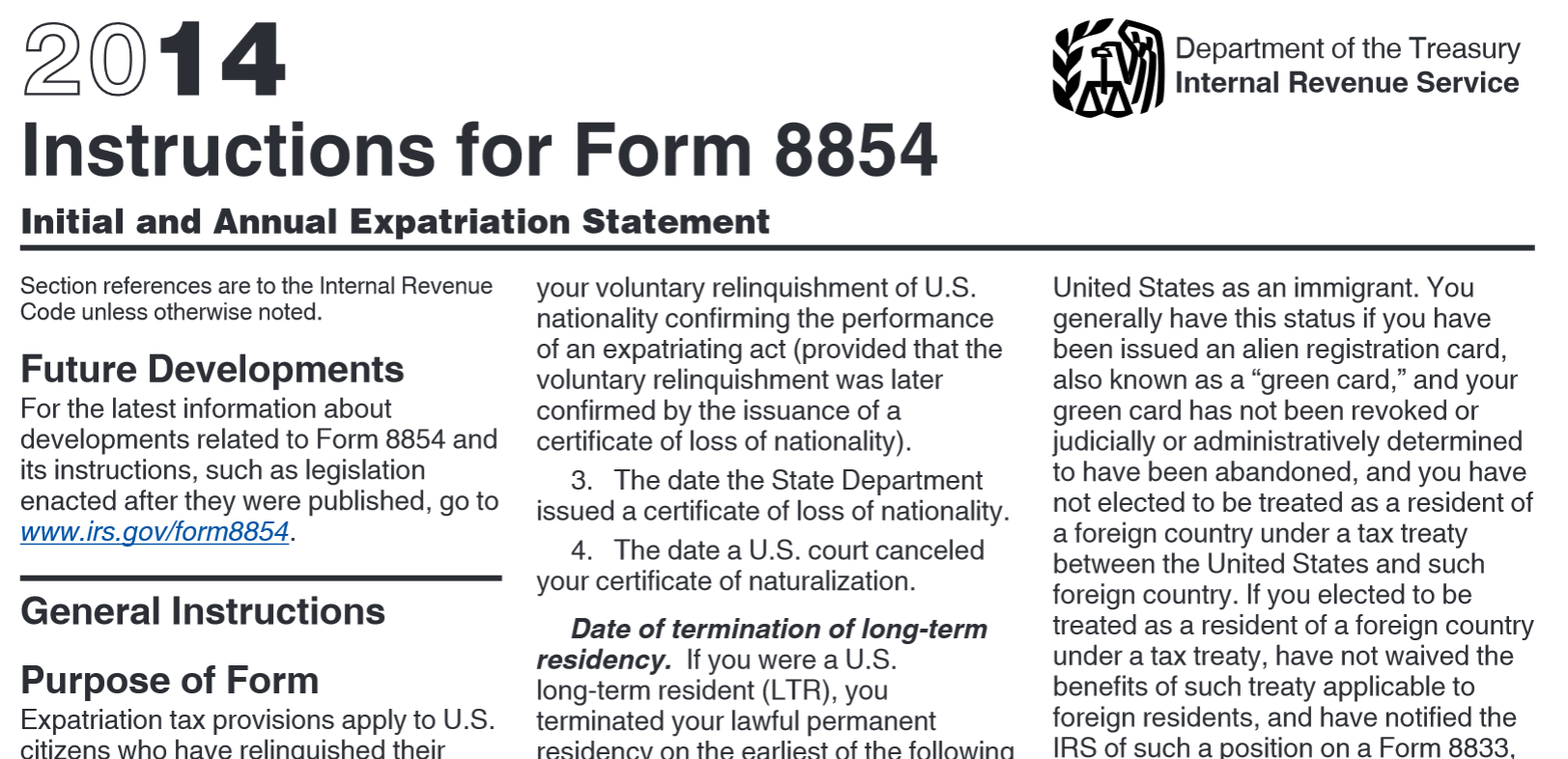
The importance of a complete and accurate IRS Form 8854, is to enable a taxpayer (if they meet other statutory requirements) to avoid “covered expatriate” status. See, the Tax Court case earlier this year 2016, Topsnik v. Commissioner (2016), where the Court found the taxpayer had failed to meet the certification requirements and was necessarily a “covered expatriate.”
Maybe most important of all, it is crucial the taxpayer understands the full range of legal and tax consequences to them regarding the important steps that might lead to “tax expatriation.” The law is complex and fraught with potential minefields. It’s always advisable to have thoughtfully analyzed and considered the consequences of “tax expatriation” long before taking specific steps (pre as opposed to post-expatriation) of renunciation of U.S. citizenship or abandonment of lawful permanent residency.
Part II: “Neither Confirm nor Deny the Existence of the TECs Database”: IRS Using the TECs Database to Track Taxpayers Movements – and Assets
Part II: This is a follow-up to the federal government’s database known as “TECS” (Treasury Enforcement Communication System)that is now operated by the Department of Homeland Security (“DHS”). The IRS uses it to track travel, trips, movement and even asset movements (e.g., wire transfers) by U.S. citizen taxpayers; including those residing outside the U.S.
This previous post described how the U.S. federal government uses the TECS to locate assets and travel patterns of U.S. citizens; specifically outside the U.S. The IRS trains their employees to (1) Not discuss TECS with taxpayers; (2) Neither confirm nor deny existence of TECS; (3) Keep in separate “Confidential” envelope; and (4) Stamp documents as “OFFICIAL USE ONLY”
The image in this post reflects a page from IRS training materials for their employees; e.g., revenue agents (those individuals who audit taxpayers and determine tax deficiencies and the like), revenue officers (those individuals who work on collecting taxes owed or alleged to be owed) and chief counsel attorneys (those individuals who litigate tax cases against taxpayers); among other IRS employees.
Frankly, there is not a lot of detailed law about how and when the IRS can use TECS or other tracking techniques of individuals and their assets. There are no tax cases (at least none that I am aware of) where the Courts have tried to impose limits on the use and methods of the federal government in collecting this type of TECS information. Indeed, there are specific provisions granting broad use of taxpayer information when the government alleges there is a “terrorist incident, threat, or activity” as that term is defined in IRC Section § 6103.
On the other hand, there are important laws about how the IRS cannot generally disclosetaxpayer information. For instance, see the same code section IRC Section § 6103 for wrongful disclosures of taxpayers’ information. That statute makes it a violation (even a criminal violation in certain willful circumstances) to disclose taxpayer information in “most” (or at least many) circumstances. The statute is comprehensive and there is a lot of case law interpreting various provisions. A good overview of the statute can be found in the Criminal Tax Manual for the Department of Justice, Tax Division – Chapter 42.00
A recent case (United States v. Garrity, 2016 U.S. Dist. LEXIS 66372 (D. Conn. 2016), discussed in Jack Townsend’s blog, was one where the IRS had disclosed the name of a deceased taxpayer Paul G. Garrity, Sr. regarding his foreign (non-U.S.) accounts. The disclosure included IRS investigation techniques that were disclosed as part of a FOIA request, which ultimately made it to the public. This was found to be disclosure of return information as defined by IRC Section § 6103. However, the Court there found that there was no violation of the statute by the IRS, as the taxpayer was deceased by the time the claim was brought by the estate. The government made a Title 31 FBAR penalty assessment of over US$1M including interest and penalties that is still pending.
It seems to me that the use of the TECS database by the IRS and Section 6103 are a bit like two heads of a coin. It all deals with taxpayer information and what rights, if any do taxpayers have to protect their personal and financial information – especially where it can (purposefully or inadvertently – e.g., through a data breach/hacking) be released to the public.
There are many unanswered questions as there has been little to no litigation regarding how and when the TECS database can and should be used.
Does the government have any limits on its use?
This ultimately becomes more of a policy discussion about how and to what extent can/should the federal government have and use and collect personal financial and travel information of individuals (particularly for tax purposes)?
How will the “Panama Papers” Affect U.S. Citizens and LPRs Abroad?
There has been a media frenzy around the world since the story broke of the so-called “Panama Papers.” It’s not clear, to date, what will become the underlying consequences for U.S. citizens (“USCs”) and lawful permanent residents (“LPRs”) residing around the world, outside the U.S. Indeed, there is now a Wikipedia website dedicated to identifying famous people linked to the “Panama Papers”. See, List of people named in the Panama Papers
So far, that Wikipedia list does not identify USCs or LPRs, as far as I can tell.
There is bound to be a major response by various countries about how is the best way to respond to their taxpayers from their countries who are not complying with their laws. The Panama Papers might become the U.S.’s version of the Swiss bank fiasco that largely started in 2009? Only time will tell.
For any USC or LPR, they simply need to be aware of the obligations of U.S. law regarding reporting and identifying assets located throughout the world, including their country of residence (e.g., their normal bank accounts), including any ownership in companies that may be formed in any particular jurisdiction outside the U.S., whether that be France, UK, Mexico, Colombia, Panama, South Africa, BVI, Hong Kong, Taiwan, Canada, Spain, etc.
For a primer for USCs and LPRs residing outside the U.S, the following blog posts identify various U.S. legal obligations reporting non-U.S. assets:







 Persons Living Outside the U.S. ***Does it still make sense?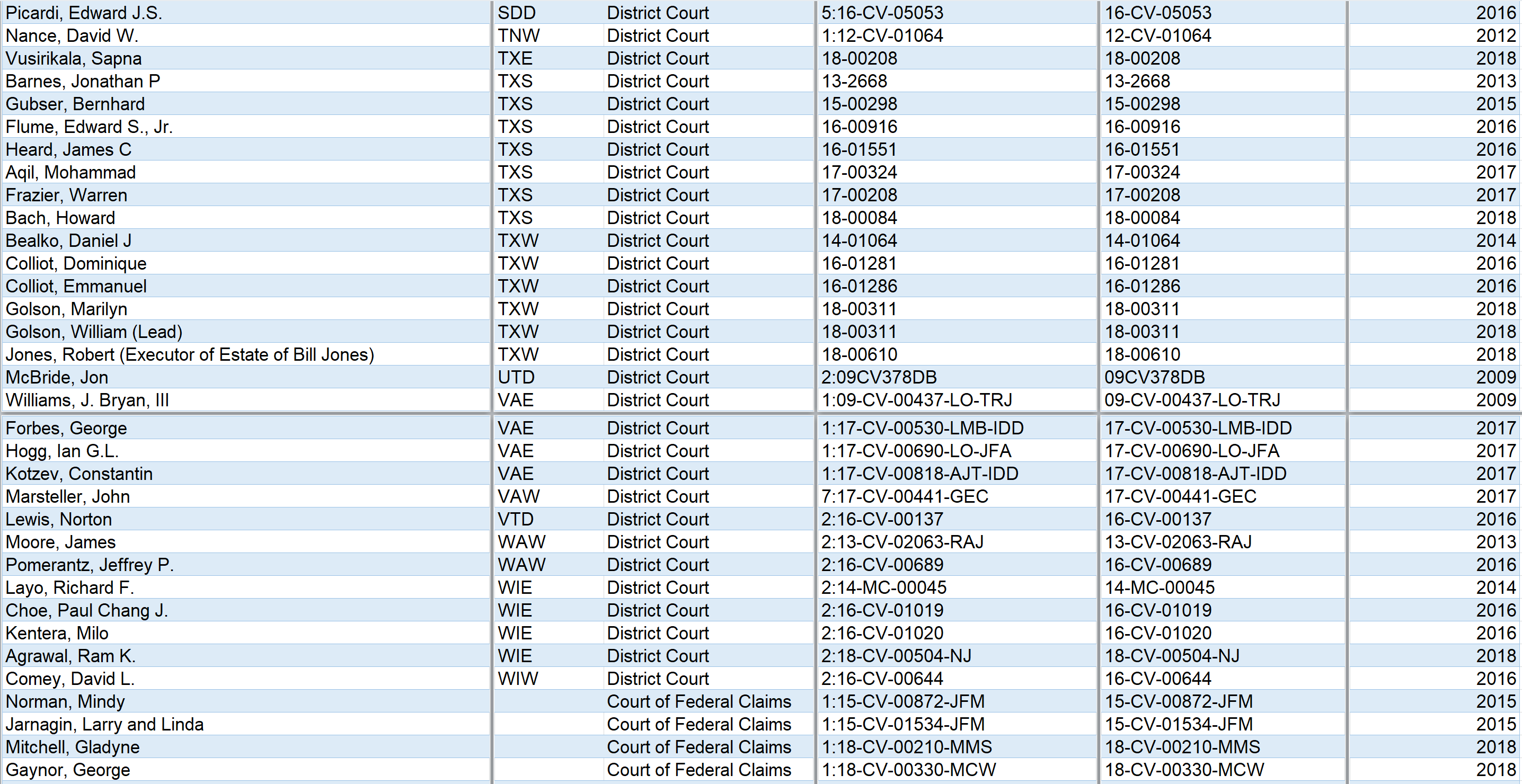


 h on September 28, 2018. Take the story of the Dewees into consideration before rushing into the OVDP.
 Section 6038 to file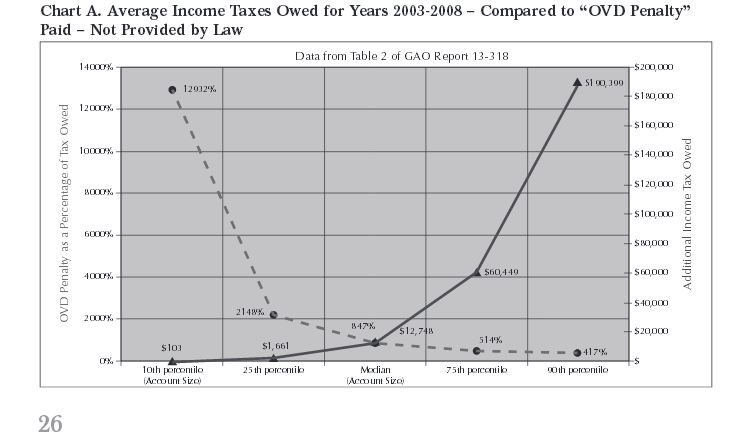

 Statement

 methods of the federal government in collecting this type of TECS information. Indeed, there are specific provisions granting broad use of taxpayer information when the government alleges there is a “terrorist incident, threat, or activity” as that term is defined in