Key Concepts of Senate Finance Chairman Hatch’s Proposal Re: “Non-Resident U.S. Citizens”
The complete report can be located at the Senate Finance Committee website at Comprehensive Tax Reform for 2015 and Beyond – Senate Republican Staff –
The crucial policy considerations are set out in the report. The key paragraph of the report is reproduced here:
The principle idea is to impose U.S. income taxation on U.S. sources only for U.S. citizens residing overseas. The report leaves many unanswered questions. One of those questions is how to integrate the “expatriation tax rules” into such a concept? There is one sentence addressing this point, which contemplates the “mark to market exit tax” will continue as part of the law, if such a proposal were to become law.
The report does not discuss how the U.S. transfer tax system (U.S. estate, gift and generation skipping transfer taxes) might be reformed. Current law, imposes worldwide U.S. estate, gift and generation skipping transfer taxes on the worldwide assets of a U.S. citizen.
Time will tell if such a proposal gets any political traction in Congress or at the White House.
WSJ (18 Feb. 2015): London Mayor Boris Johnson to Renounce U.S. Citizenship After Tussle With Uncle Sam
Ironically, the outspoken London Mayor has decided to renounce his U.S. citizenship, according to an article published by the Wall Street Journal.
See, WSJ: (18 Feb. 2015) – London Mayor Boris Johnson to Renounce U.S. Citizenship After Tussle With Uncle Sam
This article reported that his U.S. tax bill was at issue – :
In case you missed it: London Mayor Boris Johnson has said he will renounce his U.S. citizenship following a high-decibel tax squabble with his country of birth. At issue: a tax bill U.S. tax authorities claimed he owed on some London property. The mayor will (of course) keep his citizenship in the U.K. as his political ambitions continue to play out.
A previous post in November 2014 discussed a news report of the London Mayor and his U.S. citizenship and hence U.S. tax residency status. See, According to news press, London Mayor, dual citizen, refuses to pay United States income taxes
Surely, he will be careful and thoughtful about the steps he is taking as part of his U.S. citizenship renunciation. His reported response to the news reporter last year could prove risky under U.S. law, to the extent he intentionally refuses to file U.S. income tax returns and pay taxes. The following line of questions and answers could be quite damning for him:
Presenter Susan Page then pressed him whether he would pay the bill, to which he said: “I think it’s outrageous.
“Well, I’m – no is the answer. Why should I? I haven’t lived in the United States for, you know, well, since I was five years old.
“I could but I pay – I pay the lion’s share of my tax, I pay my taxes to the full in the United Kingdom where I live and work.”
Here, the London Mayor has indicated he is not filing tax returns, yet knows he has a legal duty to file them and pay a tax owing under U.S. law. He goes further to say “I could . . . pay . . .” While rarely used standing alone by prosecutors (without other criminal claims brought), it is a crime that carries up to a 12 month prison sentence, to not file a U.S. return, supply information or pay tax; see, IRC § 7203. The relevant language of the statute is as follows:
Any person required under this title to pay any estimated tax or tax, or required by this title or by regulations made under authority thereof to make a return, keep any records, or supply any information, who willfully fails to pay such estimated tax or tax, make such return, keep such records, or supply such information, at the time or times required by law or regulations, shall, in addition to other penalties provided by law, be guilty of a misdemeanor and, upon conviction thereof, shall be fined not more than $25,000 ($100,000 in the case of a corporation), or imprisoned not more than 1 year, or both, together with the costs of prosecution.
Here, the government has yet another stick it can pull from its bag of sticks to be used against current and former U.S. citizens residing outside the U.S. It is of course, very common, that individuals who have spent most of their lives outside the U.S. have not filed any U.S. tax returns nor paid any U.S. income taxes. At what point, might these individuals have U.S. civil tax liability and what facts are necessary to give rise to criminal tax liability?
The vast majority of U.S. citizens residing overseas owe little to no U.S. income taxes because (i) modest income amounts and the impact of the “foreign earned income exclusion” or (ii) they reside in a country with higher taxes and tax rates than the U.S. because of the “foreign tax credit”. See, USCs and LPRs Living Outside the U.S. – Key Tax and BSA Forms
A couple observations about London Mayor Boris Johnson. First, he would be well advised not to make public statements about filing [or not] U.S. tax returns or paying [or not] U.S. taxes. Second, he will want to carefully consider completing and filing accurate U.S. tax returns as part of his formal renunciation process; particularly for the year in which he sold his London home tax free under UK laws. Third, he will want to understand carefully, the details of what is and should be filed on IRS Form 8854, after he has visited the U.S. embassy and files his Form DS-4080, Oath of Renunciation of the Nationality of the United States.
Finally, the case could present a unique international political and public relations nightmare for the U.S. Department of Justice, if they decided to bring any sort of criminal tax charges against the London Mayor. It would seem highly unlikely in my opinion.
The government has a strict requirement that prohibits a United States Attorney (e.g., the high profile Preet Bharara, U.S. Attorney for the Southern District of N.Y. Attorney ) from unilaterally bringing tax charges against individuals. See, 6-4.200, Tax Division Jurisdiction and Procedures, which provides in relevant part:
“. . . The Assistant Attorney General, Tax Division . . . must approve any and all criminal charges that a United States Attorney intends to bring against a defendant in connection with conduct arising under the internal revenue laws, regardless of which criminal statute(s) the United States Attorney proposes to use in charging the defendant. See 28 C.F.R. § 0.70.
Also, only the Tax Division can authorize warrants of public officials, which presumably would extend to London Mayor Boris Johnson. See, See, 6-4.130, Search Warrants.
On a related post, see, How many former U.S. citizens and long-term lawful permanent residents have filed (or will file) IRS Form 8854? and Revisiting the consequences of becoming a “covered expatriate” for failing to comply with Section 877(a)(2)(C).
U.S. Tax and Expatriation Tax Laws – They Are What They Are . . .
The point of this post is a fairly simple one. The law is complex, it has evolved significantly over the years and continues to evolve; if for no other reason how the IRS enforces it. Some people might not like the law.
As those who have read and followed Tax-Expatriation.com know; it is not a place to seek legal advice. It provides lots of information – a comprehensive source of information. See, limitations. It also does not attempt to contemplate every scenario when a particular point is made; e.g., as the IRS modifies how they interpret rules or how they enforce them.
For instance, for a fairly comprehensive article about how the law works, see Accidental Americans” – Rush to Renounce U.S. Citizenship to Avoid the Ugly U.S. Tax Web” International Tax Journal,CCH Wolters Kluwer, Nov./Dec. 2012, Vol. 38 Issue 6. The net worth threshold (US$2M) and income tax thresholds (US$124,000, indexed for inflation) are spelled out in that article. It does not have the indexed inflation amounts. See, The “Average Annual Net Income Tax” Amounts for “Covered Expatriate Status” – Increases to US$160,000 for the Year 2015
Every individual who renounces their U.S. citizenship is taking, in what is my view, a very important decision. Many individuals do not like U.S. tax laws; nor the expatriation tax laws. Many individuals around the world do not like their home country tax laws; nor other laws.
This blog is not intended to be a policy blog debating whether the U.S. tax laws are good laws or bad laws. It’s designed to provide information about the law and important developments and relevant information.
Finally, the “blogosphere” is full of people who attempt to write about the law as if they understand it; particularly the complexity of Title 26, the regulations and a host of case law that spans almost 100 years. These opinions are a dime a dozen. Many get it terribly wrong – particularly in this politically charged topic – and will make statements and provide information that sounds attractive to the uninformed. The following is the type of decision that is made every day.
Path 1: If someone tells USC, Mr. X (or if he reads) the following, he might find it quite attractive: “You will have no U.S. tax liabilities if you simply do “steps Y and Z.” Plus, the U.S. federal government will never know and/or they will never be able to collect the taxes from you anyhow. Simple. Would you rather pay $0 or a bunch of money to the U.S. federal government?”
Path 2: On the other hand, if a qualified legal adviser accurately advises USC, Mr. X of the following, he may not find the answer so attractive: “Sorry, given your factual circumstances, you will have US$ 100,00X of immediate income tax liabilities if you simply do steps “Y and Z.” Plus, by doing so, if you ever bequeath or gift your U.S. citizen children, they will have to pay 40% (under current law) of the value of such inheritance or gift in U.S. taxes. This latter tax obligation will not be your obligation, but rather your U.S. citizen children.”
Not surprisingly, Mr. X may well want to take Path 1, because it is the answer he prefers. If Mr. X does steps “Y and Z”, he will now live with the U.S. legal consequences. He well might not like those legal consequences and think they are unfair, unjust or borderline immoral for any government to impose, but that is how laws often work.
U.S. Tax and Expatriation Tax Laws – They Are What They Are . . .
The President’s Proposal is NOT the Same as Current Law – Section 877A(g)(1)(B)
Some individuals are mistaken that the Obama proposal to exempt certain U.S. citizens from taxation (including the “mark to market” exit tax), is the same as the exception in IRC Section 877A(g)(1)(B).
It’s not. They are not the same, although they have some similar requirements (e.g., 5 years of certification of U.S. tax law compliance under penalty of perjury).
For a brief discussion on the President’s proposal, see –The Proposal by the President to Exempt Certain U.S. Citizens from Worldwide Taxation: – Very Small, Select Group
–

There are important differences. Most importantly, the I
RC Section 877A(g)(1)(B) exception requires the individual not only have been a dual citizen (of at least two or more countries) at birth, along with U.S. citizenship; but also continue to reside and be a tax resident of that country, i.e., the country of which they were also a citizen at the time of their birth. This tax residency/dual citizenship rule is necessarily required by I
RC Section 877A(g)(1)(B). If the person has moved to another country, they will not be eligible for this treatment and will be subject to the mark to market “exit tax” if they renounce their U.S. citizenship. Their U.S. heirs and beneficiaries will also be subject to the 40% (current tax rate) tax on “covered gifts” and “covered bequests.”
–
The President’s proposal (if it ever becomes law) will also apparently exempt all qualifying individuals from any type of U.S. taxation; other than tax that would apply to a “non-resident alien” (which would be no U.S. tax – if the individual had no U.S. source income). Not only would no “exit tax” apply, but so too would no U.S. income tax on their income from their country of residence or any other country outside the U.S. The President’s proposal would also exempt them from all U.S. tax filing requirements (other than the 5 years) and from FBAR filing requirements. See,
Nuances of FBAR – Foreign Bank Account Report Filings – for USCs and LPRs living outside the U.S.–
–
Obama Budget Proposal to “Provide Relief for Accidental Americans”? Will the Proposal to Modify the Expatriation Rules Become Law?
[See follow-on post: The Proposal by the President to Exempt Certain U.S. Citizens from Worldwide Taxation: – Very Small, Select Group– published 18 Feb. 2015]
Every year, the President of the United States, releases his proposed budget. The budget is prepared by his team of advisers at the Treasury Department and is known as the “green book“.
For a complete copy of the proposal, that was released on February 2, 2015, see, General Explanations of the Administration’s Fiscal Year 2016 Revenue Proposals (Released February 2015)
Buried deep into the proposal of the US$3.99 trillion fiscal year 2016 expenditure plan, is a provision to “provide relief for certain accidental dual citizens.” See pages 282 and 283 of the proposal.
It appears someone is listening in the Administration at Treasury; at least a little bit? Will Congress similarly be interested in such proposals? See, Will Congress Intervene to make USC based Tax Laws More User Friendly to USCs and LPRs Residing Outside the U.S.?
The proposal would not adopt residency based taxation for all U.S. citizens, as exists in the rest of the world, but would exclude certain U.S. citizens from the “mark to market” tax on expatriation (i.e., the “exit tax”). See, “Tax Simplification: The Need for Consistent Tax Treatment of All Individuals (Citizens, Lawful Permanent Residents and Non-Citizens Regardless of Immigration Status) Residing Overseas, Including the Repeal of U.S. Citizenship Based Taxation,” by Patrick W. Martin and Professor Reuven Avi-Yonah, 2013.
Those excluded from the exit tax and the tax to their U.S. heirs or beneficiaries who receive gifts or inheritances (See, The “Hidden Tax” of Expatriation – Section 2801 and its “Forever Taint.”) are those individuals who:
- became at birth a citizen of the United States and a citizen of another country,
- at all times, up to and including the individual’s expatriation date, has been a citizen of a country other than the United States,
- has not been a resident of the United States (as defined in section 7701(b)) since attaining age 18½,
- has never held a U.S. passport or has held a U.S. passport for the sole purpose of departing from the United States in compliance with 22 CFR §53.1,
- relinquishes his or her U.S. citizenship within two years after the later of January 1, 2016, or the date on which the individual learns that he or she is a U.S. citizen, and
- certifies under penalty of perjury his or her compliance with all U.S. Federal tax obligations that would have applied during the five years preceding the year of expatriation if the individual had been a nonresident alien during that period.
This would be a significant change from current law. However, the no passport requirement will narrow significantly the number of individuals who may be eligible for this relief; if it becomes law?
Most interesting about the proposal, is that it seems to say these U.S. citizen individuals (who meet all 6 criteria) will not be subject to any U.S. tax as a U.S. citizen. In other words, it seems to say they will be taxed the same as a non-resident alien, which in effect is residency based income taxation for this narrow class of U.S. citizens. The word tax is used generically, to presumably also exclude them from U.S. estate, gift and generation skipping transfer taxes.
The proposal has a window of opportunity that starts to close with time and then shuts in January 1, 2018; i.e., the 2 year period after January 1, 2016. This will mean that those future “Accidental Dual Citizens/Americans” who later learn of their U.S. citizenship, will only have 2 years from the moment they became aware of their U.S. citizenship status. One thing is to know you are a U.S. citizen as you live wherever you may around the world; another is to know and understand the U.S. taxes that are imposed upon you on your worldwide assets.
The Importance of Planning – PRIOR to Renouncing, Relinquishing or Abandoning
International tax law experts who specialize in a particular area of the law, have a fairly good understanding of the importance of tax planning. The reason is simple. The law is complex and without planning,  laypeople can often cause very adverse tax consequences to themselves and their friends and family members (in the case of tax expatriation) without understanding the full implications of the law.
“Tax expatriation” in the U.S. is particular complex for several reasons:
1. The general rule is that there is an immediate income tax payable from the “mark to market” taxation rules on unrealized gains. See, Part I: Common Myths about the U.S. Tax and Legal Consequences Surrounding “Expatriation”
2. If a tax is recognized under the U.S. tax law, the only way to discharge the liability with the U.S. federal government is to pay the tax owing. The IRS generally can collect an income tax owing against a taxpayer who lives outside the U.S. indefinitely, as the 10 year collection statute does not apply when the individual outside the United States for a continuous period of at least six months. See, IRC Section 6503(c). More on this topic in another post. In other words, the IRS can “forever” pursue the collection of the “expatriation tax” against USCs and LPRs living outside the U.S.
3. It is easy to fall into the general rule of expatriation, even if the taxpayer would not otherwise be subject to income taxation. See, Why “covered expat” (“covered expatriate”) status matters, even if you have no assets! The “Forever Taint”!
4. The friends and family of the “covered expatriate” – i.e., the former U.S. citizen and long-term lawful permanent resident can be subject to U.S. taxation during their lifetimes, even if they also live outside the U.S. See also, some of the consequences of being a “covered expatriate” – The “Hidden Tax” of Expatriation – Section 2801 and its “Forever Taint.”
Each of these points help demonstrate the need for planning prior to running to the U.S. Department of State and completing and filing the following forms when you take the oath of renunciation:
Form DS-4081, Statement of Understanding Concerning the Consequences and Ramifications of Relinquishment or Renunciation of U.S. Citizenship.
See, Documents to Request the Consular Officer When Renouncing U.S. Citizenship
At the end of the day, if the individual lives outside the U.S. and does not travel to and from the U.S., it may be practically very difficult for the IRS to collect on the tax judgment owing if the individual has no assets in the U.S. There are legal means and steps the IRS can take in an attempt to try to collect U.S. taxes on overseas assets.
For a further discussion on collection of taxes overseas:
See, U.S. Enforcement/Collection of Taxes Overseas against USCs and LPRs – Legal Limitations, and
Part II: U.S. Enforcement/Collection of Taxes Overseas against USCs and LPRs – Pasquantino – Wire Fraud and Mail Fraud
Ideally, a former U.S. citizen or long-term lawful permanent resident will wish to avoid all of the potential tax and collection issues, by engaging in thoughtful and strategic planning prior to their renunciation of U.S. citizenship or abandonment of lawful permanent residency.
Read the Q&A format here.
Proposal to U.S. Treasury and IRS: awaits Final Regulations on “Covered Gifts” and “Covered Bequests”
When people write about the taxes from expatriation, the focus seems to be on the income tax provisions. Maybe that is normal, since an income tax can be immediately triggered with reference to the “expatriation date” as defined in the law.
However, the most costly tax will often be the tax on “Covered Gifts” and “Covered Bequests” which went into effect in 2008, but is awaiting Treasury regulations for publication.
Proposed regulations are in the works and presumably were going to be released before the end of the year. In May of this year, I presented a set of formal recommendations to the U.S. Treasury and IRS on this topic in a paper entitled:
***
COVERED GIFTS & BEQUESTS: THE NEED FOR GUIDANCE (5+ YEARS OUT)
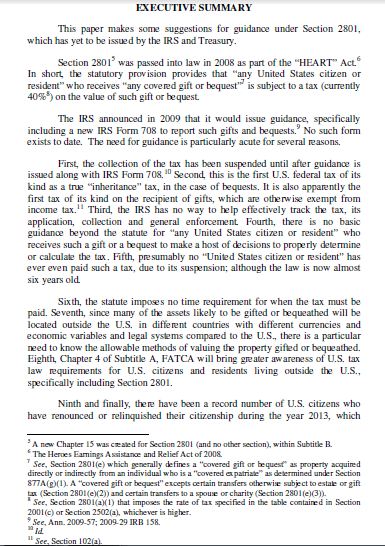
This proposal can be read in its entirety here, and the executive summary is set out below: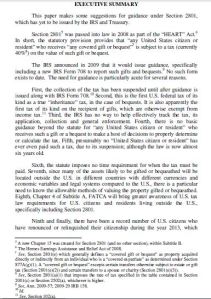
The reason these regulations are so important, is due to the tax cost of taxes upon U.S. beneficiaries. See, The “Hidden Tax” of Expatriation – Section 2801 and its “Forever Taint.”
The tax is currently levied at a 40% rate on basically the full vale of the asset upon the gift or bequest. It also continues on for potentially generations into the future; e.g., if U.S. beneficiaries receive property held in trust that was funded by a “covered expatriate.” For instance, to demonstrate the consequences, we can assume a former U.S. citizen who is a “covered expatriate” (e.g., for failure to properly certify under Section 877(a)(2)(C) and file IRS Form 8854, even though the income tax or asset tests are not satisfied) funds a trust in a foreign country for her grandchildren and great grandchildren. See, How many former U.S. citizens and long-term lawful permanent residents have filed (or will file) IRS Form 8854?
Over time, the value of those trust assets grow substantially and 30 years after her death (e.g., the year 2055), the trust starts distributing US$100,000 annually to several U.S. citizen grandchildren and grandchildren. Under the current law, each time the distribution is received, a 40% tax should be levied on each distribution. The law leaves many unanswered questions, until the proposed regulations are issued.
Part II: Common Myths about the U.S. Tax and Legal Consequences Surrounding “Expatriation”
· More Myths – about Renouncing U.S. Citizenship
There are many misunderstandings of how the law works when someone renounces U.S. citizenship. See, Part I: Common Myths about the U.S. Tax and Legal Consequences Surrounding “Expatriation”
The author regularly hears a range of myths that will befall an “Accidental American” when and if, they renounce. These “myths” include the following:
- Myth 5: There is no requirement to file U.S. income tax returns if the individual has few assets, little income or has otherwise lived outside the U.S. for almost all of their lives.
- Myth 6: There is somehow some “magical difference” under the law, for those who “renounce” citizenship (currently) versus those who “relinquished” citizenship (some time in the past) and the U.S. Department of State should recognize this “magical difference”. Such a difference will create a different U.S. tax result.
- Fact: The tax law nor immigration law makes such a distinction, even though this seems to be a common myth frequently spread throughout the Internet.
- Myth 7 : Former U.S. citizens who are “covered expatriates” can gift assets to their U.S. citizen children and friends without U.S. tax costs to them.
- Fact: This is true, i.e., there is no restriction or tax that is levied against the former U.S. citizen who makes the gift. The problem is for the recipient U.S. citizen or other “U.S. person” children or friends who will become subject to tax upon such gifts at the highest estate and gift ta rate (currently 40%).
- Myth 8: Former U.S. citizens should not worry about the IRS and its ability to collect taxes owing for the “mark-to-market” gains tax on expatriation (or on covered gifts and covered bequests) against assets located outside the U.S.?
These are just some of the myths commonly floated. There are yet more myths which will be discussed in a later post.
The Number of Citizens Leaving (Renouncing) Versus Coming (Naturalizing) is Just a Speck
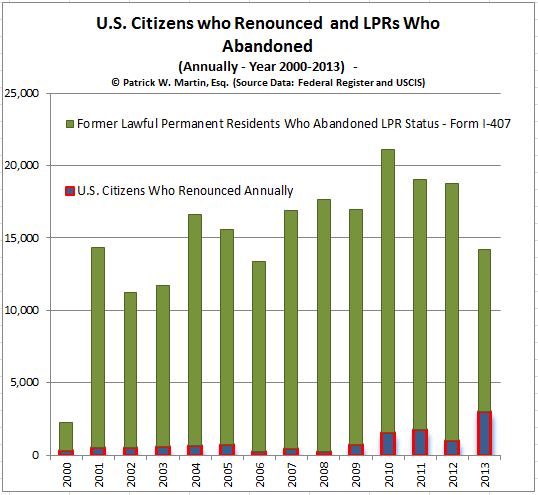
Much has been made about the number of citizens who have been renouncing their U.S. citizenship over the last few years. In historical terms, it is a relative explosion. See, earlier post – The 2014 Third Quarter Renunciations Is probably the New Norm –
However, compared to the 
 number of lawful permanent residents (LPR) who are leaving the U.S., the number is relatively small. See, earlier post The Number of LPRs “Leaving” the U.S. is 16X Greater than the Number of U.S. Citizens Renouncing Citizenship
On a related post, the question was raised –What are the Number of LPRs who Leave U.S. Annually without filing Form I-407 – Abandonment?
However, the number of individuals who wish to come to the U.S. to become citizens is far in excess of the number who are renouncing their citizenship.  According to the USCIS, there are about 700,000 individuals annually who become naturalized citizens. In the year 2008, there were more than 1 million naturalized citizens. See table:
Compare these numbers to just about 3,000 annually of individual who are renouncing their citizenship.
Of course, everyone has their own story and reasons for either coming or going, but in relative terms, those who find it desirous to renounce citizenship (at least in absolute numbers and relative terms) represent a small speck (less than 1/2 of 1 percent), compared to those who are becoming naturalized citizens.
Finally, for anyone who wishes to become a naturalized citizen, they must be aware they cannot “reverse” the decision without having potentially adverse U.S. tax consequences. See, Why a Naturalized Citizen cannot avoid “Covered Expatriate” status under IRC Section 877A(g)(1)(B)
The “Average Annual Net Income Tax” Amounts for “Covered Expatriate Status” – Increases to US$160,000 for the Year 2015
A previous post explained how the “gain exclusion” amount from the mark to market tax will increase to US$690,000 for the year 2015. See, The “Phantom” Gain Exclusion from the “Mark to Market” Tax – Increases to US$690,000 for the Year 2015.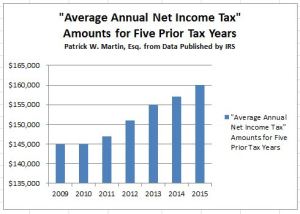
Today’s post explains that the “average annual net income tax” amount that causes someone to become a “covered expatriate” as set forth in 877 has been indexed for inflation to US$160,000 for the year 2015. See, IRS Revenue Procedure 2014-16, published this month that references those relatively few code sections which are indexed for inflation.
One of the tests for becoming a “covered expatriate” is the “income tax test” explained with the relevant language of the statute as follows:
(A) the average annual net income tax (as defined in section 38(c)(1)) of such individual for the period of 5 taxable years ending before the date of the loss of United States citizenship is greater than $124,000,
This statutory rule is indexed for inflation and the current amount for 2015 will be US$160,000.