The Number of LPRs Declined in the Corona-virus Pandemic
Not surprisingly, the number of new LPRs into the U.S. dropped substantially in correlation with the Corona-virus pandemic. See, the Office of Immigration Statistics, 28 Sept. 2021: Fiscal Year 2021 U.S. Lawful Permanent Residents Annual Flow Report. The Figure 1 (highlighted by me) and that report notes:
Just over 700 thousand persons became LPRs in 2020, as reduced international travel during the COVID-19 pandemic and policy changes brought new LPR admissions in 2020 to their lowest
level since 2003. The majority of these LPRs (62 percent) were already present in the United States when they were granted lawful permanent residence. A little under two-thirds (63 percent) were granted LPR status based on a family relationship with a U.S. citizen or current LPR. The leading countries of birth of new LPRs were Mexico, India, and People’s Republic of China (China). In 2020, there was a 31 percent reduction in U.S. grants of LPR status compared to 2019.
Largely due to the COVID-19 pandemic, LPR flows in 2020 were not representative of typical trends (Figure 1). Travel restrictions and processing slowdowns generally resulted in fewer inflows, while foreign-born residents within the United States also confronted immigration status-specific COVID-19 vulnerabilities.5
The key tax question for LPRs who no longer live in the U.S. (or who are planning to leave the U.S. to live in another country) is: Are they (or will they become) a so-called “long-term resident” as defined in the federal “expatriation” tax law?
IRC Section 877(e)(1) and (2) define a “long-term resident” and these paragraphs are included below in their entirety:
(1) In general
Any long-term resident of the United States who ceases to be a lawful permanent resident of the United States (within the meaning of section 7701(b)(6)) shall be treated for purposes of this section and sections 2107, 2501, and 6039G in the same manner as if such resident were a citizen of the United States who lost United States citizenship on the date of such cessation or commencement.
(2) Long-term resident
For purposes of this subsection, the term “long-term resident” means any individual (other than a citizen of the United States) who is a lawful permanent resident of the United States in at least 8 taxable years during the period of 15 taxable years ending with the taxable year during which the event described in paragraph (1) occurs. For purposes of the preceding sentence, an individual shall not be treated as a lawful permanent resident for any taxable year if such individual is treated as a resident of a foreign country for the taxable year under the provisions of a tax treaty between the United States and the foreign country and does not waive the benefits of such treaty applicable to residents of the foreign country.
The Next Post on this topic will break down the elements of –
(1) who will necessarily be a “long-term resident”?
(2) who may be “long-term resident”?
(3) what steps can be taken to necessarily avoid “long-term resident” status?
Finally, a discussion will be had in the last post in this series of some of the potential adverse tax consequences to “long-term residents” depending upon different factual scenarios.
Russian Citizen who Expatriated from U.S. – Pleads Guilty to Tax Fraud – US$500M Penalty
I previously wrote about how this blog (with few posts on my part over the last couple of years) is not unlike Kipling’s observation –
” . . .Oh, East is East, and West is West, and never the twain shall meet. . . ”
. . . in that it addresses principally civil federal tax law [the East] but sometimes (not never 🙂 ) crosses over from civil to criminal [the West]. In that May 2020 post, I covered the indictment in the Northern District of California of a Russian citizen who had become a naturalized U.S. citizen (“NUSC”). As a NUSC he necessarily was a “covered expatriate” upon renunciation as has been explained here in other posts. See, When does “Covered Expatriate” Status -NOT- matter?
Mr. Oleg Tinkov was indicted in May 2020 under 26 U.S.C. § 7206(1) – for Making and Subscribing A False Tax Return, Statement, and Document (Two Counts). The Indictment was originally filed under seal and the docket can be reviewed here. His sentencing is set for October 29, 2021.
As explained therein, he renounced his U.S. citizenship many years prior to the indictment – nearly 7 years before he was even criminally indicted:
11. On or about October 28, 2013, TINKOV expatriated from the United States by renouncing his U.S. citizenship before a diplomatic and consular officer of the United States.
As a very wealthy individual, the value and accuracy of his assets reflected on his Form 8854 would have been significant factually in this case. Particularly, since as a NUSC he would necessarily have been a “covered expatriate” and hence subject to the “mark-to-market” tax on his worldwide income upon his expatriation. The amount of the tax is calculated upon the amount and fair market value of the assets on the ” . . . day before the expatriation date. . . ” 26 U.S. Code § 877A(a)(1).
* Filing False Expatriation Tax Form – IRS Form 8854
Filing a false IRS Form 8854 and therefore necessarily a false tax return, becomes problematic quickly for any individual who carelessly discloses inaccurate asset information (or no asset information at all). See, the 2016 indictment of a NY business professor discussed previously here: Expatriation Tax Form 8854 is Part of Criminal Tax Case
Importantly, this is true even when a naturalized citizen decides to go back to her home country and leave the U.S. – including on a permanent basis; even when the taxpayer’s assets are located outside the U.S. This was the case with Mr. Tinkov per the indictment and the DOJ press release. See the harsh words in the DOJ press release of the guilty plea yesterday, October 1, 2021 – Founder of Russian Bank Pleads Guilty to Tax Fraud
“Tinkov renounced his U.S. Citizenship shortly after receiving millions of dollars,” said Acting Special Agent in Charge Darrell J. Waldon of the IRS-CI Washington D.C. Field Office. “Despite his knowledge of U.S. tax reporting requirements, he substantially understated his wealth on filings with the IRS. International tax cheats remain a priority for my office and our agency; and as such, the International Tax and Financial Crimes D.C.-based group will continue to aggressively pursue those committing international tax crimes.”
If you are a tax professional assisting in the preparation of tax returns and IRS Form 8854 Initial and Annual Expatriation Statement what duty to inquire do you have as to the accuracy and information provided to you by your client? What duty do tax professionals have to reasonably inquire as to “knowledge of client’s omission” – “information to be furnished” and “diligence as to accuracy”? Must the tax professional make reasonable inquiries if any information furnished to you appears to be incorrect, incomplete or inconsistent with other facts or assumptions of the taxpayer or her circumstances? Treasury Circular No. 230 §10.20, §10.21, §10.22, §10.34(d).
Can and will the U.S. federal government deny the ability of Mr. Tinkov to ever return to the United States pursuant to Title 8, U.S.C. Section 1101(a)(43) for being convicted of an aggravated felony? This is probably all moot considering it has been reported that Mr. Tinkoff was diagnosed with leukemia in March 2020 and has changed his life focus. Arrested Billionaire Banker Tinkov Switches Focus to Cancer Foundation
IRS Chief Counsel Concedes Tax Treaty Residency Position for LPR German Taxpayer in Tax Court
Those who have their “lawful permanent resident” status and live largely outside the U.S. (or plan on moving to do so in the future) should be keenly aware of the definition of a “long-term” resident. See, IRC Section 877 (e)(2).
Importantly, the U.S. Tax Court just entered a Decision for a case involving a German citizen who had been a lawful permanent resident for many years (U.S. Tax Court Docket 18451-19). In that case the IRS revenue agent took the position the German citizen was a “United States person” and therefore subject to U.S. taxation on his worldwide income and subject to “international information reporting requirements.”
As is increasingly common in IRS tax audits of international individual matters, information penalties become a cudgel to impose greater
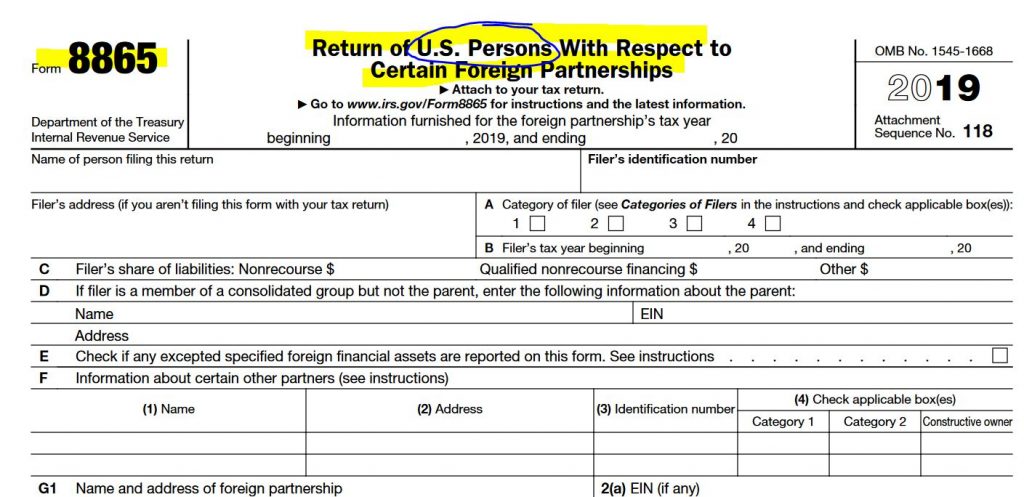
economic pressure (when the income tax determinations are relatively modest) to pursue cross border cases. In the recent U.S. Tax Court case (U.S. Tax Court Docket 18451-19), the IRS had assessed substantial penalties for more than 10 tax years for failure to file IRS Form 8865.
What was striking about the German citizen case who had been a lawful permanent resident for many years (U.S. Tax Court Docket 18451-19) is that the IRS conceded the case as part of a “qualified offer” procedure (Section 7430) where the taxpayer offered what was less than 1% of the total tax, penalty and statutory interest amounts determined by the IRS. Plus, there was both a statutory notice of deficiency (90/150 day letter) on income tax and negligence penalties plus a separate direct assessment of information penalties under IRC Section 6038(b) for not filing IRS Form 8865.
The importance of an international information penalty assessment, is that the U.S. Tax Court will often times not have jurisdiction to address the issue; at least not on first blush. See, Flume v. Commissioner, T.C. Memo 2017-21, Judge Goeke addressing 5471 penalties and IRC Sections 6330(c)(2)(B) and 6330(c)(4)(A). For an excellent discussion on these issues, see two outstanding tax authors –
The federal tax law has a very transparent system of reporting and identifying former U.S. citizens who have renounced their citizenship. The data with the names of each individual are published quarterly on the federal government’s website as Required by Section 6039G. The complete set of lists including thousands of names of former U.S. citizens going back to the mid-1990s can be reviewed here. Quarterly Publications. Quarterly Publication of Individuals, Who Have Chosen to Expatriate.
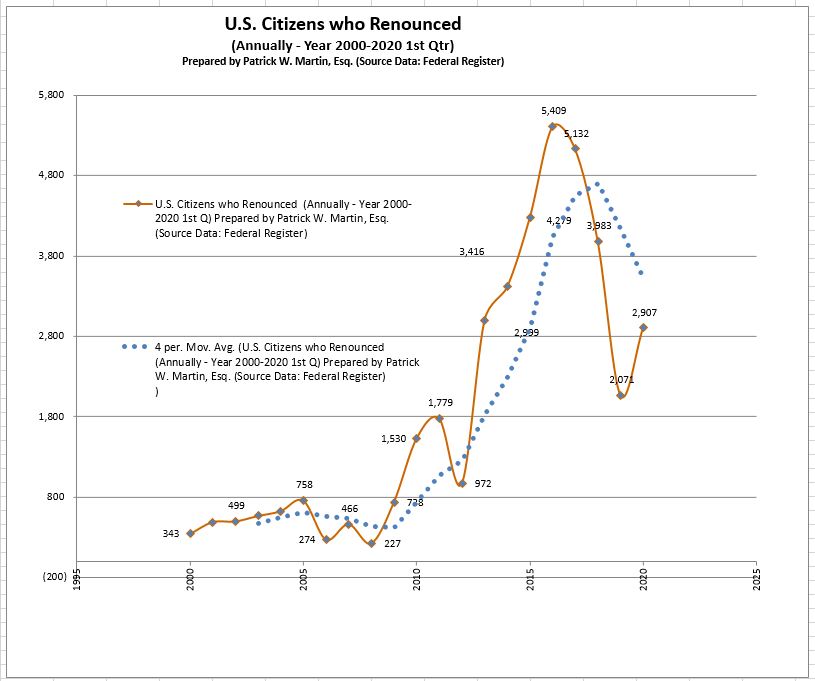
See previous posts regarding the numbers of USCs who were renouncing at an increasingly rapid pace starting at just around and just before the year 2010. The FATCA transparency laws were passed in 2010 and so too were more international information reporting requirements (IRC 6038D) and strong enforcement efforts overseas by the IRS and DOJ Tax Division; which could be part of a cause and effect consequence? See, CHAPTER 4—TAXES TO ENFORCE REPORTING ON CERTAIN FOREIGN ACCOUNTS (§§ 1471 – 1474)
Posted on : The current renunciations and now steep decline starting in 2018 may be temporary or part of a trend?
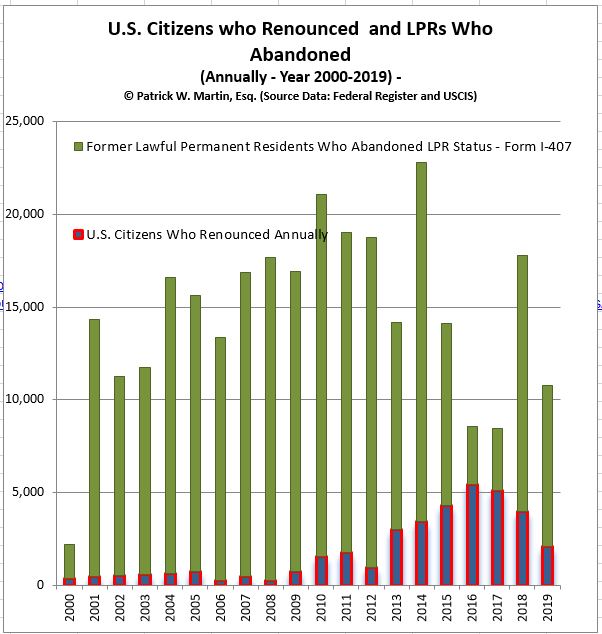
Subsequent posts will discuss the new trend of how relatively fewer lawful permanent residents (“LPRs”) are formally abandoning their status compared to USCs who formally renounce. This is true even though the number of USCs renouncing is in decline.
Old News – Important News: U.S. Tax Court Rules IRS Rev. Rul. 91-32 is NOT the Law
The U.S. Tax Court ruled that the IRS’ interpretation of when sales of partnership interests by non-U.S. persons (in this case, it was a foreign corporate partner with an interest in a U.S. limited liability company) is subject to U.S. income taxation is wrong. See,Grecian Magnesite Mining vs. Comm’r (149 T.C. No. 3 – 2017).
The Court ruled that the gain from the partnership (which was not attributed to real estate – which itself was taxable under FIRPTA/Section 897) was capital gain and not U.S. source income. The Court said it would not follow the IRS’ interpretation in Rev. Ruling 91-32.
The significance for tax expatriation considerations is that IRS Revenue Rulings and other “administrative guidance” or IRS opinions of the law (such as private letter rulings, notices, technical advice memorandum, etc.) do not carry the weight of law. Let alone IRS instructions to forms. There are a number of IRS opinions of the law regarding “expatriation tax” matters – e.g., IRS Notice 97–34 for those former citizens or LPRs who may be “covered expatriates.”
This conclusion of the Tax Court was (until Congress changed the law overriding the case law) particularly important for non-resident aliens (who were previously U.S. citizens or lawful permanent residents); as the IRS in the past has relied upon Rev. Rul. 91-32 to impose taxation on non-residents who sell their U.S. partnership interests. See, for instance, the IRS Technical Memorandum where it states the law that ” . . . capital gains are not taxable under § 871(a)(2), unless an alien is present in the United States 183 days or more. . . ” yet still concluded the gain was “effectively connected income” (“ECI”) subject to U.S. taxation. Memorandum – Internal Revenue Service
A second blow for the government came when the U.S. Court of Appeals for the D.C. Circuit confirmed the U.S. Tax Court and ruled in favor of the taxpayer.
The government appealed the U.S. Tax Court opinion to the D.C. Circuit, which also ruled in favor of the taxpayer. See full 2019 opinion – here – The DOJ, tax division attorneys of course argued for the government and Michael J. Miller based in Manhattan, an exceptional international tax lawyer, litigated the case in the U.S. Tax Court also argued on appeal for the non-U.S. taxpayer.
While a win for the taxpayer, Congress repealed the result by amending IRC Section 864(c) as part of the major tax reform of 2017 (so-called Tax Cuts and Jobs Act of 2017). Now, such gain from the sale of a partnership interest is treated as “effectively connected” with a US trade or business (“ECI”) to the extent the seller of the partnership interest would have had ECI gain had the partnership itself sold all of its assets. The gain is measured by the fair market value as of the date of sale. Also a new 10% withholding tax was imposed with the same legislation under IRC Section 1446(f). It requires the buyer of a partnership interest to withhold a 10% tax on the “amount realized.”
“LPR Tax Limbo” – Formal Abandonment of LPR (Form I-407) – BIG GAP with Actual Emigration of LPRs
Millions of lawful permanent residents (LPRs) who have left the U.S. and not “formally abandoned” their LPR status (by filing Form I-407, Record of Abandonment of Lawful Permanent Resident) typically remain in some kind of “LPR U.S. tax limbo.” How many individuals worldwide are in this LPR U.S. tax limbo?
Why are these numbers important for the tax-expatriation analysis? See, a recent post, Why Most LPRs Residing Overseas Haven’t a Clue about the Labyrinth of U.S. Taxation and Bank and Financial Reporting of Worldwide Income and Assets (Part I). Indeed, most individuals probably do not think they are a U.S. federal income tax resident when they leave the U.S. to reside overseas back to their home country. Why would they? There is no tax training manual provided to LPRs who leave the U.S. and no tax advisories – reflected on the card itself (unlike the last page of the U.S. passport, paragraph D). More precisely, most are probably not giving much, if any thought, to the complex U.S. federal tax residency rules and their extraterritorial application.
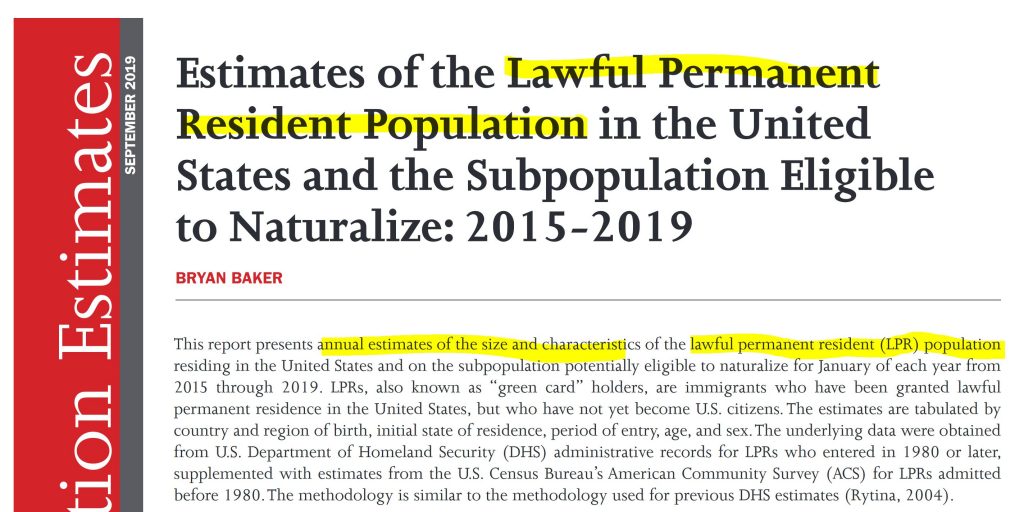
The “big gap” referred to above can be identified from the the Office of Immigration Statistics (OIS) report titled: Estimates of the Lawful Permanent Resident Population in the United States and the Subpopulation Eligible to Naturalize: 2015-2019. According to the report, more than 1 million individuals become LPRs each year. Between naturalization, mortality and emigration the report shows that the LPR population, year over year, has remained stable. In 2019 the total number of LPRs per this report was 13.6 million, up from just 13.0 million in 2015.
The “gap” is the difference between the numbers of LPRs who have left-emigrated the U.S. (some 3+ million) compared to something like an annual average of 15-19 thousand who have filed Form I-407. The gap is in the millions of persons who are in LPR U.S. tax limbo.
Mexico
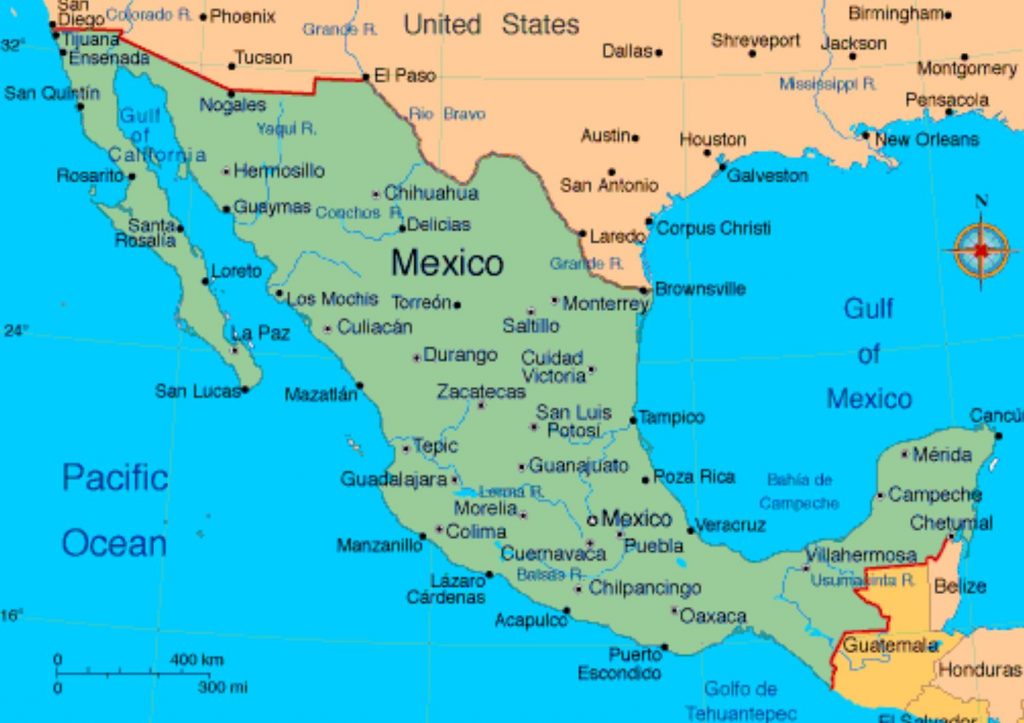
The report is also worth reading if you want to understand the demographics of the LPR population. Mexico has about 2.5 million (which is by far the greatest number) of the total 13+ million LPR population.
As the report points out there is no reliable direct measurements of LPR emigration. They do not exist. This lack of information is what drove me to file a FOIA request with the government to request information about the number USCIS Forms I-407 that are filed with the government. See, also quarterly statistics of the USCIS – Form I-407, Record of Abandonment of Lawful Permanent Resident Status (partial information for years 2016-2019).
The information I obtained in the FOIA response was surprising, since the government had records showing only 46,364 Forms I-407 were filed in the years 2013 through 2015, as follows:
SOURCE: Federal Government Response to FOIA Request: Office of Performance and Quality (OPQ), Performance Analysis and External Reporting (PAER), JJ
This represents an average of only 15,455 individuals who formally abandoned their LPR status. Contrasted with more than 3.6 million estimated to have emigrated in 2019 per the DHS report leaves a massive gap of well over 3 million persons who held a “green card” and have left. They are now in LPR U.S. tax limbo.
What about the tax consequences? How many of these LPRs who left the U.S. know, understand or have any idea whatsoever of the federal tax filing obligations regarding their status?
What is the takeaway from the DHS report and LPR – I-407 information provided to me by the FOIA response? There is a discrepancy in the millions of people. Millions of individuals who actually leave or have left the U.S. to reside somewhere else around the world; compared to only some tens of thousands of individuals who have formally filed Form I-407, Record of Abandonment of Lawful Permanent Resident.
What can these individuals do to get out of the LPR U.S. tax limbo?
The next few posts will explain the significance of key immigration law concepts for LPRs (e.g., filing Form I-407, Record of Abandonment of Lawful Permanent Resident to formally abandon LPR status). They discuss formal administrative or judicial abandonment of LPR status and the specific relationship to U.S. tax law requirements.
MILLIONS HAVE LEFT – YET FEW HAVE FORMALLY ABANDONED – NO FORM I-407: Apparently a few million LPR individuals have emigrated from the U.S. with their green card in their pocket/purse and most are probably still deemed “United States persons” for federal income tax purposes. This conclusion comes from comparing (i) federal government data indicating the number of LPRs who have emigrated (3.6 million LPRs through 2019) contrasted with (ii) those who have filed Form I-407. The next few posts explore the important tax/legal distinctions of LPRs who formally abandon and those who simply leave the U.S. ignorantly blissful of the complex U.S. tax laws.
A LPR is a so-called “resident alien” by application of the U.S. federal tax law if she or he satisfies the statutory requirements of IRC Section 7701(b)(6), without application of an applicable income tax treaty. Tax treaties can change everything. A “resident alien” includes those who have LPR status who have not formally abandonment that status. See, the Treasury regulations that provide for the so-called “green card test” –
(1) Green card test. An alien is a resident alien with respect to a calendar year if the individual is a lawful permanent resident at any time during the calendar year. A lawful permanent resident is an individual who has been lawfully granted the privilege of residing permanently in the United States as an immigrant in accordance with the immigration laws. Resident status is deemed to continue unless it is rescinded or administratively or judicially determined to have been abandoned.
The number of LPRs emigrating exceed 3 million starting in 2015. These numbers bear no correlation to the formal abandonment numbers registered with the government, which require filing Form I-407, Record of Abandonment of Lawful Permanent Resident.
Emigration. Estimating emigration accurately is difficult.The U.S. government has not collected official statistics since 1957. Most observers agree that emigration of the LPR population from the U.S. is substantial. Between 1900-90, an estimated one-quarter to one-third of LPRs emigrated from the U.S. (see Warren and Kraly, 1985; Ahmed and Robinson, 1994; Mulder, et al., 2002).
DHS: Estimates of the Legal Permanent Resident Population and Population Eligible to Naturalize in 2002 (May 2014)
This apparent lack of information is what drove me to file a Freedom of Information Act (FOIA) request with the government to ask for the number of USCIS Forms I-407 that are filed with the government.
The information I obtained in the FOIA response was surprisingly low, since the government had record of only 46,364 Forms I-407 filed in the years 2013 through 2015, as follows:
SOURCE: Federal Government Response to FOIA Request: Office of Performance and Quality (OPQ), Performance Analysis and External Reporting (PAER), JJ
This represents an average of 15,455 individuals annually who formally abandoned their LPR status. Contrast this relatively small number with the more than 3.6 million LPRs estimated to have emigrated up to and through the year 2019 per the DHS report. This leaves a massive gap of some millions (assuming about 15,000 per year file Form I-407) of LPRs who have left-emigrated from the U.S. yet never formally abandoned by filing Forms I-407.
What about the tax consequences? How many of them know, understand or have any idea whatsoever of their federal tax filing obligations regarding their continued status? Subsequent posts will explore these consequences.
What is the takeaway from (i) the Office of Immigration Statistics reporting and (ii) the LPR – I-407 information provided by the government’s response to my FOIA request? There is a discrepancy in the millions of individuals. Millions of LPRs where most of them are simply not aware of how the U.S. federal tax law continues to impact their lives after they have left the country.
The successive posts will discuss the language and definition of a “lawful permanent resident” for purposes of the tax law and what it means for individuals residing outside the U.S. that still hold their green card in their purse/pocket:
(6) Lawful permanent resident. . . . an individual is a lawful permanent resident of the United States at any time if—
(A) such individual has the status of having been lawfully accorded the privilege of residing permanently in the United States as an immigrant in accordance with the immigration laws, and
(B) such status has not been revoked (and has not been administratively or judicially determined to have been abandoned). [emphasis added]
A “Resident” is a “Resident” is a “Resident” – or Not?
Who is a “resident”? What is a “resident”? This sounds like such a basic question. It is not so simple for tax purposes; nor for other provisions of the law.
There is the colloquial meaning of resident. For instance, if Mr. Smith says, “I have been a resident of Montana on my ranch for 30 years”; to what does he refer? What if Mr. Smith has a house in California (which he has owned for 15 years) and another ranch in Alberta, Canada that he has owned for 45 years. Is he also a “resident” of Canada and California?
What if he is not a U.S. citizen but holds a particular type of visa, such as lawful permanent residency (an immigrant visa)? What if he has a non-immigrant visa, such as an E-2 visa? What if he only spends 4 months a year on his ranch in Montana, of where is he a “resident”?
Is he a “resident” in some or all of these scenarios? Why is this important in the context of “U.S. expatriation taxation”?
There are three sources of federal law where it becomes very important, which will be discussed in later posts:
In addition, various states, such as California, Texas and Washington D.C. (actually not a state; but all places I happen to be licensed to practice law) have their own definitions of who are “residents” for income tax and other purposes.
Subsequent posts will discuss the importance of understanding who is a “resident” and the implications under these various laws.
Laymen regularly have an idea of where they are “resident” – but that idea is often very different from definitions of “resident” under federal Titles 31, 26 and 8 and state laws (e.g., Texas, D.C., Florida, California, New York, etc.).
One important proposal that would impact (i) U.S. citizens residing overseas, (ii) long-term lawful permanent residents, and (iii) those who renounce/abandon such status; is the proposed repeal of the entire estate and gift tax regime (referred to “affectionately” in the report as the “death tax”).
The Tax Policy, Urban Institute – Brookings Institute, Research report, A Preliminary Analysis of the Unified Framework has concluded that the elimination of the estate and gift tax provisions will cause a loss of federal revenues of $238 and $443 billion over the next two decades, respectively. The overall loss of revenue impact, according to this study of the “Unified Framework for Fixing our Broken Tax Code” will be significant. The report provides in summary:
We find they would reduce federal revenue by $2.4 trillion over ten years and $3.2 trillion over the second decade (not including any dynamic feedback)
Separately, the Tax Foundation last year in 2016 did its own prelimiary anlaysis and concluded:
According to the Tax Foundation’s Taxes and Growth Model, the plan would reduce federal revenue by between $4.4 trillion and $5.9 trillion on a static basis. The amount depends on the nature of a key business policy provision.
Will any of these provisions get passed into legislation? Only time will tell, but so far the White House and Republican controlled Senate and House have not been able to pass any major legislation to date. Pundits who follow legislation in the Congress and this President are not optomistic that large swaths of these general tax proposals will ever become law.
New Treasury Regulations Can Effect Some Long-Term Residents (“Green Card” Holders)
There have been numerous posts about how Lawful Permanent Residents (“LPRs”) who have not formally abandoned their green card might have adverse U.S. tax consequences as part of the U.S. “expatriation tax.”
The U.S. Treasury issued new Regulations that can impact LPRs who have previously filed U.S. 1040NR tax returns under an applicable income tax treaty. On December 13, 2016, the these final regulations require foreign-owned, single-member U.S. limited liability companies (“SM-LLCs”) that are treated as disregarded entities for U.S. tax purposes to file an information return to report certain transactions. These Treasury Regulations, 26 CFR § 1.6038A-1(c) require these foreign-owned SM LLCs to be treated as if they are a separate domestic “C” corporation specifically for reporting purposes.
Treasury Regulations, 26 CFR § 1.6038A-1(c) require foreign-owned SM LLCs to be treated as if they are a domestic “C” corporation for reporting purposes (Form 5472)
An individual who is a LPR can fall into this category in certain circumstances; namely where they cease to be a “U.S. person” under IRC Section 7701(b)(6). See, IRS Form 5472 directly here –