U.S. Tax and Expatriation Tax Laws – They Are What They Are . . .
The point of this post is a fairly simple one. The law is complex, it has evolved significantly over the years and continues to evolve; if for no other reason how the IRS enforces it. Some people might not like the law.
As those who have read and followed Tax-Expatriation.com know; it is not a place to seek legal advice. It provides lots of information – a comprehensive source of information. See, limitations. It also does not attempt to contemplate every scenario when a particular point is made; e.g., as the IRS modifies how they interpret rules or how they enforce them.
For instance, for a fairly comprehensive article about how the law works, see Accidental Americans” – Rush to Renounce U.S. Citizenship to Avoid the Ugly U.S. Tax Web” International Tax Journal,CCH Wolters Kluwer, Nov./Dec. 2012, Vol. 38 Issue 6. The net worth threshold (US$2M) and income tax thresholds (US$124,000, indexed for inflation) are spelled out in that article. It does not have the indexed inflation amounts. See, The “Average Annual Net Income Tax” Amounts for “Covered Expatriate Status” – Increases to US$160,000 for the Year 2015
Every individual who renounces their U.S. citizenship is taking, in what is my view, a very important decision. Many individuals do not like U.S. tax laws; nor the expatriation tax laws. Many individuals around the world do not like their home country tax laws; nor other laws.
This blog is not intended to be a policy blog debating whether the U.S. tax laws are good laws or bad laws. It’s designed to provide information about the law and important developments and relevant information.
Finally, the “blogosphere” is full of people who attempt to write about the law as if they understand it; particularly the complexity of Title 26, the regulations and a host of case law that spans almost 100 years. These opinions are a dime a dozen. Many get it terribly wrong – particularly in this politically charged topic – and will make statements and provide information that sounds attractive to the uninformed. The following is the type of decision that is made every day.
Path 1: If someone tells USC, Mr. X (or if he reads) the following, he might find it quite attractive: “You will have no U.S. tax liabilities if you simply do “steps Y and Z.” Plus, the U.S. federal government will never know and/or they will never be able to collect the taxes from you anyhow. Simple. Would you rather pay $0 or a bunch of money to the U.S. federal government?”
Path 2: On the other hand, if a qualified legal adviser accurately advises USC, Mr. X of the following, he may not find the answer so attractive: “Sorry, given your factual circumstances, you will have US$ 100,00X of immediate income tax liabilities if you simply do steps “Y and Z.” Plus, by doing so, if you ever bequeath or gift your U.S. citizen children, they will have to pay 40% (under current law) of the value of such inheritance or gift in U.S. taxes. This latter tax obligation will not be your obligation, but rather your U.S. citizen children.”
Not surprisingly, Mr. X may well want to take Path 1, because it is the answer he prefers. If Mr. X does steps “Y and Z”, he will now live with the U.S. legal consequences. He well might not like those legal consequences and think they are unfair, unjust or borderline immoral for any government to impose, but that is how laws often work.
U.S. Tax and Expatriation Tax Laws – They Are What They Are . . .
The Proposal by the President to Exempt Certain U.S. Citizens from Worldwide Taxation: – Very Small, Select Group
A prior post explained the green book proposal published earlier in February: Obama Budget Proposal to “Provide Relief for Accidental Americans”? Will the Proposal to Modify the Expatriation Rules Become Law?
The unique consequence of such a proposal, would be to eliminate U.S. citizenship based taxation for a very small, select group of U.S. citizens. See, Co-author. “Tax Simplification: The Need for Consistent Tax Treatment of All Individuals (Citizens, Lawful Permanent Residents and Non-Citizens Regardless of Immigration Status) Residing Overseas, Including the Repeal of U.S. Citizenship Based Taxation,” by Patrick W. Martin and Professor Reuven Avi-Yonah, September 2013.
The group affected would indeed be very small. Most importantly, the requirements that would limit the number of eligible persons to a very small class of individuals are the following:
- [those who] have never held a U.S. passport or . . . held a U.S. passport for the sole purpose of departing from the United States in compliance with 22 CFR §53.1,

- [those who] relinquish . . . his or her U.S. citizenship within two years after the later of January 1, 2016, or the date on which the individual learns that he or she is a U.S. citizen.
The immigration law regulations 22 CFR § 53.1 require that a U.S. citizen have a U.S. passport to enter or depart the United States. The relevant part of the regulations is § 53.1(a) which provides as follows:
Passport requirement; definitions.
(a) It is unlawful for a citizen of the United States, unless excepted under 22 CFR 53.2, to enter or depart, or attempt to enter or depart, the United States, without a valid U.S. passport.
*
These regulations were
first published in 2006, and rely in part on a Presidential Executive Order made by President Bush (Jr.).
*
*
Assuming an individual was aware of such regulatory rule, they could not qualify for this proposed exception, if they ever lived in the U.S. since becoming 18 1/2 years old. This means that only those individuals with U.S. passports who (i) obtained a U.S. passport as a child (presumably through their parents) while (ii) living in the U.S. and (iii) did so in order to comply with this regulation 22 CFR § 53.1 would be eligible. Since the regulations were just passed in 2006, anyone who obtained a U.S. passport, for instance in 2002 (even if they never lived in the U.S.) would presumably be disqualified from this tax treatment.
Also, if they did not get a passport when they were in the U.S., leaving the country after the 2006 passport regulations were adopted, would have been a violation of the law.
Bottom line, it seems nearly impossible that anyone who ever had a U.S. passport would ever qualify for this exception.
*
Further, the two year rule, would seem to exclude most all other foreign resident USCs (of course, virtually none of whom could ever have had a U.S. passport). Once an individual becomes aware they are a U.S. citizen (even if they are unaware of any U.S. tax or bank reporting requirements), the two year window starts ticking. If they do not renounce their U.S. citizenship within that time frame, they too would also not qualify for such an exception.
*
Finally, it is worth noting that it often takes several months to get an appointment with the U.S. Consulate or Embassy to even renounce in the first place.
*
Therefore, in conclusion, even if the Obama proposal were to make its way into the law, those who could actually obtain relief would be a rare group of individuals. In short, U.S. citizenship based taxation on worldwide income, will continue to be the law of the land.
The Importance of Planning – PRIOR to Renouncing, Relinquishing or Abandoning
International tax law experts who specialize in a particular area of the law, have a fairly good understanding of the importance of tax planning. The reason is simple. The law is complex and without planning,  laypeople can often cause very adverse tax consequences to themselves and their friends and family members (in the case of tax expatriation) without understanding the full implications of the law.
“Tax expatriation” in the U.S. is particular complex for several reasons:
1. The general rule is that there is an immediate income tax payable from the “mark to market” taxation rules on unrealized gains. See, Part I: Common Myths about the U.S. Tax and Legal Consequences Surrounding “Expatriation”
2. If a tax is recognized under the U.S. tax law, the only way to discharge the liability with the U.S. federal government is to pay the tax owing. The IRS generally can collect an income tax owing against a taxpayer who lives outside the U.S. indefinitely, as the 10 year collection statute does not apply when the individual outside the United States for a continuous period of at least six months. See, IRC Section 6503(c). More on this topic in another post. In other words, the IRS can “forever” pursue the collection of the “expatriation tax” against USCs and LPRs living outside the U.S.
3. It is easy to fall into the general rule of expatriation, even if the taxpayer would not otherwise be subject to income taxation. See, Why “covered expat” (“covered expatriate”) status matters, even if you have no assets! The “Forever Taint”!
4. The friends and family of the “covered expatriate” – i.e., the former U.S. citizen and long-term lawful permanent resident can be subject to U.S. taxation during their lifetimes, even if they also live outside the U.S. See also, some of the consequences of being a “covered expatriate” – The “Hidden Tax” of Expatriation – Section 2801 and its “Forever Taint.”
Each of these points help demonstrate the need for planning prior to running to the U.S. Department of State and completing and filing the following forms when you take the oath of renunciation:
Form DS-4081, Statement of Understanding Concerning the Consequences and Ramifications of Relinquishment or Renunciation of U.S. Citizenship.
See, Documents to Request the Consular Officer When Renouncing U.S. Citizenship
At the end of the day, if the individual lives outside the U.S. and does not travel to and from the U.S., it may be practically very difficult for the IRS to collect on the tax judgment owing if the individual has no assets in the U.S. There are legal means and steps the IRS can take in an attempt to try to collect U.S. taxes on overseas assets.
For a further discussion on collection of taxes overseas:
See, U.S. Enforcement/Collection of Taxes Overseas against USCs and LPRs – Legal Limitations, and
Part II: U.S. Enforcement/Collection of Taxes Overseas against USCs and LPRs – Pasquantino – Wire Fraud and Mail Fraud
Ideally, a former U.S. citizen or long-term lawful permanent resident will wish to avoid all of the potential tax and collection issues, by engaging in thoughtful and strategic planning prior to their renunciation of U.S. citizenship or abandonment of lawful permanent residency.
Read the Q&A format here.
Proposal to U.S. Treasury and IRS: awaits Final Regulations on “Covered Gifts” and “Covered Bequests”
When people write about the taxes from expatriation, the focus seems to be on the income tax provisions. Maybe that is normal, since an income tax can be immediately triggered with reference to the “expatriation date” as defined in the law.
However, the most costly tax will often be the tax on “Covered Gifts” and “Covered Bequests” which went into effect in 2008, but is awaiting Treasury regulations for publication.
Proposed regulations are in the works and presumably were going to be released before the end of the year. In May of this year, I presented a set of formal recommendations to the U.S. Treasury and IRS on this topic in a paper entitled:
***
COVERED GIFTS & BEQUESTS: THE NEED FOR GUIDANCE (5+ YEARS OUT)
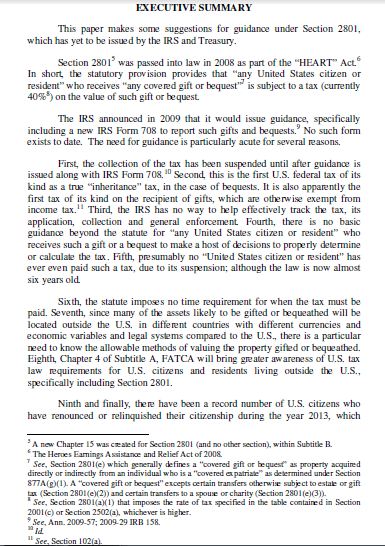
This proposal can be read in its entirety here, and the executive summary is set out below: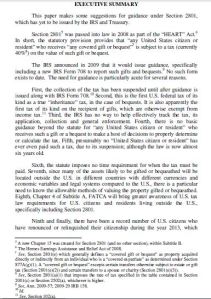
The reason these regulations are so important, is due to the tax cost of taxes upon U.S. beneficiaries. See, The “Hidden Tax” of Expatriation – Section 2801 and its “Forever Taint.”
The tax is currently levied at a 40% rate on basically the full vale of the asset upon the gift or bequest. It also continues on for potentially generations into the future; e.g., if U.S. beneficiaries receive property held in trust that was funded by a “covered expatriate.” For instance, to demonstrate the consequences, we can assume a former U.S. citizen who is a “covered expatriate” (e.g., for failure to properly certify under Section 877(a)(2)(C) and file IRS Form 8854, even though the income tax or asset tests are not satisfied) funds a trust in a foreign country for her grandchildren and great grandchildren. See, How many former U.S. citizens and long-term lawful permanent residents have filed (or will file) IRS Form 8854?
Over time, the value of those trust assets grow substantially and 30 years after her death (e.g., the year 2055), the trust starts distributing US$100,000 annually to several U.S. citizen grandchildren and grandchildren. Under the current law, each time the distribution is received, a 40% tax should be levied on each distribution. The law leaves many unanswered questions, until the proposed regulations are issued.
Part II: Common Myths about the U.S. Tax and Legal Consequences Surrounding “Expatriation”
· More Myths – about Renouncing U.S. Citizenship
There are many misunderstandings of how the law works when someone renounces U.S. citizenship. See, Part I: Common Myths about the U.S. Tax and Legal Consequences Surrounding “Expatriation”
The author regularly hears a range of myths that will befall an “Accidental American” when and if, they renounce. These “myths” include the following:
- Myth 5: There is no requirement to file U.S. income tax returns if the individual has few assets, little income or has otherwise lived outside the U.S. for almost all of their lives.
- Myth 6: There is somehow some “magical difference” under the law, for those who “renounce” citizenship (currently) versus those who “relinquished” citizenship (some time in the past) and the U.S. Department of State should recognize this “magical difference”. Such a difference will create a different U.S. tax result.
- Fact: The tax law nor immigration law makes such a distinction, even though this seems to be a common myth frequently spread throughout the Internet.
- Myth 7 : Former U.S. citizens who are “covered expatriates” can gift assets to their U.S. citizen children and friends without U.S. tax costs to them.
- Fact: This is true, i.e., there is no restriction or tax that is levied against the former U.S. citizen who makes the gift. The problem is for the recipient U.S. citizen or other “U.S. person” children or friends who will become subject to tax upon such gifts at the highest estate and gift ta rate (currently 40%).
- Myth 8: Former U.S. citizens should not worry about the IRS and its ability to collect taxes owing for the “mark-to-market” gains tax on expatriation (or on covered gifts and covered bequests) against assets located outside the U.S.?
These are just some of the myths commonly floated. There are yet more myths which will be discussed in a later post.
The Number of Citizens Leaving (Renouncing) Versus Coming (Naturalizing) is Just a Speck
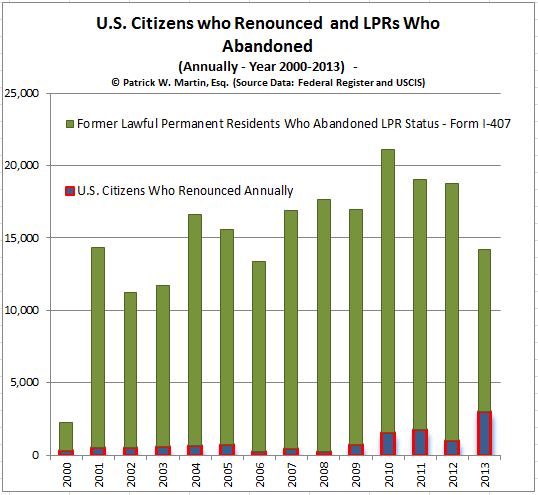
Much has been made about the number of citizens who have been renouncing their U.S. citizenship over the last few years. In historical terms, it is a relative explosion. See, earlier post – The 2014 Third Quarter Renunciations Is probably the New Norm –
However, compared to the 
 number of lawful permanent residents (LPR) who are leaving the U.S., the number is relatively small. See, earlier post The Number of LPRs “Leaving” the U.S. is 16X Greater than the Number of U.S. Citizens Renouncing Citizenship
On a related post, the question was raised –What are the Number of LPRs who Leave U.S. Annually without filing Form I-407 – Abandonment?
However, the number of individuals who wish to come to the U.S. to become citizens is far in excess of the number who are renouncing their citizenship.  According to the USCIS, there are about 700,000 individuals annually who become naturalized citizens. In the year 2008, there were more than 1 million naturalized citizens. See table:
Compare these numbers to just about 3,000 annually of individual who are renouncing their citizenship.
Of course, everyone has their own story and reasons for either coming or going, but in relative terms, those who find it desirous to renounce citizenship (at least in absolute numbers and relative terms) represent a small speck (less than 1/2 of 1 percent), compared to those who are becoming naturalized citizens.
Finally, for anyone who wishes to become a naturalized citizen, they must be aware they cannot “reverse” the decision without having potentially adverse U.S. tax consequences. See, Why a Naturalized Citizen cannot avoid “Covered Expatriate” status under IRC Section 877A(g)(1)(B)
The “Average Annual Net Income Tax” Amounts for “Covered Expatriate Status” – Increases to US$160,000 for the Year 2015
A previous post explained how the “gain exclusion” amount from the mark to market tax will increase to US$690,000 for the year 2015. See, The “Phantom” Gain Exclusion from the “Mark to Market” Tax – Increases to US$690,000 for the Year 2015.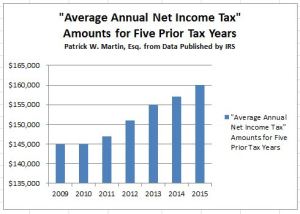
Today’s post explains that the “average annual net income tax” amount that causes someone to become a “covered expatriate” as set forth in 877 has been indexed for inflation to US$160,000 for the year 2015. See, IRS Revenue Procedure 2014-16, published this month that references those relatively few code sections which are indexed for inflation.
One of the tests for becoming a “covered expatriate” is the “income tax test” explained with the relevant language of the statute as follows:
(A) the average annual net income tax (as defined in section 38(c)(1)) of such individual for the period of 5 taxable years ending before the date of the loss of United States citizenship is greater than $124,000,
This statutory rule is indexed for inflation and the current amount for 2015 will be US$160,000.
What are the Number of LPRs who Leave U.S. Annually without filing Form I-407 – Abandonment?
A prior post identified the number of lawful permanent residents (LPRs) who file Form I-407 to formally abandon their lawful permanent residency. See, The Number of LPRs “Leaving” the U.S. is 16X Greater than the Number of U.S. Citizens Renouncing Citizenship
These numbers of I-407 forms filed annually were obtained through a freedom of Information Act (“FOIA”) request and provided by the USCIS. See tabl:
Of course, this statistic does NOT identify the number of the approximate 13.3+ million LPRs who leave the U.S. to live elsewhere in another country without completing Form I-407 and formally abandoning. The estimated number of LPRs was 13.3 million for the year 2012 as reported by the Office of Statistics of the DHS. See, Estimates of the Legal Permanent Resident Population in 2012.
Maybe the number of individuals who fall into this latter category (i.e., moving out of the U.S. without filing Form I-407) is several hundred of thousands of individuals annually?
Importantly, from a taxation perspective, anyone who moves and lives in a country with a U.S. income tax treaty (the list of these countries is set out below – from the IRS website), needs to be careful not to be deemed to be a “covered expatriate” due to the application of IRS Form 7701(b)(6). See, IRS Notice 2009-85.
See, the following posts with further explanation of the tax law for LPRs who move and live in one of the countries listed below. Countries with U.S. Income Tax Treaties & Lawful Permanent Residents (“Oops – Did I Expatriate”?)
See also, Who is a “long-term” lawful permanent resident (“LPR”) and why does it matter?
Becoming a “covered expatriate” has U.S. tax consequences not just to the “former long-term LPR”, but also to their family and friends who are “U.S. persons” (as defined under Section 7701. See, The “Hidden Tax” of Expatriation – Section 2801 and its “Forever Taint.”
A
Armenia
Australia
Austria
Azerbaijan
B
Bangladesh
Barbados
Belarus
Belgium
Bulgaria
C
Canada
China
Cyprus
Czech Republic
D
Denmark

E
Egypt
Estonia
F
Finland
France
G
Georgia
Germany
Greece
H
Hungary
I
Iceland
India
Indonesia
Ireland
Israel
Italy
J
Jamaica
Japan
K
Kazakhstan
Korea
Kyrgyzstan
L
Latvia
Lithuania
Luxembourg
M
Malta
Mexico
Moldova
Morocco
N
Netherlands
New Zealand
Norway
O
P
Pakistan
Philippines
Poland
Portugal
Q
R
Romania
Russia
S
Slovak Republic
Slovenia
South Africa
Spain
Sri Lanka
Sweden
Switzerland
T
Tajikistan
Thailand
Trinidad
Tunisia
Turkey
Turkmenistan
U
Ukraine
Union of Soviet Socialist Republics (USSR)
United Kingdom
United States Model
Uzbekistan
V
Venezuela
Part I: Common Myths about the U.S. Tax and Legal Consequences Surrounding “Expatriation”
· Myths – about Renouncing U.S. Citizenship
There are many misunderstandings of how the law works when someone renounces U.S. citizenship. The author regularly hears a range of myths that will befall an “Accidental American” when and if, they renounce. These “myths” include the following:
- Myth 1: There is a 10 year period of U.S. income taxation after renouncing citizenship.
- Fact: The old tax law from 1996 and the modifications in 2004 had a 10 year period of taxation concept after “expatriation.” There is no longer such a 10 year period of taxation for those persons who renounce on or after June 17, 2008.
- Myth 2: Former U.S. citizens will not be allowed to enter into the U.S.; i.e., will be barred from re-entry at a point of entry by a U.S. immigration officer.
- Fact: Former U.S. citizens are generally entitled to any visa status, the same as any other non-U.S. citizen. There is not a single case where a former U.S. citizen was barred re-entry to the U.S., due to tax motivated purposes.
- Myth 3 : Former U.S. citizens will not be allowed to ever re-obtain citizenship.
- Fact: Former U.S. citizens are generally entitled to U.S. citizen status, the same as any other non-U.S. citizen. Importantly, U.S. citizenship may simply not be available to any particular non-U.S. citizen, depending upon the particular circumstances.
- Myth 4: U.S. citizens do not need to renounce their U.S. citizenship if they live in a country with an income tax treaty with the U.S.; since the tie breaker rules of residency will keep them from being U.S. income tax residents.
- Fact: U.S. citizens cannot escape worldwide taxation, both income and gift/estate taxes, by living outside the U.S., since all U.S. bilateral income tax treaties and estate and gift tax treaties have a “savings clause” allowing the U.S. government to impose taxation on U.S. citizens notwithstanding the treaty.[1] This is how the U.S. tax net works on worldwide assets and income.
There are many more myths which will be discussed in a later post.
[1] See footnote no. 14 of Crow v. Commissioner, 85 T.C. 376 (1985):
14/ . . . The Treasury Department’s explanation of the Maltese treaty . . . :
“Paragraph (3) contains the traditional ‘saving clause’ under which each Contracting State reserves the right to tax its residents, as determined under Article 4 (Fiscal Residence), and its citizens as if the Treaty had not come into effect. [Department of Treasury, Technical Explanation of the Agreement Between the United States of America and the Republic of Malta with Respect to Taxes on Income 2 (Published in Treasury Department Press Release R 367 on Sept. 24, 1981), 1984-2 C.B. 366.]” This interpretation is consistent with the typical interpretations accompanying recent treaties containing general savings clauses.
“Covered Expatriate” Status is a “Scarlet Letter”
Throughout Tax-Expatriation, I have tried to emphasize the importance of avoiding “covered expatriate” status, if at all possible – and at all costs. It is a technical term defined in the tax law.
“Covered Expatriate” status is a “Scarlet Letter”.
There is much misunderstanding about how the tax expatriation provisions of the law apply. Many people think they only apply to wealthy individuals. This is not the case.
See various posts explaining the importance of the Certification Requirement of Section 877(a)(2)(C):
Why “covered expat” (“covered expatriate”) status matters, even if you have no assets! The “Forever Taint”!
Certification Requirement of Section 877(a)(2)(C) – (5 Years of Tax Compliance) and Important Timing Considerations per the Statute
Avoiding the Lobster Pot: Why becoming a Naturalized Citizen or LPR can be the proverbial “Lobster [Tax] Pot”
Why a Naturalized Citizen cannot avoid “Covered Expatriate” status under IRC Section 877A(g)(1)(B)
Can the Certification Requirement of Section 877(a)(2)(C) be Satisfied “After the Fact”?
As explained throughout, there are many ways for individuals to fall into the “covered expatriate” category. I liken it here to the “Scarlet Letter”. The fictional protagonist in Nathaniel Hawthorne book, could never shed herself of the consequences of her infidelity and wore the Scarlet Letter for life. It had devastating consequences to her, her loved ones around her and especially her daughter.
This is also true for “covered expatriate” status; but it is not fictional. Covered expatriate status can never be shed and can have disastrous consequences not only for the former USC or LPR; but also to the friends and family of the individual who carries around the “covered expatriate” status for life. See, The dangers of becoming a “covered expatriate” by not complying with Section 877(a)(2)(C).
Revisiting the consequences of becoming a “covered expatriate” for failing to comply with Section 877(a)(2)(C).
In the book, the protagonist took the Scarlet Letter to her grave and had it on her tombstone. “Covered expatriate” status extends beyond the grave and beyond the tombstone. Any loved one who is a U.S. person of a “covered expatriate” who receives a gift or inheritance, will be subject to a tax; even if the inheritance occurs many years after the death of the covered expatriate. In this case, the Scarlet Letter transfers to the loved one who receives property in the future and continues on for another generation. At least in Nathaniel Hawthorne’s book, the daughter Pearl received an inheritance not tainted by the Scarlet Letter.