Will 2015 Be a Record Year for Citizenship Renunciations?
USCs without a Social Security Number (and a Passport) Cannot Travel to the U.S.
Recent posts have focused on the dilemma facing U.S. citizens (USCs) who have no social security number (“SSN”). See an older post (23 July 2014) – Why do I have to get a Social Security Number to file a U.S. income tax return (USCs)?
These problems are quickly coming to the surface, now that financial institutions  (“FFIs”) around the world and private companies and trusts (e.g., non-financial foreign entities -NFFEs) must have their owners and clients certify they are not U.S. citizens; OR report the accounts of such U.S. citizens to the IRS under FATCA and the intergovernmental agreements (“IGAs”).
See, U.S. Citizens Overseas who Wish to Renounce without a Social Security Number will Necessarily be a “Covered Expatriate”
The intricacies of this problem are highlighted in a technical paper I recently drafted and presented to the U.S. Treasury Department and the Joint Committee of Taxation, among other federal government groups. Some key excerpts of that paper titled URGENT NEED FOR U.S. CITIZENS RESIDING OUTSIDE THE U.S. TO BE ABLE TO OBTAIN A TAXPAYER IDENTIFICATION NUMBER (“TIN”) OTHER THAN A SOCIAL SECURITY NUMBER are set out below in this section:
The U.S. tax law imposing taxation on the worldwide income of USCs[1] residing overseas has created a dilemma that prejudices these USCs without a SSN. This strict SSN/TIN regulatory rule undermines the basic tax administration system and discourages tax compliance for those USCs who never obtained a SSN. This dilemma affects numerous USCs throughout the world, which is now compounded by the certification and reporting requirements of USCs and third parties, such as FFIs and NFFEs[ under the Foreign Account Tax Compliance Act (“FATCA”).
In short, USCs without a SSN, necessarily cannot be in compliance with U.S. federal tax law. As I point out in my paper, such –
“A law that cannot be complied with is surely a bad law, the same as a “ . . .law that cannot be enforced is a bad law.”[a]
[a] See, The Case Against Taxing Citizens, Reuven S. Avi-Yonah (March 31, 2010), University of Michigan School of Law, Law & Economics Working Papers.
The paper referenced above explains how difficult it is for USCs residing overseas to ever obtain a SSN. Specifically, it explains how difficult it is to have an in-person interview at only 18 different locations around the world with a U.S. Department of State employee. See, 12 Year Old (and Older) U.S. Citizens Residing Outside the U.S. Must Have An “In-Person” Interview in a U.S. Embassy or Consulate for SSN Application in 1 of Just 17 Posts Worldwide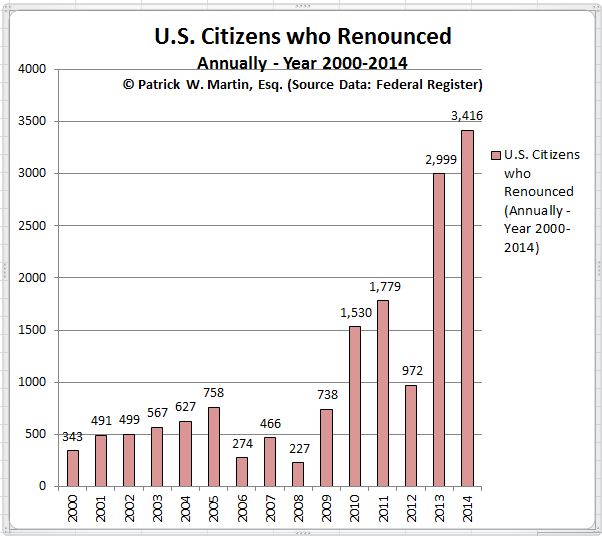
As a USC residing somewhere around the world, you might decide to simply spend the time, money and resources to travel internationally to arrive in the U.S. to apply for a SSN directly with the Social Security Administration within the U.S. Unfortunately, any USC is now legally prohibited from traveling in or out of the U.S. without a U.S. passport. There are few exceptions to this general rule, none of which contemplate U.S. federal tax compliance. See, the relevant excerpts from the white paper:
C. Travel to the U.S. is Also Not An Option for a USC without a SSN, Due to 22 CFR § 53.1 Requiring a U.S. Passport
A possible solution to this TIN/SSN dilemma may appear to be a trip to the U.S. by the USC to apply for a SSN in the U.S. Unfortunately, this simply creates another dilemma, since the USC must have a U.S. passport to travel to the U.S. The immigration law regulations 22 CFR § 53.1 require that a U.S. citizen have a U.S. passport to enter or depart the United States. The relevant part of the regulations is § 53.1(a) which provides as follows:
Passport requirement; definitions.
(a) It is unlawful for a citizen of the United States, unless excepted under 22 CFR 53.2,[2] to enter or depart, or attempt to enter or depart, the United States, without a valid U.S. passport.
These regulations were first published in 2006 and unfortunately, simply create another dilemma for the USC residing overseas without a SSN. This additional dilemma is that an application[3] for a U.S. passport requires the individual have a SSN; a vicious circle back to the inability to obtain a SSN.
At the end of the day, the restrictions imposed on USCs make it legally impossible for a USC without a passport to travel to the U.S. (even if they wish they could) to obtain a SSN.
[1] See, IRC § 61 and Treas. Reg. §§ 1.1?1(b) and 1.1?1(a)(1)..
[2] The exceptions set forth in this regulation would not generally be applicable in the case of USCs residing overseas without a SSN.
[3] Application for a U.S. Passport – http://www.state.gov/documents/organization/212239.pdf.
12 Year Old (and Older) U.S. Citizens Residing Outside the U.S. Must Have An “In-Person” Interview in a U.S. Embassy or Consulate for SSN Application in 1 of Just 17 Posts Worldwide
As previous posts have mentioned, U.S. citizens (USCs) residing overseas can only comply with U.S. tax law and FATCA certifications if they have a social security number (SSN). See, U.S. Citizens Overseas who Wish to Renounce without a Social Security Number will Necessarily be a “Covered Expatriate”
See key excerpts of the paper titled URGENT NEED FOR U.S. CITIZENS RESIDING OUTSIDE THE U.S. TO BE ABLE TO OBTAIN A TAXPAYER IDENTIFICATION NUMBER (“TIN”) OTHER THAN A SOCIAL SECURITY NUMBER that explains this dilemma:
This dilemma affects numerous USCs throughout the world, which is now compounded by the certification and reporting requirements of USCs and third parties, such as FFIs and NFFEs[2] under the Foreign Account Tax Compliance Act (“FATCA”).
* * *
The regulations provide the specific rule that all USCs must have a SSN[1] as their TIN. There are no general exceptions in the regulations to the requirement that a USC must have a SSN as their TIN.
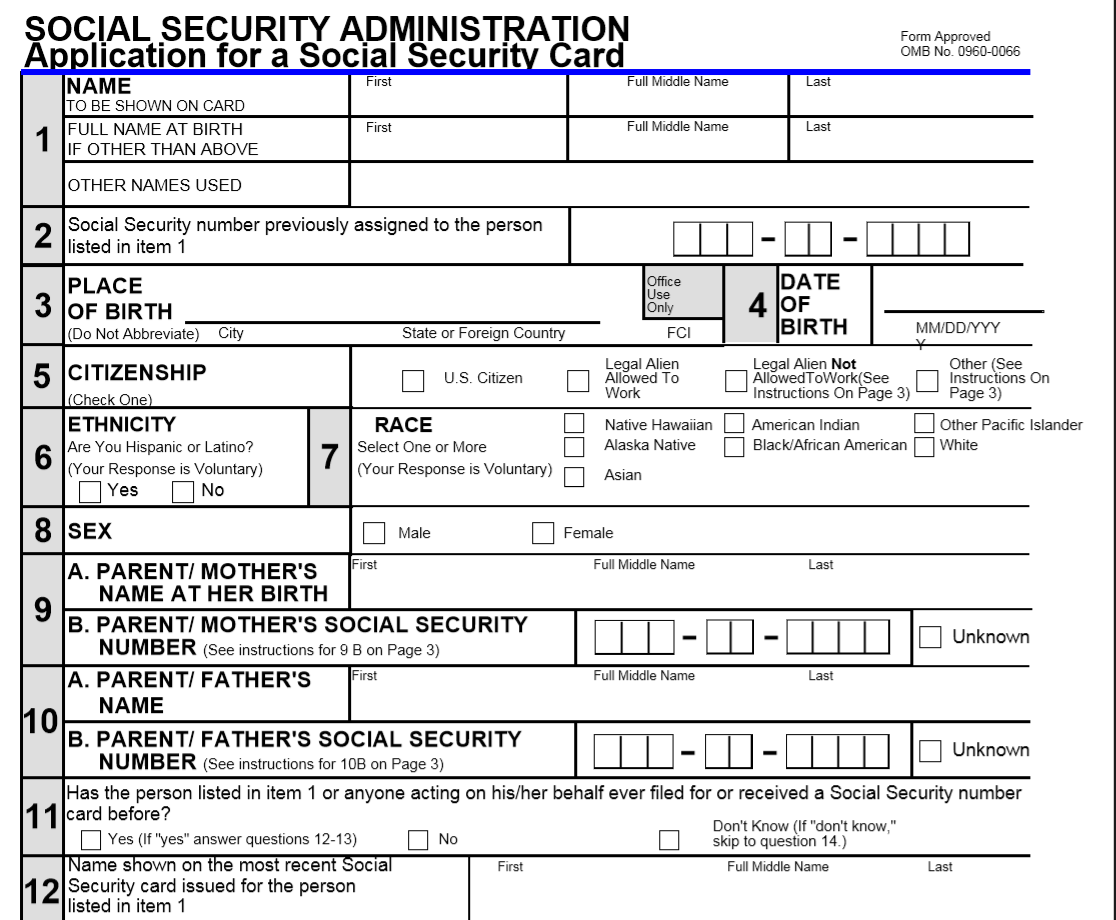
This regulatory requirement specifically directs the USC to the forms that must be completed and filed with the SSA, in order to obtain a SSN, as follows:[2]
(1) Social security number. Any individual required to furnish a social security number pursuant to paragraph (b) of this section shall apply for one, if he has not done so previously, on Form SS-5, which may be obtained from any Social Security Administration or Internal Revenue Service office. He shall make such application far enough in advance of the first required use of such number to permit issuance of the number in time for compliance with such requirement. The form, together with any supplementary statement, shall be prepared and filed in accordance with the form, instructions, and regulations applicable thereto, and shall set forth fully and clearly the data therein called for. Individuals who are ineligible for or do not wish to participate in the benefits of the social security program shall nevertheless obtain a social security number if they are required to furnish such a number pursuant to paragraph (b) of this section. [emphasis added]
These Title 26 regulations discuss individuals requesting forms from “any Social Security Administration or Internal Revenue Service office” which clearly implies that the SSA and the IRS have offices overseas.
Unfortunately, this is not the case, as the IRS recently announced it is closing its full-time walk-in offices in London, Frankfurt and Paris, as the office in Beijing, China was closed in 2014.[3] Similarly, the SSA has no overseas offices, but does have limited field office operations in Canada, the British Virgin Islands and Samoa.[4]
Therefore, it is clear that the above regulations are speaking to individuals who reside and live in the U.S., and not USCs residing overseas when it requires USCs to “ . . . make such application far enough in advance of the first required use of such number to permit issuance of the number in time for compliance with such requirement. [5]
These Title 26 regulations require the application be made well in advance of any tax filing requirements are not realistic for USCs residing overseas as is explained herein. This author has seen the issuance of SSNs take more than 6 months, even when the USC could have an interview in their country of residence.
More importantly, there are very few countries (only 17) where in-person interviews can even be held. See, discussion below.
USCs who have lived most, if not all of their lives outside the U.S., commonly do not have a SSN. The procedural requirements imposed by the SSA to obtain a SSN in these cases are complicated and unrealistic for USCs living overseas.[6] This author has seen cases where USCs residing overseas have even spent the money and resources and time to travel to the U.S. to apply for a SSN, yet were turned away by the SSA, due to various procedural requirements which were not satisfied.
Often times obtaining a SSN overseas is nearly impossible, depending upon which country and where within that country the USC resides.
A. Obtaining a SSN Outside the US by a USC – Much More than Just Filing SSA Form SS-5
The SSA does not have offices outside the U.S. although they have a so-called “Office of International Operations.”[7] The focus of OIO is the administration of social security benefits, not obtaining SSNs for USCs residing overseas. Since the SSA is assisted by the U.S. Department of State (who are not SSN experts), USCs have to rely upon various U.S. embassies and consulate offices around the world, as they try to obtain a SSN.
B. Tax Return Filing Requirements – Minimum Gross Income
Any USC individual is obligated under the U.S. federal tax law to file a federal income tax return IRS Form 1040 if they meet minimum thresholds of income. For the tax year 2015, the thresholds are low, and are reached once the gross income is at least the sum of (i) the “exemption” amount (currently $4,000) and (ii) the “standard deduction” amount (currently $6,300 for single and married filing jointly and $12,600 for married couples filing jointly).[8]
This is true, even if all of the income is earned income and eligible for the foreign earned income exclusion, which is $100,800 for the tax year 2015. [9]
Additionally, USCs living overseas necessarily have a U.S. tax return filing requirement, when they meet these low thresholds of gross income. In these cases, tax returns that are not filed by the 15th of June are not considered timely filed.[10]
II. The Social Security Administration Rules Make it Nearly Impossible for Many USCs Overseas to Reasonably Obtain a SSN
The policy and procedures of the SSA regarding issuing SSNs have changed significantly over the years.[11] The Social Security Administration (SSA) provides a detailed chronology of the major changes in policy and procedures regarding filing for and obtaining a SSN.[12] One of the most significant revisions in the last decade came from The Intelligence Reform and Terrorism Prevention Act of 2004 (P.L. 108-458), which imposes various standards for the verification of documents or records submitted by an individual.
A. Only a Few Countries Around the World have Personnel at U.S. Embassies or Consulate Offices that Can Process SSN Applications – SSA Form SS-5-FS
Applying for SSNs overseas is severely restricted compared to an application in the U.S.
According to the U.S. Department of State, Foreign Affairs Manual (“FAM”), only certain “Claims-Taking Posts” in specific countries “may” include “processing applications for Social Security Numbers.” [13]
These 17 countries (and a city in the case of Jerusalem) with Claims-Taking Posts include:
“Austria, Argentina, Costa Rica, Dominican Republic, France, Germany, Greece, Ireland, Italy, Japan, Jerusalem, Mexico, Norway, Philippines, Poland, Portugal, Spain, and the United Kingdom.”
Noticeably absent are many Western European countries, virtually all of Latin America, virtually all of Asia, virtually all of Eastern Europe, all of the Middle East (except Jerusalem), all of the African continent, all of the Australian continent and surrounding island countries and Russia, among many other significant countries, including OECD member countries.[14]
Nothing in the FAM requires any of these “Claims-Taking Posts” to actually process applications for a SSN. Plus, there are of course hundreds of other countries throughout the world, not listed above, which do not have such a U.S. Department of State Post. For these reasons, USCs in countries such as China must travel to a U.S. Department of State Post (e.g., the Philippines) which is able to process applications for SSNs.
B. In Person Interview Required for Individuals Older than 11 Years Old
Individuals who are older than 11 years old must personally go to the U.S. Embassy or Consulate with a Claims-Taking Post. See 7 FAM 530, pages 7, 12, 13 and 7 FAM EXHIBIT 530(D) Mandatory In-Person Interview Worksheet SSN Applicant Age 12 or Older – Original SSN * * *
All of these rules makes you wonder whether foreign born individuals, such as actress Kim Cattrall from Sex & the City fame would have ever obtained a social security number overseas while she lived in Canada or the UK.
[1] See, Treas. Reg. § 301.6109-1(a)(1)(ii)(A).
[2] See, Treas. Reg. § 301.6109-1(d)(1).
[3] See, Bloomberg article, 14 January 2015 by Kocieniewski, IRS Will Shut Last Overseas Taxpayer-Assistance Centers: “After budget reductions over the last four consecutive years, the IRS is forced to make tough choices during this period of fiscal austerity and these closures have relatively little impact on taxpayers and treaty partners,” said Julianne Breitbeil, an IRS spokeswoman. Also, see IRS website that still reflects the London and Paris offices as open http://www.irs.gov/uac/Contact-My-Local-Office-Internationally.
[4] See, SSA website, Service Around the World, http://www.ssa.gov/foreign/
[5] See, Treas. Reg. § 301.6109-1(d)(1).
[6] See discussion below, regarding requirements to obtain a SSN. I.II, I.I,The Social Security Administration Rules Make it Nearly Impossible for Many USCs Overseas to Reasonably Obtain a SSN
[7] See SSA website, “Office of International Operations” – http://www.ssa.gov/foreign/ “Service Around the World – Welcome to SSA’s Office of International Operations (OIO) home page. The purpose of this site is to assist Social Security customers who are outside the U.S. or planning to leave the U.S. OIO is responsible for administering the Social Security program outside the U.S. and for the implementation of the benefit provisions of international agreements. Since SSA has no offices outside the U.S., OIO is assisted by the Department of State’s embassies and consulates throughout the world.”
[8] See, IR-2014-104, Oct. 30, 2014 and IRS Publication 501.
[9] See, IRC § 911 and IRS Publication 54.
[10] See, Treas. Reg. § 1.6081-5.
[11] See, SSA website, The Story of the Social Security Number, by Carolyn Puckett, Social Security Bulletin, Vol. 69 NO. 2, 2009 (http://ssa.gov/policy/docs/ssb/v69n2/v69n2p55.html.
[12] See, SSA website, Significant Milestones in Social Security Number Policy. A detailed chronology of the major changes in policy and procedures. http://www.ssa.gov/history/ssn/ssnchron.html.
[13] See 7 FAM 530, page 2 of 64.
[14] In contrast to these 17 countries (and one city – Jerusalem) where a USC residing overseas must travel to apply for a SSN, the Treasury Department has announced it has around 100 countries that have signed, or “have reached agreements in substance” a FATCA IGA. USCs throughout the world are required by the Foreign Account Tax Compliance Act (“FACTA”) to provide their U.S. TIN to financial institutions throughout the world (on IRS Form W-9, or its equivalent), which under current law necessarily must be a SSN. Of course, if they have no SSN, they cannot sign IRS Form W-9 which provides in Part II: “Under penalties of perjury, I certify that: 1. The number shown on this form is my correct taxpayer identification number . . .”
[15] See, 7 FAM 534.3 e.
Inflation Adjusted Exclusion Amounts Since Inception of 2008 “Mark to Market” Expatriation Tax Law: Example
The current “expatriation” “exit tax” forces a “covered expatriate” to pay U.S. income taxation on their unrealized gains (the “mark to market” concept) as if they sold their worldwide assets.
An “unrealized gain” is the amount of gain “built into” the property or other investment of the individual, which has yet to be sold or otherwise disposed of by the him or her. For instance, the  diagram below reflects various assets held by a “Covered Expatriate” which includes Mexican real estate with a tax basis of US$200,000 but a current fair market value of US$1.1M. This means the unrealized gain in that Mexican real property is US$900,000 (US$1.1M – US$200K).
Who is a “covered expatriate” is a very important legal analysis that needs to be considered for each U.S. citizen who wishes to renounce or “long-term resident.” See, The dangers of becoming a “covered expatriate” by not complying with Section 877(a)(2)(C) (9 March 2014).
Importantly, the law provides for an exclusion from taxation on the former (a) U.S. citizen’s (“USC”) or (b) long-term resident’s unrealized gains. (See, Who is a “long-term” lawful permanent resident (“LPR”) and why does it matter? – 19 Aug. 2014). In other words, no U.S. income tax is due and payable by a “covered expatriate” if they did not have assets with unrealize d gains greater than a certain threshold amount.
That threshold amount has been changing annually, since the initial US$600,000 that was originally adopted into the law in 2008. It is changing due to annual inflation adjustments.
The current 2015 exclusion amount adjusted for inflation is US$690,000. See, The “Phantom” Gain Exclusion from the “Mark to Market” Tax – Increases to US$690,000 for the Year 2015 (15 November 2014).
Hence, in this case, if the only asset owned by the “covered expatriate” (assuming she became one in 2015) was the real estate in the above example with unrealized gain of US$900,000, only US$210,000 would be subject to the “mark to market” tax on expatriation (i.e., the exit tax). This is because $690,000 of the total US$900,000 unrealized gain will be excluded from taxation (US$900K – US$690K).
The Mark to Market tax regime imposes taxation on this amount, even though the real estate is never sold. This means, the “covered expatriate” must come “out of pocket” to find the cash and means necessary to pay the tax imposed under the law.
There is no economic benefit obtained from this annual inflation adjustment if a U.S. citizen or long-term resident waits to become at a later time a covered expatriate; unless they consume, deplete or lose their assets in the interim. But at least, there is an inflation adjustment, so the taxpayer is not subject to an increasing amount of gain subject to tax as time progresses and inflation eats away at the true economic value and economic growth of the individual’s assets.
U.S. Citizens Overseas who Wish to Renounce without a Social Security Number will Necessarily be a “Covered Expatriate”
U.S. Citizens Overseas who Wish to Renounce without a Social Security Number (“SSN”) will Necessarily be a “Covered Expatriate”
- The Dilemma of SSNs, TINs and USCs Residing Overseas
The prior post discussed some of the complications of United States Citizens (“USCs”) who reside outside the U.S. and do not have a social security number (“SSN”) . This dilemma exists, even though USCs are not generally required to file for or  obtain a SSN (e.g., at birth – See, SSA Publication – “Social Security Numbers For Children” page 2, It is not obligatory to file for a SSN at birth. “Must my child have a Social Security number? No. Getting a Social Security number for your newborn is voluntary. But, it is a good idea to get a number when your child is born. . . . ).
Indeed, it is the U.S. federal tax law that requires the USC must have a SSN for their taxpayer identification number (“TIN”). I will reference various excerpts from a recent paper I drafted and presented titled URGENT NEED FOR U.S. CITIZENS RESIDING OUTSIDE THE U.S. TO BE ABLE TO OBTAIN A TAXPAYER IDENTIFICATION NUMBER (“TIN”) OTHER THAN A SOCIAL SECURITY NUMBER , including the following:
. . . the IRS’ increased focus on international tax compliance has made clear that USCs residing overseas have U.S. tax return filing obligations, even if they have no assets, no income, or no real personal connections in or with the U.S. See IRS notice from 2011 which addresses numerous aspects of tax compliance for USCs overseas, including various penalties under the law[1]:
. . . U.S. Citizens or Dual Citizens Residing Outside the U.S. . . .
The IRS is aware that some taxpayers who are dual citizens of the United States and a foreign country may have failed to timely file United States federal income tax returns or Reports of Foreign Bank and Financial Accounts (FBARs), despite being required to do so. . . . 2. Penalties imposed for failure to file income tax returns or to pay tax . . . 3. Possible additional penalties that may apply in particular cases . . . 6. Possible penalties for failure to file FBAR . . . 7. New reporting requirement for foreign financial assets . . . [emphases added]
USCs residing overseas are subject to the range of tax penalties that apply to all individual taxpayers (e.g., negligence penalties, failure to file penalties, late payment or failure to pay penalties, etc.).[2] Additionally, USCs residing overseas are subject to other, typically much harsher penalties for not timely filing U.S. federal information returns regarding assets located outside the U.S.[3]; alluded to above in the IRS 2011 notice.[4]
These civil penalties typically are a minimum of US$10,000 per statutory violation. USCs who live outside the U.S. necessarily have assets, such as financial accounts in their country of residence. These Title 26 information reporting requirements[5] are referred to herein as “International Information Returns.”
The IRS will not process federal tax returns and International Information Returns without a valid TIN.[6] Plus, the law does not provide for an exception for USCs overseas who do not file returns, if they do not have a SSN. Late filed, or incomplete International Information Returns and tax returns (e.g., lacking a SSN) will typically subject USCs to these penalties even in those cases when the taxpayer has no federal income tax liability.[7]
[1] See, IRS FS-2011-13, December 2011, updated February, 2014.
[2] See, IRS FS-2011-13 and as a sample of some of the many statutory penalties that could typically apply, IRC §§ 6048, 6652(f), 6677, 6654, 6655, 6698, 6699, 6166, 6653, 6675, 6715, 6715A, 6717, 6718, 6719, 6720A, 6725, et. seq.
[3] See, IRC §§ 6038, 6038B, 6038D, 6039F, 6039G, 6046, 6046A, 6048, et. seq.
[4] See, IRS FS-2011-13, December 2011, updated February, 2014.
[5] See, IRC §§ 6038, 6038B, 6038D, 6039F, 6039G, 6046, 6046A, 6048, et. seq.
[6] See, IRS website, “General ITIN Information” – http://www.irs.gov/Individuals/General-ITIN-Information – “IRS no longer accepts, and will not process, forms showing “SSA”, 205c”, “applied for”, “NRA”,& blanks, etc.”
[7] See, IRC §§ 911 (foreign earned income exclusion) and 901 (foreign tax credit), et. seq. A USC residing overseas may have no actual federal income tax liability (for various reasons), typically due to the foreign earned income exclusion and/or foreign tax credit calculation.
The above explains fairly clearly the dilemma facing USCs residing overseas.
The complexity of getting a SSN and the requirements are covered in more detail in the paper. Some key points are:
I. The Social Security Administration Rules Make it Nearly Impossible for Many USCs Overseas to Reasonably Obtain a SSN
The policy and procedures of the SSA regarding issuing SSNs have changed significantly over the years.[1] The Social Security Administration (SSA) provides a detailed chronology of the major changes in policy and procedures  regarding filing for and obtaining a SSN.[2] One of the most significant revisions in the last decade came from The Intelligence Reform and Terrorism Prevention Act of 2004 (P.L. 108-458), which imposes various standards for the verification of documents or records submitted by an individual.
A. Only a Few Countries Around the World have Personnel at U.S. Embassies or Consulate Offices that Can Process SSN Applications – SSA Form SS-5-FS
Applying for SSNs overseas is severely restricted compared to an application in the U.S.
According to the U.S. Department of State, Foreign Affairs Manual (“FAM”), only certain “Claims-Taking Posts” in specific countries “may” include “processing applications for Social Security Numbers.” [3]
These 17 countries (and a city in the case of Jerusalem) with Claims-Taking Posts include:
“Austria, Argentina, Costa Rica, Dominican Republic, France, Germany, Greece, Ireland, Italy, Japan, Jerusalem, Mexico, Norway, Philippines, Poland, Portugal, Spain, and the United Kingdom.”
Noticeably absent are many Western European countries, virtually all of Latin America, virtually all of Asia, virtually all of Eastern Europe, all of the Middle East (except Jerusalem), all of the African continent, all of the Australian continent and surrounding island countries and Russia, among many other significant countries, including OECD member countries.[4]
Nothing in the FAM requires any of these “Claims-Taking Posts” to actually process applications for a SSN. Plus, there are of course hundreds of other countries throughout the world, not listed above, which do not have such a U.S. Department of State Post. For these reasons, USCs in countries such as China must travel to a U.S. Department of State Post (e.g., the Philippines) which is able to process applications for SSNs.
[1] See, SSA website, The Story of the Social Security Number, by Carolyn Puckett, Social Security Bulletin, Vol. 69 NO. 2, 2009 (http://ssa.gov/policy/docs/ssb/v69n2/v69n2p55.html.
[2] See, SSA website, Significant Milestones in Social Security Number Policy. A detailed chronology of the major changes in policy and procedures. http://www.ssa.gov/history/ssn/ssnchron.html.
[3] See 7 FAM 530, page 2 of 64.
[4] In contrast to these 17 countries (and one city – Jerusalem) where a USC residing overseas must travel to apply for a SSN, the Treasury Department has announced it has around 100 countries that have signed, or “have reached agreements in substance” a FATCA IGA. USCs throughout the world are required by the Foreign Account Tax Compliance Act (“FACTA”) to provide their U.S. TIN to financial institutions throughout the world (on IRS Form W-9, or its equivalent), which under current law necessarily must be a SSN. Of course, if they have no SSN, they cannot sign IRS Form W-9 which provides in Part II: “Under penalties of perjury, I certify that: 1. The number shown on this form is my correct taxpayer identification number . . .”
- The Necessary “Covered Expatriate Status” of a USC without a SSN
The core point of this post, with the above SSN background, is to explain how a USC without a SSN will necessarily be a “covered expatriate” since they will not be able to truthfully certify they have complied with the federal tax laws (title 26). See, Certification Requirement of Section 877(a)(2)(C) – (5 Years of Tax Compliance) and Important Timing Considerations per the Statute
As other posts have explained, “covered expatriate” status matters:
See, Why “covered expat” (“covered expatriate”) status matters, even if you have no assets! The “Forever Taint”! (20 May 2014) and The “Hidden Tax” of Expatriation – Section 2801 and its “Forever Taint.” (10 April 2014) and “Covered Expatriate” Status is a “Scarlet Letter” (10 Nov 2014).
If a USC has no SSN, they by definition will never be able to comply with the Certification Requirement of Section 877(a)(2)(C) since they will not be able to comply with IRC § 6109(a) and Treas. Reg. § 301.6109-1. As the SSN/TIN paper explains:
All United States citizens (“USCs”) must have a social security number (“SSN”) under current law as their TIN to file a federal income tax return.[1]
[1] See, IRC § 6109(a) and Treas. Reg. § 301.6109-1.
The IRS will not process federal tax returns and “International Information Returns”, as defined below, without a valid TIN[1]; which currently must be a SSN for a USC.
[1] See, IRS website, – http://www.irs.gov/Individuals/General-ITIN-Information – “IRS no longer accepts, and will not process, forms showing “SSA”, 205c”, “applied for”, “NRA”,& blanks, etc.”
Does the IRS have access to the USCIS immigration data for former lawful permanent residents (LPRs)?
Information about former LPRs, such as the individuals names, is not published under the statute, IRC Section 6039G, which only covers former U.S. citizens. 
This raises the question of whether the Department of Homeland Security tracks former LPRs – names and addresses overseas and provides that information to the Internal Revenue Service?
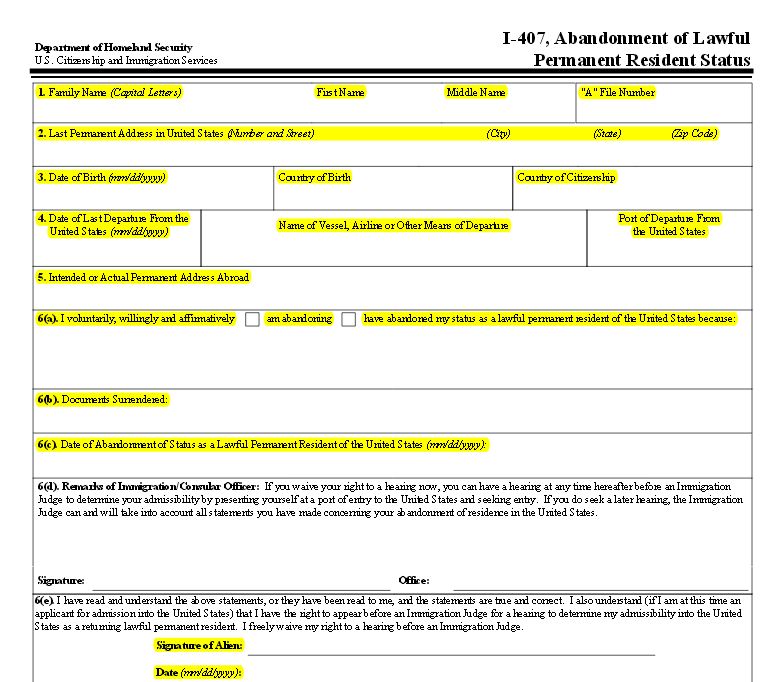
A prior post discussed the newly published USCIS immigration form I-407 for LPRs who must now use it when formally abandoning LPR status. See, More Information and More Information: USCIS Creates New Form for Abandonment of Lawful Permanent Residency
The new I-407 Form requires much more information and is 2 pages in length. The old form had only 6 lines and was less than 1/2 of a page in length. These forms  are set forth here. The new form requires the address overseas of the individual.
As readers here know, the names of former U.S. citizens are published quarterly by the U.S. federal government for the world to see. See a prior post, The 2014 Third Quarter Renunciations Is probably the New Norm –
The complete set of lists going back to the mid-1990s can be reviewed here. Quarterly Publications.
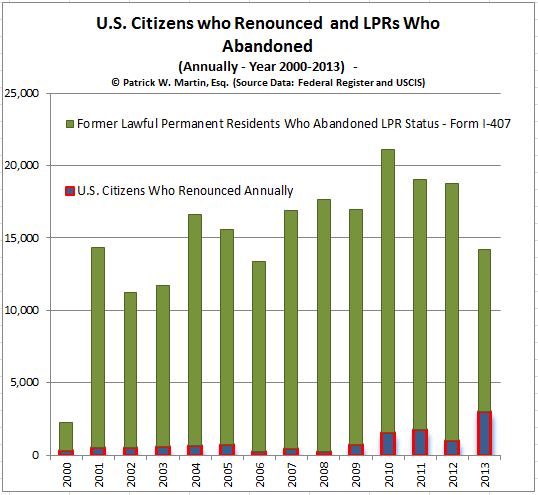
Of course, the IRS can easily select and identify individuals for audit, by simply drawing from the published names of former U.S. citizens, which is currently tracking at an average of about 850 former USCs quarterly. In contrast, the number of former LPRs who have filed USCIS Form I-407 is tracking at an average of about 4,000 to 5,000 individuals quarterly. 
While citizens are often the focus of the public press and Congress regarding “expatriation taxation”; the statute also wraps in so-called “long-term residents.” These are individuals who had or continue to have “lawful permanent residency status.” There are numerous technical considerations in this area, but needless to say, the number of former lawful permanent residents who have simply filed Form I-407 – Abandonment is far in excess of those U.S. citizens who have filed for and received a Certificate of Loss of Nationality (“CLN”) – Form DS-4083 (CLN). The graph reflects the enormous difference.
See, earlier post The Number of LPRs “Leaving” the U.S. is 16X Greater than the Number of U.S. Citizens Renouncing Citizenship
On a related post, the question was raised –What are the Number of LPRs who Leave U.S. Annually without filing Form I-407 – Abandonment?
This is important, since many LPR individuals will have “expatriated” without actually having filed USCIS Form I-407. See, Oops…Did I “Expatriate” and Never Know It: Lawful Permanent Residents Beware! International Tax Journal, CCH Wolters Kluwer, Jan.-Feb. 2014, Vol. 40 Issue 1, p9 
While the IRS has specific information about U.S. citizens, it is not clear whether the Department of Homeland Security via the USCIS provides data to the IRS regarding lawful permanent residents who have filed Form I-407? If such an individual becomes a “covered expatriate” under the U.S. tax law, the range of adverse tax consequences can follow them and their future beneficiaries and heirs, including as follows:
- “mark to market” taxation on their worldwide assets,
- 40% inheritance tax to U.S. beneficiaries,
- 40% tax on gifts to U.S. beneficiaries,
- etc.
It seems fairly easy, from a legal perspective, that the IRS can request the names, addresses (and indeed the newly completed form) from the USCIS of all individuals who have filed USCIS Form I-407. From the USCIS records, the IRS will be able to determine if the individual was a “long term resident” based upon the number of years the individual had such status.
Assuming the IRS determines the individual is a long term resident, they can then simply check to see if the they have received IRS Form 8854 from the former LPR; in order to determine if she or he satisfied the certification requirement of Section 877(a)(2)(C). If not, the IRS will necessarily know the individual is a “covered expatriate.”
The Information in DHS/USCIS Database (A-Files, EMDS, CIS, PII, eCISCOR, PCQS, Midas, etc.) on Individuals is Extensive and Can be Shared with Internal Revenue Service
A prior post discussed the new USCIS Form I-407 that must be filed by a lawful permanent resident (LPR) who wishes to formally create a record of their abandonment of LPR status. See, More Information and More Information: USCIS Creates New Form for Abandonment of Lawful Permanent Residency
Page 1 of 2 of this form is replicated here.
This raises many questions regarding how information maintained by the Department of Homeland Security (DHS) and the United States Customs and Immigration Service (USCIS) can be shared with
and provided to the IRS.
Former “long-term residents” have extensive U.S. tax compliance obligations, including certification requirements under Section 877(a)(2)(C) to avoid “covered expatriate” status and the various adverse tax consequences.
Importantly many LPR individuals will have “expatriated” without actually having filed USCIS Form I-407. See, Oops…Did I “Expatriate” and Never Know It: Lawful Permanent Residents Beware! International Tax Journal, CCH Wolters Kluwer, Jan.-Feb. 2014, Vol. 40 Issue 1, p9
Some of the important records that are maintained by DHS/USCIS, include the following, much of which can be helpful in the enforcement of U.S. federal tax obligations.
System location:
Alien Files (A-Files) are maintained in electronic and paper format throughout DHS. Digitized A-Files are located in the Enterprise Document Management System (EDMS). The Central Index System (CIS) maintains an index of the key personally identifiable information (PII) in the A-File, which can be used to retrieve additional information through such applications as Enterprise Citizenship and Immigrations Services Centralized Operational Repository (eCISCOR), the Person Centric Query Service (PCQS) and the Microfilm Digitization Application System (MiDAS). The National File Tracking System (NFTS) provides a tracking system of where the A-Files are physically located, including whether the file has been digitized.
The databases maintaining the above information are located within the DHS data center in the Washington, DC metropolitan area as well as throughout the country. Computer terminals providing electronic access are located at U.S. Citizenship and Immigration Services (USCIS) sites at Headquarters and in the Field throughout the United States and at appropriate facilities under the jurisdiction of the U.S. Department of Homeland Security (DHS) and other locations at which officers of DHS component agencies may be posted or operate to facilitate DHS’s mission of homeland security.
* * *
Categories of records in this system include:
A. The hardcopy paper A-File, which contains the official record material about each individual for whom DHS has created a record under the INA such as: naturalization certificates; various documents and attachments (e.g., birth and marriage certificates); applications and petitions for benefits under the immigration and nationality laws; reports of arrests and investigations; statements; other reports; records of proceedings before or filings made with the U.S. immigration courts and any administrative or federal district court or court of appeal; correspondence; and memoranda. Specific data elements may include:
- Alien Registration Number(s) (A-Numbers);
- Receipt file number(s);
- Full name and any aliases used;
- Physical and mailing addresses;
- Phone numbers and email addresses;
- Social Security Number (SSN);
- Date of birth;
- Place of birth (city, state, and country);
- Countries of citizenship;
- Gender;
- Physical characteristics (height, weight, race, eye and hair color, photographs, fingerprints);
- Government-issued identification information (i.e., passport, driver’s license):
? Document type,
? issuing organization,
? document number, and
? expiration date;
- Military membership;
- Arrival/Departure information (record number, expiration date, class of admission, etc.);
- Federal Bureau of Investigation (FBI) Identification Number;
- Fingerprint Identification Number;
- Immigration enforcement history, including arrests and charges, immigration proceedings and appeals, and dispositions including removals or voluntary departures;
- Immigration status;
- Family history;
- Travel history;
- Education history;
- Employment history;
- Criminal history;
- Professional accreditation information;
- Medical information relevant to an individual’s application for benefits under the INA before DHS or the immigration court, an individual’s removability from and/or admissibility to the United States, or an individual’s competency before the immigration court;
- Specific benefit eligibility information as required by the benefit being sought; and
- Video or transcript of immigration interview
Subsequent posts will discuss how and when the law allows the IRS to access these records.
More Information and More Information: USCIS Creates New Form for Abandonment of Lawful Permanent Residency
The U.S. Customs and Immigration Service (USCIS) just announced on 23 March 2015, that a new Form I-407 is available and is to be used, per the USCIS website announcement, which announcment provides in part as follows:
New Version of Form I-407 Now Available
USCIS has published a new edition of USCIS Form I-407, Record of Abandonment of Lawful Permanent Status (OMB No. 1615-0130). You can download the form on our website.
You may begin using the revised Form I-407, Record of Abandonment of Lawful Permanent Resident Status today. The current edition is dated 02/26/2015, and we will not accept previous form editions
The new form has additional information compared to the prior form. Specifically, the Alien Registration Number and USCIS ELIS Account Number is required to be included.
Now, the individual is required to state the reasons for abandoning lawful permanent residency status.
Responses to  each of these questions will have important legal consequences, including potential tax implications under IRC Sections 877, 877A, et. seq. See, for instance a prior post: What could be the focal point of IRS Criminal Investigations of Former U.S. Citizens and Lawful Permanent Residents?
One of the important enforcement and practical questions raised, is: Will the IRS be able to better track former “long-term residents” (certain former lawful permanent residents) for purposes of the “expatriation tax” under the new reporting form and system?
As has been explained, if an individual fails to certify under the tax law, they will necessarily be a “covered expatriate”; even if they do not meet the asset or income tax liability thresholds. See a prior post, Certification Requirement of Section 877(a)(2)(C) – (5 Years of Tax Compliance) and Important Timing Considerations per the Statute.
The Problem with PFICs! “Avoid PFICs Like the Plague”
There are typically numerous tax issues that USCs and LPRs need to consider prior to renouncing their citizenship; or abandoning th eir lawful permanent residency status.
One of the most confusing comes from the complex rules of a so-called “PFIC” – the acronym for a “passive foreign investment company.” A prior post in March 2014 discussed the basics of these U.S. tax creatures – “PFICs” – What is a PFIC – and their Complications for USCs and LPRs Living Outside the U.S.
Most USCs and LPRs with basic mutual fund investments in their country of residence have PFICs and probably don’t even know it.
The IRS and Treasury have recently spent much attention and resources to the regulation of PFICs. In January of 2014, temporary regulations were issued regarding PFICs. See, Regulations §1.1291–0T, et. seq.
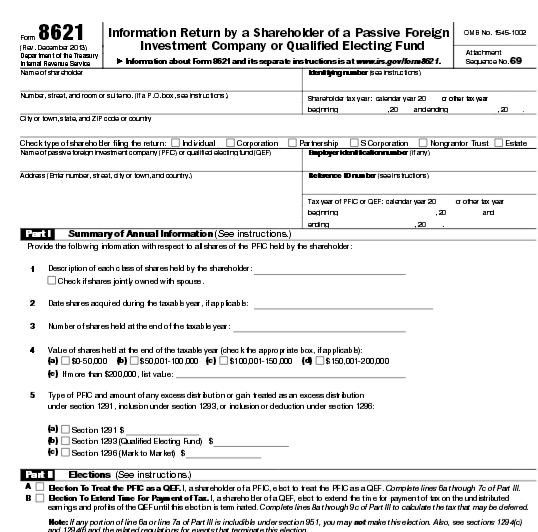
One of the many new requirements of these regulations are annual information filing requirements. This means that a U.S. taxpayer (e.g., U.S. citizen or LPR) residing outside the U.S., must file an annual report on IRS Form 8621.
- When Might You have a PFIC?
Taxpayers who have simple passive investments in mutual funds based outside the U.S.. e.g., in their country of residence, almost always have PFICs. There is no percentage ownership threshold in the foreign entity that triggers PFIC tax consequences. An ownership interest of 0.000001% triggers the consequences if either the “income test” or “asset test” are satisfied. Other type of investment funds in the form of a legal entity also typically qualify as a PFIC.
Specifically, a PFIC is a foreign corporation in which a U.S. person has some ownership in (without any percentage threshold requirement) if (i) at least 75% of its gross income is passive income (the “income test”), or (ii) at least 50% of its assets produce passive income (the “asset test”). See IRC § 1297(a).
Also, many retirement funds in various countries (including both private and many government run retirement plans) typically fall into the category of a PFIC. For instance, the Singapore retirement fund system, Central Provident Fund (“CPF”), is actually created by the government, but Singapore taxpayers who are obligated to contribute to the retirement fund will select various mutual funds to invest in through the CPF. Hence, these mutual fund investments are PFICs. See also the technical paper regarding Mexican retirement funds that argues, WHY MEXICAN RETIREMENT FUNDS SHOULD NOT BE SUBJECT TO THE NEW REPORTING REQUIREMENTS UNDER IRC SECTION 1298(f).
- Ugly Tax Consequences of a PFIC
PFICs are taxed to the U.S. taxpayer in a very complicated manner compared to taxation of U.S. based mutual funds or other U.S. based investments. In short, the income earned from PFICs, under the default regime, are taxed at the ordinary income rates, and for past years are typically taxed at the highest marginal ordinary income tax rate is 39.6% (even if the income would otherwise qualify for qualified dividend or long-term capital gains rates – which are taxed at no more than 20%).
There are three alternative regimes for how a U.S. investor is taxed in a PFIC: (i) the “excess distribution” regime (which is the default regime); (ii) the qualified electing fund (“QEF”) regime and (iii) the market-to-market (“MTM”) regime. Each of these regimes will be discussed in later posts.
One key point to know is that most foreign investment funds do not keep records and account for income and expenses in a manner that even allows a U.S. taxpayer to report accurately under the QEF or MTM regime, even if such treatment provides a lower overall U.S. tax.
More on how PFICs are taxed in a later post.
- Even Uglier Tax Reporting – Compliance Consequences of PFICs Driven by FATCA
Finally, the 2010 FATCA legislation has led to the new regulations that now require annual reporting of PFICs. This is done on IRS Form 8621. It is a laborious form and requires extensive and detailed information.
The consequences of not reporting can lead to disastrous tax results. See a prior post from March 2014, When the U.S. Tax Law has no Statute of Limitations against the IRS; i.e., for the U.S. citizen and LPR residing outside the U.S.
- Why You Don’t Want to Die with a PFIC or Gift a PFIC Away (even to Your Favorite Charity or Spouse).
Lastly, a later post will explain in more detail why a USC or LPR generally wants to avoid PFICs if at all possible. Many countries require their residents to contribute on a mandatory basis to retirement funds that invest in mutual funds, which may not allow a USC to avoid PFICs. One of the principle reasons to avoid PFICs is the income tax that arises and is owed by the U.S. person, even if he or she tries to give the PFIC away. A gift of a PFIC will typically cause an income tax to the donor in addition to the estate/gift tax rules. This is true for gifts to charity and even to your own spouse.
- Why You Should Avoid PFICs Like the Plague
At the end of the day, the above complications, mean that most USCs and LPRs residing overseas should “avoid PFICs like the plague”.
In the context of USCs who wish to renounce their U.S. citizenship, they will not be able to avoid “covered expatriate” status if they have not complied with these PFIC rules, as they will not be able to “certify under penalty of perjury that he has met the requirements of this title for the 5 preceding taxable years or fails to submit such evidence of such compliance as the Secretary may require.”
The ugly consequences of PFICs can be summarized as follows:
- Higher income tax rate than U.S. based investments on the earnings of the investment, at least under the default method;
- Practically impossible to report the earnings on a more favorable MTM or QEF method;
- Extensive information reporting requirements annually;
- Open ended statute of limitations in favor of the IRS to audit all items on the tax return, for failure to properly file IRS Form 8621;
- Paying a U.S. income tax, even if you gift away the PFIC to charity or to your spouse;
- Trying to even explain effectively the consequences of a PFIC to your tax return preparer; and
- Being subject to the “forever taint” of being a “covered expatriate” for failure to comply with the PFIC rules. See, The “Hidden Tax” of Expatriation – Section 2801 and its “Forever Taint.”
WSJ (18 Feb. 2015): London Mayor Boris Johnson to Renounce U.S. Citizenship After Tussle With Uncle Sam
Ironically, the outspoken London Mayor has decided to renounce his U.S. citizenship, according to an article published by the Wall Street Journal.
See, WSJ: (18 Feb. 2015) – London Mayor Boris Johnson to Renounce U.S. Citizenship After Tussle With Uncle Sam
This article reported that his U.S. tax bill was at issue – :
In case you missed it: London Mayor Boris Johnson has said he will renounce his U.S. citizenship following a high-decibel tax squabble with his country of birth. At issue: a tax bill U.S. tax authorities claimed he owed on some London property. The mayor will (of course) keep his citizenship in the U.K. as his political ambitions continue to play out.
A previous post in November 2014 discussed a news report of the London Mayor and his U.S. citizenship and hence U.S. tax residency status. See, According to news press, London Mayor, dual citizen, refuses to pay United States income taxes
Surely, he will be careful and thoughtful about the steps he is taking as part of his U.S. citizenship renunciation. His reported response to the news reporter last year could prove risky under U.S. law, to the extent he intentionally refuses to file U.S. income tax returns and pay taxes. The following line of questions and answers could be quite damning for him:
Presenter Susan Page then pressed him whether he would pay the bill, to which he said: “I think it’s outrageous.
“Well, I’m – no is the answer. Why should I? I haven’t lived in the United States for, you know, well, since I was five years old.
“I could but I pay – I pay the lion’s share of my tax, I pay my taxes to the full in the United Kingdom where I live and work.”
Here, the London Mayor has indicated he is not filing tax returns, yet knows he has a legal duty to file them and pay a tax owing under U.S. law. He goes further to say “I could . . . pay . . .” While rarely used standing alone by prosecutors (without other criminal claims brought), it is a crime that carries up to a 12 month prison sentence, to not file a U.S. return, supply information or pay tax; see, IRC § 7203. The relevant language of the statute is as follows:
Any person required under this title to pay any estimated tax or tax, or required by this title or by regulations made under authority thereof to make a return, keep any records, or supply any information, who willfully fails to pay such estimated tax or tax, make such return, keep such records, or supply such information, at the time or times required by law or regulations, shall, in addition to other penalties provided by law, be guilty of a misdemeanor and, upon conviction thereof, shall be fined not more than $25,000 ($100,000 in the case of a corporation), or imprisoned not more than 1 year, or both, together with the costs of prosecution.
Here, the government has yet another stick it can pull from its bag of sticks to be used against current and former U.S. citizens residing outside the U.S. It is of course, very common, that individuals who have spent most of their lives outside the U.S. have not filed any U.S. tax returns nor paid any U.S. income taxes. At what point, might these individuals have U.S. civil tax liability and what facts are necessary to give rise to criminal tax liability?
The vast majority of U.S. citizens residing overseas owe little to no U.S. income taxes because (i) modest income amounts and the impact of the “foreign earned income exclusion” or (ii) they reside in a country with higher taxes and tax rates than the U.S. because of the “foreign tax credit”. See, USCs and LPRs Living Outside the U.S. – Key Tax and BSA Forms
A couple observations about London Mayor Boris Johnson. First, he would be well advised not to make public statements about filing [or not] U.S. tax returns or paying [or not] U.S. taxes. Second, he will want to carefully consider completing and filing accurate U.S. tax returns as part of his formal renunciation process; particularly for the year in which he sold his London home tax free under UK laws. Third, he will want to understand carefully, the details of what is and should be filed on IRS Form 8854, after he has visited the U.S. embassy and files his Form DS-4080, Oath of Renunciation of the Nationality of the United States.
Finally, the case could present a unique international political and public relations nightmare for the U.S. Department of Justice, if they decided to bring any sort of criminal tax charges against the London Mayor. It would seem highly unlikely in my opinion.
The government has a strict requirement that prohibits a United States Attorney (e.g., the high profile Preet Bharara, U.S. Attorney for the Southern District of N.Y. Attorney ) from unilaterally bringing tax charges against individuals. See, 6-4.200, Tax Division Jurisdiction and Procedures, which provides in relevant part:
“. . . The Assistant Attorney General, Tax Division . . . must approve any and all criminal charges that a United States Attorney intends to bring against a defendant in connection with conduct arising under the internal revenue laws, regardless of which criminal statute(s) the United States Attorney proposes to use in charging the defendant. See 28 C.F.R. § 0.70.
Also, only the Tax Division can authorize warrants of public officials, which presumably would extend to London Mayor Boris Johnson. See, See, 6-4.130, Search Warrants.
On a related post, see, How many former U.S. citizens and long-term lawful permanent residents have filed (or will file) IRS Form 8854? and Revisiting the consequences of becoming a “covered expatriate” for failing to comply with Section 877(a)(2)(C).

 cumulative total for the year (mid way through the year of 1,795). At this pace, the year 2015 could be a slight record of U.S. citizenship renunciations compared to the record year of 2014.