Case law is starting to develop, slowly but surely, on various legal issues raised under Title 31, as to reporting foreign bank accounts.
The electronic filing deadline for foreign bank account reports (“FBARs”) is June 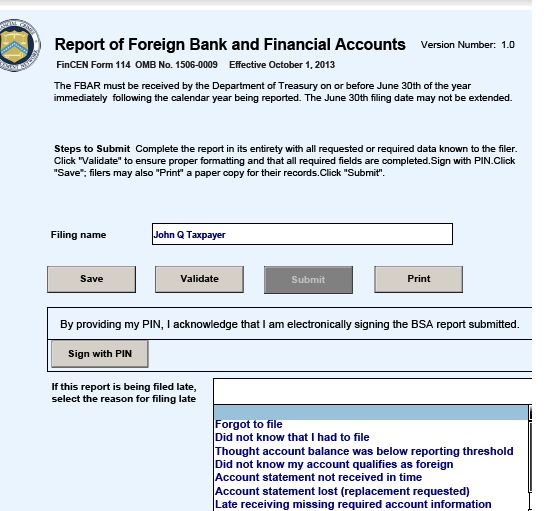 30th. This filing deadline (under Title 31) cannot be extended unlike filing of federal income tax returns (under Title 26).
U.S. citizens residing overseas and most lawful permanent residents who live substantial time (if not all of their time) outside the U.S. are generally subject to these FBAR reporting requirements as the government has made no exceptions in the regulations for such overseas residents.
See, Nuances of FBAR – Foreign Bank Account Report Filings – for USCs and LPRs living outside the U.S.
Earlier in April, the U.S. District Court in Moore v. United States, 2015 U.S. Dist. LEXIS 43979 (W.D. WA 2015) published an opinion where the IRS had assessed multiple year US$10,000 penalties. See Jack Townsend’s thoughtful comments and reference to the arguments presented by both the U.S. citizen and the government here.
There are many key questions that remain undecided by the Courts, which continue to generally be asserted by the government:
- The US$10,000 penalty should be assessed at the maximum level (versus a lesser amount);
- The US$10,000 penalty should and can be assessed multiple times for each year reporting is required, when there are multiple accounts (e.g., 8 accounts means the government will try to assess 8 violations and hence a US$80,000 penalty);
- U.S. citizens residing outside the U.S. are subject to the same penalty structure as U.S. citizens residing in the U.S.; and
- Lawful permanent residents residing outside the U.S. are subject to the same penalty structure as U.S. citizens and LPRs residing in the U.S.
To date, there is no binding case law on any of these issues.
The IRS internal revenue manual (4.26.16.4.1) summarizes how and why the IRS has authority to assess penalties for FBAR Title 31 violations as set forth below:
- As of April 8th 2003, IRS was delegated the authority to assess and collect FBAR civil penalties. 31 C.F.R. § 103.56(g). The delegation includes the authority to investigate possible FBAR civil violations, provided in Treasury Directive No. 15-41 (Dec. 1, 1992), and the authority to assess and collect the penalties for violations of the reporting and recordkeeping requirements.
- When performing these functions, the IRS is not acting under Title 26 but, instead, is acting under the authority of Title 31. Provisions of the Internal Revenue Code generally do not apply to FBARs.
- Criminal Investigation has been delegated the authority to investigate possible criminal violations of the Bank Secrecy Act. 31 C.F.R. §103.56(c)(2)