What Happens If You Become a Covered Expatriate?
Not everyone who renounces US citizenship faces the same tax consequences. People who qualify as “covered expatriates” face significant additional obligations. Here is what that means and how even modest individuals can end up in this category.
Table of contents:
The trap for the unwary: Section 877(a)(2)(C)
What are the three tests for covered expatriate status?
What happens at the embassy or consulate?
The trap for the unwary: Section 877(a)(2)(C)
One of the greatest risks for anyone who wants to give up US citizenship is Section 877(a)(2)(C). Even the most economically modest individual, with little assets or income, can fall into this trap. No one at the US Department of State will provide tax advice or interpret Section 877(a)(2)(C) for you. The renunciation appointment itself is straightforward. The tax consequences are not.
What are the three tests for covered expatriate status?
Under Section 877(a)(2), you are a covered expatriate if any one of the following is true:
(A) Your average annual net income tax liability is greater than $124,000;
(B) Your net worth is $2,000,000 or more as of your expatriation date; or
(C) You fail to certify under penalty of perjury that you have met all US tax requirements for the 5 preceding taxable years, or fail to submit the required evidence of compliance.
Any individual who meets any one of these tests will be a covered expatriate and subject to the taxation and reporting requirements under Sections 877, 877A, and 2801.
What happens at the embassy or consulate?
When you take the renunciation oath at a US embassy or consulate, the Foreign Affairs Manual provides only standard overview language about “special tax consequences.” The consular officer will not explain the specific rules of Section 877(a)(2)(C) or tell you whether you will be a covered expatriate. This is worth understanding well before going to take the oath.
This post provides general information only and is not legal advice. Consult an experienced attorney for guidance specific to your situation.
Read the full analysis here.
What Documents Should You Request When Renouncing US Citizenship?
When you attend your renunciation appointment, it is important to know exactly what paperwork you will be handling and what documentation you should take home with you. Here is a guide to help you navigate the process.
Table of contents:
What forms will you sign?
What documents should you request?
Why is the date on your receipt so important?
What happens with the Certificate of Loss of Nationality (CLN)?
Does every consulate follow the same rules?
During your appointment, you will typically sign two primary documents: Form DS-4080, which is your formal Oath of Renunciation, and Form DS-4081, a statement confirming that you understand the serious consequences of giving up your citizenship. If you do not speak English, you will also need to sign Form DS-4082, which is a witnesses’ attestation.
What documents should you request?
The government does not always automatically provide copies of the forms you sign, so you need to be proactive.
The Payment Receipt: You are entitled to a receipt for the $450 fee you pay to renounce. This is a “mere receipt,” but it is arguably the most important piece of paper you will receive that day.
An Acknowledgment Letter: Some embassies or consulates provide a letter that officially acknowledges you have taken the oath. If available, this letter will state that the Department of State will submit your Certificate of Loss of Nationality (CLN) for approval and that the consulate is retaining your U.S. passport.
Why is the date on your receipt so important?
You must keep your payment receipt in a safe place because it records the exact date of your renunciation meeting. This date is critical for your U.S. tax obligations. Under specific tax laws (Section 7701(a)(50)), this date marks a major transition and is used for timing purposes regarding your final tax responsibilities.
What happens with the Certificate of Loss of Nationality (CLN)?
You will not receive your CLN at the appointment. After you take your oath, the Department of State reviews your case. If they approve the renunciation, they will then issue the CLN. Until then, the acknowledgment letter (if your consulate provides one) serves as proof that the process is underway.
Does every consulate follow the same rules?
No, the experience can vary depending on where your appointment is held. Some offices routinely provide acknowledgment letters or copies of signed forms, while others do not. Because of this inconsistency, you should always double-check what you are given before leaving your appointment to ensure you have the proof you need for your records.
This post provides general information only and is not legal advice. Consult an experienced attorney for guidance specific to your situation.
Read the full analysis here.
Understanding Your FBAR Obligations: A Guide for U.S. Citizens and Residents Abroad
If you are a U.S. citizen or a Green Card holder living overseas, you may have heard of the “FBAR.” While it sounds like a complex tax term, it is actually a financial reporting requirement that follows you no matter where you live in the world.
Here is a breakdown of what you need to know to stay compliant, explained in plain English but with a focus on the legal details.
Table of contents:
What is the FBAR?
Who has to file?
What accounts are covered?
Is the FBAR the same as Form 8938?
The reality of FBAR penalties
How to file
What is the FBAR?
The FBAR stands for the Report of Foreign Bank and Financial Accounts. Its official name is FinCEN Form 114.
Legally, this is not an income tax requirement. It is a mandatory report required under Title 31, Section 5314 of the U.S. Code. Because it falls under “Money and Finance” laws rather than the Internal Revenue Code, you do not file it with the IRS. Instead, you file it with FinCEN (the Financial Crimes Enforcement Network), a separate branch of the Treasury Department.
Who has to file?
The requirement applies to all U.S. Citizens (USCs) and Lawful Permanent Residents (LPRs), regardless of their physical location.
Global Reach: If you are a U.S. citizen living in France, you are required to report your French bank accounts, as well as any other accounts you might hold in places like London or Geneva.
Green Card Holders: Similarly, a Green Card holder living in Sao Paulo, Brazil, must report their Brazilian accounts and any accounts held in other countries, such as Uruguay.
Defining “Resident”: Interestingly, the law for FBARs uses the tax code’s definition (Internal Revenue Code Section 7701(b)) to determine who counts as a “resident,” even though the FBAR itself is not a tax form.
Note: While many resources mention a $10,000 threshold for filing, this specific dollar amount is not mentioned in the legal excerpts provided here; you should verify current filing thresholds independently.
What accounts are covered?
The law is broad and covers bank and financial accounts located outside of the United States. This includes accounts in your country of residence and any other foreign country. Currently, all FBARs must be submitted using the electronic Form 114, which replaced the old paper form known as TD F 90-22.1.
No, though they are often confused because they involve duplicate reporting.
FBAR (Form 114): A financial report filed with FinCEN under Title 31.
Form 8938: A tax information return filed directly with your IRS tax return under Title 26.
A major legal distinction lies in the statute of limitations. The FBAR has a time limit after which the government can no longer assess penalties, even if you never filed the form. In contrast, if you fail to file Form 8938, there is no time limit for the IRS to come back and assess income taxes and penalties for that year.
The reality of FBAR penalties
The penalties for failing to file an FBAR are often discussed as being severe, but the law provides some unique protections.
Penalties are Elective: The law states the Secretary of the Treasury “may” (not “shall”) impose a penalty. This means the government has the discretion to decide whether or not to penalize a violation; it is not mandatory.
Limited Collection Powers: Unlike a standard tax debt, the government cannot simply place a tax lien or levy on your property to collect an FBAR penalty. Instead, the government typically must sue you in a judicial court action to enforce the penalty.
Expiration Dates: Because there is a statute of limitations, the government’s window to act is limited. For example, if a U.S. citizen missed a filing for the year 2006, the time for the government to assess a penalty has already lapsed.
How to file
Gone are the days of mailing paper forms. All FBARs must now be filed electronically through the BSA E-Filing System website.
Staying compliant is obligatory, but understanding these nuances can help you navigate the process with more confidence. If you have accounts abroad, ensuring your electronic Form 114 is submitted correctly is the best way to avoid the complications of a potential government investigation.
This post provides general information only and is not legal advice. Consult an experienced attorney for guidance specific to your situation.
Read the full analysis here.
Why Long-Term Green Card Holders Cannot Escape the Exit Tax Rules
When long-term green card holders give up their green card, they face the same exit tax rules as US citizens who renounce citizenship. There is one exception in the law that allows certain dual citizens by birth to avoid covered expatriate status even if they meet the income or asset tests. Long-term green card holders cannot use it. Here is why.
Table of contents:
What makes someone a covered expatriate?
Is there an exception to the income and asset tests?
Who can use this exception?
Why green card holders cannot use it
What this means if you are a long-term green card holder
What makes someone a covered expatriate?
When you give up your green card (or renounce US citizenship), the law determines whether you are a covered expatriate. You are a covered expatriate if you meet any one of three tests: an average annual income tax liability above an inflation-adjusted threshold, a net worth of $2 million or more on the date of expatriation, or a failure to certify 5 years of US tax compliance – where it is commonly certified on IRS Form 8854.
Meeting even one of these three tests makes you a covered expatriate. All three tests apply equally to US citizens who renounce and to long-term lawful permanent residents (LPRs) who give up their green card.
Is there an exception to the income and asset tests?
Yes, for some people. Under IRC Section 877A(g)(1)(B), certain individuals are exempt from the income and asset tests. If this exception applies to you, you can avoid covered expatriate status even if your net worth exceeds $2 million or your income exceeds the threshold. The certification requirement under Section 877(a)(2)(C) still applies to everyone, including those who qualify for this exception.
Who can use this exception?
The exception is narrow. Under the statute, it applies only to an individual who: became a citizen of the United States and a citizen of another country at birth; as of the date of expatriation, continues to be a citizen of and is taxed as a resident of that other country; and has been a US resident for no more than 10 taxable years during the 15-year period ending with the taxable year of expatriation. Only someone who acquired US citizenship automatically at birth, while also holding citizenship of another country from birth, can potentially qualify.
Why green card holders cannot use it
Lawful permanent residents are not US citizens. They hold a green card, which is a grant of permanent resident status, not citizenship. Because the exception in Section 877A(g)(1)(B) applies only to individuals who became US citizens at birth, long-term LPRs cannot satisfy this requirement by definition. The exception is simply not available to them.
What this means if you are a long-term green card holder
A long-term LPR who meets either the $2 million asset test or the income tax liability test will become a covered expatriate, even if they fully satisfy the 5-year certification requirement. Satisfying the certification requirement is necessary for everyone, but for long-term LPRs it is not sufficient on its own. If you also meet the income or asset test, you are a covered expatriate regardless.
The consequences include the mark-to-market exit tax on unrealized gains and the Section 2801 tax on covered gifts and bequests to US persons. These consequences can affect your US family members for decades. Understanding them well before you give up your green card, not after, is the only way to plan for them.
There are important unintended tax consequences that can befall individuals who have a green card depending upon their factual circumstances: see, Oops…Did I “Expatriate” and Never Know It: Lawful Permanent Residents Beware! International Tax Journal, CCH Wolters Kluwer, Jan.-Feb. 2014, Vol. 40 Issue 1, p9):
This post provides general information only and is not legal advice. Consult an experienced attorney for guidance specific to your situation.
Read the full analysis here.
What Is FATCA and Why Is My Foreign Bank Asking Me About My US Status?
If you received a letter from your foreign bank asking whether you are a US person, FATCA is why. FATCA (the Foreign Account Tax Compliance Act) is a US law requiring foreign banks to identify and report their American clients’ account information to the IRS. This post explains what those letters mean, what your bank is reporting, and what you should know if you are a US citizen or green card holder living abroad.
In this post
What is FATCA?
Why is my foreign bank sending me a letter about my US status?
What information does my foreign bank have to report to the IRS?
Who counts as a US person under FATCA?
What is a FATCA intergovernmental agreement?
What should I do if I receive a FATCA letter from my bank?
What is FATCA?
FATCA stands for the Foreign Account Tax Compliance Act. It added Chapter 4 to Subtitle A of the Internal Revenue Code, which is why your bank’s letter may use that formal legal phrase. In practice, it means one thing: foreign financial institutions are required by US law to collect information about clients who are US persons and report that information to the IRS.
If your bank’s letter references “Chapter 4 of Subtitle A of the US Internal Revenue Code,” it is simply their way of citing the statute behind their request.
Why is my foreign bank sending me a letter about my US status?
Your bank is required to ask. Under FATCA, foreign financial institutions must identify which of their clients are US persons and report those accounts to the IRS.
For many people, this letter is a surprise. A large number of US-born individuals who have lived most of their lives abroad find out for the first time, through a letter like this, that they are US income tax residents. Under the 14th Amendment of the US Constitution, being born in the United States makes you a US citizen and a US tax resident, regardless of where you have lived since.
In many cases, people first learn about their US tax obligations when they open a new account and the foreign bank asks them to provide an IRS Form W-9 along with their Social Security number.
Under FATCA, your bank reports your name, your account number, your taxpayer identification number (such as your Social Security number), and income earned from your account. Some institutions are also reporting account balances, even where FATCA does not yet require it.
Your bank will ask you to certify under penalty of perjury whether you are a US person or not. That is a legally significant step, not a routine form.
Who counts as a US person under FATCA?
If you were born in the United States, you are a US person, unless one of two things is true:
- You were born to diplomatic parents who were on a formal diplomatic assignment in the US at the time of your birth, or
- You have formally renounced your US citizenship and received a Certificate of Loss of Nationality (CLN) from the US Department of State.
If neither exception applies to you, you are a US person under FATCA, regardless of how long you have lived outside the United States.
What is a FATCA intergovernmental agreement?
A FATCA intergovernmental agreement (IGA) is an agreement between the US Treasury and a foreign government to exchange financial information. These agreements work in both directions: your foreign bank reports your US accounts to the IRS, and US banks may report your accounts there to your local tax authority.
This means FATCA letters are not only going to Americans with accounts abroad. Citizens of other countries are also receiving notifications that information about their US-held accounts will be shared with their home country’s tax authority. For a deeper look at how these agreements operate in practice, see The Dirty Secret of US FATCA IGAs.
What should I do if I receive a FATCA letter from my bank?
A FATCA letter is not a tax bill or a penalty notice. It means your bank is complying with its legal obligations, and that the IRS may receive information about your account.
If you are a US citizen or green card holder living abroad and have not been filing US tax returns or FBARs (FinCEN Form 114, the Foreign Bank Account Report), receiving this letter is a signal to act. Consult an experienced international tax attorney about your options.
This post provides general information only and is not legal advice. Consult an experienced attorney for guidance specific to your situation.
Read the full analysis here.
Form W-8 or W-9? Why the Wrong Choice Could Cost Green Card Holders Abroad
The choice between Form W-8 and Form W-9 comes down to one thing: your U.S. tax residency status, not your immigration status. Green card holders living abroad may be able to sign Form W-8 under a U.S. income tax treaty, but picking the wrong form means signing a false statement under penalty of perjury. And claiming treaty benefits carries a risk that many people never see coming. Consulting an experienced attorney before signing anything is essential.
Table of contents:
Both forms tell your bank or financial institution whether you are a U.S. tax resident or not. Form W-9 is for U.S. residents, who must pay U.S. taxes on income they earn anywhere in the world. Form W-8BEN is for non-residents, who generally only pay U.S. taxes on certain types of income that come from U.S. sources. The form you sign has real legal consequences, not just administrative ones.
Signing either form is a certification made under penalties of perjury. If you are a U.S. tax resident and you sign Form W-8, you are making a false statement, and serious legal consequences may follow.
Why is this more complicated for green card holders living abroad?
U.S. citizens always sign Form W-9, with no exceptions. For everyone else, it depends on tax residency status. Green card holders are generally treated as U.S. tax residents even while living in another country, which would normally mean they sign Form W-9. But there is an important exception: if the country where they live has an income tax treaty with the United States, they may be able to claim non-resident status under that treaty and sign Form W-8 instead. There are important unintended tax consequences that can befall individuals here: see, Oops…Did I “Expatriate” and Never Know It: Lawful Permanent Residents Beware! International Tax Journal, CCH Wolters Kluwer, Jan.-Feb. 2014, Vol. 40 Issue 1, p9).
The United States has 58 income tax treaties that together cover 66 countries. That includes the 1973 U.S. and U.S.S.R. income tax treaty, which still applies today to nine former Soviet republics: Armenia, Azerbaijan, Belarus, Georgia, Kyrgyzstan, Moldova, Tajikistan, Turkmenistan, and Uzbekistan.
What did the court decide in Aroeste v. United States, and why does it matter?
Aroeste v. United States (Case No. 22-cv-00682-AJB-KSC) is a federal court decision that established a 5-step analysis for green card holders who have not formally given up their green card but are living abroad. The key question the court addresses is whether a green card holder qualifies to be treated as a resident of a foreign country under an applicable U.S. income tax treaty. This ruling matters for the more than 3 million LPRs who are living outside the United States.
(Patrick W. Martin of Chamberlain Hrdlicka served as lead counsel for the taxpayer in this case. Read his full analysis of Aroeste v. United States here.)
What are the benefits of successfully claiming non-resident status under a treaty?
If a green card holder qualifies as a non-resident under a tax treaty, they may be able to stop filing U.S. federal income tax returns on their worldwide income. They may also no longer be required to file the Foreign Bank Account Report, known as the FBAR, which would help them avoid the significant penalties that come with missing that filing. The court in Aroeste laid out the specific steps required to make this claim correctly.
One important note: if you claim non-resident status under a treaty but fail to report that treaty position to the IRS on time, you face a separate penalty under IRC Section 6712(a) of $1,000 for each failure to timely file. Claiming treaty status correctly and reporting it on time are both required.
What is the risk on the other side?
Claiming treaty-based non-resident status may also legally end your U.S. tax residency. Under IRC Section 7701(b)(6), this shift may cause you to cease to be a lawful permanent resident of the United States. That change may trigger the U.S. expatriation tax rules under IRC Section 877A(g)(3), which could classify you as a covered expatriate. The Aroeste court did not address these consequences because they were not part of that case, but they are real and potentially serious.
What does covered expatriate status mean for your family?
Covered expatriate status does not only affect you. If your family members or friends in the United States later receive gifts or an inheritance from you, they may owe U.S. tax on those transfers under the covered gift and covered bequest rules. This may affect children, spouses, and anyone else who would receive something from you.
Do you need an attorney before making this decision?
The answer depends on which country you live in, which treaty applies, the value of your assets, and your long-term plans. Getting it wrong may trigger exit taxes, affect your family’s inheritance, and have consequences that cannot easily be undone. This post explains the framework but is not a substitute for legal advice specific to your situation.
If you are an attorney, read this post instead.
Why is signing an IRS Form W-8BEN a significant criminal risk for U.S. citizens living abroad?
Living or studying abroad often requires opening a foreign bank account, which is when many U.S. citizens run into IRS Form W-8BEN. While it might look like just another piece of bank paperwork, signing it as a U.S. citizen can lead to serious legal trouble. Here is a breakdown of what you need to know.
Who is legally allowed to sign Form W-8BEN?
The W-8BEN is strictly for individuals who are not “United States persons”. Under U.S. tax law (specifically IRC Section 7701(a)(30)(A)), every U.S. citizen is technically defined as a “United States person”. Because the form is a certificate of “Foreign Status,” a U.S. citizen who signs it is making a false statement about who they are. If you are a citizen, you should use Form W-9 instead to certify your status.
What specific crime is triggered by signing a false W-8BEN?
If a U.S. citizen signs a W-8BEN, they are technically committing felony perjury under IRC Section 7206(1). This is a criminal statute, not a civil one—meaning it’s about potential jail time and a criminal record, not just a tax fine. The law says it is a crime to “willfully” sign any document under penalty of perjury that you know isn’t 100% true. Since the form requires you to swear you aren’t a U.S. person, signing it as a citizen is a false statement “as a matter of law”.
Does the form need to be filed with the IRS to be considered a crime?
No. A common myth is that it only counts as a crime if you mail the form to the IRS. However, the law is much broader and covers “any statement… or other document”. This means that simply giving a signed, false W-8BEN to your foreign bank is enough to trigger the perjury statute.
How does the government prove a criminal violation?
To win a case, the government has to prove you acted “willfully”—meaning you knew the information was false but signed it anyway. While this can be hard to prove for someone who isn’t a tax expert, the government often argues that if you were born in the U.S. or grew up there, you should have known you were a citizen. They may use the fact that you signed right under a “penalty of perjury” statement as evidence that you knew what you were doing.
Why are U.S. citizens signing these forms if it is illegal?
Most of the time, it’s a mistake. Foreign banks often give Americans the wrong form by accident, and since U.S. tax laws (like Chapter 3 and Chapter 4/FATCA) are incredibly confusing, most people just sign whatever the bank tells them to. These forms have grown from simple one-page documents to 8+ pages of complex rules, making it very easy for a regular person to get overwhelmed and make an error.
What are the specific warnings for U.S. citizens?
Yes. The Form W-8BEN actually has big, highlighted warnings right at the top telling U.S. citizens not to sign it. There is also a specific section where you have to sign your name directly under a statement acknowledging the “penalties of perjury”. Because these warnings are so prominent, the government can argue that any citizen who signed the form ignored the clear instructions on purpose.
If you’re an attorney, read this post instead: https://tax-expatriation.com/w-8s-for-u-s-citizens-abroad-filing-false-information-with-non-u-s-banks/
Which IRS Form Do I Give My Foreign Bank? A Guide for U.S. Expats and LPRs
If you’re a U.S. citizen or green card holder living abroad, your foreign bank will likely ask for your U.S. tax status under FATCA. The form you need is Form W-9 — not Form W-8BEN. W-8BEN is strictly for non-U.S. persons; signing it as a U.S. citizen or LPR is a false certification under penalty of perjury. Use W-9 to confirm your U.S. taxpayer status and provide your SSN.
What are all the IRS forms and their purposes?
- W-9: Used by U.S. citizens and Lawful Permanent Residents (LPRs) to provide their Taxpayer Identification Number (TIN) to a third party.
- W-8BEN: Used by non-U.S. individuals to certify they are not “U.S. persons” for tax purposes.
- W-8BEN-E: An eight-page form used by foreign entities to identify “substantial U.S. owners”.
- W-7: Used by individuals who are not eligible for a Social Security Number to apply for an Individual Taxpayer Identification Number (ITIN).
- W-8IMY: A form for foreign intermediaries or flow-through entities that was substantially modified due to FATCA.
- W-4: Used to determine an employee’s federal income tax withholding.
- W-8ECI: Used by foreign persons to claim that income is effectively connected with a U.S. trade or business.
- W-8EXP: Used by foreign governments or other foreign organizations to claim an exemption from withholding.
- W-8: A general category of forms for foreign status reporting.
What are Taxpayer Identification Numbers (TINs)?
A TIN is a broad term for the identification number used for U.S. tax purposes. Its sub-types include:
- Social Security Number (SSN): For U.S. citizens, LPRs, and individuals with permission to work in the U.S. under specific visas.
- Individual Taxpayer Identification Number (ITIN): For individuals who are not U.S. citizens or LPRs and are ineligible for an SSN.
- Employer Identification Number (EIN): For business entities such as corporations, partnerships, and trusts.
Is Form W-9 the standard for Americans abroad?
Yes. If a foreign bank or company asks for your U.S. tax status, Form W-9 is the standard form you should use. It’s how you officially tell them, “I’m a U.S. taxpayer, and here is my ID number”.
Who Can Sign Form W-8BEN?
- U.S. Citizens: They cannot sign this form. Doing so would be a false certification that they are not a “U.S. person” under federal tax law.
- Lawful Permanent Residents (LPRs): Generally, they also cannot sign this form, as they are considered U.S. persons for tax purposes.
- Former Citizens with a CLN: While the source highlights the importance of a Certificate of Loss of Nationality (CLN) in relation to FATCA status, it does not explicitly state that holding one allows for the signing of a W-8BEN, though it notes that only non-U.S. persons can legally sign the form.
What are the banking requirements for U.S. Persons?
When a bank asks for tax status, a U.S. person should sign Form W-9. However, many Foreign Financial Institutions (FFIs) use substitute forms that comply with regulations but may not look exactly like the official IRS version.
What is the Form W-8BEN-E?
- Who completes it: Non-Financial Foreign Entities (NFFEs).
- Definitions: A “substantial U.S. owner” is generally a U.S. person who holds a 10% or greater economic interest in the foreign entity.
- Burdens: The form is eight pages long and requires the user to understand over 450 pages of FATCA regulations to select from roughly 30 different categories.
- Consequences: The form is signed under penalty of perjury. Due to its complexity, the source notes that many “good faith errors” are inevitable.
When does the 8-page Form W-8BEN-E become necessary?
This massive 8-page form is usually for businesses, not just individuals. If you own 10% or more of a foreign company, that company has to use this form to report you to the IRS as a “substantial U.S. owner”.
What are the risks of misfiling these complex entity forms?
It’s a major headache because the instructions for these forms are over 450 pages long, and you have to pick from about 30 different categories. If you check the wrong box, even by mistake, you’ve technically signed a false legal document under penalty of perjury.
Why are foreign banks suddenly demanding this information?
Because of a law called FATCA, banks all over the world—including those in China and Hong Kong—are now required to hunt down and report data on any account holders who might be U.S. taxpayers.
How does this affect my ability to maintain a bank account?
It puts you in a “Catch 22” situation. If you live abroad and want to open or keep a local bank account, you are often forced to give up this private tax info to the bank, or they might refuse to work with you.
If you’re an attorney, read this post instead: https://tax-expatriation.com/fatca-driven-new-irs-forms-w-8ben-versus-w-8ben-e-versus-w-9-etc-etc-for-uscs-and-lprs-overseas-its-all-about-information-and-more-information/
Green Card Holders (Abandonment) – so Many More than U.S. Citizens who Renounce: The Topsnik Problem(s)!
I have previously written (pre-Aroeste v. United States) about the thorny issues that LPRs face when spending substantial time outside the United States. See an earlier post titled:
Posted on August 19, 2014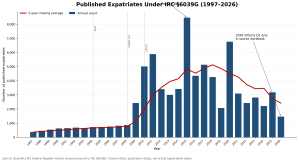
I highlighted some key concepts about why it matters if you become a “long-term” resident as that term is defined in the tax law and now the case law in Aroeste makes these risks clear as confirmed in the landmark case.
- A LPR can reside for substantially shorter periods in the U.S. (shorter than the apparent 7 or 8 years identified in the statute), and still be a “long-term resident” per IRC Section 877 (e)(2) depending upon the facts of any particular case.
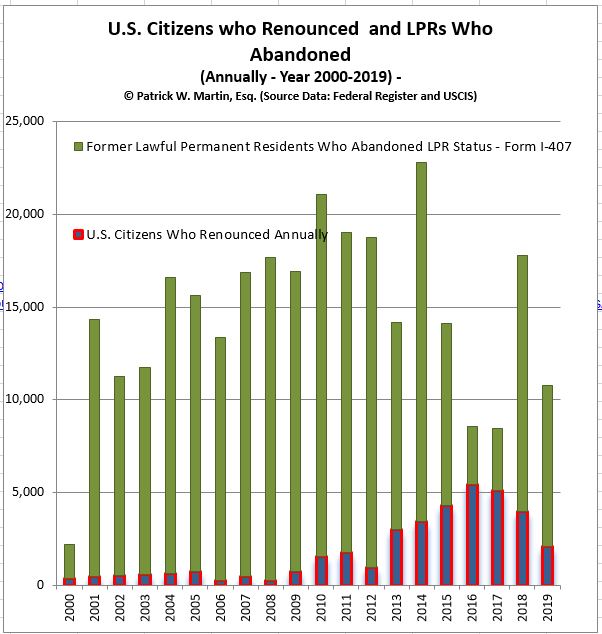
- There are far more LPRs who abandon their status (formally) than U.S. citizens who formally take the oath of renunciation. See the table above reflecting those who have formally renounced U.S. citizenship versus those who have formally abandoned their LPR status.
- Plenty of LPRs informally abandon their LPR status for immigration purposes by moving and living permanently outside the U.S.
- There are plenty of timing issues for LPRs surrounding how and when they have “abandoned” their LPR status for purposes of IRC Section 877 (e)(2). See –
Timing Issues for Lawful Permanent Residents (“LPR”) Who Never “Formally Abandoned” Their Green Card, Posted on August 15, 2015
* More Green Card Holders Abandon Status Than Citizens Renounce Citizenship
A frequently overlooked fact is that:
Formal Abandonment of LPR Status Is More Common Than Citizenship Renunciation
- Each year, substantially more lawful permanent residents formally abandon their green cards than U.S. citizens
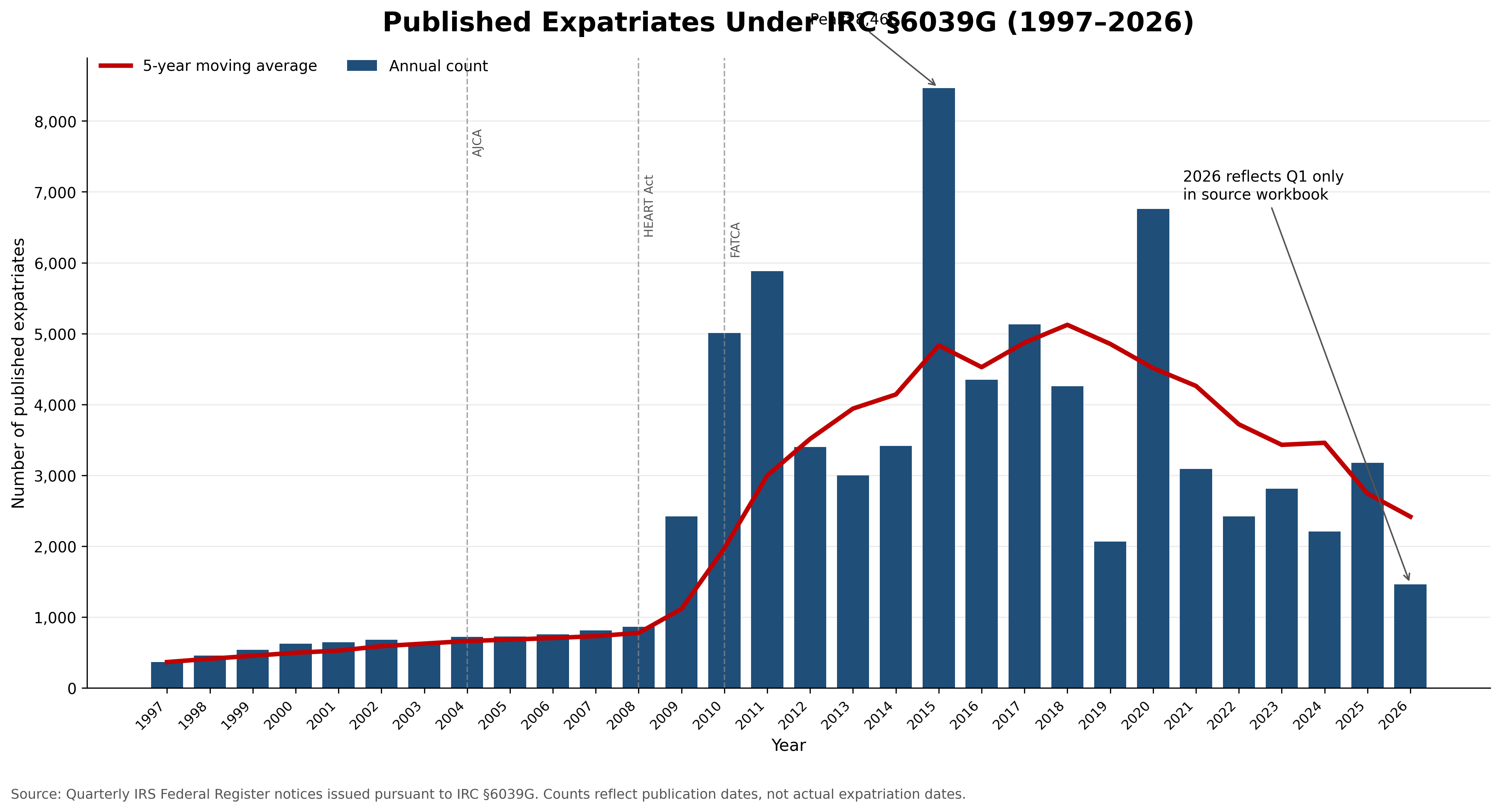
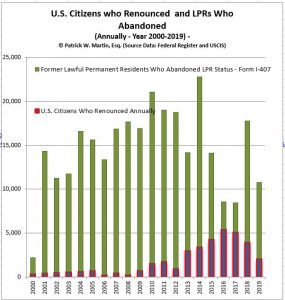 formally renounce citizenship. The focus in the press and media is typically U.S. citizens who formally renounce. Here is my most recently compiled graph, the total number of U.S. citizens renouncing is typically in the thousands (few) each year. It has trended downward post-COVID.
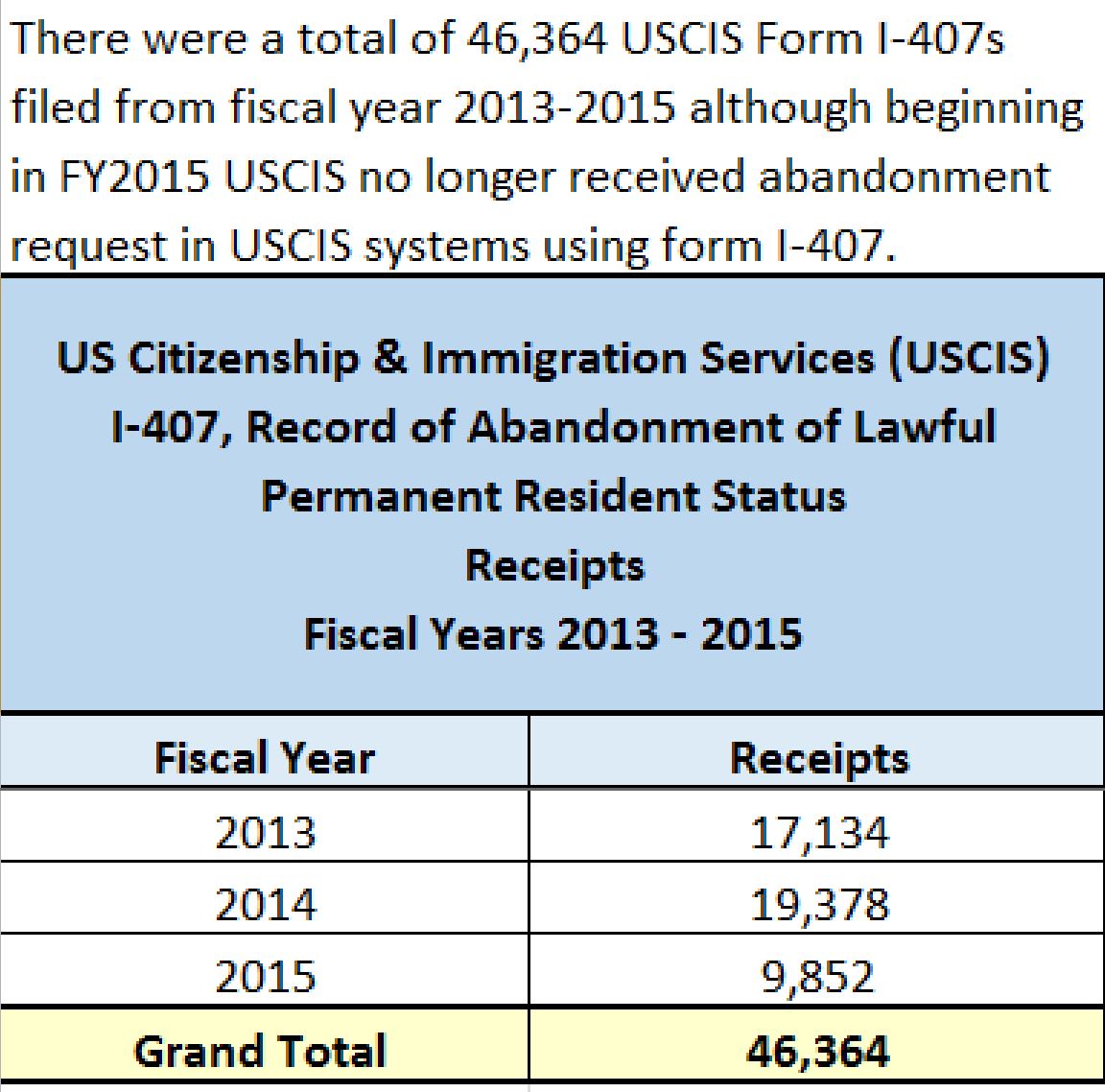
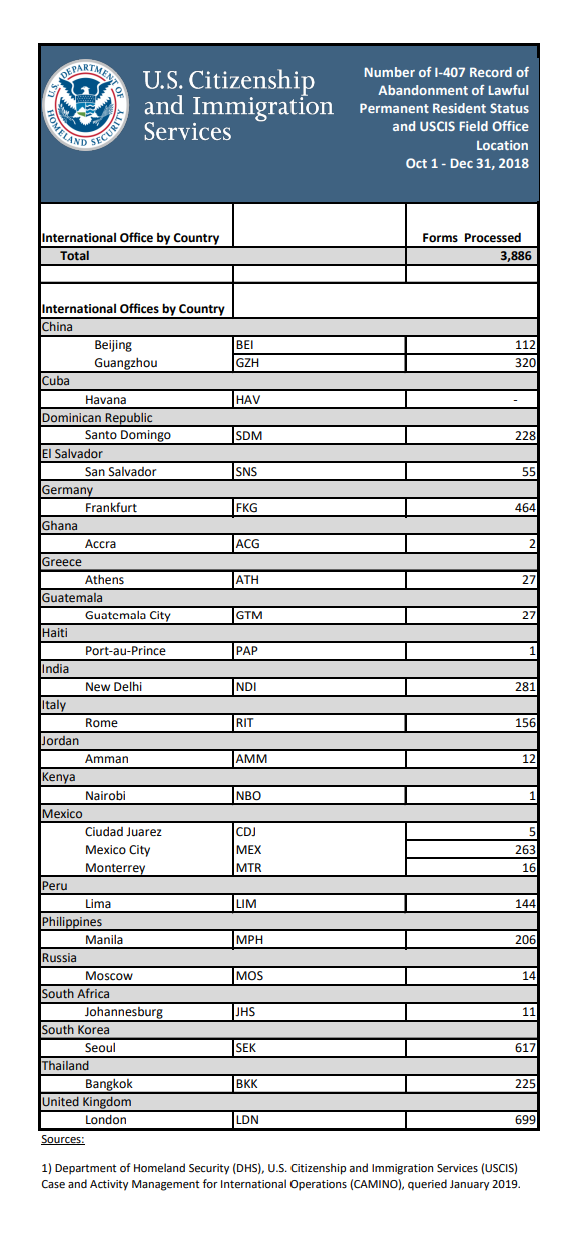
- However, with LPRs, formal recognition of abandonment by filing Form I-407 (not including informal abandonments which are multiple times greater) is multiple times greater.
- The graph I created several years ago, shows that formal LPR abandonments are mlutiple times greater than citizenship renunciation. I made a FOIA request with the government to request information about the number USCIS Forms I-407 that are filed with the government. See, also quarterly statistics of the USCIS – Form I-407, Record of Abandonment of Lawful Permanent Resident Status (partial information for years 2016-2019).
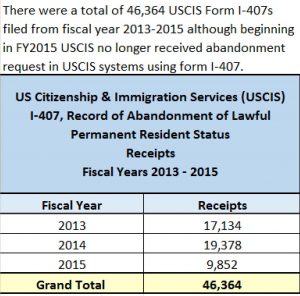
- I have made a new FOIA request for more recent records, since this data is no longer public after the year 2019 year.
- The statistics reflected above demonstrate that:
- Formal green card abandonment significantly exceeds formal citizenship renunciations.
- The population potentially affected by the expatriation rules is therefore much larger than many individuals around the world appreciate.
Lack of Control Over the Timing of Termination
One of the greatest risks for green card holders is that they often do not control the legal date on which their LPR status terminates, especially if they reside in a tax treaty country, per the analysis in the landmark case:
W hy This Matters
If abandonment is later determined by tax treaty law, effectively an CPB officer, the Executive Office for Immigration Review (EOIR) immigration court, the Board of Immigration Appeals (BIA)or a even a Federal District Court:
- The taxpayer may not control the effective date of termination – “expatriation”.
- If they are a “covered expatriate” or not.
- The tax consequences may arise unexpectedly.
- The timing can directly impact whether the tax expatriation rules apply and all of the potential consequences.
There are important unintended tax consequences that can befall individuals here: see, Oops…Did I “Expatriate” and Never Know It: Lawful Permanent Residents Beware! International Tax Journal, CCH Wolters Kluwer, Jan.-Feb. 2014, Vol. 40 Issue 1, p9).
-
-
Topsnik – Why Should I Care?
These timing issues become important when the IRS challenges tax positions taken on tax returns filed (or filed late) as was the case in Topsnik v. Commissioner (143 T.C. 240 (2014) – “Topsnik I”) and the subsequent case of Topsnik v. Commissioner (146 T.C. No. 1, 2016) – “Topsnik II”). In Topsnik II, Judge Kerrigan agreed with the IRS and ” . . . determined that P [taxpayer] was a “covered expatriate” who expatriated in 2010 and must recognize gain on the deemed sale of his installment obligation on the day before his expatriation under I.R.C. sec. 877A.” The U.S. Tax Court cited IRS Notice 2009-85 and explained it was not legally binding as follows:
We are not bound by Notice 2009-85, supra, see Compaq Computer Corp. v. Commissioner, 113 T.C. 363, 372 (1999), but it is an official statement of the Commissioner’s position and we may let it persuade us, see Nationalist Movement v. Commissioner, 102 T.C. 558, 583 (1994), aff’d, 37 F.3d 216 (5th Cir.1994).
The Tax Court went on to conclude these facts caused the court to conclude and uphold the IRS assessment of the “exit tax” on the German citizen Mr. Topsnik as a “covered expatriate” quoted as follows:
Notice 2009-85, sec. 8, 2009-45 I.R.B. at 611, explains that for purposes of certifying tax compliance for the five years before expatriation pursuant to section 877(a)(2)(C):
All U.S. citizens who relinquish their U.S. citizenship and all long-term residents who cease to be lawful permanent residents of the United States (within the meaning of section 7701(b)(6)) must file Form 8854 in order to certify, under penalties of perjury, that they have been in compliance with all federal tax laws during the five years preceding the year of expatriation. Individuals who fail to make such certification will be treated as covered expatriates within the meaning of section 877A(g) * * *
For the year of his expatriation petitioner failed to complete and file a Form 8854 certifying under penalties of perjury that he has complied with all of his U.S. Federal tax obligations for the five taxable years preceding the taxable year that includes his expatriation date. Respondent [IRS] has provided evidence that petitioner did not file all of his U.S. income tax returns before expatriatingand was not in payment compliance for taxes owed for the five years before expatriation in taxable year 2010. Thus petitioner could not have certified under penalties of perjury on a Form 8854 that he had been in tax compliance for the five years before expatriation. Consequently, because petitioner failed to certify tax compliance for the five years before expatriation, he is a “covered expatriate” as defined by section 877A(g)(1)(A).
Importantly, the court in Aroeste concluded IRS Form 8854 was not required to be filed (even though the DOJ attorney argued it was required – as set forth in the instructions to the form) as explained below:
C. Whether Aroeste Was Required to File Form 8854
The Government next argues that even if the IRS had accepted Aroeste’s amended
returns, neither amended return would have properly notified the IRS of a commencement
of treaty benefits because both failed to attach Form 8854, as required by IRS Notice 2009-
85.(Doc. No. 76-1 at 4–5.) The Government concedes Aroeste attached Form 8833 to both
amended forms. (Id.)
Aroeste responds that Notice 2009-85 is not binding authority as it fails to comply
with the Administrative Procedures Act (“APA”). (Doc. No. 78-1 at 8 (citing Green Valley
Investors, LLC v. Comm’r of Internal Revenue, 159 T.C. No. 5, at *4 (Nov. 9, 2022)) (under
the APA, agencies must follow a three-step procedure for “notice-and-comment”
rulemaking, but this requirement does not apply to “interpretive rules, general statements
of policy, or rules of agency organization, procedure, or practice.”).) The Court agrees. In
Mann Construction, Inc. v. United States, 27 F.4th 1138 (6th Cir. 2022), the court found
that Notice 2007-83 failed to comply with the APA’s notice-and-comment procedure.
Similarly here, because Notice 2009-85 has not been subject to a notice-and-comment
procedure, it does not comply with the APA and thus is not binding. As such, Aroeste was
not required to file Form 8854 with his amended returns.
Both the Green Valley Investors LLC case and Mann Construction were 2022 cases, some 6 years after Topsnik II.
My law firm, Chamberlain Hrdlicka, successfully represented the taxpayers in Green Valley and of course in Aroeste.
Most important Questions for “Green Card” Holders (“lawful permanent residents”): Part II of VI
We ended the last post (I of VI) on this topic by referencing a crucial article I authored and published more than a decade ago in the International Tax Journal– titled Oops.. .Did I Expatriate and Never Know It – (2014)
- Key Background on LPRs and “Oops . . . Did I Expatriate”?
 Please first read Part I of this series: Most important Questions for “Green Card” Holders (“lawful permanent residents”): Part I of VI, which outlines some of the foundational questions every green card holder should consider before addressing the additional issues questions below.
 Many individuals have no idea that, under the legal principles confirmed in the federal district court case I litigated — Aroeste v United States, 22-cv-00682-AJB-KSC (20 Nov. 2023) – they may already be treated as “covered expatriates” as a matter of law.
- Along Comes Section 2801 – and 2025 Final Regulations – The “Forever Taint” to Family and Friends (Paying the Taxman)
Please read an earlier post from yours truly (About the Author: Patrick W. Martin), more than a decade ago –“Covered Expatriate” Status is a “Scarlet Letter”— which discusses the severe and often misunderstood consequences of covered expatriate status.
In addition, see another earlier post I authored explaining why covered expatriate status matters even for individuals with modest or limited assets: Why “covered expat” (“covered expatriate”) status matters, even if you have no assets! The “Forever Taint”!
- Aroeste – Landmark Decision Confirms the Law – Tax Treaty Law Applies – Taxpayers Do Not Waive Benefits per Gov’t
These writings all addressed the same underlying legal and policy expectations that courts would eventually be required to confront — issues now directly addressed in Aroeste. The Aroeste decision is also consistent with positions I successfully advanced in three separate U.S. Tax Court cases involving green card holders, none of which resulted in published opinions because the government ultimately conceded to my arguments and my clients prevailed prior to trial.
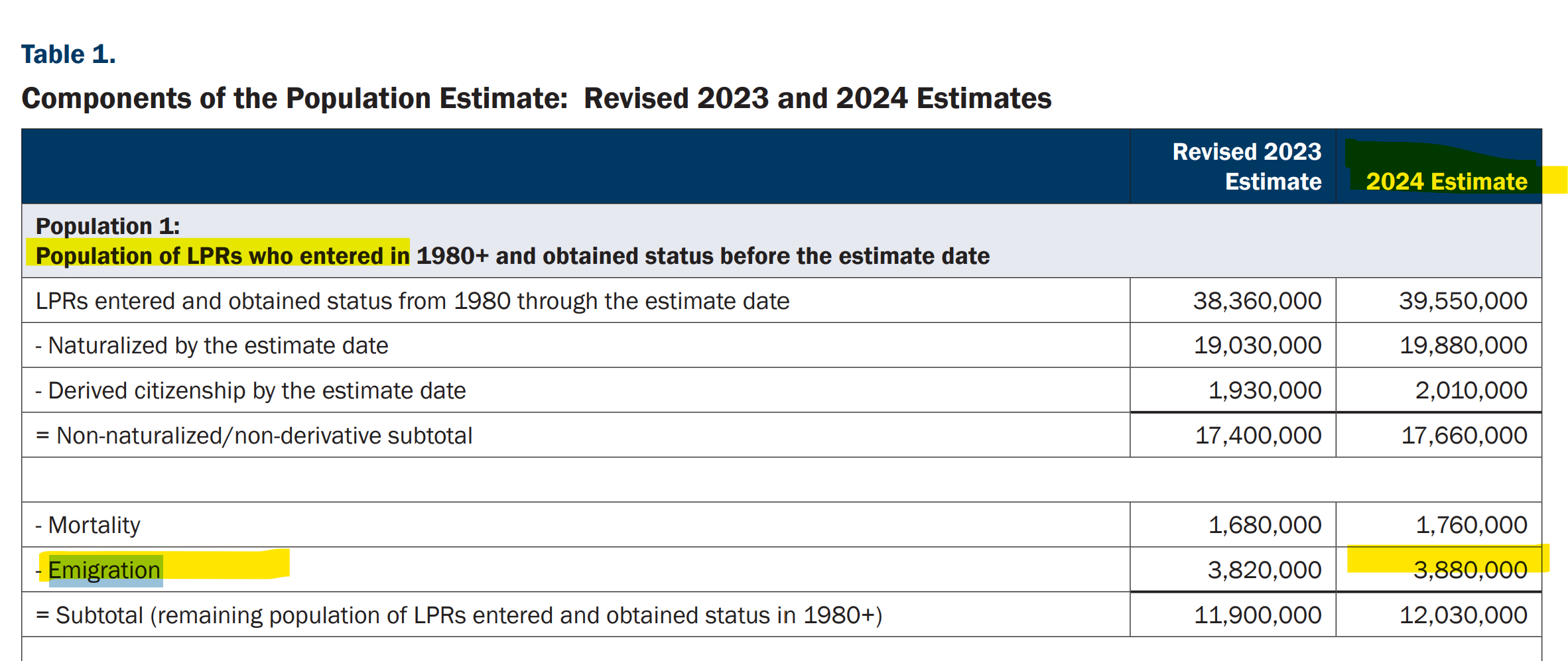
This case law has great impact on green card holders who are living principally outside of the U.S. There are 3.88 million individuals who are living outside the U.S. – per the 2024 report by the U.S. federal government. Many of them live in a treaty country. Many of these individuals might be considering their immigration law consequences (particularly after the latest announcement from the USCIS – impact these immigration consequences: U.S. Citizenship and Immigration Services Will Grant ‘Adjustment of Status’ Only in Extraordinary Circumstances (May 2026) Few have considered the tax law implications.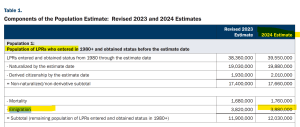
See, the Homeland Security, Office of Immigration Statistics – Estimates of the Lawful Permanent Resident Population in the United States and the Subpopulation Eligible to Naturalize: 2024, and Revised 2023; see Table 1 in the report.
In order to understand what issues anyone with a green card has (especially when living outside the U.S.), some key questions should be asked:
- Gifts and inheritances after I leave (what U.S. taxes)
- Worldwide income while I still have the green card
-
- Does the U.S. tax the salary I earn in my home country?
- Am I still a U.S. taxpayer?
-
- If I never told USCIS I left, does the IRS still consider me a U.S. tax resident?
-
- Can I be a U.S. tax resident and a tax resident of my home country at the same time?
-
- What is a “tax treaty tie-breaker” and how does it help or hurt me?
- Aroeste v. United States — what does it mean for me? –
-
- If I use the treaty to be a non-resident, am I giving up my green card automatically?
-
- Can I be a non-resident for income tax under the treaty but still be considered a “U.S. person” for other rules like FBAR?
- Do all forms I file with the U.S. federal government (IRS, USCIS, ICE and others) subject me to claims of signing under penalty of perjury?
Stay tuned . . . . . . . . . for III of VI