
Today’s “tax expatriation” provisions which are based upon “mark-to-market” concepts of a “deemed/fictional sale” of worldwide assets, look quite different from the original law. The first version was adopted by The Foreign Investors Tax Act of 1966 (“FITA”). FITA introduced a number of specific tax concepts applicable to non-residents.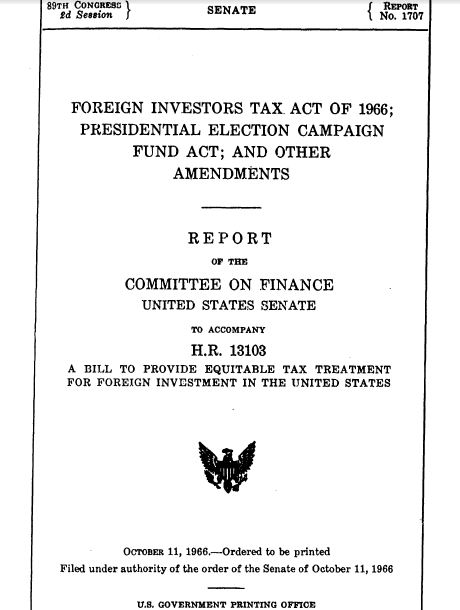
In addition, it created the first concept of “tax expatriation” for former U.S. citizens, that remained unchanged until the amendments in the law in 1996. There was no reference to lawful permanent residency (or former LPRS) in the 1966 FITA.
The basic concept of the statute remained largely unchanged from the 1996 revisions compared to the original FITA 1966 version, which then I.R.C. § 877(a)(1) provided in relevant part as follows:
**
These old rules imposed U.S. tax on gains for a 10 year period after the former U.S. citizen became a nonresident alien. The tax rate applicable was the normal U.S. rate and it was levied on gains from the sale of U.S. property, specifically stock and debt in U.S. companies. Those items of income were treated as U.S. source income for that purpose.
The big difference in the 1996 revisions, was the creation of a presumption of a “principal purpose of tax avoidance” that had to be rebutted by submitting a private letter ruling request to the IRS.
For a somewhat provocative look at the law and its history, see, CATCH ME IF YOU CAN: RELINQUISHING CITIZENSHIP FOR TAXATION PURPOSES AFTER THE HEART ACT By: Yu Hang Sunny Kwong
???????????????? ?Please click here to view the above in Chinese.?