Part 1- Unintended Consequences of FATCA – for USCs and LPRs Living Outside the U.S.
As the Foreign Account Tax Compliance Act (“FATCA”) has gone into effect (1 January 2014), there are an increasing number of consequences to United States citizens (USCs) and lawful permanent residents (LPRs) residing overseas.
There are many intended consequences of the FATCA law, such as the following:
- Identifying non-U.S. financial, investment and company assets of USCs and LPRs;
- Identifying the foreign financial institution (“FFI”) where such assets are located;
- Identifying non-financial foreign entities (“NFFE”) owned by the USC or LPR;
- Generally bringing transparency to the assets, accounts and information of worldwide assets of USCs and LPRs.
See, FATCA Driven – New IRS Forms W-8BEN versus W-8BEN-E versus W-9 (etc. etc.) for USCs and LPRs Overseas – It’s All About Information and More Information
Ironically, I see a number of unintended consequences of FATCA; meaning consequences that were never contemplated by the U.S.  Congress or the President when the laws were passed. Nor were they intended consequences of the U.S. Treasury Department as the FATCA Intergovernmental Agreements (“IGA) were negotiated throughout the world with various countries. See, Complete List of IGA Countries to Date (Very Few Notable Absences)
This and other follow on posts will discuss these unintended consequences.
One of the most significant unintended consequence, is that the U.S. federal government (the IRS, the Treasury Department, or 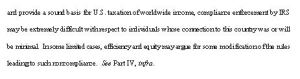 Congress) never initially even contemplated USCs and LPRs living overseas. In other words, the group targeted were U.S. resident individuals who were evading taxes through foreign financial institutions. I say this, based upon extensive conversations I have had with ex-government officials and some government officials who were involved in the original policy discussions.
The focus then was on U.S. resident taxpayers; even though the U.S. imposes U.S. income taxes on the worldwide income of USCs living anywhere in the world. See, “Tax Simplification: The Need for Consistent Tax Treatment of All Individuals (Citizens, Lawful Permanent Residents and Non-Citizens Regardless of Immigration Status) Residing Overseas, Including the Repeal of U.S. Citizenship Based Taxation,” by Patrick W. Martin and Professor Reuven Avi-Yonah, 2013.
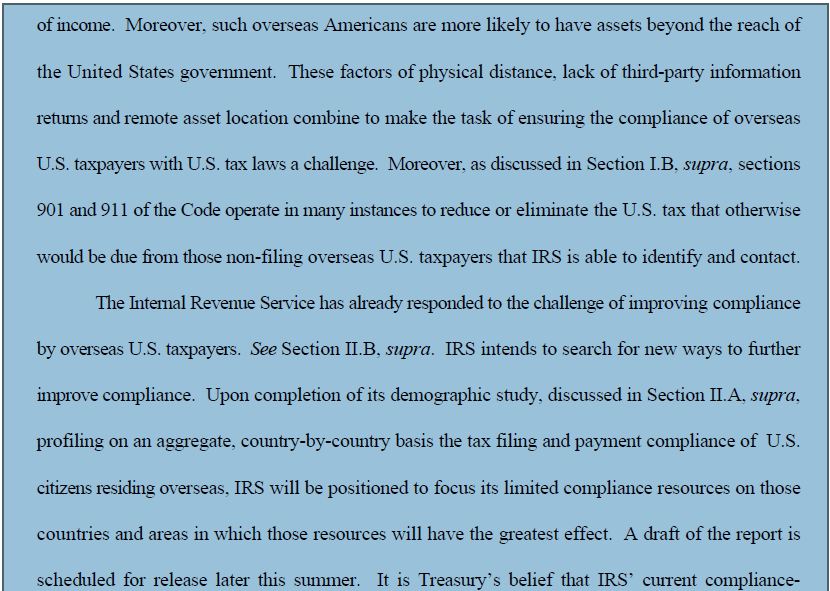
In practice, the U.S. federal government has known for many years that it can be nearly impossible to collect a tax liability against USCs who live and have their assets outside of the U.S. Specifically, the Treasury Department noted back in 1998 that . . .
- Other factors also operate to limit both compliance measurement and improvement. Because the United States asserts taxing jurisdiction over those with little or no connection to the United States other than citizenship or status as a lawful permanent resident, in many cases overseas U.S. taxpayers are difficult to trace or contact. Moreover, even when valid tax assessments can be made against overseas taxpayers, IRS has limited enforcement recourse if the taxpayer’s assets are physically located outside of the United States.
See pages 13-15 of the Treasury report which can be found at the post, Sometimes Old is as Good as New – 1998 Treasury Department Report on Citizens and LPRs
Also, the original offshore voluntary disclosure initiative in 2009 never even contemplated any particular treatment for USCs or LPRs residing overseas. I submit, the USC and LPR living overseas was not even on the “radar” of the IRS at the time the first program was created. It was not until 2011, that a new category was created that imposed a 5% penalty for persons residing overseas, but who also had only US$10,000 of U.S. sourse income.
As time has gone on, the IRS has realized that numerous USCs and LPRs indeed live somewhere other than the U.S. (millions of them) and yet again modified the 2014 OVDP to provide for a “0%” penalty in certain circumstances for these individuals.
When FATCA was originally passed in 2010, USCs and LPRs living overseas was not the focus (and barely a thought). The heavy  compliance focus as of late was an unintended consequence.
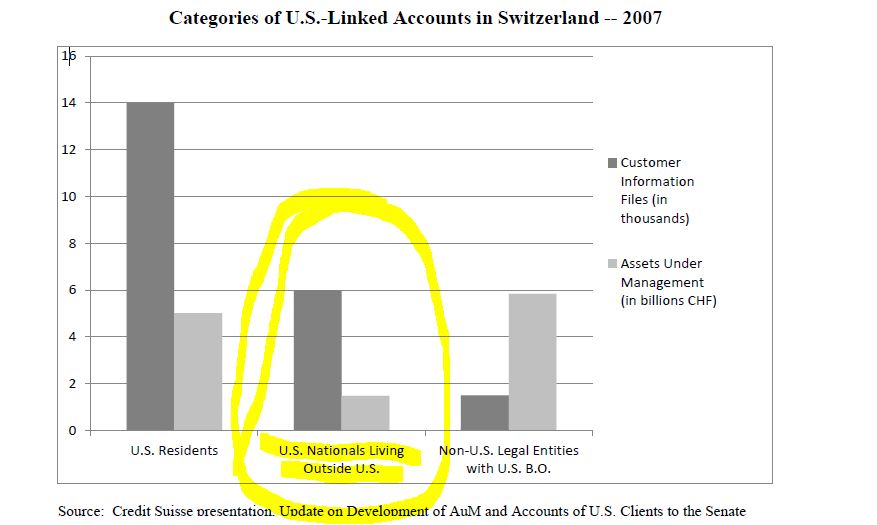
Now even the Senate has started to focus on USCs living overseas. The Senate Permanent Subcommittee on Investigations focused extensively on Swiss accounts opened by USCs living overseas. The full report can be read REPORT: Offshore Tax Evasion:The Effort to Collect Unpaid Taxes on Billions in Hidden Offshore Accounts (February 26, 2014) –
In those reports, the Senate Permanent Subcommittee on Investigations focused extensively on USC owned Swiss accounts opened by USCs living outside the U.S. See, Key Take Aways from Senate Investigations re: Foreign Banks and “Offshore Tax Evasion”: U.S. Citizens Residing Overseas have Become a Focus of the Government.;
Read the Q&A format here.
Samples of International Tax Frauds that are Flourishing Now with More Taxpayer Financial Information Required Under the Law
This post is a follow-on to the post of yesterday explaining the explosion of tax frauds that are flourishing requesting bank and financial account information. The law indeed requires U.S. citizens living abroad (and some LPRs living outside the U.S.) to report and file various detailed personal and bank information as follows:
- passport numbers,
- bank account names
- bank account addresses,
- bank and financial account information,
- highest balance in these bank accounts,
- full name of individual,
- taxpayer identification numbers of the individuals,
- along with extensive personal and financial information.
See, International Tax Frauds are Flourishing Now with More Taxpayer Financial Information Required Under the Law
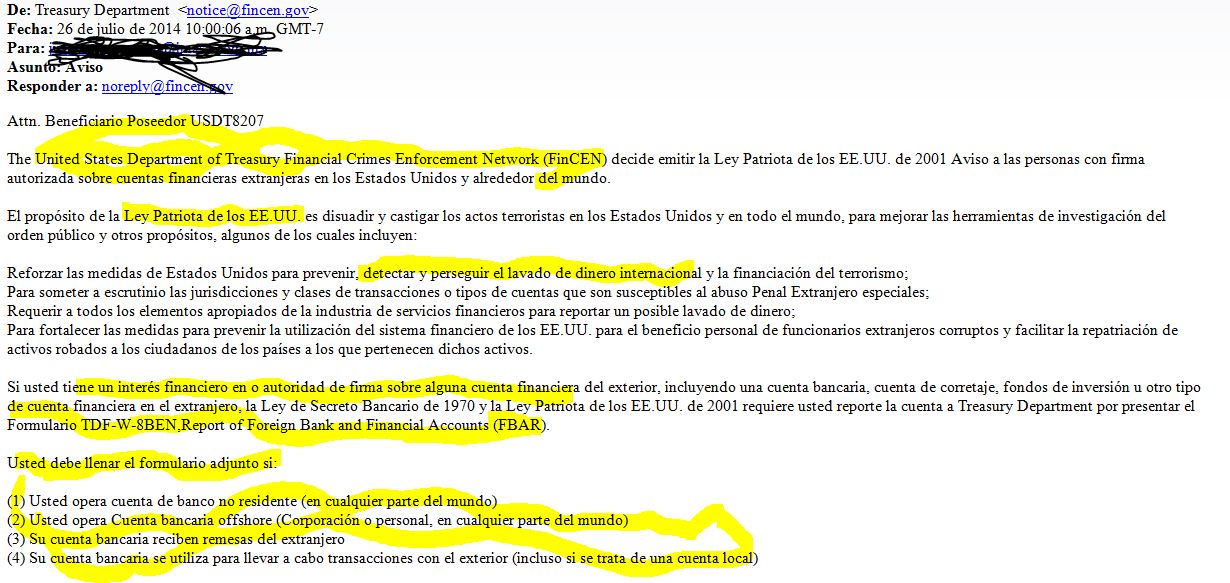
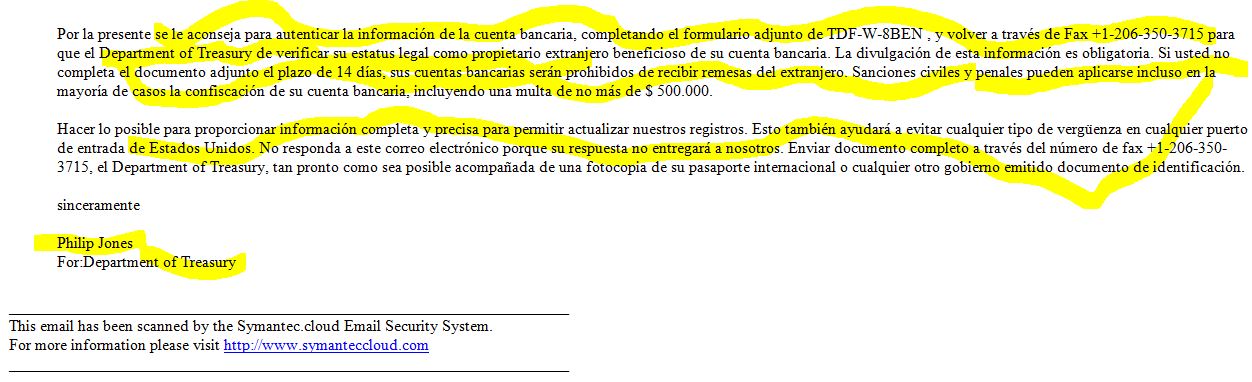
Accordingly, the type of frauds demand immediate reporting of the bank account information, purportedly to the U.S. Treasury Department. Here are examples of some of these fraudulent demands (this one in Spanish) that warns of stiff penalties, including criminal penalties for failure to provide the information within 14 days.
These requests are typically accompanied by an actual Treasury Department Form TD F 90-22.1 (Report of Foreign Bank and Financial Accounts) which are being requested to be completed with the detailed information required under the law and to be returned and sent via facsimile immediately to the U.S. Treasury Department (with an area code that is indeed in the Washington D.C. area). These are false requests.
As FATCA is implemented further throughout this year and the upcoming years, there will indeed be a range of fraudulent schemes designed to capture financial and personal information of individuals around the world. See, FATCA Driven – New IRS Forms W-8BEN versus W-8BEN-E versus W-9 (etc. etc.) for USCs and LPRs Overseas – It’s All About Information and More Information
U.S. Tax Court Rules Against Lawful Permanent Resident (LPR) in Abrahamsen
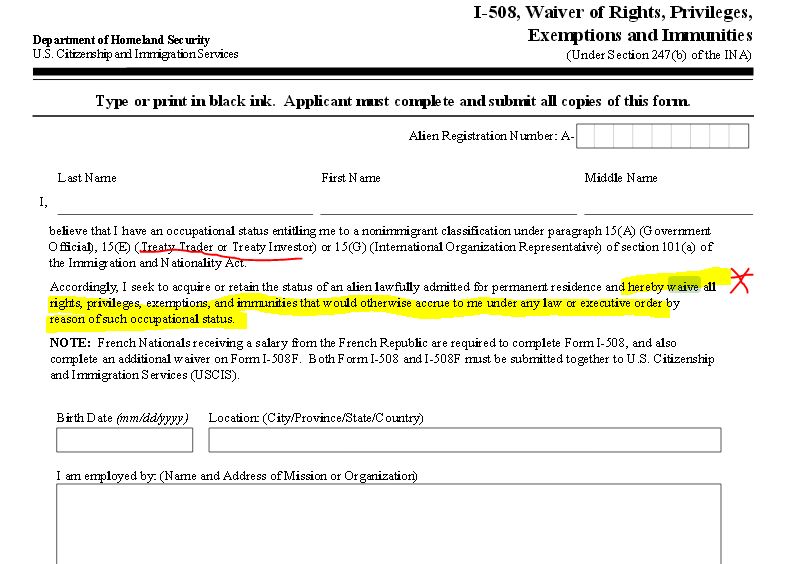
The U.S. Tax Court, in an opinion written by Judge Lauber (Abrahamsen v. Commissioner) placed much legal tax significance on the immigration form I-508 that Ms. Abrahamsen signed. 
The Court noted this form, I-508, Waiver of Rights, Privileges, Exemptions and Immunities (Under Section 247(b) of the INA) specifically provides that the non-U.S. citizen “waive all rights, privileges, exemptions and immunities which would otherwise accrue to [her] under any law or executive order by reason of [her] occupational status.”
In that case, the individual was a Finnish citizen who eventually applied for lawful permanent residency. The immigration forms were not related to any specific tax form, such as the new IRS Forms W-8BEN; see, IRS Releases New IRS Form W8-BEN. * U.S. citizens and LPRs beware of completing such form at the request of a third party.
The takeaway from this opinion, is that individuals need to be aware of how signing a particular form (that is not a tax form) can have adverse tax consequences. In this case, the Court ruled that she had waived her benefits to IRC Section 893 by signing immigration Form I-508. The opinion of the Tax Court raises an interesting legal question about how signing a form (I-508) can seem to override the statutory protection granted which provides protection to a qualifying “. . . employee [who] is not a citizen of the United States . . . “
Signing various tax forms can cause even greater risks for non-citizen taxpayers; e.g., IRS Form W-9 versus W-8BEN. See, FATCA Driven – New IRS Forms W-8BEN versus W-8BEN-E versus W-9 (etc. etc.) for USCs and LPRs Overseas – It’s All About Information and More Information*
Fortunately for the taxpayer in the Abrahamsen case, she was not subject to the Section 6662 accuracy related penalty (“negligence” penalty) assessed by the IRS.
A subsequent post will analyze some potential U.S. tax consequences for individuals who sign immigration Form I-485, Application to Register Permanent Residence or Adjust Status
Why do I have to get a Social Security Number to file a U.S. income tax return (USCs)?
U.S. citizens who meet certain income thresholds (currently about US$10,000 for individuals not filing married-jointly; and about US$20,000 for individuals filing married-jointly) who reside outside the U.S. have no choice but to obtain a SSN in order to file tax returns under U.S. law. See the specific income thresholds for who is required by law to file a U.S. tax return, here.
As explained in a previous post, under U.S. tax jargon a “taxpayer identification number” (TIN) is a broad definition and includes all of the following, which are TINs –
- U.S. Social Security Number (“SSN”) in the case of certain individuals (USCs, LPRs and those who have permission to work in the U.S. under a particular visa);
- “Individual Taxpayer Identification Numbers” (ITIN) in the case of other individuals who are not USCs or LPRs and not otherwise eligible for a SSN (another post will explain how ITINs are obtained);
- Employer identification numbers (EINs) for certain entities, such as corporations, partnerships and trusts.
Most importantly, the regulations specifically require a U.S. citizen to obtain a SSN to use it as the “taxpayer identifying number.” The relevant regulations provides that
(A) Except as otherwise provided in paragraph (a)(1)(ii)(B) and (D) of this section, and § 301.6109-3, an individual required to furnish a taxpayer identifying number must use a social security number.
The exceptions referred to above where a SSN is not required in these regulations are principally for individuals who are not U.S. citizens and not eligible to obtain a SSN. See, Social Security Numbers for Noncitizens as published by the Social Security Administration (“SSA”). Any U.S. citizen is eligible for obtaining a SSN. For information regarding applying for a SSN, see the SSA website.
Ironically, it can be very difficult (nearly impossible in some cases) for USCs who have spent most (if not all) of their lives outside the U.S.; considering the methods of proof required by the SSA when the Application For a Social Security Card (Form SS-5-FS) is submitted.
Once a SSN is obtained, the USC is required to complete IRS Form W-9 vis-a-vis third parties providing them proof of their status and SSN.
More will be discussed in later posts about how to get a SSN overseas from a U.S. Embassy and some Consulate offices. Also, see, The Catch 22 of Opening a Bank Account in Your Own Country – for USCs and LPRs.
Part II: IRS Form W8-IMY – FATCA Driven – More on the W-9 and W-8 Alphabet Soup with FATCA: IRS Form W8-IMY
Part II: IRS Form W8-IMY – FATCA Driven – More on the W-9 and W-8 Alphabet Soup of FORMs: IRS Form W-8-IMY
FATCA, “Chapter 4”, withholding started the first week of this month, July 1, 2014. Presumably the amount of FATCA withholding will be nominal, if for no other reason, virtually all of the major world economies are countries that have actually signed an IGA or “reached an agreement [FATCA] in substance”.
See the complete and most recent list of countries who have signed FATCA IGAs or “reached an agreement in substance.” See, Russia Joins the FATCA Group – On the Last Day? Complete List of Countries to Date (Very Few Notable Absences)
As explained in previous posts, the U.S. federal tax authority, the Internal Revenue Service (IRS) has been modifying dramatically the tax forms required to be filled out and filed by both individuals, financial institutions around the world (FFI) and by non-financial foreign entities (NFFE) all due to FATCA. See, specifically the post that focused on new form W8-BEN-E. See, FATCA Driven – New IRS Forms W-8BEN versus W-8BEN-E versus W-9 (etc. etc.) for USCs and LPRs Overseas – It’s All About Information and More Information
United States Citizens (USCs) and Lawful Permanent Residents (LPRs) who reside outside the U.S. will need to have a general understanding of how these forms are to be completed. This is particularly important, since they are to be signed under “penalty of perjury” as to their accuracy. There will be a host of institutions that will be requesting USCs and LPRs residing overseas to complete these forms, including their banks, investment and brokerage houses, investment funds, private companies, mutual funds, etc. in their home country of residence or any other country outside the U.S.
What information and how it needs to be provided, depends upon whether the USC or LPR is being asked to sign as an individual. If that is the case see, FATCA Driven – New IRS Forms W-8BEN versus W-8BEN-E versus W-9 (etc. etc.) for USCs and LPRs Overseas – It’s All About Information and More Information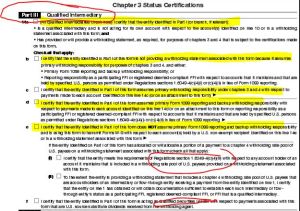
If the account with the financial institution is not an individual account, a W8-BEN-E or W8-IMY will typically be required to be completed by the entity, when the USC or LPR has an ownership interest in the entity (e.g., corporation, partnership or trust). Specifically when a USC or LPR is a “substantial U.S. owner” as defined by the statute and FATCA regulations. In short, a “substantial U.S. owner” is a “U.S. person” (which always includes USCs and sometimes includes LPRs) with more than a 10% interest by vote or value in a foreign corporation, partnership or trust.
There is no 10% ownership threshold for “foreign investment vehicles” (as defined in IRC Sections 1473(2)(B) and 1471(d)(5)(C)) such as investment funds, private equity funds, private companies, etc. where itis engaged (or holding itself out as being engaged) primarily in the business of investing, reinvesting, or trading in securities, partnership interests, commodities, or any interest (including a futures or forward contract or option) in such securities, partnership interests, or commodities.
As you can see, this is a very broad definition that does not require any ownership threshold to cause reporting; a .00001% ownership interest in a “foreign investment vehicle” will give rise to a “U.S. owner” and hence subject to FATCA reporting.
This post and follow-up posts focuses on a few key aspects of the Form W-8IMY.
Incorporated into this post are key pages, showing the different categories that a partnership or a trust (or other “flow through” entity) will be required to complete when representing their status to different third parties, including foreign financial institutions.
Normally, the individual USC or LPR will not need to complete the W-8IMY (but certainly may be required if they are the managing partner of a partnership, trustee of a trust, or fall into other categories identified in the law). It will be the trust or partnership itself that will be collecting information about its U.S. owners (e.g., through an IRS Form W-9). The trust or partnership itself, will then be reporting this information to the foreign financial institution that will then report to the IRS (or to their own country who will then report to the IRS if there is an IGA in place).
U.S. Enforcement/Collection of Taxes Overseas against USCs and LPRs – Legal Limitations
Maybe its a natural response for USCs and LPRs living overseas to ask: “What is the chance I will get audited by the IRS?” Sometimes, those individuals who either have less good faith (or are simply ignorant about how U.S. tax law functions) will also ask: “How will the U.S. government ever know of my assets or income in my home country?”
A follow-up question is how does the U.S. federal government enforce tax obligations overseas? This question often comes, of course, from individuals who reside in different countries outside the U.S. and typically have most (if not all) of their assets located in their country of residence.
A USC or LPR residing in Costa Rica, for instance, might have almost all of his business assets in Costa Rica and maybe financial investment assets in nearby regions such as Panama. Similarly, a Chinese born dual national USC may have companies and business assets in both mainland China and Hong Kong. If neither of these individuals have assets in the U.S., how can the U.S. federal government enforce tax liens, levies and the like against these individuals?
These questions are getting asked more and more now that FATCA has gone into force and financial information around the world is being collected regarding USC accounts in virtually all countries and financial institutions. See, FATCA Driven – New IRS Forms W-8BEN versus W-8BEN-E versus W-9 (etc. etc.) for USCs and LPRs Overseas – It’s All About Information and More Information
An excellent layman’s term summary of FATCA can be located on HSBC’s website here.
This overseas asset and income information will eventually be delivered, pursuant to the FATCA rules, to the U.S. Internal Revenue Service (IRS – revenue authority).
Hence, the collection of information under FATCA will be extensive. This, at least in part, answers the question of: “How will they ever know of my assets or income in my home country?” Admittedly, the complete answer to this question is far more complicated, when one considers the intricacies of FATCA and its regulations and other guidance from the IRS/Treasury.
However, that is a different question, than how that financial and income information will be used by the IRS to (a) make tax assessments, (b) assess and collect foreign bank account report (FBAR) penalties (See, Section 16 of the IRM), and (c) generally enforce and collect such tax assessments and penalties against USCs and LPRs residing outside the U.S.
1. INFORMATION – The collection of asset and financial information under FATCA has a very “long arm” around the world. Indeed, the image of the Uncle Sam octopus published in the June 28, 2014 article in the The Economist entitled Taxing America’s diaspora: FATCA’s flaws captures well the idea of the reach of FATCA.
2. INFORMATION VS COLLECTION – However, enforcing tax assessments and penalties and collecting against assets located outside the U.S. is a very different legal question, without such a “long arm”; simply because the reach and jurisdiction of U.S. law is necessarily limited and regularly in conflict with local laws of different countries.
To say it another way, Uncle Sam can indeed enforce the collection of financial and asset information under FATCA, due to the economic costs and ramifications to financial institutions and their investors if they did not comply with the automatic information exchange. However, Uncle Same cannot simply enforce the collection of U.S. taxes and penalties through the worldwide financial institutional network, the same way it can in the U.S.
The U.S. has broad lien, levy and seizure powers under U.S. tax law. The IRS can simply seize assets from U.S. bank accounts without going to a judge or court for final (or jeopardy) tax assessments provided they comply with various provisions of the law. This is not a typical concept in the law for other creditors (other than the IRS) who must generally first take steps through the courts to get some type of judicial action (e.g., a court order) before simply seizing and taking assets from an individual.
The IRS’s broad lien and levy powers against assets, however, has significant limitations overseas. See the 1998 Treasury Report – Sometimes Old is as Good as New – 1998 Treasury Department Report on Citizens and LPRs, I hav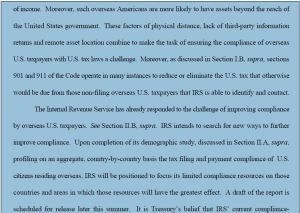 e worked with IRS Revenue Officers who specialize in international collection matters who argue and assert they can merely exercise this lien and levy power overseas against foreign financial institutions. However, this is where the power of the IRS comes to a screeching halt (or at least a major slowdown); when the collection of overseas assets is at stake.
The IRS is not without remedies to collect foreign assets, but it is not a simple process; if it can be done at all in any particular circumstance.
The IRS has no specific enforcement provisions negotiated in international treaties that will necessarily enable them to enforce and collect U.S. income taxes overseas with foreign government assistance. The cornerstone 9th Circuit case of Her Majesty held in 1979 that the Canadian tax authorities could not enforce a tax judgment against U.S. taxpayers within the U.S. –
The basic facts were these, as reported in the case:
British Columbia then served a “Notice of Intention to Enforce Payment” on the defendants in the United States, and filed a certificate of assessment in the Vancouver Registry of the Supreme Court of British Columbia. This certificate was for $195,929.50 (a penalty and interest were included), and under the laws of British Columbia its filing gave it the same effect as a judgment of the court. British Columbia then instituted the present action in the United States. It was dismissed because the court below concluded that the Oregon courts would follow the “revenue rule.” Stated simply, the revenue rule merely provides that the courts of one jurisdiction do not recognize the revenue laws of another jurisdiction.1
The U.S. 9th Circuit Court went on to say:
Although the Supreme Court has never had occasion to address the question of whether the revenue rule would prevent a foreign country from enforcing its tax judgment in the courts of the United States, the indications are strong that the Court would reach the same result as we reach in the present case. Both the majority and the dissenting opinion in Banco Nacional de Cuba v. Sabbatino, 376 U.S. 398, 84 S.Ct. 923, 11 L.Ed.2d 804 (1964), discussed the rule in a spirit which indicates a continued recognition of the revenue rule in the international sphere.10
This Majesty case specifically cited a Canadian Supreme Court case (Harden) which also applied the revenue rule in not enforcing a tax judgement in the U.S. courts for taxes against a Canadian resident:
Reciprocity would itself be a sufficient basis for denying British Columbia’s claim. The courts of British Columbia, relying upon the revenue rule, have refused to recognize the judgment of a United States court for taxes. United States v. Harden, 1963 Canada Law Reports 366 (Sup.Ct. of Canada, 1963, Affirming Court of Appeal for British Columbia).12
CONCLUSION: The revenue rule has been with us for centuries and as such has become firmly embedded in the law. There were sound reasons which supported its original adoption, and there remain sound reasons supporting its continued validity. When and if the rule is changed, it is a more proper function of the policy-making branches of our government to make such a change.
As a result of these cases and the Revenue Rule, the U.S. and Canada modified their income tax treaty to (at least in theory) allow for the international enforcement of taxes. The U.S. now has five income treaties with “mutual assistance” provisions: Canada, Sweden, France, Denmark, and the Netherlands (with a clause in the newly negotiated, but yet to go into force, Swiss treaty).
The U.S. tax and international tax world has changed dramatically since 1979 and the 9th Circuit case of Her Majesty particularly with the advent of FATCA. Nevertheless, there are serious legal limitations imposed on t he IRS in collecting assets for U.S. tax liabilities and penalties owed by USCs and LPRs residing overseas. Indeed, this is surely one of the principle reasons the IRS revised OVDP terms in June 2014 impose a 0% penalty against USCs and LPRs who participate in the so-called “streamlined process”. See, More on the New 2014 “Streamlined” Process for USCs and LPRs Residing Overseas.
The follow-on post will discuss the very limited provisions that have been recently negotiated with these five different countries and explain in more detail the limits on the U.S. federal government on the collection of taxes. It will also discuss the important differences of civil U.S. international tax enforcement/collection versus criminal tax enforcement; which are two very different beasts.
Finally, a dedicated post on the topic will discuss the steps the U.S. federal government is taking through the Department of Homeland Security and a database of information (TECS) to track and monitor people and their assets. The government describes TECS as follows: “The Treasury Enforcement Communications System (TECS) is a database maintained by the Department of Homeland Security (DHS), and it is used extensively by the law enforcement community. It contains information about individuals and businesses suspected of, or involved in, violations of federal law.”
FATCA Driven – New IRS Forms W-8BEN versus W-8BEN-E versus W-9 (etc. etc.) for USCs and LPRs Overseas – It’s All About Information and More Information
FATCA Driven – New IRS Forms W-8BEN versus W-8BEN-E versus W-9 (etc. etc.) for USCs and LPRs Overseas- It’s All About Information and More Information
An earlier post explained why U.S. citizens (and some LPRs)  cannot sign the new IRS Form W-8BEN. See, IRS Releases New IRS Form W8-BEN. * U.S. citizens and LPRs beware of completing such form at the request of a third party.
IRS Forms, W-8, W-9, W-8BEN-E, W-7, W-8IMY, W-4, W-8ECI, W-8EXP are a confusing alphabet soup of IRS forms. They have become more difficult to understand now because of the intricacies of the law of FATCA. See, The Importance of a Certificate of Loss of Nationality (“CLN”) and FATCA – Foreign Account Tax Compliance Act.
In short, these forms are designed to “track taxpayers”; their assets and their accounts. The forms track and identify USCs who are individuals and if they are “substantial owners” (basically 10%) in various foreign entities; explained more below.
U.S. tax lingo means that a “taxpayer identification number” (TIN) is a broad definition and can also include all of the following, which are TINs –
- “Social Security Number” (SSN) in the case of certain individuals (USCs, LPRs and those who have permission to work in the U.S. under a particular visa);

- “Individual Taxpayer Identification Numbers” (ITIN) in the case of other individuals who are not USCs or LPRs and not otherwise eligible for a SSN (another post will explain how ITINs are obtained);
- Employer identification numbers (EINs) for certain entities, such as corporations, partnerships and trusts.
Hence, an SSN, ITIN, EIN are all TINs, depending upon which context they are being used.
My earlier post warns U.S. citizens NOT to sign IRS Form W-8BEN, because such certification would be false. – Importantly, no U.S. citizen can legally sign and certify they are NOT a “U.S. person” under U.S. federal tax law. Hence, they cannot sign and complete IRS Form W-8BEN. –
Individual U.S. citizens should normally be signing IRS Form W-9, or the substitute form provided by the financial institution when asked for their U.S. taxpayer status. Banks and other third parties can have their own 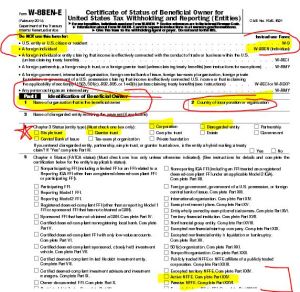 substitute returns that comply with the regulations. Hence, the form might not look exactly like the official IRS forms reflected here.
The IRS Form W-9 is to request the U.S. taxpayer identification number of a U.S. citizen and LPR (or a TIN for a U.S. company – or other company). The IRS version is reflected herein. See, The Catch 22 of Opening a Bank Account in Your Own Country – for USCs and LPRs.
Why is all of this important, now with FATCA in effect and operational throughout the world?
There is greater focus on information that will be provided to foreign financial institutions (FFIs) around the world as they collect and track data on their account holders.
In the case of USC (and many – if not most LPRs) individuals residing overseas, they will NOT be able to sign an IRS Form W-8, as explained above and in the prior posts – such as IRS Releases New IRS Form W8-BEN. * U.S. citizens and LPRs beware of completing such form at the request of a third party.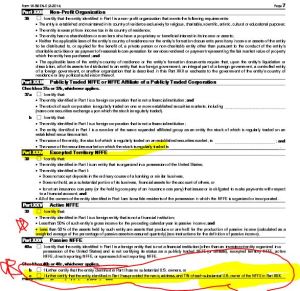
However, if a USC (and/or LPR) is a shareholder, partner or other economic owner in a non-U.S. foreign entity (such as a corporation, certain other type of companies, certain “partnership” and “trusts” – which can be known as a non-financial foreign entity – “NFFE”), the entity itself will be required to identify the “substantial U.S. owners” of the NFFE. Sounds complicated? It is very complicated.
See the key provisions of the IRS Form W-8-BEN-E highlighted in this post that reflects some of these multiple categories. This form requires the person completing it to frankly understand the FATCA regulations (some 450+ pages worth – including preamble) and properly categorize the type of entity/taxpayer in some 30+/- different categories. That is why the Form W-8BEN-E is some 8 pages in length.
Worse, for the person signing it; they must certify under penalty of perjury that it is complete and accurate. There will undoubtedly be numerous good faith errors by those who attempt to complete these new forms. Indeed, the new IRS Form W-8IMY has not even been addressed in this post, which is another form that was substantially modified due to the FATCA regulations.
If this summary has not cleared up the confusion for you; don’t worry, you are not alone!
I will try to continue to provided key summary explanations of these rules during the course of the next few months, as persons need to understand how to complete and implement properly these IRS Forms or the substitute forms provided by various FFIs throughout the world; now including China and Hong Kong!
It is during these next few months (prior to 31 December 2014) that this topic will be of great interest as FFIs around the world request this information from their account holders; not just USCs or LPRs. See, HUGE NEWS – China has “Reached an Agreement in Substance” for a FATCA Intergovernmental Agreement (IGA) – its Affect on USCs and LPRs Living in China and Hong Kong
Prefer a Q&A format instead? Read this: https://tax-expatriation.com/why-is-signing-an-irs-form-w-8ben-a-significant-criminal-risk-for-u-s-citizens-living-abroad/
IRS Releases New IRS Form W8-BEN. * U.S. citizens and LPRs beware of completing such form at the request of a third party.
Hot off the press!
The long awaited revised IRS Form W8-BEN has been released (March 2014). The major changes to IRS Forms W8, particularly W-8BEN-E (which is still in draft form), have been driven by the changes in the law under FATCA.
The new IRS Form W-8BEN and its instructions are accessible here.
Importantly, no U.S. citizen can legally sign and certify they are NOT a “U.S. person” under U.S. federal tax law. Hence, they cannot sign and complete IRS Form W-8BEN.
The form, as is true with all IRS forms, is signed under penalty of perjury. For a discussion of tax crimes of filing false documents see What could be the focal point of IRS Criminal Investigations of Former U.S. Citizens and Lawful Permanent Residents?.
Some key highlights of information on new IRS Form W-8BEN is set out below:
Importantly, lawful permanent residents (“LPRs”) have a much more complicated analysis to undertake to determine whether they ARE or are NOT a “U.S. person.”
One of the key considerations of this determination is whether the individual lives in the U.S. or is living outside the U.S. in a country which has a U.S. income tax treaty with the U.S. See Oops…Did I “Expatriate” and Never Know It: Lawful Permanent Residents Beware! International Tax Journal, CCH Wolters Kluwer, Jan.-Feb. 2014, Vol. 40 Issue 1, p9.
???????????????? ?Please click here to view the above in Chinese.?

 consequences to United States citizens (USCs) and lawful permanent residents (LPRs) residing overseas.
 Congress or the President when the laws were passed. Nor were they intended consequences of the U.S. Treasury Department as the FATCA Intergovernmental Agreements (“IGA) were negotiated throughout the world with various countries. See, Complete List of IGA Countries to Date (Very Few Notable Absences)
 Congress) never initially even contemplated USCs and LPRs living overseas. In other words, the group targeted were U.S. resident individuals who were evading taxes through foreign financial institutions. I say this, based upon extensive conversations I have had with ex-government officials and some government officials who were involved in the original policy discussions.
 compliance focus as of late was an unintended consequence.