Government Report Focuses on International Enforcement and Collection Overseas
The Treasury Department, through the Treasury Inspector General for Tax Administration (“TIGTA”) has highlighted what the U.S. government should be doing in the 21st century to collect U.S. taxes owed under U.S. law, against overseas taxpayers and their worldwide assets. The highlight of the report is set out below and the complete report of 12 Sept. 2014 can be read here TIGTA Report:

WASHINGTON – As international tax noncompliance remains a significant area of concern for the Internal Revenue Service (IRS), its collection efforts need to be enhanced to ensure that delinquent international taxpayers become compliant with their U.S. tax obligations, according to a report released publicly today by the Treasury Inspector General for Tax Administration (TIGTA).
The overall objective of TIGTA’s review was to evaluate the IRS’s collection efforts on delinquent taxpayers residing in foreign countries. Income received from international transactions of these taxpayers is subject to U.S. tax rules and reporting requirements.
“The IRS faces many unique challenges in collecting taxes from international taxpayers,” said J. Russell George, Treasury Inspector General for Tax Administration. “In today’s global economy, businesses and individuals are becoming more and more involved in international transactions. Accordingly, the role of an international revenue officer is very important in helping taxpayers comply with the tax laws and improving international tax compliance.”
TIGTA’s review found that ineffective management oversight has contributed to several control weaknesses in the International Collection program. Moreover, the IRS does not have reliable statistics on the rate of noncompliance of these taxpayers with their U.S. tax obligations.
For example, International Collection does not have:
• Adequate policies, procedures, position descriptions, or the training needed to ensure that international revenue officers can properly work International Collection cases.
• A specific inventory selection process that ensures that the International Collection cases with the highest risk are worked.
• Performance measures and enforcement results reported separately from Domestic Collection.
• A process to measure the value of the “Customs Hold” as an enforcement tool.
TIGTA recommended that the IRS: 1) develop a formal International Collection Strategic plan; 2) update International Collection guidance to provide specific policies and procedures to international revenue officers; 3) evaluate and update the current international revenue officer position descriptions; 4) develop a formal International Collection training plan using Subject Matter Experts to develop and teach international specific courses; 5) evaluate the International
Collection inventory selection criteria; 6) develop separate performance measures and track specific enforcement results for International Collection; and 7) continue to pursue direct access to the Customs Hold information.
IRS officials agreed with all of TIGTA’s recommendations and have taken or plan to take corrective actions. However, while the IRS has implemented some corrective actions to improve the selection of International Collection inventory, develop separate performance measures, and track enforcement results, TIGTA does not believe that the IRS’s completed corrective actions fully addressed the recommendations.
It seems that every time TIGTA issues a report, and demands the IRS modify their methods and procedures, the IRS takes action. If the information and premises in the TIGTA report are valid, then the IRS changes in policy can be for the good.
The IRS has already dedicated tremendous resources to the area of international taxation. It will be interesting to see if the IRS will dedicate even more resources to this area in response to the TIGTA report?
I have posted a number of posts related to the enforcement and collection of taxes against taxpayers residing overseas, including:
How will the IRS collect tax and penalty assessments against former USCs and LPRs who live exclusively outside the U.S.?, posted 8 October 2014.
U.S. Enforcement/Collection of Taxes Overseas against USCs and LPRs – Legal Limitations, posted 5 July 2014
IRS Releases Clarifying rules for U.S. Citizens Living Outside the U.S. – Re: Streamlined Filing Guidance
In June of this year, the IRS announced a new administrative method by which taxpayers can file late or never filed tax returns and information returns. See, The Risks to USCs and LPRs – Filing Late U.S. Income Tax Returns via the so-called “Streamlined” process
I previously posted a note about the so-called “Streamlined” process the IRS [which are now gone and removed from the IRS website] had announced in June 2012, Why the so-called “Streamlined” Process is “Much Ado About Nothing” – Legally Speaking. I explained that legally speaking, there is no legal protection to the taxpayer provided by this administrative procedure.
The IRS again just announced further clarifications to this program and just released on the IRS website a description of the streamlined filing compliance procedures (“SFCP”) for U.S. taxpayers residing abroad and related “FAQs”. These FAQs can be reviewed here: Specific Instructions for the Streamlined Foreign Offshore Procedures
FAQs are all the rage these days with the IRS, as the government does not take the time or spend the resources to follow the Administrative Procedures Act or similar requirements which are required in order to issue binding rules and regulations. See a previous post regarding these requirements, specifically regarding those who renounce U.S. citizenship or abandon LPR status and have not complied with IRS Notice 2009-85. See,Does IRS Notice 2009-85 regarding expatriation have the “force of law”? Posted on April 14, 2014
Hence, these SFCP are not legally binding on the IRS and they can pick cases as they choose for audit, review and penalty assessment in any manner they think is consistent with the law. Sometimes they do it in a manner that is not consistent with the law.
Of course, most practitioners do not think the IRS will “willy-nilly” ignore their own FAQs procedures for taxpayers who file under the SFCP (at least not across the board); lest taxpayers lose confidence in the IRS.
At the end of the day, any particular U.S. taxpayer residing overseas, should understand carefully these legal implications of the SFCP before “jumping in the pan”; which is hopefully not a “frying pan”.
How Congressional Hearings (Particularly In the Senate) Drive IRS and Justice Department Behavior
The separation of powers is often on full display when there are key Congressional hearings focused on the work (or lack thereof) undertaken by the key executive branch agencies responsible for tax enforcement:
1. Treasury/IRS, and
2. Justice Department.
There is an important reason why every day taxpayers should be interested in these hearings; particularly those who are considering renouncing United States Citizenship.
The actions and reactions of the IRS and Justice Department are often in response to Congressional hearings. This is very much the case with individual taxpayers with assets throughout the world.
A brief timeline of various hearings, and actions taken by the IRS and Justice Department (largely in response to such criticism) can be followed to demonstrate the influence of these hearings:
U.S. Senate Permanent Subcommittee on Investigations, published their report on August 1, 2006, entitled Tax Haven Abuses: The Enablers, The Tools & Secrecy.
Little direct action was taken by the IRS or Justice Department in this year. It was the year 2008, where the direct hearings lead to more direct action taken.
U.S. Senate Permanent Subcommittee on Investigations, headed by Chairman Carl Levin, published their report on July 16, 2008, entitled Tax Haven Banks and U.S. Tax Compliance –
November 2008, a U.S. federal grand jury indicted the Chairman and CEO of UBS Global Wealth Management and Business Banking.
U.S. Senate Permanent Subcommittee on Investigations, headed by Chairman Carl Levin, published their report on March 4, 2009 Tax Haven Banks and U. S. Tax Compliance – Obtaining the Names of U.S. Clients with Swiss Accounts
UBS agrees in February 2009 to pay a US$780M fine to the U.S. government and enter into a deferred prosecution agreement on charges of conspiring to defraud the United States by impeding the Internal Revenue Service.
IRS Implements first Offshore Voluntary Disclosure Program (“OVDP”) on March 26, 2009
Numerous taxpayers and several Swiss bankers were indicted and/or plead guilty to various tax crimes charges; mostly directly related to UBS. See, website of U.S. Department of Justice – Offshore Compliance Initiative.
Congress passes and the President signs into law, the Foreign Account Tax Compliance Act (“FATCA”) in 2010 as part of the Hiring Incentives to Restore Employment (HIRE) Act.
IRS Implements its second Offshore Voluntary Disclosure Initiative (“OVDI”) in 2011.
Numerous taxpayers and several Swiss financial advisors were indicted; and a HSBC Indian client was also indicted or plead guilty to various tax crimes charges; mostly directly related to UBS. See, website of U.S. Department of Justice – Offshore Compliance Initiative.
IRS creates an open ended OVDP program in 2012 that continues; with modifications made in 2014.
Several taxpayers were indicted; including those implicating an Israeli bank for various tax crimes charges. . See, website of U.S. Department of Justice – Offshore Compliance Initiative.
The Treasury Department obtains commitments from various countries to sign various FATCA, intergovernmental Agreements (“IGAs”) for automatic exchange of financial information; France, Germany, Italy, Spain, United Kingdom, Denmark and Mexico.
In January 2013, the U.S. Attorney’s Office in the Southern District of New York secured the guilty plea of Wegelin Bank, the oldest private bank in Switzerland and the first foreign bank to plead guilty to felony tax charges.
In August, 2013, the United States and Switzerland Issue Joint Statement Regarding Tax Evasion Investigations and ability of Swiss banks to enter into deferred prosecution agreements.
Several taxpayers were indicted and advisors; including multiple financial institutions outside of Switzerland for various tax crimes charges. See, website of U.S. Department of Justice – Offshore Compliance Initiative.
The Treasury Department obtains more commitments for signed FATCA IGAs with various countries for the automatic exchange of financial information;.
U.S. Senate Permanent Subcommittee on Investigations, headed by Chairman Carl Levin, published their report on February 26, 2014 Offshore Tax Evasion: The Effort to Collect Unpaid Taxes on Billions in Hidden Offshore Accounts
See prior post, Hearings – Permanent Subcommittee on Investigations – re: Offshore Tax Evasion: The Effort to Collect Unpaid Taxes on Billions in Hidden Offshore Accounts – February 26, 2014
Posted on February 26, 2014 Updated on March 2, 2014
IRS announces on June 18, 2014, IRS Makes Changes to Offshore Programs; Revisions Ease Burden and Help More Taxpayers Come into Compliance
See, “IRS Makes Changes to Offshore Programs; Revisions Ease Burden and Help More Taxpayers Come into Compliance” – How Will These Changes Affect USCs and LPRs Living Outside the U.S.?
See, More on the New 2014 “Streamlined” Process for USCs and LPRs Residing Overseas
The Treasury Department obtains numerous commitments for signed FATCA IGAs with various countries for the automatic exchange of financial information. See, HUGE NEWS – China has “Reached an Agreement in Substance” for a FATCA Intergovernmental Agreement (IGA) – its Affect on USCs and LPRs Living in China and Hong Kong
Part 1- Unintended Consequences of FATCA – for USCs and LPRs Living Outside the U.S.
As the Foreign Account Tax Compliance Act (“FATCA”) has gone into effect (1 January 2014), there are an increasing number of consequences to United States citizens (USCs) and lawful permanent residents (LPRs) residing overseas.
There are many intended consequences of the FATCA law, such as the following:
- Identifying non-U.S. financial, investment and company assets of USCs and LPRs;
- Identifying the foreign financial institution (“FFI”) where such assets are located;
- Identifying non-financial foreign entities (“NFFE”) owned by the USC or LPR;
- Generally bringing transparency to the assets, accounts and information of worldwide assets of USCs and LPRs.
See, FATCA Driven – New IRS Forms W-8BEN versus W-8BEN-E versus W-9 (etc. etc.) for USCs and LPRs Overseas – It’s All About Information and More Information
Ironically, I see a number of unintended consequences of FATCA; meaning consequences that were never contemplated by the U.S.  Congress or the President when the laws were passed. Nor were they intended consequences of the U.S. Treasury Department as the FATCA Intergovernmental Agreements (“IGA) were negotiated throughout the world with various countries. See, Complete List of IGA Countries to Date (Very Few Notable Absences)
This and other follow on posts will discuss these unintended consequences.
One of the most significant unintended consequence, is that the U.S. federal government (the IRS, the Treasury Department, or  Congress) never initially even contemplated USCs and LPRs living overseas. In other words, the group targeted were U.S. resident individuals who were evading taxes through foreign financial institutions. I say this, based upon extensive conversations I have had with ex-government officials and some government officials who were involved in the original policy discussions.
The focus then was on U.S. resident taxpayers; even though the U.S. imposes U.S. income taxes on the worldwide income of USCs living anywhere in the world. See, “Tax Simplification: The Need for Consistent Tax Treatment of All Individuals (Citizens, Lawful Permanent Residents and Non-Citizens Regardless of Immigration Status) Residing Overseas, Including the Repeal of U.S. Citizenship Based Taxation,” by Patrick W. Martin and Professor Reuven Avi-Yonah, 2013.
In practice, the U.S. federal government has known for many years that it can be nearly impossible to collect a tax liability against USCs who live and have their assets outside of the U.S. Specifically, the Treasury Department noted back in 1998 that . . .
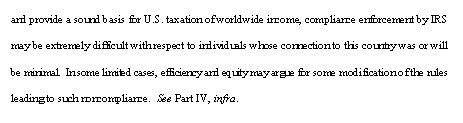
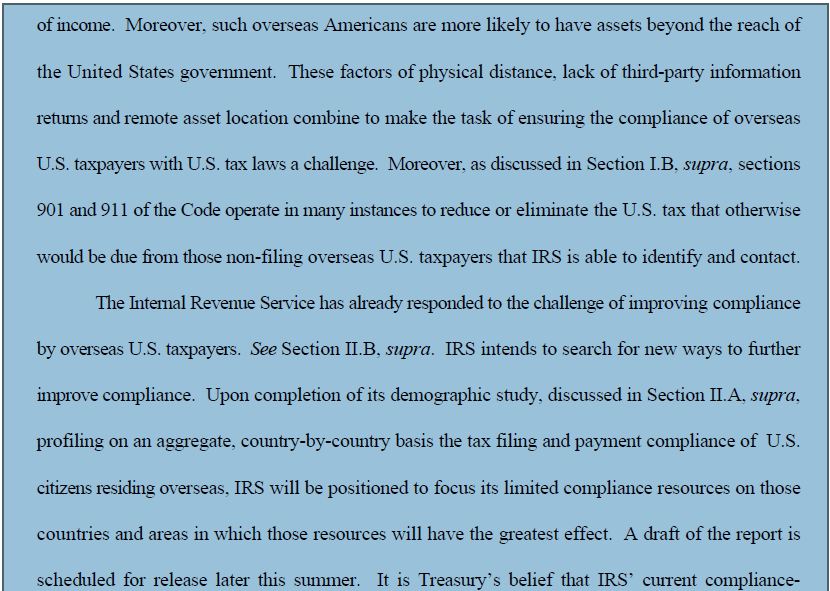
- Other factors also operate to limit both compliance measurement and improvement. Because the United States asserts taxing jurisdiction over those with little or no connection to the United States other than citizenship or status as a lawful permanent resident, in many cases overseas U.S. taxpayers are difficult to trace or contact. Moreover, even when valid tax assessments can be made against overseas taxpayers, IRS has limited enforcement recourse if the taxpayer’s assets are physically located outside of the United States.
See pages 13-15 of the Treasury report which can be found at the post, Sometimes Old is as Good as New – 1998 Treasury Department Report on Citizens and LPRs
Also, the original offshore voluntary disclosure initiative in 2009 never even contemplated any particular treatment for USCs or LPRs residing overseas. I submit, the USC and LPR living overseas was not even on the “radar” of the IRS at the time the first program was created. It was not until 2011, that a new category was created that imposed a 5% penalty for persons residing overseas, but who also had only US$10,000 of U.S. sourse income.
As time has gone on, the IRS has realized that numerous USCs and LPRs indeed live somewhere other than the U.S. (millions of them) and yet again modified the 2014 OVDP to provide for a “0%” penalty in certain circumstances for these individuals.
When FATCA was originally passed in 2010, USCs and LPRs living overseas was not the focus (and barely a thought). The heavy  compliance focus as of late was an unintended consequence.
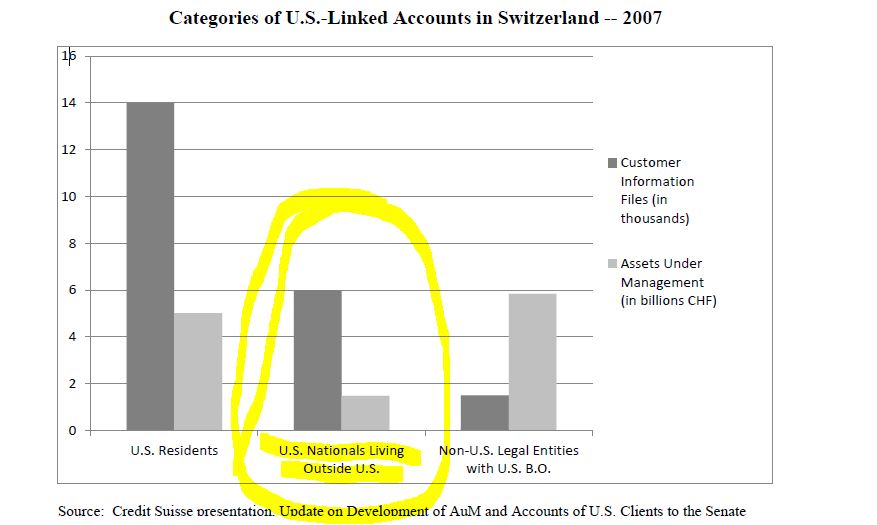
Now even the Senate has started to focus on USCs living overseas. The Senate Permanent Subcommittee on Investigations focused extensively on Swiss accounts opened by USCs living overseas. The full report can be read REPORT: Offshore Tax Evasion:The Effort to Collect Unpaid Taxes on Billions in Hidden Offshore Accounts (February 26, 2014) –
In those reports, the Senate Permanent Subcommittee on Investigations focused extensively on USC owned Swiss accounts opened by USCs living outside the U.S. See, Key Take Aways from Senate Investigations re: Foreign Banks and “Offshore Tax Evasion”: U.S. Citizens Residing Overseas have Become a Focus of the Government.;
Read the Q&A format here.
The Risks to USCs and LPRs – Filing Late U.S. Income Tax Returns via the so-called “Streamlined” process
I previously posted a note about the so-called “Streamlined” process the IRS [which are now gone and removed from the IRS website] had announced in June 2012, Why the so-called “Streamlined” Process is “Much Ado About Nothing” – Legally Speaking. I explained that legally speaking, there is no legal protection to the taxpayer provided by this administrative procedure.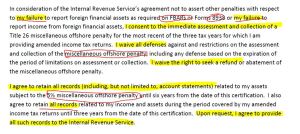
The new “streamlined” procedure from June 2014 does not provide any additional legal protection or finality. To be blunt, the government has used the FBAR as a “trap” for the taxpayer. See, Why the Zwerner FBAR Case is Probably a Pyrrhic Victory for the Government – for USCs and LPRs Living Outside the U.S. (Part II).
If the individual did not check the right box on Schedule B, Part III, therefore the government may well argue they were “willfully blind” of the requirements of filing FBARs, even if they did not know of the filing requirements. The FBAR regulations are extremely complex and I am confident few tax experts anywhere in the world could take a basic exam of what is a “financial interest in” and “signature authority over” such accounts according to these regulations and get more than about 75% (a “C” or maybe “D” grade) of these questions rights. See, Take Caution when Completing a “Tax Organizer” Provided by Your Tax Return Preparer.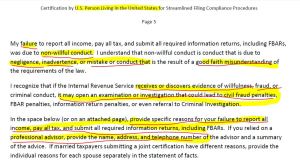
The problem with this streamlined process is there is no protection from penalties for failure to file tax returns, failure to file information returns, failure to file FBAR forms; nor from IRS audits of prior years (when the statute of limitations is still open), etc. In short, the IRS (or the Justice Department) can always fully pursue a USC or LPR who has not properly filed U.S. income tax returns, information returns on foreign assets or FBARs for prior years, as provided under the law.
In the meantime, the government will never be required to refund the so-called “5% miscellaneous offshore penalty” (which of course is not a penalty under the law in the first place), pursuant to the very terms of the Certification. The taxpayer waives ” . . . all defenses against and restrictions on the assessment and collection of the [5%] miscellaneous offshore penalty.” It is a one way street.
In addition, the individual is now subjecting themselves to potential greater liability in the event the government ever wants to challenge the certification made under penalties of perjury. Indeed, the certification is not drafted in the words of the taxpayer, but rather the U.S. federal government. Many practitioners have been analyzing and parsing the meaning of “negligence” and “inadvertence” and “mistake” that is a “good faith misunderstanding” of the requirements of the law. It’s entirely unclear how these terms will be interpreted by the government in any particular case. Certainly the vast majority of these cases that are entered into this system will not be challenged; if for no other reason the limited resources of the IRS.
However, there are so many ways they can be challenged against any particular taxpayer. What if a taxpayer threw away the monthly bank statements for the year 2012 regarding a foreign account? Will that be a breach of the Certification? Will all bets be off against the taxpayer? The terms of the certification seem to provide such a result.
I suspect we will see cases where the government will go after (selectively) some taxpayers who enter into the streamlined process. They cases they will select are the ones they think the taxpayer should have gone in under the OVDP. That will be the determination of the government, not the individual taxpayer; and hence can put the taxpayer in further jeopardy.
Finally, the most troubling issue of this program for U.S. residents, is they are agreeing to pay something that does not exist under the law and may have no correlation with any income taxes owing; i.e., the so-called “5% miscellaneous offshore penalty.” Why should a “good faith” taxpayer be paying any portion of their principal to the government, if they made an inadvertent mistake of what are typically very complex provisions in the tax law?
A basic example can demonstrate the injustice of this approach. Taxpayer Pierre, moves from France to the U.S. some 10 years ago. He was an accounting major in France and practiced as an accountant before becoming a business and property manager. His English is horrible and he relies upon a tax return preparer at “J&Q Blockhead Return Preparers” who only speaks English. His return preparer has never asked good questions, about if he has any non-U.S. assets, as he meets with him for 60 minutes each year after taking his W-2 and 1099 forms to the office as requested.
Pierre inherited from his non-U.S. citizen parents accounts in Switzerland and France with a value of US$3M and some real estate outside Paris worth approximately US$2.5M that generates rents monthly. His return preparer always sent his returns with the “No” boxes checked on Schedule B, Part III and never filed FBARs or IRS Form 8938. See, USCs and LPRs residing outside the U.S. – and IRS Form 8938. Pierre was told by his French tax advisers, who are very sophisticated, that the U.S. should not levy tax on his European assets; but rather he should only pay tax in France and Switzerland on these assets. Assume the taxes withheld at source in Europe are greater than the U.S. income tax that would be generated on this income; hence he can fully credit (with the U.S. foreign tax credit) the U.S. federal income tax, except about $700.
Pierre reads the news release on a French news website of the new “streamlined” program announced by the IRS in June 2014. He asks his return preparer about it – who has no idea what he is talking about.
What is Pierre to do? Why should Pierre pay approximately US$325,000 (5% of US$6.5M) to participate in this program when he owes less than US$1,000 of federal income tax?
When Pierre discusses this press release with the manager at “J&Q Blockhead Return Preparers”; the manager says all customers are given a (1) a package of documents and a pamphlet that says “Do you have any foreign assets?” on page 37, paragraph 3; and (2) a free coffee mug with “J&Q Blockhead Return Preparers” prominently displayed. The manager at “J&Q Blockhead Return Preparers” tells Pierre – “you are not going to pin this one on me!”
How is the payment of US$325,000 that is not contemplated under Title 26, a correct result under the law?
If Pierre does not go into the streamlined program and files amended tax returns, will the IRS and Justice Department try to “Zwerner” him (assess multiple year 50% willfulness penalties – arguing he was “willfully blind”)? What if they start an audit and investigation and ask the return preparers at “J&Q Blockhead Return Preparers” about the case with the response being “We tell all our customers they have to report their foreign assets and have it in writing. See our pamphlets and website.”
That is the risk Pierre will have to take; (1) comply with the law under Title 26 as amended returns are contemplated and risk the government will pursue him for 50% willfulness penalties (as the failure to file IRS Form 8938 – should be only for 3 years at $10,000 per year) or (2) be forced into a “streamlined” procedure that will make him pay a large portion of his family inheritance from Europe to the U.S. since he did not file IRS Form 8938 or FBARs.
Read the Q&A format here.
Does the IRS investigate United States Citizens (USCs) and Lawful Permanent Residents (LPRs) residing overseas?
One issue on the minds of many United States Citizens (USCs) and Lawful Permanent Residents (LPRs) living overseas (overseas from a U.S. perspective – i.e., offshore from a U.S. perspective) is whether the IRS investigates these individuals.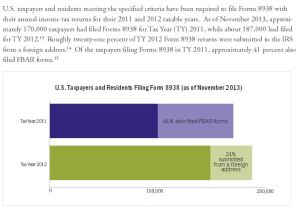
The short answer is yes, with varying degrees of investigation; reviews or audits. Of course, not all individuals are audited or investigated. However, the new data that will be collected under FATCA will be an increasingly valuable source of information for the IRS. In practice, I am increasingly seeing the IRS automatically generate “substitute for returns” for individuals living overseas where no U.S. federal income tax return has been filed. In these cases, the IRS is receiving some type of income information (e.g., from a bank or company) and then issuing the substitute for return. See, IRM regarding “Substitute for return (SFR) and delinquent return procedures were developed to deal with taxpayers who do not file required tax returns.”
There are a host of techniques used by the IRS. A series of posts will discuss some of these techniques. There are also legal limitations imposed on the IRS and Justice Department when assets are located overseas. See, U.S. Enforcement/Collection of Taxes Overseas against USCs and LPRs – Legal Limitations
First, there has been a much greater focus during the last 6 years on foreign, international tax matters. That focus continues under the current Commissioner.
Second, the IRS has been opening offices internationally in different countries. Most recently, an office in Beijing, China.
To learn more about the functions of the Tax Attachés (TA) and Deputy Tax Attachés (DTA) and how they serve in the IRS overseas Posts, see the IRM, 4.30.3 Overseas Posts
Third, with additional information that will be collected under FATCA (starting in 2015 for information for the calendar year 2014), the IRS will have additional information to sort, examine, audit, etc. This will undoubtedly cause more substitute for returns to be automatically generated by the IRS for those individuals who have not been filing U.S. income tax returns.
Fourth, the offshore voluntary disclosure program has been a treasure trove of information for the government regarding non-U.S. banks and non-U.S. advisers (bankers, accountants and attorneys).
Fifth, the deferred prosecution agreements entered into with various Swiss financial institutions will be an additional source of information regarding USCs and LPRs and their accounts and assets.
Sixth, the IRS has developed a number of methods of collecting, sorting and identifying information (including the information that will be collected above). For instance, in the Internal Revenue Manual provides the following, regarding USCs and LPRs, including those living overseas –
* * *
5.1.18.13.3 (05-20-2008)
Using Passport Information
- Use any new address or new asset information received from the passport office as discussed above.
- See IRM 5.1.12.25, Outgoing Mutual Collection Assistance Requests, if you determine that the taxpayer:
- resides in a treaty country, or
- has assets in a treaty country.
5.1.18.14 (03-27-2012)
Treasury Enforcement Communications System
- The Treasury Enforcement Communications System (TECS) is a database maintained by the Department of Homeland Security (DHS), and it is used extensively by the law enforcement community. It contains information about individuals and businesses suspected of, or involved in, violations of federal law.
- For IRS field Collection,TECS provides two sources to help make contact with taxpayers or locate assets :
- Revenue officers can request that delinquent balance due taxpayers be entered into TECS, and the Department of Homeland Security (DHS) will then advise IRS when those taxpayers travel into the United States for business, employment, or personal reasons. The taxpayers entered into TECS for this purpose are on a DHS lookout indicators list. IRS employees must help maintain the TECS database by requesting that appropriate taxpayers be entered into TECS or be deleted from TECS. (See IRM 5.1.18.14.6.1 for criteria for including taxpayers in TECS data base.)
- Revenue officers can also request information housed in TECS on past travel that a taxpayer has made to and from the United States.
5.1.18.14.1 (03-27-2012)
TECS: DHS Lookout Indicators
- Many of the taxpayers entered into TECS for a DHS lookout indicator are International ones because the cases usually concern persons who reside abroad. However, domestic taxpayers may also be entered into TECS if we have been unable to locate them and if they are believed to travel outside the US . Taxpayers placed on TECS are often not subject to ordinary administrative and judicial collection procedures because they frequently reside outside the jurisdiction of the US Courts. Information derived from placing a taxpayer on TECS can facilitate contact with these taxpayers or provide asset information which, in turn, may facilitate collection of their delinquent liabilities.
Note:
IRM 9.4.2.4.2.5.3, Other IRS Functions, also discusses TECS and prescribes the use of Form 5523, TECS Query Request, to request information from TECS. However, SB/SE Collection Field (FC) employees should not use Form 5523.
- Consider the following example as an illustration of how using TECS to place a taxpayer on the DHS lookout indicator list could help in your casework.
Example: A FC RO has a balance due taxpayer in his/her inventory and he determines the taxpayer resides in Norway. The RO transfers the case to International. The International RO determines the taxpayer is “Unable to Contact” and closes the case from open inventory. The RO requests that the taxpayer be placed on TECS. One year later, the taxpayer travels to the US and initially arrives at an airport in New York. Upon the taxpayer’s arrival, Customs and Border Protection (CBP) informs the TECS Coordinator where the taxpayer is ultimately traveling to, how long the taxpayer plans to stay, and on which flight(s) the taxpayer will be departing. The taxpayer will be staying in Denver for one week. The ROs who had previously worked the case had not been aware of any connection the taxpayer had to Denver. The TECS Coordinator notifies the group manager (GM) in International who is responsible for cases in Norway (the country in which the taxpayer resides). The International GM issues an OI to the Collection group working the location in Denver where the taxpayer is staying. The GM in Denver assigns the case to an RO, and the RO meets with the taxpayer and secures a financial statement. When this happens, the IRS learns about the taxpayer’s assets for the first time as other research methods and attempted contacts were unsuccessful. The RO provides the information to International and closes the OI. After the OI is closed, the International RO does further research once he/she is aware of the Denver nexus. He/she discovers the taxpayer has real property held in the name of a trust and files a nominee lien.
* * *
More posts to follow on specific steps taken regarding investigations by IRS of USCs and LPRs living outside the U.S.
Part I: What is “Willful” and what is “Non-Willful” for USCs and LPRs Residing Overseas Who Have Not Filed U.S. Tax Returns or FBARs?
Part I: What is “Willful” and what is “Non-Willful” for USCs and LPRs Residing Overseas Who Have Not Filed U.S. Tax Returns or FBARs?
This will be one of the most important questions to understand for any USC or LPR residing outside the U.S. who has not been filing U.S. income tax returns or FBARs. See, Nuances of FBAR – Foreign Bank Account Report Filings – for USCs and LPRs living outside the U.S.
The willfulness question is important, when the USC or LPR decides what steps they need to take regarding the filing of U.S. income tax returns.
A LPR residing predominantly in a country with a US. income tax treaty (of which there are 68) may be in the best position to “clean up” their U.S. tax filing and return positions. Specifically their facts might allow them to file as a non-resident under the “tie-breaker provisions” – typically Article 4); and indeed such filings might be applicable for several prior years.
See, Countries with U.S. Income Tax Treaties & Lawful Permanent Residents (“Oops – Did I Expatriate”?) for a comprehensive list of each income tax treaty and country.
The issue of “expatriation” becomes front and center for the LPR who notifies the IRS that he or she is not a resident of the U.S, pursuant to an applicable income tax treaty and files the treaty position accordingly.
Specifically, the statutory language of IRC Section 7701(b)(6) has three tests for when the individual is no longer a LPR for federal tax purposes:
- The individual is treated as a resident of a foreign country under the provisions of a tax treaty;
- The individual does not waive the benefits of the treaty, and
- Notifies the Secretary of the commencement of such treatment.
See, LPR status can be abandoned for tax purposes (since 2008 tax law changes) by merely leaving and moving outside the U.S. in some cases.
If the LPR has had that status for the requisite number of 8 years or more, to be treated as a “long term resident”, he or she would generally be subject to the “exit tax” of Sections 877 and 877A (plus a tax to any future U.S. persons who receive gifts or inheritances from such former LPR). See, The “Hidden Tax” of Expatriation – Section 2801 and its “Forever Taint.”
If the LPR has not been “non-willful” (double negative intended) by not filing U.S. income tax returns, interesting legal questions are raised as to the consequences to the LPR.
In addition, the IRS “streamlined” procedure announced on June 18th, 2014, has specific requirements obligating the taxpayer to certify “non-willful” behavior.
Various consequences of signing these certifications under penalty of perjury, will be discussed in later posts.
Read the Q&A format here.
Webinar: “New and Improved” June 2014 IRS Offshore Voluntary Disclosure Program – Version 3.0: Including “Streamlined” Rules that are a Game Changer Thursday, July 17, 2014, 12 noon – 1:30 p.m. (PST)
The State Bar of California – Taxation Section
Webinar: “New and Improved” June 2014 IRS Offshore Voluntary Disclosure Program – Version 3.0: Including “Streamlined” Rules that are a Game Changer
Thursday, July 17, 2014, 12 noon – 1:30 p.m. (PST)
Speakers:
• Patrick W. Martin of (Procopio et al San Diego – ), who is the tax team leader of the firm’s tax practice and specializes in international tax matters, with a strong focus on international tax compliance
• Mark E. Matthews of (Caplan & Drysdale in DC – ) focuses his practice on criminal tax enforcement, broad-based civil tax compliance and was Chief of the IRS Criminal Investigation Division, the agency’s investigative and law enforcement arm.
This program offers 1.5 hours participatory MCLE credit, 1.5 legal specialization credit in the area of Taxation Law and .5 hour credit in Legal Ethics. You must register in advance in order to participate.
Just days ago (June 2014), the IRS significantly revamped the “offshore voluntary disclosure program” (“OVDP”) that has existed since 2009. The new terms of the OVDP have now completely changed the “rules of the road” about how and when taxpayers can or should participate in such program. In addition, the so-called “streamlined” process has been changed in virtually all respects.
Learn – when should a taxpayer be considering the 2014 OVDP? When should a taxpayer not participate in the 2014 OVDP? When is an individual eligible? Learn important differences under the 2014 OVDP for those who reside in the U.S. versus U.S. citizens and lawful permanent residents who reside outside the U.S.
Understand the legal ramifications for those who sign certifications under penalties of perjury.
Understand the legal risks for financial, tax and legal advisers.
These changes create numerous legal risks for the unwary and for the financial, tax and legal advisers.
Find out how you can best assist your clients and minimize their legal risks, while simultaneously complying with the labyrinth of rules imposed by the Internal Revenue Service, including modifications to their own terms. This Webinar is appropriate for tax lawyers, non-tax lawyers (such as trusts and estate lawyers and business lawyers), certified public accountants, bankers, trust officers, trustees, enrolled agents and others who have clients who have assets located outside the U.S.
A detailed highlight of the new rules of circular 230 and their application in light of these changes to the OVDP will be discussed, along with other important ethical considerations and practice pointers.
Understand the legal ramifications of U.S. taxpayers who sign certifications under penalties of perjury, specifically including those required by the OVDP. How will United States citizens and lawful permanent residents (“LPR”) who are residing outside the United States view these rules? What are the pitfalls of the revisions in this program? How does the recent jury verdict in the willfulness FBAR 50% penalty case (with 150% penalty found by the jury) in Zwerner affect decisions of taxpayers and their advisers?
This webinar is taught by experienced tax lawyers, all former employees of the IRS, including a former Chief of the IRS Criminal Investigation Division, including experts who specialize in international tax related matters and advising those with worldwide assets; multi-national families and U.S. citizens and LPRs residing outside the U.S.
Extensive written materials will be provided that analyze the law, consider various legal implications of the 2014 OVDP. The course will specifically focus on current trends and developments of the IRS and Tax Division/Justice Department and current civil and criminal cases moving forward.
Plus, understand the basics of FATCA (the Foreign Account Tax Compliance Act) now in effect for 2014 and how this affects this arena of practice and international tax compliance. Specifically understand the role of FATCA under the new IRS modifications to the OVDP and why it is more important than ever.
Finally, some key income tax concepts of residency and international information reporting requirements under Title 26 and Title 31 will be briefly analyzed in the context of the 2014 OVDP.
Moderator: Eric D. Swenson of (Procopio et al San Diego – http://www.procopio.com/attorneys/eric-d-swenson) is a tax attorney with multiple years at Chief Counsel in the IRS and handles complex tax controversy and defense cases against the IRS and State taxing authorities.
Speakers:
• Patrick W. Martin of (Procopio et al San Diego – http://www.procopio.com/attorneys/patrick-w–martin), who is the tax team leader of the firm’s tax practice and specializes in international tax matters, with a strong focus on international tax compliance
• Mark E. Matthews of (Caplan & Drysdale in DC – http://www.capdale.com/mmatthews) focuses his practice on criminal tax enforcement, broad-based civil tax compliance and was Chief of the IRS Criminal Investigation Division, the agency’s investigative and law enforcement arm.
To register, see Webinar: “New and Improved” June 2014 IRS Offshore Voluntary Disclosure Program – Version 3.0 or go to http://www.calbar.org/online-cle and select Taxation or Webinars.
U.S. Enforcement/Collection of Taxes Overseas against USCs and LPRs – Legal Limitations
Maybe its a natural response for USCs and LPRs living overseas to ask: “What is the chance I will get audited by the IRS?” Sometimes, those individuals who either have less good faith (or are simply ignorant about how U.S. tax law functions) will also ask: “How will the U.S. government ever know of my assets or income in my home country?”
A follow-up question is how does the U.S. federal government enforce tax obligations overseas? This question often comes, of course, from individuals who reside in different countries outside the U.S. and typically have most (if not all) of their assets located in their country of residence.
A USC or LPR residing in Costa Rica, for instance, might have almost all of his business assets in Costa Rica and maybe financial investment assets in nearby regions such as Panama. Similarly, a Chinese born dual national USC may have companies and business assets in both mainland China and Hong Kong. If neither of these individuals have assets in the U.S., how can the U.S. federal government enforce tax liens, levies and the like against these individuals?
These questions are getting asked more and more now that FATCA has gone into force and financial information around the world is being collected regarding USC accounts in virtually all countries and financial institutions. See, FATCA Driven – New IRS Forms W-8BEN versus W-8BEN-E versus W-9 (etc. etc.) for USCs and LPRs Overseas – It’s All About Information and More Information
An excellent layman’s term summary of FATCA can be located on HSBC’s website here.
This overseas asset and income information will eventually be delivered, pursuant to the FATCA rules, to the U.S. Internal Revenue Service (IRS – revenue authority).
Hence, the collection of information under FATCA will be extensive. This, at least in part, answers the question of: “How will they ever know of my assets or income in my home country?” Admittedly, the complete answer to this question is far more complicated, when one considers the intricacies of FATCA and its regulations and other guidance from the IRS/Treasury.
However, that is a different question, than how that financial and income information will be used by the IRS to (a) make tax assessments, (b) assess and collect foreign bank account report (FBAR) penalties (See, Section 16 of the IRM), and (c) generally enforce and collect such tax assessments and penalties against USCs and LPRs residing outside the U.S.
1. INFORMATION – The collection of asset and financial information under FATCA has a very “long arm” around the world. Indeed, the image of the Uncle Sam octopus published in the June 28, 2014 article in the The Economist entitled Taxing America’s diaspora: FATCA’s flaws captures well the idea of the reach of FATCA.
2. INFORMATION VS COLLECTION – However, enforcing tax assessments and penalties and collecting against assets located outside the U.S. is a very different legal question, without such a “long arm”; simply because the reach and jurisdiction of U.S. law is necessarily limited and regularly in conflict with local laws of different countries.
To say it another way, Uncle Sam can indeed enforce the collection of financial and asset information under FATCA, due to the economic costs and ramifications to financial institutions and their investors if they did not comply with the automatic information exchange. However, Uncle Same cannot simply enforce the collection of U.S. taxes and penalties through the worldwide financial institutional network, the same way it can in the U.S.
The U.S. has broad lien, levy and seizure powers under U.S. tax law. The IRS can simply seize assets from U.S. bank accounts without going to a judge or court for final (or jeopardy) tax assessments provided they comply with various provisions of the law. This is not a typical concept in the law for other creditors (other than the IRS) who must generally first take steps through the courts to get some type of judicial action (e.g., a court order) before simply seizing and taking assets from an individual.
The IRS’s broad lien and levy powers against assets, however, has significant limitations overseas. See the 1998 Treasury Report – Sometimes Old is as Good as New – 1998 Treasury Department Report on Citizens and LPRs, I hav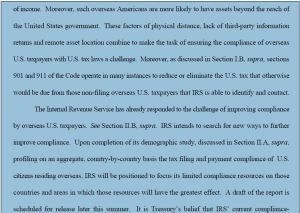 e worked with IRS Revenue Officers who specialize in international collection matters who argue and assert they can merely exercise this lien and levy power overseas against foreign financial institutions. However, this is where the power of the IRS comes to a screeching halt (or at least a major slowdown); when the collection of overseas assets is at stake.
The IRS is not without remedies to collect foreign assets, but it is not a simple process; if it can be done at all in any particular circumstance.
The IRS has no specific enforcement provisions negotiated in international treaties that will necessarily enable them to enforce and collect U.S. income taxes overseas with foreign government assistance. The cornerstone 9th Circuit case of Her Majesty held in 1979 that the Canadian tax authorities could not enforce a tax judgment against U.S. taxpayers within the U.S. –
The basic facts were these, as reported in the case:
British Columbia then served a “Notice of Intention to Enforce Payment” on the defendants in the United States, and filed a certificate of assessment in the Vancouver Registry of the Supreme Court of British Columbia. This certificate was for $195,929.50 (a penalty and interest were included), and under the laws of British Columbia its filing gave it the same effect as a judgment of the court. British Columbia then instituted the present action in the United States. It was dismissed because the court below concluded that the Oregon courts would follow the “revenue rule.” Stated simply, the revenue rule merely provides that the courts of one jurisdiction do not recognize the revenue laws of another jurisdiction.1
The U.S. 9th Circuit Court went on to say:
Although the Supreme Court has never had occasion to address the question of whether the revenue rule would prevent a foreign country from enforcing its tax judgment in the courts of the United States, the indications are strong that the Court would reach the same result as we reach in the present case. Both the majority and the dissenting opinion in Banco Nacional de Cuba v. Sabbatino, 376 U.S. 398, 84 S.Ct. 923, 11 L.Ed.2d 804 (1964), discussed the rule in a spirit which indicates a continued recognition of the revenue rule in the international sphere.10
This Majesty case specifically cited a Canadian Supreme Court case (Harden) which also applied the revenue rule in not enforcing a tax judgement in the U.S. courts for taxes against a Canadian resident:
Reciprocity would itself be a sufficient basis for denying British Columbia’s claim. The courts of British Columbia, relying upon the revenue rule, have refused to recognize the judgment of a United States court for taxes. United States v. Harden, 1963 Canada Law Reports 366 (Sup.Ct. of Canada, 1963, Affirming Court of Appeal for British Columbia).12
CONCLUSION: The revenue rule has been with us for centuries and as such has become firmly embedded in the law. There were sound reasons which supported its original adoption, and there remain sound reasons supporting its continued validity. When and if the rule is changed, it is a more proper function of the policy-making branches of our government to make such a change.
As a result of these cases and the Revenue Rule, the U.S. and Canada modified their income tax treaty to (at least in theory) allow for the international enforcement of taxes. The U.S. now has five income treaties with “mutual assistance” provisions: Canada, Sweden, France, Denmark, and the Netherlands (with a clause in the newly negotiated, but yet to go into force, Swiss treaty).
The U.S. tax and international tax world has changed dramatically since 1979 and the 9th Circuit case of Her Majesty particularly with the advent of FATCA. Nevertheless, there are serious legal limitations imposed on t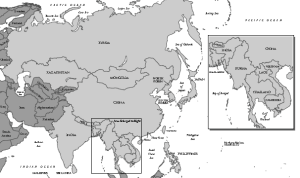 he IRS in collecting assets for U.S. tax liabilities and penalties owed by USCs and LPRs residing overseas. Indeed, this is surely one of the principle reasons the IRS revised OVDP terms in June 2014 impose a 0% penalty against USCs and LPRs who participate in the so-called “streamlined process”. See, More on the New 2014 “Streamlined” Process for USCs and LPRs Residing Overseas.
The follow-on post will discuss the very limited provisions that have been recently negotiated with these five different countries and explain in more detail the limits on the U.S. federal government on the collection of taxes. It will also discuss the important differences of civil U.S. international tax enforcement/collection versus criminal tax enforcement; which are two very different beasts.
Finally, a dedicated post on the topic will discuss the steps the U.S. federal government is taking through the Department of Homeland Security and a database of information (TECS) to track and monitor people and their assets. The government describes TECS as follows: “The Treasury Enforcement Communications System (TECS) is a database maintained by the Department of Homeland Security (DHS), and it is used extensively by the law enforcement community. It contains information about individuals and businesses suspected of, or involved in, violations of federal law.”
More on the New 2014 “Streamlined” Process for USCs and LPRs Residing Overseas
The June 2014 changes by the IRS in its offshore voluntary disclosure (“OVD”) program are significant and worthy of discussion for USCs and LPRs residing overseas.
I will dedicate several blogs to this topic over the next few weeks. See, these posts on the topic for additional background: See, “IRS Makes Changes to Offshore Programs; Revisions Ease Burden and Help More Taxpayers Come into Compliance” – How Will These Changes Affect USCs and LPRs Living Outside the U.S.?
See, New 2014 “Streamlined” Process for USCs and LPRs Residing Overseas – The Thorny “Certification Requirement”
See,earlier post –Why the so-called “Streamlined” Process is “Much Ado About Nothing” – Legally Speaking,
This post is dedicated to some background, about the legal framework of the OVD and what the IRS calls “streamlined” filing.
First, it is worth reiterating, that the tax law, Title 26, is not the source of the terms of either the OVD or Streamlined. For some basic background of the statutory regime and Title 26 (along with Title 31, et. seq), see, Why the FBAR (late filed or never filed) is not a requirement for the Certification Requirement of Section 877(a)(2)(C) – (5 Years of Tax Compliance)
In addition, the Bank Secrecy Law, title 31, is not the source of the terms of either the OVD or Streamlined.
Rather, the Internal Revenue Service (the agency responsible for enforcing Title 26) has created its own terms and conditions as part of both the OVD and the “Streamlined” process. See,the “FAQs” that are published by the IRS: Offshore Voluntary Disclosure Program Frequently Asked Questions and Answers: Effective for OVDP Submissions Made On or After July 1, 2014
The terms of these FAQs are not law. The IRS can change them at anytime and without notice to anyone. Indeed the IRS has changed and modified them on numerous occasions since the initial OVD program in 2009.
Second, it is crucial to understand the basic framework of the law from Title 26 that all USCs living overseas are subject to; and the various consequences of the law. Plus, many LPRs living overseas are subject to Title 26 (but not all of them – depending upon a number of factors). The U.S. tax law is complex and there are numerous compliance requirements with onerous penalties that can be assessed. For instance, see, “PFICs” – What is a PFIC – and their Complications for USCs and LPRs Living Outside the U.S.
Also, see, US Citizenship Based Taxation. In addition, see, What could be the focal point of IRS Criminal Investigations of Former U.S. Citizens and Lawful Permanent Residents?
In that post, I summarize the principle criminal statutory rules in Title 26 – which are set out below:
1. Criminal Offenses under Title 26 (Federal Tax Law)
a. Tax Evasion (IRC Section 7201)
b. Filing a False Return or Other Document – Perjury (IRC Section 7206(1) )
- (i) Aiding or assisting in the perpetration of a false or fraudulent document (26 U.S.C. § 7206(2))
- (ii) Removal or concealment with intent to defraud, commonly related to untaxed liquor (26 U.S.C. § 7206(4))
- (iii) Compromises and closing agreements involving fraud or concealment (26 U.S.C. § 7206(5))
c. Failure to File Return, Supply Information, or Pay Tax – (IRC § 7203 – Misdemeanor – up to 12 months imprisonment)
d. Fraudulent Returns, Statements, or Other Documents (IRC § 7207)
e. “Structuring” Transactions to Evade Cash Reporting (IRC § 6050I)
In addition to these tax specific crimes, other key crimes commonly used by IRS CI agents in tax cases, particularly international cases, include:
2. Tax Related Criminal Offenses under Titles 18 and 31 (Not Tax Law Specific)
a. Conspiracy (Section 371 of Title 18)
- (i) Elements of the Offense
- (ii) Penalties and Statute of Limitations
b. False Statements (Title 18 U.S.C. § 1001)
- (i) Penalties and Statute of Limitations
c. Perjury
d. Mail fraud
e. Principals and those Who Aid and Abet (Title 18)
f. Accessory After the Fact
You may be asking – “If the terms and conditions of OVD and Streamlined are not the law – why should I consider either in my circumstances?”
The OVD is a bargain between the IRS/Justice Department and taxpayers. In short, if you participate by its terms, you will not (at least “should not”) be criminally prosecuted. The OVD program is in my view a program worthy of consideration for those who have committed any of the above tax and tax related crimes; and this will depend entirely upon the facts of each case. How, when and if these laws have been violated, can only be analyzed and considered for each particular case, based upon the detailed factual circumstances of each individual.
For those individuals, who have not committed any of the above tax related crimes, the OVD program is probably not a good option for such USC or LPR residing overseas. See an earlier article I published titled – The 2013 GAO Report of the IRS Offshore Voluntary Disclosure Program, International Tax Journal, CCH Wolters Kluwer, January-February 2014. PDF version here.
There is one caveat to this issue, which arises from the willfulness FBAR penalty. The government has argued (at least in one case) that multiple year 50% willfulness penalties can apply, even if the individual had no knowledge of the law – See, FBAR Penalties for USCs and LPRs Residing Overseas – Can the Taxpayer have no knowledge of the law and still be liable for the willfulness penalty? See government memorandum.
Clearly, the facts of the Zwerner case need to be considered carefully in how and why the government argued their position. It seems, maybe the biggest fact used against the taxpayer was that he had “touched the money”; i.e., drawn and spent some of the funds over the years?
Next, if there is little risk of a 50% willfulness penalty and there is no criminal liability, the so-called “Streamlined” process is an option. However, again, the terms of the “Streamlined” are not terms set forth in Title 26; they are made up by the IRS. They also do not bind the IRS. I strongly recommend reading the post, –Why the so-called “Streamlined” Process is “Much Ado About Nothing” – Legally Speaking, which provides the following about the process (before modified in its current form – which continues to be applicable today):
Does any of the above [referring to Streamlined] protect the USC residing outside the U.S. from an audit for any year a U.S. federal income tax return was not filed? The short answer is – NO!
Does any of the above statements in the IRS announcement mean that a USC residing overseas could not be subject to late payment or late filing penalties for not previously filing U.S. tax returns. The short answer is – NO!
Does any provision in the IRS announcement mean the FBAR penalties could not apply for failure to file. The short answer is – NO! See, When does the Statute of Limitations Run Against the U.S. Government Regarding FBAR Filings?
Does any of the above statements in the IRS announcement mean that a USC residing overseas can never be subject to penalties for not filing information returns regarding their non-U.S. international assets and “specified foreign financial assets”? The short answer is – NO! See, USCs and LPRs residing outside the U.S. – and IRS Form 8938
Importantly, there is nothing in the law (e.g., Title 26 or elsewhere) that would obligate any USC or LPR residing overseas to participate in either OVD or the “streamlined” process. Both have different consequences, potential benefits, and certainly legal risks.
Finally, the last option, that is actually subject to the law, i.e., Title 26, is filing tax returns through normal channels. Most all U.S. taxpayer file tax returns through this normal procedure.
As always is the case, but particularly for those who have not filed tax returns or FBARs, the facts of each particular case need to be considered, to determine the legal risks, benefits and consequences of any of these three approaches.