Where the IRS will likely look overseas: USCs are Millions Yet U.S. Tax Returns are Just a Few Hundred Thousand
The IRS has key tax return filing information in their current records; pre-FATCA flow of financial information. Various reports indicate there are probably around 6-7 million U.S. citizens residing overseas, although there is no certainty in these numbers. See, Taxpayer’s Advocate Annual Report of 2012 – that  discussed both the number and type of individuals overseas, and potentially unidentified individuals.
The IRS tracks and keep information on U.S. income tax returns filed by U.S. individual taxpayers overseas.
The information is not only the number of tax returns (head count), but also the amount of income reported. For instance, TAS reported about 700,000 returns were filed in 2010 by U.S. taxpayers abroad, while estimating about 6.32 million U.S. citizens reside abroad. See, p. 37 of the Taxpayer’s Advocate Annual Report of 2012 –
These numbers do not even try to quantify the number of lawful permanent residents (“green card holders”) who reside around the world, who are not filing U.S. income tax returns. In 2012, the estimated number of LPRs was 13.3 million as reported by the Office of Statistics of the DHS. See, Estimates of the Legal Permanent Resident Population in 2012
How many of these LPRs are living outside the U.S. and not filing or reporting their worldwide income on U.S. income tax returns?
In addition, for the tax year 2011, the IRS Tax Statistics (“SOI”) in the “SOI Tax Stats – International Individual Tax Statistics” reported that only about 450,000 returns were filed with the foreign earned income exclusion. See, The Foreign Earned Income Exclusion is Only Available If a U.S. Income Tax Return is Filed
A detailed report of these statistics commissioned by the IRS and prepared by Scott Hollenbeck and Maureen Keenan Kahr titled Individual Foreign-Earned Income and Foreign Tax Credit, 2011 provides numerous insights about the likely under reporting and non-filers of U.S. income tax returns .
.
This report provides the following information reflecting the UK as the number one country with foreign earned income (Section 911) followed by Canada. Ironically Afghanistan (presumably due to the U.S. citizens working in that country as a result of the war?) is the country in the 4th location, ahead of Hong Kong and Japan.
Noticeably absent from that graph is Mexico, which reportedly has the largest number of U.S. citizens residing in any particular country. Canada is the second most populated country with U.S. citizens according to numerous reports.
Only about 46,000 returns were filed by Canadian residents claiming the foreign earned income exclusion, and even more surprising are the mere 7,000 returns from Mexican based U.S. taxpayers. See Table 2 of the report – Individual Foreign-Earned Income and Foreign Tax Credit, 2011
These are the two most populated countries with U.S. citizens.
As the IRS receives information around the world from governments and financial institutions via FATCA, of U.S. citizens and their bank accounts, it will be fairly easy for them to start targeting certain countries and commence tax audits against residents in those countries.
What are the Number of LPRs who Leave U.S. Annually without filing Form I-407 – Abandonment?
A prior post identified the number of lawful permanent residents (LPRs) who file Form I-407 to formally abandon their lawful permanent residency. See, The Number of LPRs “Leaving” the U.S. is 16X Greater than the Number of U.S. Citizens Renouncing Citizenship
These numbers of I-407 forms filed annually were obtained through a freedom of Information Act (“FOIA”) request and provided by the USCIS. See tabl:
Of course, this statistic does NOT identify the number of the approximate 13.3+ million LPRs who leave the U.S. to live elsewhere in another country without completing Form I-407 and formally abandoning. The estimated number of LPRs was 13.3 million for the year 2012 as reported by the Office of Statistics of the DHS. See, Estimates of the Legal Permanent Resident Population in 2012.
Maybe the number of individuals who fall into this latter category (i.e., moving out of the U.S. without filing Form I-407) is several hundred of thousands of individuals annually?
Importantly, from a taxation perspective, anyone who moves and lives in a country with a U.S. income tax treaty (the list of these countries is set out below – from the IRS website), needs to be careful not to be deemed to be a “covered expatriate” due to the application of IRS Form 7701(b)(6). See, IRS Notice 2009-85.
See, the following posts with further explanation of the tax law for LPRs who move and live in one of the countries listed below. Countries with U.S. Income Tax Treaties & Lawful Permanent Residents (“Oops – Did I Expatriate”?)
See also, Who is a “long-term” lawful permanent resident (“LPR”) and why does it matter?
Becoming a “covered expatriate” has U.S. tax consequences not just to the “former long-term LPR”, but also to their family and friends who are “U.S. persons” (as defined under Section 7701. See, The “Hidden Tax” of Expatriation – Section 2801 and its “Forever Taint.”
A
Armenia
Australia
Austria
Azerbaijan
B
Bangladesh
Barbados
Belarus
Belgium
Bulgaria
C
Canada
China
Cyprus
Czech Republic
D
Denmark

E
Egypt
Estonia
F
Finland
France
G
Georgia
Germany
Greece
H
Hungary
I
Iceland
India
Indonesia
Ireland
Israel
Italy
J
Jamaica
Japan
K
Kazakhstan
Korea
Kyrgyzstan
L
Latvia
Lithuania
Luxembourg
M
Malta
Mexico
Moldova
Morocco
N
Netherlands
New Zealand
Norway
O
P
Pakistan
Philippines
Poland
Portugal
Q
R
Romania
Russia
S
Slovak Republic
Slovenia
South Africa
Spain
Sri Lanka
Sweden
Switzerland
T
Tajikistan
Thailand
Trinidad
Tunisia
Turkey
Turkmenistan
U
Ukraine
Union of Soviet Socialist Republics (USSR)
United Kingdom
United States Model
Uzbekistan
V
Venezuela
According to news press, London Mayor, dual citizen, refuses to pay United States income taxes
The headlines read: “No Siree! Boris Johnson refuses to pay USA tax bill”
21 November, 2014 –
The following is a direct report from this article, and reflects the typical feeling and response of a dual national United States citizen who has spent virtually no time living in the United States, yet is required to pay taxes. This is largely a policy question and many have argued the law must change; see, Co-author. “Tax Simplification: The Need for Consistent Tax Treatment of All Individuals (Citizens, Lawful Permanent Residents and Non-Citizens Regardless of Immigration Status) Residing Overseas, Including the Repeal of U.S. Citizenship Based Taxation,” by Patrick W. Martin and Professor Reuven Avi-Yonah, September 2013.-
Directly from article-
The prospective Conservative Parliamentary candidate, who was born in New York and holds a US passport, revealed his dispute with the US Treasury during an American radio phone-in while he was publicising his new book, The Churchill Factor. [See, Sir Winston Churchill – Famous People. Did he become a U.S. citizen at birth via “derivative citizenship”? Did he file U.S. income tax returns? – posted 1 April 2014]
His claims came after he was asked about renouncing his US citizenship, which the caller said was “very hard”, on National Public Radio.
Mr Johnson said: “I have to confess to you, that you’re right, it is a very – it is very hard, but I will say this, the great United States of America does have some pretty tough rules, you know.
“You may not believe this but if you’re an American citizen, America exercises this incredible doctrine of global taxation, so that even though tax rates in the UK are far higher and I’m Mayor of London, I pay all my tax in the UK and so I pay a much higher proportion of my income in tax than I would if I lived in America.
“The United States comes after me, would you believe it, for the – for capital gains tax on the sale of your first residence which is not taxable in Britain, but they’re trying to hit me with some bill, can you believe it?”
Presenter Susan Page then pressed him whether he would pay the bill, to which he said: “I think it’s outrageous.
“Well, I’m – no is the answer. Why should I? I haven’t lived in the United States for, you know, well, since I was five years old.
“I could but I pay – I pay the lion’s share of my tax, I pay my taxes to the full in the United Kingdom where I live and work.”
How Congressional Hearings (Particularly In the Senate) Drive IRS and Justice Department Behavior
The separation of powers is often on full display when there are key Congressional hearings focused on the work (or lack thereof) undertaken by the key executive branch agencies responsible for tax enforcement:
1. Treasury/IRS, and
2. Justice Department.
There is an important reason why every day taxpayers should be interested in these hearings; particularly those who are considering renouncing United States Citizenship.
The actions and reactions of the IRS and Justice Department are often in response to Congressional hearings. This is very much the case with individual taxpayers with assets throughout the world.
A brief timeline of various hearings, and actions taken by the IRS and Justice Department (largely in response to such criticism) can be followed to demonstrate the influence of these hearings:
U.S. Senate Permanent Subcommittee on Investigations, published their report on August 1, 2006, entitled Tax Haven Abuses: The Enablers, The Tools & Secrecy.
Little direct action was taken by the IRS or Justice Department in this year. It was the year 2008, where the direct hearings lead to more direct action taken.
U.S. Senate Permanent Subcommittee on Investigations, headed by Chairman Carl Levin, published their report on July 16, 2008, entitled Tax Haven Banks and U.S. Tax Compliance –
November 2008, a U.S. federal grand jury indicted the Chairman and CEO of UBS Global Wealth Management and Business Banking.
U.S. Senate Permanent Subcommittee on Investigations, headed by Chairman Carl Levin, published their report on March 4, 2009 Tax Haven Banks and U. S. Tax Compliance – Obtaining the Names of U.S. Clients with Swiss Accounts
UBS agrees in February 2009 to pay a US$780M fine to the U.S. government and enter into a deferred prosecution agreement on charges of conspiring to defraud the United States by impeding the Internal Revenue Service.
IRS Implements first Offshore Voluntary Disclosure Program (“OVDP”) on March 26, 2009
Numerous taxpayers and several Swiss bankers were indicted and/or plead guilty to various tax crimes charges; mostly directly related to UBS. See, website of U.S. Department of Justice – Offshore Compliance Initiative.
Congress passes and the President signs into law, the Foreign Account Tax Compliance Act (“FATCA”) in 2010 as part of the Hiring Incentives to Restore Employment (HIRE) Act.
IRS Implements its second Offshore Voluntary Disclosure Initiative (“OVDI”) in 2011.
Numerous taxpayers and several Swiss financial advisors were indicted; and a HSBC Indian client was also indicted or plead guilty to various tax crimes charges; mostly directly related to UBS. See, website of U.S. Department of Justice – Offshore Compliance Initiative.
IRS creates an open ended OVDP program in 2012 that continues; with modifications made in 2014.
Several taxpayers were indicted; including those implicating an Israeli bank for various tax crimes charges. . See, website of U.S. Department of Justice – Offshore Compliance Initiative.
The Treasury Department obtains commitments from various countries to sign various FATCA, intergovernmental Agreements (“IGAs”) for automatic exchange of financial information; France, Germany, Italy, Spain, United Kingdom, Denmark and Mexico.
In January 2013, the U.S. Attorney’s Office in the Southern District of New York secured the guilty plea of Wegelin Bank, the oldest private bank in Switzerland and the first foreign bank to plead guilty to felony tax charges.
In August, 2013, the United States and Switzerland Issue Joint Statement Regarding Tax Evasion Investigations and ability of Swiss banks to enter into deferred prosecution agreements.
Several taxpayers were indicted and advisors; including multiple financial institutions outside of Switzerland for various tax crimes charges. See, website of U.S. Department of Justice – Offshore Compliance Initiative.
The Treasury Department obtains more commitments for signed FATCA IGAs with various countries for the automatic exchange of financial information;.
U.S. Senate Permanent Subcommittee on Investigations, headed by Chairman Carl Levin, published their report on February 26, 2014 Offshore Tax Evasion: The Effort to Collect Unpaid Taxes on Billions in Hidden Offshore Accounts
See prior post, Hearings – Permanent Subcommittee on Investigations – re: Offshore Tax Evasion: The Effort to Collect Unpaid Taxes on Billions in Hidden Offshore Accounts – February 26, 2014
Posted on February 26, 2014 Updated on March 2, 2014
IRS announces on June 18, 2014, IRS Makes Changes to Offshore Programs; Revisions Ease Burden and Help More Taxpayers Come into Compliance
See, “IRS Makes Changes to Offshore Programs; Revisions Ease Burden and Help More Taxpayers Come into Compliance” – How Will These Changes Affect USCs and LPRs Living Outside the U.S.?
See, More on the New 2014 “Streamlined” Process for USCs and LPRs Residing Overseas
The Treasury Department obtains numerous commitments for signed FATCA IGAs with various countries for the automatic exchange of financial information. See, HUGE NEWS – China has “Reached an Agreement in Substance” for a FATCA Intergovernmental Agreement (IGA) – its Affect on USCs and LPRs Living in China and Hong Kong
U.S. Enforcement/Collection of Taxes Overseas against USCs and LPRs – Legal Limitations
Maybe its a natural response for USCs and LPRs living overseas to ask: “What is the chance I will get audited by the IRS?” Sometimes, those individuals who either have less good faith (or are simply ignorant about how U.S. tax law functions) will also ask: “How will the U.S. government ever know of my assets or income in my home country?”
A follow-up question is how does the U.S. federal government enforce tax obligations overseas? This question often comes, of course, from individuals who reside in different countries outside the U.S. and typically have most (if not all) of their assets located in their country of residence.
A USC or LPR residing in Costa Rica, for instance, might have almost all of his business assets in Costa Rica and maybe financial investment assets in nearby regions such as Panama. Similarly, a Chinese born dual national USC may have companies and business assets in both mainland China and Hong Kong. If neither of these individuals have assets in the U.S., how can the U.S. federal government enforce tax liens, levies and the like against these individuals?
These questions are getting asked more and more now that FATCA has gone into force and financial information around the world is being collected regarding USC accounts in virtually all countries and financial institutions. See, FATCA Driven – New IRS Forms W-8BEN versus W-8BEN-E versus W-9 (etc. etc.) for USCs and LPRs Overseas – It’s All About Information and More Information
An excellent layman’s term summary of FATCA can be located on HSBC’s website here.
This overseas asset and income information will eventually be delivered, pursuant to the FATCA rules, to the U.S. Internal Revenue Service (IRS – revenue authority).
Hence, the collection of information under FATCA will be extensive. This, at least in part, answers the question of: “How will they ever know of my assets or income in my home country?” Admittedly, the complete answer to this question is far more complicated, when one considers the intricacies of FATCA and its regulations and other guidance from the IRS/Treasury.
However, that is a different question, than how that financial and income information will be used by the IRS to (a) make tax assessments, (b) assess and collect foreign bank account report (FBAR) penalties (See, Section 16 of the IRM), and (c) generally enforce and collect such tax assessments and penalties against USCs and LPRs residing outside the U.S.
1. INFORMATION – The collection of asset and financial information under FATCA has a very “long arm” around the world. Indeed, the image of the Uncle Sam octopus published in the June 28, 2014 article in the The Economist entitled Taxing America’s diaspora: FATCA’s flaws captures well the idea of the reach of FATCA.
2. INFORMATION VS COLLECTION – However, enforcing tax assessments and penalties and collecting against assets located outside the U.S. is a very different legal question, without such a “long arm”; simply because the reach and jurisdiction of U.S. law is necessarily limited and regularly in conflict with local laws of different countries.
To say it another way, Uncle Sam can indeed enforce the collection of financial and asset information under FATCA, due to the economic costs and ramifications to financial institutions and their investors if they did not comply with the automatic information exchange. However, Uncle Same cannot simply enforce the collection of U.S. taxes and penalties through the worldwide financial institutional network, the same way it can in the U.S.
The U.S. has broad lien, levy and seizure powers under U.S. tax law. The IRS can simply seize assets from U.S. bank accounts without going to a judge or court for final (or jeopardy) tax assessments provided they comply with various provisions of the law. This is not a typical concept in the law for other creditors (other than the IRS) who must generally first take steps through the courts to get some type of judicial action (e.g., a court order) before simply seizing and taking assets from an individual.
The IRS’s broad lien and levy powers against assets, however, has significant limitations overseas. See the 1998 Treasury Report – Sometimes Old is as Good as New – 1998 Treasury Department Report on Citizens and LPRs, I hav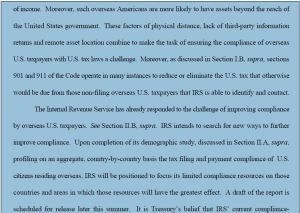 e worked with IRS Revenue Officers who specialize in international collection matters who argue and assert they can merely exercise this lien and levy power overseas against foreign financial institutions. However, this is where the power of the IRS comes to a screeching halt (or at least a major slowdown); when the collection of overseas assets is at stake.
The IRS is not without remedies to collect foreign assets, but it is not a simple process; if it can be done at all in any particular circumstance.
The IRS has no specific enforcement provisions negotiated in international treaties that will necessarily enable them to enforce and collect U.S. income taxes overseas with foreign government assistance. The cornerstone 9th Circuit case of Her Majesty held in 1979 that the Canadian tax authorities could not enforce a tax judgment against U.S. taxpayers within the U.S. –
The basic facts were these, as reported in the case:
British Columbia then served a “Notice of Intention to Enforce Payment” on the defendants in the United States, and filed a certificate of assessment in the Vancouver Registry of the Supreme Court of British Columbia. This certificate was for $195,929.50 (a penalty and interest were included), and under the laws of British Columbia its filing gave it the same effect as a judgment of the court. British Columbia then instituted the present action in the United States. It was dismissed because the court below concluded that the Oregon courts would follow the “revenue rule.” Stated simply, the revenue rule merely provides that the courts of one jurisdiction do not recognize the revenue laws of another jurisdiction.1
The U.S. 9th Circuit Court went on to say:
Although the Supreme Court has never had occasion to address the question of whether the revenue rule would prevent a foreign country from enforcing its tax judgment in the courts of the United States, the indications are strong that the Court would reach the same result as we reach in the present case. Both the majority and the dissenting opinion in Banco Nacional de Cuba v. Sabbatino, 376 U.S. 398, 84 S.Ct. 923, 11 L.Ed.2d 804 (1964), discussed the rule in a spirit which indicates a continued recognition of the revenue rule in the international sphere.10
This Majesty case specifically cited a Canadian Supreme Court case (Harden) which also applied the revenue rule in not enforcing a tax judgement in the U.S. courts for taxes against a Canadian resident:
Reciprocity would itself be a sufficient basis for denying British Columbia’s claim. The courts of British Columbia, relying upon the revenue rule, have refused to recognize the judgment of a United States court for taxes. United States v. Harden, 1963 Canada Law Reports 366 (Sup.Ct. of Canada, 1963, Affirming Court of Appeal for British Columbia).12
CONCLUSION: The revenue rule has been with us for centuries and as such has become firmly embedded in the law. There were sound reasons which supported its original adoption, and there remain sound reasons supporting its continued validity. When and if the rule is changed, it is a more proper function of the policy-making branches of our government to make such a change.
As a result of these cases and the Revenue Rule, the U.S. and Canada modified their income tax treaty to (at least in theory) allow for the international enforcement of taxes. The U.S. now has five income treaties with “mutual assistance” provisions: Canada, Sweden, France, Denmark, and the Netherlands (with a clause in the newly negotiated, but yet to go into force, Swiss treaty).
The U.S. tax and international tax world has changed dramatically since 1979 and the 9th Circuit case of Her Majesty particularly with the advent of FATCA. Nevertheless, there are serious legal limitations imposed on t he IRS in collecting assets for U.S. tax liabilities and penalties owed by USCs and LPRs residing overseas. Indeed, this is surely one of the principle reasons the IRS revised OVDP terms in June 2014 impose a 0% penalty against USCs and LPRs who participate in the so-called “streamlined process”. See, More on the New 2014 “Streamlined” Process for USCs and LPRs Residing Overseas.
The follow-on post will discuss the very limited provisions that have been recently negotiated with these five different countries and explain in more detail the limits on the U.S. federal government on the collection of taxes. It will also discuss the important differences of civil U.S. international tax enforcement/collection versus criminal tax enforcement; which are two very different beasts.
Finally, a dedicated post on the topic will discuss the steps the U.S. federal government is taking through the Department of Homeland Security and a database of information (TECS) to track and monitor people and their assets. The government describes TECS as follows: “The Treasury Enforcement Communications System (TECS) is a database maintained by the Department of Homeland Security (DHS), and it is used extensively by the law enforcement community. It contains information about individuals and businesses suspected of, or involved in, violations of federal law.”
Russia Joins the FATCA Group – On the Last Day? Complete List of Countries to Date (Very Few Notable Absences)
According to The Moscow Times, Putin Signs Last-Minute Law to Satisfy FATCA
With China and Russia as prior major holdouts, the recent news from both countries probably assures the long-term success of FATCA.
See, HUGE NEWS – China has “Reached an Agreement in Substance” for a FATCA Intergovernmental Agreement (IGA) – its Affect on USCs and LPRs Living in China and Hong Kong
There are very few notable “hold-outs” on FATCA IGAs. The following list reflects those countries of note (from my perspective) who have not signed or “reached an agreement in substance”:
Kenya
Nigeria
Egypt
Pakistan
Bahrain
Philippines
Malaysia
Guatemala
Uruguay
El Salvador
Nicaragua
Ecuador
Argentina
Venezuela
Lots of other countries with less commercial and financial ties to the U.S., did not – including – countries such as Kazakhstan, Uzbekistan and Cambodia.
There are currently 90 countries identified by the U.S. Treasury as having an IGA or “reaching an agreement in substance” as follows (note there are fewer signed IGAs than unsigned):
Countries that have signed agreements:
Model 1 IGA
1) Australia (4-28-2014)
2) Belgium (4-23-2014)
3) Canada (2-5-2014)
4) Cayman Islands (11-29-2013)
5) Costa Rica (11-26-2013)
6) Denmark (11-19-2012)
7) Estonia (4-11-2014)
8) Finland (3-5-2014)
9) France (11-14-2013)
10) Germany (5-31-2013)
11) Gibraltar (5-8-2014)
12) Guernsey (12-13-2013)
13) Hungary (2-4-2014)
14) Honduras (3-31-2014)
15) Ireland (1-23-2013)
16) Isle of Man (12-13-2013)
17) Italy (1-10-2014)
18) Jamaica (5-1-2014)
19) Jersey (12-13-2013)
20) Latvia (6-27-2014)
21) Liechtenstein (5-19-2014)
22) Luxembourg (3-28-2014)
23) Malta (12-16-2013)
24) Mauritius (12-27-2013)
25) Mexico (4-9-2014)
26) Netherlands (12-18-2013)
27) New Zealand (6-12-2014)
28) Norway (4-15-2013)
29) South Africa (6-9-2014)
30) Spain (5-14-2013)
31) Slovenia (6-2-2014)
32) United Kingdom (9-12-2012)
Model 2 IGA (signed agreements)
33) Austria (4-29-2014)
34) Bermuda (12-19-2013)
35) Chile (3-5-2014)
36) Japan (6-11-2013)
37) Switzerland (2-14-2013)
And those countries which are deemed to have “reached agreement in substance” –
Model 1 IGA
38) Algeria (6-30-2014)
39) Antigua and Barbuda (6-3-2014)
40) Azerbaijan (5-16-2014)
41) Bahamas (4-17-2014)
42) Barbados (5-27-2014)
43) Belarus (6-6-2014)
44) Brazil (4-2-2014)
45) British Virgin Islands (4-2-2014)
46) Bulgaria (4-23-2014)
47) China (6-26-2014)
48) Colombia (4-23-2014)
49) Croatia (4-2-2014)
50) Curaçao (4-30-2014)
51) Czech Republic (4-2-2014)
52) Cyprus (4-22-2014)
53) Dominica (6-19-2014)
54) Dominican Republic (6-30-2014)
55) Georgia (6-12-201)
56) Greenland (6-29-2014)
57) Grenada (6-16-2014)
58) Guyana (6-24-2014)
59) India (4-11-2014)
60) Indonesia (5-4-2014)
61) Israel (4-28-2014)
62) Kosovo (4-2-2014)
63) Kuwait (5-1-2014)
64) Lithuania (4-2-2014)
65) Panama (5-1-2014)
66) Peru (5-1-2014)
67) Poland (4-2-2014)
68) Portugal (4-2-2014)
69) Qatar (4-2-2014)
70) Romania (4-2-2014)
71) St. Kitts and Nevis (6-4-2014)
72) St. Lucia (6-12-2014)
73) St. Vincent and the Grenadines (6-2-2014)
74) Saudi Arabia (6-24-2014)
75) Seychelles (5-28-2014)
76) Singapore (5-5-2014)
77) Slovak Republic (4-11-2014)
78) South Korea (4-2-2014)
79) Sweden (4-24-2014)
80) Thailand (6-24-2014)
81) Turkey (6-3-2014)
82) Turkmenistan (6-3-2014)
83) Turks and Caicos Islands (5-12-2014)
84) Ukraine (6-26-2014)
85) United Arab Emirates (5-21-2014)
Model 2 IGA
86) Armenia (5-8-2014)
87) Hong Kong (5-9-2014)
88) Moldova (6-30-2014)
89) Paraguay (6-6-2014)
90) Taiwan (6-23-2014)*
How will USCs and LPRs living overseas be affected? Credit Suisse is reportedly in talks to pay well over $ 1 billion to resolve tax transgressions with the U.S. Department of Justice
UBS paid US$780M to resolve its issues with the US DOJ and IRS in 2009. It’s deferred prosecution agreement seemed harsh to many at the time. However, if recent news reports are correct, Credit Suisse will be paying well over $1 Billion to settle allegations of tax misconduct, including possible criminal indictments?
See Bloomberg, Credit Suisse Said Near U.S. Tax Deal for Over $1 Billion, By Tom Schoenberg, David Voreacos and Elena Logutenkova
Also, Jack Townsend issued a report on his blog about the possibilities of such a settlement – Credit Suisse Reports (5/6/14; 5/7/14)
How will USCs and LPRs living overseas be affected?
This is a question of great importance to many of the millions of USCs and LPRs residing outside the U.S. Certainly, USC and LPR individuals with accounts at Credit Suisse are bound to be directly affected.
According to the Senate report, there were some 6,000 USCs residing outside the U.S. with accounts at Credit Suisse. For further observations on this topic, see an earlier post – Key Take Aways from Senate Investigations re: Foreign Banks and “Offshore Tax Evasion”: U.S. Citizens Residing Overseas have Become a Focus of the Government.; Posted on March 4, 2014
Will an agreement with Credit Suisse regarding USC accounts, specifically including those who live outside the U.S. bring greater attention by the IRS and DOJ to the tax compliance of USCs and LPRs residing outside the U.S.?
See, Is the new government focus on U.S. citizens living outside the U.S. misguided or a glimpse at the new future?
Only time will tell, what type of USCs and LPRs are of most interest to the IRS and DOJ. Will they include large numbers of individuals living outside the U.S.? Will it go beyond USC accounts at Credit Suisse to Canadian resident account holders at Royal Bank of Canada; to British resident account holders at Barclays Bank; to Mexican resident account holders at Banamex; French resident account holders at Banpais, etc. etc. etc.?
Millions of USCs reside around the world. See, Coming to America. . . Accidental Americans Beware – The Law Requires a U.S. Passport!
Technology (with the help of FATCA) has enabled the U.S. government to now readily access information of financial accounts of USCs and LPRs residing throughout the world. See, The Catch 22 of Opening a Bank Account in Your Own Country – for USCs and LPRs (Posted on April 30, 2014)
???????????????? ?Please click here to view the above in Chinese.?
T.S. Eliot – Famous Former U.S. Citizens (Tax Rates Then & Now)
Thomas Stearns Eliot, who was better known as “T.S. Eliot” left the U.S. in the 1920s. He was recognized as one of the great writers of the early and middle 1900s. He published poetry, wrote plays and literature and was a social critic of his time.
T.S. Eliot received the Nobel Price for Literature.
He follows the lines of many other famous former U.S. citizens, in that he was not born on either the East Coast or West Coast of the U.S. He was born and raised in St. Louis, Missouri. Josephine Baker was also born in St. Louis, Missouri and Tina Turner in Tennessee, both famous individuals who shed their U.S. citizenship.
He either relinquished or renounced his U.S. citizenship as he became a naturalized British citizen in 1927. At the time, there were no adverse U.S. tax consequences for shedding U.S. citizenship. The first “expatriation tax” law was not adopted until 1966 as part of the The Foreign Investors Tax Act of 1966 (“FITA”) – The Origin of U.S. Tax Expatriation Law (Posted on April 6, 2014)
The highest U.S. federal income tax rate in 1927 was 25%. See, Personal Exemptions and Individual Income Tax Rates, 1913-2002. There was no Social Security tax at that time, as the Social Security programs were enacted in the Social Security Act of 1935.
Today’s highest marginal income tax rate is 39.6%, and the combined employer/employee portion of federal social security and medicare tax is 15.3%.
???????????????? ?Please click here to view the above in Chinese.?
Countries with U.S. Income Tax Treaties & Lawful Permanent Residents (“Oops – Did I Expatriate”?)
The U.S. has income tax treaties with multiple countries. My post from yesterday briefly explains how a LPR living in one of these countries may become a “covered expatriate” if the three conditions of the statute, IRC Section 7701(b)(6) that was added into the law in 2008 are satisfied. See, LPR status can be abandoned for tax purposes (since 2008 tax law changes) by merely leaving and moving outside the U.S. in some cases. Posted on April 28, 2014
Importantly, a LPR who resides in one of these countries where he or she has income tax residency in the treaty country, can inadvertently “expatriate” for U.S. federal income, estate, gift and inheritance taxes. See, Oops…Did I “Expatriate” and Never Know It: Lawful Permanent Residents Beware! International Tax Journal, CCH Wolters Kluwer, Jan.-Feb. 2014, Vol. 40 Issue 1, p9
The list of those countries with income tax treaties are as follows and can be reviewed at IRS website:
A
Armenia
Australia
Austria
Azerbaijan
B
Bangladesh
Barbados
Belarus
Belgium
Bulgaria
C
Canada
China
Cyprus
Czech Republic
D
Denmark
E
Egypt
Estonia
F
Finland
France
G
Georgia
Germany
Greece
H
Hungary
I
Iceland
India
Indonesia
Ireland
Israel
Italy
J
Jamaica
Japan
K
Kazakhstan
Korea
Kyrgyzstan
L
Latvia
Lithuania
Luxembourg
M
Malta
Mexico
Moldova
Morocco
N
Netherlands
New Zealand
Norway
P
Pakistan
Philippines
Poland
Portugal
R
Romania
Russia
S
Slovak Republic
Slovenia
South Africa
Spain
Sri Lanka
Sweden
Switzerland
T
Tajikistan
Thailand
Trinidad
Tunisia
Turkey
Turkmenistan
U
Ukraine
Union of Soviet Socialist Republics (USSR)
United Kingdom
United States Model
Uzbekistan
V
Venezuela
Coming to America. . . Accidental Americans Beware – The Law Requires a U.S. Passport!
Dual nationals who have lived almost all of their lives outside the U.S. routinely travel with their passport of their country of residence. 
They are typically not aware that they must have a U.S. passport to travel to the U.S. pursuant to a 2004 law, known as the Intelligence Reform and Terrorism Prevention Act.
There are many dual nationals living in countries throughout the world. The statistics are a bit fuzzy as to the exact numbers.
Apparently, Mexico is the country where more U.S. citizens reside, according to the State Department, and Canada is number two on the list. Approximately 1 million U.S. citizens lived in Mexico, while 687,000 were in Canada. Other countries with large numbers of U.S. citizens included the United Kingdom (224,000), Germany (211,000), Israel (184,000), Italy (169,000), Philippines (105,000), Australia (103,000), France (102,000), and Spain (95,000). According to State Department data, these ten countries contain about 70% of all U.S. citizens living abroad. See,
Accidental Americans” – Rush to Renounce U.S. Citizenship to Avoid the Ugly U.S. Tax Web” International Tax Journal,
CCH Wolters Kluwer, Nov./Dec. 2012, Vol. 38 Issue 6, p45.
*
Most of these individuals (who were born in the U.S. or who have U.S. citizenship via derivative citizenship) living outside the U.S. are probably unaware that U.S. law requires they obtain a U.S. passport to travel in or out of the U.S. A foreign resident individual with a U.S. parent, must consider whether they too are also a U.S. citizen by the concept known as “
derivative citizenship“; i.e., “derived” from a U.S. citizen parent. If so, this law,
Intelligence Reform and Terrorism Prevention Act, requires a U.S. passport.
*
The Department of Homeland Security and Department of State published
regulations in 2008 that specifically require all U.S. citizens (including dual nationals) to generally have a U.S. passport to enter into or leave the U.S. This was not the case in previous years. There are 4 substitute documents (instead of a U.S. passport) that can be used in certain circumstance (although the U.S. passport card – is the only practical document in most cases), which consist of the following:
*
(2) a U.S. passport card; (3) a valid trusted traveler card (
NEXUS, FAST, or
SENTRI);
(4) a valid MMD when traveling in conjunction with official maritime business; or
(5) a valid U.S. Military identification card when traveling on official orders or permit.
*
At the end of the day, the law almost always requires any U.S. citizen, including “Accidental Americans” to have a U.S. passport or U.S. passport card when they travel into the U.S. Having a passport of the country of residence is not sufficient.
???????????????? ?Please click here to view the above in Chinese.?

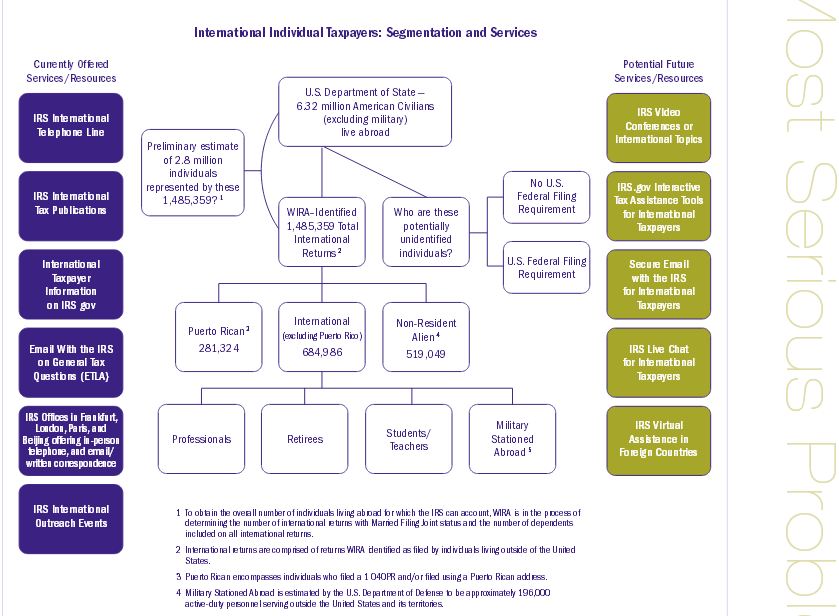 discussed both the number and type of individuals overseas, and potentially unidentified individuals.
 .
.