Inflation Adjusted Exclusion Amounts Since Inception of 2008 “Mark to Market” Expatriation Tax Law: Example
The current “expatriation” “exit tax” forces a “covered expatriate” to pay U.S. income taxation on their unrealized gains (the “mark to market” concept) as if they sold their worldwide assets.
An “unrealized gain” is the amount of gain “built into” the property or other investment of the individual, which has yet to be sold or otherwise disposed of by the him or her. For instance, the  diagram below reflects various assets held by a “Covered Expatriate” which includes Mexican real estate with a tax basis of US$200,000 but a current fair market value of US$1.1M. This means the unrealized gain in that Mexican real property is US$900,000 (US$1.1M – US$200K).
Who is a “covered expatriate” is a very important legal analysis that needs to be considered for each U.S. citizen who wishes to renounce or “long-term resident.” See, The dangers of becoming a “covered expatriate” by not complying with Section 877(a)(2)(C) (9 March 2014).
Importantly, the law provides for an exclusion from taxation on the former (a) U.S. citizen’s (“USC”) or (b) long-term resident’s unrealized gains. (See, Who is a “long-term” lawful permanent resident (“LPR”) and why does it matter? – 19 Aug. 2014). In other words, no U.S. income tax is due and payable by a “covered expatriate” if they did not have assets with unrealize d gains greater than a certain threshold amount.
That threshold amount has been changing annually, since the initial US$600,000 that was originally adopted into the law in 2008. It is changing due to annual inflation adjustments.
The current 2015 exclusion amount adjusted for inflation is US$690,000. See, The “Phantom” Gain Exclusion from the “Mark to Market” Tax – Increases to US$690,000 for the Year 2015 (15 November 2014).
Hence, in this case, if the only asset owned by the “covered expatriate” (assuming she became one in 2015) was the real estate in the above example with unrealized gain of US$900,000, only US$210,000 would be subject to the “mark to market” tax on expatriation (i.e., the exit tax). This is because $690,000 of the total US$900,000 unrealized gain will be excluded from taxation (US$900K – US$690K).
The Mark to Market tax regime imposes taxation on this amount, even though the real estate is never sold. This means, the “covered expatriate” must come “out of pocket” to find the cash and means necessary to pay the tax imposed under the law.
There is no economic benefit obtained from this annual inflation adjustment if a U.S. citizen or long-term resident waits to become at a later time a covered expatriate; unless they consume, deplete or lose their assets in the interim. But at least, there is an inflation adjustment, so the taxpayer is not subject to an increasing amount of gain subject to tax as time progresses and inflation eats away at the true economic value and economic growth of the individual’s assets.
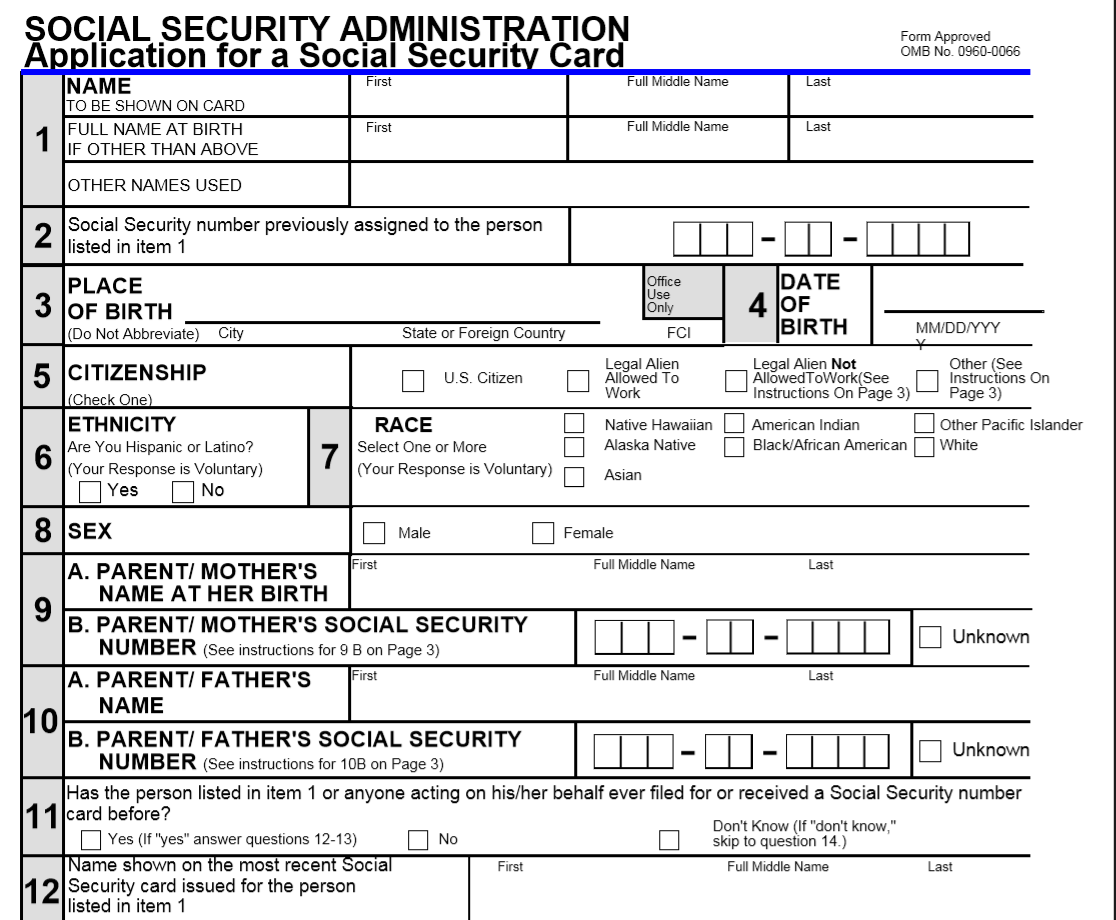
U.S. Citizens Overseas who Wish to Renounce without a Social Security Number will Necessarily be a “Covered Expatriate”
U.S. Citizens Overseas who Wish to Renounce without a Social Security Number (“SSN”) will Necessarily be a “Covered Expatriate”
- The Dilemma of SSNs, TINs and USCs Residing Overseas
The prior post discussed some of the complications of United States Citizens (“USCs”) who reside outside the U.S. and do not have a social security number (“SSN”) . This dilemma exists, even though USCs are not generally required to file for or  obtain a SSN (e.g., at birth – See, SSA Publication – “Social Security Numbers For Children” page 2, It is not obligatory to file for a SSN at birth. “Must my child have a Social Security number? No. Getting a Social Security number for your newborn is voluntary. But, it is a good idea to get a number when your child is born. . . . ).
Indeed, it is the U.S. federal tax law that requires the USC must have a SSN for their taxpayer identification number (“TIN”). I will reference various excerpts from a recent paper I drafted and presented titled URGENT NEED FOR U.S. CITIZENS RESIDING OUTSIDE THE U.S. TO BE ABLE TO OBTAIN A TAXPAYER IDENTIFICATION NUMBER (“TIN”) OTHER THAN A SOCIAL SECURITY NUMBER , including the following:
. . . the IRS’ increased focus on international tax compliance has made clear that USCs residing overseas have U.S. tax return filing obligations, even if they have no assets, no income, or no real personal connections in or with the U.S. See IRS notice from 2011 which addresses numerous aspects of tax compliance for USCs overseas, including various penalties under the law[1]:
. . . U.S. Citizens or Dual Citizens Residing Outside the U.S. . . .
The IRS is aware that some taxpayers who are dual citizens of the United States and a foreign country may have failed to timely file United States federal income tax returns or Reports of Foreign Bank and Financial Accounts (FBARs), despite being required to do so. . . . 2. Penalties imposed for failure to file income tax returns or to pay tax . . . 3. Possible additional penalties that may apply in particular cases . . . 6. Possible penalties for failure to file FBAR . . . 7. New reporting requirement for foreign financial assets . . . [emphases added]
USCs residing overseas are subject to the range of tax penalties that apply to all individual taxpayers (e.g., negligence penalties, failure to file penalties, late payment or failure to pay penalties, etc.).[2] Additionally, USCs residing overseas are subject to other, typically much harsher penalties for not timely filing U.S. federal information returns regarding assets located outside the U.S.[3]; alluded to above in the IRS 2011 notice.[4]
These civil penalties typically are a minimum of US$10,000 per statutory violation. USCs who live outside the U.S. necessarily have assets, such as financial accounts in their country of residence. These Title 26 information reporting requirements[5] are referred to herein as “International Information Returns.”
The IRS will not process federal tax returns and International Information Returns without a valid TIN.[6] Plus, the law does not provide for an exception for USCs overseas who do not file returns, if they do not have a SSN. Late filed, or incomplete International Information Returns and tax returns (e.g., lacking a SSN) will typically subject USCs to these penalties even in those cases when the taxpayer has no federal income tax liability.[7]
[1] See, IRS FS-2011-13, December 2011, updated February, 2014.
[2] See, IRS FS-2011-13 and as a sample of some of the many statutory penalties that could typically apply, IRC §§ 6048, 6652(f), 6677, 6654, 6655, 6698, 6699, 6166, 6653, 6675, 6715, 6715A, 6717, 6718, 6719, 6720A, 6725, et. seq.
[3] See, IRC §§ 6038, 6038B, 6038D, 6039F, 6039G, 6046, 6046A, 6048, et. seq.
[4] See, IRS FS-2011-13, December 2011, updated February, 2014.
[5] See, IRC §§ 6038, 6038B, 6038D, 6039F, 6039G, 6046, 6046A, 6048, et. seq.
[6] See, IRS website, “General ITIN Information” – http://www.irs.gov/Individuals/General-ITIN-Information – “IRS no longer accepts, and will not process, forms showing “SSA”, 205c”, “applied for”, “NRA”,& blanks, etc.”
[7] See, IRC §§ 911 (foreign earned income exclusion) and 901 (foreign tax credit), et. seq. A USC residing overseas may have no actual federal income tax liability (for various reasons), typically due to the foreign earned income exclusion and/or foreign tax credit calculation.
The above explains fairly clearly the dilemma facing USCs residing overseas.
The complexity of getting a SSN and the requirements are covered in more detail in the paper. Some key points are:
I. The Social Security Administration Rules Make it Nearly Impossible for Many USCs Overseas to Reasonably Obtain a SSN
The policy and procedures of the SSA regarding issuing SSNs have changed significantly over the years.[1] The Social Security Administration (SSA) provides a detailed chronology of the major changes in policy and procedures  regarding filing for and obtaining a SSN.[2] One of the most significant revisions in the last decade came from The Intelligence Reform and Terrorism Prevention Act of 2004 (P.L. 108-458), which imposes various standards for the verification of documents or records submitted by an individual.
A. Only a Few Countries Around the World have Personnel at U.S. Embassies or Consulate Offices that Can Process SSN Applications – SSA Form SS-5-FS
Applying for SSNs overseas is severely restricted compared to an application in the U.S.
According to the U.S. Department of State, Foreign Affairs Manual (“FAM”), only certain “Claims-Taking Posts” in specific countries “may” include “processing applications for Social Security Numbers.” [3]
These 17 countries (and a city in the case of Jerusalem) with Claims-Taking Posts include:
“Austria, Argentina, Costa Rica, Dominican Republic, France, Germany, Greece, Ireland, Italy, Japan, Jerusalem, Mexico, Norway, Philippines, Poland, Portugal, Spain, and the United Kingdom.”
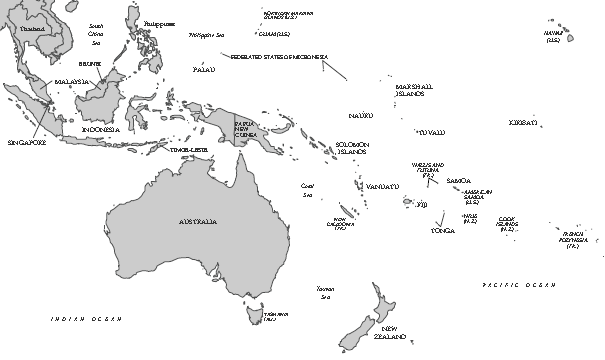
Noticeably absent are many Western European countries, virtually all of Latin America, virtually all of Asia, virtually all of Eastern Europe, all of the Middle East (except Jerusalem), all of the African continent, all of the Australian continent and surrounding island countries and Russia, among many other significant countries, including OECD member countries.[4]
Nothing in the FAM requires any of these “Claims-Taking Posts” to actually process applications for a SSN. Plus, there are of course hundreds of other countries throughout the world, not listed above, which do not have such a U.S. Department of State Post. For these reasons, USCs in countries such as China must travel to a U.S. Department of State Post (e.g., the Philippines) which is able to process applications for SSNs.
[1] See, SSA website, The Story of the Social Security Number, by Carolyn Puckett, Social Security Bulletin, Vol. 69 NO. 2, 2009 (http://ssa.gov/policy/docs/ssb/v69n2/v69n2p55.html.
[2] See, SSA website, Significant Milestones in Social Security Number Policy. A detailed chronology of the major changes in policy and procedures. http://www.ssa.gov/history/ssn/ssnchron.html.
[3] See 7 FAM 530, page 2 of 64.
[4] In contrast to these 17 countries (and one city – Jerusalem) where a USC residing overseas must travel to apply for a SSN, the Treasury Department has announced it has around 100 countries that have signed, or “have reached agreements in substance” a FATCA IGA. USCs throughout the world are required by the Foreign Account Tax Compliance Act (“FACTA”) to provide their U.S. TIN to financial institutions throughout the world (on IRS Form W-9, or its equivalent), which under current law necessarily must be a SSN. Of course, if they have no SSN, they cannot sign IRS Form W-9 which provides in Part II: “Under penalties of perjury, I certify that: 1. The number shown on this form is my correct taxpayer identification number . . .”
- The Necessary “Covered Expatriate Status” of a USC without a SSN
The core point of this post, with the above SSN background, is to explain how a USC without a SSN will necessarily be a “covered expatriate” since they will not be able to truthfully certify they have complied with the federal tax laws (title 26). See, Certification Requirement of Section 877(a)(2)(C) – (5 Years of Tax Compliance) and Important Timing Considerations per the Statute
As other posts have explained, “covered expatriate” status matters:
See, Why “covered expat” (“covered expatriate”) status matters, even if you have no assets! The “Forever Taint”! (20 May 2014) and The “Hidden Tax” of Expatriation – Section 2801 and its “Forever Taint.” (10 April 2014) and “Covered Expatriate” Status is a “Scarlet Letter” (10 Nov 2014).
If a USC has no SSN, they by definition will never be able to comply with the Certification Requirement of Section 877(a)(2)(C) since they will not be able to comply with IRC § 6109(a) and Treas. Reg. § 301.6109-1. As the SSN/TIN paper explains:
All United States citizens (“USCs”) must have a social security number (“SSN”) under current law as their TIN to file a federal income tax return.[1]
[1] See, IRC § 6109(a) and Treas. Reg. § 301.6109-1.
The IRS will not process federal tax returns and “International Information Returns”, as defined below, without a valid TIN[1]; which currently must be a SSN for a USC.
[1] See, IRS website, – http://www.irs.gov/Individuals/General-ITIN-Information – “IRS no longer accepts, and will not process, forms showing “SSA”, 205c”, “applied for”, “NRA”,& blanks, etc.”
The Problem with PFICs! “Avoid PFICs Like the Plague”
There are typically numerous tax issues that USCs and LPRs need to consider prior to renouncing their citizenship; or abandoning th eir lawful permanent residency status.
One of the most confusing comes from the complex rules of a so-called “PFIC” – the acronym for a “passive foreign investment company.” A prior post in March 2014 discussed the basics of these U.S. tax creatures – “PFICs” – What is a PFIC – and their Complications for USCs and LPRs Living Outside the U.S.
Most USCs and LPRs with basic mutual fund investments in their country of residence have PFICs and probably don’t even know it.
The IRS and Treasury have recently spent much attention and resources to the regulation of PFICs. In January of 2014, temporary regulations were issued regarding PFICs. See, Regulations §1.1291–0T, et. seq.
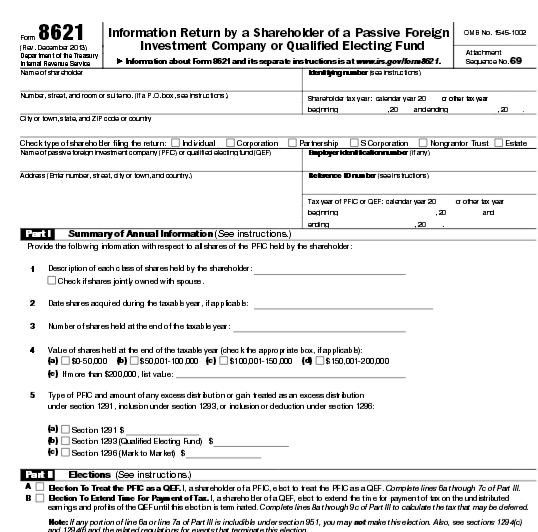
One of the many new requirements of these regulations are annual information filing requirements. This means that a U.S. taxpayer (e.g., U.S. citizen or LPR) residing outside the U.S., must file an annual report on IRS Form 8621.
- When Might You have a PFIC?
Taxpayers who have simple passive investments in mutual funds based outside the U.S.. e.g., in their country of residence, almost always have PFICs. There is no percentage ownership threshold in the foreign entity that triggers PFIC tax consequences. An ownership interest of 0.000001% triggers the consequences if either the “income test” or “asset test” are satisfied. Other type of investment funds in the form of a legal entity also typically qualify as a PFIC.
Specifically, a PFIC is a foreign corporation in which a U.S. person has some ownership in (without any percentage threshold requirement) if (i) at least 75% of its gross income is passive income (the “income test”), or (ii) at least 50% of its assets produce passive income (the “asset test”). See IRC § 1297(a).
Also, many retirement funds in various countries (including both private and many government run retirement plans) typically fall into the category of a PFIC. For instance, the Singapore retirement fund system, Central Provident Fund (“CPF”), is actually created by the government, but Singapore taxpayers who are obligated to contribute to the retirement fund will select various mutual funds to invest in through the CPF. Hence, these mutual fund investments are PFICs. See also the technical paper regarding Mexican retirement funds that argues, WHY MEXICAN RETIREMENT FUNDS SHOULD NOT BE SUBJECT TO THE NEW REPORTING REQUIREMENTS UNDER IRC SECTION 1298(f).
- Ugly Tax Consequences of a PFIC
PFICs are taxed to the U.S. taxpayer in a very complicated manner compared to taxation of U.S. based mutual funds or other U.S. based investments. In short, the income earned from PFICs, under the default regime, are taxed at the ordinary income rates, and for past years are typically taxed at the highest marginal ordinary income tax rate is 39.6% (even if the income would otherwise qualify for qualified dividend or long-term capital gains rates – which are taxed at no more than 20%).
There are three alternative regimes for how a U.S. investor is taxed in a PFIC: (i) the “excess distribution” regime (which is the default regime); (ii) the qualified electing fund (“QEF”) regime and (iii) the market-to-market (“MTM”) regime. Each of these regimes will be discussed in later posts.
One key point to know is that most foreign investment funds do not keep records and account for income and expenses in a manner that even allows a U.S. taxpayer to report accurately under the QEF or MTM regime, even if such treatment provides a lower overall U.S. tax.
More on how PFICs are taxed in a later post.
- Even Uglier Tax Reporting – Compliance Consequences of PFICs Driven by FATCA
Finally, the 2010 FATCA legislation has led to the new regulations that now require annual reporting of PFICs. This is done on IRS Form 8621. It is a laborious form and requires extensive and detailed information.
The consequences of not reporting can lead to disastrous tax results. See a prior post from March 2014, When the U.S. Tax Law has no Statute of Limitations against the IRS; i.e., for the U.S. citizen and LPR residing outside the U.S.
- Why You Don’t Want to Die with a PFIC or Gift a PFIC Away (even to Your Favorite Charity or Spouse).
Lastly, a later post will explain in more detail why a USC or LPR generally wants to avoid PFICs if at all possible. Many countries require their residents to contribute on a mandatory basis to retirement funds that invest in mutual funds, which may not allow a USC to avoid PFICs. One of the principle reasons to avoid PFICs is the income tax that arises and is owed by the U.S. person, even if he or she tries to give the PFIC away. A gift of a PFIC will typically cause an income tax to the donor in addition to the estate/gift tax rules. This is true for gifts to charity and even to your own spouse.
- Why You Should Avoid PFICs Like the Plague
At the end of the day, the above complications, mean that most USCs and LPRs residing overseas should “avoid PFICs like the plague”.
In the context of USCs who wish to renounce their U.S. citizenship, they will not be able to avoid “covered expatriate” status if they have not complied with these PFIC rules, as they will not be able to “certify under penalty of perjury that he has met the requirements of this title for the 5 preceding taxable years or fails to submit such evidence of such compliance as the Secretary may require.”
The ugly consequences of PFICs can be summarized as follows:
- Higher income tax rate than U.S. based investments on the earnings of the investment, at least under the default method;
- Practically impossible to report the earnings on a more favorable MTM or QEF method;
- Extensive information reporting requirements annually;
- Open ended statute of limitations in favor of the IRS to audit all items on the tax return, for failure to properly file IRS Form 8621;
- Paying a U.S. income tax, even if you gift away the PFIC to charity or to your spouse;
- Trying to even explain effectively the consequences of a PFIC to your tax return preparer; and
- Being subject to the “forever taint” of being a “covered expatriate” for failure to comply with the PFIC rules. See, The “Hidden Tax” of Expatriation – Section 2801 and its “Forever Taint.”
Where the IRS will Likely Look in Latin America: Country Specific Tax Returns filed by U.S. Individual Taxpayers – Latin America (Excluding Mexico)
The prior post asked the “question”: Where the IRS will likely look overseas: USCs are Millions Yet U.S. Tax Returns are Just a Few Hundred Thousand [?]
As a continuation of the prior post, some further analysis by geographical region is provided here. This post is focused on Latin American countries  where U.S. citizens, lawful permanent residents (“LPRs”) or other individuals who may be U.S. tax residents (e.g., those individuals who make an election to be treated as a “U.S. person” for federal income tax purposes) are or are not filing U.S. tax returns. For an important discussion of LPRs, see, Who is a “long-term” lawful permanent resident (“LPR”) and why does it matter?
The IRS provides detailed statistical information on tax returns filed; how many, and in various groupings and from various locations. One such grouping by the IRS office of statistics, is by those individuals who filed tax returns which contained the “foreign earned income exclusion” which is reported on Form 2555: Foreign-Earned Income Exclusion, Housing Exclusion, and Housing Deduction.
See, The Foreign Earned Income Exclusion is Only Available If a U.S. Income Tax Return is File
The IRS reports that less than 15,000 tax returns were filed from all of of Latin/South America (excluding Mexico); for the year 2011, the last year they reported these statistics reflecting the foreign earned income exclusion. One of the more surprising statistics is that according to the U.S. Department of State, some 120,000 U.S. citizens reside in Costa Rica alone, yet only about 2,100 U.S. income tax returns were filed from Costa Rica with the foreign earned income exclusion.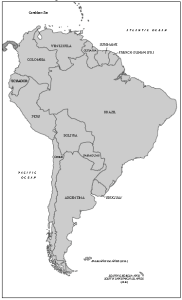
Indeed, according to the U.S. federal government’s own numbers, there are approximately more than 8 times the number of U.S. citizens, simply living in Costa Rica (approx. 120,000) compared to the total number of U.S. tax returns (14,732) filed from all of the Latin/South American countries (excluding Mexico) that had the foreign earned income exclusion.
Similarly, Panama according to the U.S. Department of State, has ” . . . About 25,000 American citizens reside in Panama, many retirees from the Panama Canal Commission and individuals who hold dual nationality. There is also a rapidly growing enclave of American retirees in the Chiriqui Province in western Panama.” However, only about 1,200 U.S. income tax returns were filed from Panama with the foreign earned income exclusion.
Each Latin/South America country from which the number of U.S. tax returns were filed in 2011, with the foreign earned income exclusion is set out below:
| Latin/South America, total |
14,732 |
| Argentina |
986 |
| Brazil |
3,351 |
| Chile |
1,383 |
| Colombia |
1,524 |
| Costa Rica |
2,147 |
| Panama |
1,187 |
| Peru |
1,098 |
| Venezuela |
778 |
| Other Latin and South American countries |
2,280 |
This analysis is surely the type of analysis being conducted by the IRS which will be supplemented with information as they start receiving financial account and income information from countries and their financial institutions around the world (not just Latin America) from FATCA and the IGAs. See, Part 1- Unintended Consequences of FATCA – for USCs and LPRs Living Outside the U.S.
Three key observations about the above analysis.
First, there are many U.S. citizens residing overseas who have (a) income below certain thresholds, (b) are simply retired or unemployed – and have no foreign earned income, and/or (c) are not aware of how they can benefit from the foreign income exclusions; and therefore are not filing U.S. tax returns with the foreign earned income exclusion. However, the disproportionate number of U.S. citizens living throughout Latin America compared with the tax returns that are filed in this category is a strong indicator of low compliance by these taxpayers. The IRS will surely take note of this key consideration.
Second, the above numbers do not try to identify the number of LPRs who are residing in these Latin American countries who are also not filing U.S. income tax returns. There are some 13-14 million LPRs. See, What are the Number of LPRs who Leave U.S. Annually without filing Form I-407 – Abandonment?
Third, Latin America has the largest percentage of the population throughout the world where more U.S. citizens reside. See, a 2012 proposal I prepared for the State Bar of California, Taxation Section: Proposed Expansion of Category of Registered Deemed-Compliant FFI: “The Good Faith Local FFI” and the Accidental American along with Liliana Menzie that describes the high concentration of U.S. citizens throughout the region. “Latin America, as a prime example, has a high concentration of U.S. citizens residing in various countries pursuant to the State Department data, in some cases representing a large percentage of the population (e.g., nearly one half of a percent -0.4%- of the total population of the Americas consisted of U.S. citizen[s] . . .”
Where the IRS will likely look overseas: USCs are Millions Yet U.S. Tax Returns are Just a Few Hundred Thousand
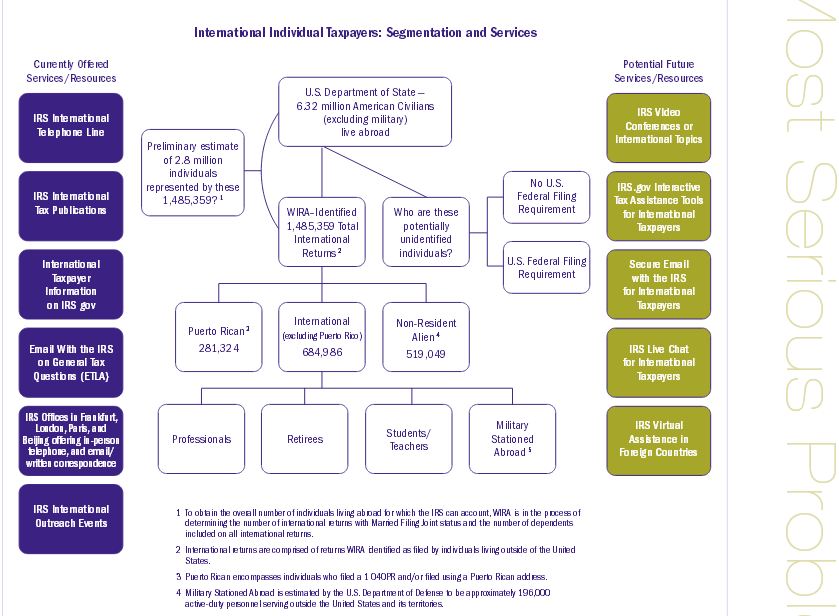
The IRS has key tax return filing information in their current records; pre-FATCA flow of financial information. Various reports indicate there are probably around 6-7 million U.S. citizens residing overseas, although there is no certainty in these numbers. See, Taxpayer’s Advocate Annual Report of 2012 – that  discussed both the number and type of individuals overseas, and potentially unidentified individuals.
The IRS tracks and keep information on U.S. income tax returns filed by U.S. individual taxpayers overseas.
The information is not only the number of tax returns (head count), but also the amount of income reported. For instance, TAS reported about 700,000 returns were filed in 2010 by U.S. taxpayers abroad, while estimating about 6.32 million U.S. citizens reside abroad. See, p. 37 of the Taxpayer’s Advocate Annual Report of 2012 –
These numbers do not even try to quantify the number of lawful permanent residents (“green card holders”) who reside around the world, who are not filing U.S. income tax returns. In 2012, the estimated number of LPRs was 13.3 million as reported by the Office of Statistics of the DHS. See, Estimates of the Legal Permanent Resident Population in 2012
How many of these LPRs are living outside the U.S. and not filing or reporting their worldwide income on U.S. income tax returns?
In addition, for the tax year 2011, the IRS Tax Statistics (“SOI”) in the “SOI Tax Stats – International Individual Tax Statistics” reported that only about 450,000 returns were filed with the foreign earned income exclusion. See, The Foreign Earned Income Exclusion is Only Available If a U.S. Income Tax Return is Filed
A detailed report of these statistics commissioned by the IRS and prepared by Scott Hollenbeck and Maureen Keenan Kahr titled Individual Foreign-Earned Income and Foreign Tax Credit, 2011 provides numerous insights about the likely under reporting and non-filers of U.S. income tax returns .
.
This report provides the following information reflecting the UK as the number one country with foreign earned income (Section 911) followed by Canada. Ironically Afghanistan (presumably due to the U.S. citizens working in that country as a result of the war?) is the country in the 4th location, ahead of Hong Kong and Japan.
Noticeably absent from that graph is Mexico, which reportedly has the largest number of U.S. citizens residing in any particular country. Canada is the second most populated country with U.S. citizens according to numerous reports.
Only about 46,000 returns were filed by Canadian residents claiming the foreign earned income exclusion, and even more surprising are the mere 7,000 returns from Mexican based U.S. taxpayers. See Table 2 of the report – Individual Foreign-Earned Income and Foreign Tax Credit, 2011
These are the two most populated countries with U.S. citizens.
As the IRS receives information around the world from governments and financial institutions via FATCA, of U.S. citizens and their bank accounts, it will be fairly easy for them to start targeting certain countries and commence tax audits against residents in those countries.
What are the Number of LPRs who Leave U.S. Annually without filing Form I-407 – Abandonment?
A prior post identified the number of lawful permanent residents (LPRs) who file Form I-407 to formally abandon their lawful permanent residency. See, The Number of LPRs “Leaving” the U.S. is 16X Greater than the Number of U.S. Citizens Renouncing Citizenship
These numbers of I-407 forms filed annually were obtained through a freedom of Information Act (“FOIA”) request and provided by the USCIS. See tabl:
Of course, this statistic does NOT identify the number of the approximate 13.3+ million LPRs who leave the U.S. to live elsewhere in another country without completing Form I-407 and formally abandoning. The estimated number of LPRs was 13.3 million for the year 2012 as reported by the Office of Statistics of the DHS. See, Estimates of the Legal Permanent Resident Population in 2012.
Maybe the number of individuals who fall into this latter category (i.e., moving out of the U.S. without filing Form I-407) is several hundred of thousands of individuals annually?
Importantly, from a taxation perspective, anyone who moves and lives in a country with a U.S. income tax treaty (the list of these countries is set out below – from the IRS website), needs to be careful not to be deemed to be a “covered expatriate” due to the application of IRS Form 7701(b)(6). See, IRS Notice 2009-85.
See, the following posts with further explanation of the tax law for LPRs who move and live in one of the countries listed below. Countries with U.S. Income Tax Treaties & Lawful Permanent Residents (“Oops – Did I Expatriate”?)
See also, Who is a “long-term” lawful permanent resident (“LPR”) and why does it matter?
Becoming a “covered expatriate” has U.S. tax consequences not just to the “former long-term LPR”, but also to their family and friends who are “U.S. persons” (as defined under Section 7701. See, The “Hidden Tax” of Expatriation – Section 2801 and its “Forever Taint.”
A
Armenia
Australia
Austria
Azerbaijan
B
Bangladesh
Barbados
Belarus
Belgium
Bulgaria
C
Canada
China
Cyprus
Czech Republic
D
Denmark

E
Egypt
Estonia
F
Finland
France
G
Georgia
Germany
Greece
H
Hungary
I
Iceland
India
Indonesia
Ireland
Israel
Italy
J
Jamaica
Japan
K
Kazakhstan
Korea
Kyrgyzstan
L
Latvia
Lithuania
Luxembourg
M
Malta
Mexico
Moldova
Morocco
N
Netherlands
New Zealand
Norway
O
P
Pakistan
Philippines
Poland
Portugal
Q
R
Romania
Russia
S
Slovak Republic
Slovenia
South Africa
Spain
Sri Lanka
Sweden
Switzerland
T
Tajikistan
Thailand
Trinidad
Tunisia
Turkey
Turkmenistan
U
Ukraine
Union of Soviet Socialist Republics (USSR)
United Kingdom
United States Model
Uzbekistan
V
Venezuela
How will the IRS collect tax and penalty assessments against former USCs and LPRs who live exclusively outside the U.S.?
How will the IRS collect tax and penalty assessments against individuals who live exclusively outside the U.S.?
This is a practical problem for the U.S. federal government who has laws that extend far beyond its borders. See, for instance, HUGE NEWS – China has “Reached an Agreement in Substance” for a FATCA Intergovernmental Agreement (IGA) – its Affect on USCs and LPRs Living in China and Hong Kong
However, the limits on the enforcement and collection of taxes overseas, beyond U.S. borders is more problematic for the government. Some of the tools at its disposal are as follows:
- Limited enforcement authority via income tax treaty. For all practical purposes, it has been nearly impossible for the federal government to use tax treaties to enforce U.S. civil tax judgments against overseas assets of individuals who also reside outside the U.S.
More on this topic will be discussed as case law and policy develops. For now, this may be the weak link in the global enforcement efforts of U.S. law that imposes worldwide taxation on worldwide assets of U.S. citizens residing overseas. See, Co-author. “Tax Simplification: The Need for Consistent Tax Treatment of All Individuals (Citizens, Lawful Permanent Residents and Non-Citizens Regardless of Immigration Status) Residing Overseas, Including the Repeal of U.S. Citizenship Based Taxation,” by Patrick W. Martin and Professor Reuven Avi-Yonah, September 2013.
How Congressional Hearings (Particularly In the Senate) Drive IRS and Justice Department Behavior
The separation of powers is often on full display when there are key Congressional hearings focused on the work (or lack thereof) undertaken by the key executive branch agencies responsible for tax enforcement:
1. Treasury/IRS, and
2. Justice Department.
There is an important reason why every day taxpayers should be interested in these hearings; particularly those who are considering renouncing United States Citizenship.
The actions and reactions of the IRS and Justice Department are often in response to Congressional hearings. This is very much the case with individual taxpayers with assets throughout the world.
A brief timeline of various hearings, and actions taken by the IRS and Justice Department (largely in response to such criticism) can be followed to demonstrate the influence of these hearings:
U.S. Senate Permanent Subcommittee on Investigations, published their report on August 1, 2006, entitled Tax Haven Abuses: The Enablers, The Tools & Secrecy.
Little direct action was taken by the IRS or Justice Department in this year. It was the year 2008, where the direct hearings lead to more direct action taken.
U.S. Senate Permanent Subcommittee on Investigations, headed by Chairman Carl Levin, published their report on July 16, 2008, entitled Tax Haven Banks and U.S. Tax Compliance –
November 2008, a U.S. federal grand jury indicted the Chairman and CEO of UBS Global Wealth Management and Business Banking.
U.S. Senate Permanent Subcommittee on Investigations, headed by Chairman Carl Levin, published their report on March 4, 2009 Tax Haven Banks and U. S. Tax Compliance – Obtaining the Names of U.S. Clients with Swiss Accounts
UBS agrees in February 2009 to pay a US$780M fine to the U.S. government and enter into a deferred prosecution agreement on charges of conspiring to defraud the United States by impeding the Internal Revenue Service.
IRS Implements first Offshore Voluntary Disclosure Program (“OVDP”) on March 26, 2009
Numerous taxpayers and several Swiss bankers were indicted and/or plead guilty to various tax crimes charges; mostly directly related to UBS. See, website of U.S. Department of Justice – Offshore Compliance Initiative.
Congress passes and the President signs into law, the Foreign Account Tax Compliance Act (“FATCA”) in 2010 as part of the Hiring Incentives to Restore Employment (HIRE) Act.
IRS Implements its second Offshore Voluntary Disclosure Initiative (“OVDI”) in 2011.
Numerous taxpayers and several Swiss financial advisors were indicted; and a HSBC Indian client was also indicted or plead guilty to various tax crimes charges; mostly directly related to UBS. See, website of U.S. Department of Justice – Offshore Compliance Initiative.
IRS creates an open ended OVDP program in 2012 that continues; with modifications made in 2014.
Several taxpayers were indicted; including those implicating an Israeli bank for various tax crimes charges. . See, website of U.S. Department of Justice – Offshore Compliance Initiative.
The Treasury Department obtains commitments from various countries to sign various FATCA, intergovernmental Agreements (“IGAs”) for automatic exchange of financial information; France, Germany, Italy, Spain, United Kingdom, Denmark and Mexico.
In January 2013, the U.S. Attorney’s Office in the Southern District of New York secured the guilty plea of Wegelin Bank, the oldest private bank in Switzerland and the first foreign bank to plead guilty to felony tax charges.
In August, 2013, the United States and Switzerland Issue Joint Statement Regarding Tax Evasion Investigations and ability of Swiss banks to enter into deferred prosecution agreements.
Several taxpayers were indicted and advisors; including multiple financial institutions outside of Switzerland for various tax crimes charges. See, website of U.S. Department of Justice – Offshore Compliance Initiative.
The Treasury Department obtains more commitments for signed FATCA IGAs with various countries for the automatic exchange of financial information;.
U.S. Senate Permanent Subcommittee on Investigations, headed by Chairman Carl Levin, published their report on February 26, 2014 Offshore Tax Evasion: The Effort to Collect Unpaid Taxes on Billions in Hidden Offshore Accounts
See prior post, Hearings – Permanent Subcommittee on Investigations – re: Offshore Tax Evasion: The Effort to Collect Unpaid Taxes on Billions in Hidden Offshore Accounts – February 26, 2014
Posted on February 26, 2014 Updated on March 2, 2014
IRS announces on June 18, 2014, IRS Makes Changes to Offshore Programs; Revisions Ease Burden and Help More Taxpayers Come into Compliance
See, “IRS Makes Changes to Offshore Programs; Revisions Ease Burden and Help More Taxpayers Come into Compliance” – How Will These Changes Affect USCs and LPRs Living Outside the U.S.?
See, More on the New 2014 “Streamlined” Process for USCs and LPRs Residing Overseas
The Treasury Department obtains numerous commitments for signed FATCA IGAs with various countries for the automatic exchange of financial information. See, HUGE NEWS – China has “Reached an Agreement in Substance” for a FATCA Intergovernmental Agreement (IGA) – its Affect on USCs and LPRs Living in China and Hong Kong
Part II of III: Tracking Travelers’ Entries and Exits – Guest Immigration Law Post by Atty Mr. Jan Bejar
Part II of III: Tracking Travelers’ Entries and Exits –
Guest Immigration Law Post by Atty Mr. Jan Bejar
This post is a continuation of Part I of III: Tracking Travelers’ Entries and Exits – Guest Immigration Law Post by Atty Mr. Jan Bejar
. . .
For certain classes of nonimmigrants at air and sea ports of entry, electronic I-94 and I-94W records are generated using APIS data and stored in the NIIS. As of April 30, 2013, CBP stopped issuing paper I-94 records at air and sea ports of entry. Currently, CBP still issues paper I-94 records at land ports of entry, which are then entered into the NIIS.
Trusted traveler programs are another method of tracking and recording entries into the U.S. Trusted traveler programs include Global Entry, NEXUS on the northern border, and SENTRI on the southern border, among others. Travelers voluntarily provide detailed biometric and biographic data to CBP in exchange for expedited admission at ports of entry. Members use their machine-readable identification documents and/or RFID cards when entering the U.S., and their entries are accordingly recorded and stored.
Even today, despite the high inspection rates and various technologies, it is occasionally possible that an entry into the U.S. at a land port of entry would not be recorded. For example, if an inspector at a land port of entry simply looks at a U.S. passport or other travel document that is not RFID-enabled and does not “swipe” it to use its machine-readable capabilities, then the traveler’s entry may not be recorded. Along the same lines, a minor under 16 years old entering the U.S. at a land port of entry with a birth certificate may not have the entry recorded.
The U.S does not have a history of tracking departing travelers, and therefore comprehensively tracking exits has proved more elusive, particularly for land departures. Various pilot programs have been tested and later discontinued. Presently, at certain land ports of entry on the southern border, travelers may be subjected to screening and inspection upon departure. CBP’s mandate in conducting these inspections is to address violence in Mexico and to interrupt transnational criminal organizations’ activities. Outbound screening tends to happen in short-term surges, followed by periods of reduced inspection.[1] Simply passing through the screening, however, does not create a record of the departure.
For travelers departing the U.S. by air and sea, as mentioned above, CBP uses APIS to collect commercial passenger and crew manifests for all outbound international departures. Compliance by carriers is near 100%. CBP then transfers this data for non-U.S. citizens to ADIS, which matches arrivals to and departures from the U.S. Anecdotally, this system for tracking exits from the U.S. is not foolproof.
For example, just a few months ago, a lawful permanent resident client who had applied for naturalization purchased a ticket to depart the U.S. while her naturalization application was pending (which is entirely permissible). Ultimately, however, she opted not to travel abroad and postponed her flight. At her recent naturalization interview, when the USCIS officer asked about her trips outside the U.S. during the past five years, he asked about her departure on the date of the canceled flight. He had presumably accessed APIS and/or ADIS, and presumably the airline carrier had shared her name as a passenger with CBP, even though she had not boarded the plane. She honestly denied departing the U.S. that day. Fortunately, the officer believed her and moved on, but the error could have been difficult and time-consuming to correct had it been necessary to do so. Further, if she had been a nonimmigrant with authorization only to remain in the U.S. until the day of her scheduled flight, the system may not have detected her overstay.
As another example along the same lines, the American Immigration Lawyers Association (AILA) just reported that USCIS has recently denied in error multiple applications for changes of status (to a different nonimmigrant status) and for adjustment of status (to permanent resident status) where the applicants had purchased, but not used, airline tickets to depart the U.S.[2]
These applications, in contrast to a naturalization application, typically require that the applicant remain in the U.S. until receiving a decision. The sole reason that USCIS cited in these denials was the applicants’ alleged departures from the U.S. and constructive abandonment of the applications. Presumably these officers accessed APIS, the NIIS, and/or ADIS but did not click through the electronic records deep enough to see that the applicants had not actually used the international plane tickets. USCIS is supposedly aware of this training issue, but these denials underscore the difficulty in tracking exits from the U.S.
[1] See, supra, at fn. 3.
[2] See “CBP Practice Alert: ‘Implied Departure’ and Denial of USCIS Benefits, AILA InfoNet Doc. No. 14090243 (posted Sep. 2, 2014); see also “Minutes from AILA CBP Liaison Committee Teleconference with Suzanne Shepherd, ESTA Director regarding I-94 web portal and travel history information,” August 6, 2014, AILA InfoNet Doc. No. 14082042 (posted August 20, 2014).
Jan Joseph Bejar, Esq.
(For: JAN JOSEPH BEJAR, APC)
Tel: (619) 291-1112
Fax:(619) 291-1102
E-mail: jbejar@immigrationlawclinic.com
Website: www.immigrationlawclinic.com
Wowzers! Consular Fees for Processing U.S. Citizenship Renunciations Increased More than 500% (US$2,350 Fee)
Wowzers! Consular Fees for Processing U.S. Citizenship Renunciations Increased More than 500%
The recent U.S. Department of State announcement of new fees for renouncing U.S. citizenship have been increased significantly. The costs of the “Hotel California” have gone up to US$ 2,350 from US$450. 
This information comes on the heals of distressing news that in some Consulate offices throughout the world, U.S. citizens are not able to get meetings for renunciations until the year 2015.
| Type of Service |
Previous Fee |
New Fee |
| Renunciation of Citizenship |
$450 |
$2,350 |
Fees for Consular Services to Change on September 12, 2014
Mexico City, August 28, 2014 – Effective September 12, 2014, the Department of State will adjust processing fees for some services. The fees for most categories of immigrant visas will change, while fees for nonimmigrant visas largely remain the same. The fee for processing an application for Renunciation of U.S. Citizenship is increasing to reflect the true cost of providing this service.
The Department seeks to recover, as far as possible, the cost of providing consular services through the collection of consular fees. The Department regularly reviews these costs and adjusts fees as necessary to reflect the cost of service.
Although most categories of nonimmigrant visa processing fees will remain the same, the fee for E visas (treaty-traders and treaty-investors) will decrease and the fee for K visas (for fiancé(e)s of U.S. citizens) will increase. The fee charged for Border Crossing Cards for Mexican citizen minor applicants under the age of 15 will increase by $1.
For immigrant visa processing, the fee for family-sponsored immigrant visas will increase, as will the fee for domestic review of an Affidavit of Support. All other immigrant and special visa processing fees that are changing will decrease.
Documenting a U.S. citizen’s renunciation of citizenship is extremely costly, requiring U.S. consular officers overseas to spend substantial amounts of time to accept, process, and adjudicate cases. The fee for processing renunciation of citizenship, which had previously been subsidized, is now reflective of the true cost.
Nonimmigrant Visa Processing Fees
| Type of Visa |
Previous Fee |
New Fee |
| Treaty Investor and Trader visas (E) |
$270 |
$205 |
| Fiancé(e) visas (K) |
$240 |
$265 |
| Border Crossing Card (under age 15) |
$15 |
$16 |
Immigrant Visa Processing Fees
| Type of Visa |
Previous Fee |
New Fee |
| Immediate Relative and Family Preference Applications |
$230 |
$325 |
| Employment-Based Applications |
$405 |
$345 |
| Other Immigrant Visa Applications |
$220 |
$205 |
| Determining Returning Resident Status |
$275 |
$180 |
| Waiver of Two-Year Residency Requirement |
$215 |
$120 |
| Affidavit of Support Review (only when reviewed domestically) |
$88 |
$120 |
Citizens’ and Administrative Services
| Type of Service |
Previous Fee |
New Fee |
| Renunciation of Citizenship |
$450 |
$2,350 |
| Charge for Consular Time (for fee services performed outside of normal business hours or away from the office) |
$231 |
$135 |
The proposed fees were published in the Federal Register today, and will take effect in 15 days. To view the interim final rule, visit www.regulations.gov. Comments will be accepted until 60 days after publication. At that time, the Department will consider the public comments, and the published final rule will include the Department’s response to any comments received.
Fee information may also be found on the Bureau of Consular Affairs website, travel.state.gov, and on the websites of U.S. embassies and consulates.
Read the Q&A format here.

 diagram below reflects various assets held by a “Covered Expatriate” which includes Mexican real estate with a tax basis of US$200,000 but a current fair market value of US$1.1M. This means the unrealized gain in that Mexican real property is US$900,000 (US$1.1M – US$200K).
 d gains greater than a certain threshold amount.