International Tax · Citizenship Renunciation · LPR Abandonment
International Tax Shareholder
Why Most LPRs Residing Overseas Haven’t a Clue about the Labyrinth of U.S. Taxation and Bank and Financial Reporting of Worldwide Income and Assets (Part I)
1998 Report from Department of Treasury to Chairman of House Committee on Ways and Means
Whether you have a “foreign bank account” for instance, is not intuitive, if you reside principally in a country outside the U.S. In other words, the accounts one may have in their country of tax residency (e.g., Germany, Canada, U.K., India, the U.S., Denmark, Mexico, etc.) will not seem like a “foreign bank account” at all. Rather, it is an account in a financial institution in their country of residency, i.e. a “domestic account.” Similarly, a U.S. bank account for an LPR residing outside the U.S. will intuitively seem like a “foreign bank account.” This is just one counter-intuitive example. Others will be explored in subsequent posts – e.g., “foreign corporations” and “foreign partnerships” among others.
There is a particularly formal way of abandoning LPR status, which is by filing Form I-407, Record of Abandonment of Lawful Permanent Resident. The very instructions to the form imply that it is not the only way to abandon – as the form ” . . . is designed to provide a simple procedure to record an individual’s abandonment . . . “
To complicate the law further, Treasury regulations provide for the so-called “green card test” – but do not contemplate the application of an income tax treaty for which we have nearly 70 with various countries:
(1) Green card test. An alien is a resident alien with respect to a calendar year if the individual is a lawful permanent resident at any time during the calendar year. A lawful permanent resident is an individual who has been lawfully granted the privilege of residing permanently in the United States as an immigrant in accordance with the immigration laws. Resident status is deemed to continue unless it is rescinded or administratively or judicially determined to have been abandoned.
Treas. Reg. § 301.7701(b)-1(b).
To review the nearly 70 income tax treaties with different countries, they can be reviewed on the IRS website – United States Income Tax Treaties – A to Z – The application of these treaties to LPRs will be explored in later posts. Incidentally, no where on the actual “green card” is there express reference to tax obligations as exists on the back page of a U.S. passport.
I will leave you with an excerpt from the 1998 report referred to above starting on page 14:
” . . . Other factors also operate to limit both compliance measurement and improvement. Because the United States asserts taxing jurisdiction over those with little or no connection to the United States other than citizenship or status as a lawful permanent resident, in many cases overseas U.S.taxpayers are difficult to trace or contact. Moreover, even when valid tax assessments can be made against overseas taxpayers, IRS has limited enforcement recourse if the taxpayer’s assets are physically located outside of the United States. In addition, persons may be unaware of their status as U.S. taxpayers with an obligation to file a U.S. tax return. As described in Section II.B, supra, IRS has undertaken various taxpayer education initiatives to increase awareness of filing and payment obligations. In some cases, however,education may not be sufficient. For example, an individual who was born outside the United States and has never even visited the country may, nevertheless, be a U.S. citizen by reason of his parents’ U.S. citizenship. Such a person may not even know that he is a U.S. citizen and thus likely will not know of his obligation to file a U.S. tax return. Similarly, the United States imposes tax on greencard holders who no longer reside in the United States but who have not surrendered their greencards. Although the immigration laws may no longer recognize the validity of the green card if the holder attempted to reenter the country, and the individual may no longer consider himself entitled to lawful permanent resident status, the individual [generally] remains subject to U.S. tax under the Code.[emphasis added along with clarifying language in brackets]
Importantly, no where throughout all of this extensive 1998 report is there even a mention of the foreign bank account reporting obligations. Imagine, the Treasury never once in their report explained how and to what extent FBAR reporting applied to these taxpayers – even-though the ” . . . report responds to section 513 of the Health Insurance Portability and Accountability Act, Pub. L. 104-191, which directs the Secretary of the Treasury to prepare a report that describes income tax compliance by U.S. citizens and lawful permanent residents residing outside the United States . . . “
Taxpayer’s Advocate (TAS) and Passport Revocations – Unconstitutional Restriction on Right to Travel Internationally?
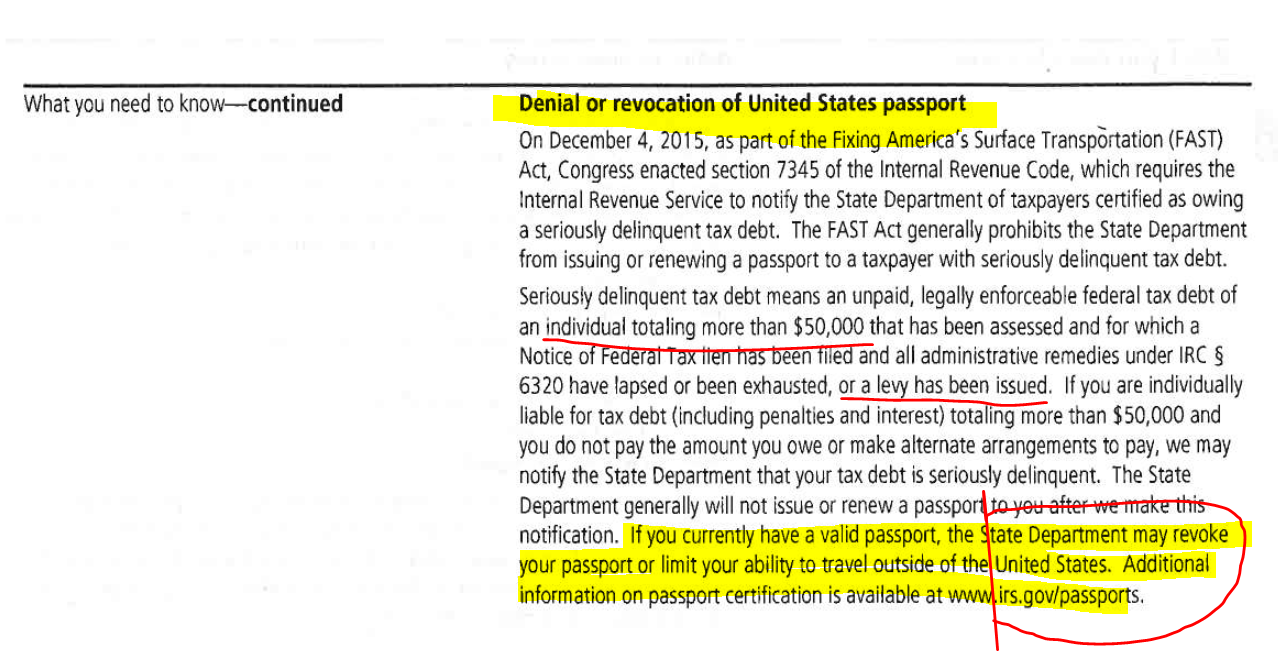
As the State Department starts rolling out more letters denying U.S. passport renewals and initial applications on the backs of IRS Notices CP 508C to U.S. citizens (USCs); USC taxpayers are highly motivated to address their “seriously delinquent tax debts.” What rights do USCs have vis-a-vis these government allegations in their tax certifications?
For a deep dive into a range of issues that USCs need to consider, if they find themselves on the side of an unfortunate IRS Notices CP 508C – see the TAS’s excellent Interim Guidance Memorandum dated April 26, 2018. One key point made by the TAS memo is:
The right to travel internationally is a fundamental right, protected by the Due Process Clause of the Constitution. Under the Universal Declaration of Human Rights, adopted in 1948 by the United Nations after a unanimous vote (including the United States) “[e]veryone has the right to leave any country, including his own, and to return to his country.” The National Taxpayer Advocate expressed concerns that the IRS’s implementation of the passport program fails to protect taxpayers’ right to travel as well as their rights promised under the Taxpayer Bill of Rights. See the National Taxpayer Advocate’s blog and the Fiscal Year 2018 Objectives Report to Congress.
The U.S. Supreme Court, in an opinion penned by retired Justice Souter in Sosa v. Alvarez-Machain (2004), has some interesting observations about the Universal Declaration of Human Rights (which is cited above by the Taxpayer Advocate) limiting its application in the Alvarez-Machain case. This is a fascinating case to read, as it arises out of the tragic torture and murder of a DEA agent, Enrique Camarena-Salazar in 1985 in Mexico. Physician Alvarez-Machain was subsequently indicted in the U.S. as part of the torture and murder scheme and the DEA hired private Mexican nationals to seize Alvarez and bring him to the United States in a private plane to stand trial.
Alvarez-Machain was ultimately granted motion for a judgement of acquittal on the criminal charges.
In response, Alvarez-Machain then sued the federal government under the Federal Tort Claims Act and the Alien Tort Statute.
The Supreme Court opined (on these tort action claims and the application of international law as to U.S. federal tort statutes) as follows:
. . . To begin with, Alvarez cites two well-known international agreements that, despite their moral authority, have little utility under the standard set out in this opinion. He says that his abduction by Sosa was an “arbitrary arrest” within the meaning of the Universal Declaration of Human Rights (Declaration), G. A. Res. 217A (III), U. N. Doc. A/810 (1948). And he traces the rule against arbitrary arrest not only to the Declaration, but also to article nine of the International Covenant on Civil and Political Rights (Covenant), Dec. 19, 1996, 999 U. N. T. S. 171,22 to which the United States is a party, and to various other conventions to which it is not. But the Declaration does not of its own force impose obligations as a matter of international law. See Humphrey, The UN Charter and the Universal Declaration of Human Rights, in The International Protection of Human Rights 39, 50 (E. Luard ed. 1967) (quoting Eleanor Roosevelt calling the Declaration “ ‘a statement of principles … setting up a common standard of achievement for all peoples and all nations’ ” and “ ‘not a treaty or international agreement … impos[ing] legal obligations’ ”).23 And, although the Covenant does bind the United States as a matter of international law, the United States ratified the Covenant on the express understanding that it was not self-executing and so did not itself create obligations enforceable in the federal courts. . . [emphasis added]
Section 7345(e) provides for judicial review of the IRS’s certifications of “seriously delinquent tax debts” as follows:
(e)Judicial review of certification
(1)In general
After the Commissioner notifies an individual under subsection (d), the taxpayer may bring a civil action against the United States in a district court of the United States or the Tax Court to determine whether the certification was erroneous or whether the Commissioner has failed to reverse the certification.
(2)Determination
If the court determines that such certification was erroneous, then the court may order the Secretary to notify the Secretary of State that such certification was erroneous.
Surely, the U.S. Tax Court and Federal District Courts will have much more to say about the rights of USCs who have their U.S. passports revoked or renewals denied by application of 26 U.S.C. 7345. Will the Universal Declaration of Human Rights be meaningful to the Courts applying Section 7345?
How many errors will the IRS make in issuing certifications of “seriously delinquent tax debts” to USCs around the world?
22. Article nine provides that “[n]o one shall be subjected to arbitrary arrest or detention,” that “[n]o one shall be deprived of his liberty except on such grounds and in accordance with such procedure as are established by law,” and that “[a]nyone who has been the victim of unlawful arrest or detention shall have an enforceable right to compensation.” 999 U. N. T. S., at 175—176.
23. It has nevertheless had substantial indirect effect on international law. See Brownlie, supra, at 535 (calling the Declaration a “good example of an informal prescription given legal significance by the actions of authoritative decision-makers”).
The “965 Hammer” (aka the “Transition” or “Repatriation” Tax) for USCs Residing Overseas
Small businesses around the world commonly operate through companies established in their country of operation. According to the U.S. Tax Foundation, with admittedly outdated information from the year 2014, there were 1.7 million traditional C corporations, compared to 7.4 million partnerships and S corporations; even more sole proprietorships operating in the U.S.
I could not find similar data for other countries around the world, which is where Section 965 takes us.
USCs who live outside the U.S. and operate a business through a corporate entity in their country of residence (e.g., Canada, Mexico, UK, France, South Africa, Japan, Brazil, Hong Kong, Sweden, etc.) can be shocked when they learn how the new tax provision of IRC Section 965 works.
Hence, new IRC Section 965 imposes a one-time mandatory repatriation tax on accumulated earnings and profits of foreign corporations. The tax is paid by the U.S. shareholder. This makes policy sense, if the goal is to tax U.S. based taxpayers, especially mega companies with billions or 100s of millions of dollars of offshore un-taxed cash. In the past, much of these offshore profits could avoid U.S. taxation indefinitely as long as they were not actually repatriated in the form of dividends to the U.S. shareholder(s).
However, most people at the time were not expecting that this same repatriation tax would befall USCs living overseas arising from their local business operations.
Probably Congress and the Administration did not contemplate the fallout to these USC taxpayers. They were focusing on a different group of taxpayer. Nevertheless, Section 965 imposes immediate U.S. individual taxation on the “phantom income” (i.e., when no dividends are distributed to the USC shareholder) of the USC shareholder.
The next few posts will be dedicated to trying to explain in plain English how the “965 Hammer” (as I am affectionately calling it) applies to USCs residing in their home country with a business or investment assets held in a corporation.
The due date under the statute for paying this 965 tax has “come and past”; however, the IRS has granted certain extensions of time. These will be discussed in subsequent posts.
Importantly, a timely election under Section 965(h)(1) must be made by the due date (including extensions) for filing the return for the relevant year. For USCs residing outside the U.S., that due date was June 15th, 2018 and hopefully all USCs filed an automatic extension (IRS Form 4868) by that date, which would extend your due date to October 15, 2018 and the time to file the 965(h)(1) election.
. . . However, the IRS has determined that, if an individual’s net tax liability under section 965 in the individual’s 2017 taxable year is less than $1 million, the individual makes a timely election under section 965(h), and the individual did not pay the full amount of the first installment by the due date under section 965(h)(2), the failure to make the payment will not result in an acceleration event under section 965(h)(3) so long as the individual pays the full amount of the first installment (and its second installment) by the due date for its 2018 return (determined without regard to extensions). . .
A USC’s extensions and elections are very important here. A later post will explain how a USC residing outside the U.S. can obtain an additional extension at the discretion of the IRS. This can extend the due date of the 2017 income tax returns (IRS Form 1040) from the extended October 15th date to a further extended date of December 15th, 2018; for which the 965 election must be correctly made by the USC individual shareholder of a non-U.S. corporation.
The U.S. Supreme Court and Tax Cases (e.g., Topsnik and Section 877A)
Individuals around the world are often curious about how and when the U.S. Supreme Court hears tax cases. In some countries, tax cases represent the majority or large percentage of total cases heard by their Supreme Court (e.g., Mexico).
The 2013 term was unusual in that the Supreme Court heard three federal tax cases (U.S. v. Woods, U.S. v. Quality Stores, Inc. and U.S. v. Clarke). Similarly, in 2015 the Supreme Court issued opinions in three tax cases (although each dealt with powers of states to impose taxation – Alabama Dept. of Revenue v. CSX Transportation, Inc. a property tax case; Direct Marketing Association v. Brohl a sales tax case; and, Maryland v. Wynne an income tax case).
None of these cases or any Supreme Court case before them has dealt with the U.S. “exit tax” arising out of IRC Sections 877, 877A, 2801, et. seq. Indeed, to date, there have been few cases heard by other courts regarding these provisions. One of the most important and relevant is the Topsnik v. Comm’r (146 T.C. No. 1) case published this year. The Topsnik case will be discussed in more detail in a later post. The short version is that the taxpayer in Topsnik lost the case and was found to have been a “covered expatriate” with the consequent adverse tax consequences that follow.
Taxpayers have a right of appeal from the U.S. Tax Court. If a case is appealed from the U.S. Tax Court, e.g., Topsnik or another federal court (e.g., from Court of Federal Claims) it will go to one of 13 appellate courts. An appeal from one of these 13 appellate courts will lie with the U.S. Supreme Court.
The U.S. Supreme Court is generally not obliged to review cases (per the Certiori Act of 1925), including tax cases, and will rarely take up a tax case, whether or not it addresses a Constitutional question. Hence, a case like Topsnik will almost certainly never become binding precedent to all the courts in the land, e.g., the Court of Federal Claims.
The world is starting to wake up to better understand how the U.S. Treasury negotiated so-called “bilateral” FATCA Intergovernmental Agreements (“IGAs”) with some 113 countries around the world. The list of all countries can be found here at the Treasury website – Foreign Account Tax Compliance Act (FATCA)
Not all of these countries have actually signed the IGAs. Many of them have what the U.S. Treasury calls an “agreement in substance.”
How does this impact USCs and LPRs residing outside the U.S.? Many ways.
First, extensive information is being collected by foreign financial institutions (FFIs – non-U.S. financial institutions) throughout the world to identify “U.S. Persons” and “Substantial U.S. Owners.” The IGAs use the term “Specified U.S. Person” with respect to what are defined as “U.S. Reportable Accounts.” See as an example, the Treasury FATCA IGA with Colombia, which is largely identical in form to almost all other IGAs.
Second, many FFIs have adopted a policy to no longer accept or retain U.S. accounts, due to the cost of compliance associated with U.S. citizens and lawful permanent residents. Also, many FFIs simply want to avoid the risk of being penalized heavily by the U.S. federal government for having U.S. taxpayers and being charged with some type of wrongdoing; namely aiding and abetting U.S. taxpayers to evade U.S. tax obligations. See, Jack Townsend’s thoughtful website Federal Tax Crimes that reviews in detail the various cases with foreign banks, with a particular focus on Swiss banks, U.S. DOJ Program for Swiss Banks .
Now to the “dirty little secret” of FATCA IGAs. They are not bilateral in the sense that U.S. banks do not need to provide the same detailed information on their non-U.S. clients (e.g., UK, French, Canadian, Mexican, Chinese, Dutch, Spanish, Colombian, Brazilian, residents, etc.) as do FFIs regarding “U.S. accounts.” This is no real secret, since a simple reading of the FATCA IGAs will get you to this conclusion by simply understanding the difference between what is defined as a “U.S. Reportable Account” (which is extraordinarily broad) compared to “Country X Reportable Account.” The latter definition, e.g., a Colombian Reportable Account, only obligates U.S. banks to send information of individual residents on U.S. source income under chapter 3 and certain accounts of Colombian entities.
Hence, all non-U.S. source income to a Colombia resident individual is not subject to reporting by the U.S. financial institution. She could have a portfolio of US$150M in non-U.S. mutual funds, ADRs traded on the NYSE and have no reporting of all of her income going back to the Colombian government. Also, stock sales of U.S. corporations (e.g., Apple, Ford or Microsoft) is not treated as “U.S. source income” defined under chapter 3. Plus, a Colombian resident who has an offshore corporation (e.g., a BVI company) that owns the investments, NO reporting is required of the U.S. financial institution; even if the entire US$150M portfolio were invested in U.S. stocks, U.S. treasuries, and other American made financial investments.
Contrast that with what is defined as a “U.S. Reportable Account” that would include a U.S. Person that is a “Controlling Person” of a “Non-U.S. Entity.” Take the same example in reverse; a Colombian bank must identify all of its clients with Non-U.S. Entities (undertake an expensive due diligence process) to then identify whether such entities (e.g., a BVI company) has a “Specified U.S. Person”. Plus, it does not matter if the income is from Colombian sources or non-Colombian sources. Income is income and must be reported by the FFI.
Accordingly, Banks around the world in at least 113 countries (e.g., UK, French, Mexican, Chinese, Dutch, Spanish, Colombian, Brazilian, Cayman, Singapore, Guatemala, Hong Kong, etc.) are required to drill down and collect detailed information on beneficial owners of basically all companies, trusts and other legal entities. This work is required, so as to identify who are “U.S. persons” to identify “substantial U.S. owners” as that term is defined in the FATCA regulations. The IGAs call these essentially “U.S. Reportable Accounts.” In the case of FFIs, U.S. taxpayers cannot hide behind offshore opaque legal entities (e.g., which would generally be illegal for USCs to form and hold assets in a foreign corporation and not report the assets, activities and earnings of the foreign corporation, which would generally be a CFC or possibly a PFIC). See prior post: March 30, 2015, The Problem with PFICs! “Avoid PFICs Like the Plague”
The FATCA IGAs, require these FFIs to provide extensive information on all income on these “U.S. Reportable Account” to the IRS, either directly or indirectly through their own governments.
In contrast, individuals resident in any foreign country (e.g., UK, French, Mexican, Chinese, Dutch, Spanish, Colombian, Brazilian, Belgium, Guatemala, Luxembourg, etc.) can generally hold their ownership interests of U.S. investment assets in U.S. banks and financial institutions through opaque legal structures and hide behind the entity without worrying that a U.S. financial institution has any duty to identify and disclose who are the beneficial owners to the tax authorities of those residents. See Colombian individual scenario above with a BVI company.
Why did the Treasury purposefully create this limited reporting obligations for U.S. financial institutions while creating extensive and detailed reporting obligations for FFIs?
Why are U.S. financial institutions not required under FATCA IGAs to identify the beneficial owners of opaque legal structures to report the income and gains to foreign tax authorities?
Why are U.S. financial institutions not required under FATCA IGAs to identify the and report non-U.S. source income in their U.S. accounts?
Why has the U.S. refused to participate in the OECD common reporting standards?
How will the “Panama Papers” Affect U.S. Citizens and LPRs Abroad?
There has been a media frenzy around the world since the story broke of the so-called “Panama Papers.” It’s not clear, to date, what will become the underlying consequences for U.S. citizens (“USCs”) and lawful permanent residents (“LPRs”) residing around the world, outside the U.S. Indeed, there is now a Wikipedia website dedicated to identifying famous people linked to the “Panama Papers”. See, List of people named in the Panama Papers
So far, that Wikipedia list does not identify USCs or LPRs, as far as I can tell.
There is bound to be a major response by various countries about how is the best way to respond to their taxpayers from their countries who are not complying with their laws. The Panama Papers might become the U.S.’s version of the Swiss bank fiasco that largely started in 2009? Only time will tell.
For any USC or LPR, they simply need to be aware of the obligations of U.S. law regarding reporting and identifying assets located throughout the world, including their country of residence (e.g., their normal bank accounts), including any ownership in companies that may be formed in any particular jurisdiction outside the U.S., whether that be France, UK, Mexico, Colombia, Panama, South Africa, BVI, Hong Kong, Taiwan, Canada, Spain, etc.
For a primer for USCs and LPRs residing outside the U.S, the following blog posts identify various U.S. legal obligations reporting non-U.S. assets:
The automatic exchange of bank and financial information is driven by the U.S. Treasury driven Intergovernmental Agreement (IGA).
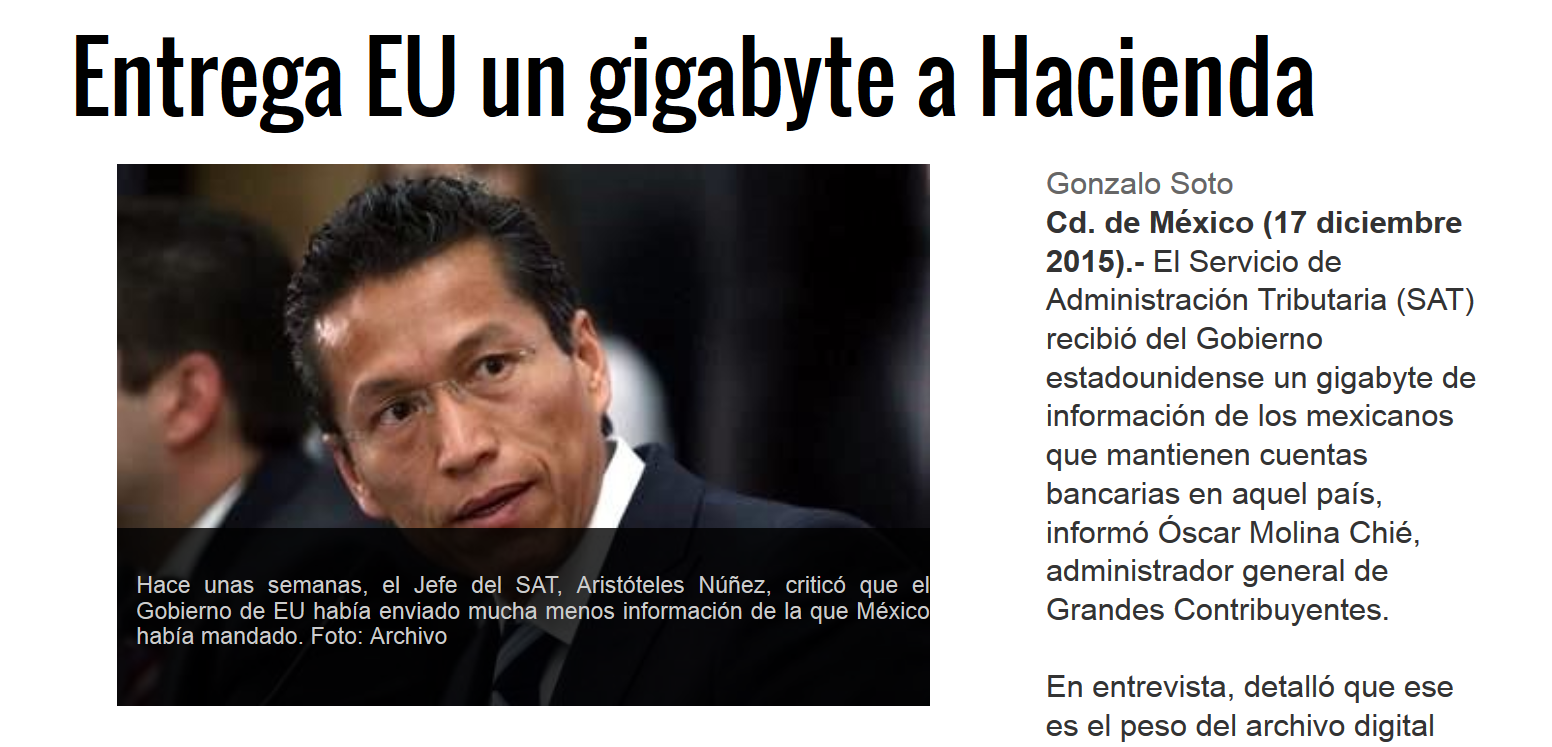
As a follow-up, the Mexican newspaper Reformareported on the 17th of December that the U.S. just provided Mexico’s treasury with a gigabyte of Mexican taxpayer information regarding U.S. financial and bank accounts. See, Entrega EU un gigabyte a Hacienda, dated Dec 17, 2015.
This news comes on the heals of the earlier criticism by the Commissioner of the Mexican IRS (SAT – Servicio de Administración Tributaria (SAT)), Mr. Aristóteles Núñez Sánchez. The Reformaarticle quotes Óscar Molina Chié (who is in charge of the large taxpayers division at SAT) generously regarding how and what information was provided by the U.S. federal government.
Finally, the article emphasized that Mexico has sent the IRS information regarding Mexican bank accounts of U.S. citizens.
The Commissioner of the Mexican IRS (SAT – Servicio de Administración Tributaria (SAT)), Mr. Aristóteles Núñez Sánchez just announced that the U.S. government is not holding up its side of the bargain under the U.S.-Mexico IGA. See, the Dec. 12, 2015 article en the national Mexican newspaper, El Universal, EU incumple entrega de informacion: SAT: Mexico ha hecho su parte, asegura Aristóteles Núñez
The article, which is in Spanish, explains that Mexico has complied with its obligations under the IGA by providing detailed information about U.S. taxpayers with accounts in Mexican financial institutions to the U.S. government. However, the U.S. government has not complied with its side of the bargain. The news report says no specific details were provided by Mr. Núñez about what type of information was provided.
Financial institutions, outside the U.S. have been taking numerous steps to advise their U.S. born clients and U.S. resident clients about the reporting of their account information to the U.S. Internal Revenue Service.
These letters take various forms, depending upon the institution. In short, they normally say that as a result of the “Foreign Account Tax Compliance Act” (aka – FATCA, which comes from the newly created Chapter 4 of Subtitle A of the Internal Revenue Code, Title 26) they will be providing various account information to the U.S. Internal Revenue Service.
Some institutions are accelerating the information provided to include the account number, account holders/owners, balances and income from all sources. FATCA does not require all of this information until it is fully phased in over the next couple of years.
In many cases, I have seen and advised individuals who are first learning of these obligations when they open new accounts and the financial institution outside the U.S. requests an IRS Form W-9 with a U.S. taxpayer identification number, i.e., the social security number for U.S. citizens. See an older post (23 July 2014) – Why do I have to get a Social Security Number to file a U.S. income tax return (USCs)?
The financial institution will have them certify under penalty of perjury their status as a U.S. person or not. If the individual was born in the U.S., they will necessarily be a U.S. person unless (i) they were born to diplomatic parents who were on diplomatic assignment in the U.S., or (ii) they renounced their U.S. citizenship and obtained a Certificate of Loss of Nationality from the U.S. Department of State. See, The Importance of a Certificate of Loss of Nationality (“CLN”) and FATCA – Foreign Account Tax Compliance Act
These FATCA letters are no longer just for U.S. taxpayers with non-U.S. accounts. Countries throughout the world are using the exchange of information agreements between the U.S. Treasury and other countries, the Intergovernmental Agreements to notify their taxpayers that soon information about their U.S. accounts will be made available to their tax authorities. See, recent Mexican articles released including August 26, 2015, in the El Siglo de Torreón, titled Preparan SAT y EU auditorías: ”
“El Servicio de Administración Tributaria (SAT) realizará el primer intercambio de información con Estados Unidos en septiembre para las primeras auditorías de personas con cuentas bancarias en Estados Unidos a partir del próximo año, aseguró Aristóteles Núñez, jefe del fisco.
“Vamos a poder conocer quiénes tienen cuentas en Estados Unidos y con ello empezar a revisar quién ha pagado sus impuestos y si no lo ha hecho habrá auditorías.”
12 Year Old (and Older) U.S. Citizens Residing Outside the U.S. Must Have An “In-Person” Interview in a U.S. Embassy or Consulate for SSN Application in 1 of Just 17 Posts Worldwide
This dilemma affects numerous USCs throughout the world, which is now compounded by the certification and reporting requirements of USCs and third parties, such as FFIs and NFFEs[2] under the Foreign Account Tax Compliance Act (“FATCA”).
* * *
The regulations provide the specific rule that all USCs must have a SSN[1] as their TIN. There are no general exceptions in the regulations to the requirement that a USC must have a SSN as their TIN.
This regulatory requirement specifically directs the USC to the forms that must be completed and filed with the SSA, in order to obtain a SSN, as follows:[2]
(1) Social security number. Any individual required to furnish a social security number pursuant to paragraph (b) of this section shall apply for one, if he has not done so previously, on Form SS-5, which may be obtained from any Social Security Administration or Internal Revenue Service office. He shall make such application far enough in advance of the first required use of such number to permit issuance of the number in time for compliance with such requirement. The form, together with any supplementary statement, shall be prepared and filed in accordance with the form, instructions, and regulations applicable thereto, and shall set forth fully and clearly the data therein called for. Individuals who are ineligible for or do not wish to participate in the benefits of the social security program shall nevertheless obtain a social security number if they are required to furnish such a number pursuant to paragraph (b) of this section. [emphasis added]
These Title 26 regulations discuss individuals requesting forms from “any Social Security Administration or Internal Revenue Service office” which clearly implies that the SSA and the IRS have offices overseas.
Unfortunately, this is not the case, as the IRS recently announced it is closing its full-time walk-in offices in London, Frankfurt and Paris, as the office in Beijing, China was closed in 2014.[3] Similarly, the SSA has no overseas offices, but does have limited field office operations in Canada, the British Virgin Islands and Samoa.[4]
Therefore, it is clear that the above regulations are speaking to individuals who reside and live in the U.S., and not USCs residing overseas when it requires USCs to “ . . . make such application far enough in advance of the first required use of such number to permit issuance of the number in time for compliance with such requirement.[5]
These Title 26 regulations require the application be made well in advance of any tax filing requirements are not realistic for USCs residing overseas as is explained herein. This author has seen the issuance of SSNs take more than 6 months, even when the USC could have an interview in their country of residence.
More importantly, there are very few countries (only 17) where in-person interviews can even be held. See, discussion below.
USCs who have lived most, if not all of their lives outside the U.S., commonly do not have a SSN. The procedural requirements imposed by the SSA to obtain a SSN in these cases are complicated and unrealistic for USCs living overseas.[6] This author has seen cases where USCs residing overseas have even spent the money and resources and time to travel to the U.S. to apply for a SSN, yet were turned away by the SSA, due to various procedural requirements which were not satisfied.
Often times obtaining a SSN overseas is nearly impossible, depending upon which country and where within that country the USC resides.
A. Obtaining a SSN Outside the US by a USC – Much More than Just Filing SSA Form SS-5
The SSA does not have offices outside the U.S. although they have a so-called “Office of International Operations.”[7] The focus of OIO is the administration of social security benefits, not obtaining SSNs for USCs residing overseas. Since the SSA is assisted by the U.S. Department of State (who are not SSN experts), USCs have to rely upon various U.S. embassies and consulate offices around the world, as they try to obtain a SSN.
B. Tax Return Filing Requirements – Minimum Gross Income
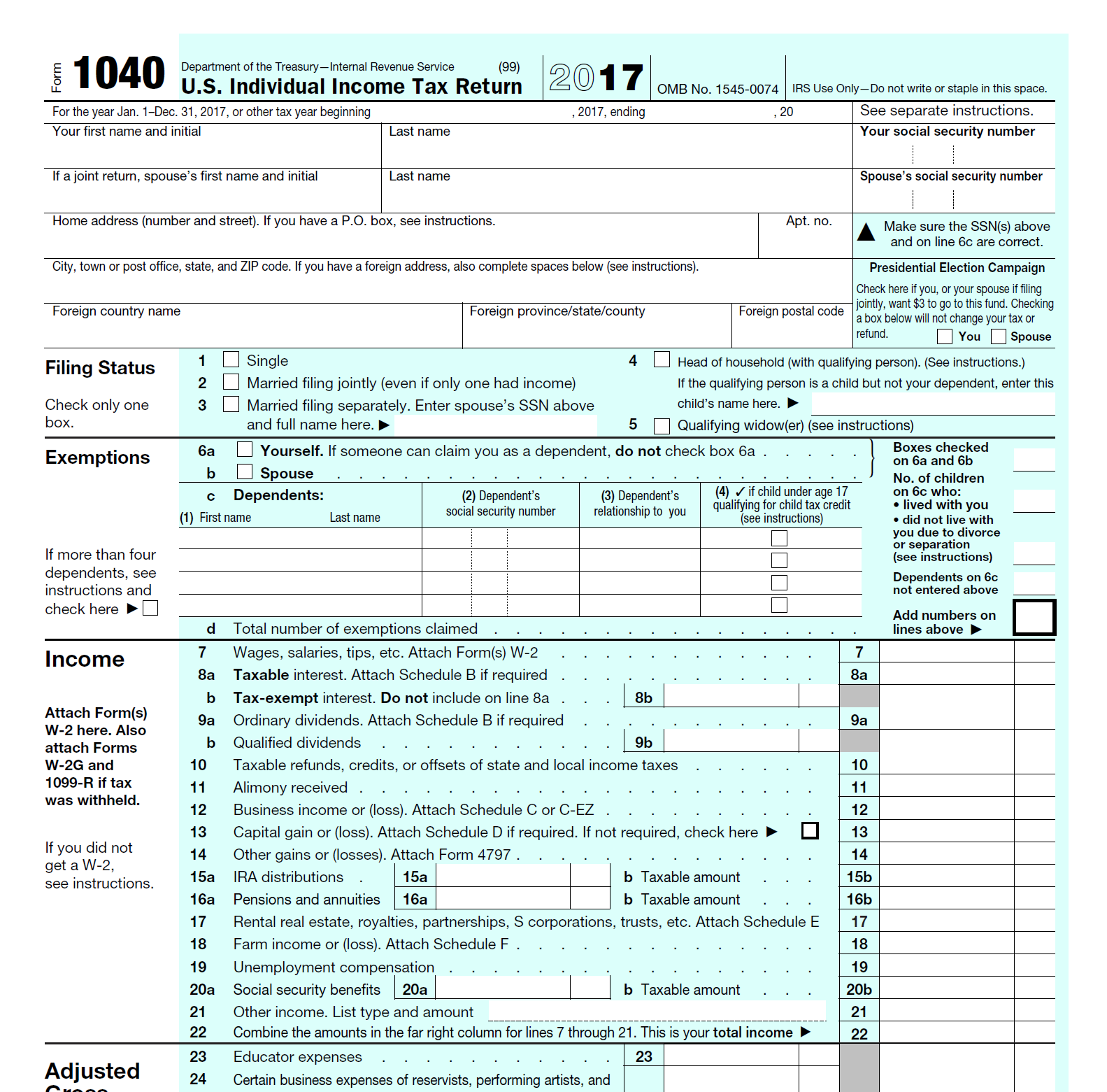
Any USC individual is obligated under the U.S. federal tax law to file a federal income tax return IRS Form 1040 if they meet minimum thresholds of income. For the tax year 2015, the thresholds are low, and are reached once the gross income is at least the sum of (i) the “exemption” amount (currently $4,000) and (ii) the “standard deduction” amount (currently $6,300 for single and married filing jointly and $12,600 for married couples filing jointly).[8]
This is true, even if all of the income is earned income and eligible for the foreign earned income exclusion, which is $100,800 for the tax year 2015.[9]
Additionally, USCs living overseas necessarily have a U.S. tax return filing requirement, when they meet these low thresholds of gross income. In these cases, tax returns that are not filed by the 15th of June are not considered timely filed.[10]
II. The Social Security Administration Rules Make it Nearly Impossible for Many USCs Overseas to Reasonably Obtain a SSN
The policy and procedures of the SSA regarding issuing SSNs have changed significantly over the years.[11] The Social Security Administration (SSA) provides a detailed chronology of the major changes in policy and procedures regarding filing for and obtaining a SSN.[12] One of the most significant revisions in the last decade came from The Intelligence Reform and Terrorism Prevention Act of 2004 (P.L. 108-458), which imposes various standards for the verification of documents or records submitted by an individual.
A. Only a Few Countries Around the World have Personnel at U.S. Embassies or Consulate Offices that Can Process SSN Applications – SSA Form SS-5-FS
Applying for SSNs overseas is severely restricted compared to an application in the U.S.
According to the U.S. Department of State, Foreign Affairs Manual (“FAM”), only certain “Claims-Taking Posts” in specific countries “may” include “processing applications for Social Security Numbers.” [13]
These 17 countries (and a city in the case of Jerusalem) with Claims-Taking Posts include:
“Austria, Argentina, Costa Rica, Dominican Republic, France, Germany, Greece, Ireland, Italy, Japan, Jerusalem, Mexico, Norway, Philippines, Poland, Portugal, Spain, and the United Kingdom.”
Noticeably absent are many Western European countries, virtually all of Latin America, virtually all of Asia, virtually all of Eastern Europe, all of the Middle East (except Jerusalem), all of the African continent, all of the Australian continent and surrounding island countries and Russia, among many other significant countries, including OECD member countries.[14]
Nothing in the FAM requires any of these “Claims-Taking Posts” to actually process applications for a SSN. Plus, there are of course hundreds of other countries throughout the world, not listed above, which do not have such a U.S. Department of State Post. For these reasons, USCs in countries such as China must travel to a U.S. Department of State Post (e.g., the Philippines) which is able to process applications for SSNs.
B. In Person Interview Required for Individuals Older than 11 Years Old
Individuals who are older than 11 years old must personally go to the U.S. Embassy or Consulate with a Claims-Taking Post. See 7 FAM 530, pages 7, 12, 13 and 7 FAM EXHIBIT 530(D) Mandatory In-Person Interview Worksheet SSN Applicant Age 12 or Older – Original SSN * * *
All of these rules makes you wonder whether foreign born individuals, such as actress Kim Cattrall from Sex & the City fame would have ever obtained a social security number overseas while she lived in Canada or the UK.
[3]See, Bloomberg article, 14 January 2015 by Kocieniewski, IRS Will Shut Last Overseas Taxpayer-Assistance Centers: “After budget reductions over the last four consecutive years, the IRS is forced to make tough choices during this period of fiscal austerity and these closures have relatively little impact on taxpayers and treaty partners,” said Julianne Breitbeil, an IRS spokeswoman. Also, see IRS website that still reflects the London and Paris offices as open http://www.irs.gov/uac/Contact-My-Local-Office-Internationally.
[6] See discussion below, regarding requirements to obtain a SSN. I.II, I.I,The Social Security Administration Rules Make it Nearly Impossible for Many USCs Overseas to Reasonably Obtain a SSN
[7] See SSA website, “Office of International Operations” – http://www.ssa.gov/foreign/ “Service Around the World – Welcome to SSA’s Office of International Operations (OIO) home page. The purpose of this site is to assist Social Security customers who are outside the U.S. or planning to leave the U.S. OIO is responsible for administering the Social Security program outside the U.S. and for the implementation of the benefit provisions of international agreements. Since SSA has no offices outside the U.S., OIO is assisted by the Department of State’s embassies and consulates throughout the world.”
[8]See, IR-2014-104, Oct. 30, 2014 and IRS Publication 501.
[12]See, SSA website, Significant Milestones in Social Security Number Policy. A detailed chronology of the major changes in policy and procedures. http://www.ssa.gov/history/ssn/ssnchron.html.
[14] In contrast to these 17 countries (and one city – Jerusalem) where a USC residing overseas must travel to apply for a SSN, the Treasury Department has announced it has around 100 countries that have signed, or “have reached agreements in substance” a FATCA IGA. USCs throughout the world are required by the Foreign Account Tax Compliance Act (“FACTA”) to provide their U.S. TIN to financial institutions throughout the world (on IRS Form W-9, or its equivalent), which under current law necessarily must be a SSN. Of course, if they have no SSN, they cannot sign IRS Form W-9 which provides in Part II: “Under penalties of perjury, I certify that: 1. The number shown on this form is my correct taxpayer identification number . . .”



 address their “seriously delinquent tax debts.” What rights do USCs have vis-a-vis these government allegations in their tax certifications?

 The list of all countries can be found here at the Treasury website –
  government for having U.S. taxpayers and being charged with some type of wrongdoing; namely aiding and abetting U.S. taxpayers to evade U.S. tax obligations. See, Jack Townsend’s thoughtful website
 See prior post: March 30, 2015,