What are the Number of LPRs who Leave U.S. Annually without filing Form I-407 – Abandonment?
A prior post identified the number of lawful permanent residents (LPRs) who file Form I-407 to formally abandon their lawful permanent residency. See, The Number of LPRs “Leaving” the U.S. is 16X Greater than the Number of U.S. Citizens Renouncing Citizenship
These numbers of I-407 forms filed annually were obtained through a freedom of Information Act (“FOIA”) request and provided by the USCIS. See tabl:
Of course, this statistic does NOT identify the number of the approximate 13.3+ million LPRs who leave the U.S. to live elsewhere in another country without completing Form I-407 and formally abandoning. The estimated number of LPRs was 13.3 million for the year 2012 as reported by the Office of Statistics of the DHS. See, Estimates of the Legal Permanent Resident Population in 2012.
Maybe the number of individuals who fall into this latter category (i.e., moving out of the U.S. without filing Form I-407) is several hundred of thousands of individuals annually?
Importantly, from a taxation perspective, anyone who moves and lives in a country with a U.S. income tax treaty (the list of these countries is set out below – from the IRS website), needs to be careful not to be deemed to be a “covered expatriate” due to the application of IRS Form 7701(b)(6). See, IRS Notice 2009-85.
See, the following posts with further explanation of the tax law for LPRs who move and live in one of the countries listed below. Countries with U.S. Income Tax Treaties & Lawful Permanent Residents (“Oops – Did I Expatriate”?)
See also, Who is a “long-term” lawful permanent resident (“LPR”) and why does it matter?
Becoming a “covered expatriate” has U.S. tax consequences not just to the “former long-term LPR”, but also to their family and friends who are “U.S. persons” (as defined under Section 7701. See, The “Hidden Tax” of Expatriation – Section 2801 and its “Forever Taint.”
A
Armenia
Australia
Austria
Azerbaijan
B
Bangladesh
Barbados
Belarus
Belgium
Bulgaria
C
Canada
China
Cyprus
Czech Republic
D
Denmark

E
Egypt
Estonia
F
Finland
France
G
Georgia
Germany
Greece
H
Hungary
I
Iceland
India
Indonesia
Ireland
Israel
Italy
J
Jamaica
Japan
K
Kazakhstan
Korea
Kyrgyzstan
L
Latvia
Lithuania
Luxembourg
M
Malta
Mexico
Moldova
Morocco
N
Netherlands
New Zealand
Norway
O
P
Pakistan
Philippines
Poland
Portugal
Q
R
Romania
Russia
S
Slovak Republic
Slovenia
South Africa
Spain
Sri Lanka
Sweden
Switzerland
T
Tajikistan
Thailand
Trinidad
Tunisia
Turkey
Turkmenistan
U
Ukraine
Union of Soviet Socialist Republics (USSR)
United Kingdom
United States Model
Uzbekistan
V
Venezuela
How Congressional Hearings (Particularly In the Senate) Drive IRS and Justice Department Behavior
The separation of powers is often on full display when there are key Congressional hearings focused on the work (or lack thereof) undertaken by the key executive branch agencies responsible for tax enforcement:
1. Treasury/IRS, and
2. Justice Department.
There is an important reason why every day taxpayers should be interested in these hearings; particularly those who are considering renouncing United States Citizenship.
The actions and reactions of the IRS and Justice Department are often in response to Congressional hearings. This is very much the case with individual taxpayers with assets throughout the world.
A brief timeline of various hearings, and actions taken by the IRS and Justice Department (largely in response to such criticism) can be followed to demonstrate the influence of these hearings:
U.S. Senate Permanent Subcommittee on Investigations, published their report on August 1, 2006, entitled Tax Haven Abuses: The Enablers, The Tools & Secrecy.
Little direct action was taken by the IRS or Justice Department in this year. It was the year 2008, where the direct hearings lead to more direct action taken.
U.S. Senate Permanent Subcommittee on Investigations, headed by Chairman Carl Levin, published their report on July 16, 2008, entitled Tax Haven Banks and U.S. Tax Compliance –
November 2008, a U.S. federal grand jury indicted the Chairman and CEO of UBS Global Wealth Management and Business Banking.
U.S. Senate Permanent Subcommittee on Investigations, headed by Chairman Carl Levin, published their report on March 4, 2009 Tax Haven Banks and U. S. Tax Compliance – Obtaining the Names of U.S. Clients with Swiss Accounts
UBS agrees in February 2009 to pay a US$780M fine to the U.S. government and enter into a deferred prosecution agreement on charges of conspiring to defraud the United States by impeding the Internal Revenue Service.
IRS Implements first Offshore Voluntary Disclosure Program (“OVDP”) on March 26, 2009
Numerous taxpayers and several Swiss bankers were indicted and/or plead guilty to various tax crimes charges; mostly directly related to UBS. See, website of U.S. Department of Justice – Offshore Compliance Initiative.
Congress passes and the President signs into law, the Foreign Account Tax Compliance Act (“FATCA”) in 2010 as part of the Hiring Incentives to Restore Employment (HIRE) Act.
IRS Implements its second Offshore Voluntary Disclosure Initiative (“OVDI”) in 2011.
Numerous taxpayers and several Swiss financial advisors were indicted; and a HSBC Indian client was also indicted or plead guilty to various tax crimes charges; mostly directly related to UBS. See, website of U.S. Department of Justice – Offshore Compliance Initiative.
IRS creates an open ended OVDP program in 2012 that continues; with modifications made in 2014.
Several taxpayers were indicted; including those implicating an Israeli bank for various tax crimes charges. . See, website of U.S. Department of Justice – Offshore Compliance Initiative.
The Treasury Department obtains commitments from various countries to sign various FATCA, intergovernmental Agreements (“IGAs”) for automatic exchange of financial information; France, Germany, Italy, Spain, United Kingdom, Denmark and Mexico.
In January 2013, the U.S. Attorney’s Office in the Southern District of New York secured the guilty plea of Wegelin Bank, the oldest private bank in Switzerland and the first foreign bank to plead guilty to felony tax charges.
In August, 2013, the United States and Switzerland Issue Joint Statement Regarding Tax Evasion Investigations and ability of Swiss banks to enter into deferred prosecution agreements.
Several taxpayers were indicted and advisors; including multiple financial institutions outside of Switzerland for various tax crimes charges. See, website of U.S. Department of Justice – Offshore Compliance Initiative.
The Treasury Department obtains more commitments for signed FATCA IGAs with various countries for the automatic exchange of financial information;.
U.S. Senate Permanent Subcommittee on Investigations, headed by Chairman Carl Levin, published their report on February 26, 2014 Offshore Tax Evasion: The Effort to Collect Unpaid Taxes on Billions in Hidden Offshore Accounts
See prior post, Hearings – Permanent Subcommittee on Investigations – re: Offshore Tax Evasion: The Effort to Collect Unpaid Taxes on Billions in Hidden Offshore Accounts – February 26, 2014
Posted on February 26, 2014 Updated on March 2, 2014
IRS announces on June 18, 2014, IRS Makes Changes to Offshore Programs; Revisions Ease Burden and Help More Taxpayers Come into Compliance
See, “IRS Makes Changes to Offshore Programs; Revisions Ease Burden and Help More Taxpayers Come into Compliance” – How Will These Changes Affect USCs and LPRs Living Outside the U.S.?
See, More on the New 2014 “Streamlined” Process for USCs and LPRs Residing Overseas
The Treasury Department obtains numerous commitments for signed FATCA IGAs with various countries for the automatic exchange of financial information. See, HUGE NEWS – China has “Reached an Agreement in Substance” for a FATCA Intergovernmental Agreement (IGA) – its Affect on USCs and LPRs Living in China and Hong Kong
Part I: Then and Now: Certificates of Loss of Nationality (CLNs)
How the world has changed since the 1960s; or rather how the world has remained the same and we humans have changed it so!?!
Imagine the shock and fear one might have if they learn they are a U.S. citizen while at the same time learning about U.S. citizenship based taxation of worldwide income regardless of where one lives. I use these terms purposefully, because a U.S. citizen who has spent almost all of their lives in the U.S., will likely have the sam reaction if they were born in another country and they were just told they should have been filing tax returns and detailed bank account reports for the last several decades under the law of that country (e.g., France, Canada, Libya, Mexico, South Africa, Germany, Eritrea, etc.). That person would probably be shocked and would also have some “fear” – depending upon which country is identified.
See, Why Section 7701(a)(50) is so important for those who “relinquished” citizenship years ago (without a CLN). . . This “shock and fear” was recently on display with a client who realized (rather should I say – “thought”) he was a U.S. citizen and therefore a U.S. income tax resident. For more background on U.S. citizenship and taxation, see – Sometimes Old is as Good as New – 1998 Treasury Department Report on Citizens and LPRs.
Ironically, the CLNs issued by the then U.S. Department of Sate versus the CLNs issued today are surprisingly similar in format and content. See Wide Window of Wait Times for CLN: One Month to 9 Months (or More?)
Imagine you have lived all of your life in your home country, for decades and decades. You were raised, educated and built your business or profession in your home country. Indeed you have become quite successful in your own country after a long life dedicated to your work.
However, by a pure act of arbitrariness (at least as far as you are concerned – since it was your mother who gave birth – without any input from you), you were born on U.S. soil. For those of us who live along the international border, this is a common occurrence.
Here in San Diego, the border crossing is one of the busiest land crossing in the world (if not the busiest). The U.S. federal government has reported (in the year 2000, which was presumably much less busier than today) it “ . . . processed over 41.5 million northbound passengers in personal vehicles and 8 million northbound pedestrians.” That is nearly 50 million going northbound, not counting the border crossing going southbound to Mexico.
The United States Department of Transportation reported that ” . . . Personal vehicles entered the United States nearly 96 million times in 2012, 33.1 million from Canada, and 62.7 million from Mexico, according to the U.S. Department of Transportation’s Bureau of Transportation Statistics’ (BTS). Border crossings also included 10.7 million trucks, 320 thousand buses, and 37 thousand trains in 2012 (Table 1).. . . ”
Needless to say lots of Canadians and Mexicans are born in the U.S. as part of the transit to and from the U.S., just along the borders.
This gentleman was born in the border town of Brownsville, Texas, many decades ago, where thousands of Mexicans are born to this day. He took an oath of allegiance to the Mexican government in the 1960s as was required at that time pursuant to the Mexican Constitution, so as not to lose Mexican citizenship. See, the 1997 article by Paula Gutierrez in the LMU of LA International and Comparative Law Review, Mexico’s Dual Nationality Amendments: They Do Not Undermine U.S. Citizens’ Allegiance and Loyalty or U.S. Political Sovereignty.
Recently, his U.S. citizenship and tax journey began after some 40+ years.
The redacted CLN from the 1970s is part of the story.
Subsequent posts will discuss the tax and other legal implications of this CLN, when it was issued, how and why;
- what the tax law said then versus now;
- what the immigration law said then versus now;
- what it meant (under U.S. immigration law) to take an oath of allegiance to a foreign country;
- the timing of when and what date is used for “renunciation” (how many years back in time?);
- what penalties (if any) he might have vis-à-vis U.S. law?
In this case, the basic fact that he never remembered taking these specific steps back when he was a teenager of 18 years of age and shortly thereafter as a young man.
He never notified the IRS of his USC renunciation (or maybe you prefer to call it relinquishment – though there is no clear legal distinction between these two terms) pursuant to Section 7701(a)(50). – See, Why Section 7701(a)(50) is so important for those who “relinquished” citizenship years ago (without a CLN). . .
His story, fortunately has a very happy ending considering the application of Section 877, et. seq.
To be continued . . .
More on “PFICs” and their Complications for USCs and LPRs Living Outside the U.S. -(What if there are No Records?)
More on “PFICs” and their Complications for USCs and LPRs Living Outside the U.S. – -(What if there are No Records?)
The statutory rules of PFICs are set forth in 26 U.S. Code § 1297 – Passive foreign investment company. The U.S. Treasury and IRS also published new regulations in January 2014 on PFICs.
For an overview, see “PFICs” – What is a PFIC – and their Complications for USCs and LPRs Living Outside the U.S.
United States Citizens living overseas, whether or not they are “Accidental Americans”, as well as lawful permanent  residents (LPRs) living outside the U.S. generally have the burden of proof under U.S. tax law to show they complied with U.S. law. Indeed, when the Internal Revenue Service (IRS – the U.S. revenue authority) makes a tax assessment against an individual, the law generally carries with it a “presumption of correctness” in favor of the IRS.
This presumption of correctness was confirmed by the U.S. Supreme Court and therefore imposes the burden on the taxpayer of proving that the assessment made by the IRS is erroneous. During my career, I have seen plenty of erroneous assessments made by the IRS, and an increasing number of assessments made against taxpayers residing in countries throughout the world, be it France, Australia, Canada, Russia, Germany, Mexico, Thailand, Japan, Hong Kong, etc.
Why is this presumption of correctness relevant, when PFICs are explained and discussed here? The law of PFICs is complex, to the point that very few IRS revenue agents really have any detailed understanding of how PFICs work, when they apply and how taxpayers are to report their investments in PFICs. Very few U.S. tax practitioners understand PFICs.
Accordingly, I regularly see errors made by the IRS in proposed tax assessments, including PFIC calculations. Unfortunately for the individual taxpayer, they must prove the IRS is wrong in its tax assessment.
PFICs create a real burden on individual taxpayers who have shares in a PFIC in different locations around the world, since it is rare that foreign companies, investment funds, mutual funds and the like ever provide any detailed accounting of (a) asset, or (b) income information (per U.S. tax rules) that are required to be reported by PFIC investors who are USCs or LPRs.
Unlike a controlled foreign corporation (CFC), a PFIC has no ownership threshold. If a USC owns just 1,000 shares/units out of 20M issued shares in a foreign mutual fund, the U.S. citizen will nevertheless need to report this 1,000 share/unit interest (even though this is only 0.0005% of the fund) on his or her individual income tax return if the foreign mutual fund meets – the income test or asset test. Virtually all mutual and investments funds will satisfy these tests, since by definition the funds are making investments in other companies or other passive income items, such as bonds, stocks, futures, ETFs, etc.
The income test is met when at least 75% of the income is passive income as defined under the law. The asset test is satisfied when at least 50% of the foreign corporation’s average assets produce such passive income.
The practical problem arises when the individual taxpayer needs information from the fund (or other foreign entity) that reflects information such as –
- the pro-rata share of the “ordinary” earnings (in the example above, just 1,000 share/20M shares – 0.0005% of the fund);
- the pro-rata share of the “net capital gain”;
- the total cash or property distributed;
- the total cash or property “deemed” distributed (which means there was actually no distribution – but the law “deems” there to have been a distribution); and
- many other complex calculations that require basic information to be provided by the PFIC in the first place.
What foreign fund or investment company around the world (located in whatever country – catering to customers commonly in their own country) even tracks or accounts for income and gains for U.S. tax law purposes; i.e. “ordinary” earnings versus “capital gains” – specifically including the netting of “capital gains” and “capital losses” as required by U.S. law? I certainly do not see such accounting records provided in the marketplace of investment funds, hedge funds and companies that cater to persons residing outside the U.S.
Most foreign companies around the world (unless they are controlled and managed by USCs who are aware of these U.S. tax obligations) never maintain such accounting records or the detailed information necessary to even provide it to their USC or LPR investors. Hence, USCs/LPR investors may never be able to accurate make these PFIC calculations.
Also, the ownership of shares/units of the fund might always be changing throughout the year. In other words, even if the “ordinary income” and “net capital gain” is available for a particular fund/PFIC, the total number of outstanding shares/units has to be stable or known for the USC or LPR to calculate their pro-rata share. In the above example, if there are 20M outstanding shares/units at the beginning of the year, but by the end of the year there are 22M outstanding shares/units, how is the USC or LPR investor ever going to be able to calculate their pro-rata share, assuming they have the “ordinary” earnings and “capital gains” amounts for the entire calendar year? Its not simply the “ordinary” earnings and “capital gains” multiplied by 0.0005%.
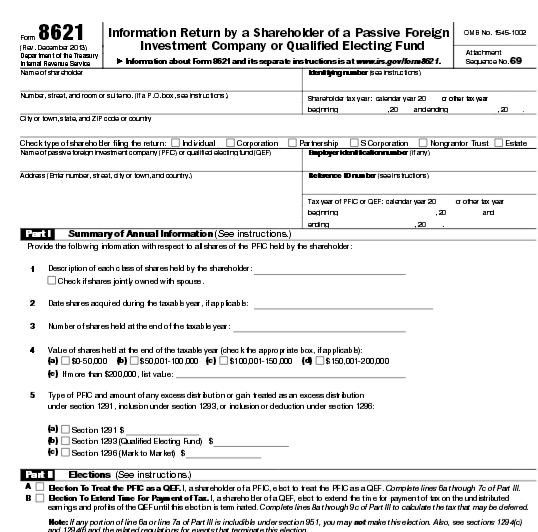
The only “good news” in this explanation of PFICs, is that there is not an automatic US$10,000 penalty for failure to file their investments in a PFIC on IRS Form 8621, Information Return by a Shareholder of a Passive Foreign Investment Company or Qualified Electing Fund.
This is a departure from the normal rule of a minimum US$10,000 penalty for failure to file information returns regarding international (i.e., non-U.S. assets and investments). See, USCs and LPRs Living Outside the U.S. – Key Tax and BSA Forms.
All of these tax compliance rules begs a very important question for a USC who is considering renouncing their U.S. citizenship. The issue arises if they have had investments in PFICs during the last five years. If the USC has not been complying with IRC Section 1297 regarding PFICs, how can the taxpayer ever certify under penalty of perjury ” . . . that he has met the requirements of this title for the 5 preceding taxable years. . . [for purposes of Section 877(a)(2)(C)]”?
See, Certification Requirement of Section 877(a)(2)(C) – (5 Years of Tax Compliance) and Important Timing Considerations per the Statute
More details about PFICs to come in later posts.
Russia Joins the FATCA Group – On the Last Day? Complete List of Countries to Date (Very Few Notable Absences)
According to The Moscow Times, Putin Signs Last-Minute Law to Satisfy FATCA
With China and Russia as prior major holdouts, the recent news from both countries probably assures the long-term success of FATCA.
See, HUGE NEWS – China has “Reached an Agreement in Substance” for a FATCA Intergovernmental Agreement (IGA) – its Affect on USCs and LPRs Living in China and Hong Kong
There are very few notable “hold-outs” on FATCA IGAs. The following list reflects those countries of note (from my perspective) who have not signed or “reached an agreement in substance”:
Kenya
Nigeria
Egypt
Pakistan
Bahrain
Philippines
Malaysia
Guatemala
Uruguay
El Salvador
Nicaragua
Ecuador
Argentina
Venezuela
Lots of other countries with less commercial and financial ties to the U.S., did not – including – countries such as Kazakhstan, Uzbekistan and Cambodia.
There are currently 90 countries identified by the U.S. Treasury as having an IGA or “reaching an agreement in substance” as follows (note there are fewer signed IGAs than unsigned):
Countries that have signed agreements:
Model 1 IGA
1) Australia (4-28-2014)
2) Belgium (4-23-2014)
3) Canada (2-5-2014)
4) Cayman Islands (11-29-2013)
5) Costa Rica (11-26-2013)
6) Denmark (11-19-2012)
7) Estonia (4-11-2014)
8) Finland (3-5-2014)
9) France (11-14-2013)
10) Germany (5-31-2013)
11) Gibraltar (5-8-2014)
12) Guernsey (12-13-2013)
13) Hungary (2-4-2014)
14) Honduras (3-31-2014)
15) Ireland (1-23-2013)
16) Isle of Man (12-13-2013)
17) Italy (1-10-2014)
18) Jamaica (5-1-2014)
19) Jersey (12-13-2013)
20) Latvia (6-27-2014)
21) Liechtenstein (5-19-2014)
22) Luxembourg (3-28-2014)
23) Malta (12-16-2013)
24) Mauritius (12-27-2013)
25) Mexico (4-9-2014)
26) Netherlands (12-18-2013)
27) New Zealand (6-12-2014)
28) Norway (4-15-2013)
29) South Africa (6-9-2014)
30) Spain (5-14-2013)
31) Slovenia (6-2-2014)
32) United Kingdom (9-12-2012)
Model 2 IGA (signed agreements)
33) Austria (4-29-2014)
34) Bermuda (12-19-2013)
35) Chile (3-5-2014)
36) Japan (6-11-2013)
37) Switzerland (2-14-2013)
And those countries which are deemed to have “reached agreement in substance” –
Model 1 IGA
38) Algeria (6-30-2014)
39) Antigua and Barbuda (6-3-2014)
40) Azerbaijan (5-16-2014)
41) Bahamas (4-17-2014)
42) Barbados (5-27-2014)
43) Belarus (6-6-2014)
44) Brazil (4-2-2014)
45) British Virgin Islands (4-2-2014)
46) Bulgaria (4-23-2014)
47) China (6-26-2014)
48) Colombia (4-23-2014)
49) Croatia (4-2-2014)
50) Curaçao (4-30-2014)
51) Czech Republic (4-2-2014)
52) Cyprus (4-22-2014)
53) Dominica (6-19-2014)
54) Dominican Republic (6-30-2014)
55) Georgia (6-12-201)
56) Greenland (6-29-2014)
57) Grenada (6-16-2014)
58) Guyana (6-24-2014)
59) India (4-11-2014)
60) Indonesia (5-4-2014)
61) Israel (4-28-2014)
62) Kosovo (4-2-2014)
63) Kuwait (5-1-2014)
64) Lithuania (4-2-2014)
65) Panama (5-1-2014)
66) Peru (5-1-2014)
67) Poland (4-2-2014)
68) Portugal (4-2-2014)
69) Qatar (4-2-2014)
70) Romania (4-2-2014)
71) St. Kitts and Nevis (6-4-2014)
72) St. Lucia (6-12-2014)
73) St. Vincent and the Grenadines (6-2-2014)
74) Saudi Arabia (6-24-2014)
75) Seychelles (5-28-2014)
76) Singapore (5-5-2014)
77) Slovak Republic (4-11-2014)
78) South Korea (4-2-2014)
79) Sweden (4-24-2014)
80) Thailand (6-24-2014)
81) Turkey (6-3-2014)
82) Turkmenistan (6-3-2014)
83) Turks and Caicos Islands (5-12-2014)
84) Ukraine (6-26-2014)
85) United Arab Emirates (5-21-2014)
Model 2 IGA
86) Armenia (5-8-2014)
87) Hong Kong (5-9-2014)
88) Moldova (6-30-2014)
89) Paraguay (6-6-2014)
90) Taiwan (6-23-2014)*
Round Two – Catch 22 of Opening a Bank Account in Your Own Country – for USCs and LPRs
A prior post explained how opening a bank account (for USCs) in their home country of residence, is increasingly complex now that FATCA is in full force, See, The Catch 22 of Opening a Bank Account in Your Own Country – for USCs and LPRs.
The financial institution (“FFI”) is generally required to have an IRS Form W-9 completed by the USC; or a substitute W-9 form as provided for in the regulations. Identifying the elusive “U.S. person” under U.S. federal tax law is the goal of the law. USCs are “U.S. persons” and LPRs generally are “U.S. persons”
Some samples of substitute W-9 forms are set out in this post, including those in different languages, as is the case with the Deutsche Kreditbank AG substitute form:
The U.S. laws now obligate FFIs throughout the world to collect this information, whether it is Deutsche Bank in Germany, HSBC, Bank of Singapore, Oversea-Chinese Banking Corporation Limited, Banco Comercial Português in Portugal, Société Générale in France, Banco Nacional de Panamá, Skandinaviska Enskilda Banken in Sweden, Helsinki OP Bank in Finland, Banco Santander, etc. Importantly, many of these documents and forms will be provided in a substitute format in the language of the country where the principle operations of the bank are located. 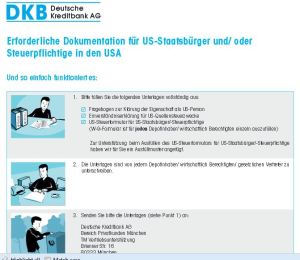
The many “Catch 22s” is that under U.S. law, the only U.S. taxpayer identification number (“TIN”) that may be used by an individual is a U.S. social security number (“SSN”). To repeat, a U.S. citizen (e.g., someone who was born in the U.S. or obtained it through a U.S. citizen parent – via derivative citizenship) has no choice but to obtain a U.S. Social Security Number (“SSN”) as their taxpayer identification number (“TIN”), in accordance with U.S. tax law. See 26 U.S. Code § 6109 – Identifying numbers and the regulations thereunder.
Every individual, who was born to a parent who was a U.S. citizen must consider whether they too are also a U.S. citizen by the concept known as “derivative citizenship“; i.e., “derived” from a U.S. citizen parent. The U.S. Citizenship and Immigration Services (USCIS) has a “Nationality Chart 1, for Children Born Outside U.S.” to help determine if the individual was a U.S. citizen at birth.
Importantly, a USC, even if they have never lived a day in the U.S. (e.g., because they have derivative citizenship via a parent), cannot legally sign an IRS Form W-8 certifying they are a non-resident of the U.S.
There are two completely different concepts of residency; (1) physical residence in the U.S. on contrast with (2) “tax residence” via USC or LPR status. A USC who has never lived in the U.S., or who has not lived for many years, nevertheless is treated as a U.S. income tax resident, i.e., a “U.S. person.” See, US Citizenship Based Taxation
 Any U.S. individual income tax resident who intentionally signs a false IRS Form W-8, would be filing a false document that would fall under the purview of Filing a False Return or Other Document – Perjury (IRC Section 7206(1) ). See, What could be the focal point of IRS Criminal Investigations of Former U.S. Citizens and Lawful Permanent Residents?
The complexities of obtaining a SSN by USCs who reside overseas will be explained in a later post; which is itself another “Catch 22”.
Unfortunately, these round about requirements imposed under U.S. law for USCs and LPRs who reside outside the U.S. can become discouraging (to say the least) for individuals who would like to comply with their legal obligations; but practically speaking, may have no real means by which to properly comply, depending upon their particular circumstances.
Countries with U.S. Income Tax Treaties & Lawful Permanent Residents (“Oops – Did I Expatriate”?)
The U.S. has income tax treaties with multiple countries. My post from yesterday briefly explains how a LPR living in one of these countries may become a “covered expatriate” if the three conditions of the statute, IRC Section 7701(b)(6) that was added into the law in 2008 are satisfied. See, LPR status can be abandoned for tax purposes (since 2008 tax law changes) by merely leaving and moving outside the U.S. in some cases. Posted on April 28, 2014
Importantly, a LPR who resides in one of these countries where he or she has income tax residency in the treaty country, can inadvertently “expatriate” for U.S. federal income, estate, gift and inheritance taxes. See, Oops…Did I “Expatriate” and Never Know It: Lawful Permanent Residents Beware! International Tax Journal, CCH Wolters Kluwer, Jan.-Feb. 2014, Vol. 40 Issue 1, p9
The list of those countries with income tax treaties are as follows and can be reviewed at IRS website:
A
Armenia
Australia
Austria
Azerbaijan
B
Bangladesh
Barbados
Belarus
Belgium
Bulgaria
C
Canada
China
Cyprus
Czech Republic
D
Denmark
E
Egypt
Estonia
F
Finland
France
G
Georgia
Germany
Greece
H
Hungary
I
Iceland
India
Indonesia
Ireland
Israel
Italy
J
Jamaica
Japan
K
Kazakhstan
Korea
Kyrgyzstan
L
Latvia
Lithuania
Luxembourg
M
Malta
Mexico
Moldova
Morocco
N
Netherlands
New Zealand
Norway
P
Pakistan
Philippines
Poland
Portugal
R
Romania
Russia
S
Slovak Republic
Slovenia
South Africa
Spain
Sri Lanka
Sweden
Switzerland
T
Tajikistan
Thailand
Trinidad
Tunisia
Turkey
Turkmenistan
U
Ukraine
Union of Soviet Socialist Republics (USSR)
United Kingdom
United States Model
Uzbekistan
V
Venezuela
Coming to America. . . Accidental Americans Beware – The Law Requires a U.S. Passport!
Dual nationals who have lived almost all of their lives outside the U.S. routinely travel with their passport of their country of residence. 
They are typically not aware that they must have a U.S. passport to travel to the U.S. pursuant to a 2004 law, known as the Intelligence Reform and Terrorism Prevention Act.
There are many dual nationals living in countries throughout the world. The statistics are a bit fuzzy as to the exact numbers.
Apparently, Mexico is the country where more U.S. citizens reside, according to the State Department, and Canada is number two on the list. Approximately 1 million U.S. citizens lived in Mexico, while 687,000 were in Canada. Other countries with large numbers of U.S. citizens included the United Kingdom (224,000), Germany (211,000), Israel (184,000), Italy (169,000), Philippines (105,000), Australia (103,000), France (102,000), and Spain (95,000). According to State Department data, these ten countries contain about 70% of all U.S. citizens living abroad. See,
Accidental Americans” – Rush to Renounce U.S. Citizenship to Avoid the Ugly U.S. Tax Web” International Tax Journal,
CCH Wolters Kluwer, Nov./Dec. 2012, Vol. 38 Issue 6, p45.
*
Most of these individuals (who were born in the U.S. or who have U.S. citizenship via derivative citizenship) living outside the U.S. are probably unaware that U.S. law requires they obtain a U.S. passport to travel in or out of the U.S. A foreign resident individual with a U.S. parent, must consider whether they too are also a U.S. citizen by the concept known as “
derivative citizenship“; i.e., “derived” from a U.S. citizen parent. If so, this law,
Intelligence Reform and Terrorism Prevention Act, requires a U.S. passport.
*
The Department of Homeland Security and Department of State published
regulations in 2008 that specifically require all U.S. citizens (including dual nationals) to generally have a U.S. passport to enter into or leave the U.S. This was not the case in previous years. There are 4 substitute documents (instead of a U.S. passport) that can be used in certain circumstance (although the U.S. passport card – is the only practical document in most cases), which consist of the following:
*
(2) a U.S. passport card; (3) a valid trusted traveler card (
NEXUS, FAST, or
SENTRI);
(4) a valid MMD when traveling in conjunction with official maritime business; or
(5) a valid U.S. Military identification card when traveling on official orders or permit.
*
At the end of the day, the law almost always requires any U.S. citizen, including “Accidental Americans” to have a U.S. passport or U.S. passport card when they travel into the U.S. Having a passport of the country of residence is not sufficient.
???????????????? ?Please click here to view the above in Chinese.?
Tina Turner – Famous People Who Renounced U.S. Citizenship.
Proud Mary and the “keep on burning” lyrics is one of many mega hits of Tina Turner who was born a U.S. citizen in Tennessee.
Her fame spans multiple decades that continues today.
According to The Washington Post, she became a naturalized Swiss citizen in April 2013 and then “relinquished” (not renounced) her U.S. citizenship in 2013 (and is married to a German citizen):
-
By Al Kamen
-
November 12, 2013 at 4:38 pm
???????????????? ?Please click here to view the above in Chinese.?
The dangers of becoming a “covered expatriate” by not complying with Section 877(a)(2)(C).
Probably the most misunderstood concept in the U.S. tax expatriation law provisions is Section 877(a)(2)(C) for several reasons.
1. People of modest means with modest to little income and little to no assets can fall into this category.
2. Most individuals think the mark-to-market tax upon expatriation is only applicable to rich, wealthy or otherwise individuals with high levels of income. See, Accidental Americans” – Rush to Renounce U.S. Citizenship to Avoid the Ugly U.S. Tax Web” International Tax Journal,CCH Wolters Kluwer, Nov./Dec. 2012, Vol. 38 Issue 6, p45
3. Lawful permanent residents (“LPRs”) can inadvertently fall into this category without doing anything, other than living principally in a country outside the U.S., which has a U.S. income tax treaty. See, Oops…Did I “Expatriate” and Never Know It: Lawful Permanent Residents Beware! International Tax Journal, CCH Wolters Kluwer, Jan.-Feb. 2014, Vol. 40 Issue 1, p9. At the end of this post is a list of the countries with U.S. income tax treaties.
4. Few individuals understand exactly what must be included and reported in IRS Form 8854 to be able to satisfy the certification requirement above. For more details, see What are the consequences of becoming a “covered expatriate” for failing to comply with Section 877(a)(2)(C)?
The relevant provisions of Section 877(a)(2)(C) are highlighted below:
- This section shall apply to any individual if—
- (A) the average annual net income tax . . . is greater than $124,000,
- (B) the net worth of the individual as of such date is $2,000,000 or more, or
- (C) such individual fails to certify under penalty of perjury that he has met the requirements of this title for the 5 preceding taxable years or fails to submit such evidence of such compliance as the Secretary may require.
Failure to certify truthfully about compliance with U.S. tax law for 5 years, as set forth above in the statute, means the individual necessarily will be a “covered expatriate.” Does this mean that if a U.S. citizen who renounces citizenship or a LPR who abandons their green card, will necessarily be a “covered expatriate” if they fail to follow IRS Notice 2009-45 “Guidance for Expatriates Under Section 877A”?
What steps will the IRS take if someone intentionally does not comply with the certification requirement? Will they become a target of a criminal investigation, and under what circumstances? What could be the focal point of IRS Criminal Investigations of Former U.S. Citizens and Lawful Permanent Residents?
There are many pending and open questions not answered by current law, as the U.S. Treasury has yet to publish regulations under Section 877A, 877 or 2801.
APPENDIX – Countries with Income Tax Treaties with the United States