The author has extensively discussed the appropriate IRS Form for individuals to sign under penalties of perjury when dealing with their banks and third parties, irrespective of the banks’ location. The choice between IRS Forms W-8 and W-9 hinges on the U.S. income tax residency status of the individual. Forms W-8 and W-9 serve the purpose of conveying the tax residency status of the individual to third parties. The correct (or incorrect form) can have a range of different tax and legal consequences to the individual. A non-resident is generally not subject to income taxation in the United States, except for on limited types of income. In contrast, a resident (for federal income tax purposes) is subject to taxation on their worldwide income. If an income tax resident of the United States falsely certifies their status using Form W-8, severe adverse legal consequences can follow. See e.g., W-8s for U.S. Citizens Abroad: Filing False Information with Non-U.S. Banks (2016)
IRS Forms W-8 or W-9 (or Other)?
For U.S. citizens, the process is straightforward—they must sign IRS Form W-9. However, for individuals without U.S. citizenship, the situation becomes more intricate. The following posts delve into critical legal considerations surrounding IRS Form W-8BEN.
These comments provide in-depth insights into the legal consequences of filing and signing specific IRS forms (or their equivalents produced by financial institutions: W-8 vs. W-9). Notably, UBS’s explanation titled “UBS One Source Understanding tax forms—non U.S. taxpayers” sheds light on the efforts foreign financial institutions need to dedicate to assist clients who are not “United States persons” for federal tax purposes, ensuring compliance with U.S. federal tax laws.
Green Card Holders Living Abroad Have Further Analysis to Consider
The complexity heightens for “Green Card” holders living abroad, especially those residing in countries covered by an income tax treaty with the United States. See, Aroeste v. United States, Case No. 22-cv-00682-AJB-KSC. Aroeste v United States – Order Nov 2023, emphasizes a 5-step analysis for Green Card holders who have not formally abandoned their status. The ultimate test is whether the individual is entitled to be treated as a resident of a foreign country under a tax treaty.
Aroeste v. United States: Decision’s Impact on LPR Individuals
The decision could potentially affect millions of Green Card holders living outside the U.S. Aroeste Court’s 5-step analysis becomes crucial for the 3+ million LPRs residing abroad, determining whether they qualify as “United States persons” under the law.
LPR Individuals Living in 66 Different Countries Could Be Impacted by Aroeste vs. U.S.
The United States has a total of 58 income tax treaties that covers around 66 countries. The 1973 U.S. – U.S.S.R. income tax treaty applies to Armenia, Azerbaijan, Belarus, Georgia, Kyrgyzstan, Moldova, Tajikistan, Turkmenistan, and Uzbekistan. Some have been cancelled.
Importance of Figuring Out your Residency Status if you Never Formally Abandoned your Green Card and Live in an Income Tax Treaty Country.
The impact of the Aroeste v United States decision presents a dual scenario for individuals who have not formally abandoned their “lawful permanent residency” status. On the positive side, there is an opportunity to inform the Internal Revenue Service (IRS) of their non-resident status by utilizing the applicable income tax treaty. There are specific steps to take as explained by the Court in Aroeste vs. United States. This action can relieve them of U.S. federal income tax filing obligations and Foreign Bank Account Report (FBAR) filing requirements, helping to steer clear of potential penalties and taxes that might otherwise be owed. The Court in Aroeste concluded such late filings could subject the individual ” . . . to penalties pursuant to I.R.C. § 6712(a) equal to $1,000 per failure to timely report his Treaty position. . . “
Potential Downside for “LPRs” Living in an Income Tax Treaty Country.
However, on the flip side, this termination of U.S. income tax residency status may lead to the individual “cease[ing] to be a lawful permanent resident of the United States (within the meaning of section 7701(b)(6)).” Such a shift can trigger adverse U.S. tax consequences, affecting not only the individual but also extending to children, spouses, family members, and friends who could receive “covered gifts” or “covered bequests.” This classification may result in the individual being deemed a “covered expatriate” under the expatriation tax law, as outlined in IRC 877A(g)(3). See, IRC 877A(g)(3). Potentially severe adverse tax consequences can follow from this edge of the sword. The Court in Aroeste vs. United States did not address these adverse tax consequences as they were not at issue.
This Blog is intended to provide general information about tax expatriation legal concepts under U.S. law to help readers better understand often very complex issues within the U.S. international tax field for citizens and lawful permanent residents. General legal information is not the same as legal advice, that is, the concrete application of law to a specific case with unique and particular facts.
Legal advice also should include strategic planning and advice to a particular case. A legal adviser should be able to assist an individual in taking important decisions and steps, related to the specific goals of the individual, while understanding the legal and tax consequences of each step. There are a range of consequences that the “U.S. tax expatriation” laws impose upon different types of transactions, transfers, reorganization of assets, etc. None of these items are discussed in this Blog.
Although the author has taken great care to make sure that the information contained herein is accurate and useful, it is necessary that you consult an experienced attorney to address any particular situation. Most importantly, if you are contemplating renouncing (or proving relinquishment) of U.S. citizenship or formally abandoning your LPR status, you must get legal advice. This is a very important decision with a range of complex legal consequences.
The Number of LPRs Declined in the Corona-virus Pandemic
Not surprisingly, the number of new LPRs into the U.S. dropped substantially in correlation with the Corona-virus pandemic. See, the Office of Immigration Statistics, 28 Sept. 2021: Fiscal Year 2021 U.S. Lawful Permanent Residents Annual Flow Report. The Figure 1 (highlighted by me) and that report notes:
Just over 700 thousand persons became LPRs in 2020, as reduced international travel during the COVID-19 pandemic and policy changes brought new LPR admissions in 2020 to their lowest
level since 2003. The majority of these LPRs (62 percent) were already present in the United States when they were granted lawful permanent residence. A little under two-thirds (63 percent) were granted LPR status based on a family relationship with a U.S. citizen or current LPR. The leading countries of birth of new LPRs were Mexico, India, and People’s Republic of China (China). In 2020, there was a 31 percent reduction in U.S. grants of LPR status compared to 2019.
Largely due to the COVID-19 pandemic, LPR flows in 2020 were not representative of typical trends (Figure 1). Travel restrictions and processing slowdowns generally resulted in fewer inflows, while foreign-born residents within the United States also confronted immigration status-specific COVID-19 vulnerabilities.5
The key tax question for LPRs who no longer live in the U.S. (or who are planning to leave the U.S. to live in another country) is: Are they (or will they become) a so-called “long-term resident” as defined in the federal “expatriation” tax law?
IRC Section 877(e)(1) and (2) define a “long-term resident” and these paragraphs are included below in their entirety:
(1) In general
Any long-term resident of the United States who ceases to be a lawful permanent resident of the United States (within the meaning of section 7701(b)(6)) shall be treated for purposes of this section and sections 2107, 2501, and 6039G in the same manner as if such resident were a citizen of the United States who lost United States citizenship on the date of such cessation or commencement.
(2) Long-term resident
For purposes of this subsection, the term “long-term resident” means any individual (other than a citizen of the United States) who is a lawful permanent resident of the United States in at least 8 taxable years during the period of 15 taxable years ending with the taxable year during which the event described in paragraph (1) occurs. For purposes of the preceding sentence, an individual shall not be treated as a lawful permanent resident for any taxable year if such individual is treated as a resident of a foreign country for the taxable year under the provisions of a tax treaty between the United States and the foreign country and does not waive the benefits of such treaty applicable to residents of the foreign country.
The Next Post on this topic will break down the elements of –
(1) who will necessarily be a “long-term resident”?
(2) who may be “long-term resident”?
(3) what steps can be taken to necessarily avoid “long-term resident” status?
Finally, a discussion will be had in the last post in this series of some of the potential adverse tax consequences to “long-term residents” depending upon different factual scenarios.
The next few posts will explain the significance of key immigration law concepts for LPRs (e.g., filing Form I-407, Record of Abandonment of Lawful Permanent Resident to formally abandon LPR status). They discuss formal administrative or judicial abandonment of LPR status and the specific relationship to U.S. tax law requirements.
MILLIONS HAVE LEFT – YET FEW HAVE FORMALLY ABANDONED – NO FORM I-407: Apparently a few million LPR individuals have emigrated from the U.S. with their green card in their pocket/purse and most are probably still deemed “United States persons” for federal income tax purposes. This conclusion comes from comparing (i) federal government data indicating the number of LPRs who have emigrated (3.6 million LPRs through 2019) contrasted with (ii) those who have filed Form I-407. The next few posts explore the important tax/legal distinctions of LPRs who formally abandon and those who simply leave the U.S. ignorantly blissful of the complex U.S. tax laws.
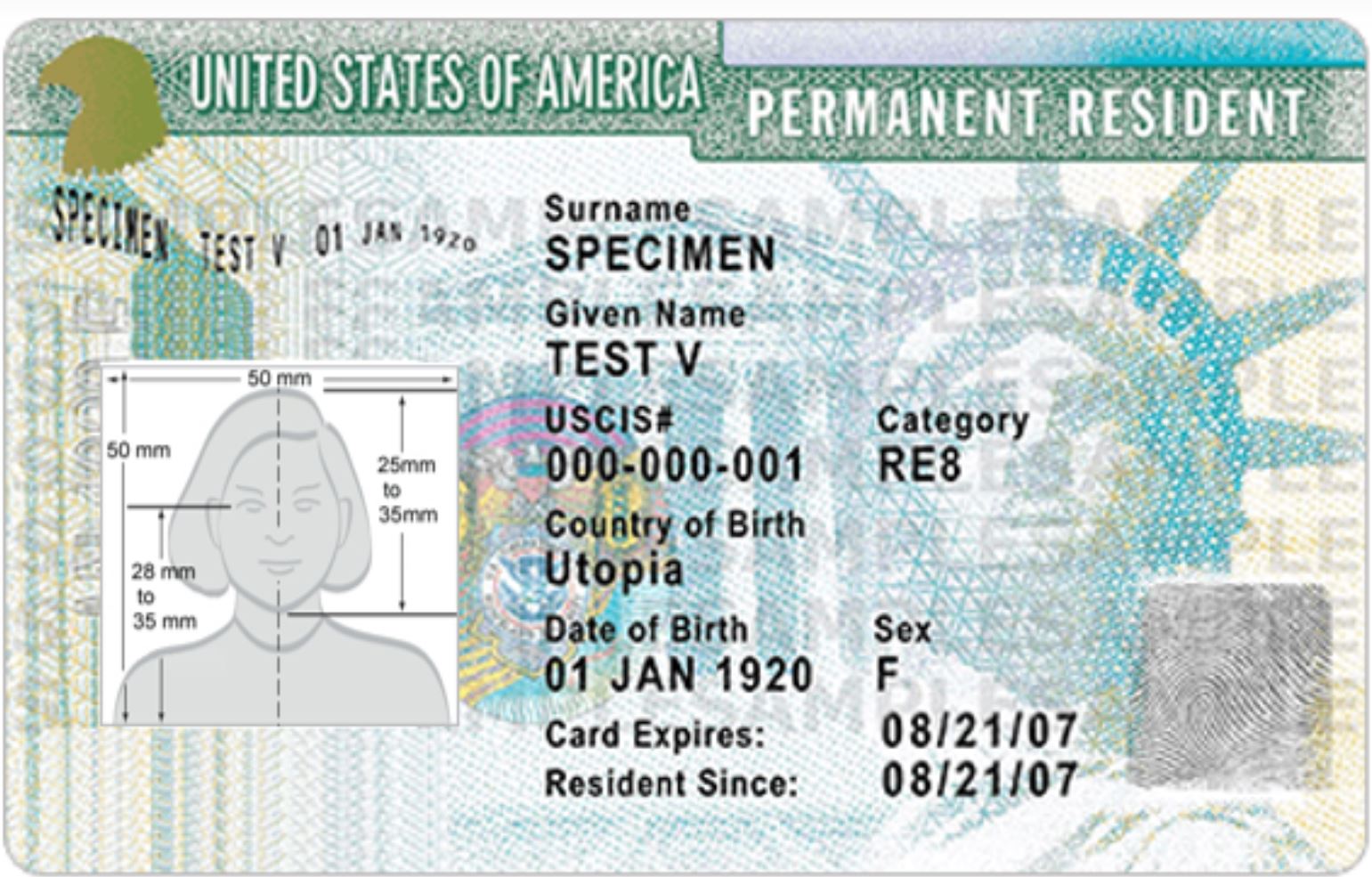
A LPR is a so-called “resident alien” by application of the U.S. federal tax law if she or he satisfies the statutory requirements of IRC Section 7701(b)(6), without application of an applicable income tax treaty. Tax treaties can change everything. A “resident alien” includes those who have LPR status who have not formally abandonment that status. See, the Treasury regulations that provide for the so-called “green card test” –
(1) Green card test. An alien is a resident alien with respect to a calendar year if the individual is a lawful permanent resident at any time during the calendar year. A lawful permanent resident is an individual who has been lawfully granted the privilege of residing permanently in the United States as an immigrant in accordance with the immigration laws. Resident status is deemed to continue unless it is rescinded or administratively or judicially determined to have been abandoned.
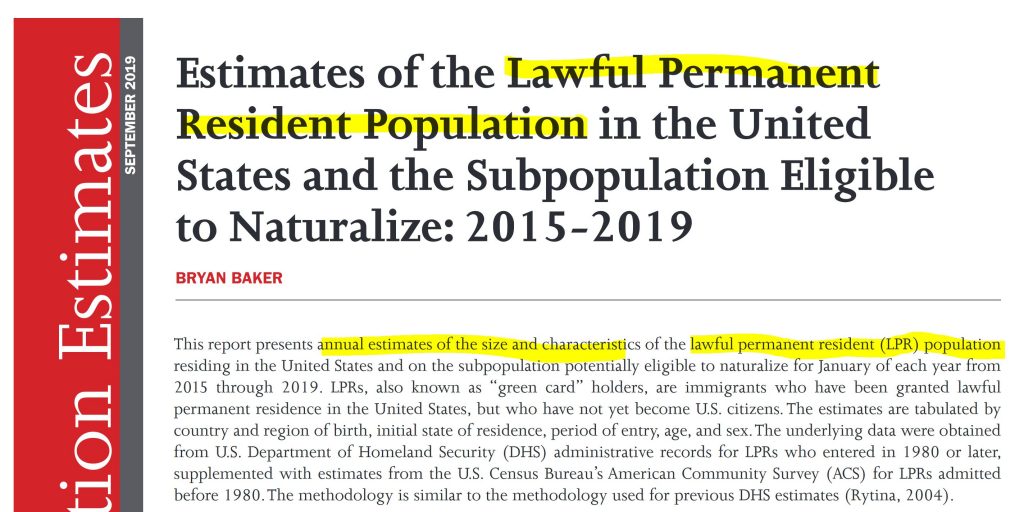
The number of LPRs emigrating exceed 3 million starting in 2015. These numbers bear no correlation to the formal abandonment numbers registered with the government, which require filing Form I-407, Record of Abandonment of Lawful Permanent Resident.
Emigration. Estimating emigration accurately is difficult.The U.S. government has not collected official statistics since 1957. Most observers agree that emigration of the LPR population from the U.S. is substantial. Between 1900-90, an estimated one-quarter to one-third of LPRs emigrated from the U.S. (see Warren and Kraly, 1985; Ahmed and Robinson, 1994; Mulder, et al., 2002).
DHS: Estimates of the Legal Permanent Resident Population and Population Eligible to Naturalize in 2002 (May 2014)
This apparent lack of information is what drove me to file a Freedom of Information Act (FOIA) request with the government to ask for the number of USCIS Forms I-407 that are filed with the government.
The information I obtained in the FOIA response was surprisingly low, since the government had record of only 46,364 Forms I-407 filed in the years 2013 through 2015, as follows:
SOURCE: Federal Government Response to FOIA Request: Office of Performance and Quality (OPQ), Performance Analysis and External Reporting (PAER), JJ
This represents an average of 15,455 individuals annually who formally abandoned their LPR status. Contrast this relatively small number with the more than 3.6 million LPRs estimated to have emigrated up to and through the year 2019 per the DHS report. This leaves a massive gap of some millions (assuming about 15,000 per year file Form I-407) of LPRs who have left-emigrated from the U.S. yet never formally abandoned by filing Forms I-407.
What about the tax consequences? How many of them know, understand or have any idea whatsoever of their federal tax filing obligations regarding their continued status? Subsequent posts will explore these consequences.
What is the takeaway from (i) the Office of Immigration Statistics reporting and (ii) the LPR – I-407 information provided by the government’s response to my FOIA request? There is a discrepancy in the millions of individuals. Millions of LPRs where most of them are simply not aware of how the U.S. federal tax law continues to impact their lives after they have left the country.
The successive posts will discuss the language and definition of a “lawful permanent resident” for purposes of the tax law and what it means for individuals residing outside the U.S. that still hold their green card in their purse/pocket:
(6) Lawful permanent resident. . . . an individual is a lawful permanent resident of the United States at any time if—
(A) such individual has the status of having been lawfully accorded the privilege of residing permanently in the United States as an immigrant in accordance with the immigration laws, and
(B) such status has not been revoked (and has not been administratively or judicially determined to have been abandoned). [emphasis added]
Additional Time for Tax Return Filing – Extension until December 15th for USCs Residing Overseas: “Avoiding the Acceleration of the ‘Repatriation’ Tax”
A prior post explained how a USC can avoid the acceleration of the 965 Repatriation tax for a USC residing outside the U.S., by timely filing an extension. See, the following comment regarding the relief granted by the IRS –
a timely election under Section 965(h)(1) needs to have been made, which is typically extends the return due date until October 15, 2018 (USCs residing outside the U.S., the extension due date was June 15th, 2018 and requires the filing of a specific automatic extension form (IRS Form 4868) by that date); and . . .
. . . the IRS has determined that, if an individual’s net tax liability under section 965 in the individual’s 2017 taxable year is less than $1 million, the individual makes a timely election under section 965(h), and the individual did not pay the full amount of the first installment by the due date under section 965(h)(2), the failure to make the payment will not result in an acceleration event under section 965(h)(3) so long as the individual pays the full amount of the first installment (and its second installment) by the due date for its 2018 return (determined without regard to extensions).
The only way to make a timely election, is to do so prior to the due date of the tax return. For USCs residing outside the U.S. (who already properly filed an extension by June 15th, 2018 with IRS Form 4868, the due date of the election and return filing is days away – due October 15, 2018.
There is a way to further extend the due date from October 15th for USCs residing overseas until December 15th.
Treas. Reg. Section 1.6081-1(b)(1) allows USCs residing overseas to request an additional extension until December 15th, provided
. . . A taxpayer desiring an extension of the time for filing a return, statement, or other document shall submit an application for extension on or before the due date of such return . . . ; however, taxpayers may apply for an extension in a letterthat includes the information required by this paragraph. . . . the taxpayer should make the application for extension to the Internal Revenue Service office where such return . . . is required to be filed . . . the application must be in writing, signed by the taxpayer or his duly authorized agent, and must clearly set forth—
1.6081-1(b)(1)(i) – The particular tax return, information return, statement, or other document, including the taxable year or period thereof, for which the taxpayer requests an extension; and
1.6081-1(b)(1)(ii) – An explanation of the reasons for requesting the extensionto aid the internal revenue officer in determining whether to grant the request.
A sample letter requesting an additional extension might look like this – with the foreign address of the USC reflected on the top of the letter:
Taxpayer 1 (USC) & Taxpayer 2 (USC)
No. 807 Address Foreign Street
Foreign City, Foreign Country, Codigo 87903-187
October 3, 2018 Department of the Treasury Internal Revenue Service Center Austin, TX 73301-0215
VIA CERTIFIED MAIL
Re: Additional Extension of Time to File IRS Form 1040: Taxpayer 1 (USC – SSN ***-**-7497) & Taxpayer 2 (USC SSN ***-**-4916)
Dear Sir or Madam:
We previously filed Form 4868 to extend our 2017 personal tax return. We live overseas outside of the good old US of A. Pursuant to Treas. Reg. §1.6081-1 (b), we are requesting an additional 2 months extension so that we can accurately file complete and accurate returns.
We are shareholders of certain foreign companies (in our country of residence, and the records are kept in Foreign Country and are in foreign currency and in Foreign Language. Additional time is required for the complex international information recording requirements on our tax returns, including IRS Forms 8865 and 8938 (which we know you would like to assess us penalties of US$10,000 for each form that you might argue are substantially incomplete in their presentation).
Please confirm this is approved. All taxes due were paid when we requested the extension in June, 2018.
Congress passed largest federal tax reform since the 1986 TRA – key provisions can impact “expatriates” –
I have not devoted the time to post regular blogs these last few months.
Now that we have major tax revisions to the U.S. federal tax law (many that can impact various individuals who are considering renouncing their U.S. citizenship or abandoning their U.S. lawful permanent resident – LPR – immigration status), I will find some more time to identify key provisions and provide some observations.
As always, the federal tax law is complex and these posts do not represent formal legal advice to anyone who might read them. Do get proper advice from a qualified tax professional to help you navigate your particular circumstances.
New Proposed Treasury Regulations Will Not Affect USCs But Will Affect some LPRs
United States Citizens (“USCs”) and lawful permanent residents (“LPRs”) who live largely outside the U.S. must generally be aware of U.S. federal tax laws and how they apply to them. USCs and LPRs “expats” (living outside the U.S.) are of course constantly being required to understand U.S. tax law and comply with its provisions.
Recently, the U.S. Treasury proposed new regulations requiring certain foreign owned single member U.S. limited liability companies and grantor trusts to report information.
The preamble to the proposed regulations (which are titled – Treatment of Certain Domestic Entities Disregarded as Separate From Their Owners as Corporations for Purposes of Section 6038A) note that:
Some disregarded entities are not obligated to file a return or obtain an employer identification number (“EIN”). In the absence of a return filing obligation (and associated record maintenance requirements) or the identification of a responsible party as required in applying for an EIN, it is difficult for the United States to carry out the obligations it has undertaken in its tax treaties, tax information exchange agreements and similar international agreements to provide other jurisdictions with relevant information on U.S. entities with owners that are tax resident in the partner jurisdiction or otherwise have a tax nexus with respect to the partner jurisdiction. . . . a disregarded entity is not subject to a separate income or information return filing requirement. Its owner is treated as owning directly the entity’s assets and liabilities, and the information available with respect to the disregarded entity depends on the owner’s own return filings, if any are required.
For those LPRs residing outside the U.S. who are not U.S. taxpayers by virtue of an applicable income tax treaty (i.e., by application of the treaty tie-breaker rules, typically Article 4), it appears these newly proposed regulations could be applicable to their single member LLCs or grantor trusts. USCs will not be effected, since the proposed regulations impose this reporting requirement when there is “(2) One foreign person [who] has direct or indirect sole ownership of the entity.” A USC cannot be a “foreign person”; which is not a defined term in the current statute or regulation. A “United States person” is a defined term and so is a “nonresident alien”; but not a “foreign person.”
Curiously, the Treasury is using IRC Section 6038A as the authority to issue such regulations. That statute only references “a corporation” which is a technically defined term under IRC Section 7701(a)(3), (a)(4) and (a)(30)(C). Section 6038A makes no reference to a”disregarded entity” a “grantor trust” or any other company or entity that are not “corporations.” Therefore, it is difficult to imagine how the Treasury has the statutory authority to issue this proposed regulation without legislative authority?
“Expatriation” Implies Leaving the U.S., But Many More Want to Come to the U.S.: Tax Consequences
U.S. citizens and long-term residents who are considering renouncing their citizenship or abandoning their lawful permanent residency (“LPR”) are increasingly undertaking more sophisticated life and tax planning before “taking the plunge”!
Many (in my experience – all) of these “expatriates” eventually want to be able to visit the U.S. and in some cases possibly come back to live permanently. Many simply apply for and obtain a B1/B2 visa.
This is the other “side of the coin” so to speak, since individuals contemplating coming to the U.S. often should undertake pre-immigration tax planning. One means for non-U.S. citizens to become LPRs and eventually U.S. citizens, is through the EB-5 visa program.
The next post on this site will be a complete article by Ms. Teodora Purcell explaining in more detail the EB-5 visa program and recent developments.
As to the tax implications of immigration to the U.S. (as opposed to emigration from it), I wrote the tax chapter in the latest edition of the American Immigration Lawyers Association (“AILA’s) treatise – Immigration Options for Investors & Entrepreneurs US$199.
12 Year Old (and Older) U.S. Citizens Residing Outside the U.S. Must Have An “In-Person” Interview in a U.S. Embassy or Consulate for SSN Application in 1 of Just 17 Posts Worldwide
This dilemma affects numerous USCs throughout the world, which is now compounded by the certification and reporting requirements of USCs and third parties, such as FFIs and NFFEs[2] under the Foreign Account Tax Compliance Act (“FATCA”).
* * *
The regulations provide the specific rule that all USCs must have a SSN[1] as their TIN. There are no general exceptions in the regulations to the requirement that a USC must have a SSN as their TIN.
This regulatory requirement specifically directs the USC to the forms that must be completed and filed with the SSA, in order to obtain a SSN, as follows:[2]
(1) Social security number. Any individual required to furnish a social security number pursuant to paragraph (b) of this section shall apply for one, if he has not done so previously, on Form SS-5, which may be obtained from any Social Security Administration or Internal Revenue Service office. He shall make such application far enough in advance of the first required use of such number to permit issuance of the number in time for compliance with such requirement. The form, together with any supplementary statement, shall be prepared and filed in accordance with the form, instructions, and regulations applicable thereto, and shall set forth fully and clearly the data therein called for. Individuals who are ineligible for or do not wish to participate in the benefits of the social security program shall nevertheless obtain a social security number if they are required to furnish such a number pursuant to paragraph (b) of this section. [emphasis added]
These Title 26 regulations discuss individuals requesting forms from “any Social Security Administration or Internal Revenue Service office” which clearly implies that the SSA and the IRS have offices overseas.
Unfortunately, this is not the case, as the IRS recently announced it is closing its full-time walk-in offices in London, Frankfurt and Paris, as the office in Beijing, China was closed in 2014.[3] Similarly, the SSA has no overseas offices, but does have limited field office operations in Canada, the British Virgin Islands and Samoa.[4]
Therefore, it is clear that the above regulations are speaking to individuals who reside and live in the U.S., and not USCs residing overseas when it requires USCs to “ . . . make such application far enough in advance of the first required use of such number to permit issuance of the number in time for compliance with such requirement.[5]
These Title 26 regulations require the application be made well in advance of any tax filing requirements are not realistic for USCs residing overseas as is explained herein. This author has seen the issuance of SSNs take more than 6 months, even when the USC could have an interview in their country of residence.
More importantly, there are very few countries (only 17) where in-person interviews can even be held. See, discussion below.
USCs who have lived most, if not all of their lives outside the U.S., commonly do not have a SSN. The procedural requirements imposed by the SSA to obtain a SSN in these cases are complicated and unrealistic for USCs living overseas.[6] This author has seen cases where USCs residing overseas have even spent the money and resources and time to travel to the U.S. to apply for a SSN, yet were turned away by the SSA, due to various procedural requirements which were not satisfied.
Often times obtaining a SSN overseas is nearly impossible, depending upon which country and where within that country the USC resides.
A. Obtaining a SSN Outside the US by a USC – Much More than Just Filing SSA Form SS-5
The SSA does not have offices outside the U.S. although they have a so-called “Office of International Operations.”[7] The focus of OIO is the administration of social security benefits, not obtaining SSNs for USCs residing overseas. Since the SSA is assisted by the U.S. Department of State (who are not SSN experts), USCs have to rely upon various U.S. embassies and consulate offices around the world, as they try to obtain a SSN.
B. Tax Return Filing Requirements – Minimum Gross Income
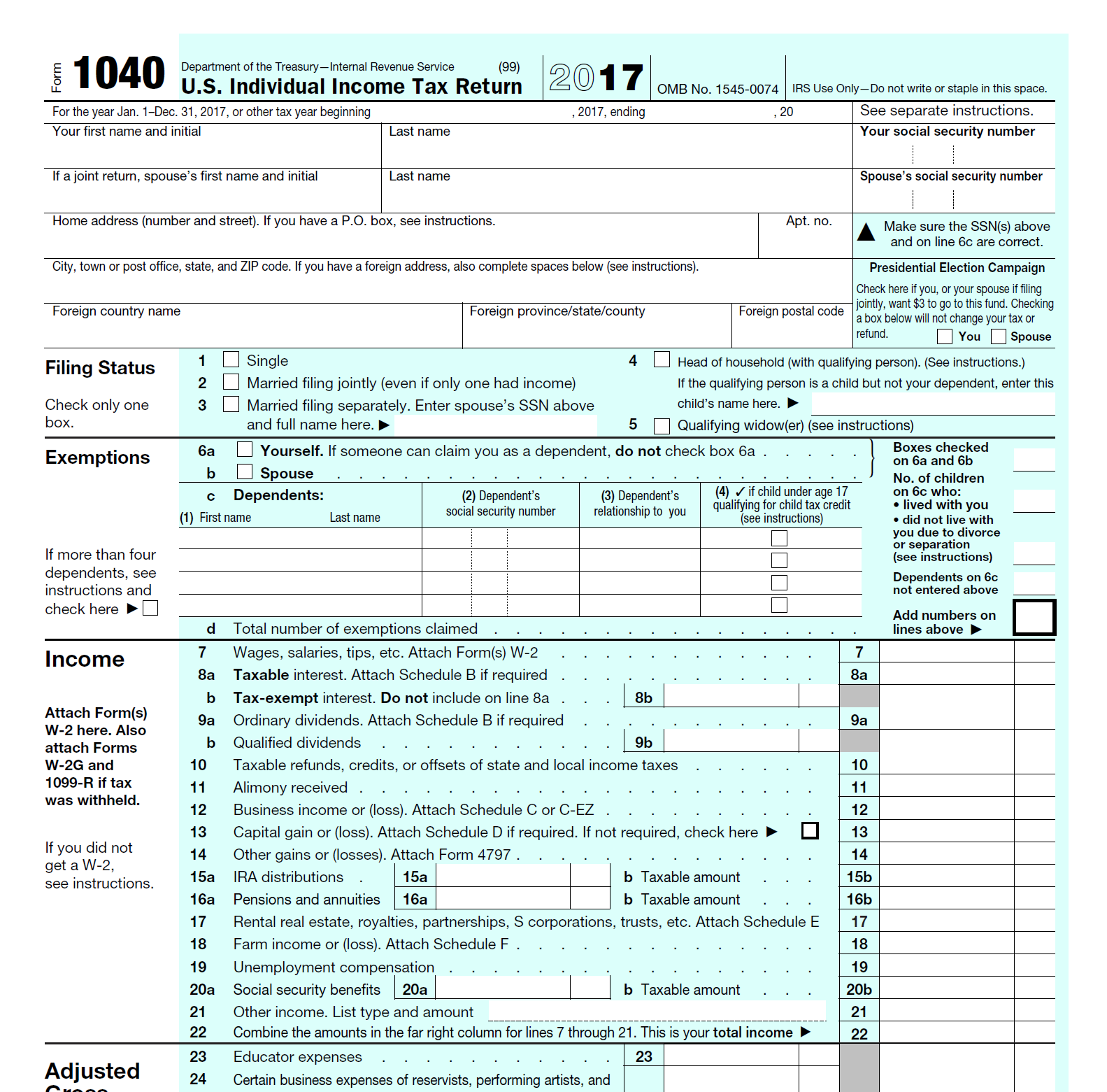
Any USC individual is obligated under the U.S. federal tax law to file a federal income tax return IRS Form 1040 if they meet minimum thresholds of income. For the tax year 2015, the thresholds are low, and are reached once the gross income is at least the sum of (i) the “exemption” amount (currently $4,000) and (ii) the “standard deduction” amount (currently $6,300 for single and married filing jointly and $12,600 for married couples filing jointly).[8]
This is true, even if all of the income is earned income and eligible for the foreign earned income exclusion, which is $100,800 for the tax year 2015.[9]
Additionally, USCs living overseas necessarily have a U.S. tax return filing requirement, when they meet these low thresholds of gross income. In these cases, tax returns that are not filed by the 15th of June are not considered timely filed.[10]
II. The Social Security Administration Rules Make it Nearly Impossible for Many USCs Overseas to Reasonably Obtain a SSN
The policy and procedures of the SSA regarding issuing SSNs have changed significantly over the years.[11] The Social Security Administration (SSA) provides a detailed chronology of the major changes in policy and procedures regarding filing for and obtaining a SSN.[12] One of the most significant revisions in the last decade came from The Intelligence Reform and Terrorism Prevention Act of 2004 (P.L. 108-458), which imposes various standards for the verification of documents or records submitted by an individual.
A. Only a Few Countries Around the World have Personnel at U.S. Embassies or Consulate Offices that Can Process SSN Applications – SSA Form SS-5-FS
Applying for SSNs overseas is severely restricted compared to an application in the U.S.
According to the U.S. Department of State, Foreign Affairs Manual (“FAM”), only certain “Claims-Taking Posts” in specific countries “may” include “processing applications for Social Security Numbers.” [13]
These 17 countries (and a city in the case of Jerusalem) with Claims-Taking Posts include:
“Austria, Argentina, Costa Rica, Dominican Republic, France, Germany, Greece, Ireland, Italy, Japan, Jerusalem, Mexico, Norway, Philippines, Poland, Portugal, Spain, and the United Kingdom.”
Noticeably absent are many Western European countries, virtually all of Latin America, virtually all of Asia, virtually all of Eastern Europe, all of the Middle East (except Jerusalem), all of the African continent, all of the Australian continent and surrounding island countries and Russia, among many other significant countries, including OECD member countries.[14]
Nothing in the FAM requires any of these “Claims-Taking Posts” to actually process applications for a SSN. Plus, there are of course hundreds of other countries throughout the world, not listed above, which do not have such a U.S. Department of State Post. For these reasons, USCs in countries such as China must travel to a U.S. Department of State Post (e.g., the Philippines) which is able to process applications for SSNs.
B. In Person Interview Required for Individuals Older than 11 Years Old
Individuals who are older than 11 years old must personally go to the U.S. Embassy or Consulate with a Claims-Taking Post. See 7 FAM 530, pages 7, 12, 13 and 7 FAM EXHIBIT 530(D) Mandatory In-Person Interview Worksheet SSN Applicant Age 12 or Older – Original SSN * * *
All of these rules makes you wonder whether foreign born individuals, such as actress Kim Cattrall from Sex & the City fame would have ever obtained a social security number overseas while she lived in Canada or the UK.
[3]See, Bloomberg article, 14 January 2015 by Kocieniewski, IRS Will Shut Last Overseas Taxpayer-Assistance Centers: “After budget reductions over the last four consecutive years, the IRS is forced to make tough choices during this period of fiscal austerity and these closures have relatively little impact on taxpayers and treaty partners,” said Julianne Breitbeil, an IRS spokeswoman. Also, see IRS website that still reflects the London and Paris offices as open http://www.irs.gov/uac/Contact-My-Local-Office-Internationally.
[6] See discussion below, regarding requirements to obtain a SSN. I.II, I.I,The Social Security Administration Rules Make it Nearly Impossible for Many USCs Overseas to Reasonably Obtain a SSN
[7] See SSA website, “Office of International Operations” – http://www.ssa.gov/foreign/ “Service Around the World – Welcome to SSA’s Office of International Operations (OIO) home page. The purpose of this site is to assist Social Security customers who are outside the U.S. or planning to leave the U.S. OIO is responsible for administering the Social Security program outside the U.S. and for the implementation of the benefit provisions of international agreements. Since SSA has no offices outside the U.S., OIO is assisted by the Department of State’s embassies and consulates throughout the world.”
[8]See, IR-2014-104, Oct. 30, 2014 and IRS Publication 501.
[12]See, SSA website, Significant Milestones in Social Security Number Policy. A detailed chronology of the major changes in policy and procedures. http://www.ssa.gov/history/ssn/ssnchron.html.
[14] In contrast to these 17 countries (and one city – Jerusalem) where a USC residing overseas must travel to apply for a SSN, the Treasury Department has announced it has around 100 countries that have signed, or “have reached agreements in substance” a FATCA IGA. USCs throughout the world are required by the Foreign Account Tax Compliance Act (“FACTA”) to provide their U.S. TIN to financial institutions throughout the world (on IRS Form W-9, or its equivalent), which under current law necessarily must be a SSN. Of course, if they have no SSN, they cannot sign IRS Form W-9 which provides in Part II: “Under penalties of perjury, I certify that: 1. The number shown on this form is my correct taxpayer identification number . . .”
The crucial policy considerations are set out in the report. The key paragraph of the report is reproduced here:
The principle idea is to impose U.S. income taxation on U.S. sources only for U.S. citizens residing overseas. The report leaves many unanswered questions. One of those questions is how to integrate the “expatriation tax rules” into such a concept? There is one sentence addressing this point, which contemplates the “mark to market exit tax” will continue as part of the law, if such a proposal were to become law.
The report does not discuss how the U.S. transfer tax system (U.S. estate, gift and generation skipping transfer taxes) might be reformed. Current law, imposes worldwide U.S. estate, gift and generation skipping transfer taxes on the worldwide assets of a U.S. citizen.
Time will tell if such a proposal gets any political traction in Congress or at the White House.
Throughout most of the last 100+/- years, there has never been a repeal of U.S. citizenship based taxation. Indeed, it is difficult to locate any legislative proposals from years past (if there were any) that proposed such a modification.
However, it is worth noting the following string of events over the last 18 months, which may indicate U.S. citizenship based tax reform could be possible:
For the first time, both political parties and the President have identified issues with the current U.S. citizenship based taxation rules which they have proposed to modify;
Fourth, in December of 2014, the the Senate Finance Committee Republican Staff issued a detailed report dedicating substantial discussion and analysis to “Non-Resident U.S. Citizens”. See pages 282 and 283 of the Comprehensive Tax Reform for 2015 and Beyond – Senate Republican Staff
This is the first time in my career, where both political parties and the President are at least talking about the possibility of tax reform in this area.
There is one key piece of the legislative puzzle missing from the above picture. The House has not weighed in on a proposal to modify substantially or repeal U.S. citizenship based taxation. See, former House Ways and Means Committee Chair Camp’s proposal to modify substantially international tax policy and rules (Making America A More Attractive Place To Hire and Invest: International Tax Reform). These House proposals do not include U.S. citizenship based taxation reform. In addition, I am not aware of any Democrats in the House who are pushing such a reform.
Even if there is approval in both the Senate and with the President (as there has been in other major legislative reform proposal, such as immigration), it is entirely possible the House will block any such U.S. citizenship based tax reform.






 in the individual’s 2017 taxable year
 various individuals who are considering renouncing their U.S. citizenship or abandoning their U.S. lawful permanent resident – LPR – immigration status), I will find some more time to identify key provisions and provide some observations.