IT AIN’T FAIR: First (1) taxing me as a U.S. citizen and then (2) taxing me on my relinquishment or renunciation of U.S. citizenship or LPR abandoment and further (3) taxing my children on their inheritance from me!@!@!
This sums up the argument of many critics of U.S. citizenship based taxation of worldwide income.
Many may agree with this conclusion from an equity or sense of fairness argument. See proposal below at the end of this post. 
However, the argument of fairness has little place in interpretations of Title 26, the U.S. federal tax law. For example, the U.S. Tax Courts are not courts of equity. See, The United States Tax Court – An Historical Analysis, Dubroff and Hellwig, footnote 668.
Also, virtually no courts of the U.S. find U.S. tax laws to be unconstitutional. It is a very rare occurrence that the U.S. Supreme Court even takes up a tax case to determine its constitutionality. The “Obamacare” with broad application throughout society was a case heard by the Supreme Court which upheld a law signed by President Obama on March 23, 2010, more correctly called the Patient Protection and Affordable Care Act. That law increased Medicare taxes and imposed a penalty surcharge on individuals who do not maintain certain health coverage.
In contrast, U.S. citizens and lawful permanent residents (LPRs) residing overseas are a relatively small population of the U.S. taxpayer population. Accordingly, it was only until late the U.S. government even began focusing on this population to collect taxes from them. See, Is the new government focus on U.S. citizens living outside the U.S. misguided or a glimpse at the new future?, posted March 6, 2014. 
Finally, see various proposals to modify the law: e.g., U.S. Citizenship Based Taxation – Proposals for Reform – “Tax Simplification: The Need for Consistent Tax Treatment of All Individuals (Citizens, Lawful Permanent Residents and Non-Citizens Regardless of Immigration Status) Residing Overseas, Including the Repeal of U.S. Citizenship Based Taxation,” by Patrick W. Martin and Professor Reuven Avi-Yonah, September 2013.
Executive Summary
This paper proposes to eliminate the U.S. citizenship based taxation and create a consistent exit tax system. The complex web of the current U.S. tax law has made it nearly impossible for all but the most sophisticated U.S. citizens and lawful permanent residents (“LPRs”) residing overseas to file complete and accurate tax returns. The proposal should bring consistency, tax simplicity for taxpayers residing outside the U.S., and do so in part by eliminating the U.S. citizenship based tax system, which is unique in the world, dates to the civil war and is inappropriate for the global world we live in.
- Summary of Current Status of the Law
To date, there is no serious and comprehensive proposal to modify the U.S. federal tax law imposing U.S. taxation of the worldwide income of USCs and LPRs residing outside the U.S.
There are also no serious proposals to repeal the current U.S. “expatriation tax” on (1) mark to market income and gains (When does “Covered Expatriate” Status -NOT- matter?) and (2) the 40% tax on covered gifts and inheritances (see, Proposed Regulations for “Covered Gifts” and “Covered Bequests” Issued by Treasury Last Week (Be Careful What You Ask For!)
Unplanned Expatriation: Lawful Permanent Residents’ Deportation Risks for Filing U.S. Federal False Tax Returns
One sure way to “get expatriated” as a lawful permanent resident (even if that was not the plan) is to file a false federal tax return, statement or provide false information to the government. U.S. citizens cannot be deported for filing false tax returns, due to Constitutional rights. 
Kawashima vs. Holder, (2012), is a story of a Japanese family that lived legally in the U.S. with lawful permanent residency status. According to the L.A. Times,
“Akio and Fukado Kawashima came to Southern California in 1984 as lawful Japanese immigrants determined to succeed in business. They operated popular sushi restaurants in Thousand Oaks and Tarzana and recently opened a new eatery in Encino.
But after they underreported their business income in 1991, they paid a hefty price. The Internal Revenue Service hit them with $245,000 in taxes and penalties. The couple pleaded guilty and paid in full. A decade later, the Immigration and Naturalization Service decided to deport them. . . “
The crucial mistake was the filing of a false return as defined under IRC Section 7206(1):
“(1) Declaration under penalties of perjury . . . Willfully makes and subscribes any return, statement, or other document . . . made under the penalties of perjury, and which he does not believe to be true and correct as to every material matter . . . “
The Supreme Court ruled in this case that the false return that generated a revenue loss of at least US$10,000 for the government was properly classified by the government as an “aggravated felony.” In other words, the tax returns were materially false (which the taxpayers had plead to previously) and created an unpaid tax liability of at least US$10,000. The Supreme Court cited the immigration law (Title 8) and found such an offense to be a violation of Section 1227(a)(2)(A)(iii) as an:
“(iii) Aggravated felony
Any alien who is convicted of an aggravated felony at any time after admission is deportable.
The false tax return which created a tax liability of a relatively low threshold of US$10,000 therefore carries potentially sever consequences.
See a prior post that briefly discusses IRC Section 7206(1), see, What could be the focal point of IRS Criminal Investigations of Former U.S. Citizens and Lawful Permanent Residents?
While most USCs residing overseas will never be concerned about deportation (which should generally not be available to the government, due to constitutional rights of the U.S. citizen) LPRs filing tax returns will indeed want to consider carefully the implications of ” . . . any [and all tax and other] return[s], statement[s], or other document[s] . . . ” submitted to the federal government.
Also, prior posts discussed the law and risks associated with filing or sending false documents, information or returns to the Internal Revenue Service (“IRS”) –
See,Take Caution when Completing a “Tax Organizer” Provided by Your Tax Return Preparer, posted July 19, 2014;
*Is the new government focus on U.S. citizens living outside the U.S. misguided or a glimpse at the new future?* posted March 6, 2014, Will the Justice Department and Criminal Investigation Division of the IRS Turn Their Sights on USCs or LPRs living Overseas? posted March 19, 2014,
The relevance of the Kawashima case to readers of this blog, is how a “long-term resident” may inadvertently find they will trigger the “mark-to-market” tax on their worldwide assets and later cause their U.S. beneficiaries to be subject to what is currently a 40% tax on the receipt of certain gifts and inheritances. See, prior posts on LPR status – Who is a “long-term” lawful permanent resident (“LPR”) and why does it matter?, posted August 19, 2014.
Some prior news coverage of the Kawashima v. Holder case here:
Legal immigrants face deportation for filing false tax return
The Supreme Court rules against a couple who pleaded guilty and paid in full, saying the crime was an ‘aggravated felony’ subject to automatic deportation. Tax lawyers say the decision is ominous.
February 26, 2012|By David Savage and Catherine Saillant, Los Angeles Times
Timing Issues for Lawful Permanent Residents (“LPR”) Who Never “Formally Abandoned” Their Green Card
The “tax expatriation” statutory provisions are fraught with ambiguity and incomplete answers for those individuals who have cases that span different time periods. This is because the law has been changed numerous times over the last several years and ad hoc concepts added, including the technical concept of “long-term residents” for the first time in 1996. As has been previously explained, the first “expatriation tax” law was not adopted until 1966 as part of the The Foreign Investors Tax Act of 1966 (“FITA”) – The Origin of U.S. Tax Expatriation Law (Posted on April 6, 2014).
Next, 1996 amendments kept the basic regime but added a number of key concepts, including “long-term residents”. The changes in the law in 2004 made significant changes and in 2008 the first “mark to market” regime was adopted. Each time, the concept of “long-term residents” was maintained, but without clear thought as to the meaning and timing of “expatriation” in various cases. See, Timeline Summary of Changes in Tax Expatriation Provisions Since 1996, (Posted on April 9, 2014)
Unfortunately, none of these amendments to the law over the years carefully incorporated transition and timing rules for cases where the individual has lived in (or had U.S. citizenship or LPR) during one more of these time periods:
- 1966-1996
- 1996-2004
- 2004-2008
- 2008-present
There are many inconsistent concepts among the law and one clear example is demonstrated by an individual who became a lawful permanent resident prior to 1996 and prior to amendments in the definition of a “resident alien” which was adopted generally in the federal tax in the law in 1984. This 1984 definition was not part of any specific “expatriation tax” provisions.
Remember, the technical definition of who is a “resident alien” is the basic definition of who is generally subject to U.S. income taxation on their worldwide income. See, Co-author. “Tax Simplification: The Need for Consistent Tax Treatment of All Individuals (Citizens, Lawful Permanent Residents and Non-Citizens Regardless of Immigration Status) Residing Overseas, Including the Repeal of U.S. Citizenship Based Taxation,” by Patrick W. Martin and Professor Reuven Avi-Yonah, September 2013.
Prior to 1984, a LPR was not necessarily an income tax resident of the U.S. This concept of LPR (i.e., a “green card”) driving U.S. income tax residency was adopted in 1984, long before Congress became obsessed with U.S. individual tax expatriation. For background in the law, see the 1985 Penn State Law Review Article – Internal Revenue Code 7701(b): A More Certain Definition of Resident
The Joint Committee on Taxation report on the 1984 changes in the tax law (“General explanation of the revenue provisions of the Deficit Reduction Act of 1984 : (H.R. 4170, 98th Congress; Public Law 98-369)“) addressing the tax residency test of “lawful permanent residency” rules provides the following language:
. . . The Act defines “lawful permanent resident” to mean an individual who has the status of having been lawfully accorded the privilege of residing permanently in the United States as an immigrant in accordance with the immigration laws, if such status has not been revoked or administratively or judicially determined to have been abandoned. Therefore, an alien who comes to the United States so infrequently that, on scrutiny, he or she is no longer legally entitled to permanent resident status, but who has not officially lost or abandoned that status, will be a resident for tax purposes. The purpose for this requirement of revocation or determination is to prevent aliens from attempting to retain an apparent right to enter or remain in the United States while attempting to avoid the tax responsibility that accompanies that right.
The logic of the LPR test is clear based upon this explanation. If one has the right to live in the U.S., they cannot avoid the tax responsibility that accompanies that right. However, as immigration lawyers will explain, there is no right to enter the U.S. after you have abandoned your LPR status and moved outside the U.S. on a permanent basis.
At the same time, there is other discussion in the report that would support the position that these provisions only apply for the years 1985 and thereafter (long after many individuals obtained LPR status, but who moved out of the country – e.g., in cases where individuals obtained LPR in the 1970s and left before 1985). Specifically, the explanation in the Joint Committee of Taxation is as follows:
. . . The purpose of this effective date rule is to delay tax resident status for only new green cardholders for a short time. Congress understood further that an alien may acquire lawful permanent resident status for immigration purposes before U.S. presence. Congress sought to impose tax resident status on all lawful permanent residents once they arrive in the United States. The Act does not affect the determination of residence, even for green card holders, for taxable years beginning before January 1, 1985.
Of course, the report by the Joint Committee on Taxation (“JCT”) is not the law and does not bind the IRS or the taxpayer. However, the JCT usually get their explanations of the law right.
Why is all of this important for LPRs who never formally abandoned their “green card”? The IRS might well try to argue they never terminated their U.S. federal income tax residency for purposes of the “tax expatriation provisions”, as later versions of the statute impose an obligation to notify the IRS. If the individual never notified the IRS, the government might ar
See, for instance Section 7701(b)(6) with specific rules for LPR individuals who live in a country with a U.S. income tax treaty. Importantly, the definition of a lawful permanent resident for tax purposes (as defined in Section 7701(b) ) is not identical to the definition for immigration law purposes as the legislative history to the 1984 amendments to the law explains.
See, Oops…Did I “Expatriate” and Never Know It: Lawful Permanent Residents Beware! International Tax Journal, CCH Wolters Kluwer, Jan.-Feb. 2014, Vol. 40 Issue 1, p9.
Finally, the information required as part of the process of formal abandonment is much more extensive than in the past.
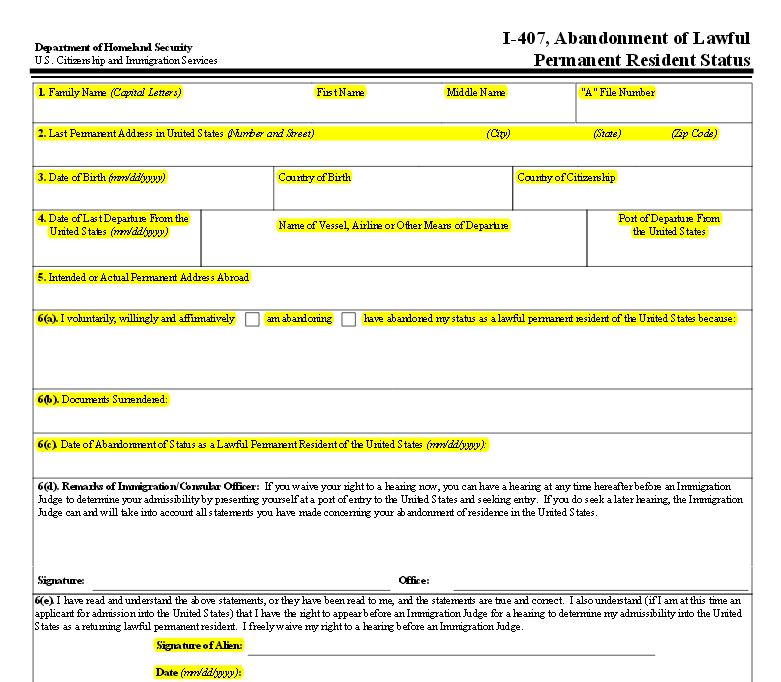
A prior post discussed the published USCIS immigration form I-407 for LPRs who must now use it when formally abandoning LPR status. See, More Information and More Information: USCIS Creates New Form for Abandonment of Lawful Permanent Residency
See, new I-407 Form requires that much more information and is 2 pages in length.
Inflation Adjusted Exclusion Amounts Since Inception of 2008 “Mark to Market” Expatriation Tax Law: Example
The current “expatriation” “exit tax” forces a “covered expatriate” to pay U.S. income taxation on their unrealized gains (the “mark to market” concept) as if they sold their worldwide assets.
An “unrealized gain” is the amount of gain “built into” the property or other investment of the individual, which has yet to be sold or otherwise disposed of by the him or her. For instance, the  diagram below reflects various assets held by a “Covered Expatriate” which includes Mexican real estate with a tax basis of US$200,000 but a current fair market value of US$1.1M. This means the unrealized gain in that Mexican real property is US$900,000 (US$1.1M – US$200K).
Who is a “covered expatriate” is a very important legal analysis that needs to be considered for each U.S. citizen who wishes to renounce or “long-term resident.” See, The dangers of becoming a “covered expatriate” by not complying with Section 877(a)(2)(C) (9 March 2014).
Importantly, the law provides for an exclusion from taxation on the former (a) U.S. citizen’s (“USC”) or (b) long-term resident’s unrealized gains. (See, Who is a “long-term” lawful permanent resident (“LPR”) and why does it matter? – 19 Aug. 2014). In other words, no U.S. income tax is due and payable by a “covered expatriate” if they did not have assets with unrealize d gains greater than a certain threshold amount.
That threshold amount has been changing annually, since the initial US$600,000 that was originally adopted into the law in 2008. It is changing due to annual inflation adjustments.
The current 2015 exclusion amount adjusted for inflation is US$690,000. See, The “Phantom” Gain Exclusion from the “Mark to Market” Tax – Increases to US$690,000 for the Year 2015 (15 November 2014).
Hence, in this case, if the only asset owned by the “covered expatriate” (assuming she became one in 2015) was the real estate in the above example with unrealized gain of US$900,000, only US$210,000 would be subject to the “mark to market” tax on expatriation (i.e., the exit tax). This is because $690,000 of the total US$900,000 unrealized gain will be excluded from taxation (US$900K – US$690K).
The Mark to Market tax regime imposes taxation on this amount, even though the real estate is never sold. This means, the “covered expatriate” must come “out of pocket” to find the cash and means necessary to pay the tax imposed under the law.
There is no economic benefit obtained from this annual inflation adjustment if a U.S. citizen or long-term resident waits to become at a later time a covered expatriate; unless they consume, deplete or lose their assets in the interim. But at least, there is an inflation adjustment, so the taxpayer is not subject to an increasing amount of gain subject to tax as time progresses and inflation eats away at the true economic value and economic growth of the individual’s assets.
Does the IRS have access to the USCIS immigration data for former lawful permanent residents (LPRs)?
Information about former LPRs, such as the individuals names, is not published under the statute, IRC Section 6039G, which only covers former U.S. citizens. 
This raises the question of whether the Department of Homeland Security tracks former LPRs – names and addresses overseas and provides that information to the Internal Revenue Service?
A prior post discussed the newly published USCIS immigration form I-407 for LPRs who must now use it when formally abandoning LPR status. See, More Information and More Information: USCIS Creates New Form for Abandonment of Lawful Permanent Residency
The new I-407 Form requires much more information and is 2 pages in length. The old form had only 6 lines and was less than 1/2 of a page in length. These forms  are set forth here. The new form requires the address overseas of the individual.
As readers here know, the names of former U.S. citizens are published quarterly by the U.S. federal government for the world to see. See a prior post, The 2014 Third Quarter Renunciations Is probably the New Norm –
The complete set of lists going back to the mid-1990s can be reviewed here. Quarterly Publications.
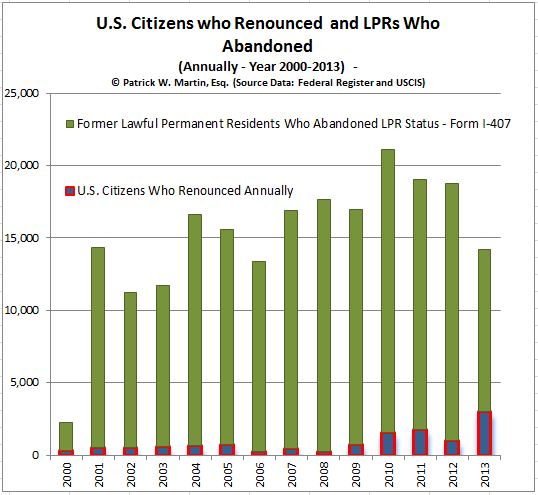
Of course, the IRS can easily select and identify individuals for audit, by simply drawing from the published names of former U.S. citizens, which is currently tracking at an average of about 850 former USCs quarterly. In contrast, the number of former LPRs who have filed USCIS Form I-407 is tracking at an average of about 4,000 to 5,000 individuals quarterly. 
While citizens are often the focus of the public press and Congress regarding “expatriation taxation”; the statute also wraps in so-called “long-term residents.” These are individuals who had or continue to have “lawful permanent residency status.” There are numerous technical considerations in this area, but needless to say, the number of former lawful permanent residents who have simply filed Form I-407 – Abandonment is far in excess of those U.S. citizens who have filed for and received a Certificate of Loss of Nationality (“CLN”) – Form DS-4083 (CLN). The graph reflects the enormous difference.
See, earlier post The Number of LPRs “Leaving” the U.S. is 16X Greater than the Number of U.S. Citizens Renouncing Citizenship
On a related post, the question was raised –What are the Number of LPRs who Leave U.S. Annually without filing Form I-407 – Abandonment?
This is important, since many LPR individuals will have “expatriated” without actually having filed USCIS Form I-407. See, Oops…Did I “Expatriate” and Never Know It: Lawful Permanent Residents Beware! International Tax Journal, CCH Wolters Kluwer, Jan.-Feb. 2014, Vol. 40 Issue 1, p9 
While the IRS has specific information about U.S. citizens, it is not clear whether the Department of Homeland Security via the USCIS provides data to the IRS regarding lawful permanent residents who have filed Form I-407? If such an individual becomes a “covered expatriate” under the U.S. tax law, the range of adverse tax consequences can follow them and their future beneficiaries and heirs, including as follows:
- “mark to market” taxation on their worldwide assets,
- 40% inheritance tax to U.S. beneficiaries,
- 40% tax on gifts to U.S. beneficiaries,
- etc.
It seems fairly easy, from a legal perspective, that the IRS can request the names, addresses (and indeed the newly completed form) from the USCIS of all individuals who have filed USCIS Form I-407. From the USCIS records, the IRS will be able to determine if the individual was a “long term resident” based upon the number of years the individual had such status.
Assuming the IRS determines the individual is a long term resident, they can then simply check to see if the they have received IRS Form 8854 from the former LPR; in order to determine if she or he satisfied the certification requirement of Section 877(a)(2)(C). If not, the IRS will necessarily know the individual is a “covered expatriate.”
Key Concepts of Senate Finance Chairman Hatch’s Proposal Re: “Non-Resident U.S. Citizens”
The complete report can be located at the Senate Finance Committee website at Comprehensive Tax Reform for 2015 and Beyond – Senate Republican Staff –
The crucial policy considerations are set out in the report. The key paragraph of the report is reproduced here:
The principle idea is to impose U.S. income taxation on U.S. sources only for U.S. citizens residing overseas. The report leaves many unanswered questions. One of those questions is how to integrate the “expatriation tax rules” into such a concept? There is one sentence addressing this point, which contemplates the “mark to market exit tax” will continue as part of the law, if such a proposal were to become law.
The report does not discuss how the U.S. transfer tax system (U.S. estate, gift and generation skipping transfer taxes) might be reformed. Current law, imposes worldwide U.S. estate, gift and generation skipping transfer taxes on the worldwide assets of a U.S. citizen.
Time will tell if such a proposal gets any political traction in Congress or at the White House.
The President’s Proposal is NOT the Same as Current Law – Section 877A(g)(1)(B)
Some individuals are mistaken that the Obama proposal to exempt certain U.S. citizens from taxation (including the “mark to market” exit tax), is the same as the exception in IRC Section 877A(g)(1)(B).
It’s not. They are not the same, although they have some similar requirements (e.g., 5 years of certification of U.S. tax law compliance under penalty of perjury).
For a brief discussion on the President’s proposal, see –The Proposal by the President to Exempt Certain U.S. Citizens from Worldwide Taxation: – Very Small, Select Group
–
There are important differences. Most importantly, the I
RC Section 877A(g)(1)(B) exception requires the individual not only have been a dual citizen (of at least two or more countries) at birth, along with U.S. citizenship; but also continue to reside and be a tax resident of that country, i.e., the country of which they were also a citizen at the time of their birth. This tax residency/dual citizenship rule is necessarily required by I
RC Section 877A(g)(1)(B). If the person has moved to another country, they will not be eligible for this treatment and will be subject to the mark to market “exit tax” if they renounce their U.S. citizenship. Their U.S. heirs and beneficiaries will also be subject to the 40% (current tax rate) tax on “covered gifts” and “covered bequests.”
–
The President’s proposal (if it ever becomes law) will also apparently exempt all qualifying individuals from any type of U.S. taxation; other than tax that would apply to a “non-resident alien” (which would be no U.S. tax – if the individual had no U.S. source income). Not only would no “exit tax” apply, but so too would no U.S. income tax on their income from their country of residence or any other country outside the U.S. The President’s proposal would also exempt them from all U.S. tax filing requirements (other than the 5 years) and from FBAR filing requirements. See,
Nuances of FBAR – Foreign Bank Account Report Filings – for USCs and LPRs living outside the U.S.–
–
Obama Budget Proposal to “Provide Relief for Accidental Americans”? Will the Proposal to Modify the Expatriation Rules Become Law?
[See follow-on post: The Proposal by the President to Exempt Certain U.S. Citizens from Worldwide Taxation: – Very Small, Select Group– published 18 Feb. 2015]
Every year, the President of the United States, releases his proposed budget. The budget is prepared by his team of advisers at the Treasury Department and is known as the “green book“.
For a complete copy of the proposal, that was released on February 2, 2015, see, General Explanations of the Administration’s Fiscal Year 2016 Revenue Proposals (Released February 2015)
Buried deep into the proposal of the US$3.99 trillion fiscal year 2016 expenditure plan, is a provision to “provide relief for certain accidental dual citizens.” See pages 282 and 283 of the proposal.
It appears someone is listening in the Administration at Treasury; at least a little bit? Will Congress similarly be interested in such proposals? See, Will Congress Intervene to make USC based Tax Laws More User Friendly to USCs and LPRs Residing Outside the U.S.?
The proposal would not adopt residency based taxation for all U.S. citizens, as exists in the rest of the world, but would exclude certain U.S. citizens from the “mark to market” tax on expatriation (i.e., the “exit tax”). See, “Tax Simplification: The Need for Consistent Tax Treatment of All Individuals (Citizens, Lawful Permanent Residents and Non-Citizens Regardless of Immigration Status) Residing Overseas, Including the Repeal of U.S. Citizenship Based Taxation,” by Patrick W. Martin and Professor Reuven Avi-Yonah, 2013.
Those excluded from the exit tax and the tax to their U.S. heirs or beneficiaries who receive gifts or inheritances (See, The “Hidden Tax” of Expatriation – Section 2801 and its “Forever Taint.”) are those individuals who:
- became at birth a citizen of the United States and a citizen of another country,
- at all times, up to and including the individual’s expatriation date, has been a citizen of a country other than the United States,
- has not been a resident of the United States (as defined in section 7701(b)) since attaining age 18½,
- has never held a U.S. passport or has held a U.S. passport for the sole purpose of departing from the United States in compliance with 22 CFR §53.1,
- relinquishes his or her U.S. citizenship within two years after the later of January 1, 2016, or the date on which the individual learns that he or she is a U.S. citizen, and
- certifies under penalty of perjury his or her compliance with all U.S. Federal tax obligations that would have applied during the five years preceding the year of expatriation if the individual had been a nonresident alien during that period.
This would be a significant change from current law. However, the no passport requirement will narrow significantly the number of individuals who may be eligible for this relief; if it becomes law?
Most interesting about the proposal, is that it seems to say these U.S. citizen individuals (who meet all 6 criteria) will not be subject to any U.S. tax as a U.S. citizen. In other words, it seems to say they will be taxed the same as a non-resident alien, which in effect is residency based income taxation for this narrow class of U.S. citizens. The word tax is used generically, to presumably also exclude them from U.S. estate, gift and generation skipping transfer taxes.
The proposal has a window of opportunity that starts to close with time and then shuts in January 1, 2018; i.e., the 2 year period after January 1, 2016. This will mean that those future “Accidental Dual Citizens/Americans” who later learn of their U.S. citizenship, will only have 2 years from the moment they became aware of their U.S. citizenship status. One thing is to know you are a U.S. citizen as you live wherever you may around the world; another is to know and understand the U.S. taxes that are imposed upon you on your worldwide assets.
The Importance of Planning – PRIOR to Renouncing, Relinquishing or Abandoning
International tax law experts who specialize in a particular area of the law, have a fairly good understanding of the importance of tax planning. The reason is simple. The law is complex and without planning,  laypeople can often cause very adverse tax consequences to themselves and their friends and family members (in the case of tax expatriation) without understanding the full implications of the law.
“Tax expatriation” in the U.S. is particular complex for several reasons:
1. The general rule is that there is an immediate income tax payable from the “mark to market” taxation rules on unrealized gains. See, Part I: Common Myths about the U.S. Tax and Legal Consequences Surrounding “Expatriation”
2. If a tax is recognized under the U.S. tax law, the only way to discharge the liability with the U.S. federal government is to pay the tax owing. The IRS generally can collect an income tax owing against a taxpayer who lives outside the U.S. indefinitely, as the 10 year collection statute does not apply when the individual outside the United States for a continuous period of at least six months. See, IRC Section 6503(c). More on this topic in another post. In other words, the IRS can “forever” pursue the collection of the “expatriation tax” against USCs and LPRs living outside the U.S.
3. It is easy to fall into the general rule of expatriation, even if the taxpayer would not otherwise be subject to income taxation. See, Why “covered expat” (“covered expatriate”) status matters, even if you have no assets! The “Forever Taint”!
4. The friends and family of the “covered expatriate” – i.e., the former U.S. citizen and long-term lawful permanent resident can be subject to U.S. taxation during their lifetimes, even if they also live outside the U.S. See also, some of the consequences of being a “covered expatriate” – The “Hidden Tax” of Expatriation – Section 2801 and its “Forever Taint.”
Each of these points help demonstrate the need for planning prior to running to the U.S. Department of State and completing and filing the following forms when you take the oath of renunciation:
Form DS-4081, Statement of Understanding Concerning the Consequences and Ramifications of Relinquishment or Renunciation of U.S. Citizenship.
See, Documents to Request the Consular Officer When Renouncing U.S. Citizenship
At the end of the day, if the individual lives outside the U.S. and does not travel to and from the U.S., it may be practically very difficult for the IRS to collect on the tax judgment owing if the individual has no assets in the U.S. There are legal means and steps the IRS can take in an attempt to try to collect U.S. taxes on overseas assets.
For a further discussion on collection of taxes overseas:
See, U.S. Enforcement/Collection of Taxes Overseas against USCs and LPRs – Legal Limitations, and
Part II: U.S. Enforcement/Collection of Taxes Overseas against USCs and LPRs – Pasquantino – Wire Fraud and Mail Fraud
Ideally, a former U.S. citizen or long-term lawful permanent resident will wish to avoid all of the potential tax and collection issues, by engaging in thoughtful and strategic planning prior to their renunciation of U.S. citizenship or abandonment of lawful permanent residency.
Read the Q&A format here.
Part II: Common Myths about the U.S. Tax and Legal Consequences Surrounding “Expatriation”
· More Myths – about Renouncing U.S. Citizenship
There are many misunderstandings of how the law works when someone renounces U.S. citizenship. See, Part I: Common Myths about the U.S. Tax and Legal Consequences Surrounding “Expatriation”
The author regularly hears a range of myths that will befall an “Accidental American” when and if, they renounce. These “myths” include the following:
- Myth 5: There is no requirement to file U.S. income tax returns if the individual has few assets, little income or has otherwise lived outside the U.S. for almost all of their lives.
- Myth 6: There is somehow some “magical difference” under the law, for those who “renounce” citizenship (currently) versus those who “relinquished” citizenship (some time in the past) and the U.S. Department of State should recognize this “magical difference”. Such a difference will create a different U.S. tax result.
- Fact: The tax law nor immigration law makes such a distinction, even though this seems to be a common myth frequently spread throughout the Internet.
- Myth 7 : Former U.S. citizens who are “covered expatriates” can gift assets to their U.S. citizen children and friends without U.S. tax costs to them.
- Fact: This is true, i.e., there is no restriction or tax that is levied against the former U.S. citizen who makes the gift. The problem is for the recipient U.S. citizen or other “U.S. person” children or friends who will become subject to tax upon such gifts at the highest estate and gift ta rate (currently 40%).
- Myth 8: Former U.S. citizens should not worry about the IRS and its ability to collect taxes owing for the “mark-to-market” gains tax on expatriation (or on covered gifts and covered bequests) against assets located outside the U.S.?
These are just some of the myths commonly floated. There are yet more myths which will be discussed in a later post.