IRS Releases Clarifying rules for U.S. Citizens Living Outside the U.S. – Re: Streamlined Filing Guidance
In June of this year, the IRS announced a new administrative method by which taxpayers can file late or never filed tax returns and information returns. See, The Risks to USCs and LPRs – Filing Late U.S. Income Tax Returns via the so-called “Streamlined” process
I previously posted a note about the so-called “Streamlined” process the IRS [which are now gone and removed from the IRS website] had announced in June 2012, Why the so-called “Streamlined” Process is “Much Ado About Nothing” – Legally Speaking. I explained that legally speaking, there is no legal protection to the taxpayer provided by this administrative procedure.
The IRS again just announced further clarifications to this program and just released on the IRS website a description of the streamlined filing compliance procedures (“SFCP”) for U.S. taxpayers residing abroad and related “FAQs”. These FAQs can be reviewed here: Specific Instructions for the Streamlined Foreign Offshore Procedures
FAQs are all the rage these days with the IRS, as the government does not take the time or spend the resources to follow the Administrative Procedures Act or similar requirements which are required in order to issue binding rules and regulations. See a previous post regarding these requirements, specifically regarding those who renounce U.S. citizenship or abandon LPR status and have not complied with IRS Notice 2009-85. See,Does IRS Notice 2009-85 regarding expatriation have the “force of law”? Posted on April 14, 2014
Hence, these SFCP are not legally binding on the IRS and they can pick cases as they choose for audit, review and penalty assessment in any manner they think is consistent with the law. Sometimes they do it in a manner that is not consistent with the law.
Of course, most practitioners do not think the IRS will “willy-nilly” ignore their own FAQs procedures for taxpayers who file under the SFCP (at least not across the board); lest taxpayers lose confidence in the IRS.
At the end of the day, any particular U.S. taxpayer residing overseas, should understand carefully these legal implications of the SFCP before “jumping in the pan”; which is hopefully not a “frying pan”.
Certification Requirement of Section 877(a)(2)(C) – (5 Years of Tax Compliance) and Important Timing Considerations per the Statute
People who cite to IRS forms, should have an appreciation that neither the form or its conditions may have the “force of law.” This is particularly important, when the statute itself, regarding the Certification Requirement of Section 877(a)(2)(C) does not specific whether the certification has to be made “prior to” (or after) the date of loss of nationality? See the relevant provision of the statute below – Section 877(a)(2)(C), which causes an individual to be a “covered expatriate” if::
- (C) such individual fails to certify under penalty of perjury that he has met the requirements of this title for the 5 preceding taxable years or fails to submit such evidence of such compliance as the Secretary may require.
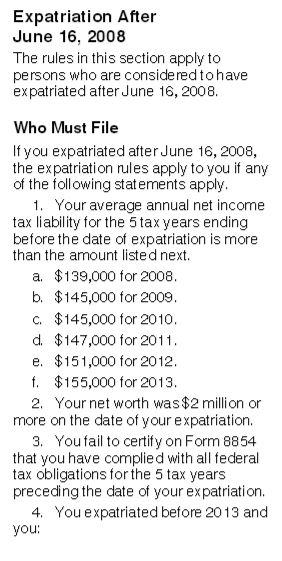
Consider the language of the instructions of IRS Form 8854, however, which expressly states that the certification must reflect you have ” . . . complied with all of your federal tax obligations for the 5 tax years preceding the date of your expatriation.”
Does this mean the IRS requires the compliance to have been satisfied prior to the expatriation/renunciation date? That is what the instructions say.
See the bottom of page 2 of the Form 8854 instructions –
“If you expatriated after June 16, 2008, the expatriation rules apply to you if any of the following statements apply.
1. Your average annual net income tax liability for the 5 tax years ending before the date of your expatriation is more than the amount listed next . . .
2. Your net worth is $2 million or more on the date of your expatriation.
3. You fail to certify on Form 8854 that you have complied with all of your federal tax obligations for the 5 tax years preceding the date of your expatriation.”
In this case, the instructions to the form, say the former USC or LPR must ” . . . have complied with all of your federal tax obligations preceding the date of your expatriation. . . ”
If this statement were true, a taxpayer could not satisfy the rule by attempting to comply with all federal tax obligations after they have renounced their U.S. citizenship?
In other words, if such were true, attempting to comply with all provisions of the U.S. federal tax law for 5 years and then filing 8854, all after taking the oath of renunciation, would prohibit someone from avoiding “covered expatriate” status?
Importantly, the Treasury/IRS cannot create law by merely publishing a substantive rule in an IRS Form. Indeed, there are no regulations to date; that have been issued by the Treasury; only a few notices. See prior post, Does IRS Notice 2009-85 regarding expatriation have the “force of law”?
Of course, this does not mean the IRS will not challenge any former USC as not complying with Certification Requirement of Section 877(a)(2)(C) by not also complying with the condition set forth in the IRS own instructions?
This is an example of an important detail that any former USC will want to carefully consider prior to rushing off to take the oath of renunciation.
As always, see Limitations.
Read the Q&A format here.
Online/Self Diagnoses: Great “Tax Myths” of “Expatriation” Propogated on the WWW – Internet
There are many misconceptions about how the U.S. federal tax law works in general; and specifically regarding the “expatriation tax” provisions. This resource – https://tax-expatriation.com/ – is specifically designed to try to bring clarity to these complex tax laws where there are many “tax myths” floating around in the internet.
This website of general information is certainly not a substitute for personal legal and tax advice to your specific circumstances. See, Limitations that explains why general legal information is not the same as legal advice, that is, the concrete application of law to a specific case with unique and particular facts.
In order to provide a public resource, this website tries to help clarify some of these myths. Incidentally, the internet is a great resource for information and at the same time – misi nformation, misleading information, self-help snake oil gibberish and the like. I am often times amused, in a disturbed way – if I realize how someone might be making an important life mistake because of the lack the information and knowledge a person demonstrates they have in this area of the law, based upon their writings.
As a wonderful example of this, see this WWW-website reference to medical self-diagnoses – which is ironic in so many different ways. It is written by “Dr. John Anderson” who is apparently not a medical doctor at all, but rather has a PhD in fisheries.
It is common to see lay persons (or even purported tax advisers) reading and interpreting the law in a way they wish it were; the way they see it most favorable to their own circumstances, etc. These internet interpretations are usually not well founded in the law, especially not a comprehensive reading of the law, and especially in light of how the IRS and U.S. Treasury interpret the law. These comments are often a regurgitation of something someone has read on the internet or heard from a friend or acquaintance or a particular website.
They often are full of “legal arguments” that at times smack of what U.S. courts have consistently found to be deemed “tax protestor” arguments which consistently lose in U.S. courts. Another post will be forthcoming explaining this important concept, as I expect we will see similar expatriation cases work their way through IRS tax audits, administrative tax appeals and eventually some will reach the U.S. courts surrounding the “expatriation tax” provisions.
The world wide web is a powerful tool, when used prudently.
Enough of my musings about how myths of U.S. “expatriation tax law” are compounded throughout the world with the WWW!
If the law is not clear in its application, I will say it is unclear. If the law has been interpreted specifically by a particular Court, I will provide a discussion of that opinion. The “expatriation tax law” is an area of the tax law which has NO case law to date. There is not a single case that has been litigated by a taxpayer or the government surrounding Section 877 or any of the companion provisions.
There are also no regulations to date; that have been issued by the Treasury; only a few notices. See, Does IRS Notice 2009-85 regarding expatriation have the “force of law”?
However, the Treasury is working on issuing regulations under Section 2801, regarding the tax on “covered gifts” and “covered bequests.” The proposed regulations under Section 2801 are expected within the next few months; hopefully before year end. I have prepared and presented specific comments and recommendations to the Treasury and IRS on these yet unissued proposed regulations. For more background, see, The “Hidden Tax” of Expatriation – Section 2801 and its “Forever Taint.”
Also, see, Why “covered expat” (“covered expatriate”) status matters, even if you have no assets! The “Forever Taint”!
How many former U.S. citizens and long-term lawful permanent residents have filed (or will file) IRS Form 8854?
How many former U.S. citizens and long-term lawful permanent residents have filed (or will file) IRS Form 8854?
Can this information be obtained directly from the IRS through a Freedom of Information Act (“FOIA”) request?
See, Does IRS Notice 2009-85 regarding expatriation have the “force of law”? Posted April 14, 2014.
Unfortunately, the law has left much confusion for USCs and LPRs living overseas who have –
- “relinquished” their citizenship many years ago (in the case of USCs), or
- terminated U.S. income tax residency by application of a U.S. income tax treaty (in the case of LPRs).
See, Why Section 7701(a)(50) is so important for those who “relinquished” citizenship years ago (without a CLN)
See, Countries with U.S. Income Tax Treaties & Lawful Permanent Residents (“Oops – Did I Expatriate”?)
The one certainty under the law, is that any former USC or LPR, regardless of their wealth or income, will necessarily be a “covered expatriate” if they do not file IRS Form 8854 and meet the certification requirements under the law.
This begs the question: how many have filed IRS Form 8854?
See, Revisiting the consequences of becoming a “covered expatriate” for failing to comply with Section 877(a)(2)(C). (Posted on April 16, 2014)
The List is Out – and Its 1,001 Former U.S. Citizens for the 1st Quarter 2014
The IRS published today the list of former U.S. citizens for the first quarter of 2014 and it can be reviewed here. It’s a record for any first quarter by 47%.
This is a record pace from any prior year, considering the entire year of 2013 had a record pace of 2,999 former U.S. citizens for the entire year. The 1,001 listed persons in the first quarter of 2014 is a 47% increase over the 679 former citizens published in the same period a year ago. No other first quarter list had more than 500.
There are a number of interesting questions that are created by this trend.
- Does the IRS have access to the data for former lawful permanent residents? That information is not published under the statute (Section 6039G), which only covers U.S. citizens. Does the Department of Homeland Security track former LPR – names, addresses, etc.?
- Will the IRS simply select the list of published former citizens for audits? The complete set of lists going back to the mid-1990s can be reviewed here. Quarterly Publications.
- How many former citizens are not included in this quarterly list? The statute provides the names are compiled from data received from the U.S. Department of State and the federal agency principally responsible for immigration, among others..
- How many of these former citizens will be subject to the US$10,000 penalty under Section 6039G(c)?
- How will the IRS collect tax and penalty assessments against individuals who live exclusively outside the U.S.?
There has been a clear trend of a growing list of former U.S. citizens. As more “Accidental Americans” learn they are U.S. tax residents by virtue of their U.S. citizenship, I think the trend will continue. The longer term consequences will be interesting as they unfold.
???????????????? ?Please click here to view the above in Chinese.?
Revisiting the consequences of becoming a “covered expatriate” for failing to comply with Section 877(a)(2)(C).
There are many unanswered questions about the tax  consequences of Sections 877 and 877A. The language in the statute is not clear as to its meaning for those who file incomplete, fail to file, or fail to “timely file” IRS Form 8854. Be careful to understand the meaning and how the IRS interprets the law.
One of the greatest risks for anyone who thinks they will not be a “covered expatriate” because of the asset test or income tax liability test, is the certification requirements set forth in Section 877(a)(2)(C).
Anyone who renounces their citizenship at the Embassy or Consulate will find that process relatively easy. See forms. However, no one at the U.S. Department of State will provide tax advice or try to interpret the meaning of Section 877(a)(2)(C). Indeed, the Foreign Affairs Manual used to read to the person taking the oath, simply provides the standard overview language of “special tax consequences” arising form the renunciation.
Even the most economically modest individual, with little assets or income, can fall into this trap for the unwary – Section 877(a)(2)(C). The statute is spelled out below –
- This section shall apply to any individual if—
- (A) the average annual net income tax . . . is greater than $124,000,
- (B) the net worth of the individual as of such date is $2,000,000 or more, or
- (C) such individual fails to certify under penalty of perjury that he has met the requirements of this title for the 5 preceding taxable years or fails to submit such evidence of such compliance as the Secretary may require.
*
What happens to the former U.S. citizen or “long-term resident” (former lawful permanent resident who abandoned his or her “green card”) if they –
- Did not fully complete or file the information set forth in IRS Form 8854?
- Did not convert the values of the assets and liabilities from the foreign currency where they were held into U.S. dollars?
- What if the former USC or long-term resident does not file a dual-status return for the part of the taxable year that includes the day before the expatriation date?
- What if the tax returns (and hence IRS Form 8854) are filed beyond their normal filing dates required? See filing dates in –IRS Beats the Drums – Re: Foreign Assets, Just Days Before April 15 Posted on April 12, 2014
- What if the date of relinquishment (not renunciation) is a date prior to the year when the last tax return is required to be filed pursuant to IRS Notice 2009-85? For instance, what if the relinquishment date is October 1, 2009 (as reflected by the final Certificate of Loss of Nationality from the U.S. Department of State) and the former USC has to decide how and when to file in the year 2014?
*
This is worth understanding well, before rushing off to take the oath of renunciation at the U.S. Embassy or the U.S. Consulate.
Does IRS Notice 2009-85 regarding expatriation have the “force of law”?
The above statement may sound quite provocative, until one explores in more detail some of the basic principles identified by the U.S. Supreme Court.
IRS Notice 2009-85 is the guidance issued by the IRS after Section 877A was adopted in 2008 and attempts to address a number of issues regarding the mark to market rules. This IRS Notice is a type of so-called “IRB” guidance (Internal Revenue Bulletin). Other IRS guidance that falls into this “IRB” guidance category includes revenue rulings and revenue procedures.
Two key Supreme Court cases, Mayo Clinic and Home Concrete and the 3rd Circuit Cohen decision, among many others, help articulate when such IRS authority is valid, and when it can be successfully challenged by taxpayers. A thoughtful law review article by Kristin Hickman, Unpacking the Force of Law, articulates in much detail the law in this regard and when IRS guidance, specifically including IRS Notices are subject to other U.S. laws, including the Administrative Procedures Act (“APA”).
Below is a list of some of the provisions of IRS Notice 2009-85 that seem to fall outside the language of the statute:
What are the consequences if a former USC or LPR does not comply with one or more of the above requirements that are only set forth in a Notice and not the statute?
Can the IRS make a determination that the taxpayer is a “covered expatriate”, even if they otherwise do not meet the asset or tax liability thresholds?
There is no “timely filed” requirement in the statute or even an inference in it, as to the time and effective nature of notifying the IRS?
Can the IRS successfully argue that the certification requirement of Section 877(a)(2)(C) has not been satisfied and the individual is a “covered expatriate” if IRS Form 8854 is not “timely filed” as defined by the IRS in the Notice?
Must a taxpayer necessarily agree to “such other treatment as the Secretary determines” appropriate, even if such determination is contrary to the terms of an applicable income tax treaty? Can the Secretary unilaterally override the terms of an income tax treaty negotiated between two countries?
These and other questions remain as a result of IRS Notice 2009-85.
???????????????? ?Please click here to view the above in Chinese.?
WSJ Says – Nearly One-Third of Expats Confused by U.S. Tax Filing Requirements?
The difference between news and advertisement/self-promotion can sometimes be confusing. In this sense, I am not sure the report in the WSJ is very helpful, thoughtful or accurate. It consists largely of a survey conducted by H&R Block, which has its own bias and looks more like an advertisement.
Nevertheless, the following tidbit of information from this H&R Block survey may be of interest:
- The survey found that a majority of expats seek assistance. And when they do, more than three-quarters of the time — 78 percent — they seek the help of a U.S.-based tax preparer. The survey also found that more than 4 out of 10 expats file in March or April — a full two to three months before the filing deadline of June 15.
I question whether the majority of citizens residing overseas do seek assistance? I also doubt whether the vast majority of those, 78%, actually seek a U.S. based tax return preparer?
Filing U.S. income tax returns (along with the tax returns in the country of residence) is one of the most frustrating experiences that USCs and LPRs living overseas have for several reasons:
- There are rarely good and efficient U.S. international tax return preparers who understand the specific tax rules in the various countries and specific locations where USCs and LPRs live. See, USCs and LPRs Living Outside the U.S. – Key Tax and BSA Forms
- How many USCs even know they have to file U.S. income tax returns?
- Any USC living outside the U.S. will be required to file a U.S. federal income tax return for the year 2013 if any of the following gross income thresholds (depending upon the filing category) are met:
| Filing Status |
Age at December 31, 2013 |
Gross Income |
| Single |
Under 65 |
$10,000 |
| 65 or older |
$11,500 |
| Married Filing Jointly |
Under 65 (both) |
$20,000 |
| 65 or older (both) |
$22,400 |
| Under 65 (one) |
$21,200 |
| Married Filing Separately |
Any |
$6,100 |
| Head of Household |
Under 65 |
$12,850 |
| 65 or older |
$14,350 |
| Qualifying Widow(er) |
Under 65 |
$16,100 |
| 65 or older |
$17,300 |
This filing requirement not only applies to United States Citizens, but also to Lawful Permanent Residents (“LPRS”) who live in a country that has no U.S. income tax treaty with the U.S.
The Taxpayer Advocate has been a vocal critic in several reports about the complexities of the tax law, Title 26:
1. The Current Tax Code Imposes Huge Compliance Burdens on Individual Taxpayers and Businesses.
Consider the following:
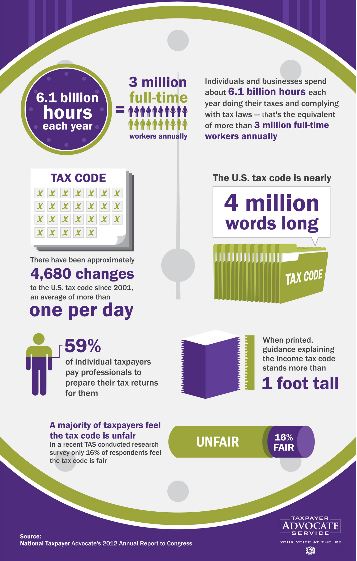
?? According to a TAS analysis of IRS data, individuals and businesses spend about 6.1 billion hours a year complying with the filing requirements of the Internal Revenue Code. And that figure does not include the millions of additional hours that taxpayers must spend when they are required to respond to IRS notices or audits.
?? If tax compliance were an industry, it would be one of the largest in the United States. To consume 6.1 billion hours, the “tax industry” requires the equivalent of more than three million full-time workers.
?? Compliance costs are huge both in absolute terms and relative to the amount of tax revenue collected. Based on Bureau of Labor Statistics data on the hourly cost of an employee, TAS estimates that the costs of complying with the individual and corporate income tax requirements for 2010 amounted to $168 billion — or a staggering 15 percent of aggregate income tax receipts. 
?? According to a tally compiled by a leading publisher of tax information, there have been approximately 4,680 changes to the tax code since 2001, an average of more than one a day.
?? The tax code has grown so long that it has become challenging even to figure out how long it is. A search of the Code conducted using the “word count” feature in Microsoft Word turned up nearly four million words.
?? Individual taxpayers find return preparation so overwhelming that about 59 percent now pay preparers to do it for them.12 Among unincorporated business taxpayers, the figure rises to about 71 percent.13 An additional 30 percent of individual taxpayers use tax software to help them prepare their returns,14 with leading software packages costing $50 or more. For 2007, IRS researchers estimated that the monetary compliance burden of the median individual taxpayer (as measured by income) was $258.
???????????????? ?Please click here to view the above in Chinese.?
IRS Beats the Drums – Re: Foreign Assets, Just Days Before April 15
The IRS is not letting up regarding USCs and LPRs living outside the U.S. Quite the opposite, the most recent announcement of the IRS released yesterday on April 11th, emphasizes the U.S. tax law requirements and their applicability to these individuals.
Specifically, the IRS reiterates as follows in IR-2014-52 – IRS Reminds Those with Foreign Assets of U.S. Tax Obligations:
- The Internal Revenue Service reminds U.S. citizens and resident aliens, including those with dual citizenship who have lived or worked abroad during all or part of 2013, that they may have a U.S. tax liability and a filing requirement in 2014.
- The filing deadline is Monday, June 16, 2014, for U.S. citizens and resident aliens living overseas, or serving in the military outside the U.S. on the regular due date of their tax return. Eligible taxpayers get one additional day because the normal June 15 extended due date falls on Sunday this year. To use this automatic two-month extension, taxpayers must attach a statement to their return explaining which of these two situations applies. See U.S. Citizens and Resident Aliens Abroad for details.
The April 11th date of the notice is ironic, since it is on the eve of the filing deadline for individuals who live within the U.S. Surely, the IRS wants to bring attention to these legal requirements days before the April 15th deadline for those residing in the U.S.
The irony is that the tax law does not require USCs or LPRs who live outside the U.S. and have U.S. tax filing obligations to file by April 15th. The deadline for these individuals who live outside the U.S. is not until June 15th as explained in the IRS notice (June 16th in 2014, since the 15th falls on a Sunday).
In this notice, the IRS does not emphasize the draconian penalties that befall these taxpayers for not filing international information returns or FBARs. The minimum civil penalties for failures to file these forms is almost always at least US$10,000. See, USCs and LPRs Living Outside the U.S. – Key Tax and BSA Forms.
Next, the due date for filing of FBARs is not the same as the due date for income tax returns, June 15th, but always falls on June 30th. There is no extension for FBARs, unlike income tax returns. See, Nuances of FBAR – Foreign Bank Account Report Filings – for USCs and LPRs living outside the U.S.
Will the IRS publish another notice, or beat more drums on the eve of the June 15th (16th for 2014) filing deadline for USCs and LPRs living outside the United States?
???????????????? ?Please click here to view the above in Chinese.?
Certifying Under Penalty of Perjury – Meeting the Requirements of Title 26 for Preceding 5 Taxable Years
The statutory language of Section 877(a)(2)(C) provides that the individual will be a “covered expatriate” if he or she ” . . . fails to certify under penalty of perjury that he has met the requirements of this title for the 5 preceding taxable years or fails to submit such evidence of such compliance as the Secretary may require.”
The reference to “this title” is to Title 26, which is commonly known as the “Internal Revenue Code” and covers all provisions of federal tax law and taxes, including income, estate, gift, excise, employment, alcohol and tobacco, etc. The complexity of the law is discussed below at the bottom of this post.
This provision is commonly forgotten by two groups of individuals.
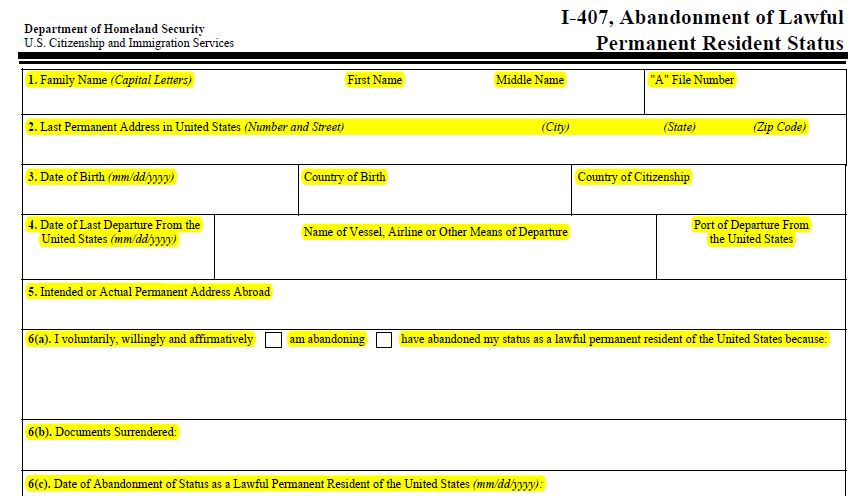
1. Lawful permanent residents (“LPRs”) who abandon their status formally by filing Form I-407 or 
by application of a U.S. income tax treaty and IRC Section 7701(b)(6). See, U.S. TAX TREATIES AND SECTION 6114: WHY A TAXPAYER’S FAILURE TO “TAKE” A TREATY POSITION DOES NOT DENY TREATY BENEFITS
2. U.S. Citizens (“USCs”) who renounce or relinquish their U.S. citizenship status; via the U.S. Department of State.

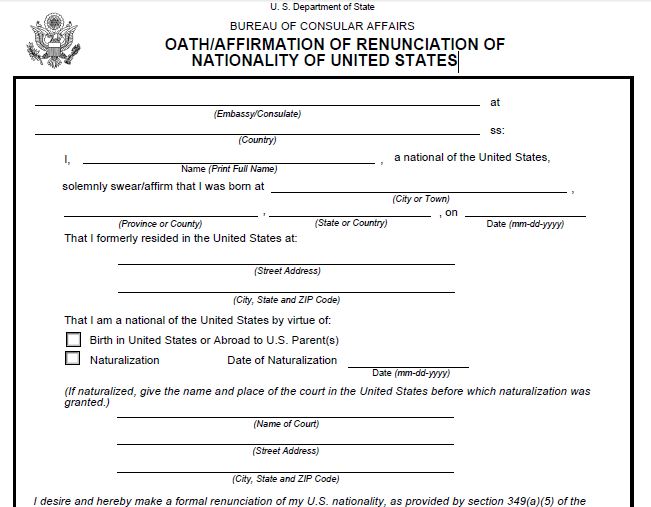
Filing Form DS-4080, Oath of Renunciation of the Nationality of the United States is a requirement for renunciation.
Under current law, both of these groups of individuals need to certify they have “met the requirements” of the tax law for the five preceding years. How can any taxpayer feel comfortable they have met the requirements of such a complex law?
What steps does an individual in one of the above categories need to take to help assure they have met this requirement? See, USCs and LPRs Living Outside the U.S. – Key Tax and BSA Forms for a basic overview of the foreign earned income law and forms, foreign tax credit law and forms and information reporting requirements under Title 26.
The Taxpayer Advocate Report identifies many of the complexities of this tax law, Title 26:
1. The Current Tax Code Imposes Huge Compliance Burdens on Individual
Taxpayers and Businesses.
Consider the following:
?? According to a TAS analysis of IRS data, individuals and businesses spend about 6.1 billion hours a year complying with the filing requirements of the Internal Revenue Code.7 And that figure does not include the millions of additional hours that taxpayers must spend when they are required to respond to IRS notices or audits.
?? If tax compliance were an industry, it would be one of the largest in the United States. To consume 6.1 billion hours, the “tax industry” requires the equivalent of more than three million full-time workers.8
?? Compliance costs are huge both in absolute terms and relative to the amount of tax revenue collected. Based on Bureau of Labor Statistics data on the hourly cost of an employee, TAS estimates that the costs of complying with the individual and corporate income tax requirements for 2010 amounted to $168 billion — or a staggering 15 percent of aggregate income tax receipts.9
?? According to a tally compiled by a leading publisher of tax information, there have been approximately 4,680 changes to the tax code since 2001, an average of more than one a day.10
?? The tax code has grown so long that it has become challenging even to figure out how long it is. A search of the Code conducted using the “word count” feature in Microsoft Word turned up nearly four million words.11
?? Individual taxpayers find return preparation so overwhelming that about 59 percent now pay preparers to do it for them.12 Among unincorporated business taxpayers, the figure rises to about 71 percent.13 An additional 30 percent of individual taxpayers use tax software to help them prepare their returns,14 with leading software packages costing $50 or more. For 2007, IRS researchers estimated that the monetary compliance burden of the median individual taxpayer (as measured by income) was $258.15
???????????????? ?Please click here to view the above in Chinese.?