FATCA Driven (Even More . . . ) – New IRS Forms W-8BEN versus W-8BEN-E versus W-9 (etc. etc.) for USCs and LPRs Overseas – It’s All About Information and More Information (Part III)
Information and more information is the mantra of revised IRS Forms as a result of FATCA. See, FATCA Driven – New IRS Forms W-8BEN versus W-8BEN-E versus W-9 (etc. etc.) for USCs and LPRs Overseas – It’s All About Information and More Information
U.S. citizens residing outside the U.S. along with lawful permanent residents (“LPRs”) are not the only persons who need to understand the IRS forms referenced above. Indeed, all entities and institutions, whether they are small privately held companies or large and traditional financial institutions are required to complete and have signed a range of IRS forms.
The forms can be either the actual IRS form, or a satisfactory substitute form. Many individuals are of the erroneous view that if they are not financial institutions, they do not need to concern themselves with these classifications.
Unfortunately, that is not the case. Also, these classification rules apply to the surprise of many, if there are (or are not) U.S. persons involved.
In addition to a basic understanding of U.S. laws, it is also crucial that the parties see if their country has entered into an IGA. For instance, if we examine the tiny little country of Liechtenstein which has a relatively large financial sector, it is necessary to first classify the type of entity.
All of this is necessary in order to properly determine which IRS form is to be required to be completed (e.g., IRS Form W-8BEN-E o W-8BEN o W-9 or W-8IMY or W-8EXP, etc.). In addition, each of these classifications will help determine how to complete such forms.
For instance, if it is a Liechtenstein Stiftung, it will probably (but not necessary) be a trust and not a corporation. See the IRS Memorandum from 2009 that provides that a Liechtenstein Stiftung will be classified as a trust, if its primary purpose is to protect or conserve the property transferred to the Stiftung for the Stiftung’s beneficiaries and is usually not established primarily for actively carrying on business activities.[1]
[1] See Memorandum Number: AM2009-012, dated October 16, 2009, issued by the Office of Chief Counsel, Internal Revenue Service.
Next, in this example, with a Liechtenstein Stiftung, the country of Liechtenstein has entered into an Intergovernmental Agreement (“IGA”).
Hence, the terms of the IGA are most important. Under the IGA, as is the case generally for FATCA, the entity has to be either an Foreign Financial Institution (“FFI” or “FI”) or a Non-Financial Foreign Entity (“NFFE”).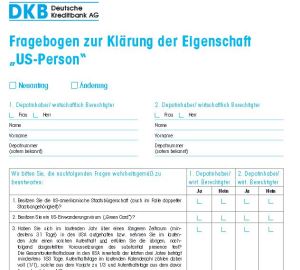
1) Definition of Financial Institution (“FI”)
A financial institution is any entity that:
- Accepts deposits in the ordinary course of a banking or similar business (“Depository Institution”);[1]
- Holds, as a substantial portion of its business financial assets for the benefit of one or more other persons (“Custodial Institution”);[2]
- Is an investment entity; or
- Is an specified insurance company or holding company that is a member of an expanded group;[3]
[1] See Article 1(i), IGA.
[2] See Article 1(h), IGA.
[3] See Article 1(k), IGA.
Generally a private Liechtenstein Stiftung would not satisfy any of these requirements (although it could conceivably be the case that one could be an “investment entity”). Hence, it would generally be an NFFE and not an FI.
NFFEs can be passive or active. The kind of compliance obligations varies depending on the type of NFFE (passive or active).
- Passive NFFEs
A passive NFFE is an NFFE which is not an active NFFE or a withholding foreign partnership or withholding foreign trust.[1]
There are several criteria under which a NFFE can be classified as an active NFFE. The following explain the most relevant criteria.
- Active NFFEs
Among the criteria that the IGA establishes, under which a NFFE can be considered as an Active NFFE, are the following:
1) If less than 50% of the NFFE’s gross income is passive income and less than 50% of the assets held by the NFFE are assets that produce or are held for the production of passive income during the preceding calendar year. A
2) Substantially all of the activities of the NFFE consist of holding (in whole or in part) the outstanding stock of, or providing financing and businesses other than the business of a Financial Institution.
Sometimes trusts or Stiftungs will also participate in or hold interests in companies, some of which may engage in active trades or businesses or simply hold passive investments. On the contrary, the companies/subsidiaries only hold other assets from which they derived passive income (e.g., dividends, interests, rents, royalties, etc.).[2]
This will determine if a Stiftung will be classified as a Passive NFFE or not under FATCA regulations and the IGA.
[1] It also can make a difference if the trust (or Stiftung in this example) is a so-called “withholding” foreign trust; which generally requires an agreement with the IRS.
[2] Treas. Reg. § 1.1472-1.
Not surprisingly, the above analysis is complex, because the rules are complex. Accordingly, it has been the author’s experience, that many institutions around the world which request one or more of the above IRS Forms have great difficulty in even implementing these rules. Most of their employees seem to have little understanding of what is a very complex area of law, even when their resident country has issued extensive regulations or guidance about how the terms of the IGA are to be implemented.
12 Year Old (and Older) U.S. Citizens Residing Outside the U.S. Must Have An “In-Person” Interview in a U.S. Embassy or Consulate for SSN Application in 1 of Just 17 Posts Worldwide
As previous posts have mentioned, U.S. citizens (USCs) residing overseas can only comply with U.S. tax law and FATCA certifications if they have a social security number (SSN). See, U.S. Citizens Overseas who Wish to Renounce without a Social Security Number will Necessarily be a “Covered Expatriate”
See key excerpts of the paper titled URGENT NEED FOR U.S. CITIZENS RESIDING OUTSIDE THE U.S. TO BE ABLE TO OBTAIN A TAXPAYER IDENTIFICATION NUMBER (“TIN”) OTHER THAN A SOCIAL SECURITY NUMBER that explains this dilemma:
This dilemma affects numerous USCs throughout the world, which is now compounded by the certification and reporting requirements of USCs and third parties, such as FFIs and NFFEs[2] under the Foreign Account Tax Compliance Act (“FATCA”).
* * *
The regulations provide the specific rule that all USCs must have a SSN[1] as their TIN. There are no general exceptions in the regulations to the requirement that a USC must have a SSN as their TIN.
This regulatory requirement specifically directs the USC to the forms that must be completed and filed with the SSA, in order to obtain a SSN, as follows:[2]
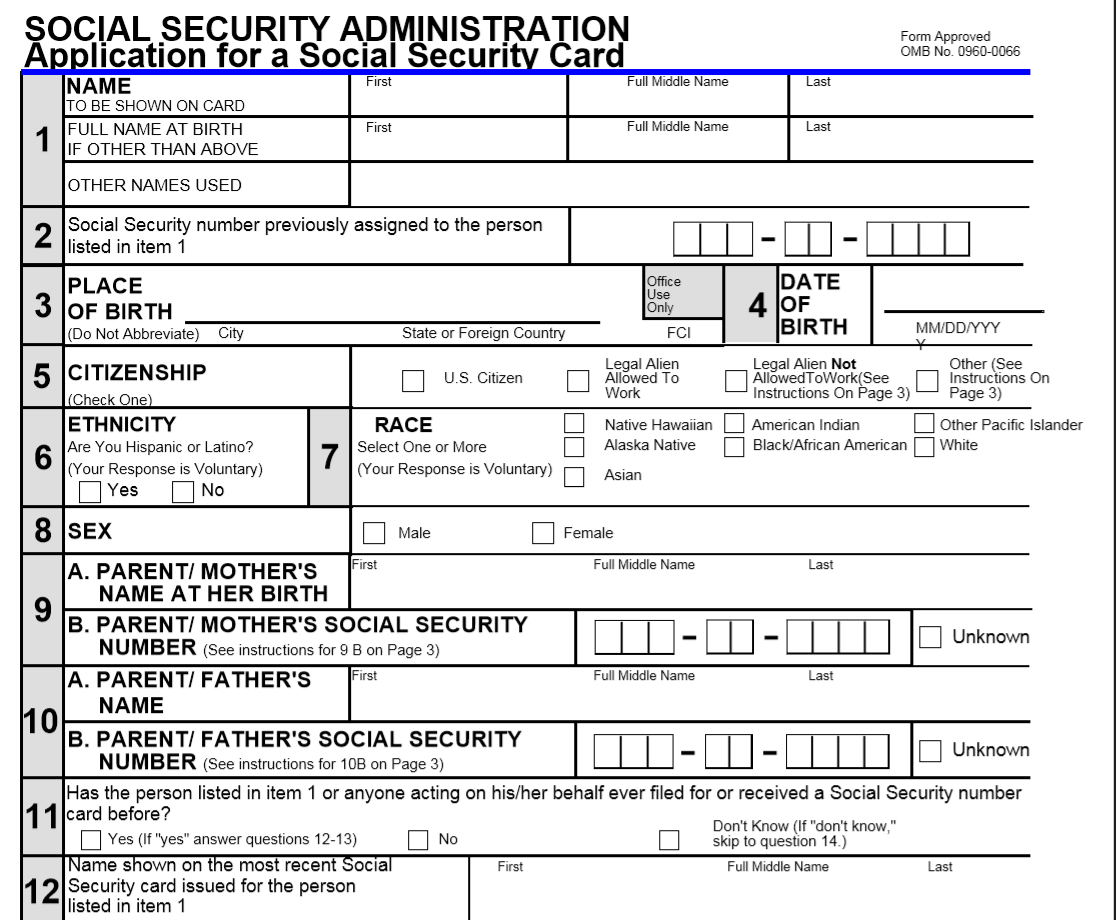
(1) Social security number. Any individual required to furnish a social security number pursuant to paragraph (b) of this section shall apply for one, if he has not done so previously, on Form SS-5, which may be obtained from any Social Security Administration or Internal Revenue Service office. He shall make such application far enough in advance of the first required use of such number to permit issuance of the number in time for compliance with such requirement. The form, together with any supplementary statement, shall be prepared and filed in accordance with the form, instructions, and regulations applicable thereto, and shall set forth fully and clearly the data therein called for. Individuals who are ineligible for or do not wish to participate in the benefits of the social security program shall nevertheless obtain a social security number if they are required to furnish such a number pursuant to paragraph (b) of this section. [emphasis added]
These Title 26 regulations discuss individuals requesting forms from “any Social Security Administration or Internal Revenue Service office” which clearly implies that the SSA and the IRS have offices overseas.
Unfortunately, this is not the case, as the IRS recently announced it is closing its full-time walk-in offices in London, Frankfurt and Paris, as the office in Beijing, China was closed in 2014.[3] Similarly, the SSA has no overseas offices, but does have limited field office operations in Canada, the British Virgin Islands and Samoa.[4]
Therefore, it is clear that the above regulations are speaking to individuals who reside and live in the U.S., and not USCs residing overseas when it requires USCs to “ . . . make such application far enough in advance of the first required use of such number to permit issuance of the number in time for compliance with such requirement. [5]
These Title 26 regulations require the application be made well in advance of any tax filing requirements are not realistic for USCs residing overseas as is explained herein. This author has seen the issuance of SSNs take more than 6 months, even when the USC could have an interview in their country of residence.
More importantly, there are very few countries (only 17) where in-person interviews can even be held. See, discussion below.
USCs who have lived most, if not all of their lives outside the U.S., commonly do not have a SSN. The procedural requirements imposed by the SSA to obtain a SSN in these cases are complicated and unrealistic for USCs living overseas.[6] This author has seen cases where USCs residing overseas have even spent the money and resources and time to travel to the U.S. to apply for a SSN, yet were turned away by the SSA, due to various procedural requirements which were not satisfied.
Often times obtaining a SSN overseas is nearly impossible, depending upon which country and where within that country the USC resides.
A. Obtaining a SSN Outside the US by a USC – Much More than Just Filing SSA Form SS-5
The SSA does not have offices outside the U.S. although they have a so-called “Office of International Operations.”[7] The focus of OIO is the administration of social security benefits, not obtaining SSNs for USCs residing overseas. Since the SSA is assisted by the U.S. Department of State (who are not SSN experts), USCs have to rely upon various U.S. embassies and consulate offices around the world, as they try to obtain a SSN.
B. Tax Return Filing Requirements – Minimum Gross Income
Any USC individual is obligated under the U.S. federal tax law to file a federal income tax return IRS Form 1040 if they meet minimum thresholds of income. For the tax year 2015, the thresholds are low, and are reached once the gross income is at least the sum of (i) the “exemption” amount (currently $4,000) and (ii) the “standard deduction” amount (currently $6,300 for single and married filing jointly and $12,600 for married couples filing jointly).[8]
This is true, even if all of the income is earned income and eligible for the foreign earned income exclusion, which is $100,800 for the tax year 2015. [9]
Additionally, USCs living overseas necessarily have a U.S. tax return filing requirement, when they meet these low thresholds of gross income. In these cases, tax returns that are not filed by the 15th of June are not considered timely filed.[10]
II. The Social Security Administration Rules Make it Nearly Impossible for Many USCs Overseas to Reasonably Obtain a SSN
The policy and procedures of the SSA regarding issuing SSNs have changed significantly over the years.[11] The Social Security Administration (SSA) provides a detailed chronology of the major changes in policy and procedures regarding filing for and obtaining a SSN.[12] One of the most significant revisions in the last decade came from The Intelligence Reform and Terrorism Prevention Act of 2004 (P.L. 108-458), which imposes various standards for the verification of documents or records submitted by an individual.
A. Only a Few Countries Around the World have Personnel at U.S. Embassies or Consulate Offices that Can Process SSN Applications – SSA Form SS-5-FS
Applying for SSNs overseas is severely restricted compared to an application in the U.S.
According to the U.S. Department of State, Foreign Affairs Manual (“FAM”), only certain “Claims-Taking Posts” in specific countries “may” include “processing applications for Social Security Numbers.” [13]
These 17 countries (and a city in the case of Jerusalem) with Claims-Taking Posts include:
“Austria, Argentina, Costa Rica, Dominican Republic, France, Germany, Greece, Ireland, Italy, Japan, Jerusalem, Mexico, Norway, Philippines, Poland, Portugal, Spain, and the United Kingdom.”
Noticeably absent are many Western European countries, virtually all of Latin America, virtually all of Asia, virtually all of Eastern Europe, all of the Middle East (except Jerusalem), all of the African continent, all of the Australian continent and surrounding island countries and Russia, among many other significant countries, including OECD member countries.[14]
Nothing in the FAM requires any of these “Claims-Taking Posts” to actually process applications for a SSN. Plus, there are of course hundreds of other countries throughout the world, not listed above, which do not have such a U.S. Department of State Post. For these reasons, USCs in countries such as China must travel to a U.S. Department of State Post (e.g., the Philippines) which is able to process applications for SSNs.
B. In Person Interview Required for Individuals Older than 11 Years Old
Individuals who are older than 11 years old must personally go to the U.S. Embassy or Consulate with a Claims-Taking Post. See 7 FAM 530, pages 7, 12, 13 and 7 FAM EXHIBIT 530(D) Mandatory In-Person Interview Worksheet SSN Applicant Age 12 or Older – Original SSN * * *
All of these rules makes you wonder whether foreign born individuals, such as actress Kim Cattrall from Sex & the City fame would have ever obtained a social security number overseas while she lived in Canada or the UK.
[1] See, Treas. Reg. § 301.6109-1(a)(1)(ii)(A).
[2] See, Treas. Reg. § 301.6109-1(d)(1).
[3] See, Bloomberg article, 14 January 2015 by Kocieniewski, IRS Will Shut Last Overseas Taxpayer-Assistance Centers: “After budget reductions over the last four consecutive years, the IRS is forced to make tough choices during this period of fiscal austerity and these closures have relatively little impact on taxpayers and treaty partners,” said Julianne Breitbeil, an IRS spokeswoman. Also, see IRS website that still reflects the London and Paris offices as open http://www.irs.gov/uac/Contact-My-Local-Office-Internationally.
[4] See, SSA website, Service Around the World, http://www.ssa.gov/foreign/
[5] See, Treas. Reg. § 301.6109-1(d)(1).
[6] See discussion below, regarding requirements to obtain a SSN. I.II, I.I,The Social Security Administration Rules Make it Nearly Impossible for Many USCs Overseas to Reasonably Obtain a SSN
[7] See SSA website, “Office of International Operations” – http://www.ssa.gov/foreign/ “Service Around the World – Welcome to SSA’s Office of International Operations (OIO) home page. The purpose of this site is to assist Social Security customers who are outside the U.S. or planning to leave the U.S. OIO is responsible for administering the Social Security program outside the U.S. and for the implementation of the benefit provisions of international agreements. Since SSA has no offices outside the U.S., OIO is assisted by the Department of State’s embassies and consulates throughout the world.”
[8] See, IR-2014-104, Oct. 30, 2014 and IRS Publication 501.
[9] See, IRC § 911 and IRS Publication 54.
[10] See, Treas. Reg. § 1.6081-5.
[11] See, SSA website, The Story of the Social Security Number, by Carolyn Puckett, Social Security Bulletin, Vol. 69 NO. 2, 2009 (http://ssa.gov/policy/docs/ssb/v69n2/v69n2p55.html.
[12] See, SSA website, Significant Milestones in Social Security Number Policy. A detailed chronology of the major changes in policy and procedures. http://www.ssa.gov/history/ssn/ssnchron.html.
[13] See 7 FAM 530, page 2 of 64.
[14] In contrast to these 17 countries (and one city – Jerusalem) where a USC residing overseas must travel to apply for a SSN, the Treasury Department has announced it has around 100 countries that have signed, or “have reached agreements in substance” a FATCA IGA. USCs throughout the world are required by the Foreign Account Tax Compliance Act (“FACTA”) to provide their U.S. TIN to financial institutions throughout the world (on IRS Form W-9, or its equivalent), which under current law necessarily must be a SSN. Of course, if they have no SSN, they cannot sign IRS Form W-9 which provides in Part II: “Under penalties of perjury, I certify that: 1. The number shown on this form is my correct taxpayer identification number . . .”
[15] See, 7 FAM 534.3 e.
U.S. Citizens Overseas who Wish to Renounce without a Social Security Number will Necessarily be a “Covered Expatriate”
U.S. Citizens Overseas who Wish to Renounce without a Social Security Number (“SSN”) will Necessarily be a “Covered Expatriate”
- The Dilemma of SSNs, TINs and USCs Residing Overseas
The prior post discussed some of the complications of United States Citizens (“USCs”) who reside outside the U.S. and do not have a social security number (“SSN”) . This dilemma exists, even though USCs are not generally required to file for or  obtain a SSN (e.g., at birth – See, SSA Publication – “Social Security Numbers For Children” page 2, It is not obligatory to file for a SSN at birth. “Must my child have a Social Security number? No. Getting a Social Security number for your newborn is voluntary. But, it is a good idea to get a number when your child is born. . . . ).
Indeed, it is the U.S. federal tax law that requires the USC must have a SSN for their taxpayer identification number (“TIN”). I will reference various excerpts from a recent paper I drafted and presented titled URGENT NEED FOR U.S. CITIZENS RESIDING OUTSIDE THE U.S. TO BE ABLE TO OBTAIN A TAXPAYER IDENTIFICATION NUMBER (“TIN”) OTHER THAN A SOCIAL SECURITY NUMBER , including the following:
. . . the IRS’ increased focus on international tax compliance has made clear that USCs residing overseas have U.S. tax return filing obligations, even if they have no assets, no income, or no real personal connections in or with the U.S. See IRS notice from 2011 which addresses numerous aspects of tax compliance for USCs overseas, including various penalties under the law[1]:
. . . U.S. Citizens or Dual Citizens Residing Outside the U.S. . . .
The IRS is aware that some taxpayers who are dual citizens of the United States and a foreign country may have failed to timely file United States federal income tax returns or Reports of Foreign Bank and Financial Accounts (FBARs), despite being required to do so. . . . 2. Penalties imposed for failure to file income tax returns or to pay tax . . . 3. Possible additional penalties that may apply in particular cases . . . 6. Possible penalties for failure to file FBAR . . . 7. New reporting requirement for foreign financial assets . . . [emphases added]
USCs residing overseas are subject to the range of tax penalties that apply to all individual taxpayers (e.g., negligence penalties, failure to file penalties, late payment or failure to pay penalties, etc.).[2] Additionally, USCs residing overseas are subject to other, typically much harsher penalties for not timely filing U.S. federal information returns regarding assets located outside the U.S.[3]; alluded to above in the IRS 2011 notice.[4]
These civil penalties typically are a minimum of US$10,000 per statutory violation. USCs who live outside the U.S. necessarily have assets, such as financial accounts in their country of residence. These Title 26 information reporting requirements[5] are referred to herein as “International Information Returns.”
The IRS will not process federal tax returns and International Information Returns without a valid TIN.[6] Plus, the law does not provide for an exception for USCs overseas who do not file returns, if they do not have a SSN. Late filed, or incomplete International Information Returns and tax returns (e.g., lacking a SSN) will typically subject USCs to these penalties even in those cases when the taxpayer has no federal income tax liability.[7]
[1] See, IRS FS-2011-13, December 2011, updated February, 2014.
[2] See, IRS FS-2011-13 and as a sample of some of the many statutory penalties that could typically apply, IRC §§ 6048, 6652(f), 6677, 6654, 6655, 6698, 6699, 6166, 6653, 6675, 6715, 6715A, 6717, 6718, 6719, 6720A, 6725, et. seq.
[3] See, IRC §§ 6038, 6038B, 6038D, 6039F, 6039G, 6046, 6046A, 6048, et. seq.
[4] See, IRS FS-2011-13, December 2011, updated February, 2014.
[5] See, IRC §§ 6038, 6038B, 6038D, 6039F, 6039G, 6046, 6046A, 6048, et. seq.
[6] See, IRS website, “General ITIN Information” – http://www.irs.gov/Individuals/General-ITIN-Information – “IRS no longer accepts, and will not process, forms showing “SSA”, 205c”, “applied for”, “NRA”,& blanks, etc.”
[7] See, IRC §§ 911 (foreign earned income exclusion) and 901 (foreign tax credit), et. seq. A USC residing overseas may have no actual federal income tax liability (for various reasons), typically due to the foreign earned income exclusion and/or foreign tax credit calculation.
The above explains fairly clearly the dilemma facing USCs residing overseas.
The complexity of getting a SSN and the requirements are covered in more detail in the paper. Some key points are:
I. The Social Security Administration Rules Make it Nearly Impossible for Many USCs Overseas to Reasonably Obtain a SSN
The policy and procedures of the SSA regarding issuing SSNs have changed significantly over the years.[1] The Social Security Administration (SSA) provides a detailed chronology of the major changes in policy and procedures  regarding filing for and obtaining a SSN.[2] One of the most significant revisions in the last decade came from The Intelligence Reform and Terrorism Prevention Act of 2004 (P.L. 108-458), which imposes various standards for the verification of documents or records submitted by an individual.
A. Only a Few Countries Around the World have Personnel at U.S. Embassies or Consulate Offices that Can Process SSN Applications – SSA Form SS-5-FS
Applying for SSNs overseas is severely restricted compared to an application in the U.S.
According to the U.S. Department of State, Foreign Affairs Manual (“FAM”), only certain “Claims-Taking Posts” in specific countries “may” include “processing applications for Social Security Numbers.” [3]
These 17 countries (and a city in the case of Jerusalem) with Claims-Taking Posts include:
“Austria, Argentina, Costa Rica, Dominican Republic, France, Germany, Greece, Ireland, Italy, Japan, Jerusalem, Mexico, Norway, Philippines, Poland, Portugal, Spain, and the United Kingdom.”
Noticeably absent are many Western European countries, virtually all of Latin America, virtually all of Asia, virtually all of Eastern Europe, all of the Middle East (except Jerusalem), all of the African continent, all of the Australian continent and surrounding island countries and Russia, among many other significant countries, including OECD member countries.[4]
Nothing in the FAM requires any of these “Claims-Taking Posts” to actually process applications for a SSN. Plus, there are of course hundreds of other countries throughout the world, not listed above, which do not have such a U.S. Department of State Post. For these reasons, USCs in countries such as China must travel to a U.S. Department of State Post (e.g., the Philippines) which is able to process applications for SSNs.
[1] See, SSA website, The Story of the Social Security Number, by Carolyn Puckett, Social Security Bulletin, Vol. 69 NO. 2, 2009 (http://ssa.gov/policy/docs/ssb/v69n2/v69n2p55.html.
[2] See, SSA website, Significant Milestones in Social Security Number Policy. A detailed chronology of the major changes in policy and procedures. http://www.ssa.gov/history/ssn/ssnchron.html.
[3] See 7 FAM 530, page 2 of 64.
[4] In contrast to these 17 countries (and one city – Jerusalem) where a USC residing overseas must travel to apply for a SSN, the Treasury Department has announced it has around 100 countries that have signed, or “have reached agreements in substance” a FATCA IGA. USCs throughout the world are required by the Foreign Account Tax Compliance Act (“FACTA”) to provide their U.S. TIN to financial institutions throughout the world (on IRS Form W-9, or its equivalent), which under current law necessarily must be a SSN. Of course, if they have no SSN, they cannot sign IRS Form W-9 which provides in Part II: “Under penalties of perjury, I certify that: 1. The number shown on this form is my correct taxpayer identification number . . .”
- The Necessary “Covered Expatriate Status” of a USC without a SSN
The core point of this post, with the above SSN background, is to explain how a USC without a SSN will necessarily be a “covered expatriate” since they will not be able to truthfully certify they have complied with the federal tax laws (title 26). See, Certification Requirement of Section 877(a)(2)(C) – (5 Years of Tax Compliance) and Important Timing Considerations per the Statute
As other posts have explained, “covered expatriate” status matters:
See, Why “covered expat” (“covered expatriate”) status matters, even if you have no assets! The “Forever Taint”! (20 May 2014) and The “Hidden Tax” of Expatriation – Section 2801 and its “Forever Taint.” (10 April 2014) and “Covered Expatriate” Status is a “Scarlet Letter” (10 Nov 2014).
If a USC has no SSN, they by definition will never be able to comply with the Certification Requirement of Section 877(a)(2)(C) since they will not be able to comply with IRC § 6109(a) and Treas. Reg. § 301.6109-1. As the SSN/TIN paper explains:
All United States citizens (“USCs”) must have a social security number (“SSN”) under current law as their TIN to file a federal income tax return.[1]
[1] See, IRC § 6109(a) and Treas. Reg. § 301.6109-1.
The IRS will not process federal tax returns and “International Information Returns”, as defined below, without a valid TIN[1]; which currently must be a SSN for a USC.
[1] See, IRS website, – http://www.irs.gov/Individuals/General-ITIN-Information – “IRS no longer accepts, and will not process, forms showing “SSA”, 205c”, “applied for”, “NRA”,& blanks, etc.”
Is “It’s Almost Impossible for Me to Get a U.S. Taxpayer Identification Number”; a Defense to Not Filing U.S. Tax Returns?
The U.S. federal government has made the basic task of getting taxpayer identification numbers (“TINs”) very difficult for many individuals. Without a TIN, an individual cannot file tax returns or information reporting returns.
- U.S. Citizens and SSNs – No Exceptions

U.S. citizens (USCs) residing overseas without a social security number (“SSN”) must use a SSN for their TIN. I presented a recent report to various government officials, including the international tax counsel at the U.S. Treasury Department and the Joint Committee of Taxation, among other groups. Some key excerpts of that paper titled URGENT NEED FOR U.S. CITIZENS RESIDING OUTSIDE THE U.S. TO BE ABLE TO OBTAIN A TAXPAYER IDENTIFICATION NUMBER (“TIN”) OTHER THAN A SOCIAL SECURITY NUMBER are set out below in this section:
The U.S. tax law imposing taxation on the worldwide income of USCs[1] residing overseas has created a dilemma that prejudices these USCs without a SSN. This strict SSN/TIN regulatory rule undermines the basic tax administration system and discourages tax compliance for those USCs who never obtained a SSN. This dilemma affects numerous USCs throughout the world, which is now compounded by the certification and reporting requirements of USCs and third parties, such as FFIs and NFFEs[2] under the Foreign Account Tax Compliance Act (“FATCA”).
This dilemma is a creature of the Title 26 regulatory law going back to 1974[3] and how the Social Security Administration (“SSA”) imposes strict requirements on the issuance of SSNs to residents overseas.[4] One essential step is that the USC overseas must have an in-person interview, with a designated individual (who are typically U.S. Department of State employees and some designated military personnel). They are located in only a few cities around the world.[5] Some USCs need to travel thousands of miles to merely be able to apply for and obtain a SSN.
[1] See, IRC § 61 and Treas. Reg. §§ 1.1?1(b) and 1.1?1(a)(1).
[2] See, IRC §§ 1471 et. seq. and the regulations thereunder which define “foreign financial institutions” (“FFIs”) and “non-financial foreign entity” (“NFFEs”).
[3] See, Treas. Reg. § 301.6109-1(a)(1)(ii)(A).
[4] See, 7 FAM 534.3 Applications for a Social Security Number (Form SS-5-FS).
[5] Id, page 7 FAM 534.3 Applications for a Social Security Number (Form SS-5-FS).
Further posts will discuss a number of the adverse consequences imposed on USCs who do not have a SSN and the severe penalty regime that exists under current law for those unwitting individuals.
- Non-U.S. Citizens and ITINs –
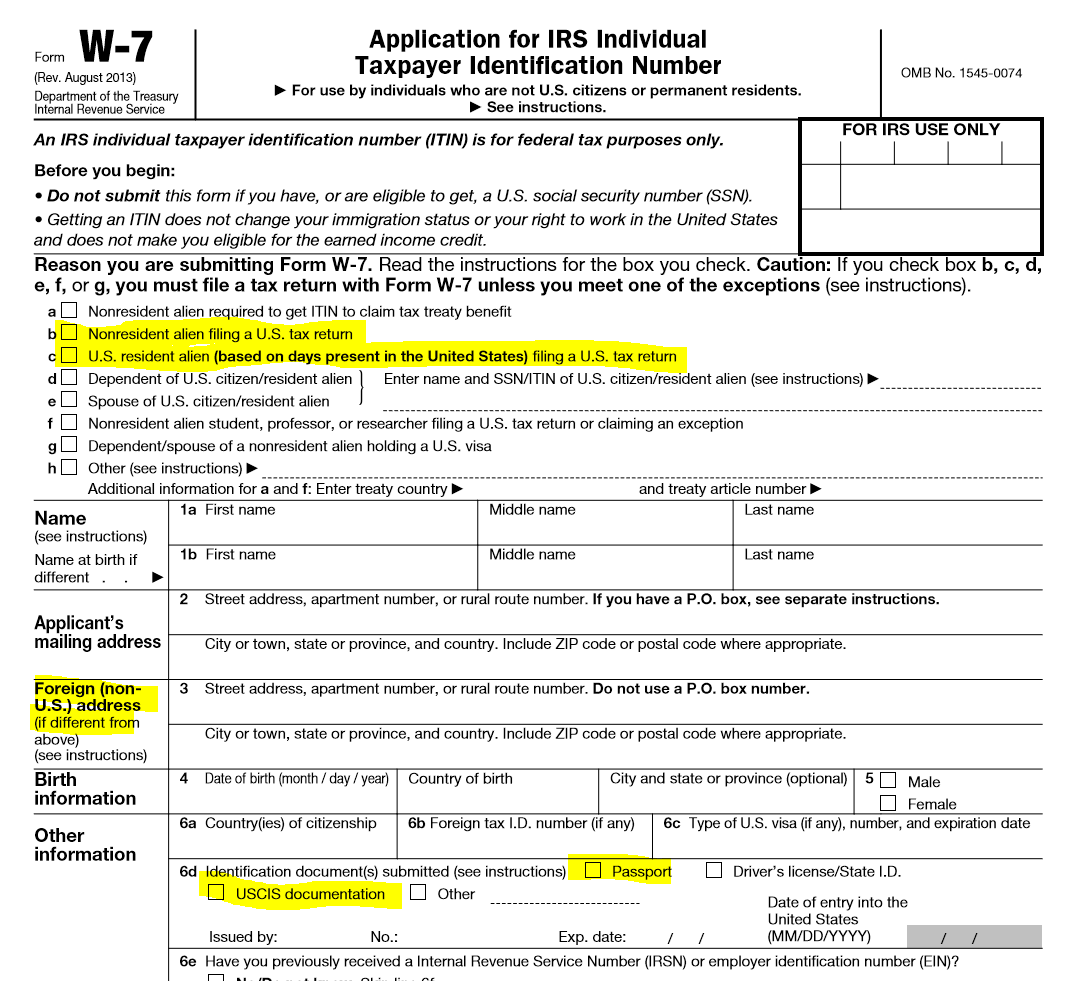
Many individuals who are not USCs nevertheless need to file a tax return and must obtain what is called an individual taxpayer identification number (“ITIN”). See IRS report Obtaining an ITIN from Abroad. An ITIN is applied for by filing an IRS  Form W-7, and providing various original documents, principally a passport, directly to the IRS. The process is complex and time consuming. Indeed, the Taxpayer Advocate report included a key summary explanation of the problems associated with obtaining ITINs as follows:
- IRS ITIN Policy Changes Make Return Filing Difficult and Frustrating
Recent changes to the IRS’s Individual Taxpayer Identification Number (ITIN) application program are burdening taxpayers and may harm voluntary compliance.
ITINs play an important role in tax administration, as any individual who has a federal tax filing obligation but is not eligible for a Social Security number must apply to the IRS for an ITIN and then use the ITIN on any return, statement, or other document which requires a taxpayer identifying number
Under the new procedures, most applicants must now submit original documentation by mail or travel to Taxpayer Assistance Centers (TACs) to have documents certified, making the application process more difficult
Since December 17, 2003, the IRS has required ITIN applicants with a filing requirement to attach a valid federal tax return with their application (unless they qualify for an exception).
On June 22, 2012, the IRS implemented temporary changes that required all ITIN applicants to submit original documents supporting the information on their applications. Under these procedures, applicants could no longer submit notarized copies and had to send in original documentation, even if a certified acceptance agent (CAA) reviewed and certified the documentation.
On November 29, 2012, the IRS announced revised procedures for the 2013 filing season that require applicants to submit original documentation or copies certified by the issuing agency.
Although the IRS allows CAAs to submit copies of documentation for primary and secondary taxpayers after reviewing original documentation or certified copies, CAAs must still send in original documentation for all dependent applicants.
A limited number of TACs can certify documents for primary, secondary, and dependent taxpayers.
The Revised Procedures Create an Impediment for Taxpayers Required to File Returns.
The recent changes to the ITIN program have made it difficult for taxpayers to file returns.
More on ITINs to follow in later posts.
The complexities of obtaining a U.S. TIN begs the question: “Is it a legal defense for a taxpayer to NOT file U.S. tax returns, international information returns, if it is particularly difficult (or nearly impossible in some cases) for that individual to even obtain a TIN?”
Will such a taxpayer have a “reasonable cause” defense to avoid penalties in the case of an audit? These are questions unanswered by any case law to date.
USCs throughout the world are required by FATCA to provide their U.S. TIN to financial institutions throughout the world (on IRS Form W-9, or its equivalent), which under current law necessarily must be a SSN. Of course, if they have no SSN, they cannot sign IRS Form W-9 which provides in Part II: “Under penalties of perjury, I certify that: 1. The number shown on this form is my correct taxpayer identification number . . . “
As FATCA requires overseas individuals, including USCs to certify under penalty of perjury their U.S. taxpayer identification number (and if they have none), they necessarily will not be able to comply with this basic reporting requirement.
Will these individuals have a defense under the law for not complying under these circumstances?
Will the government provide relief for these individuals?
More on FATCA Driven IRS Forms, specifically including IRS Form W-8BEN-E ~ It’s All About Information and More Information
The lives of United States Citizens and Lawful Permanent Residents living outside the U.S. has necessarily become more complicated due to FATCA. 
Previous posts discussed unintended consequences of FATCA. See, Part 2 – Unintended Consequences of FATCA – for USCs and LPRs Living Outside the U.S.
Also, see, Part 1- Unintended Consequences of FATCA – for USCs and LPRs Living Outside the U.S.
– One of the most significant unintended consequence, is that the U.S. federal government (the IRS, the Treasury Department, or  Congress) never initially even contemplated USCs and LPRs living overseas. In other words, the group targeted were U.S. resident individuals who were evading taxes through foreign financial institutions. I say this, based upon extensive conversations I have had with ex-government officials and some government officials who were involved in the original policy discussions.
Also, see FATCA Driven – New IRS Forms W-8BEN versus W-8BEN-E versus W-9 (etc. etc.) for USCs and LPRs Overseas – It’s All About Information and More Information*
Currently, the IRS has revised or created the following new tax forms as a result of FATCA (all in  the English language), which can be located at the IRS website at FATCA – Current Alerts and Other News:
Importantly, none of these forms are in other key languages such as Spanish, French, Mandarin, Cantonese, Portuguese, etc. Imagine the daunting nature of completing these complex forms just in English when English is your first language, let alone completing them when you speak little to no English.
As the financial and account information of U.S. citizens and LPRs at financial institutions worldwide is now being collected to be reported in 2015 to the IRS under FATCA, a better understanding of FATCA forms is required. A follow-up post will specifically discuss how financial and account information of non-U.S. shareholders and owners of foreign corporations, companies and foreign trusts will also 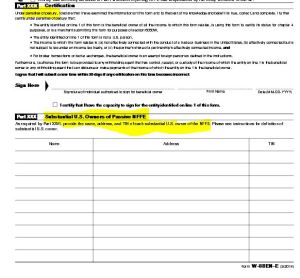 indirectly be reported to the IRS, when there is a “substantial U.S. owner.”
A detailed discussion of how and when this information will be released to the IRS will be explained in a follow-up discussion of a passive “non-financial foreign entity” (“NFFE”) which will typically be a foreign corporation (non-U.S.), companies and foreign trusts.
This information is set forth and requested in Parts XXX and XXIX on the last page of IRS Form W-8BEN-E on page 8. These items are highlighted here in yellow reflecting the information requested.
A follow-up post will explain what is a “passive” NFFE and what information is required to be reported per the form. For a better understanding of the importance of signing a document “under penalty of perjury” see Certifying Under Penalty of Perjury – Meeting the Requirements of Title 26 for Preceding 5 Taxable Years.
Part 3 – Unintended Consequences of FATCA: Will Taxpayer (Individual’s) Personal Financial Data at IRS get “Snowdened”?
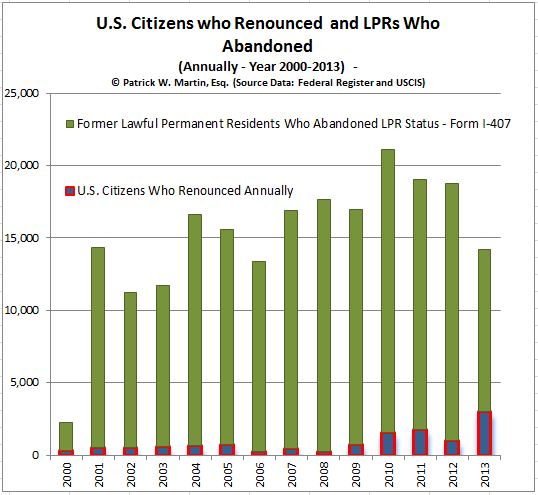
Prior posts discussed unintended consequences of FATCA, including devaluing the U.S. citizenship to some with a resulting surge in U.S. citizenship renunciations. See, Part 2 – Unintended Consequences of FATCA – for USCs and LPRs Living Outside the U.S.
Under FATCA, countries will be collecting and then delivering massive amounts of taxpayer data to and from government agencies. Will governments use private contractors to manage and move this information (as did the NSA with Mr. Snowden)? The type of information that will be provided under FATCA is extensive, including names, financial account numbers, bank account names, taxpayer identification numbers (e.g., social security numbers, etc.), income earned from account assets, etc.
See, FATCA Driven – New IRS Forms W-8BEN versus W-8BEN-E versus W-9 (etc. etc.) for USCs and LPRs Overseas – It’s All About Information and More Information*
The Washington Post, 14 August 2014, in an article titled IRS handed taxpayer information to contractors without background checks focused on the recently released report of the Treasury Department oversight agency (The Treasury Inspector General for Tax Administration). In that news account, the article stated that the ” . . . that the IRS handed over a disc containing sensitive data on about 1.4 million taxpayers to a printing firm without any of the company’s employees being subjected to screenings. . . ”
The full TIGTA report from 7 July 2014 can be reviewed here and is titled, Some Contractor Personnel Without Background Investigations Had Access to Taxpayer Data and Other Sensitive Information
As more and more information is made available, and as it goes through more and more hands via FATCA channels, there is bound to be significant leaks and stolen personal financial information of individuals around the world.
Part 1- Unintended Consequences of FATCA – for USCs and LPRs Living Outside the U.S.
As the Foreign Account Tax Compliance Act (“FATCA”) has gone into effect (1 January 2014), there are an increasing number of consequences to United States citizens (USCs) and lawful permanent residents (LPRs) residing overseas.
There are many intended consequences of the FATCA law, such as the following:
- Identifying non-U.S. financial, investment and company assets of USCs and LPRs;
- Identifying the foreign financial institution (“FFI”) where such assets are located;
- Identifying non-financial foreign entities (“NFFE”) owned by the USC or LPR;
- Generally bringing transparency to the assets, accounts and information of worldwide assets of USCs and LPRs.
See, FATCA Driven – New IRS Forms W-8BEN versus W-8BEN-E versus W-9 (etc. etc.) for USCs and LPRs Overseas – It’s All About Information and More Information
Ironically, I see a number of unintended consequences of FATCA; meaning consequences that were never contemplated by the U.S. Congress or the President when the laws were passed. Nor were they intended consequences of the U.S. Treasury Department as the FATCA Intergovernmental Agreements (“IGA) were negotiated throughout the world with various countries. See, Complete List of IGA Countries to Date (Very Few Notable Absences)
This and other follow on posts will discuss these unintended consequences.
One of the most significant unintended consequence, is that the U.S. federal government (the IRS, the Treasury Department, or 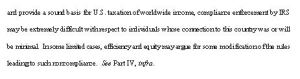 Congress) never initially even contemplated USCs and LPRs living overseas. In other words, the group targeted were U.S. resident individuals who were evading taxes through foreign financial institutions. I say this, based upon extensive conversations I have had with ex-government officials and some government officials who were involved in the original policy discussions.
The focus then was on U.S. resident taxpayers; even though the U.S. imposes U.S. income taxes on the worldwide income of USCs living anywhere in the world. See, “Tax Simplification: The Need for Consistent Tax Treatment of All Individuals (Citizens, Lawful Permanent Residents and Non-Citizens Regardless of Immigration Status) Residing Overseas, Including the Repeal of U.S. Citizenship Based Taxation,” by Patrick W. Martin and Professor Reuven Avi-Yonah, 2013.
In practice, the U.S. federal government has known for many years that it can be nearly impossible to collect a tax liability against USCs who live and have their assets outside of the U.S. Specifically, the Treasury Department noted back in 1998 that . . .
- Other factors also operate to limit both compliance measurement and improvement. Because the United States asserts taxing jurisdiction over those with little or no connection to the United States other than citizenship or status as a lawful permanent resident, in many cases overseas U.S. taxpayers are difficult to trace or contact. Moreover, even when valid tax assessments can be made against overseas taxpayers, IRS has limited enforcement recourse if the taxpayer’s assets are physically located outside of the United States.
See pages 13-15 of the Treasury report which can be found at the post, Sometimes Old is as Good as New – 1998 Treasury Department Report on Citizens and LPRs
Also, the original offshore voluntary disclosure initiative in 2009 never even contemplated any particular treatment for USCs or LPRs residing overseas. I submit, the USC and LPR living overseas was not even on the “radar” of the IRS at the time the first program was created. It was not until 2011, that a new category was created that imposed a 5% penalty for persons residing overseas, but who also had only US$10,000 of U.S. sourse income.
As time has gone on, the IRS has realized that numerous USCs and LPRs indeed live somewhere other than the U.S. (millions of them) and yet again modified the 2014 OVDP to provide for a “0%” penalty in certain circumstances for these individuals.
When FATCA was originally passed in 2010, USCs and LPRs living overseas was not the focus (and barely a thought). The heavy  compliance focus as of late was an unintended consequence.
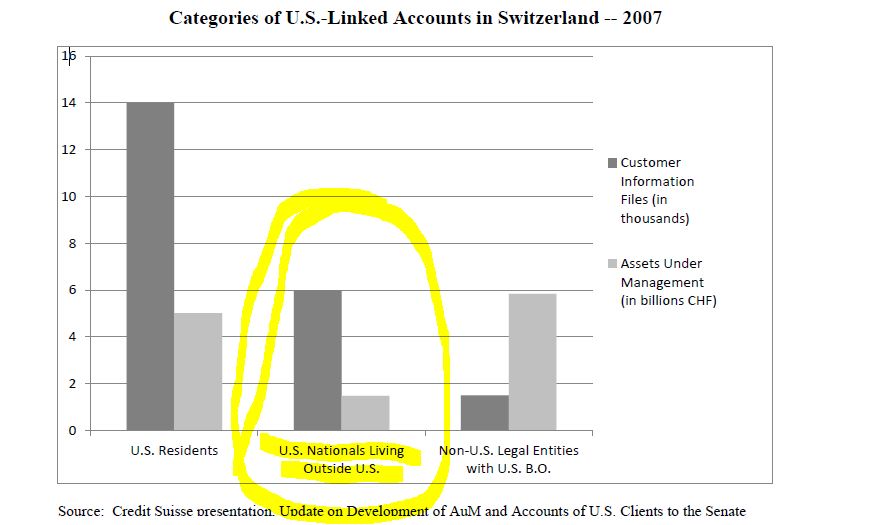
Now even the Senate has started to focus on USCs living overseas. The Senate Permanent Subcommittee on Investigations focused extensively on Swiss accounts opened by USCs living overseas. The full report can be read REPORT: Offshore Tax Evasion:The Effort to Collect Unpaid Taxes on Billions in Hidden Offshore Accounts (February 26, 2014) –
In those reports, the Senate Permanent Subcommittee on Investigations focused extensively on USC owned Swiss accounts opened by USCs living outside the U.S. See, Key Take Aways from Senate Investigations re: Foreign Banks and “Offshore Tax Evasion”: U.S. Citizens Residing Overseas have Become a Focus of the Government.;
Read the Q&A format here.
Samples of International Tax Frauds that are Flourishing Now with More Taxpayer Financial Information Required Under the Law
This post is a follow-on to the post of yesterday explaining the explosion of tax frauds that are flourishing requesting bank and financial account information. The law indeed requires U.S. citizens living abroad (and some LPRs living outside the U.S.) to report and file various detailed personal and bank information as follows:
- passport numbers,
- bank account names
- bank account addresses,
- bank and financial account information,
- highest balance in these bank accounts,
- full name of individual,
- taxpayer identification numbers of the individuals,
- along with extensive personal and financial information.
See, International Tax Frauds are Flourishing Now with More Taxpayer Financial Information Required Under the Law
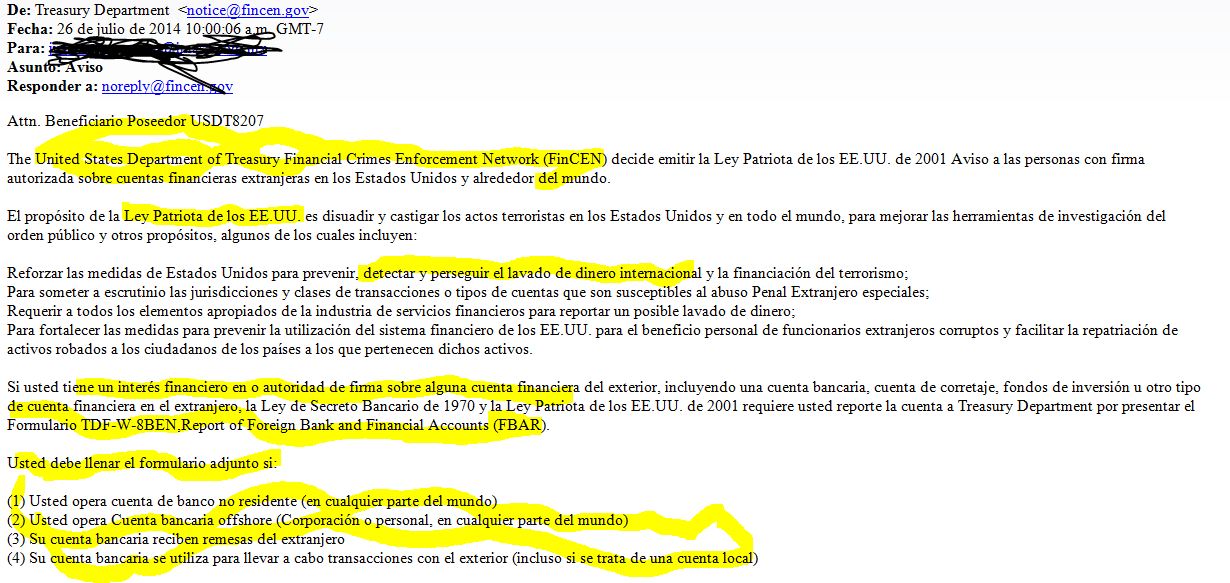
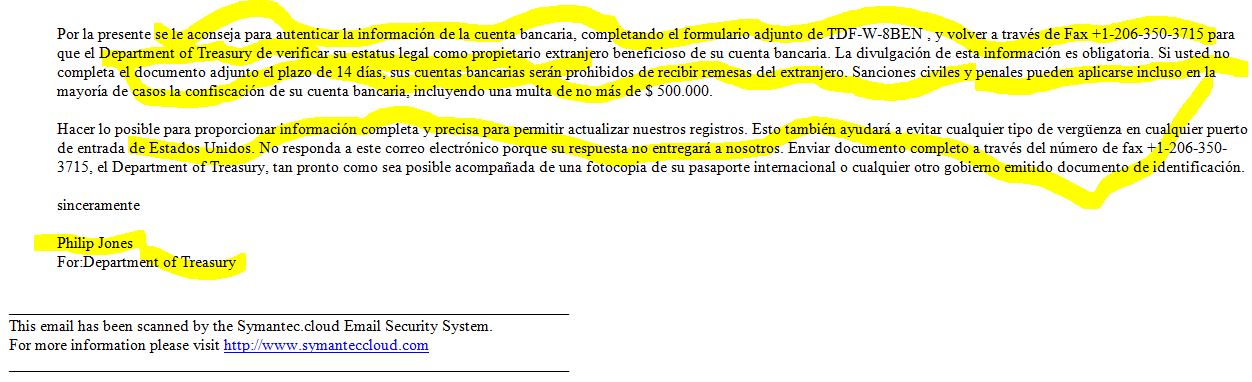
Accordingly, the type of frauds demand immediate reporting of the bank account information, purportedly to the U.S. Treasury Department. Here are examples of some of these fraudulent demands (this one in Spanish) that warns of stiff penalties, including criminal penalties for failure to provide the information within 14 days.
These requests are typically accompanied by an actual Treasury Department Form TD F 90-22.1 (Report of Foreign Bank and Financial Accounts) which are being requested to be completed with the detailed information required under the law and to be returned and sent via facsimile immediately to the U.S. Treasury Department (with an area code that is indeed in the Washington D.C. area). These are false requests.
As FATCA is implemented further throughout this year and the upcoming years, there will indeed be a range of fraudulent schemes designed to capture financial and personal information of individuals around the world. See, FATCA Driven – New IRS Forms W-8BEN versus W-8BEN-E versus W-9 (etc. etc.) for USCs and LPRs Overseas – It’s All About Information and More Information
U.S. Tax Court Rules Against Lawful Permanent Resident (LPR) in Abrahamsen
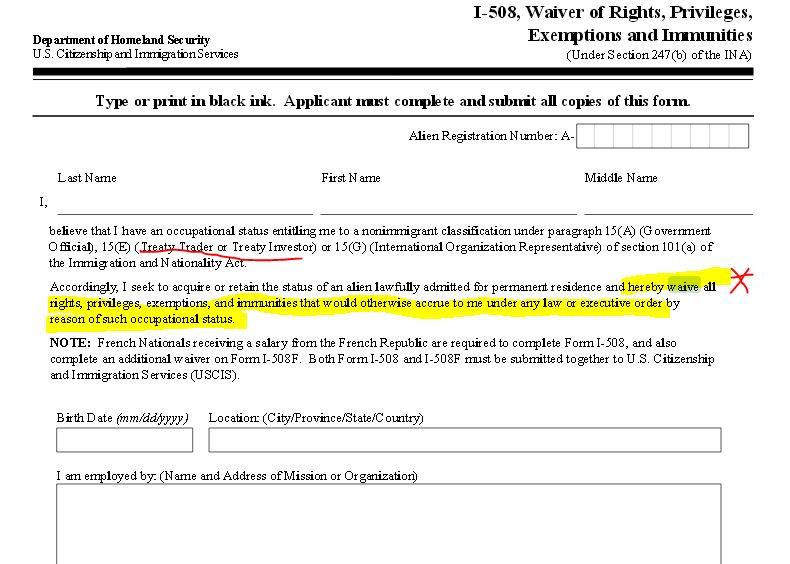
The U.S. Tax Court, in an opinion written by Judge Lauber (Abrahamsen v. Commissioner) placed much legal tax significance on the immigration form I-508 that Ms. Abrahamsen signed. 
The Court noted this form, I-508, Waiver of Rights, Privileges, Exemptions and Immunities (Under Section 247(b) of the INA) specifically provides that the non-U.S. citizen “waive all rights, privileges, exemptions and immunities which would otherwise accrue to [her] under any law or executive order by reason of [her] occupational status.”
In that case, the individual was a Finnish citizen who eventually applied for lawful permanent residency. The immigration forms were not related to any specific tax form, such as the new IRS Forms W-8BEN; see, IRS Releases New IRS Form W8-BEN. * U.S. citizens and LPRs beware of completing such form at the request of a third party.
The takeaway from this opinion, is that individuals need to be aware of how signing a particular form (that is not a tax form) can have adverse tax consequences. In this case, the Court ruled that she had waived her benefits to IRC Section 893 by signing immigration Form I-508. The opinion of the Tax Court raises an interesting legal question about how signing a form (I-508) can seem to override the statutory protection granted which provides protection to a qualifying “. . . employee [who] is not a citizen of the United States . . . “
Signing various tax forms can cause even greater risks for non-citizen taxpayers; e.g., IRS Form W-9 versus W-8BEN. See, FATCA Driven – New IRS Forms W-8BEN versus W-8BEN-E versus W-9 (etc. etc.) for USCs and LPRs Overseas – It’s All About Information and More Information*
Fortunately for the taxpayer in the Abrahamsen case, she was not subject to the Section 6662 accuracy related penalty (“negligence” penalty) assessed by the IRS.
A subsequent post will analyze some potential U.S. tax consequences for individuals who sign immigration Form I-485, Application to Register Permanent Residence or Adjust Status
Why do I have to get a Social Security Number to file a U.S. income tax return (USCs)?
U.S. citizens who meet certain income thresholds (currently about US$10,000 for individuals not filing married-jointly; and about US$20,000 for individuals filing married-jointly) who reside outside the U.S. have no choice but to obtain a SSN in order to file tax returns under U.S. law. See the specific income thresholds for who is required by law to file a U.S. tax return, here.
As explained in a previous post, under U.S. tax jargon a “taxpayer identification number” (TIN) is a broad definition and includes all of the following, which are TINs –
- U.S. Social Security Number (“SSN”) in the case of certain individuals (USCs, LPRs and those who have permission to work in the U.S. under a particular visa);
- “Individual Taxpayer Identification Numbers” (ITIN) in the case of other individuals who are not USCs or LPRs and not otherwise eligible for a SSN (another post will explain how ITINs are obtained);
- Employer identification numbers (EINs) for certain entities, such as corporations, partnerships and trusts.
Most importantly, the regulations specifically require a U.S. citizen to obtain a SSN to use it as the “taxpayer identifying number.” The relevant regulations provides that
(A) Except as otherwise provided in paragraph (a)(1)(ii)(B) and (D) of this section, and § 301.6109-3, an individual required to furnish a taxpayer identifying number must use a social security number.
The exceptions referred to above where a SSN is not required in these regulations are principally for individuals who are not U.S. citizens and not eligible to obtain a SSN. See, Social Security Numbers for Noncitizens as published by the Social Security Administration (“SSA”). Any U.S. citizen is eligible for obtaining a SSN. For information regarding applying for a SSN, see the SSA website.
Ironically, it can be very difficult (nearly impossible in some cases) for USCs who have spent most (if not all) of their lives outside the U.S.; considering the methods of proof required by the SSA when the Application For a Social Security Card (Form SS-5-FS) is submitted.
Once a SSN is obtained, the USC is required to complete IRS Form W-9 vis-a-vis third parties providing them proof of their status and SSN.
More will be discussed in later posts about how to get a SSN overseas from a U.S. Embassy and some Consulate offices. Also, see, The Catch 22 of Opening a Bank Account in Your Own Country – for USCs and LPRs.

 persons who need to understand the IRS forms referenced above. Indeed, all entities and institutions, whether they are small privately held companies or large and traditional financial institutions are required to complete and have signed a range of IRS forms.