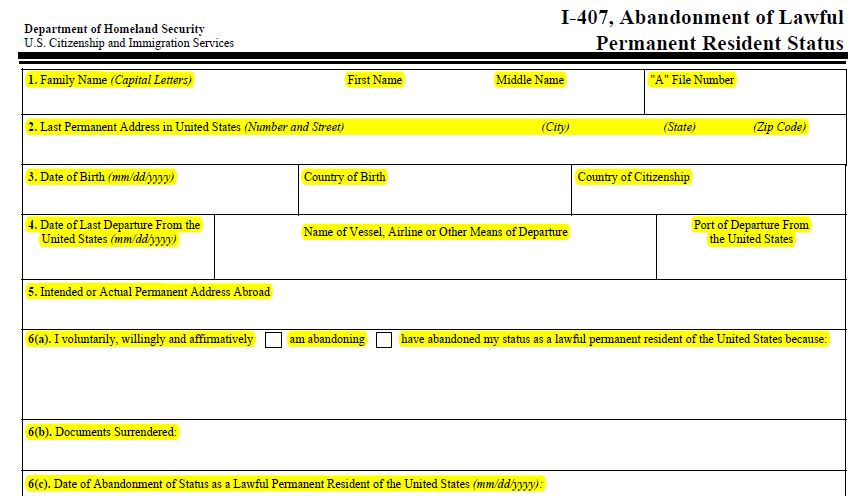
More Information and More Information: USCIS Creates New Form for Abandonment of Lawful Permanent Residency
The U.S. Customs and Immigration Service (USCIS) just announced on 23 March 2015, that a new Form I-407 is available and is to be used, per the USCIS website announcement, which announcment provides in part as follows:
New Version of Form I-407 Now Available
USCIS has published a new edition of USCIS Form I-407, Record of Abandonment of Lawful Permanent Status (OMB No. 1615-0130). You can download the form on our website.
You may begin using the revised Form I-407, Record of Abandonment of Lawful Permanent Resident Status today. The current edition is dated 02/26/2015, and we will not accept previous form editions
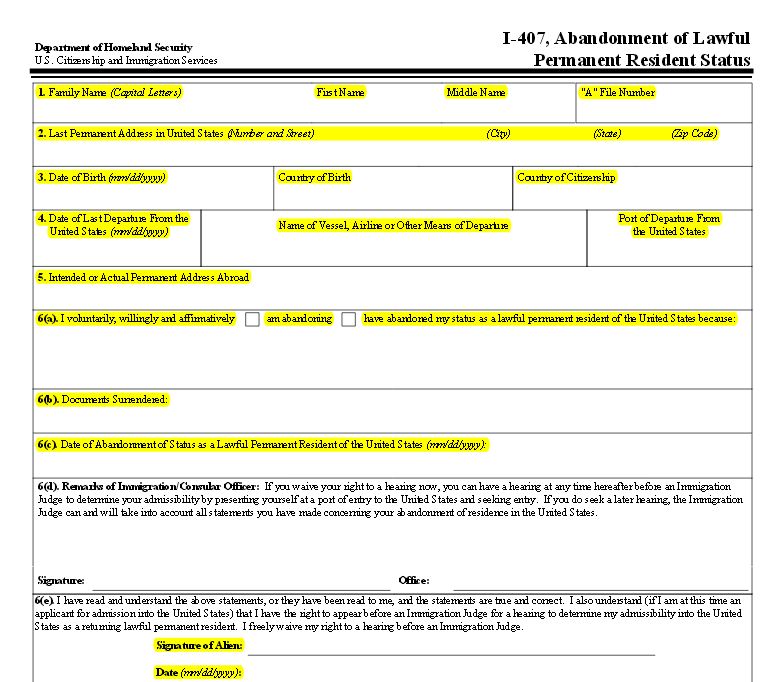
The new form has additional information compared to the prior form. Specifically, the Alien Registration Number and USCIS ELIS Account Number is required to be included.
Now, the individual is required to state the reasons for abandoning lawful permanent residency status.
Responses to  each of these questions will have important legal consequences, including potential tax implications under IRC Sections 877, 877A, et. seq. See, for instance a prior post: What could be the focal point of IRS Criminal Investigations of Former U.S. Citizens and Lawful Permanent Residents?
One of the important enforcement and practical questions raised, is: Will the IRS be able to better track former “long-term residents” (certain former lawful permanent residents) for purposes of the “expatriation tax” under the new reporting form and system?
As has been explained, if an individual fails to certify under the tax law, they will necessarily be a “covered expatriate”; even if they do not meet the asset or income tax liability thresholds. See a prior post, Certification Requirement of Section 877(a)(2)(C) – (5 Years of Tax Compliance) and Important Timing Considerations per the Statute.
Where the IRS will Likely Look in Latin America: Country Specific Tax Returns filed by U.S. Individual Taxpayers – Latin America (Excluding Mexico)
The prior post asked the “question”: Where the IRS will likely look overseas: USCs are Millions Yet U.S. Tax Returns are Just a Few Hundred Thousand [?]
As a continuation of the prior post, some further analysis by geographical region is provided here. This post is focused on Latin American countries  where U.S. citizens, lawful permanent residents (“LPRs”) or other individuals who may be U.S. tax residents (e.g., those individuals who make an election to be treated as a “U.S. person” for federal income tax purposes) are or are not filing U.S. tax returns. For an important discussion of LPRs, see, Who is a “long-term” lawful permanent resident (“LPR”) and why does it matter?
The IRS provides detailed statistical information on tax returns filed; how many, and in various groupings and from various locations. One such grouping by the IRS office of statistics, is by those individuals who filed tax returns which contained the “foreign earned income exclusion” which is reported on Form 2555: Foreign-Earned Income Exclusion, Housing Exclusion, and Housing Deduction.
See, The Foreign Earned Income Exclusion is Only Available If a U.S. Income Tax Return is File
The IRS reports that less than 15,000 tax returns were filed from all of of Latin/South America (excluding Mexico); for the year 2011, the last year they reported these statistics reflecting the foreign earned income exclusion. One of the more surprising statistics is that according to the U.S. Department of State, some 120,000 U.S. citizens reside in Costa Rica alone, yet only about 2,100 U.S. income tax returns were filed from Costa Rica with the foreign earned income exclusion.
Indeed, according to the U.S. federal government’s own numbers, there are approximately more than 8 times the number of U.S. citizens, simply living in Costa Rica (approx. 120,000) compared to the total number of U.S. tax returns (14,732) filed from all of the Latin/South American countries (excluding Mexico) that had the foreign earned income exclusion.
Similarly, Panama according to the U.S. Department of State, has ” . . . About 25,000 American citizens reside in Panama, many retirees from the Panama Canal Commission and individuals who hold dual nationality. There is also a rapidly growing enclave of American retirees in the Chiriqui Province in western Panama.” However, only about 1,200 U.S. income tax returns were filed from Panama with the foreign earned income exclusion.
Each Latin/South America country from which the number of U.S. tax returns were filed in 2011, with the foreign earned income exclusion is set out below:
| Latin/South America, total |
14,732 |
| Argentina |
986 |
| Brazil |
3,351 |
| Chile |
1,383 |
| Colombia |
1,524 |
| Costa Rica |
2,147 |
| Panama |
1,187 |
| Peru |
1,098 |
| Venezuela |
778 |
| Other Latin and South American countries |
2,280 |
This analysis is surely the type of analysis being conducted by the IRS which will be supplemented with information as they start receiving financial account and income information from countries and their financial institutions around the world (not just Latin America) from FATCA and the IGAs. See, Part 1- Unintended Consequences of FATCA – for USCs and LPRs Living Outside the U.S.
Three key observations about the above analysis.
First, there are many U.S. citizens residing overseas who have (a) income below certain thresholds, (b) are simply retired or unemployed – and have no foreign earned income, and/or (c) are not aware of how they can benefit from the foreign income exclusions; and therefore are not filing U.S. tax returns with the foreign earned income exclusion. However, the disproportionate number of U.S. citizens living throughout Latin America compared with the tax returns that are filed in this category is a strong indicator of low compliance by these taxpayers. The IRS will surely take note of this key consideration.
Second, the above numbers do not try to identify the number of LPRs who are residing in these Latin American countries who are also not filing U.S. income tax returns. There are some 13-14 million LPRs. See, What are the Number of LPRs who Leave U.S. Annually without filing Form I-407 – Abandonment?
Third, Latin America has the largest percentage of the population throughout the world where more U.S. citizens reside. See, a 2012 proposal I prepared for the State Bar of California, Taxation Section: Proposed Expansion of Category of Registered Deemed-Compliant FFI: “The Good Faith Local FFI” and the Accidental American along with Liliana Menzie that describes the high concentration of U.S. citizens throughout the region. “Latin America, as a prime example, has a high concentration of U.S. citizens residing in various countries pursuant to the State Department data, in some cases representing a large percentage of the population (e.g., nearly one half of a percent -0.4%- of the total population of the Americas consisted of U.S. citizen[s] . . .”
The Number of Citizens Leaving (Renouncing) Versus Coming (Naturalizing) is Just a Speck
Much has been made about the number of citizens who have been renouncing their U.S. citizenship over the last few years. In historical terms, it is a relative explosion. See, earlier post – The 2014 Third Quarter Renunciations Is probably the New Norm –
However, compared to the 
 number of lawful permanent residents (LPR) who are leaving the U.S., the number is relatively small. See, earlier post The Number of LPRs “Leaving” the U.S. is 16X Greater than the Number of U.S. Citizens Renouncing Citizenship
On a related post, the question was raised –What are the Number of LPRs who Leave U.S. Annually without filing Form I-407 – Abandonment?
However, the number of individuals who wish to come to the U.S. to become citizens is far in excess of the number who are renouncing their citizenship.  According to the USCIS, there are about 700,000 individuals annually who become naturalized citizens. In the year 2008, there were more than 1 million naturalized citizens. See table:
Compare these numbers to just about 3,000 annually of individual who are renouncing their citizenship.
Of course, everyone has their own story and reasons for either coming or going, but in relative terms, those who find it desirous to renounce citizenship (at least in absolute numbers and relative terms) represent a small speck (less than 1/2 of 1 percent), compared to those who are becoming naturalized citizens.
Finally, for anyone who wishes to become a naturalized citizen, they must be aware they cannot “reverse” the decision without having potentially adverse U.S. tax consequences. See, Why a Naturalized Citizen cannot avoid “Covered Expatriate” status under IRC Section 877A(g)(1)(B)
What are the Number of LPRs who Leave U.S. Annually without filing Form I-407 – Abandonment?
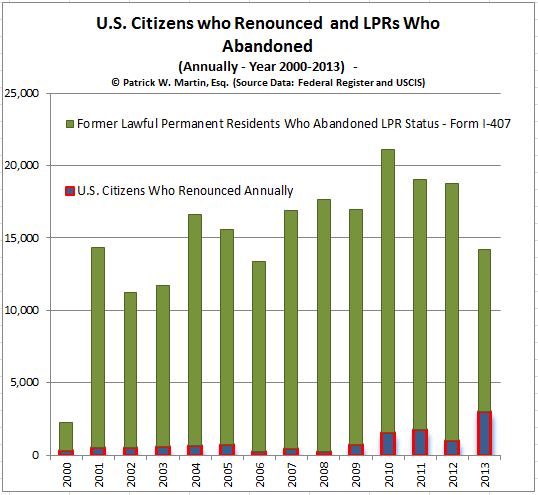
A prior post identified the number of lawful permanent residents (LPRs) who file Form I-407 to formally abandon their lawful permanent residency. See, The Number of LPRs “Leaving” the U.S. is 16X Greater than the Number of U.S. Citizens Renouncing Citizenship
These numbers of I-407 forms filed annually were obtained through a freedom of Information Act (“FOIA”) request and provided by the USCIS. See tabl:
Of course, this statistic does NOT identify the number of the approximate 13.3+ million LPRs who leave the U.S. to live elsewhere in another country without completing Form I-407 and formally abandoning. The estimated number of LPRs was 13.3 million for the year 2012 as reported by the Office of Statistics of the DHS. See, Estimates of the Legal Permanent Resident Population in 2012.
Maybe the number of individuals who fall into this latter category (i.e., moving out of the U.S. without filing Form I-407) is several hundred of thousands of individuals annually?
Importantly, from a taxation perspective, anyone who moves and lives in a country with a U.S. income tax treaty (the list of these countries is set out below – from the IRS website), needs to be careful not to be deemed to be a “covered expatriate” due to the application of IRS Form 7701(b)(6). See, IRS Notice 2009-85.
See, the following posts with further explanation of the tax law for LPRs who move and live in one of the countries listed below. Countries with U.S. Income Tax Treaties & Lawful Permanent Residents (“Oops – Did I Expatriate”?)
See also, Who is a “long-term” lawful permanent resident (“LPR”) and why does it matter?
Becoming a “covered expatriate” has U.S. tax consequences not just to the “former long-term LPR”, but also to their family and friends who are “U.S. persons” (as defined under Section 7701. See, The “Hidden Tax” of Expatriation – Section 2801 and its “Forever Taint.”
A
Armenia
Australia
Austria
Azerbaijan
B
Bangladesh
Barbados
Belarus
Belgium
Bulgaria
C
Canada
China
Cyprus
Czech Republic
D
Denmark

E
Egypt
Estonia
F
Finland
France
G
Georgia
Germany
Greece
H
Hungary
I
Iceland
India
Indonesia
Ireland
Israel
Italy
J
Jamaica
Japan
K
Kazakhstan
Korea
Kyrgyzstan
L
Latvia
Lithuania
Luxembourg
M
Malta
Mexico
Moldova
Morocco
N
Netherlands
New Zealand
Norway
O
P
Pakistan
Philippines
Poland
Portugal
Q
R
Romania
Russia
S
Slovak Republic
Slovenia
South Africa
Spain
Sri Lanka
Sweden
Switzerland
T
Tajikistan
Thailand
Trinidad
Tunisia
Turkey
Turkmenistan
U
Ukraine
Union of Soviet Socialist Republics (USSR)
United Kingdom
United States Model
Uzbekistan
V
Venezuela
The Number of LPRs “Leaving” the U.S. is 16X Greater than the Number of U.S. Citizens Renouncing Citizenship
The focus of Tax-Expatriation is to discuss legal matters of U.S. citizenship renunciation-relinquishment and lawful permanent residency abandonment.
There have been a great deal of resources discussing the number of USCs residing outside the U.S. and those who ultimately renounce citizenship.
See prior posts related to this topic –
The 2014 Third Quarter Renunciations Is probably the New Norm –
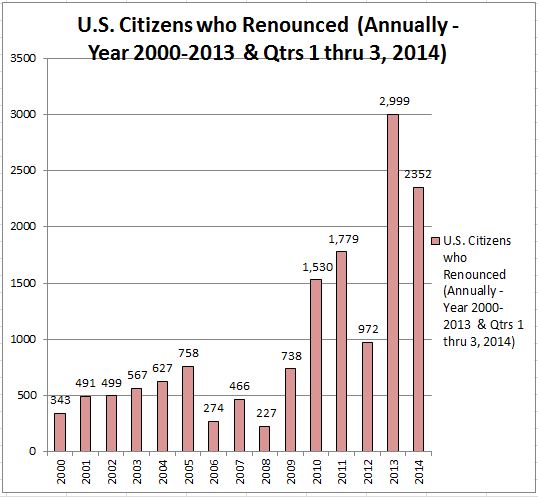
Wow, the number of 2,999 U.S. citizens who renounced in the year 2013 shattered the prior record set in 2011 of 1,782 renunciations. Why so many renunciations?
The List is Out – and Its 1,001 Former U.S. Citizens for the 1st Quarter 2014
There has not been any detailed discussion of the number of LPRs who leave the U.S. annually. The data provided by the U.S. Citizenship and Immigration Services reflects about 16 times more LPRs formally abandon their lawful permanent residency status by filing Form I-407 compared to U.S. citizens who renounce. The chart here shows a comparison for the years 2000 through 2013 of the total (i) USCs who have renounced compared to (ii) LPRs who have formally abandoned that status.
Note that for the year 2013, it is only through May 2013, so the total abandoned for the entire calendar year 2013 could well exceed 20,000.
Of course, this statistic does NOT identify the number of total current 13.3+ million LPRs who leave the U.S. to live elsewhere in another country without completing Form I-407 and formally abandoning. The estimated number of LPRs was 13.3 million for the year 2012 as reported by the Office of Statistics of the DHS. See, Estimates of the Legal Permanent Resident Population in 2012
See also The Foreign-Born Population of the United States: Multi-National Families and “Tax Expatriation”
The 2014 Third Quarter Renunciations Is probably the New Norm –
The Treasury Department announced 776 renunciations, which brings the 2014 total to 2,353, on track to match last year’s record breaking 2,999 citizens who renounced.
US Citizen Renunciations 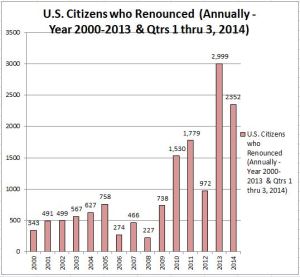 Q1 thru Q3 – 2014
See, Will Qtr 2 Exceed Qtr 1 – 2014, Record of USC Renunciations?
As has been mentioned previously, this list does not include lawful permanent residents who have terminated their LPR status for purposes of these tax law provisions. For further reading on LPRs, see, Oops…Did I “Expatriate” and Never Know It: Lawful Permanent Residents Beware! International Tax Journal, CCH Wolters Kluwer, Jan.-Feb. 2014, Vol. 40 Issue 1, p9
Maybe the LPR list represents several hundred thousands of individuals? The current total estimated number of LPRs is 13.3 million for the year 2012 as reported by the Office of Statistics of the DHS. See, Estimates of the Legal Permanent Resident Population in 2012
There are two distinct ways that LPRs can terminate their tax residency status. First, through the formal immigration law process typically involving filing Form I-407. See, Who is a “long-term” lawful permanent resident (“LPR”) and why does it matter?
Second, they can terminate their LPR status, for tax purposes, by merely meeting the statutory  requirements of IRC Section 7701(b)(6). This simply requires the individual to move from the U.S. and live in a country with a U.S. income tax treaty and meet the other two statutory requirements.
This statutory language has three tests for when the individual is no longer a LPR for federal tax purposes:
- The individual is treated as a resident of a foreign country under the provisions of a tax treaty;
- The individual does not waive the benefits of the treaty, and
- Notifies the Secretary of the commencement of such treatment.
See, LPR status can be abandoned for tax purposes (since 2008 tax law changes) by merely leaving and moving outside the U.S. [and filing a U.S. tax return] in some cases?
Who is a “long-term” lawful permanent resident (“LPR”) and why does it matter?
The answer to the above question will only matter, for purposes of “tax expatriation” if the LPR plans on living and moving outside the U.S. The law defines a “’long-term resident’ as any individual (other than a citizen of the United States) who is a lawful permanent resident of the United States in at least 8 taxable years during the period of 15 taxable years.” See, IRC Section 877 (e)(2.
Importantly, there are key concepts of who satisfies these requirements, which is not as simple as it seems on its face. See, for instance Section 7701(b)(6) with specific rules for individuals who live in a country with a U.S. income tax treaty. Importantly, the definition of a lawful permanent resident for tax purposes (as defined in Section 7701(b) ) is not identical to the definition for immigration law purposes.
The importance of LPR status for tax purposes in the expatriation context is crucial. Its the saying “black or white” or “night or day” when thinking about the U.S. “expatriation” tax consequences to LPRs. In short, a LPR who never becomes a “long-term resident” as that technical term is defined in IRC Section 877 (e)(2) can avoid the various taxes that arise from otherwise being a “covered expatriate”. The future heirs and beneficiaries who receive assets from this LPR (who never was a “long-term resident?) can also avoid a major tax; currently 40% of the value of the gift or bequest. See, Revisiting the consequences of becoming a “covered expatriate” for failing to comply with Section 877(a)(2)(C).
The reason it is so important, is that if a LPR never becomes a “long-term resident”, he or she can never cause themselves to “expatriate” as that term is defined in IRC Section 877A(g)(2).
If a LPR never can “expatriate” under the tax law, he or she can never become subject to a range of adverse (some would say draconian) tax consequences that apply. See the following post for a further explanation of the various adverse tax consequences: Why “covered expat” (“covered expatriate”) status matters, even if you have no assets! The “Forever Taint”!
If there is no way in these circumstances for the LPR to “expatriate” there can be no “mark to market” tax and no future tax on covered gifts or covered bequests. See, Oops…Did I “Expatriate” and Never Know It: Lawful Permanent Residents Beware! International Tax Journal, CCH Wolters Kluwer, Jan.-Feb. 2014, Vol. 40 Issue 1, p9
Obviously, this is a very good result for a LPR to never become a “long-term resident”. Planning for it is another task; particularly given the personal living arrangements of each particular individual.
The determination of if or when one becomes a “long-term resident” is highly complex, due to different cross-provisions in the tax law. Specifically, Section 7701(b)(6) has a provision that can have unintended consequences for the unwary LPR. See, for instance, LPR status can be abandoned for tax purposes (since 2008 tax law changes) by merely leaving and moving outside the U.S. in some cases?
The IRS does not give a “Certificate of Expatriation” or similar tax document . . .
After a U.S. citizen has formally renounced (or relinquished) their U.S. citizenship, the U.S. Department of State provides a “Certificate of Loss of Nationality” (“CLN”). This form can be located here at – Certificate of Loss of Nationality of the United States, Form DS-4083 (CLN)
 Also, lawful permanent residents who formally abandon their “green card” status will do so by filing an Abandonment of Lawful Permanent Resident Status Form I-407.
Those LPRs who mail the Form I-407, will never receive any type of confirmation from the government, other than their own copies of documents filed and proof of mailing it (e.g., certified mail, return receipt). If the Form I-407 is presented to the U.S. Consulate or Embassy, the individual should receive a stamped copy of the form which should be given to the former LPR by the consular officer.
However, the Internal Revenue Service (“IRS”) which has very different responsibilities as compared to the U.S. Department of State, does not issue any sort of similar document to the CLN. There is no equivalent “Tax CLN.” Indeed, many individuals feel let down or “without closure” when they learn that it is a one-way flow of information; from the individual to the IRS. The IRS does not have an obligation to even confirm receipt of the documents filed with the IRS.
This is quite disorienting for many USCs and LPRs residing overseas, where the revenue authority in their country will regularly give a confirmation of tax documents received. Sometimes, a government will provide a confirmation of the taxes owing and paid through some specific type of feedback or response.
The IRS does no such a thing; and there is no document that will come from the IRS certifying “tax expatriation” has occurred.
The legal burden is therefore generally on the taxpayer to be able to prove the filing of the tax returns and IRS Form 8854. See, How many former U.S. citizens and long-term lawful permanent residents have filed (or will file) IRS Form 8854?
Filing the returns through an overnight courier service (e.g., DHL, Federal Express, etc.) and maintaining the proof of mailing and delivery is always important. If the tax documents are filed from the U.S., they should always be sent with such proof, or via U.S. certified mail, return receipt. One recommendation/pointer, is to ask the IRS to stamp date the receipt (e.g., a copy of the cover/transmittal letter) and return it to you in a self-addressed return envelope.
All of this is quite important, particularly to get the “clock ticking” against the IRS to bring an audit, under the statute of limitations period. See, When the U.S. Tax Law has no Statute of Limitations against the IRS; i.e., for the U.S. citizen and LPR residing outside the U.S.
LPR status can be abandoned for tax purposes (since 2008 tax law changes) by merely leaving and moving outside the U.S. in some cases?
Lawful permanent residents may erroneously think they have not “expatriated” for U.S. tax purposes, as long as they have not returned it to the U.S. Citizenship and Immigration Services (USCIS) – i.e., formally abandoned their green cards. Unfortunately, for these individuals, they can be in for a rude awakening regarding the application of IRC Section 7701(b)(6) that was added by Congress in 2008.
The relevant portion of the statute provides as follows:
- An individual shall cease to be treated as a lawful permanent resident of the United States if such individual commences to be treated as a resident of a foreign country under the provisions of a tax treaty between the United States and the foreign country, does not waive the benefits of such treaty applicable to residents of the foreign country, and notifies the Secretary of the commencement of such treatment.
This statutory language has three tests for when the individual is no longer a LPR for federal tax purposes:
- The individual is treated as a resident of a foreign country under the provisions of a tax treaty;
- The individual does not waive the benefits of the treaty, and
- Notifies the Secretary of the commencement of such treatment.
Each of the above tests seem to be satisified by any “green card” holder who files IRS Form 1040NR as a non-resident, when they live in a country with a U.S. income tax treaty. A list of treaty countries is to follow in a later post.
There can be a host of unintended consequences to the individual who falls into this category; i.e., who ceases to be a “lawful permanent resident” under the federal tax law. The expatriation provisions of Section 877A and 2801 (among others) can be implicated, along with many other provisions of the law. See, Accidental Americans” – Rush to Renounce U.S. Citizenship to Avoid the Ugly U.S. Tax Web” International Tax Journal, CCH Wolters Kluwer, Nov./Dec. 2012, Vol. 38 Issue 6, p45.
For those who wish to formally abandon their LPR, there is a specific DHS/USCIS form (I-407) that is used for this purpose:
Read the Q&A format here.
Immigration Law Perspective – Abandonment of Lawful Permanent Resident Status – It Can Happen Automatically
This is a guest post from immigration lawyer Jan Bejar –
Abandonment of Lawful Permanent Resident Status – It Can Happen Automatically
A lawful permanent resident (LPR) of the U.S. – or in other words, someone who has a “green card” – can lose permanent resident status through removal (“deportation”) or abandonment.
First, an LPR may lose permanent resident status if he commits an act that makes him deportable, for example commission of a certain crime, and if the immigration court issues a final order of removal (“deportation”) after immigration court hearings.
Second, an LPR may abandon his or her permanent resident status. An LPR abandons his or her LPR status automatically, by operation of law, when he or she engages in an abandoning act, such as submitting a Form I-407, Abandonment of Lawful Permanent Resident Status, or by simply departing the U.S. for more than a temporary visit abroad. Completing and submitting Form I-407 contemplates a conscious choice to abandon permanent resident status. On the other hand, departing the U.S. for more than a temporary visit abroad may lack the same formality but carries the same serious consequences.
As a general matter, a permanent resident card is not a tourist vista. An LPR cannot live outside the U.S. and use a permanent resident card to visit the U.S. occasionally without maintaining signs of a residence in the U.S. The Department of Homeland Security (DHS) will make an abandonment finding after an LPR has taken a single trip outside the U.S. of more than one year, and the LPR can only challenge the finding in the context of removal proceedings. For a single trip outside the U.S. of six months up to one year, DHS will presume that the LPR intended to abandon his or her permanent resident status, but the LPR may rebut the presumption. Further, on a case-by-case basis, DHS may deem that an LPR has abandoned his or her residency even if he or she has not been outside the U.S. for more than six months on any single trip if he or she has spent a significant amount of time outside the U.S. on multiple trips abroad.
The factors that DHS and the courts look at to determine if an LPR has abandoned his or her permanent resident status include the purpose and duration of the trip abroad; the event abroad, if any, after which the LPR planned to return; and the LPR’s family ties, employment, property holdings, and business affiliations in the U.S. and in the foreign country. Filing a U.S. income tax return as a tax nonresident alien raises a rebuttable presumption of abandonment.
If an LPR is aware that he or she will need to spend significant time abroad, then he or she should apply for a reentry permit prior to departure. The reentry permit alone does not guarantee that the LPR will be allowed to reenter following a long absence, but the reentry permit increases the chance of admission and is evidence of the intent to return to the U.S. and maintain permanent resident status.
Jan Joseph Bejar, Esq.
For: JAN JOSEPH BEJAR,
A Professional Law Corporation
Tel: (619)291-1112
Fax:(619)291-1102
E-mail: jbejar@immigrationlawclinic.com
Website: www.immigrationlawclinic.com
???????????????? ?Please click here to view the above in Chinese.?


 each of these questions will have important legal consequences, including potential tax implications under IRC Sections 877, 877A, et. seq. See, for instance a prior post: What could be the focal point of IRS Criminal Investigations of Former U.S. Citizens and Lawful Permanent Residents?