Proposal to U.S. Treasury and IRS: awaits Final Regulations on “Covered Gifts” and “Covered Bequests”
When people write about the taxes from expatriation, the focus seems to be on the income tax provisions. Maybe that is normal, since an income tax can be immediately triggered with reference to the “expatriation date” as defined in the law.
However, the most costly tax will often be the tax on “Covered Gifts” and “Covered Bequests” which went into effect in 2008, but is awaiting Treasury regulations for publication.
Proposed regulations are in the works and presumably were going to be released before the end of the year. In May of this year, I presented a set of formal recommendations to the U.S. Treasury and IRS on this topic in a paper entitled:
***
COVERED GIFTS & BEQUESTS: THE NEED FOR GUIDANCE (5+ YEARS OUT)
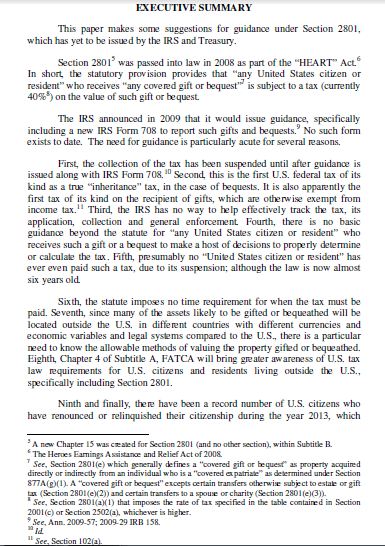
This proposal can be read in its entirety here, and the executive summary is set out below: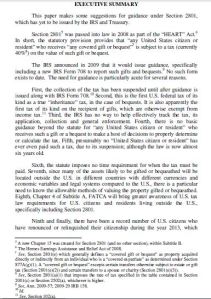
The reason these regulations are so important, is due to the tax cost of taxes upon U.S. beneficiaries. See, The “Hidden Tax” of Expatriation – Section 2801 and its “Forever Taint.”
The tax is currently levied at a 40% rate on basically the full vale of the asset upon the gift or bequest. It also continues on for potentially generations into the future; e.g., if U.S. beneficiaries receive property held in trust that was funded by a “covered expatriate.” For instance, to demonstrate the consequences, we can assume a former U.S. citizen who is a “covered expatriate” (e.g., for failure to properly certify under Section 877(a)(2)(C) and file IRS Form 8854, even though the income tax or asset tests are not satisfied) funds a trust in a foreign country for her grandchildren and great grandchildren. See, How many former U.S. citizens and long-term lawful permanent residents have filed (or will file) IRS Form 8854?
Over time, the value of those trust assets grow substantially and 30 years after her death (e.g., the year 2055), the trust starts distributing US$100,000 annually to several U.S. citizen grandchildren and grandchildren. Under the current law, each time the distribution is received, a 40% tax should be levied on each distribution. The law leaves many unanswered questions, until the proposed regulations are issued.
Why a “long-term” LPR can NEVER avoid “Covered Expatriate” status under IRC Section 877A(g)(1)(B) if Asset or Tax Liability Test is Satisfied!
There have been multiple posts explaining the importance of the certification requirement of Section 877(a)(2)(C).
See for instance, Certification Requirement of Section 877(a)(2)(C) – (5 Years of Tax Compliance) and Important Timing Considerations per the Statute, also see Can the Certification Requirement of Section 877(a)(2)(C) be Satisfied “After the Fact”?
This specific act of “certifying” is a requirement under the law, that requires all individuals (whether U.S. citizens or LPRs) to satisfy the elements of the certification, in order to avoid “covered expatriate” status.
Also, there is an important exception to “covered expatriate” status set forth in IRC Section 877A(g)(1)(B). Only certain individuals may be able to satisfy this important requirement, which provides as follows:
(B) Exceptions
An individual shall not be treated as meeting the requirements of subparagraph (A) or (B) of section 877 (a)(2) if—
(i) the individual—
(I) became at birth a citizen of the United States and a citizen of another country and, as of the expatriation date, continues to be a citizen of, and is taxed as a resident of, such other country, and
(II) has been a resident of the United States (as defined in section 7701 (b)(1)(A)(ii)) for not more than 10 taxable years during the 15-taxable year period ending with the taxable year during which the expatriation date occurs, or . . .
***
Importantly, the elements of the statute apply only to persons who “became at birth a citizen of the United States”; and in the case of lawful permanent residents (LPRs), they be definition will not have become at birth a citizen of the United States.
***
Accordingly, a “long term” LPR who meets either the US$2M asset test, or average income tax liability test (currently

US$157,000 for the year 2014), will necessarily become a “covered expatriate” even if they can satisfy the
Certification Requirement of Section 877(a)(2)(C).
**
**
**
Accordingly, it is important for each “long-term” LPR to understand clearly the current and future U.S. tax consequences to (i) them – the “mark-to market” tax, and (2) tax on “covered gifts” and “covered bequests” to U.S. persons. Importantly, understanding these consequences should be long before the LPR ceases to be a LPR for tax purposes; irrespective of the immigration law consequences.
IRA Distributions – (Counter-intuitive Results) U.S. Tax Consequences to Former USCs and Long Term Residents (LPRs)
IRA Distributions – (Counter-intuitive Results) U.S. Tax Consequences to Former USCs and Long Term Residents (LPRs)
Those USCs who have renounced citizenship (or who are contemplating renunciation) and those LPRs who (were/are/will) fall into the category of “long-term residents” who have qualified retirement accounts, known as “Individual Retirement Arrangement” (“IRAs”) have special considerations to consider under IRC Sections 877, et. seq. For more details on how IRAs work and the deduction limits, see the IRS website explanation.
In short, if an individual is a “covered expatriate” upon renunciation (or LPR abandonment), they will generally be subject to U.S. income taxation on the entire amount of the IRA (along with all other assets with unrealized gains), reduced by the exemption amount (currently US$680,000 for the year 2014).
Unfortunately, it is fairly easy to become a “covered expatriate” even if the asset or tax liability tests are not satisfied, simply if the individual fails to satisfy the certification requirement under Section 877(a)(2)(C). There are multiple posts that address this important certification requirement of Section 877(a)(2)(C), irrespective of how poor or how few of assets might be held by the individual. See, Certification Requirement of Section 877(a)(2)(C) – (5 Years of Tax Compliance) and Important Timing Considerations per the Statute, also see Can the Certification Requirement of Section 877(a)(2)(C) be Satisfied “After the Fact”?
Plus, the topic is covered yet further in More on “PFICs” and their Complications for USCs and LPRs Living Outside the U.S. -(What if there are No Records?)
Generally “covered expatriate” status is to be avoided, give the various adverse tax consequences. See, for instance, Why “covered expat” (“covered expatriate”) status matters, even if you have no assets! The “Forever Taint”!
However, since the U.S. tax law is complex and oftentimes full of unintended consequences, there may be times when “covered expatriate” status is desirable in any particular circumstance. I have seen and advised on several; including scenarios, where some planning steps can help get a much better U.S. tax result in various cases.
Assume a former USC does not meet the certification requirement (e.g., since they neglected to properly file a complete and accurate IRS Form 8854, or they otherwise did not comply with Title 26 for one or more of the five years preceding the renunciation/abandonment). Further, let us assume, she has an IRA with a total value of US$1.4M and all of her other assets have no unrealized gain (e.g., Euros in a bank in Europe and an apartment she purchased in her country of residence in Europe that continues to have depressed real estate prices). These other assets, the apartment and Euros are US$500,000 in value; hence, less than the US$2M net worth threshold. However, we will assume she did not timely comply with the certification requirements under the law.
In such an “unfortunate” case, she would have to accelerate all of the income (gain) from her IRA in the year she has her “date of expatriation”. This would cause a U.S. federal income tax liability of about US$260,000 that would become immediately due and payable. This amount is calculated as follows: US$1.4M total IRA, less the $680,000 exclusion amount, for a total taxable income of about $720,000 (which will generate an approximate US$260,000 income tax for someone who is not married filing jointly. This represents an effective tax rate of approximately 36% on the taxable income portion (US$260,000/US$720,000). Remember, however, $680,000 escapes taxation under the exclusion amount. Hence, the effective tax rate on the entire IRA portion is actually only about 18.6% in this case. This amount is calculated as total IRA income of US$1.4M against tax of US$260,000 (i.e., $260,000/$1.4M= 18.6%).
An 18.6% tax rate is generally a very “attractive” U.S. individual income tax rate for those who have high amounts of income, as is this case with US$1.4M.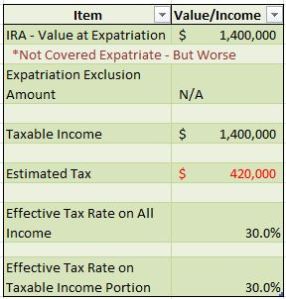
If instead, she is not a “covered expatriate” at the time she renounces her citizenship in 2014 (as she did comply with the certification requirements and otherwise would not meet the $2M net worth and her average annual net income tax liability for the preceding 5 years did not exceed $157,000) she would have a very different tax result. In short, she would not have to accelerate the entire tax liability. That sounds like good news, until one considers the U.S. tax rate on future IRA distributions to her after she ceases to be a U.S. citizen. Absent, an income tax treaty, she would have a 30% tax withheld at source (i.e., by the U.S. payer – trustee of the IRA) on each distribution made. If all US$1.4M is distributed out in one lump sum, there will be a tax of US$420,00 (US$1.4M X 30%); much more than the $260,000 for the “covered expatriate” scenario above. See calculations in this table:
Also, if she prefers to defer the IRA distributions (e.g., to make 14 annual distributions of US$100,000), she will have the same 30% tax withheld on each payment; hence, a total tax of US$420,00.
Obviously, a 30% tax is much worse than an 18.6% tax. Accordingly, this is a scenario where an individual may prefer to be a “covered expatriate” as opposed to avoiding such status. A bunch of factual analysis and strategic considerations would need to be considered in her case (e..g, where are her future heirs, what other income might she receive, will she receive any future gifts of inheritances herself, etc. etc.?).
Indeed, in this particular case, I can imagine a scenario (if accompanied by some focused tax planning), she could pay no more than a total effective tax rate of 12.2% on her income. Of course, 12.2% is better than 18.6% and 30%.
Finally, there is one more important wrinkle that can modify these results yet further; a particular income tax treaty with the U.S. that has a specific tax result that is better than the statutory 30% rate on distributions from an IRA to a non-resident alien. The U.S. has numerous income tax treaties with numerous countries, almost all of which have different terms and conditions. See, Countries with U.S. Income Tax Treaties & Lawful Permanent Residents (“Oops – Did I Expatriate”?)
Will the IRS simply select the list of published former citizens for tax audits?
Will the IRS simply select the list of published former citizens for audits? It is a simple process for them to cross reference the names that are published.
The complete set of lists going back to the mid-1990s can be reviewed here. Quarterly Publications.
The IRS does not have to wait for IRS Form 8854 to be filed by the former USC.
See an earlier post regarding IRS CI activity in this area: This is a bit of a Bombshell – If the IRS Criminal Investigation (“CI”) is investigating U.S. citizens renouncing their citizenship?
A later post will discuss methods by which the IRS may be identifying long-term lawful permanent residents (LPRs) who have formally (or informally – by operation of law) abandoned their LPR status for tax purposes. The list of LPRs is NOT provided in the quarterly publications list that list USCs; and it is not as simple of a process for the selection and identification of LPR taxpayers for audits, reviews and investigations by the IRS.
Certification Requirement of Section 877(a)(2)(C) – (5 Years of Tax Compliance) and Important Timing Considerations per the Statute
People who cite to IRS forms, should have an appreciation that neither the form or its conditions may have the “force of law.” This is particularly important, when the statute itself, regarding the Certification Requirement of Section 877(a)(2)(C) does not specific whether the certification has to be made “prior to” (or after) the date of loss of nationality? See the relevant provision of the statute below – Section 877(a)(2)(C), which causes an individual to be a “covered expatriate” if::
- (C) such individual fails to certify under penalty of perjury that he has met the requirements of this title for the 5 preceding taxable years or fails to submit such evidence of such compliance as the Secretary may require.
Consider the language of the instructions of IRS Form 8854, however, which expressly states that the certification must reflect you have ” . . . complied with all of your federal tax obligations for the 5 tax years preceding the date of your expatriation.”
Does this mean the IRS requires the compliance to have been satisfied prior to the expatriation/renunciation date? That is what the instructions say.
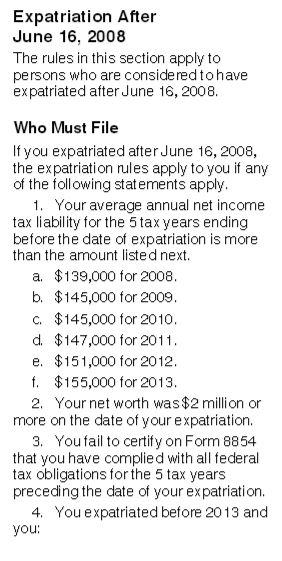
See the bottom of page 2 of the Form 8854 instructions –
“If you expatriated after June 16, 2008, the expatriation rules apply to you if any of the following statements apply.
1. Your average annual net income tax liability for the 5 tax years ending before the date of your expatriation is more than the amount listed next . . .
2. Your net worth is $2 million or more on the date of your expatriation.
3. You fail to certify on Form 8854 that you have complied with all of your federal tax obligations for the 5 tax years preceding the date of your expatriation.”
In this case, the instructions to the form, say the former USC or LPR must ” . . . have complied with all of your federal tax obligations preceding the date of your expatriation. . . ”
If this statement were true, a taxpayer could not satisfy the rule by attempting to comply with all federal tax obligations after they have renounced their U.S. citizenship?
In other words, if such were true, attempting to comply with all provisions of the U.S. federal tax law for 5 years and then filing 8854, all after taking the oath of renunciation, would prohibit someone from avoiding “covered expatriate” status?
Importantly, the Treasury/IRS cannot create law by merely publishing a substantive rule in an IRS Form. Indeed, there are no regulations to date; that have been issued by the Treasury; only a few notices. See prior post, Does IRS Notice 2009-85 regarding expatriation have the “force of law”?
Of course, this does not mean the IRS will not challenge any former USC as not complying with Certification Requirement of Section 877(a)(2)(C) by not also complying with the condition set forth in the IRS own instructions?
This is an example of an important detail that any former USC will want to carefully consider prior to rushing off to take the oath of renunciation.
As always, see Limitations.
Read the Q&A format here.
Can the Certification Requirement of Section 877(a)(2)(C) be Satisfied “After the Fact”?
Probably most “Accidental Americans” around the world do not and have not filed U.S. federal income tax returns during their lifetimes. A most important issue for these individuals who are considering renouncing their USC, is whether they can satisfy the statutory requirement (set out below) late; i.e., “after the fact” – if they have not previously filed tax returns?
See the relevant provision of the statute below:
- (C) such individual fails to certify under penalty of perjury that he has met the requirements of this title for the 5 preceding taxable years or fails to submit such evidence of such compliance as the Secretary may require.
Can an “Accidental American” who has lived almost all of their lives outside the U.S., and who has never filed U.S. income tax returns satisfy the statutory language “. . . of the the requirements of this title [Title 26 – Federal Tax Laws] for the 5 preceding taxable years. . . “?
Some interpret the statute to say that filing late income tax returns (e.g., in 2014 for the years 2009 through 2013/2014) should be permissible, provided the former USC indeed satisfies all of the requirements set forth in the law at some later point in time.
Will the IRS argue late filings of tax returns means the taxpayer has not met the requirements of Title 26? Will they argue that a failure to file a timely return and violation of Section 6651 means such an individual did not meet the requirements of the law? See, § 6651 – Failure to file tax return or to pay tax, which provides in relevant part –
a) Addition to the tax
In case of failure—
(1) to file any return required under authority of subchapter A of chapter 61. . . on the date prescribed therefor (determined with regard to any extension of time for filing), unless it is shown that such failure is due to reasonable cause and not due to willful neglect, . . .
Will the IRS or Tax Division, Justice Department lawyers argue that any federal tax returns that are not timely filed under Section 7502, means that a former USC cannot have satisfy the statutory language of “. . . the requirements of this title [Title 26 – Federal Tax Laws] for the 5 preceding taxable years. . . “?
Obviously, the stakes can be very high for any such former U.S. citizen (or LPR), due to the consequences of being deemed a “covered expatriate.” See, Why “covered expat” (“covered expatriate”) status matters, even if you have no assets! The “Forever Taint”!
The IRS does not give a “Certificate of Expatriation” or similar tax document . . .
After a U.S. citizen has formally renounced (or relinquished) their U.S. citizenship, the U.S. Department of State provides a “Certificate of Loss of Nationality” (“CLN”). This form can be located here at – Certificate of Loss of Nationality of the United States, Form DS-4083 (CLN)
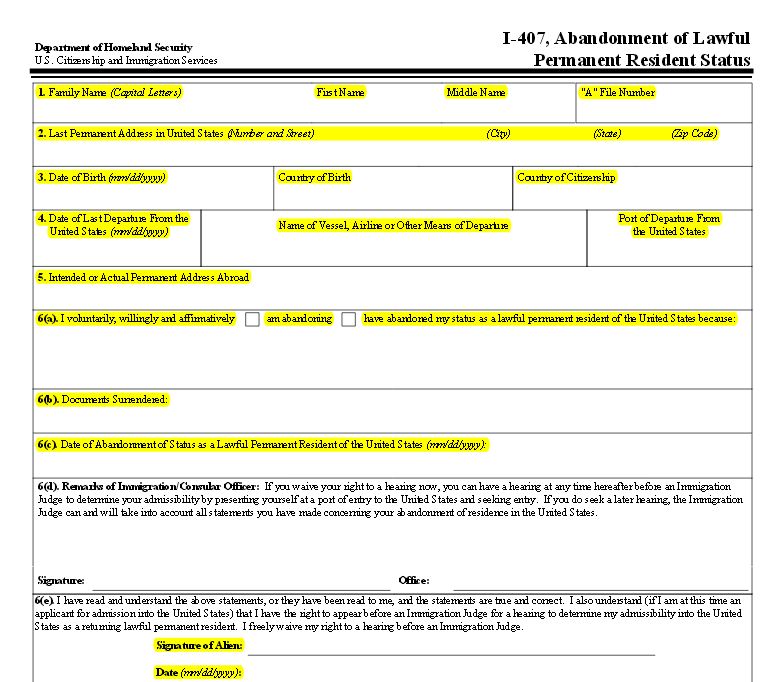
 Also, lawful permanent residents who formally abandon their “green card” status will do so by filing an Abandonment of Lawful Permanent Resident Status Form I-407.
Those LPRs who mail the Form I-407, will never receive any type of confirmation from the government, other than their own copies of documents filed and proof of mailing it (e.g., certified mail, return receipt). If the Form I-407 is presented to the U.S. Consulate or Embassy, the individual should receive a stamped copy of the form which should be given to the former LPR by the consular officer.
However, the Internal Revenue Service (“IRS”) which has very different responsibilities as compared to the U.S. Department of State, does not issue any sort of similar document to the CLN. There is no equivalent “Tax CLN.” Indeed, many individuals feel let down or “without closure” when they learn that it is a one-way flow of information; from the individual to the IRS. The IRS does not have an obligation to even confirm receipt of the documents filed with the IRS.
This is quite disorienting for many USCs and LPRs residing overseas, where the revenue authority in their country will regularly give a confirmation of tax documents received. Sometimes, a government will provide a confirmation of the taxes owing and paid through some specific type of feedback or response.
The IRS does no such a thing; and there is no document that will come from the IRS certifying “tax expatriation” has occurred.
The legal burden is therefore generally on the taxpayer to be able to prove the filing of the tax returns and IRS Form 8854. See, How many former U.S. citizens and long-term lawful permanent residents have filed (or will file) IRS Form 8854?
Filing the returns through an overnight courier service (e.g., DHL, Federal Express, etc.) and maintaining the proof of mailing and delivery is always important. If the tax documents are filed from the U.S., they should always be sent with such proof, or via U.S. certified mail, return receipt. One recommendation/pointer, is to ask the IRS to stamp date the receipt (e.g., a copy of the cover/transmittal letter) and return it to you in a self-addressed return envelope.
All of this is quite important, particularly to get the “clock ticking” against the IRS to bring an audit, under the statute of limitations period. See, When the U.S. Tax Law has no Statute of Limitations against the IRS; i.e., for the U.S. citizen and LPR residing outside the U.S.
Loss of US Nationality – Renunciation versus Relinquishment?
[The following is a Guest Post from Immigration Lawyer Ms. Teodora Purcell and does not address tax issues.
A word of caution – Do not be lulled in to thinking that by “relinquishment” you have escaped the federal tax consequences of Sections 877, 877A, 2801, 7701(a)(50), et. seq. See, Why Section 7701(a)(50) is so important for those who “relinquished” citizenship years ago (without a CLN)] See also, How many former U.S. citizens and long-term lawful permanent residents have filed (or will file) IRS Form 8854?]
Loss of US Nationality – Renunciation versus Relinquishment?
If you are a US citizen or a US non-citizen national,[1] you can lose your nationality (“expatriate”) by committing certain acts specified in the immigration statute [2] voluntarily and with the intention to relinquish your nationality.[3]
Expatriation is a personal right that cannot be exercised by another, for example, a parent cannot renounce the US citizenship of a minor child. Your motivation is also not relevant, unless you later claim you gave up your US citizenship under duress or involuntary
How can you lose US nationality?
You can lose your US nationality as a result of renunciation or relinquishment and if you make such a claim, the burden is on you to show by preponderance of the evidence (i.e. more likely than not) that all requirements have been met.[4]
The most unequivocal and the formal way of losing your US nationality is by virtue of renunciation, i.e. when you formally give up your US citizenship by taking a sworn renunciation oath before a diplomatic or consular officer abroad[5].
Other expatriating acts under the immigration statute include: entering or serving in the armed forces of a foreign state engaged in hostilities against the United States or serving as a commissioned or non-commissioned officer in the armed forces of a foreign state; or accepting policy level employment with a foreign government after the age of 18 (if you have the nationality of that foreign state or an oath of allegiance is required in accepting the position);; or if are convicted of treason against the US Government.[6]
The expatriating act must occur abroad (except for an oath of renunciation taken during the state of war or conviction of treason) for it to be effective.[7]
If you perform an expatriating act listed in the statute, there is a rebuttable presumption that it was voluntarily.
If you relinquish your US citizenship, you must establish not only the expatriating act, but also your intent to expatriate and complete a detailed questionnaire (Form DS-4079, Request for Determining Possible Loss of US Citizenship) [8] have an interview with a US diplomatic or consular officer abroad, and get it approved by a Department of State (DOS) official which will issue a Certificate of Loss of Nationality of the United States, Form DS-4083 (CLN)[9].
Formal renunciation of citizenship at a US Consulate is the quicker and more unequivocal way to give up your US citizenship.[10]
However, if you renounce your US citizenship, it is much more difficult to establish a lack of intent or duress if you seek reconsideration at a later time.
[1] INA § 308
[2] Immigration and Nationality Act (“INA”)
[3] INA § 349
[4] INA § 349(a)
[5] INA § 349(a)(5). Also, 7 FAM § 1210 and § 1280
[6] INA § 349 (a)
[7] INA §349(a)(6)
[8] Form DS-4079 –
[9] Form DS-4082 –
[10] INA § 349(a)(5). Also, 7 FAM § 1210 and § 1280
Teodora Purcell | Attorney at Law
FRAGOMAN
11238 El Camino Real, Suite 100, San Diego, CA 92130, USA
Direct: +1 (858) 793-1600 ext. 52424 | Fax: +1 (858) 793-1600
TPurcell@Fragomen.com
How many former U.S. citizens and long-term lawful permanent residents have filed (or will file) IRS Form 8854?
How many former U.S. citizens and long-term lawful permanent residents have filed (or will file) IRS Form 8854?
Can this information be obtained directly from the IRS through a Freedom of Information Act (“FOIA”) request?
See, Does IRS Notice 2009-85 regarding expatriation have the “force of law”? Posted April 14, 2014.
Unfortunately, the law has left much confusion for USCs and LPRs living overseas who have –
- “relinquished” their citizenship many years ago (in the case of USCs), or
- terminated U.S. income tax residency by application of a U.S. income tax treaty (in the case of LPRs).
See, Why Section 7701(a)(50) is so important for those who “relinquished” citizenship years ago (without a CLN)
See, Countries with U.S. Income Tax Treaties & Lawful Permanent Residents (“Oops – Did I Expatriate”?)
The one certainty under the law, is that any former USC or LPR, regardless of their wealth or income, will necessarily be a “covered expatriate” if they do not file IRS Form 8854 and meet the certification requirements under the law.
This begs the question: how many have filed IRS Form 8854?
See, Revisiting the consequences of becoming a “covered expatriate” for failing to comply with Section 877(a)(2)(C). (Posted on April 16, 2014)
The List is Out – and Its 1,001 Former U.S. Citizens for the 1st Quarter 2014
The IRS published today the list of former U.S. citizens for the first quarter of 2014 and it can be reviewed here. It’s a record for any first quarter by 47%.
This is a record pace from any prior year, considering the entire year of 2013 had a record pace of 2,999 former U.S. citizens for the entire year. The 1,001 listed persons in the first quarter of 2014 is a 47% increase over the 679 former citizens published in the same period a year ago. No other first quarter list had more than 500.
There are a number of interesting questions that are created by this trend.
- Does the IRS have access to the data for former lawful permanent residents? That information is not published under the statute (Section 6039G), which only covers U.S. citizens. Does the Department of Homeland Security track former LPR – names, addresses, etc.?
- Will the IRS simply select the list of published former citizens for audits? The complete set of lists going back to the mid-1990s can be reviewed here. Quarterly Publications.
- How many former citizens are not included in this quarterly list? The statute provides the names are compiled from data received from the U.S. Department of State and the federal agency principally responsible for immigration, among others..
- How many of these former citizens will be subject to the US$10,000 penalty under Section 6039G(c)?
- How will the IRS collect tax and penalty assessments against individuals who live exclusively outside the U.S.?
There has been a clear trend of a growing list of former U.S. citizens. As more “Accidental Americans” learn they are U.S. tax residents by virtue of their U.S. citizenship, I think the trend will continue. The longer term consequences will be interesting as they unfold.
???????????????? ?Please click here to view the above in Chinese.?