International Tax · Citizenship Renunciation · LPR Abandonment
International Tax Shareholder
Federal District Court Rules in Favor of Mexican Citizen – Aroeste vs. United States (LPR) – Tax Treaty Applies: Government’s Motion for Summary Judgment is Denied
Last week (Nov. 20, 2023), Judge Battaglia in the Southern District of California (San Diego) ruled in favor of our client Mr. Alberto Aroeste regarding the application of the U.S.-Mexico Tax Treaty. The DOJ, Tax Division arguments on behalf of the Internal Revenue Service in the case (and their Motion for Summary Judgment – MSJ) were largely rejected by the Court.
A thorough read of the Order from the Court is recommended to understand the substantial legal findings and legal analysis made by the Court relevant to those who possess a “green card” referred to as “lawfully admitted for permanent residence” in Title 8, § 1101(a)(13) [Immigration and Nationality Act]. Key to this case, Title 26, § 7701(b)(6) [Federal Tax Code] then rather contorts the concept by saying an individual is a “lawful permanent resident” in accordance with immigration laws; but then goes on to put conditions on who apparently is a “lawful permanent resident” for federal tax purposes. While immigration law requires the individual be ” . . . accorded the privilege of residing permanently in the United States as an immigrant in accordance with the immigration laws, such status not having changed”; the tax definition seems to ignore that status (i.e., has it changed and is the personal no longer accorded the privilege of residing permanently in the U.S.?).
The Board of Immigration Appeals (the “Board”), has long recognized that an alien’s status may change by operation of law, such that an alien may abandon his LPR status without a finding of removability (or, formerly, deportability or excludability) after a formal adjudicatory process. See United States v. Yakou, 428 F.3d 241, 247 (D.C. Cir. 2005); at 247-51 (discussing case law regarding abandonment and holding that an alien may abandon LPR status without formal administrative action); see also Matter of Quijencio, 15 I. & N. Dec. 95 (B.I.A. 1974); Matter of Kane, 15 I. & N. Dec. 258 (B.I.A. 1975); Matter of Muller, 16 I. & N. Dec. 637 (B.I.A. 1978); Matter of Abdoulin, 17 I. & N. Dec. 458, 460 (B.I.A. 1980); Matter of Huang, 19 I. & N. Dec. 749 (B.I.A. 1988).
The Court did not need to get into the nuances of immigration law to rule against the government in this case.
Some of the substantial takeaways from the decision are:
Waiver of the Tax Treaty: The government cannot assert an individual waived the treaty law because she initially filed the wrong IRS forms (1040) instead of the non-resident form (1040NR) and IRS Form 8833.
The Court agrees with Aroeste. Although Aroeste gave untimely notice of his treaty position, the Court finds this does not waive the benefits of the Treaty as asserted by the Government. Rather, I.R.C. § 6712 provides the consequences for failure to comply with I.R.C. § 6114, namely a penalty of $1,000 for each failure to meet § 6114’s requirements of disclosing a treaty position.
Aroeste v United States – Order 20 Nov 2023 (p. 17)
Expatriation Tax form – IRS Form 8854: Validity and its Failure to Comply with the Administrative Procedure Act (“APA”)
C. Whether Aroeste Was Required to File Form 8854 The Government next argues that even if the IRS had accepted Aroeste’s amended returns, neither amended return would have properly notified the IRS of a commencement of treaty benefits because both failed to attach Form 8854, as required by IRS Notice 2009-85. (Doc. No. 76-1 at 4–5.) The Government concedes Aroeste attached Form 8833 to both amended forms. (Id.) Aroeste responds that Notice 2009-85 is not binding authority as it fails to comply with the Administrative Procedures Act (“APA”). (Doc. No. 78-1 at 8 (citing Green Valley Investors, LLC v. Comm’r of Internal Revenue, 159 T.C. No. 5, at *4 (Nov. 9, 2022)) (under the APA, agencies must follow a three-step procedure for “notice-and-comment” rulemaking, but this requirement does
not apply to “interpretive rules, general statements of policy, or rules of agency organization, procedure, or practice.”).) The Court agrees. In Mann Construction, Inc. v. United States, 27 F.4th 1138 (6th Cir. 2022), the court found that Notice 2007-83 failed to comply with the APA’s notice-and-comment procedure. Similarly here, because Notice 2009-85 has not been subject to a notice-and-comment procedure, it does not comply with the APA and thus is not binding. As such, Aroeste was not required to file Form 8854 with his amended returns.
Aroeste v United States – Order 20 Nov 2023 (p. 11)
Tax Treaty Law Applies – Article 4 Regarding Tax Residency
Various detailed analysis and discussions from the Court –
Aroeste v United States – Order 20 Nov 2023 (p. 11-14)
The Preamble to the FBAR Regulations is Not the Law –
. . . the Government points to the preamble to the 31 C.F.R. Part 1010 regulations, providing that “[a] legal permanent resident who elects under a tax treaty to be treated as a non-resident for tax purposes must still file the FBAR.” Amendment to the Bank Secrecy Act Regulations—Reports of Foreign Financial Accounts, 76 Fed. Reg. 10234-01 (Feb. 24, 2011). The Court finds this unavailing. The Government’s argument does not refute the plain language of the FBAR regulations, which explicitly invoke provisions of Title 26, including the provision that requires consideration of an individual’s status under an applicable tax treaty for the purpose of determining whether an individual is a “United States person” subject to FBAR filing. Specifically, Title 31 C.F.R. § 1010.350, which governs reporting of FBARs, subsection (b)(2) states that a “resident of the United States is an individual who is a resident alien under 26 U.S.C. 7701(b) and the regulations thereunder . . . .” The Government fails to cite to any case law or statue indicating otherwise, and the Court finds none. As such, because the Court finds the Treaty applicable to Aroeste, then the residence provisions of the Treaty, or the “tie breaker rules” dictates whether Aroeste may be treated as a nonresident alien.
Aroeste v United States – Order 20 Nov 2023 (p. 14)
This is the third court case (the other two were in U.S. Tax Court) I have had over the last several years where the IRS tried to assess substantial penalties and taxes against LPRs who resided substantially outside the United States. The other two cases were conceded by the IRS prior to going to trial. One case had over US$40M at stake as assessed by the IRS. This case, in federal district court, was pushed all the way to this favorable (to Mr. Aroeste and those around the world in similar circumstances) outcome by the government. We were successful with all of these non-U.S. citizen cases (two brothers from Mexico and an individual from Germany).
Short Window of Wait Times for CLN: One Month to 6 Weeks?
The wait times for the State Department to issue a Certificate of Loss of Nationality (“CLNs”) used to be quite long, based upon the author’s experience with various clients. That has all changed since about the beginning of this year 2023. The author has seen cases that are taking less than 6 weeks from the date of the meeting to take the oath of renunciation before a consular officer.
Too Much? – Treasury Proposes Changes in the Expatriation Tax Law – per Green Book (2023 Fiscal Year) – Part I of II
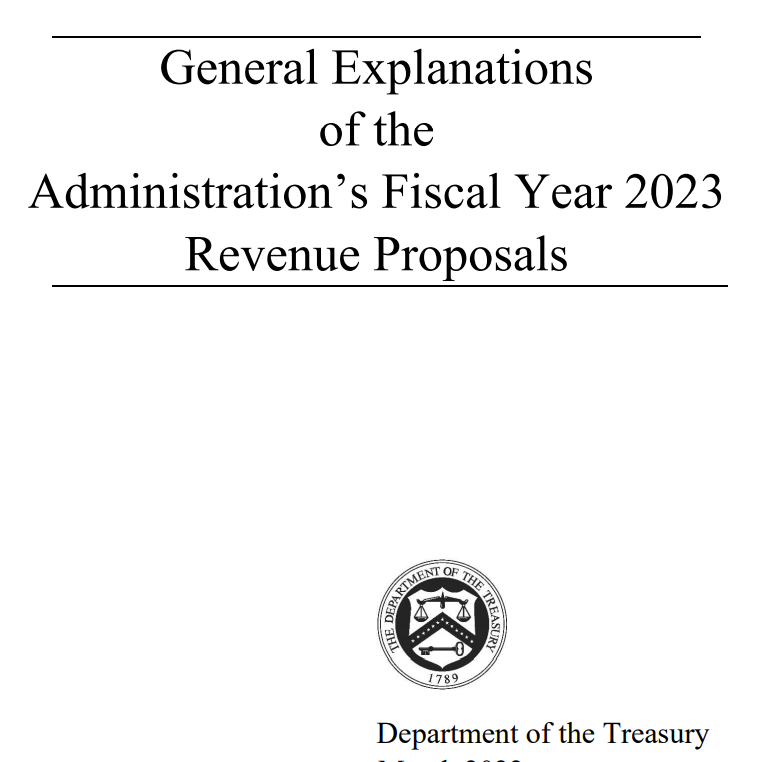
The Administration made specific proposals in its Fiscal Year 2023 Revenue Proposals to modify key provisions in the law associated with “covered expatriates.” Importantly, they proposed two key concepts that can have far reaching consequences –
Creating, in effect, a new monitoring system of those who become “tax expatriates” – specific to filing of IRS Form 8854 – and
Extending the statute of limitations period indefinitely in the event IRS Form 8854 is not filed by the “tax expatriate”.
What does this mean from a practical perspective to individuals around the world? Specifically, to (i) citizens who formally renounce their citizenship, and (ii) lawful permanent residents who have left the U.S. and did not formally abandon their immigration status with USCIS?
First, anyone who fails to file IRS Form 8854 with their tax return or files a false or inaccurate form has to be concerned under current U.S. tax law.
The U.S. federal tax law has a specific crime, for making a false statement or signing a false tax return or other document – which is known as the perjury statute (IRC Section 7206(1)). This is a criminal statute, not civil. Some people are also under the misunderstanding that a false tax return needs to be filed. The statute is much broader and includes “. . . any statement . . . or other document . . . “.
(1) Declaration under penalties of perjury
Willfully makes and subscribes any return, statement, or other document, which contains or is verified by a written declaration that it is made under the penalties of perjury, and which he does not believe to be true and correct as to every material matter; or . . .
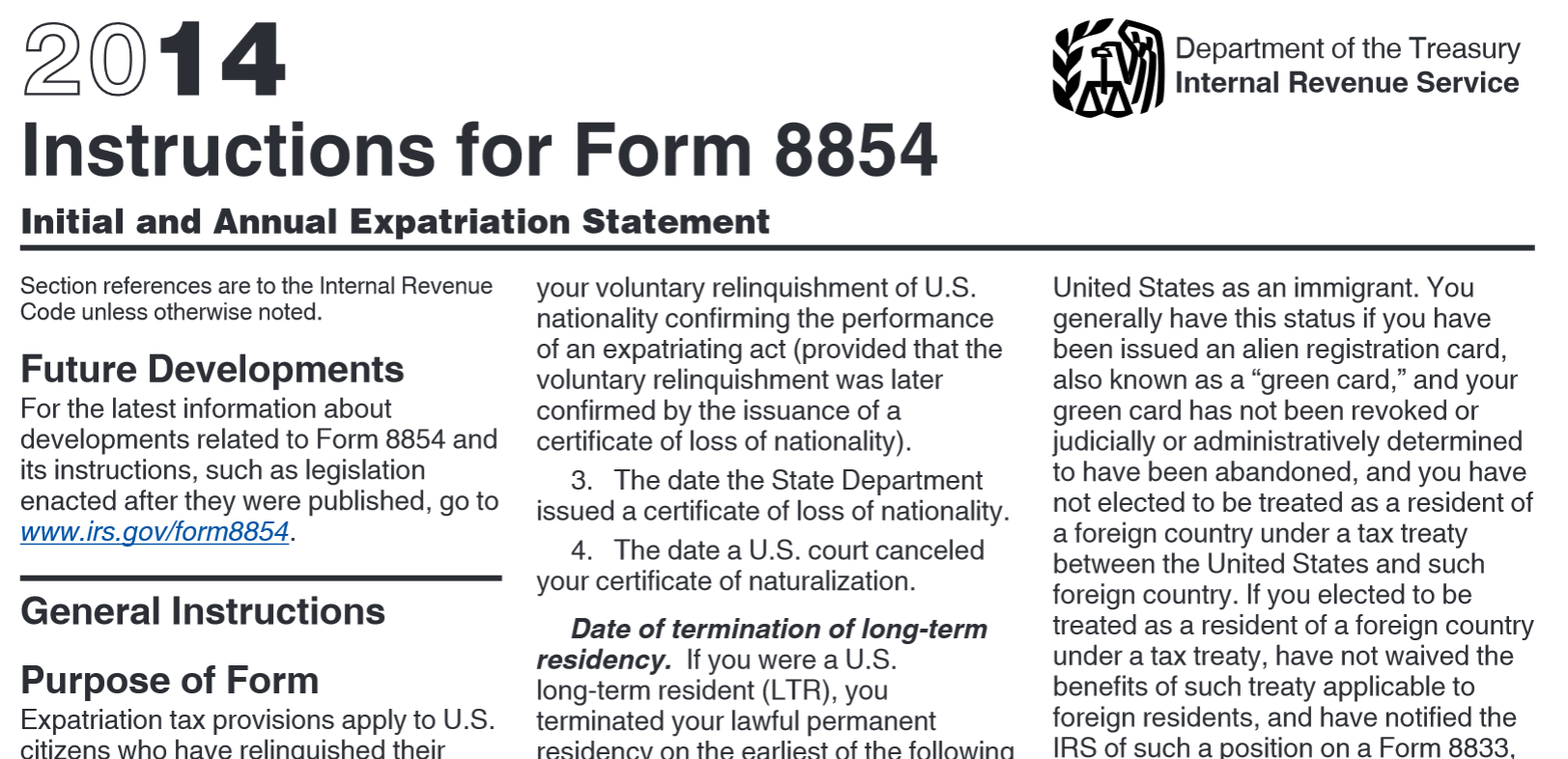
The IRS Form 8854has a specific penalty of perjury signature requirement independent of any U.S. federal income tax return to be filed. See the current language below:
See a prior post –
* Filing False Expatriation Tax Form – IRS Form 8854
Filing a false IRS Form 8854 . . . becomes problematic quickly for any individual who carelessly discloses inaccurate asset information (or no asset information at all). See, the 2016 indictment of a NY business professor discussed previously here: Expatriation Tax Form 8854 is Part of Criminal Tax Case
In addition to these cases, the Department of Justice has been actively involved in pursuing criminal charges against various individuals associated with tax expatriation cases. See the U.S. Supreme Court of last year to take up a criminal case – Regarding an Unnamed Law Firm that Advises International Tax & Expatriation Matters. A petition for a writ of certiorari to the U.S. Supreme Court was unsealed regarding the 9th Circuit case, In re Grand Jury, case Nos. 21-55085, 21-55145. In that case a law firm and a company was held in contempt of court: Re: a Grand Jury Subpoenas –
The panel affirmed the district court’s orders holding appellants, a company and a law firm, in contempt for failure to comply with grand jury subpoenas related to a criminal investigation, in a case in which the district court ruled that certain dual-purpose communications were not privileged because the “primary purpose” of the documents was to obtain tax advice, not legal advice.
Importantly, the IRS and the DOJ currently have extensive legal tools at their disposal to pursue taxpayers who may owe taxes as a result of becoming a “covered expatriate.” The above criminal cases reflect their interest and appetite in pursuing such cases.
In addition to criminal exposure, the civil tax exposure can be extensive and the IRS is not shy about assessing tax and international information penalties (even if the assessment for penalties such as not filing IRS Form 5471 are unlawful, as determined by the U.S. Tax Court recently – ). See April 3rd, 2023 decision by the United States Tax Court (the “Tax Court”) – Farhy,[6] stating that the IRS does not have statutory authority to assess penalties under section 6038(b).
The next Part II post will discuss the details of the Administration’s proposed change.
Spoiler Alert: The Author thinks its highly unlikely these changes will be adopted by Congress!
Russian Citizen who Expatriated from U.S. – Pleads Guilty to Tax Fraud – US$500M Penalty
I previously wrote about how this blog (with few posts on my part over the last couple of years) is not unlike Kipling’s observation –
” . . .Oh, East is East, and West is West, and never the twain shall meet. . . ”
. . . in that it addresses principally civil federal tax law [the East] but sometimes (not never 🙂 ) crosses over from civil to criminal [the West]. In that May 2020 post, I covered the indictment in the Northern District of California of a Russian citizen who had become a naturalized U.S. citizen (“NUSC”). As a NUSC he necessarily was a “covered expatriate” upon renunciation as has been explained here in other posts. See, When does “Covered Expatriate” Status -NOT- matter?
Mr. Oleg Tinkov was indicted in May 2020 under 26 U.S.C. § 7206(1) – for Making and Subscribing A False Tax Return, Statement, and Document (Two Counts). The Indictment was originally filed under seal and the docket can be reviewed here. His sentencing is set for October 29, 2021.
As explained therein, he renounced his U.S. citizenship many years prior to the indictment – nearly 7 years before he was even criminally indicted:
11. On or about October 28, 2013, TINKOV expatriated from the United States by renouncing his U.S. citizenship before a diplomatic and consular officer of the United States.
As a very wealthy individual, the value and accuracy of his assets reflected on his Form 8854 would have been significant factually in this case. Particularly, since as a NUSC he would necessarily have been a “covered expatriate” and hence subject to the “mark-to-market” tax on his worldwide income upon his expatriation. The amount of the tax is calculated upon the amount and fair market value of the assets on the ” . . . day before the expatriation date. . . ” 26 U.S. Code § 877A(a)(1).
* Filing False Expatriation Tax Form – IRS Form 8854
Filing a false IRS Form 8854 and therefore necessarily a false tax return, becomes problematic quickly for any individual who carelessly discloses inaccurate asset information (or no asset information at all). See, the 2016 indictment of a NY business professor discussed previously here: Expatriation Tax Form 8854 is Part of Criminal Tax Case
Importantly, this is true even when a naturalized citizen decides to go back to her home country and leave the U.S. – including on a permanent basis; even when the taxpayer’s assets are located outside the U.S. This was the case with Mr. Tinkov per the indictment and the DOJ press release. See the harsh words in the DOJ press release of the guilty plea yesterday, October 1, 2021 – Founder of Russian Bank Pleads Guilty to Tax Fraud
“Tinkov renounced his U.S. Citizenship shortly after receiving millions of dollars,” said Acting Special Agent in Charge Darrell J. Waldon of the IRS-CI Washington D.C. Field Office. “Despite his knowledge of U.S. tax reporting requirements, he substantially understated his wealth on filings with the IRS. International tax cheats remain a priority for my office and our agency; and as such, the International Tax and Financial Crimes D.C.-based group will continue to aggressively pursue those committing international tax crimes.”
If you are a tax professional assisting in the preparation of tax returns and IRS Form 8854 Initial and Annual Expatriation Statement what duty to inquire do you have as to the accuracy and information provided to you by your client? What duty do tax professionals have to reasonably inquire as to “knowledge of client’s omission” – “information to be furnished” and “diligence as to accuracy”? Must the tax professional make reasonable inquiries if any information furnished to you appears to be incorrect, incomplete or inconsistent with other facts or assumptions of the taxpayer or her circumstances? Treasury Circular No. 230 §10.20, §10.21, §10.22, §10.34(d).
Can and will the U.S. federal government deny the ability of Mr. Tinkov to ever return to the United States pursuant to Title 8, U.S.C. Section 1101(a)(43) for being convicted of an aggravated felony? This is probably all moot considering it has been reported that Mr. Tinkoff was diagnosed with leukemia in March 2020 and has changed his life focus. Arrested Billionaire Banker Tinkov Switches Focus to Cancer Foundation
A Rochester, New York emeritus professor of business administration pleaded guilty today to conspiring with others to defraud the United States and to submitting a false expatriation statement to the Internal Revenue Service (IRS), announced Principal Deputy Assistant Attorney General Caroline D. Ciraolo, head of the Justice Department’s Tax Division, and U.S. Attorney Dana J. Boente of the Eastern District of Virginia, after the plea was accepted by U.S. District Judge T.S. Ellis III.
The importance of a complete and accurate IRS Form 8854, is to enable a taxpayer (if they meet other statutory requirements) to avoid “covered expatriate” status. See, the Tax Court case earlier this year 2016, Topsnik v. Commissioner (2016), where the Court found the taxpayer had failed to meet the certification requirements and was necessarily a “covered expatriate.”
Maybe most important of all, it is crucial the taxpayer understands the full range of legal and tax consequences to them regarding the important steps that might lead to “tax expatriation.” The law is complex and fraught with potential minefields. It’s always advisable to have thoughtfully analyzed and considered the consequences of “tax expatriation” long before taking specific steps (pre as opposed to post-expatriation) of renunciation of U.S. citizenship or abandonment of lawful permanent residency.
IT AIN’T FAIR: First (1) taxing me as a U.S. citizen and then (2) taxing me on my relinquishment or renunciation of U.S. citizenship or LPR abandoment and further (3) taxing my children on their inheritance from me!@!@!
This sums up the argument of many critics of U.S. citizenship based taxation of worldwide income.
Many may agree with this conclusion from an equity or sense of fairness argument. See proposal below at the end of this post.
Also, virtually no courts of the U.S. find U.S. tax laws to be unconstitutional. It is a very rare occurrence that the U.S. Supreme Court even takes up a tax case to determine its constitutionality. The “Obamacare” with broad application throughout society was a case heard by the Supreme Court which upheld a law signed by President Obama on March 23, 2010, more correctly called the Patient Protection and Affordable Care Act. That law increased Medicare taxes and imposed a penalty surcharge on individuals who do not maintain certain health coverage.
This paper proposes to eliminate the U.S. citizenship based taxation and create a consistent exit tax system. The complex web of the current U.S. tax law has made it nearly impossible for all but the most sophisticated U.S. citizens and lawful permanent residents (“LPRs”) residing overseas to file complete and accurate tax returns. The proposal should bring consistency, tax simplicity for taxpayers residing outside the U.S., and do so in part by eliminating the U.S. citizenship based tax system, which is unique in the world, dates to the civil war and is inappropriate for the global world we live in.
Summary of Current Status of the Law
To date, there is no serious and comprehensive proposal to modify the U.S. federal tax law imposing U.S. taxation of the worldwide income of USCs and LPRs residing outside the U.S.
How Many of the 5,211 Former U.S. Citizens (who Renounced in 2014 and 2015) are Still U.S. Taxpayers?
CORRECTION TO THIS POST: If you renounced your U.S. citizenship, you may think you cease to be a U.S. taxpayer. This depends upon when the termination of citizenship occurred.
More posts will follow addressing these issues.
Unfortunately, the law is not that simple, regardless of your wealth, income, assets or future inheritances or gifts.
The law continues to obligate certain former U.S. citizens to be subject to the U.S. taxation laws on a worldwide bases, unless and until they notify the IRS and certify under penalty of perjury. This depends upon the time of the renunciation.
Does the IRS have access to the USCIS immigration data for former lawful permanent residents (LPRs)?
Information about former LPRs, such as the individuals names, is not published under the statute, IRC Section 6039G, which only covers former U.S. citizens.
This raises the question of whether the Department of Homeland Security tracks former LPRs – names and addresses overseas and provides that information to the Internal Revenue Service?
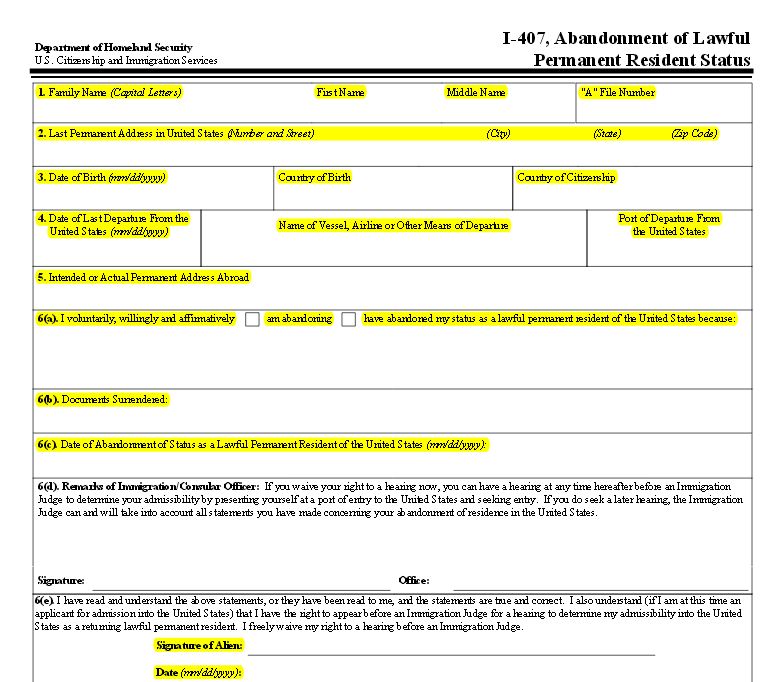
The new I-407 Form requires much more information and is 2 pages in length. The old form had only 6 lines and was less than 1/2 of a page in length. These forms are set forth here. The new form requires the address overseas of the individual.
The complete set of lists going back to the mid-1990s can be reviewed here. Quarterly Publications.
Of course, the IRS can easily select and identify individuals for audit, by simply drawing from the published names of former U.S. citizens, which is currently tracking at an average of about 850 former USCs quarterly. In contrast, the number of former LPRs who have filed USCIS Form I-407 is tracking at an average of about 4,000 to 5,000 individuals quarterly.
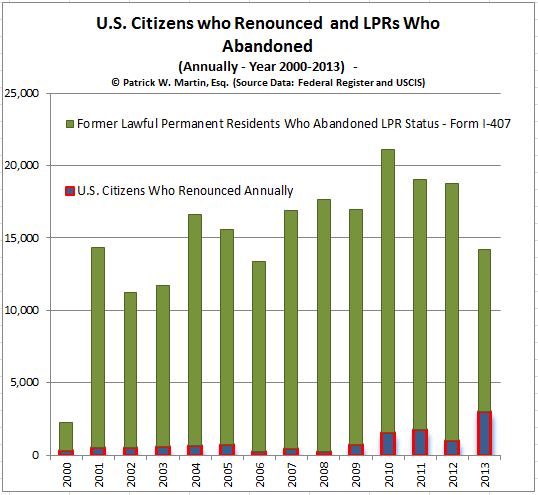
While citizens are often the focus of the public press and Congress regarding “expatriation taxation”; the statute also wraps in so-called “long-term residents.” These are individuals who had or continue to have “lawful permanent residency status.” There are numerous technical considerations in this area, but needless to say, the number of former lawful permanent residents who have simply filed Form I-407 – Abandonment is far in excess of those U.S. citizens who have filed for and received a Certificate of Loss of Nationality (“CLN”) – Form DS-4083 (CLN). The graph reflects the enormous difference.
While the IRS has specific information about U.S. citizens, it is not clear whether the Department of Homeland Security via the USCIS provides data to the IRS regarding lawful permanent residents who have filed Form I-407? If such an individual becomes a “covered expatriate” under the U.S. tax law, the range of adverse tax consequences can follow them and their future beneficiaries and heirs, including as follows:
“mark to market” taxation on their worldwide assets,
40% inheritance tax to U.S. beneficiaries,
40% tax on gifts to U.S. beneficiaries,
etc.
It seems fairly easy, from a legal perspective, that the IRS can request the names, addresses (and indeed the newly completed form) from the USCIS of all individuals who have filed USCIS Form I-407. From the USCIS records, the IRS will be able to determine if the individual was a “long term resident” based upon the number of years the individual had such status.
Assuming the IRS determines the individual is a long term resident, they can then simply check to see if the they have received IRS Form 8854 from the former LPR; in order to determine if she or he satisfied the certification requirement of Section 877(a)(2)(C). If not, the IRS will necessarily know the individual is a “covered expatriate.”
This article reported that his U.S. tax bill was at issue – :
In case you missed it: London Mayor Boris Johnson has said he will renounce his U.S. citizenship following a high-decibel tax squabble with his country of birth. At issue: a tax bill U.S. tax authorities claimed he owed on some London property. The mayor will (of course) keep his citizenship in the U.K. as his political ambitions continue to play out.
Surely, he will be careful and thoughtful about the steps he is taking as part of his U.S. citizenship renunciation. His reported response to the news reporter last year could prove risky under U.S. law, to the extent he intentionally refuses to file U.S. income tax returns and pay taxes. The following line of questions and answers could be quite damning for him:
Presenter Susan Page then pressed him whether he would pay the bill, to which he said: “I think it’s outrageous.
“Well, I’m – no is the answer. Why should I? I haven’t lived in the United States for, you know, well, since I was five years old.
“I could but I pay – I pay the lion’s share of my tax, I pay my taxes to the full in the United Kingdom where I live and work.”
Here, the London Mayor has indicated he is not filing tax returns, yet knows he has a legal duty to file them and pay a tax owing under U.S. law. He goes further to say “I could . . . pay . . .” While rarely used standing alone by prosecutors (without other criminal claims brought), it is a crime that carries up to a 12 month prison sentence, to not file a U.S. return, supply information or pay tax; see, IRC § 7203. The relevant language of the statute is as follows:
Any person required under this title to pay any estimated tax or tax, or required by this title or by regulations made under authority thereof to make a return, keep any records, or supply any information, who willfully fails to pay such estimated tax or tax, make such return, keep such records, or supply such information, at the time or times required by law or regulations, shall, in addition to other penalties provided by law, be guilty of a misdemeanor and, upon conviction thereof, shall be fined not more than $25,000 ($100,000 in the case of a corporation), or imprisoned not more than 1 year, or both, together with the costs of prosecution.
Here, the government has yet another stick it can pull from its bag of sticks to be used against current and former U.S. citizens residing outside the U.S. It is of course, very common, that individuals who have spent most of their lives outside the U.S. have not filed any U.S. tax returns nor paid any U.S. income taxes. At what point, might these individuals have U.S. civil tax liability and what facts are necessary to give rise to criminal tax liability?
The vast majority of U.S. citizens residing overseas owe little to no U.S. income taxes because (i) modest income amounts and the impact of the “foreign earned income exclusion” or (ii) they reside in a country with higher taxes and tax rates than the U.S. because of the “foreign tax credit”. See, USCs and LPRs Living Outside the U.S. – Key Tax and BSA Forms
A couple observations about London Mayor Boris Johnson. First, he would be well advised not to make public statements about filing [or not] U.S. tax returns or paying [or not] U.S. taxes. Second, he will want to carefully consider completing and filing accurate U.S. tax returns as part of his formal renunciation process; particularly for the year in which he sold his London home tax free under UK laws. Third, he will want to understand carefully, the details of what is and should be filed on IRS Form 8854, after he has visited the U.S. embassy and files his Form DS-4080, Oath of Renunciation of the Nationality of the United States.
Finally, the case could present a unique international political and public relations nightmare for the U.S. Department of Justice, if they decided to bring any sort of criminal tax charges against the London Mayor. It would seem highly unlikely in my opinion.
“. . . The Assistant Attorney General, Tax Division . . . must approve any and all criminal charges that a United States Attorney intends to bring against a defendant in connection with conduct arising under the internal revenue laws, regardless of which criminal statute(s) the United States Attorney proposes to use in charging the defendant. See 28 C.F.R. § 0.70.
Also, only the Tax Division can authorize warrants of public officials, which presumably would extend to London Mayor Boris Johnson. See, See, 6-4.130, Search Warrants.
The President’s Proposal is NOT the Same as Current Law – Section 877A(g)(1)(B)
Some individuals are mistaken that the Obama proposal to exempt certain U.S. citizens from taxation (including the “mark to market” exit tax), is the same as the exception in IRC Section 877A(g)(1)(B).
It’s not. They are not the same, although they have some similar requirements (e.g., 5 years of certification of U.S. tax law compliance under penalty of perjury).
There are important differences. Most importantly, the IRC Section 877A(g)(1)(B) exception requires the individual not only have been a dual citizen (of at least two or more countries) at birth, along with U.S. citizenship; but also continue to reside and be a tax resident of that country, i.e., the country of which they were also a citizen at the time of their birth. This tax residency/dual citizenship rule is necessarily required by IRC Section 877A(g)(1)(B). If the person has moved to another country, they will not be eligible for this treatment and will be subject to the mark to market “exit tax” if they renounce their U.S. citizenship. Their U.S. heirs and beneficiaries will also be subject to the 40% (current tax rate) tax on “covered gifts” and “covered bequests.”
–
The President’s proposal (if it ever becomes law) will also apparently exempt all qualifying individuals from any type of U.S. taxation; other than tax that would apply to a “non-resident alien” (which would be no U.S. tax – if the individual had no U.S. source income). Not only would no “exit tax” apply, but so too would no U.S. income tax on their income from their country of residence or any other country outside the U.S. The President’s proposal would also exempt them from all U.S. tax filing requirements (other than the 5 years) and from FBAR filing requirements. See, Nuances of FBAR – Foreign Bank Account Report Filings – for USCs and LPRs living outside the U.S.







 Statement