Certification Requirement of Section 877(a)(2)(C) – (5 Years of Tax Compliance) and Important Timing Considerations per the Statute
People who cite to IRS forms, should have an appreciation that neither the form or its conditions may have the “force of law.” This is particularly important, when the statute itself, regarding the Certification Requirement of Section 877(a)(2)(C) does not specific whether the certification has to be made “prior to” (or after) the date of loss of nationality? See the relevant provision of the statute below – Section 877(a)(2)(C), which causes an individual to be a “covered expatriate” if::
- (C) such individual fails to certify under penalty of perjury that he has met the requirements of this title for the 5 preceding taxable years or fails to submit such evidence of such compliance as the Secretary may require.
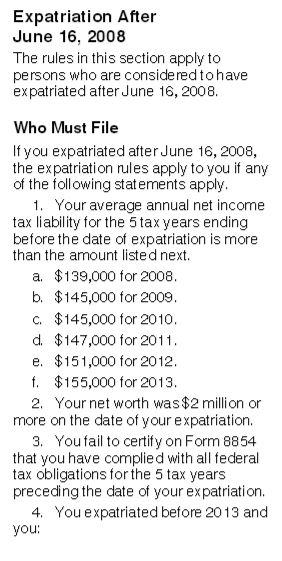
Consider the language of the instructions of IRS Form 8854, however, which expressly states that the certification must reflect you have ” . . . complied with all of your federal tax obligations for the 5 tax years preceding the date of your expatriation.”
Does this mean the IRS requires the compliance to have been satisfied prior to the expatriation/renunciation date? That is what the instructions say.
See the bottom of page 2 of the Form 8854 instructions –
“If you expatriated after June 16, 2008, the expatriation rules apply to you if any of the following statements apply.
1. Your average annual net income tax liability for the 5 tax years ending before the date of your expatriation is more than the amount listed next . . .
2. Your net worth is $2 million or more on the date of your expatriation.
3. You fail to certify on Form 8854 that you have complied with all of your federal tax obligations for the 5 tax years preceding the date of your expatriation.”
In this case, the instructions to the form, say the former USC or LPR must ” . . . have complied with all of your federal tax obligations preceding the date of your expatriation. . . ”
If this statement were true, a taxpayer could not satisfy the rule by attempting to comply with all federal tax obligations after they have renounced their U.S. citizenship?
In other words, if such were true, attempting to comply with all provisions of the U.S. federal tax law for 5 years and then filing 8854, all after taking the oath of renunciation, would prohibit someone from avoiding “covered expatriate” status?
Importantly, the Treasury/IRS cannot create law by merely publishing a substantive rule in an IRS Form. Indeed, there are no regulations to date; that have been issued by the Treasury; only a few notices. See prior post, Does IRS Notice 2009-85 regarding expatriation have the “force of law”?
Of course, this does not mean the IRS will not challenge any former USC as not complying with Certification Requirement of Section 877(a)(2)(C) by not also complying with the condition set forth in the IRS own instructions?
This is an example of an important detail that any former USC will want to carefully consider prior to rushing off to take the oath of renunciation.
As always, see Limitations.
Read the Q&A format here.
Why the FBAR (late filed or never filed) is not a requirement for the Certification Requirement of Section 877(a)(2)(C) – (5 Years of Tax Compliance)
Myths abound about how and when the certification requirements must be satisfied under Section 877(a)(2)(C), in order to avoid “covered expatriate” status. See a previous post, Why “covered expat” (“covered expatriate”) status matters, even if you have no assets! The “Forever Taint”!
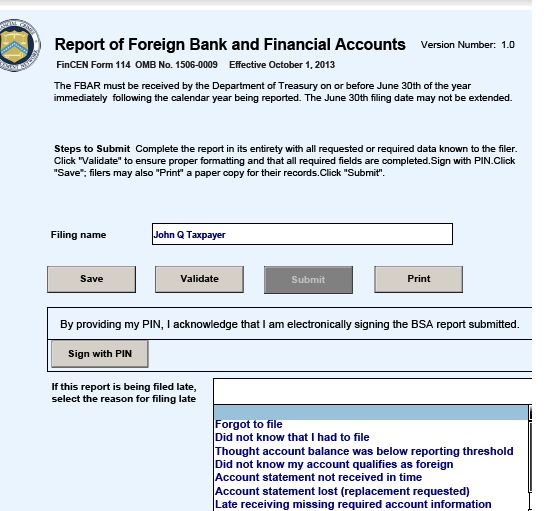
One common notion, is that if a USC or long-term LPR has not filed foreign bank account reports (“FBARs”) pursuant to Title 31, they will not be able to make the certification as required by the statute – Section 877(a)(2)(C), which causes an individual to be a “covered expatriate” if:
- (C) such individual fails to certify under penalty of perjury that he has met the requirements of this title for the 5 preceding taxable years or fails to submit such evidence of such compliance as the Secretary may require.
Importantly, the statutory reference to “this title” is a reference only to “Title 26, Internal Revenue Code,” i.e. the federal tax laws. It is not a reference to any other “Title” of the federal laws. The federal statutory laws are organized by “Titles“; e.g., Title 8 is “Aliens and Nationality” (i.e., immigration law) and Title 7 is “Agriculture”, etc.
Specifically, Section 877(a)(2)(C) of the tax law, does not also require the individual to be able to certify his or her compliance with any other title for the preceding 5 years, such as Title 31 Money and Finance: Treasury.
Title 31 is the law that creates the FBAR filing requirements and is known as the “Money and Finance: Treasury.”
Accordingly, someone who has not filed FBARs, i.e., and not complied with Title 31 or Title 7 (e.g., regarding “Agriculture”) will not be barred from being able to comply with the tax requirements of Section 877(a)(2)(C), if they have complied with “Title 26, Internal Revenue Code, i.e. the federal tax laws. See, Nuances of FBAR – Foreign Bank Account Report Filings – for USCs and LPRs living outside the U.S.
To put this into a concrete example, assume a USC living in Canada has filed complete and accurate U.S. federal income tax returns for the years 2008 through 2013; but never filed any FBARs regarding the Canadian corporate accounts over which the individual has had signature authority. Maybe this individual’s Canadian accounts also exceeded US$10,000 in at some point through the year? Nevertheless, if he or she renounces their U.S. citizenship in 2014, they should nevertheless, be able to avoid “covered expatriate” status by complying with Section 877(a)(2)(C), even though they failed to comply with Title 31 requirements.
As always, see Limitations.
Can the Certification Requirement of Section 877(a)(2)(C) be Satisfied “After the Fact”?
Probably most “Accidental Americans” around the world do not and have not filed U.S. federal income tax returns during their lifetimes. A most important issue for these individuals who are considering renouncing their USC, is whether they can satisfy the statutory requirement (set out below) late; i.e., “after the fact” – if they have not previously filed tax returns?
See the relevant provision of the statute below:
- (C) such individual fails to certify under penalty of perjury that he has met the requirements of this title for the 5 preceding taxable years or fails to submit such evidence of such compliance as the Secretary may require.
Can an “Accidental American” who has lived almost all of their lives outside the U.S., and who has never filed U.S. income tax returns satisfy the statutory language “. . . of the the requirements of this title [Title 26 – Federal Tax Laws] for the 5 preceding taxable years. . . “?
Some interpret the statute to say that filing late income tax returns (e.g., in 2014 for the years 2009 through 2013/2014) should be permissible, provided the former USC indeed satisfies all of the requirements set forth in the law at some later point in time.
Will the IRS argue late filings of tax returns means the taxpayer has not met the requirements of Title 26? Will they argue that a failure to file a timely return and violation of Section 6651 means such an individual did not meet the requirements of the law? See, § 6651 – Failure to file tax return or to pay tax, which provides in relevant part –
a) Addition to the tax
In case of failure—
(1) to file any return required under authority of subchapter A of chapter 61. . . on the date prescribed therefor (determined with regard to any extension of time for filing), unless it is shown that such failure is due to reasonable cause and not due to willful neglect, . . .
Will the IRS or Tax Division, Justice Department lawyers argue that any federal tax returns that are not timely filed under Section 7502, means that a former USC cannot have satisfy the statutory language of “. . . the requirements of this title [Title 26 – Federal Tax Laws] for the 5 preceding taxable years. . . “?
Obviously, the stakes can be very high for any such former U.S. citizen (or LPR), due to the consequences of being deemed a “covered expatriate.” See, Why “covered expat” (“covered expatriate”) status matters, even if you have no assets! The “Forever Taint”!
The Foreign-Born Population of the United States: Multi-National Families and “Tax Expatriation”
The U.S. is known as the “melting pot” of people and immigrants from around the world that fuse and mix together. The term became popularized from the 1908 play of the same name, The Melting Pot by Israel Zangwill.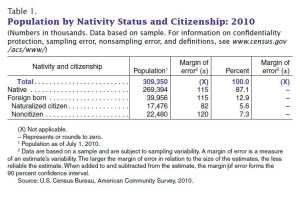
The United States Census Bureau publishes various data and statistics of foreign-born persons residing in the U.S., which can be reviewed here. Some highlights from the The Foreign-Born Population in the United States: 2010 are as follows (with nearly 40 million foreign born persons). What number of foreign resident family members might these 40 million persons have? What type of assets and businesses remain in the country of origin for these foreign-born persons?
The regions of greatest foreign-born populations is Latin America (21 Million), Asia (11 Million) and Europe only 4.8 Million.
 Why is this so important for “U.S. tax expatriation” purposes? As people move in and out of the U.S. (family members, entire families, newly wed members of a multinational family) necessarily may trigger the application of the U.S. tax expatriation provisions discussed in this blog. The tax issues can be particularly acute for lawful permanent residents. See, Countries with U.S. Income Tax Treaties & Lawful Permanent Residents (“Oops – Did I Expatriate”?)
Foreign born families regularly (if not most commonly) keep important ties with their home country. Some have the majority of their family members living in that country, assets and businesses from the country of origin or neighboring countries in the same economic region, and many may ultimately have a plan to move back to their country of origin.
More related information and details to come in future posts.
Online/Self Diagnoses: Great “Tax Myths” of “Expatriation” Propogated on the WWW – Internet
There are many misconceptions about how the U.S. federal tax law works in general; and specifically regarding the “expatriation tax” provisions. This resource – https://tax-expatriation.com/ – is specifically designed to try to bring clarity to these complex tax laws where there are many “tax myths” floating around in the internet.
This website of general information is certainly not a substitute for personal legal and tax advice to your specific circumstances. See, Limitations that explains why general legal information is not the same as legal advice, that is, the concrete application of law to a specific case with unique and particular facts.
In order to provide a public resource, this website tries to help clarify some of these myths. Incidentally, the internet is a great resource for information and at the same time – misi nformation, misleading information, self-help snake oil gibberish and the like. I am often times amused, in a disturbed way – if I realize how someone might be making an important life mistake because of the lack the information and knowledge a person demonstrates they have in this area of the law, based upon their writings.
As a wonderful example of this, see this WWW-website reference to medical self-diagnoses – which is ironic in so many different ways. It is written by “Dr. John Anderson” who is apparently not a medical doctor at all, but rather has a PhD in fisheries.
It is common to see lay persons (or even purported tax advisers) reading and interpreting the law in a way they wish it were; the way they see it most favorable to their own circumstances, etc. These internet interpretations are usually not well founded in the law, especially not a comprehensive reading of the law, and especially in light of how the IRS and U.S. Treasury interpret the law. These comments are often a regurgitation of something someone has read on the internet or heard from a friend or acquaintance or a particular website.
They often are full of “legal arguments” that at times smack of what U.S. courts have consistently found to be deemed “tax protestor” arguments which consistently lose in U.S. courts. Another post will be forthcoming explaining this important concept, as I expect we will see similar expatriation cases work their way through IRS tax audits, administrative tax appeals and eventually some will reach the U.S. courts surrounding the “expatriation tax” provisions.
The world wide web is a powerful tool, when used prudently.
Enough of my musings about how myths of U.S. “expatriation tax law” are compounded throughout the world with the WWW!
If the law is not clear in its application, I will say it is unclear. If the law has been interpreted specifically by a particular Court, I will provide a discussion of that opinion. The “expatriation tax law” is an area of the tax law which has NO case law to date. There is not a single case that has been litigated by a taxpayer or the government surrounding Section 877 or any of the companion provisions.
There are also no regulations to date; that have been issued by the Treasury; only a few notices. See, Does IRS Notice 2009-85 regarding expatriation have the “force of law”?
However, the Treasury is working on issuing regulations under Section 2801, regarding the tax on “covered gifts” and “covered bequests.” The proposed regulations under Section 2801 are expected within the next few months; hopefully before year end. I have prepared and presented specific comments and recommendations to the Treasury and IRS on these yet unissued proposed regulations. For more background, see, The “Hidden Tax” of Expatriation – Section 2801 and its “Forever Taint.”
Also, see, Why “covered expat” (“covered expatriate”) status matters, even if you have no assets! The “Forever Taint”!
Why “covered expat” (“covered expatriate”) status matters, even if you have no assets! The “Forever Taint”!
The point of this post is to explain why “covered expatriate” status does matter, even for those with no assets. Most people in the world, probably think the tax expatriation provisions only are for the rich, wealthy and worldwide private jet owners. This is how the press (and members of Congress) typically portray those who renounce U.S. citizenship. The press articles typically cover the likes of Ms. Tina Turner and Mr. Eduardo Saverin, co-founder of Facebook. See,Tina Turner – Famous People Who Renounced U.S. Citizenship.
Most articles focus on the “net worth test” (US$2M) and the “income tax liability test” (“US$125K+/-). See, Revisiting the consequences of becoming a “covered expatriate” for failing to comply with Section 877(a)(2)(C).
Unfortunately, U.S. “expatriation tax law”, applies to the poorest former U.S. citizen (and certain long-term LPRs), wherever they reside if they do not comply with the certification requirements of Section 877(a)(2)(C). See, Accidental Americans” – Rush to Renounce U.S. Citizenship to Avoid the Ugly U.S. Tax Web” International Tax Journal, CCH Wolters Kluwer, Nov./Dec. 2012, Vol. 38 Issue 6, p45.
So far so clear? But you are surely asking yourself, “this does not explain how this costs me any money or taxes, if I have no assets to begin with . . . “?
If the certification requirements are not satisfied, the individual with no assets should have no U.S. income tax to pay as he or she will have no unrealized gains. If there are no “unrealized gains”, there can be no tax base and hence no income tax caused by the “mark to market regime”.
However, there are two points of potential taxation under the law. First, when the USC or LPR leaves the U.S. (“expatriates”); which does not cause taxation in this example for the individual without “unrealized gains.” However, there is second point of taxation, under the law, which arises when a U.S. person receives a covered gift or bequest. IRC Section 2801. This might not happen until decades into the future, long after the expatriation event.
Incidentally, someone could have significant assets, without any unrealized gains. Both individuals (the rich and the poor) would be in the same position as they leave/expatriate from the U.S.; i.e., and have no U.S. income tax to pay. For instance, USC “A” with US$5,000 in total assets, would have the same income tax to pay ($0) as USC “B” with US$15M of cash in the bank; assuming no other assets. Neither would have unrealized gains upon which to cause any U.S. tax. This is because US dollars/”cash” have a tax basis – the same as the currency amount. Hence, there is no unrealized gains in US dollars-cash.
However, if in this case, assume both individuals (USC “A” and USC “B”) cannot satisfy the certification requirements of Section 877(a)(2)(C), and hence both would be “covered expatriates.” So what does that mean to them during their lifetimes (what U.S. tax might they have to pay)?
The potential U.S. tax created to both USC “A” and USC “B” in this circumstance, is IF AND WHEN, they were ever to make a future gift or bequest (directly or indirectly – e.g., through trust) to a U.S. person. At that point in time, the U.S. beneficiary will have to pay effectively a 40% tax on the fair market value of the property received. This tax is created under Internal Revenue Code Section 2801, that was passed in 2008. See, The “Hidden Tax” of Expatriation – Section 2801 and its “Forever Taint.” A common example is a child or sibling who is a dual national, who might inherit assets in the future.
The 40% tax is a lot of tax to pay – as there are virtually no deductions or exemptions from the amount of tax paid.
I have proposed a series of recommendations to the Treasury regarding concepts and provisions that hopefully will be incorporated into their propose regulation project under Section 2801. More to come on this important topic.
You might say – “I have no future U.S. beneficiaries and/or I have no assets. Why do I care?”
Very simply, you should care, if –
- You may grow your future assets (or inherit assets from others) while not being a U.S. citizen (post-expatriation). If that is your goal or your lot in life, you might end up with much more in assets than you have today (assuming you are the same as USC “A” in the example), while having virtually no assets today; and
- You may have family and friends who will become U.S. residents, even if none of them are today.
Assume USC “A” renounces citizenship and in 40 years leaves a bequest to a daughter of US$120,000; the daughter has moved to the U.S. In this case, the U.S. tax law would impose more than a US$40,000 tax on the daughter when she receives the inheritance. This is a very high tax burden to pay, on what is a relatively modest inheritance. This is one, of multiple scenarios of why “covered expatriate” status can be so important – over the long run.
In my practice, over the years, I have seen numerous cases where one single family member moves to the U.S. temporarily for work or study, e.g., graduate school, gets married and decides to stay on and live in the U.S., even for a while. Often times, they will have children, who will be U.S. citizens by birth in the U.S. Hence, a U.S. person is now part of the family tree.
Read the Q&A format here.
Famous Former U.S. Citizens – Oscar-winning actor Yul Brynner (Tax Rates Then and Now)
Yul Brynner was born as Yuliy Borisovich Briner in 1920 in Russia.
He won an Academy Award for best actor and two Tony Awards for the King and I.  He also played the Egyptian king Ramses II in The Ten Commandments.
He started the process for naturalization of U.S. citizenship in 1943 according to the document, Declaration of Intention, filed with the U.S. federal district court in the Southern District of New York.
Note the photograph and prior residence identified as Dairem South Manchuria,
as his last place of foreign residency; which is a major port city located in China in the Liaodong peninsula. Apparently, Dairem is popular with Russian tourists. He was Russian.

This is particularly interesting, since Yul Brynner was Russian and apparently moved to what was then known as “South Manchuria”?
He renounced citizenship in 1965 in Bern, Switzerland, apparently for tax reasons according to a biography about his life.
The highest U.S. federal income tax rate in 1965 was 70% (compared to today’s 39.6% rate). See, Personal Exemptions and Individual Income Tax Rates, 1913-2002. The income tax rate was substantially higher then, compared with the current rate, although it is a bit like comparing “apples” and “oranges”; since the tax deductions, exemptions and credits that existed in 1965, look little like the current law.
Social security taxes in 1965 were about 1/2 the tax rate as today, but it only applied to the first US$4,800 of income (which represents about $36,125 in inflation adjusted dollars today). Current social security rates apply to the first $117,000 of income, without limits on the Medicare portion of 2.8%. For historical social security rates, see,
???????????????? ?Please click here to view the above in Chinese.?
Surprise – You are Not a Citizen After All . . . NYT Article – After Forming Deep Roots in U.S., Man Discovers He Isn’t a Citizen
The New York Times has a fascinating article titled After Forming Deep Roots in U.S., Man Discovers He Isn’t a Citizen, May 12, 2014, by Lizette Alvarez.
The article discusses the “opposite” of someone considering expatriation; rather when a long-term resident of the U.S., who always thought he was a U.S. citizen, discovers he is not, to his dismay.
Ironically, if Mr. Mario Hernandez was never a U.S. citizen (and never a lawful permanent resident) he would be able to leave the U.S. without having adverse U.S. income tax consequences (nor his family and friends having adverse gift or inheritance tax consequences), if he can comply with the certification requirement of Section 877(a)(2)C). Never being a USC or a LPR is a blessing in disguise, when it comes to the application of the “expatriation tax” rules.
Since the resources dedicated in tax-expatriation.com focus on USCs and LPRs who reside outside the U.S., this is just a theoretical observation that surely would not be in the interest of this gentleman who has lived most of his life in the U.S. and has always considered himself a “U.S. person.”
NYT’s article –
. . . Mario Hernandez made a discovery recently that rattled him to his core: He is not an American citizen. In fact, he is not even a United States resident.
Nobody had ever told him. Not his mother or his grandparents. Not the United States Army, where he served for three years in the 1970s. Not the election supervisors in four states who tallied his votes in every major election since Jimmy Carter won the White House. Not the two state agencies where he was employed, one in Washington State and the other in Florida. And not the two federal agencies, including the Justice Department, where he spent most of his career as a prison supervisor handling notorious inmates and undergoing thorough background checks every five years. Citizenship is a requirement for the job.
The revelation came only after Mr. Hernandez and his wife, Bonita, started planning a trip to celebrate his recent retirement from the Bureau of Prisons after 22 years. The two had settled on a Caribbean cruise, which would have been Mr. Hernandez’s first time out of the country since arriving in 1965 as a Cuban refugee. On a cruise line website, he found out that a United States passport was a requirement. He did not have one and wondered whether he even had naturalization papers.
The article highlights a number of key considerations. First, how any U.S. citizen, living in any part of the world, must have a U.S. passport to enter into the U.S. See an earlier post – Coming to America. . . Accidental Americans Beware – The Law Requires a U.S. Passport!
There are a host of practical problems for people who live both in and outside of the U.S. who do not have a U.S. passport. This article highlights a very important example.
The article also demonstrates the complexity of anyone knowing with certainty, their own citizenship status and whether they are a “U.S. person” for U.S. federal income tax purposes. Imagine, the difficulties that financial institutions and companies throughout the world will have to comply with FATCA, as they attempt to identify whether their existing or new customer accounts or owners validly hold USC or LPR status. See, The Catch 22 of Opening a Bank Account in Your Own Country – for USCs and LPRs.
Incidentally, in the case of Mr. Mario Hernandez, he was a “U.S. person” for U.S. federal income tax purposes for all of the years he resided in the U.S. This is true, even if he had no legal immigration status to live in the U.S. Anyone satisfying the physical residency rules (“substantial presence test”), regardless of their legal or illegal immigration status, will be a U.S. income tax resident and subject to income tax and reporting on their worldwide income. See, “Tax Simplification: The Need for Consistent Tax Treatment of All Individuals (Citizens, Lawful Permanent Residents and Non-Citizens Regardless of Immigration Status) Residing Overseas, Including the Repeal of U.S. Citizenship Based Taxation,” by Patrick W. Martin and Professor Reuven Avi-Yonah, 2013.
???????????????? ?Please click here to view the above in Chinese.?
Ausbürgerung – ???? – Expatriación – – ????????? – Expatrié – Ausgebürgerter – ?? – Espatri
Ausbürgerung – ???? – Expatriación – – ????????? – Expatrié – Ausgebürgerter – ?? – Espatri
Each of these terms can have a significantly different meaning, depending upon each country, different histories and distinct cultural experiences. The meaning of “expatriate” in the U.S. itself has now become a loaded word, meaning different things to different people.
Only recently has the term “expatriate” conjured up tax consequences, largely due to U.S. tax law and the attention it has gotten over the last 5-6 years around the world. The term “expatriate” or “expatriation” appeared sparingly in the U.S. tax law (less than a dozen times), until modifications made in 2008, which introduced no less than 46 news uses of the term “expatriate” or “expatriation” in Section 877A.
Different countries throughout history have had their own experiences with so-called “expatriates.” I will write a series of posts that touch upon the meaning of such terms throughout different societies, including in different points of time and history.
Ausbürgerung – ???? – Expatriación – – ????????? – Expatrié – Ausgebürgerter – ?? – Espatri
???????????????? ?Please click here to view the above in Chinese.?
How many former U.S. citizens and long-term lawful permanent residents have filed (or will file) IRS Form 8854?
How many former U.S. citizens and long-term lawful permanent residents have filed (or will file) IRS Form 8854?
Can this information be obtained directly from the IRS through a Freedom of Information Act (“FOIA”) request?
See, Does IRS Notice 2009-85 regarding expatriation have the “force of law”? Posted April 14, 2014.
Unfortunately, the law has left much confusion for USCs and LPRs living overseas who have –
- “relinquished” their citizenship many years ago (in the case of USCs), or
- terminated U.S. income tax residency by application of a U.S. income tax treaty (in the case of LPRs).
See, Why Section 7701(a)(50) is so important for those who “relinquished” citizenship years ago (without a CLN)
See, Countries with U.S. Income Tax Treaties & Lawful Permanent Residents (“Oops – Did I Expatriate”?)
The one certainty under the law, is that any former USC or LPR, regardless of their wealth or income, will necessarily be a “covered expatriate” if they do not file IRS Form 8854 and meet the certification requirements under the law.
This begs the question: how many have filed IRS Form 8854?
See, Revisiting the consequences of becoming a “covered expatriate” for failing to comply with Section 877(a)(2)(C). (Posted on April 16, 2014)