Part I: Tax Timing Problems for Former U.S. Citizens is Nothing New – the IRS and the Courts Have Decided Similar Issues in the Past (Pre IRC Section 877A(g)(4))
One of the most burning questions of the day in expatriation tax law is whether changes in the tax law in 2008 regarding the date of “relinquishment of citizenship” mean what the plain language of the statute says in IRC Section 877A(g)(4). This statutory rule is referenced in IRC Section 7701(a)(50). See, a prior post on 6 May 2014, Why Section 7701(a)(50) is so important for those who “relinquished” citizenship years ago (without a CLN). . .
–
Section 877A(g)(4), provides as follows:
–
(4) Relinquishment of citizenship
–
A citizen shall be treated as relinquishing his United States citizenship on the earliest of—
–
(A)the date the individual renounces his United States nationality before a diplomatic or consular officer of the United States pursuant to paragraph (5) of section 349(a) of the Immigration and Nationality Act (8 U.S.C. 1481(a)(5)),
–
(B)the date the individual furnishes to the United States Department of State a signed statement of voluntary relinquishment of United States nationality confirming the performance of an act of expatriation specified in paragraph (1), (2), (3), or (4) of section 349(a) of the Immigration and Nationality Act (8 U.S.C. 1481(a)(1)–(4)),
–
(C)the date the United States Department of State issues to the individual a certificate of loss of nationality, or
–
(D)the date a court of the United States cancels a naturalized citizen’s certificate of naturalization. [emphasis added]
–
Many thoughtful attorneys have argued that the statute cannot have the literal meaning it provides, because many U.S. citizens relinquished their citizenship without ever obtaining any document from the U.S. federal government, let alone, a certificate of loss of nationality (“CLN”). See, for instance, Michael J. Miller Expats Live in Fear of Malevolent Time Machine . Also, see Virginia La Torre Jeker J.D., Part III: Living in the Past: Citizenship “Relinquishments” – Am I Still a US “Tax Citizen”?
I sympathize with the arguments made by Mr. Miller and Ms. La Torre Jeker and others. The statutory language creates what appears to be a very harsh result to a U.S. citizen who argues they did some type of act that terminated their U.S. citizenship many years ago. Many individuals argue: “I should not have to be subject to U.S. federal tax law that follows U.S. citizens, their assets and their income, wherever in the world they might be located, as I am no longer a U.S. citizen (although I have no CLN or similar document from the U.S. government saying otherwise).”
Reviewing old case law and IRS revenue rulings is instructive in this area to see how the Courts and the IRS considered the tax consequences to those individuals who had purportedly lost their U.S. citizenship in the past.
This is the first discussion (Part I) of a discussion of these cases and IRS rulings.
In a 1970 IRS Revenue Ruling (Rev. Rul. 70-506) the naturalized individual had actually been deemed to have lost her citizenship under a specific statutory provision (section 352(a)) of the Immigration and Nationality Act. This immigration law determination however was found to be unconstitutional by the U.S. Supreme Court in Schneider v. Rusk, 377 U.S. 163 (1964). In the revenue ruling, the IRS made the following determination saying she ” . . always has been since naturalization, a citizen of the United States and is taxable under section 1 or section 1201(b) of the Code on income from sources both within and without the United States. [emphasis added]”:
1 Tax treatment of naturalized citizens mistakenly deemed to have lost their citizenship under section 352(a) of the Immigration and Nationality Act of 1952, declared unconstitutional by the Supreme Court.
–
Advice has been requested whether under the circumstances described below, an individual is taxable as a United States citizen or as a nonresident alien.
–
A, a national of a foreign country, became a naturalized citizen under the immigration and nationality laws of the United States. A resided, except for visits to the United States, continuously in a foreign country for a period in excess of 5 years. By operation of section 352(a) of the Immigration and Nationality Act of 1952 (8 U.S.C. 1484(a)), A lost his United States citizenship.
* * *
*2 In Schneider v. Rusk, 377 U.S. 163 (1964), the Supreme Court ruled on the constitutionality of section 352(a)(1) of the Immigration and Nationality Act of 1952. Mrs. Schneider, born in Germany, acquired derivative United States citizenship at age 16 through her mother, but later returned to Germany, married a German national and resided in Germany for more than three years after her marriage. The United States denied her a passport, the State Department certifying that she had lost her United States citizenship under section 352(a)(1) of the Act. The Supreme Court held that the statute was so unjustifiably discriminatory against naturalized citizens, as opposed to native born citizens, that it was violative of due process under the Fifth Amendment of the Constitution.
–
The decision in Schneider v. Rusk has been interpreted to apply as well to action taken by the State Department pursuant to section 352(a)(2) of the Immigration and Nationality Act to certify loss of citizenship in the case of a naturalized citizen continuously residing for at least five years in a foreign state other than the state of which he was formerly a national or in which he was born. Such action is considered void ab initio and thus any such individual continues to be a naturalized citizen of the United States in the absence of facts establishing that he is not a United States citizen by virtue of other provisions of law.
–
As a result of the decision in Schneider v. Rusk, any Certificate of Loss of Nationality of the United States issued by reason of section 352(a) of the Immigration and Nationality Act of 1952 is considered null and void and the individual affected thereby is a citizen of the United States and taxable under section 1 or section 1201(b) of the Code on income received from sources within and without the United States.
–
Accordingly, A is, and always has been since naturalization, a citizen of the United States and is taxable under section 1 or section 1201(b) of the Code on income from sources both within and without the United States. [emphasis added]
–
This conclusion by the IRS sounds particularly harsh, since the individual who thought she was NOT a U.S. citizen by operation of an express statutory provision of the law, was actually deemed to be a USC and “retroactively” subject to U.S. income taxation for each year since her naturalization. This sounds similar to the arguments made by individuals who assert they have “relinquished” their citizenship years ago, but never obtained a CLN.
–
For better or worse, its seems clear the tax statute supports this conclusion in IRS Revenue Ruling 70-506; i.e., that a “U.S. person” which necessarily includes a U.S. citizen is subject to U.S. income taxation on their worldwide income for the entire time he or she was a citizen. See, IRC § 61 and Treas. Reg. §§ 1.1-1(b) and 1.1-1(a)(1). The question is, what will the Courts say, if and when a taxpayer is willing to challenge the IRS’ determination as to the meaning of IRC Section 877A(g)(4).
Tax Expatriation: The Numbers Affected Are Far Greater for Lawful Permanent Residents vs. Citizens
The last post discusses a scenario where an individual can be forced into “tax expatriation” by a third-party; i.e., the government, if a criminal tax investigation were to be pursued successfully. See, Unplanned Expatriation: Lawful Permanent Residents’ Deportation Risks for Filing U.S. Federal False Tax Returns
We can call this “forced expatriation”; when the government takes investigative action to deport a lawful permanent resident (“LPR); i.e., cause a forced tax expatriation where an individual files a false return, provides false information or otherwise submits a false document to the government.
Other posts have discussed the role of U.S. income tax treaties in accidental “expatriation” for lawful permanent residents. See, Countries with U.S. Income Tax Treaties & Lawful Permanent Residents (“Oops – Did I Expatriate”?), posted April 29,. 2014 and The dangers of becoming a “covered expatriate” by not complying with Section 877(a)(2)(C), posted March 9, 2014.
We can call this “inadvertent expatriation”; when the individual themselves who is a LPR inadvertently causes a tax expatriation by operation of law.
There are other data points and relevant government operations of importance to LPRs. For instance, see, Does the IRS have access to the USCIS immigration data for former lawful permanent residents (LPRs)?, posted April 11, 2015. See, More Inforation and More Information: USCIS Creates New Form for Abandonment of Lawful Permanent Residency
The point of this post is to highlight a point previously made:
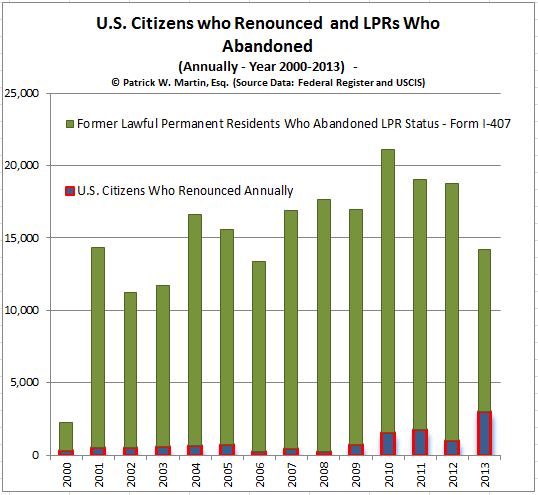
While citizens are often the focus of the public press and Congress regarding “expatriation taxation”; the statute also wraps in so-called “long-term residents.” These are individuals who had or continue to have “lawful permanent residency status.” There are numerous technical considerations in this area, but needless to say, the number of former lawful permanent residents who have simply filed Form I-407 – Abandonment is far in excess of those U.S. citizens who have filed for and received a Certificate of Loss of Nationality (“CLN”) – Form DS-4083 (CLN). The graph reflects the enormous difference.
See, earlier post The Number of LPRs “Leaving” the U.S. is 16X Greater than the Number of U.S. Citizens Renouncing Citizenship
On a related post, the question was raised –What are the Number of LPRs who Leave U.S. Annually without filing Form I-407 – Abandonment?
This is important, since many LPR individuals will have “expatriated” without actually having filed USCIS Form I-407. See, Oops…Did I “Expatriate” and Never Know It: Lawful Permanent Residents Beware! International Tax Journal, CCH Wolters Kluwer, Jan.-Feb. 2014, Vol. 40 Issue 1, p9
See, The Information in DHS/USCIS Database (A-Files, EMDS, CIS, PII, eCISCOR, PCQS, Midas, etc.) on Individuals is Extensive and Can be Shared with Internal Revenue Service, Posted on April 4, 2015
A prior post discussed the new USCIS Form I-407 that must be filed by a lawful permanent resident (LPR) who wishes to formally create a record of their abandonment of LPR status. See, More Information and More Information: USCIS Creates New Form for Abandonment of Lawful Permanent Residency
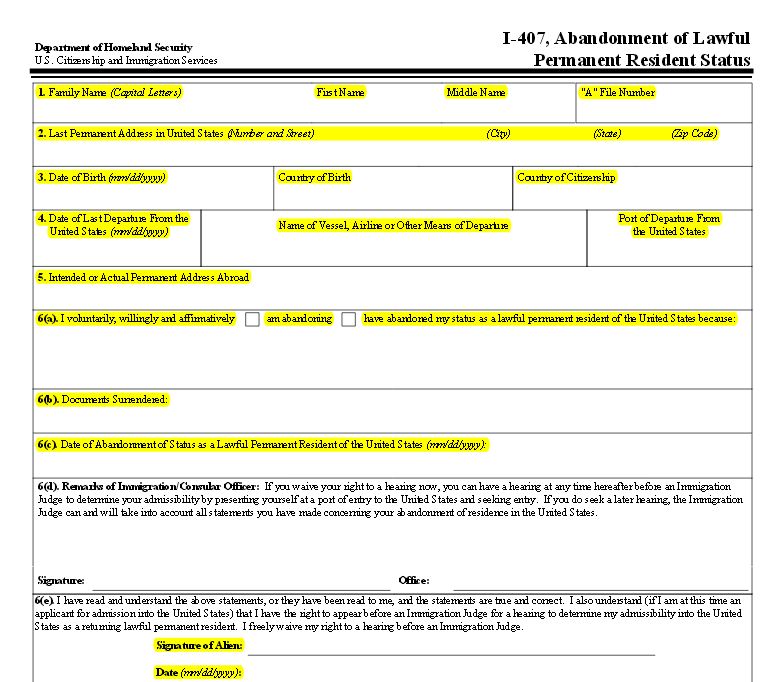
Page 1 of 2 of this form is replicated here.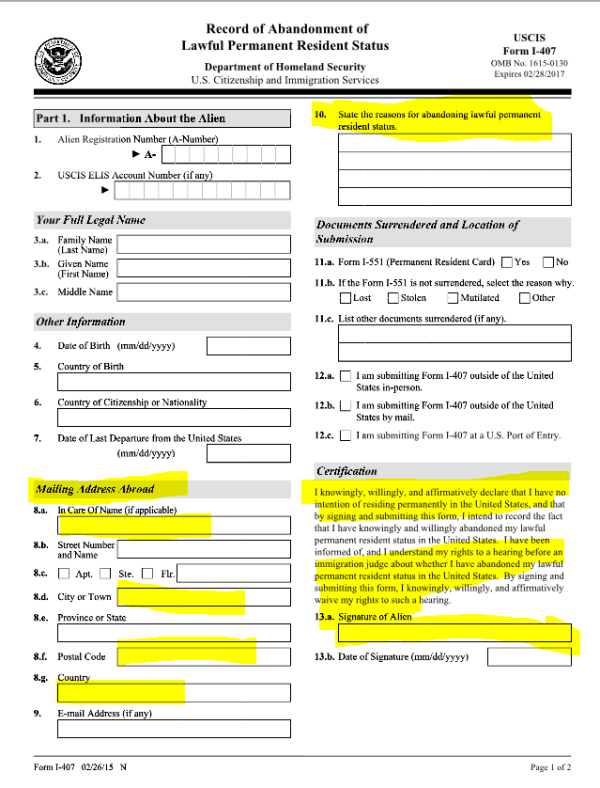
This raises many questions regarding how information maintained by the Department of Homeland Security (DHS) and the United States Customs and Immigration Service (USCIS) can be shared with
and provided to the IRS.
Former “long-term residents” have extensive U.S. tax compliance obligations, including certification requirements under Section 877(a)(2)(C) to avoid “covered expatriate” status and the various adverse tax consequences.
Importantly many LPR individuals will have “expatriated” without actually having filed USCIS Form I-407. See, Oops…Did I “Expatriate” and Never Know It: Lawful Permanent Residents Beware! International Tax Journal, CCH Wolters Kluwer, Jan.-Feb. 2014, Vol. 40 Issue 1, p9
Some of the important records that are maintained by DHS/USCIS, include the following, much of which can be helpful in the enforcement of U.S. federal tax obligations.
System location:
Alien Files (A-Files) are maintained in electronic and paper format throughout DHS. Digitized A-Files are located in the Enterprise Document Management System (EDMS). The Central Index System (CIS) maintains an index of the key personally identifiable information (PII) in the A-File, which can be used to retrieve additional information through such applications as Enterprise Citizenship and Immigrations Services Centralized Operational Repository (eCISCOR), the Person Centric Query Service (PCQS) and the Microfilm Digitization Application System (MiDAS). The National File Tracking System (NFTS) provides a tracking system of where the A-Files are physically located, including whether the file has been digitized.
The databases maintaining the above information are located within the DHS data center in the Washington, DC metropolitan area as well as throughout the country. Computer terminals providing electronic access are located at U.S. Citizenship and Immigration Services (USCIS) sites at Headquarters and in the Field throughout the United States and at appropriate facilities under the jurisdiction of the U.S. Department of Homeland Security (DHS) and other locations at which officers of DHS component agencies may be posted or operate to facilitate DHS’s mission of homeland security.
* * *
- Receipt file number(s);
- Full name and any aliases used;
- Physical and mailing addresses;
- Phone numbers and email addresses;
- Social Security Number (SSN);
- Date of birth;
- Place of birth (city, state, and country);
- Countries of citizenship;
- Gender;
- Physical characteristics (height, weight, race, eye and hair color, photographs, fingerprints);
- Government-issued identification information (i.e., passport, driver’s license):
More Information and More Information: USCIS Creates New Form for Abandonment of Lawful Permanent Residency, Posted on April 3, 2015
The U.S. Customs and Immigration Service (USCIS) announced on 23 March 2015, that a new Form I-407 is available and is to be used, per the USCIS website announcement,
CORRECTION TO A PRIOR POST – How Many of the 5,211 Former U.S. Citizens (who Renounced in 2014 and 2015) are Still U.S. Taxpayers?
My goal is to provide useful information on U.S. federal tax law provisions for U.S. citizens who renounce. As this blog provides, it does not provide legal advice specific to any individual circumstances.
A prior post (How Many of the 5,211 Former U.S. Citizens (who Renounced in 2014 and 2015) are Still U.S. Taxpayers?) erroneously indicated that many of these individuals continue to be U.S. persons for federal income tax purposes.
This is not necessarily the case, depending upon when the U.S. citizenship terminated; i.e., when was the “expatriation date” as provided for in the statute. It is very possible that individuals who have renounced citizenship and did not certify under Section 877(a)(2)(C) are “covered expatriates” with all of the adverse tax consequences that befall that status (including to any future U.S. beneficiaries).
They will not necessarily continue to be “U.S. persons” for other purposes of Title 26.
I will run a series of posts over the next month or so that will discuss some of the vexing timing issues in the statute in this regard.
How Many of the 5,211 Former U.S. Citizens (who Renounced in 2014 and 2015) are Still U.S. Taxpayers?
CORRECTION TO THIS POST: If you renounced your U.S. citizenship, you may think you cease to be a U.S. taxpayer. This depends upon when the termination of citizenship occurred.
More posts will follow addressing these issues.
Unfortunately, the law is not that simple, regardless of your wealth, income, assets or future inheritances or gifts.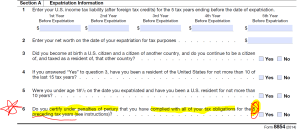
The way the federal tax law works, is that the U.S. “expatriation tax law” applies to the poorest former U.S. citizen (and certain long-term LPRs), wherever they reside if they do not comply with the certification requirements of Section 877(a)(2)(C). See, Why “covered expat” (“covered expatriate”) status matters, even if you have no assets! The “Forever Taint”!
The law continues to obligate certain former U.S. citizens to be subject to the U.S. taxation laws on a worldwide bases, unless and until they notify the IRS and certify under penalty of perjury. This depends upon the time of the renunciation.
Timing Issues for Lawful Permanent Residents (“LPR”) Who Never “Formally Abandoned” Their Green Card
The “tax expatriation” statutory provisions are fraught with ambiguity and incomplete answers for those individuals who have cases that span different time periods. This is because the law has been changed numerous times over the last several years and ad hoc concepts added, including the technical concept of “long-term residents” for the first time in 1996. As has been previously explained, the first “expatriation tax” law was not adopted until 1966 as part of the The Foreign Investors Tax Act of 1966 (“FITA”) – The Origin of U.S. Tax Expatriation Law (Posted on April 6, 2014).
Next, 1996 amendments kept the basic regime but added a number of key concepts, including “long-term residents”. The changes in the law in 2004 made significant changes and in 2008 the first “mark to market” regime was adopted. Each time, the concept of “long-term residents” was maintained, but without clear thought as to the meaning and timing of “expatriation” in various cases. See, Timeline Summary of Changes in Tax Expatriation Provisions Since 1996, (Posted on April 9, 2014)
Unfortunately, none of these amendments to the law over the years carefully incorporated transition and timing rules for cases where the individual has lived in (or had U.S. citizenship or LPR) during one more of these time periods:
- 1966-1996
- 1996-2004
- 2004-2008
- 2008-present
There are many inconsistent concepts among the law and one clear example is demonstrated by an individual who became a lawful permanent resident prior to 1996 and prior to amendments in the definition of a “resident alien” which was adopted generally in the federal tax in the law in 1984. This 1984 definition was not part of any specific “expatriation tax” provisions.
Remember, the technical definition of who is a “resident alien” is the basic definition of who is generally subject to U.S. income taxation on their worldwide income. See, Co-author. “Tax Simplification: The Need for Consistent Tax Treatment of All Individuals (Citizens, Lawful Permanent Residents and Non-Citizens Regardless of Immigration Status) Residing Overseas, Including the Repeal of U.S. Citizenship Based Taxation,” by Patrick W. Martin and Professor Reuven Avi-Yonah, September 2013.
Prior to 1984, a LPR was not necessarily an income tax resident of the U.S. This concept of LPR (i.e., a “green card”) driving U.S. income tax residency was adopted in 1984, long before Congress became obsessed with U.S. individual tax expatriation. For background in the law, see the 1985 Penn State Law Review Article – Internal Revenue Code 7701(b): A More Certain Definition of Resident
The Joint Committee on Taxation report on the 1984 changes in the tax law (“General explanation of the revenue provisions of the Deficit Reduction Act of 1984 : (H.R. 4170, 98th Congress; Public Law 98-369)“) addressing the tax residency test of “lawful permanent residency” rules provides the following language:
. . . The Act defines “lawful permanent resident” to mean an individual who has the status of having been lawfully accorded the privilege of residing permanently in the United States as an immigrant in accordance with the immigration laws, if such status has not been revoked or administratively or judicially determined to have been abandoned. Therefore, an alien who comes to the United States so infrequently that, on scrutiny, he or she is no longer legally entitled to permanent resident status, but who has not officially lost or abandoned that status, will be a resident for tax purposes. The purpose for this requirement of revocation or determination is to prevent aliens from attempting to retain an apparent right to enter or remain in the United States while attempting to avoid the tax responsibility that accompanies that right.
The logic of the LPR test is clear based upon this explanation. If one has the right to live in the U.S., they cannot avoid the tax responsibility that accompanies that right. However, as immigration lawyers will explain, there is no right to enter the U.S. after you have abandoned your LPR status and moved outside the U.S. on a permanent basis.
At the same time, there is other discussion in the report that would support the position that these provisions only apply for the years 1985 and thereafter (long after many individuals obtained LPR status, but who moved out of the country – e.g., in cases where individuals obtained LPR in the 1970s and left before 1985). Specifically, the explanation in the Joint Committee of Taxation is as follows:
. . . The purpose of this effective date rule is to delay tax resident status for only new green cardholders for a short time. Congress understood further that an alien may acquire lawful permanent resident status for immigration purposes before U.S. presence. Congress sought to impose tax resident status on all lawful permanent residents once they arrive in the United States. The Act does not affect the determination of residence, even for green card holders, for taxable years beginning before January 1, 1985.
Of course, the report by the Joint Committee on Taxation (“JCT”) is not the law and does not bind the IRS or the taxpayer. However, the JCT usually get their explanations of the law right.
Why is all of this important for LPRs who never formally abandoned their “green card”? The IRS might well try to argue they never terminated their U.S. federal income tax residency for purposes of the “tax expatriation provisions”, as later versions of the statute impose an obligation to notify the IRS. If the individual never notified the IRS, the government might ar
See, for instance Section 7701(b)(6) with specific rules for LPR individuals who live in a country with a U.S. income tax treaty. Importantly, the definition of a lawful permanent resident for tax purposes (as defined in Section 7701(b) ) is not identical to the definition for immigration law purposes as the legislative history to the 1984 amendments to the law explains.
See, Oops…Did I “Expatriate” and Never Know It: Lawful Permanent Residents Beware! International Tax Journal, CCH Wolters Kluwer, Jan.-Feb. 2014, Vol. 40 Issue 1, p9.
Finally, the information required as part of the process of formal abandonment is much more extensive than in the past.
A prior post discussed the published USCIS immigration form I-407 for LPRs who must now use it when formally abandoning LPR status. See, More Information and More Information: USCIS Creates New Form for Abandonment of Lawful Permanent Residency
See, new I-407 Form requires that much more information and is 2 pages in length.
Inflation Adjusted Exclusion Amounts Since Inception of 2008 “Mark to Market” Expatriation Tax Law: Example
The current “expatriation” “exit tax” forces a “covered expatriate” to pay U.S. income taxation on their unrealized gains (the “mark to market” concept) as if they sold their worldwide assets.
An “unrealized gain” is the amount of gain “built into” the property or other investment of the individual, which has yet to be sold or otherwise disposed of by the him or her. For instance, the  diagram below reflects various assets held by a “Covered Expatriate” which includes Mexican real estate with a tax basis of US$200,000 but a current fair market value of US$1.1M. This means the unrealized gain in that Mexican real property is US$900,000 (US$1.1M – US$200K).
Who is a “covered expatriate” is a very important legal analysis that needs to be considered for each U.S. citizen who wishes to renounce or “long-term resident.” See, The dangers of becoming a “covered expatriate” by not complying with Section 877(a)(2)(C) (9 March 2014).
Importantly, the law provides for an exclusion from taxation on the former (a) U.S. citizen’s (“USC”) or (b) long-term resident’s unrealized gains. (See, Who is a “long-term” lawful permanent resident (“LPR”) and why does it matter? – 19 Aug. 2014). In other words, no U.S. income tax is due and payable by a “covered expatriate” if they did not have assets with unrealize d gains greater than a certain threshold amount.
That threshold amount has been changing annually, since the initial US$600,000 that was originally adopted into the law in 2008. It is changing due to annual inflation adjustments.
The current 2015 exclusion amount adjusted for inflation is US$690,000. See, The “Phantom” Gain Exclusion from the “Mark to Market” Tax – Increases to US$690,000 for the Year 2015 (15 November 2014).
Hence, in this case, if the only asset owned by the “covered expatriate” (assuming she became one in 2015) was the real estate in the above example with unrealized gain of US$900,000, only US$210,000 would be subject to the “mark to market” tax on expatriation (i.e., the exit tax). This is because $690,000 of the total US$900,000 unrealized gain will be excluded from taxation (US$900K – US$690K).
The Mark to Market tax regime imposes taxation on this amount, even though the real estate is never sold. This means, the “covered expatriate” must come “out of pocket” to find the cash and means necessary to pay the tax imposed under the law.
There is no economic benefit obtained from this annual inflation adjustment if a U.S. citizen or long-term resident waits to become at a later time a covered expatriate; unless they consume, deplete or lose their assets in the interim. But at least, there is an inflation adjustment, so the taxpayer is not subject to an increasing amount of gain subject to tax as time progresses and inflation eats away at the true economic value and economic growth of the individual’s assets.
U.S. Citizens Overseas who Wish to Renounce without a Social Security Number will Necessarily be a “Covered Expatriate”
U.S. Citizens Overseas who Wish to Renounce without a Social Security Number (“SSN”) will Necessarily be a “Covered Expatriate”
- The Dilemma of SSNs, TINs and USCs Residing Overseas
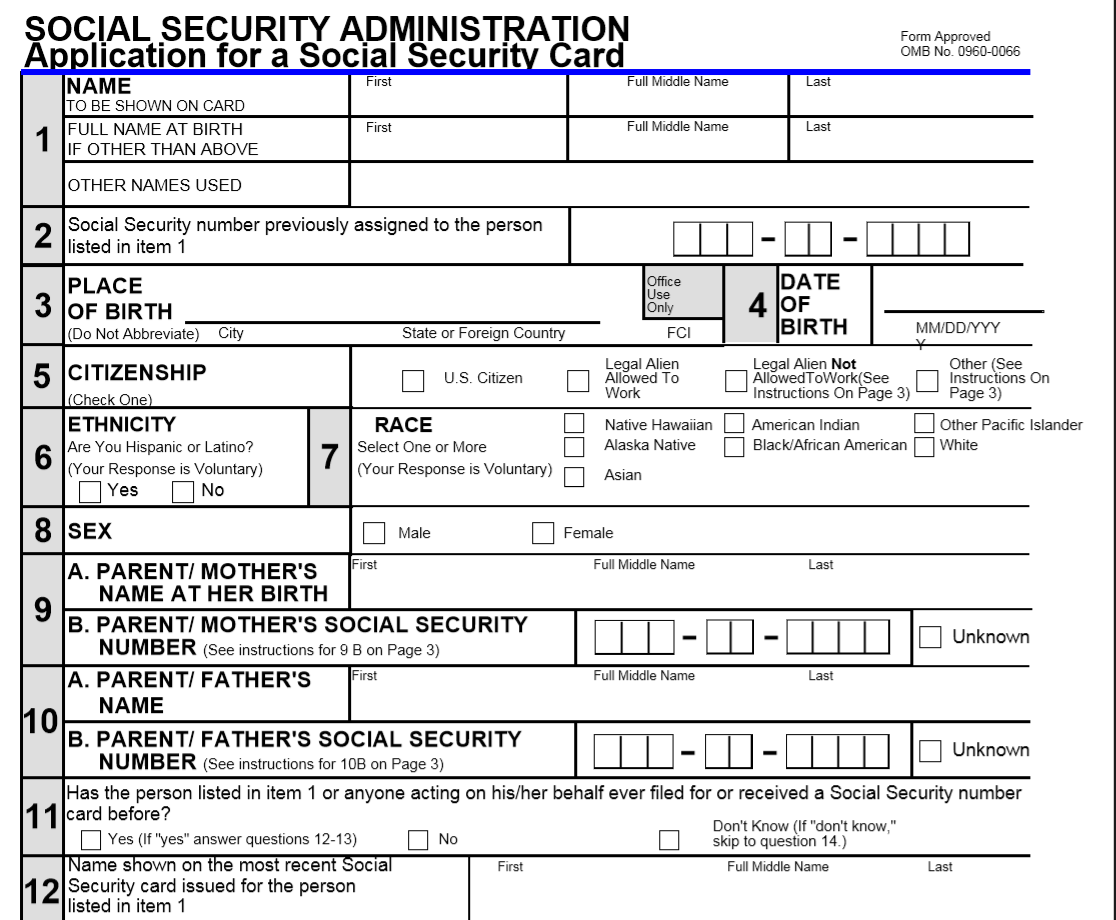
The prior post discussed some of the complications of United States Citizens (“USCs”) who reside outside the U.S. and do not have a social security number (“SSN”) . This dilemma exists, even though USCs are not generally required to file for or  obtain a SSN (e.g., at birth – See, SSA Publication – “Social Security Numbers For Children” page 2, It is not obligatory to file for a SSN at birth. “Must my child have a Social Security number? No. Getting a Social Security number for your newborn is voluntary. But, it is a good idea to get a number when your child is born. . . . ).
Indeed, it is the U.S. federal tax law that requires the USC must have a SSN for their taxpayer identification number (“TIN”). I will reference various excerpts from a recent paper I drafted and presented titled URGENT NEED FOR U.S. CITIZENS RESIDING OUTSIDE THE U.S. TO BE ABLE TO OBTAIN A TAXPAYER IDENTIFICATION NUMBER (“TIN”) OTHER THAN A SOCIAL SECURITY NUMBER , including the following:
. . . the IRS’ increased focus on international tax compliance has made clear that USCs residing overseas have U.S. tax return filing obligations, even if they have no assets, no income, or no real personal connections in or with the U.S. See IRS notice from 2011 which addresses numerous aspects of tax compliance for USCs overseas, including various penalties under the law[1]:
. . . U.S. Citizens or Dual Citizens Residing Outside the U.S. . . .
The IRS is aware that some taxpayers who are dual citizens of the United States and a foreign country may have failed to timely file United States federal income tax returns or Reports of Foreign Bank and Financial Accounts (FBARs), despite being required to do so. . . . 2. Penalties imposed for failure to file income tax returns or to pay tax . . . 3. Possible additional penalties that may apply in particular cases . . . 6. Possible penalties for failure to file FBAR . . . 7. New reporting requirement for foreign financial assets . . . [emphases added]
USCs residing overseas are subject to the range of tax penalties that apply to all individual taxpayers (e.g., negligence penalties, failure to file penalties, late payment or failure to pay penalties, etc.).[2] Additionally, USCs residing overseas are subject to other, typically much harsher penalties for not timely filing U.S. federal information returns regarding assets located outside the U.S.[3]; alluded to above in the IRS 2011 notice.[4]
These civil penalties typically are a minimum of US$10,000 per statutory violation. USCs who live outside the U.S. necessarily have assets, such as financial accounts in their country of residence. These Title 26 information reporting requirements[5] are referred to herein as “International Information Returns.”
The IRS will not process federal tax returns and International Information Returns without a valid TIN.[6] Plus, the law does not provide for an exception for USCs overseas who do not file returns, if they do not have a SSN. Late filed, or incomplete International Information Returns and tax returns (e.g., lacking a SSN) will typically subject USCs to these penalties even in those cases when the taxpayer has no federal income tax liability.[7]
[1] See, IRS FS-2011-13, December 2011, updated February, 2014.
[2] See, IRS FS-2011-13 and as a sample of some of the many statutory penalties that could typically apply, IRC §§ 6048, 6652(f), 6677, 6654, 6655, 6698, 6699, 6166, 6653, 6675, 6715, 6715A, 6717, 6718, 6719, 6720A, 6725, et. seq.
[3] See, IRC §§ 6038, 6038B, 6038D, 6039F, 6039G, 6046, 6046A, 6048, et. seq.
[4] See, IRS FS-2011-13, December 2011, updated February, 2014.
[5] See, IRC §§ 6038, 6038B, 6038D, 6039F, 6039G, 6046, 6046A, 6048, et. seq.
[6] See, IRS website, “General ITIN Information” – http://www.irs.gov/Individuals/General-ITIN-Information – “IRS no longer accepts, and will not process, forms showing “SSA”, 205c”, “applied for”, “NRA”,& blanks, etc.”
[7] See, IRC §§ 911 (foreign earned income exclusion) and 901 (foreign tax credit), et. seq. A USC residing overseas may have no actual federal income tax liability (for various reasons), typically due to the foreign earned income exclusion and/or foreign tax credit calculation.
The above explains fairly clearly the dilemma facing USCs residing overseas.
The complexity of getting a SSN and the requirements are covered in more detail in the paper. Some key points are:
I. The Social Security Administration Rules Make it Nearly Impossible for Many USCs Overseas to Reasonably Obtain a SSN
The policy and procedures of the SSA regarding issuing SSNs have changed significantly over the years.[1] The Social Security Administration (SSA) provides a detailed chronology of the major changes in policy and procedures  regarding filing for and obtaining a SSN.[2] One of the most significant revisions in the last decade came from The Intelligence Reform and Terrorism Prevention Act of 2004 (P.L. 108-458), which imposes various standards for the verification of documents or records submitted by an individual.
A. Only a Few Countries Around the World have Personnel at U.S. Embassies or Consulate Offices that Can Process SSN Applications – SSA Form SS-5-FS
Applying for SSNs overseas is severely restricted compared to an application in the U.S.
According to the U.S. Department of State, Foreign Affairs Manual (“FAM”), only certain “Claims-Taking Posts” in specific countries “may” include “processing applications for Social Security Numbers.” [3]
These 17 countries (and a city in the case of Jerusalem) with Claims-Taking Posts include:
“Austria, Argentina, Costa Rica, Dominican Republic, France, Germany, Greece, Ireland, Italy, Japan, Jerusalem, Mexico, Norway, Philippines, Poland, Portugal, Spain, and the United Kingdom.”
Noticeably absent are many Western European countries, virtually all of Latin America, virtually all of Asia, virtually all of Eastern Europe, all of the Middle East (except Jerusalem), all of the African continent, all of the Australian continent and surrounding island countries and Russia, among many other significant countries, including OECD member countries.[4]
Nothing in the FAM requires any of these “Claims-Taking Posts” to actually process applications for a SSN. Plus, there are of course hundreds of other countries throughout the world, not listed above, which do not have such a U.S. Department of State Post. For these reasons, USCs in countries such as China must travel to a U.S. Department of State Post (e.g., the Philippines) which is able to process applications for SSNs.
[1] See, SSA website, The Story of the Social Security Number, by Carolyn Puckett, Social Security Bulletin, Vol. 69 NO. 2, 2009 (http://ssa.gov/policy/docs/ssb/v69n2/v69n2p55.html.
[2] See, SSA website, Significant Milestones in Social Security Number Policy. A detailed chronology of the major changes in policy and procedures. http://www.ssa.gov/history/ssn/ssnchron.html.
[3] See 7 FAM 530, page 2 of 64.
[4] In contrast to these 17 countries (and one city – Jerusalem) where a USC residing overseas must travel to apply for a SSN, the Treasury Department has announced it has around 100 countries that have signed, or “have reached agreements in substance” a FATCA IGA. USCs throughout the world are required by the Foreign Account Tax Compliance Act (“FACTA”) to provide their U.S. TIN to financial institutions throughout the world (on IRS Form W-9, or its equivalent), which under current law necessarily must be a SSN. Of course, if they have no SSN, they cannot sign IRS Form W-9 which provides in Part II: “Under penalties of perjury, I certify that: 1. The number shown on this form is my correct taxpayer identification number . . .”
- The Necessary “Covered Expatriate Status” of a USC without a SSN
The core point of this post, with the above SSN background, is to explain how a USC without a SSN will necessarily be a “covered expatriate” since they will not be able to truthfully certify they have complied with the federal tax laws (title 26). See, Certification Requirement of Section 877(a)(2)(C) – (5 Years of Tax Compliance) and Important Timing Considerations per the Statute
As other posts have explained, “covered expatriate” status matters:
See, Why “covered expat” (“covered expatriate”) status matters, even if you have no assets! The “Forever Taint”! (20 May 2014) and The “Hidden Tax” of Expatriation – Section 2801 and its “Forever Taint.” (10 April 2014) and “Covered Expatriate” Status is a “Scarlet Letter” (10 Nov 2014).
If a USC has no SSN, they by definition will never be able to comply with the Certification Requirement of Section 877(a)(2)(C) since they will not be able to comply with IRC § 6109(a) and Treas. Reg. § 301.6109-1. As the SSN/TIN paper explains:
All United States citizens (“USCs”) must have a social security number (“SSN”) under current law as their TIN to file a federal income tax return.[1]
[1] See, IRC § 6109(a) and Treas. Reg. § 301.6109-1.
The IRS will not process federal tax returns and “International Information Returns”, as defined below, without a valid TIN[1]; which currently must be a SSN for a USC.
[1] See, IRS website, – http://www.irs.gov/Individuals/General-ITIN-Information – “IRS no longer accepts, and will not process, forms showing “SSA”, 205c”, “applied for”, “NRA”,& blanks, etc.”
Does the IRS have access to the USCIS immigration data for former lawful permanent residents (LPRs)?
Information about former LPRs, such as the individuals names, is not published under the statute, IRC Section 6039G, which only covers former U.S. citizens. 
This raises the question of whether the Department of Homeland Security tracks former LPRs – names and addresses overseas and provides that information to the Internal Revenue Service?
A prior post discussed the newly published USCIS immigration form I-407 for LPRs who must now use it when formally abandoning LPR status. See, More Information and More Information: USCIS Creates New Form for Abandonment of Lawful Permanent Residency
The new I-407 Form requires much more information and is 2 pages in length. The old form had only 6 lines and was less than 1/2 of a page in length. These forms  are set forth here. The new form requires the address overseas of the individual.
As readers here know, the names of former U.S. citizens are published quarterly by the U.S. federal government for the world to see. See a prior post, The 2014 Third Quarter Renunciations Is probably the New Norm –
The complete set of lists going back to the mid-1990s can be reviewed here. Quarterly Publications.
Of course, the IRS can easily select and identify individuals for audit, by simply drawing from the published names of former U.S. citizens, which is currently tracking at an average of about 850 former USCs quarterly. In contrast, the number of former LPRs who have filed USCIS Form I-407 is tracking at an average of about 4,000 to 5,000 individuals quarterly.
While citizens are often the focus of the public press and Congress regarding “expatriation taxation”; the statute also wraps in so-called “long-term residents.” These are individuals who had or continue to have “lawful permanent residency status.” There are numerous technical considerations in this area, but needless to say, the number of former lawful permanent residents who have simply filed Form I-407 – Abandonment is far in excess of those U.S. citizens who have filed for and received a Certificate of Loss of Nationality (“CLN”) – Form DS-4083 (CLN). The graph reflects the enormous difference.
See, earlier post The Number of LPRs “Leaving” the U.S. is 16X Greater than the Number of U.S. Citizens Renouncing Citizenship
On a related post, the question was raised –What are the Number of LPRs who Leave U.S. Annually without filing Form I-407 – Abandonment?
This is important, since many LPR individuals will have “expatriated” without actually having filed USCIS Form I-407. See, Oops…Did I “Expatriate” and Never Know It: Lawful Permanent Residents Beware! International Tax Journal, CCH Wolters Kluwer, Jan.-Feb. 2014, Vol. 40 Issue 1, p9 
While the IRS has specific information about U.S. citizens, it is not clear whether the Department of Homeland Security via the USCIS provides data to the IRS regarding lawful permanent residents who have filed Form I-407? If such an individual becomes a “covered expatriate” under the U.S. tax law, the range of adverse tax consequences can follow them and their future beneficiaries and heirs, including as follows:
- “mark to market” taxation on their worldwide assets,
- 40% inheritance tax to U.S. beneficiaries,
- 40% tax on gifts to U.S. beneficiaries,
- etc.
It seems fairly easy, from a legal perspective, that the IRS can request the names, addresses (and indeed the newly completed form) from the USCIS of all individuals who have filed USCIS Form I-407. From the USCIS records, the IRS will be able to determine if the individual was a “long term resident” based upon the number of years the individual had such status.
Assuming the IRS determines the individual is a long term resident, they can then simply check to see if the they have received IRS Form 8854 from the former LPR; in order to determine if she or he satisfied the certification requirement of Section 877(a)(2)(C). If not, the IRS will necessarily know the individual is a “covered expatriate.”
The Information in DHS/USCIS Database (A-Files, EMDS, CIS, PII, eCISCOR, PCQS, Midas, etc.) on Individuals is Extensive and Can be Shared with Internal Revenue Service
A prior post discussed the new USCIS Form I-407 that must be filed by a lawful permanent resident (LPR) who wishes to formally create a record of their abandonment of LPR status. See, More Information and More Information: USCIS Creates New Form for Abandonment of Lawful Permanent Residency
Page 1 of 2 of this form is replicated here.
This raises many questions regarding how information maintained by the Department of Homeland Security (DHS) and the United States Customs and Immigration Service (USCIS) can be shared with
and provided to the IRS.
Former “long-term residents” have extensive U.S. tax compliance obligations, including certification requirements under Section 877(a)(2)(C) to avoid “covered expatriate” status and the various adverse tax consequences.
Importantly many LPR individuals will have “expatriated” without actually having filed USCIS Form I-407. See, Oops…Did I “Expatriate” and Never Know It: Lawful Permanent Residents Beware! International Tax Journal, CCH Wolters Kluwer, Jan.-Feb. 2014, Vol. 40 Issue 1, p9
Some of the important records that are maintained by DHS/USCIS, include the following, much of which can be helpful in the enforcement of U.S. federal tax obligations.
System location:
Alien Files (A-Files) are maintained in electronic and paper format throughout DHS. Digitized A-Files are located in the Enterprise Document Management System (EDMS). The Central Index System (CIS) maintains an index of the key personally identifiable information (PII) in the A-File, which can be used to retrieve additional information through such applications as Enterprise Citizenship and Immigrations Services Centralized Operational Repository (eCISCOR), the Person Centric Query Service (PCQS) and the Microfilm Digitization Application System (MiDAS). The National File Tracking System (NFTS) provides a tracking system of where the A-Files are physically located, including whether the file has been digitized.
The databases maintaining the above information are located within the DHS data center in the Washington, DC metropolitan area as well as throughout the country. Computer terminals providing electronic access are located at U.S. Citizenship and Immigration Services (USCIS) sites at Headquarters and in the Field throughout the United States and at appropriate facilities under the jurisdiction of the U.S. Department of Homeland Security (DHS) and other locations at which officers of DHS component agencies may be posted or operate to facilitate DHS’s mission of homeland security.
* * *
Categories of records in this system include:
A. The hardcopy paper A-File, which contains the official record material about each individual for whom DHS has created a record under the INA such as: naturalization certificates; various documents and attachments (e.g., birth and marriage certificates); applications and petitions for benefits under the immigration and nationality laws; reports of arrests and investigations; statements; other reports; records of proceedings before or filings made with the U.S. immigration courts and any administrative or federal district court or court of appeal; correspondence; and memoranda. Specific data elements may include:
- Alien Registration Number(s) (A-Numbers);
- Receipt file number(s);
- Full name and any aliases used;
- Physical and mailing addresses;
- Phone numbers and email addresses;
- Social Security Number (SSN);
- Date of birth;
- Place of birth (city, state, and country);
- Countries of citizenship;
- Gender;
- Physical characteristics (height, weight, race, eye and hair color, photographs, fingerprints);
- Government-issued identification information (i.e., passport, driver’s license):
? Document type,
? issuing organization,
? document number, and
? expiration date;
- Military membership;
- Arrival/Departure information (record number, expiration date, class of admission, etc.);
- Federal Bureau of Investigation (FBI) Identification Number;
- Fingerprint Identification Number;
- Immigration enforcement history, including arrests and charges, immigration proceedings and appeals, and dispositions including removals or voluntary departures;
- Immigration status;
- Family history;
- Travel history;
- Education history;
- Employment history;
- Criminal history;
- Professional accreditation information;
- Medical information relevant to an individual’s application for benefits under the INA before DHS or the immigration court, an individual’s removability from and/or admissibility to the United States, or an individual’s competency before the immigration court;
- Specific benefit eligibility information as required by the benefit being sought; and
- Video or transcript of immigration interview
Subsequent posts will discuss how and when the law allows the IRS to access these records.
More Information and More Information: USCIS Creates New Form for Abandonment of Lawful Permanent Residency
The U.S. Customs and Immigration Service (USCIS) just announced on 23 March 2015, that a new Form I-407 is available and is to be used, per the USCIS website announcement, which announcment provides in part as follows:
New Version of Form I-407 Now Available
USCIS has published a new edition of USCIS Form I-407, Record of Abandonment of Lawful Permanent Status (OMB No. 1615-0130). You can download the form on our website.
You may begin using the revised Form I-407, Record of Abandonment of Lawful Permanent Resident Status today. The current edition is dated 02/26/2015, and we will not accept previous form editions
The new form has additional information compared to the prior form. Specifically, the Alien Registration Number and USCIS ELIS Account Number is required to be included.
Now, the individual is required to state the reasons for abandoning lawful permanent residency status.
Responses to  each of these questions will have important legal consequences, including potential tax implications under IRC Sections 877, 877A, et. seq. See, for instance a prior post: What could be the focal point of IRS Criminal Investigations of Former U.S. Citizens and Lawful Permanent Residents?
One of the important enforcement and practical questions raised, is: Will the IRS be able to better track former “long-term residents” (certain former lawful permanent residents) for purposes of the “expatriation tax” under the new reporting form and system?
As has been explained, if an individual fails to certify under the tax law, they will necessarily be a “covered expatriate”; even if they do not meet the asset or income tax liability thresholds. See a prior post, Certification Requirement of Section 877(a)(2)(C) – (5 Years of Tax Compliance) and Important Timing Considerations per the Statute.