Certification Requirement of Section 877(a)(2)(C) – (5 Years of Tax Compliance) and Important Timing Considerations per the Statute
People who cite to IRS forms, should have an appreciation that neither the form or its conditions may have the “force of law.” This is particularly important, when the statute itself, regarding the Certification Requirement of Section 877(a)(2)(C) does not specific whether the certification has to be made “prior to” (or after) the date of loss of nationality? See the relevant provision of the statute below – Section 877(a)(2)(C), which causes an individual to be a “covered expatriate” if::
- (C) such individual fails to certify under penalty of perjury that he has met the requirements of this title for the 5 preceding taxable years or fails to submit such evidence of such compliance as the Secretary may require.
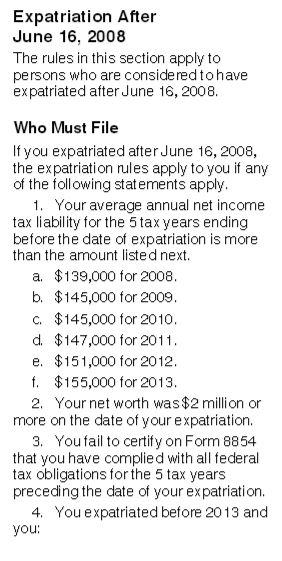
Consider the language of the instructions of IRS Form 8854, however, which expressly states that the certification must reflect you have ” . . . complied with all of your federal tax obligations for the 5 tax years preceding the date of your expatriation.”
Does this mean the IRS requires the compliance to have been satisfied prior to the expatriation/renunciation date? That is what the instructions say.
See the bottom of page 2 of the Form 8854 instructions –
“If you expatriated after June 16, 2008, the expatriation rules apply to you if any of the following statements apply.
1. Your average annual net income tax liability for the 5 tax years ending before the date of your expatriation is more than the amount listed next . . .
2. Your net worth is $2 million or more on the date of your expatriation.
3. You fail to certify on Form 8854 that you have complied with all of your federal tax obligations for the 5 tax years preceding the date of your expatriation.”
In this case, the instructions to the form, say the former USC or LPR must ” . . . have complied with all of your federal tax obligations preceding the date of your expatriation. . . ”
If this statement were true, a taxpayer could not satisfy the rule by attempting to comply with all federal tax obligations after they have renounced their U.S. citizenship?
In other words, if such were true, attempting to comply with all provisions of the U.S. federal tax law for 5 years and then filing 8854, all after taking the oath of renunciation, would prohibit someone from avoiding “covered expatriate” status?
Importantly, the Treasury/IRS cannot create law by merely publishing a substantive rule in an IRS Form. Indeed, there are no regulations to date; that have been issued by the Treasury; only a few notices. See prior post, Does IRS Notice 2009-85 regarding expatriation have the “force of law”?
Of course, this does not mean the IRS will not challenge any former USC as not complying with Certification Requirement of Section 877(a)(2)(C) by not also complying with the condition set forth in the IRS own instructions?
This is an example of an important detail that any former USC will want to carefully consider prior to rushing off to take the oath of renunciation.
As always, see Limitations.
Read the Q&A format here.
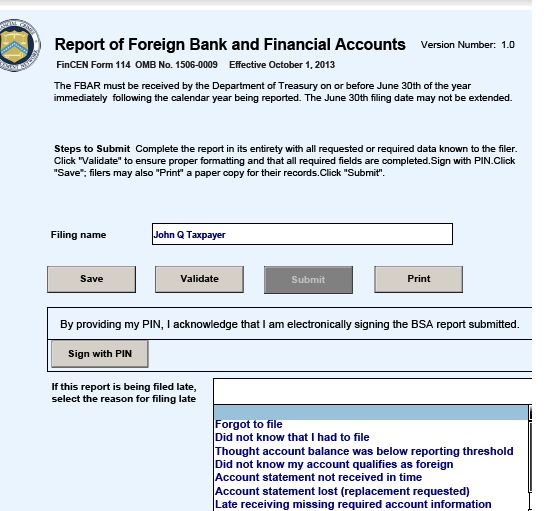
Why the FBAR (late filed or never filed) is not a requirement for the Certification Requirement of Section 877(a)(2)(C) – (5 Years of Tax Compliance)
Myths abound about how and when the certification requirements must be satisfied under Section 877(a)(2)(C), in order to avoid “covered expatriate” status. See a previous post, Why “covered expat” (“covered expatriate”) status matters, even if you have no assets! The “Forever Taint”!
One common notion, is that if a USC or long-term LPR has not filed foreign bank account reports (“FBARs”) pursuant to Title 31, they will not be able to make the certification as required by the statute – Section 877(a)(2)(C), which causes an individual to be a “covered expatriate” if:
- (C) such individual fails to certify under penalty of perjury that he has met the requirements of this title for the 5 preceding taxable years or fails to submit such evidence of such compliance as the Secretary may require.
Importantly, the statutory reference to “this title” is a reference only to “Title 26, Internal Revenue Code,” i.e. the federal tax laws. It is not a reference to any other “Title” of the federal laws. The federal statutory laws are organized by “Titles“; e.g., Title 8 is “Aliens and Nationality” (i.e., immigration law) and Title 7 is “Agriculture”, etc.
Specifically, Section 877(a)(2)(C) of the tax law, does not also require the individual to be able to certify his or her compliance with any other title for the preceding 5 years, such as Title 31 Money and Finance: Treasury.
Title 31 is the law that creates the FBAR filing requirements and is known as the “Money and Finance: Treasury.”
Accordingly, someone who has not filed FBARs, i.e., and not complied with Title 31 or Title 7 (e.g., regarding “Agriculture”) will not be barred from being able to comply with the tax requirements of Section 877(a)(2)(C), if they have complied with “Title 26, Internal Revenue Code, i.e. the federal tax laws. See, Nuances of FBAR – Foreign Bank Account Report Filings – for USCs and LPRs living outside the U.S.
To put this into a concrete example, assume a USC living in Canada has filed complete and accurate U.S. federal income tax returns for the years 2008 through 2013; but never filed any FBARs regarding the Canadian corporate accounts over which the individual has had signature authority. Maybe this individual’s Canadian accounts also exceeded US$10,000 in at some point through the year? Nevertheless, if he or she renounces their U.S. citizenship in 2014, they should nevertheless, be able to avoid “covered expatriate” status by complying with Section 877(a)(2)(C), even though they failed to comply with Title 31 requirements.
As always, see Limitations.
Can the Certification Requirement of Section 877(a)(2)(C) be Satisfied “After the Fact”?
Probably most “Accidental Americans” around the world do not and have not filed U.S. federal income tax returns during their lifetimes. A most important issue for these individuals who are considering renouncing their USC, is whether they can satisfy the statutory requirement (set out below) late; i.e., “after the fact” – if they have not previously filed tax returns?
See the relevant provision of the statute below:
- (C) such individual fails to certify under penalty of perjury that he has met the requirements of this title for the 5 preceding taxable years or fails to submit such evidence of such compliance as the Secretary may require.
Can an “Accidental American” who has lived almost all of their lives outside the U.S., and who has never filed U.S. income tax returns satisfy the statutory language “. . . of the the requirements of this title [Title 26 – Federal Tax Laws] for the 5 preceding taxable years. . . “?
Some interpret the statute to say that filing late income tax returns (e.g., in 2014 for the years 2009 through 2013/2014) should be permissible, provided the former USC indeed satisfies all of the requirements set forth in the law at some later point in time.
Will the IRS argue late filings of tax returns means the taxpayer has not met the requirements of Title 26? Will they argue that a failure to file a timely return and violation of Section 6651 means such an individual did not meet the requirements of the law? See, § 6651 – Failure to file tax return or to pay tax, which provides in relevant part –
a) Addition to the tax
In case of failure—
(1) to file any return required under authority of subchapter A of chapter 61. . . on the date prescribed therefor (determined with regard to any extension of time for filing), unless it is shown that such failure is due to reasonable cause and not due to willful neglect, . . .
Will the IRS or Tax Division, Justice Department lawyers argue that any federal tax returns that are not timely filed under Section 7502, means that a former USC cannot have satisfy the statutory language of “. . . the requirements of this title [Title 26 – Federal Tax Laws] for the 5 preceding taxable years. . . “?
Obviously, the stakes can be very high for any such former U.S. citizen (or LPR), due to the consequences of being deemed a “covered expatriate.” See, Why “covered expat” (“covered expatriate”) status matters, even if you have no assets! The “Forever Taint”!
Online/Self Diagnoses: Great “Tax Myths” of “Expatriation” Propogated on the WWW – Internet
There are many misconceptions about how the U.S. federal tax law works in general; and specifically regarding the “expatriation tax” provisions. This resource – https://tax-expatriation.com/ – is specifically designed to try to bring clarity to these complex tax laws where there are many “tax myths” floating around in the internet.
This website of general information is certainly not a substitute for personal legal and tax advice to your specific circumstances. See, Limitations that explains why general legal information is not the same as legal advice, that is, the concrete application of law to a specific case with unique and particular facts.
In order to provide a public resource, this website tries to help clarify some of these myths. Incidentally, the internet is a great resource for information and at the same time – misi nformation, misleading information, self-help snake oil gibberish and the like. I am often times amused, in a disturbed way – if I realize how someone might be making an important life mistake because of the lack the information and knowledge a person demonstrates they have in this area of the law, based upon their writings.
As a wonderful example of this, see this WWW-website reference to medical self-diagnoses – which is ironic in so many different ways. It is written by “Dr. John Anderson” who is apparently not a medical doctor at all, but rather has a PhD in fisheries.
It is common to see lay persons (or even purported tax advisers) reading and interpreting the law in a way they wish it were; the way they see it most favorable to their own circumstances, etc. These internet interpretations are usually not well founded in the law, especially not a comprehensive reading of the law, and especially in light of how the IRS and U.S. Treasury interpret the law. These comments are often a regurgitation of something someone has read on the internet or heard from a friend or acquaintance or a particular website.
They often are full of “legal arguments” that at times smack of what U.S. courts have consistently found to be deemed “tax protestor” arguments which consistently lose in U.S. courts. Another post will be forthcoming explaining this important concept, as I expect we will see similar expatriation cases work their way through IRS tax audits, administrative tax appeals and eventually some will reach the U.S. courts surrounding the “expatriation tax” provisions.
The world wide web is a powerful tool, when used prudently.
Enough of my musings about how myths of U.S. “expatriation tax law” are compounded throughout the world with the WWW!
If the law is not clear in its application, I will say it is unclear. If the law has been interpreted specifically by a particular Court, I will provide a discussion of that opinion. The “expatriation tax law” is an area of the tax law which has NO case law to date. There is not a single case that has been litigated by a taxpayer or the government surrounding Section 877 or any of the companion provisions.
There are also no regulations to date; that have been issued by the Treasury; only a few notices. See, Does IRS Notice 2009-85 regarding expatriation have the “force of law”?
However, the Treasury is working on issuing regulations under Section 2801, regarding the tax on “covered gifts” and “covered bequests.” The proposed regulations under Section 2801 are expected within the next few months; hopefully before year end. I have prepared and presented specific comments and recommendations to the Treasury and IRS on these yet unissued proposed regulations. For more background, see, The “Hidden Tax” of Expatriation – Section 2801 and its “Forever Taint.”
Also, see, Why “covered expat” (“covered expatriate”) status matters, even if you have no assets! The “Forever Taint”!
Why “covered expat” (“covered expatriate”) status matters, even if you have no assets! The “Forever Taint”!
The point of this post is to explain why “covered expatriate” status does matter, even for those with no assets. Most people in the world, probably think the tax expatriation provisions only are for the rich, wealthy and worldwide private jet owners. This is how the press (and members of Congress) typically portray those who renounce U.S. citizenship. The press articles typically cover the likes of Ms. Tina Turner and Mr. Eduardo Saverin, co-founder of Facebook. See,Tina Turner – Famous People Who Renounced U.S. Citizenship.
Most articles focus on the “net worth test” (US$2M) and the “income tax liability test” (“US$125K+/-). See, Revisiting the consequences of becoming a “covered expatriate” for failing to comply with Section 877(a)(2)(C).
Unfortunately, U.S. “expatriation tax law”, applies to the poorest former U.S. citizen (and certain long-term LPRs), wherever they reside if they do not comply with the certification requirements of Section 877(a)(2)(C). See, Accidental Americans” – Rush to Renounce U.S. Citizenship to Avoid the Ugly U.S. Tax Web” International Tax Journal, CCH Wolters Kluwer, Nov./Dec. 2012, Vol. 38 Issue 6, p45.
So far so clear? But you are surely asking yourself, “this does not explain how this costs me any money or taxes, if I have no assets to begin with . . . “?
If the certification requirements are not satisfied, the individual with no assets should have no U.S. income tax to pay as he or she will have no unrealized gains. If there are no “unrealized gains”, there can be no tax base and hence no income tax caused by the “mark to market regime”.
However, there are two points of potential taxation under the law. First, when the USC or LPR leaves the U.S. (“expatriates”); which does not cause taxation in this example for the individual without “unrealized gains.” However, there is second point of taxation, under the law, which arises when a U.S. person receives a covered gift or bequest. IRC Section 2801. This might not happen until decades into the future, long after the expatriation event.
Incidentally, someone could have significant assets, without any unrealized gains. Both individuals (the rich and the poor) would be in the same position as they leave/expatriate from the U.S.; i.e., and have no U.S. income tax to pay. For instance, USC “A” with US$5,000 in total assets, would have the same income tax to pay ($0) as USC “B” with US$15M of cash in the bank; assuming no other assets. Neither would have unrealized gains upon which to cause any U.S. tax. This is because US dollars/”cash” have a tax basis – the same as the currency amount. Hence, there is no unrealized gains in US dollars-cash.
However, if in this case, assume both individuals (USC “A” and USC “B”) cannot satisfy the certification requirements of Section 877(a)(2)(C), and hence both would be “covered expatriates.” So what does that mean to them during their lifetimes (what U.S. tax might they have to pay)?
The potential U.S. tax created to both USC “A” and USC “B” in this circumstance, is IF AND WHEN, they were ever to make a future gift or bequest (directly or indirectly – e.g., through trust) to a U.S. person. At that point in time, the U.S. beneficiary will have to pay effectively a 40% tax on the fair market value of the property received. This tax is created under Internal Revenue Code Section 2801, that was passed in 2008. See, The “Hidden Tax” of Expatriation – Section 2801 and its “Forever Taint.” A common example is a child or sibling who is a dual national, who might inherit assets in the future.
The 40% tax is a lot of tax to pay – as there are virtually no deductions or exemptions from the amount of tax paid.
I have proposed a series of recommendations to the Treasury regarding concepts and provisions that hopefully will be incorporated into their propose regulation project under Section 2801. More to come on this important topic.
You might say – “I have no future U.S. beneficiaries and/or I have no assets. Why do I care?”
Very simply, you should care, if –
- You may grow your future assets (or inherit assets from others) while not being a U.S. citizen (post-expatriation). If that is your goal or your lot in life, you might end up with much more in assets than you have today (assuming you are the same as USC “A” in the example), while having virtually no assets today; and
- You may have family and friends who will become U.S. residents, even if none of them are today.
Assume USC “A” renounces citizenship and in 40 years leaves a bequest to a daughter of US$120,000; the daughter has moved to the U.S. In this case, the U.S. tax law would impose more than a US$40,000 tax on the daughter when she receives the inheritance. This is a very high tax burden to pay, on what is a relatively modest inheritance. This is one, of multiple scenarios of why “covered expatriate” status can be so important – over the long run.
In my practice, over the years, I have seen numerous cases where one single family member moves to the U.S. temporarily for work or study, e.g., graduate school, gets married and decides to stay on and live in the U.S., even for a while. Often times, they will have children, who will be U.S. citizens by birth in the U.S. Hence, a U.S. person is now part of the family tree.
Read the Q&A format here.
Why vested Social Security Retirement Benefits are not lost when a USC or LPR sheds their citizenship or immigration status. The Answer to: What happens to social security benefits to former USCs and LPRS including a “covered expatriate”?
The law of the Social Security Act is a bit obscure for persons who are not (i..e, no longer are) U.S. citizens. It is “obscure” because the law is silent as to former U.S. citizens. For basic background, see, Social Security Retirement Benefits – for former USCs and LPRs (Intersection of U.S. Tax and Social Security Law)
While USCs have broad, largely unfettered rights to social security (including when they reside exclusively outside the United States), former USCs and LPRs fall into a different category, specifically including the tax treatment of those benefits.
Also, the U.S. Congress has imposed limitations, first under the so-called Illegal Immigration Reform and Immigrant Responsibility Act of 1996 and later by the Social Security Protection Act of 2004.
For the “Accidental American” who has spent virtually all of their lives outside the U.S. (and has never been employed by a U.S. employer), this discussion will largely be irrelevant to you as you will probably have no rights to Social Security Retirement Benefits.
However, for the former USC or LPR who falls into any of the following categories, and worked full-time for the requisite 40 quarters, they should have Social Security Retirement Benefits that are due and payable when they meet the age requirements:
- self-employed (and paid and filed self-employment tax returns – paying social security); or
- employed within the United States (even by a foreign employer); or
- employed outside the United States by a U.S. employer.
For a detailed discussion of how and when these federal employment taxes apply (including at what rates), please see “Comparative Overview of U.S. and Mexican Federal Employment Taxes,” CCH International Tax Journal, November–December 2009. Current Social Security Tax Rates, and the taxable base – contribution base (which adjusts annually) can be reviewed on the Social Security Website.
The 1996 and 2004 statutory amendments reflected above, do not modify the rights of former USCs or LPRs. They do affect the rights of individuals who were not USCs or LPRs; namely who did not have legal immigration status while working and living in the U.S.
For a detailed discussion of this part of the law, please see the Congressional Research Report of 2010 titled Social Security Benefits for Noncitizens.
The final conclusion about whether the Social Security Act restricts social security retirement benefits to “covered expatriates”, can NOT be expressly found in the statute or the regulations themselves. There is no affirmative answer in Title 42 or the regulations thereunder, regarding “covered expatriates.” It is silent on the issue and not expressly addressed.
Most importantly, throughout the Social Security Act and regulations thereunder, because of the “silence” of the statute, there are no restrictions expressly imposed on “covered expatriates” or any other former USCs or LPRs. This category of persons, “covered expatriates” is not somehow identified or segregated in the law for disparate treatment. The law provides generally that Social Security Retirement Benefits are available to non-citizens and those who no longer have LPR status; provided they meet the previous work and eligibility requirements. Shedding USC or LPR does not strip these individuals of these benefits.
While it is always hard (impossible) to “prove a negative”; our office has also received telephonic confirmation from technical support personnel of the Social Security Administration, that the above conclusion is a correct interpretation of the law.
Stay tuned to another post about how the U.S. imposes income and withholding taxes on Social Security benefits to “covered expatriates”; which is indeed different than for current USCs (and some LPRs) residing overseas.
???????????????? ?Please click here to view the above in Chinese.?
Social Security Retirement Benefits – for former USCs and LPRs (Intersection of U.S. Tax and Social Security Law)
The basic law of social security, regarding retirement income (not survivors or dependent’s benefits) is set out below, and does not consider those countries with a Totalization Agreement (of which there are 26 countries, 25 which are currently in force):
- Generally, a worker must have 40 quarters (which is 10 years) of “covered employment” to be eligible for Social Security retirement benefits.
- U.S. citizens have virtually no limitations imposed upon them for receiving retirement benefits, provided they have met the 40 quarters of “covered employment”.
- Covered employment largely means the individual was
- self employed in the U.S. (and paid social security taxes) or
- was working for a U.S. employer (where the actual employer was/is a U.S. corporation or otherwise a U.S. tax resident) either in or outside the U.S.; and
- the employment must generally be full time.
- Historically, there were no limits on Social Security payments to non-U.S. citizens.
- Congress then passed a law in 1956 that required non-citizens to generally reside in the U.S. to receive Social Security payments.
- Subsequently, the Illegal Immigration Reform and Immigrant Responsibility Act of 1996 added Section 202(y) to the Social Security Act. Section 202(y) of the act, which became effective for applications filed on or after December 1, 1996, states:
- Notwithstanding any other provision of law, no monthly benefit under [Title II of the Social Security Act] shall be payable to any alien in the United States for any month during which such alien is not lawfully present in the United States as determined by the Attorney General.
More details on social security retirement benefits regarding former USCs and former LPRs to come in a further post; specifically including a discussion of how the vested retirement benefits under the Social Security Act are not terminated upon a change of immigration status or loss of U.S. citizenship.
See also, What happens to social security benefits to former USCs and LPRS including a “covered expatriate”?
???????????????? ?Please click here to view the above in Chinese.?
How many former U.S. citizens and long-term lawful permanent residents have filed (or will file) IRS Form 8854?
How many former U.S. citizens and long-term lawful permanent residents have filed (or will file) IRS Form 8854?
Can this information be obtained directly from the IRS through a Freedom of Information Act (“FOIA”) request?
See, Does IRS Notice 2009-85 regarding expatriation have the “force of law”? Posted April 14, 2014.
Unfortunately, the law has left much confusion for USCs and LPRs living overseas who have –
- “relinquished” their citizenship many years ago (in the case of USCs), or
- terminated U.S. income tax residency by application of a U.S. income tax treaty (in the case of LPRs).
See, Why Section 7701(a)(50) is so important for those who “relinquished” citizenship years ago (without a CLN)
See, Countries with U.S. Income Tax Treaties & Lawful Permanent Residents (“Oops – Did I Expatriate”?)
The one certainty under the law, is that any former USC or LPR, regardless of their wealth or income, will necessarily be a “covered expatriate” if they do not file IRS Form 8854 and meet the certification requirements under the law.
This begs the question: how many have filed IRS Form 8854?
See, Revisiting the consequences of becoming a “covered expatriate” for failing to comply with Section 877(a)(2)(C). (Posted on April 16, 2014)
Why Section 7701(a)(50) is so important for those who “relinquished” citizenship years ago (without a CLN). . .
So you relinquished your citizenship years ago and therefore you think you somehow escape the current expatriation tax provisions? The U.S. federal government views their hands are tied in what the statute says.
Is it Constitutional?
Practitioners and indeed IRS attorneys struggle with the various “expatriation” tax provisions that have been added by Congress. First, there were the rules from 1966. The first “expatriation tax” law was not adopted until 1966 as part of the The Foreign Investors Tax Act of 1966 (“FITA”) – The Origin of U.S. Tax Expatriation Law (Posted on April 6, 2014).
Next, 1996 amendments kept the basic regime but added a number of key concepts. The changes in the law in 2004 made significant changes. See, Timeline Summary of Changes in Tax Expatriation Provisions Since 1996, (Posted on April 9, 2014)
Finally the 2008 revisions made wholesale changes and introduced a completely new set of taxes under Section 2801. See, Joint Committee Reports – 2008 Report re: HEROES Act – Mark to Market Regime – New Section 877A
I have recently presented a set of proposed rules (via the International Tax Committee of the State Bar of California, Taxation Section) to the IRS and Treasury regarding Section 2801 and the inheritance tax and tax on gifts from “covered expatriates.” Those comments will be published soon by TaxAnalysts.
The reason this issue is so important, are the adverse long-term consequences of not satisfying Section 877(a)(2)(C), which include the “forever taint” of Section 2801 (covered gifts and covered bequests). See, The “Hidden Tax” of Expatriation – Section 2801 and its “Forever Taint.”, (Posted on April 10, 2014).
In addition if there are unrealized gains that get triggered from the “mark to market” rules, they will come due; all tied to the date of expatriation.
The sad consequence of the revisions in 2008, is that Section 7701(a)(50) was adopted and has a very clear timing rule about when a person “. . . cease[s] to be treated as a United States citizen. . . ” It is not the same as for immigration law purposes.
The plain reading of the language of the statute is quite clear and provides in its entirety as follows:
- (50) Termination of United States citizenship
- An individual shall not cease to be treated as a United States citizen before the date on which the individual’s citizenship is treated as relinquished under section 877A (g)(4).
- Under regulations prescribed by the Secretary, subparagraph (A) shall not apply to an individual who became at birth a citizen of the United States and a citizen of another country.
Section 7701(a)(50)(A) is clear as it references 877A(g)(4) that clearly states that the term “relinquishment of citizenship” (at least for tax purposes – Title 26 purposes) does not have the same meaning as “relinquishment” for immigration law purposes.
Rather, each of the dates set forth in the tax statute to determine “relinquishment” are dates that are not retroactive to the actual loss of citizenship date for immigration law purposes. The tax law defines the “ . . . citizen shall be treated as relinquishing his United States citizenship on the earliest of—
- (A) the date the individual renounces his United States nationality before a diplomatic or consular officer of the United States pursuant to paragraph (5) of section 349(a) of the Immigration and Nationality Act (8 U.S.C. 1481 (a)(5)),
- (B) the date the individual furnishes to the United States Department of State a signed statement of voluntary relinquishment of United States nationality confirming the performance of an act of expatriation specified in paragraph (1), (2), (3), or (4) of section 349(a) of the Immigration and Nationality Act (8 U.S.C. 1481 (a)(1)–(4)),
- (C) the date the United States Department of State issues to the individual a certificate of loss of nationality, or
- (D) the date a court of the United States cancels a naturalized citizen’s certificate of naturalization.?
To put this statute in practice, let us assume a dual national living in Country X, goes to the U.S. Embassy or Consulate in Country X in the year 2014 (May 4, 2014, to be exact) to request a relinquishment of citizenship back in time, i.e., to the “relinquishing act” for immigration law purposes. He or she is able to convince the U.S. Department of State that the relinquishing act was in December of 1989. The CLN that is later issued, reflects the December 1989 date. Unfortunately, the tax statutes referenced above, clearly state the earliest date of “relinquishment of citizenship” occurs on the date the dual national went to the U.S. Department of State, i.e., on May 4, 2014.
Not a day earlier than 4 May 2014.
Section 7701(a)(50)(B) allows the Treasury to adopt regulations modifying this rule, for a limited class of “expatriates” who were dual nationals from birth. To date, no regulations were issued, although proposed regulations under section 2801 are forthcoming.
This is what some have called an “absurd result”; but is indeed a plain reading of the statute. The Treasury Department generally feels their hands are tied, because of the plain language of the statute.
Is such a provision even Constitutional under the principles articulated by the U.S. Supreme Court in Cook vs. Tait? In that case, at least the individual was a U.S. citizen. In the hypothetical set out above, the individual lost their U.S. citizenship in 1989. How can Congress hence impose U.S. taxation and reporting requirements on such an individual from the year 1989 through the May, 2014?
See the summary of current law below:
U.S. taxation of citizens has a long history going back to 1861 and the Civil War.4 The concept of citizenship based taxation was upheld by the U.S. Supreme Court in the 1920s.5 See Cook v. Tait,6 where a U.S. citizen resided permanently and was domiciled in Mexico City with his Mexican citizen wife and the Court found that U.S. taxation of his Mexican source income was indeed constitutional. Notwithstanding the long history of U.S. citizenship based taxation, the authors view it as an anachronism in the 21st century since it is particularly difficult to administer and cannot be enforced effectively overseas.7
The complete proposal can be read at “Tax Simplification: The Need for Consistent Tax Treatment of All Individuals (Citizens, Lawful Permanent Residents and Non-Citizens Regardless of Immigration Status) Residing Overseas, Including the Repeal of U.S. Citizenship Based Taxation,” by Patrick W. Martin and Professor Reuven Avi-Yonah, 2013.
What happens to social security benefits to former USCs and LPRS including a “covered expatriate”?
There is much confusion about the U.S. federal social security law versus the U.S. federal tax law. They are two very different laws. The Social Security Act was originally passed in 1935 and is codified currently in Title 42.
The federal tax law was originally passed during the Civil War. See, The U.S. Civil War is the Origin of U.S. Citizenship Based Taxation on Worldwide Income for Persons Living Outside the U.S. ***Does it still make sense?. (Posted on April 1, 2014). The federal tax law is currently codified in Title 26.
I will provide a series of posts that highlight some of the key provisions in both laws. There are specific tax provisions under Title 26 regarding Social Security payments under Title 42.
???????????????? ?Please click here to view the above in Chinese.?