The U.S. Supreme Court and Tax Cases (e.g., Topsnik and Section 877A)
Individuals around the world are often curious about how and when the U.S. Supreme Court hears tax cases. In some countries, tax cases represent the majority or large percentage of total cases heard by their Supreme Court (e.g., Mexico). 
The Supreme Court typically hears some 100-150 cases per year out of more than 7000 cases a year it is asked to review. Many of these cases deal with the constitutionality of particular laws. They rarely take up tax cases.
The 2013 term was unusual in that the Supreme Court heard three federal tax cases (U.S. v. Woods, U.S. v. Quality Stores, Inc. and U.S. v. Clarke). Similarly, in 2015 the Supreme Court issued opinions in three tax cases (although each dealt with powers of states to impose taxation – Alabama Dept. of Revenue v. CSX Transportation, Inc. a property tax case; Direct Marketing Association v. Brohl a sales tax case; and, Maryland v. Wynne an income tax case).
None of these cases or any Supreme Court case before them has dealt with the U.S. “exit tax” arising out of IRC Sections 877, 877A, 2801, et. seq. Indeed, to date, there have been few cases heard by other courts regarding these provisions. One of the most important and relevant is the Topsnik v. Comm’r (146 T.C. No. 1) case published this year. The Topsnik case will be discussed in more detail in a later post. The short version is that the taxpayer in Topsnik lost the case and was found to have been a “covered expatriate” with the consequent adverse tax consequences that follow.
Taxpayers have a right of appeal from the U.S. Tax Court. If a case is appealed from the U.S. Tax Court, e.g., Topsnik or another federal court (e.g., from Court of Federal Claims) it will go to one of 13 appellate courts. An appeal from one of these 13 appellate courts will lie with the U.S. Supreme Court.
The U.S. Supreme Court is generally not obliged to review cases (per the Certiori Act of 1925), including tax cases, and will rarely take up a tax case, whether or not it addresses a Constitutional question. Hence, a case like Topsnik will almost certainly never become binding precedent to all the courts in the land, e.g., the Court of Federal Claims.
Like Canada’s “Deemed Acquisition” Rules: IRC Section 877A(h)(2)
The Canadian income tax system has a sensible rule that treats immigrants into the country “as if” they had sold their non-Canadian assets just prior to becoming a Canadian income tax resident.
The Canada Revenue Agency (“CRA”) explains it as follows:
- If you owned certain properties, other than taxable Canadian properties, while you were a non-resident of Canada, we consider you to have sold the properties and to have immediately reacquired them at a cost equal to their fair market value on the date you became a resident of Canada. This is called a deemed acquisition.
- Usually, the fair market value is the highest dollar value you can get for your property in a normal business transaction.
- You should keep a record of the fair market value of your properties on the date you arrived in Canada. The fair market value will be your cost when you calculate your gain or loss from selling the property in the future.
The U.S. does not have such a rule generally for immigrants coming to America. Instead, the non-U.S. citizen will typically have their historic tax basis (by applying U.S. tax principles) in the property they own prior to coming to the U.S. For instance, an immigrant from the South American continent who owns real estate in their country of citizenship, may have a large “unrealized gain” in that property for U.S. federal income tax purposes.
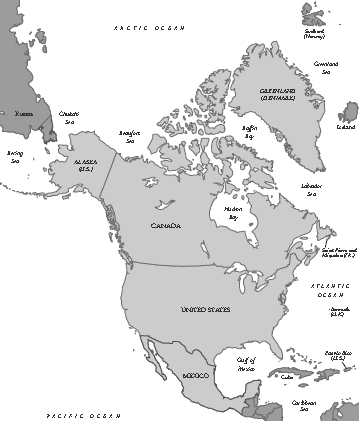
This means that if the South American sells the real estate, while being a U.S. income tax resident (after immigrating to the U.S.), the gain in the South American real estate will be subject to taxation in the U.S. This is very different from the sensible Canadian rule, which exempts the appreciation in the property of the immigrant while living outside of the North American continent.
This can be a very bad result for the uninformed immigrant, since the example above can get worse, when the immigrant to the U.S. has received properties in the form of gifts (e.g., from their family members) which could have very low tax bases per U.S. tax law. Assume a gift of South American real estate received by the immigrant prior to moving to the U.S. with a low historic basis of US$500K. Assume further it is sold for US$3.3M while the immigrant is residing in the U.S. If the property was worth US$3.2M when she immigrated to the U.S., only US$100K of appreciation occurred while residing in the U.S. Nevertheless, under U.S. law, the entire US$2.8M gain (US$2.7M of which occurred while living outside the U.S.) will generally be subject to U.S. federal income tax.
This comes as quite a surprise to many. 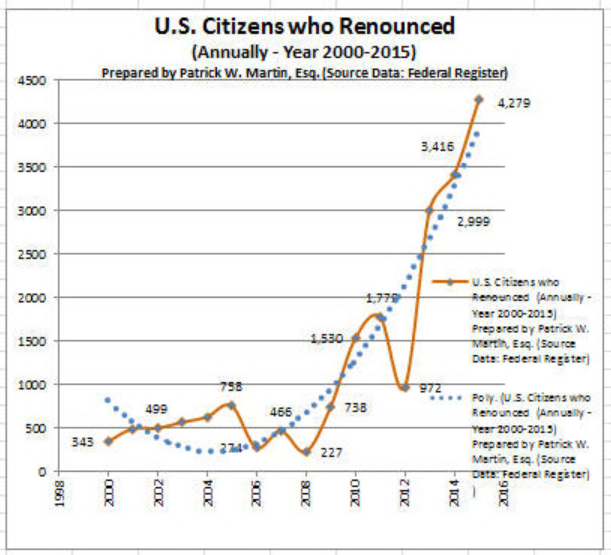
An immigrant to Canada in the same case, would only have US$100K of taxable gain, with the US$2.7M gain being free from taxation under Canada’s “deemed acquisition” rules.
There is one exception in the U.S. tax law. Unfortunately, it applies to “covered expatriates” who readers of this site understand, that the U.S. tax regimes are typically quite undesirable. They are as follows:
The statutory provision under IRC Section 877A(h)(2) provides relief from the first tax; for purposes of calculating the “mark to market” tax. It provides in relevant part that the “covered expatriate” –
- . . . shall be treated as having a basis on such date [the date of immigration to the U.S. in the first place] of not less than the fair market value of such property on such date . . .”
Accordingly, the appreciation of the property owned by the immigrant (see, US$2.7M example above – who is in the process of emigrating out of the U.S. -by way of “covered expatriate” status) will generally escape income taxation under IRC Section 877A(h)(2) on the unrealized gain in the property that arises prior to moving to the U.S. in the first place. This limited rule is similar to the sensible Canadian “deemed acquisition” rules.
Unfortunately, there is no such rule as this “deemed acquisition” concept that could reduce the future tax payable by U.S. beneficiaries of “covered gifts” and “covered bequests.”
Trendlines Show United States Citizens Renouncing at Historical Levels
Graphs and charts are a nice way to show key pieces of information quickly. The charts I create showing the numbers of U.S. citizens (“USCs”) who have renounced their citizenship help me better understand and track the detailed data behind the graphs.
In this vein, I have added trend-lines to two of the graphs that reflect the total annual and quarterly numbers of individuals who have renounced over the last few years.
The trend-lines are the blue dotted lines in each chart. The first chart reflects annual renunciations over a longer period of time, which is compressed much more along the “x axis” – i.e., the horizontal axis. The trend of USCs who are renouncing looks quite dramatic in this chart; a giant ski slope heading upwards fast.
The next chart includes many more data points along the “x axis” spread out over a shorter period of time, which is also reflected by the dotted blue trend-line. Accordingly, the trend-line appears to be a more gradual increase of USC renunciations.

Nevertheless, both show the trend over time as increasing substantially over time.
As has been explained in prior posts, those U.S. citizens who are considering renouncing U.S. citizenship should not take the decision lightly unless they want to be a “covered expatriate” with various adverse U.S. tax and legal consequences.
See, for instance the following prior blogs, Revisiting the consequences of becoming a “covered expatriate” for failing to comply with Section 877(a)(2)(C).
U.S. Citizens Overseas who Wish to Renounce without a Social Security Number will Necessarily be a “Covered Expatriate”
The “Hidden Tax” of Expatriation – Section 2801 and its “Forever Taint.”
Will U.S. Tax Law Regarding “Covered Expatriates” get Modified with Recent Government Push in International?
It is rare to have the President of the United States hold press conferences specifically dealing with international tax policy and tax enforcement. Nevertheless, this is what happened last week when President Obama announced his administration’s recent efforts in the field of international tax, anti-corruption and financial transparency.
His remarks can be watched here: President Obama’s Efforts on Financial Transparency and Anti-Corruption: What You Need to Know
Also, the White House is putting forward a series of initiatives in this area:
Fact Sheet: Obama Administration Announces Steps to Strengthen Financial Transparency, and Combat Money Laundering, Corruption, and Tax Evasion
To date, none of the specific initiatives address current “tax expatriation law” under IRC Sections 877, 877A, et. seq.
U.S citizens (USCs) and Lawful Permanent Residents (LPRs): Caution When Making Gifts. US Tax Court Recently Ruled a 1972 Gift by Sumner Redstone Still Open to IRS Challenge
The statute of limitations is one of the most important considerations for any individual when considering what tax consequences the Internal Revenue Service (“IRS”) might argue they have for years past. This can occur many years into the future as explained further below. 
Former USCs and LPRs can be in a particularly precarious position, as was recently demonstrated by a U.S. Tax Court case for a gift that was made decades ago in 1972. See, Redstone vs. Commissioner (TCM 2015-237). Although this U.S. Tax Court case involving Sumner Redstone had nothing to do with renunciation of citizenship, it shows how the IRS can reach back many years and even decades in assessing taxes it claims are owing. The newly (in year 2010) added IRC Section 6501(c)(8) makes this highly likely under current revised law.
- Transfers to U.S. Beneficiaries (e.g., U.S. resident or citizen children or grandchildren who might receive gifts or bequests from a “Covered Expatriate” the former USCs or “long-term resident” – Green Card Holders)
Former USCs and any U.S. beneficiaries of theirs (e.g., U.S. resident children or grandchildren who might receive gifts or bequests from the former USCs) should be cognizant of the statute of limitations. See a prior post from 2014, When the U.S. Tax Law has no Statute of Limitations against the IRS; i.e., for the U.S. citizen and LPR residing outside the U.S.
As this prior post noted, there are at least three basic scenarios when there is no statute of limitations for federal tax matters are as follows:
1. The former USC or LPR does not file a U.S. income tax return, when they had a requirement to so file. IRC Section 6501(c)(3). See a post from 2014, When do I meet the gross income thresholds that require me to file a U.S. income tax return?
- Fraud when Tax Return Filed

2. There is fraud on the part of the taxpayer (e.g., the taxpayer intentionally does not report income). IRC Sections 6501(c)(1), (c)(2).
- Missing Information on Tax Return Filed – re: International Matters
3. The USC or LPR fails to report certain foreign transactions, including inadvertently neglecting to report. IRC Section 6501(c)(8). This rule was only recently adopted as part of the “HIRE Act” which also created FATCA. The types of transactions set above in the table provides a brief summary of when transactions can give rise to an “open” statute of limitations period. In other words, as many years and decades can pass (see Redstone 1972 gift transaction) before the IRS ever has to make a proposed assessment of taxes and penalties. These include numerous ownership or economic interests in foreign (non-U.S.) companies, partnerships, foreign trusts, foreign investment accounts, among others.
This is indeed one of those areas where the IRS can argue a “gotcha moment”; simply because the former USC or LPR was not aware of the extremely complex rules of reporting assets (normally in their own country of residence outside the U.S.). The consequences to these families can go on indefinitely, per post from September 2015, Finally – Proposed Regulations for “Covered Gifts” and “Covered Bequests” Issued by Treasury Last Week (Be Careful What You Ask For!)
For a more in depth review of the international (non-U.S.) transactions that give rise to this reporting, see IRS Forms 3520, 3520-A, 5471, 8865, 5472, 8938, 8858, 926 among others.
IT AIN’T FAIR: First (1) taxing me as a U.S. citizen and then (2) taxing me on my relinquishment or renunciation of U.S. citizenship or LPR abandoment and further (3) taxing my children on their inheritance from me!@!@!
This sums up the argument of many critics of U.S. citizenship based taxation of worldwide income.
Many may agree with this conclusion from an equity or sense of fairness argument. See proposal below at the end of this post. 
However, the argument of fairness has little place in interpretations of Title 26, the U.S. federal tax law. For example, the U.S. Tax Courts are not courts of equity. See, The United States Tax Court – An Historical Analysis, Dubroff and Hellwig, footnote 668.
Also, virtually no courts of the U.S. find U.S. tax laws to be unconstitutional. It is a very rare occurrence that the U.S. Supreme Court even takes up a tax case to determine its constitutionality. The “Obamacare” with broad application throughout society was a case heard by the Supreme Court which upheld a law signed by President Obama on March 23, 2010, more correctly called the Patient Protection and Affordable Care Act. That law increased Medicare taxes and imposed a penalty surcharge on individuals who do not maintain certain health coverage.
In contrast, U.S. citizens and lawful permanent residents (LPRs) residing overseas are a relatively small population of the U.S. taxpayer population. Accordingly, it was only until late the U.S. government even began focusing on this population to collect taxes from them. See, Is the new government focus on U.S. citizens living outside the U.S. misguided or a glimpse at the new future?, posted March 6, 2014. 
Finally, see various proposals to modify the law: e.g., U.S. Citizenship Based Taxation – Proposals for Reform – “Tax Simplification: The Need for Consistent Tax Treatment of All Individuals (Citizens, Lawful Permanent Residents and Non-Citizens Regardless of Immigration Status) Residing Overseas, Including the Repeal of U.S. Citizenship Based Taxation,” by Patrick W. Martin and Professor Reuven Avi-Yonah, September 2013.
Executive Summary
This paper proposes to eliminate the U.S. citizenship based taxation and create a consistent exit tax system. The complex web of the current U.S. tax law has made it nearly impossible for all but the most sophisticated U.S. citizens and lawful permanent residents (“LPRs”) residing overseas to file complete and accurate tax returns. The proposal should bring consistency, tax simplicity for taxpayers residing outside the U.S., and do so in part by eliminating the U.S. citizenship based tax system, which is unique in the world, dates to the civil war and is inappropriate for the global world we live in.
- Summary of Current Status of the Law
To date, there is no serious and comprehensive proposal to modify the U.S. federal tax law imposing U.S. taxation of the worldwide income of USCs and LPRs residing outside the U.S.
There are also no serious proposals to repeal the current U.S. “expatriation tax” on (1) mark to market income and gains (When does “Covered Expatriate” Status -NOT- matter?) and (2) the 40% tax on covered gifts and inheritances (see, Proposed Regulations for “Covered Gifts” and “Covered Bequests” Issued by Treasury Last Week (Be Careful What You Ask For!)
Tax Expatriation: The Numbers Affected Are Far Greater for Lawful Permanent Residents vs. Citizens
The last post discusses a scenario where an individual can be forced into “tax expatriation” by a third-party; i.e., the government, if a criminal tax investigation were to be pursued successfully. See, Unplanned Expatriation: Lawful Permanent Residents’ Deportation Risks for Filing U.S. Federal False Tax Returns
We can call this “forced expatriation”; when the government takes investigative action to deport a lawful permanent resident (“LPR); i.e., cause a forced tax expatriation where an individual files a false return, provides false information or otherwise submits a false document to the government.
Other posts have discussed the role of U.S. income tax treaties in accidental “expatriation” for lawful permanent residents. See, Countries with U.S. Income Tax Treaties & Lawful Permanent Residents (“Oops – Did I Expatriate”?), posted April 29,. 2014 and The dangers of becoming a “covered expatriate” by not complying with Section 877(a)(2)(C), posted March 9, 2014.
We can call this “inadvertent expatriation”; when the individual themselves who is a LPR inadvertently causes a tax expatriation by operation of law.
There are other data points and relevant government operations of importance to LPRs. For instance, see, Does the IRS have access to the USCIS immigration data for former lawful permanent residents (LPRs)?, posted April 11, 2015. See, More Inforation and More Information: USCIS Creates New Form for Abandonment of Lawful Permanent Residency
The point of this post is to highlight a point previously made:
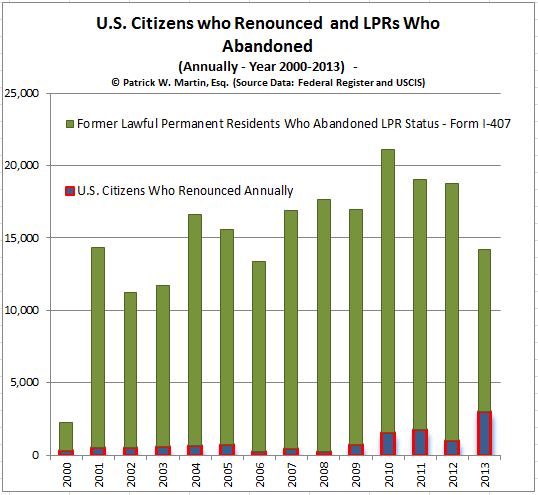
While citizens are often the focus of the public press and Congress regarding “expatriation taxation”; the statute also wraps in so-called “long-term residents.” These are individuals who had or continue to have “lawful permanent residency status.” There are numerous technical considerations in this area, but needless to say, the number of former lawful permanent residents who have simply filed Form I-407 – Abandonment is far in excess of those U.S. citizens who have filed for and received a Certificate of Loss of Nationality (“CLN”) – Form DS-4083 (CLN). The graph reflects the enormous difference.
See, earlier post The Number of LPRs “Leaving” the U.S. is 16X Greater than the Number of U.S. Citizens Renouncing Citizenship
On a related post, the question was raised –What are the Number of LPRs who Leave U.S. Annually without filing Form I-407 – Abandonment?
This is important, since many LPR individuals will have “expatriated” without actually having filed USCIS Form I-407. See, Oops…Did I “Expatriate” and Never Know It: Lawful Permanent Residents Beware! International Tax Journal, CCH Wolters Kluwer, Jan.-Feb. 2014, Vol. 40 Issue 1, p9
See, The Information in DHS/USCIS Database (A-Files, EMDS, CIS, PII, eCISCOR, PCQS, Midas, etc.) on Individuals is Extensive and Can be Shared with Internal Revenue Service, Posted on April 4, 2015
A prior post discussed the new USCIS Form I-407 that must be filed by a lawful permanent resident (LPR) who wishes to formally create a record of their abandonment of LPR status. See, More Information and More Information: USCIS Creates New Form for Abandonment of Lawful Permanent Residency
Page 1 of 2 of this form is replicated here.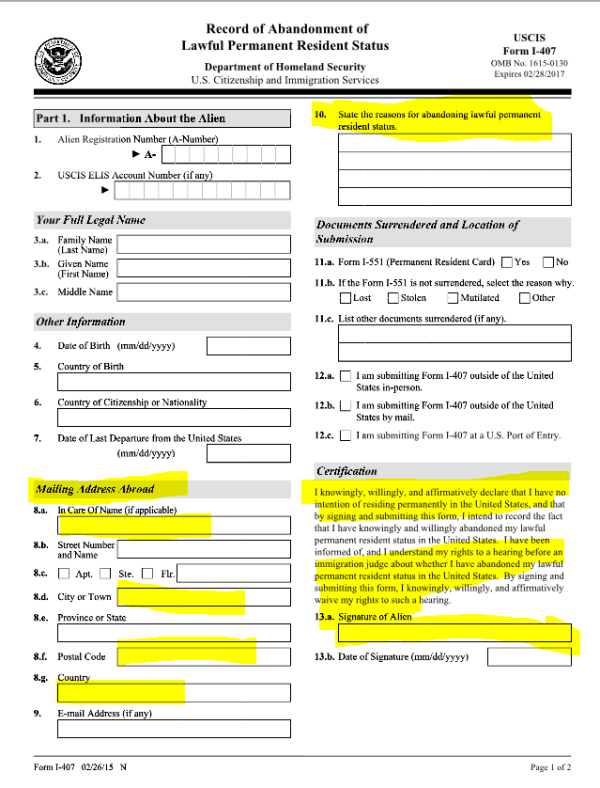
This raises many questions regarding how information maintained by the Department of Homeland Security (DHS) and the United States Customs and Immigration Service (USCIS) can be shared with
and provided to the IRS.
Former “long-term residents” have extensive U.S. tax compliance obligations, including certification requirements under Section 877(a)(2)(C) to avoid “covered expatriate” status and the various adverse tax consequences.
Importantly many LPR individuals will have “expatriated” without actually having filed USCIS Form I-407. See, Oops…Did I “Expatriate” and Never Know It: Lawful Permanent Residents Beware! International Tax Journal, CCH Wolters Kluwer, Jan.-Feb. 2014, Vol. 40 Issue 1, p9
Some of the important records that are maintained by DHS/USCIS, include the following, much of which can be helpful in the enforcement of U.S. federal tax obligations.
System location:
Alien Files (A-Files) are maintained in electronic and paper format throughout DHS. Digitized A-Files are located in the Enterprise Document Management System (EDMS). The Central Index System (CIS) maintains an index of the key personally identifiable information (PII) in the A-File, which can be used to retrieve additional information through such applications as Enterprise Citizenship and Immigrations Services Centralized Operational Repository (eCISCOR), the Person Centric Query Service (PCQS) and the Microfilm Digitization Application System (MiDAS). The National File Tracking System (NFTS) provides a tracking system of where the A-Files are physically located, including whether the file has been digitized.
The databases maintaining the above information are located within the DHS data center in the Washington, DC metropolitan area as well as throughout the country. Computer terminals providing electronic access are located at U.S. Citizenship and Immigration Services (USCIS) sites at Headquarters and in the Field throughout the United States and at appropriate facilities under the jurisdiction of the U.S. Department of Homeland Security (DHS) and other locations at which officers of DHS component agencies may be posted or operate to facilitate DHS’s mission of homeland security.
* * *
- Receipt file number(s);
- Full name and any aliases used;
- Physical and mailing addresses;
- Phone numbers and email addresses;
- Social Security Number (SSN);
- Date of birth;
- Place of birth (city, state, and country);
- Countries of citizenship;
- Gender;
- Physical characteristics (height, weight, race, eye and hair color, photographs, fingerprints);
- Government-issued identification information (i.e., passport, driver’s license):
More Information and More Information: USCIS Creates New Form for Abandonment of Lawful Permanent Residency, Posted on April 3, 2015
The U.S. Customs and Immigration Service (USCIS) announced on 23 March 2015, that a new Form I-407 is available and is to be used, per the USCIS website announcement,
Finally – Proposed Regulations for “Covered Gifts” and “Covered Bequests” Issued by Treasury Last Week (Be Careful What You Ask For!)
The U.S. Treasury department has issued proposed regulations implementing the tax on “covered gifts” and “covered bequests.” There have been numerous posts about this tax that was first created in 2008 by new IRC Section 2801 (which has it’s own chapter in Title 26 – aka the Internal Revenue Code or “IRC”: Chapter 15, Gifts and Bequests from Expatriates). The regulations can be reviewed here – Guidance under Section 2801 Regarding the Imposition of Tax on Certain Gifts and Bequests from Covered Expatriates
See prior posts, When does “Covered Expatriate” Status -NOT- matter?, (May 2015); See, The “Hidden Tax” of Expatriation – Section 2801 and its “Forever Taint.” (April 2014) and Proposal to U.S. Treasury and IRS: awaits Final Regulations on “Covered Gifts” and “Covered Bequests” (December 2014).
The tax is levied currently at 40% and can be a big surprise to U.S. beneficiaries who receive so-called “covered gifts” and “covered bequests.” The actual implementation of the tax and its enforcement was suspended until Treasury issued regulations. That day has now come and final regulations will follow shortly.
The proposed regulations create an ingenious mechanism by which assets that are received from foreign trusts (which make an election to be taxed as domestic trusts) cannot escape the 40% taxation. Specifically, there was concern expressed to me by Treasury officials drafting the regulations, when I had submitted a proposal to the U.S. Treasury on the subject in May of 2014. See, COVERED GIFTS & BEQUESTS: THE NEED FOR GUIDANCE (5+ YEARS OUT)
* * *
There was concern by the U.S. Treasury that U.S. persons could escape the tax when assets are received by foreign trusts which elect to be taxed as domestic trusts. In those cases, the statute imposes the tax liability on the trust and not the U.S. beneficiary. Hence, the concern expressed by some of the key drafters at U.S. Treasury of the regulations, was that a foreign trust would make the election and purposefully NOT pay the tax imposed by the statute, since the trustee would be outside the U.S. and largely outside the jurisdiction of the IRS.
The proposed regulations create a mechanism by which the trustee cannot slip away so easily, as they will NOT be treated as a domestic trust (versus a foreign trust) in such circumstances where the tax is not actually paid. In those cases, the U.S. beneficiary will be liable for the tax.
It also has some unique concepts that are not necessarily intuitive under the law. For instance, those individuals who are not U.S. citizens, yet live in the U.S. on a nearly full time basis, might still be able to avoid the application of the tax (at least in certain circumstances) if they are not “domiciled” in the U.S. The term “domicile” is a key estate and gift tax term of tax residency, that is not tied to the number of days an individual spend in the U.S. Rather, it is tied to the subjective intention of whether they expect to spend the rest of their lives in the U.S. See, Section 28.2801-2(b) of the proposed regulations which defines residents as those under “Chapter 11” and “Chapter 12”; which are the rules of “domicile” for transfer tax purposes. These are different from the rules of income tax residency found in IRC Section 7701.
The operative definition is found in (b)(1) of the Regulations: 26 CFR 20.0-1 – Introduction.:
“A person acquires a domicile in a place by living there, for even a brief period of time, with no definite present intention of later removing therefrom. Residence without the requisite intention to remain indefinitely will not suffice to constitute domicile, nor will intention to change domicile effect such a change unless accompanied by actual removal.”
Notice, there is no reference to the number of days physically spent in the U.S.
More to be discussed on the proposed regulations in later posts.
CORRECTION TO A PRIOR POST – How Many of the 5,211 Former U.S. Citizens (who Renounced in 2014 and 2015) are Still U.S. Taxpayers?
My goal is to provide useful information on U.S. federal tax law provisions for U.S. citizens who renounce. As this blog provides, it does not provide legal advice specific to any individual circumstances.
A prior post (How Many of the 5,211 Former U.S. Citizens (who Renounced in 2014 and 2015) are Still U.S. Taxpayers?) erroneously indicated that many of these individuals continue to be U.S. persons for federal income tax purposes.
This is not necessarily the case, depending upon when the U.S. citizenship terminated; i.e., when was the “expatriation date” as provided for in the statute. It is very possible that individuals who have renounced citizenship and did not certify under Section 877(a)(2)(C) are “covered expatriates” with all of the adverse tax consequences that befall that status (including to any future U.S. beneficiaries).
They will not necessarily continue to be “U.S. persons” for other purposes of Title 26.
I will run a series of posts over the next month or so that will discuss some of the vexing timing issues in the statute in this regard.
How Many of the 5,211 Former U.S. Citizens (who Renounced in 2014 and 2015) are Still U.S. Taxpayers?
CORRECTION TO THIS POST: If you renounced your U.S. citizenship, you may think you cease to be a U.S. taxpayer. This depends upon when the termination of citizenship occurred.
More posts will follow addressing these issues.
Unfortunately, the law is not that simple, regardless of your wealth, income, assets or future inheritances or gifts.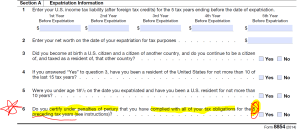
The way the federal tax law works, is that the U.S. “expatriation tax law” applies to the poorest former U.S. citizen (and certain long-term LPRs), wherever they reside if they do not comply with the certification requirements of Section 877(a)(2)(C). See, Why “covered expat” (“covered expatriate”) status matters, even if you have no assets! The “Forever Taint”!
The law continues to obligate certain former U.S. citizens to be subject to the U.S. taxation laws on a worldwide bases, unless and until they notify the IRS and certify under penalty of perjury. This depends upon the time of the renunciation.