International Tax · Citizenship Renunciation · LPR Abandonment
International Tax Shareholder
Short Window of Wait Times for CLN: One Month to 6 Weeks?
The wait times for the State Department to issue a Certificate of Loss of Nationality (“CLNs”) used to be quite long, based upon the author’s experience with various clients. That has all changed since about the beginning of this year 2023. The author has seen cases that are taking less than 6 weeks from the date of the meeting to take the oath of renunciation before a consular officer.
Too Much? – Treasury Proposes Changes in the Expatriation Tax Law – per Green Book (2023 Fiscal Year) – Part I of II
The Administration made specific proposals in its Fiscal Year 2023 Revenue Proposals to modify key provisions in the law associated with “covered expatriates.” Importantly, they proposed two key concepts that can have far reaching consequences –
Creating, in effect, a new monitoring system of those who become “tax expatriates” – specific to filing of IRS Form 8854 – and
Extending the statute of limitations period indefinitely in the event IRS Form 8854 is not filed by the “tax expatriate”.
What does this mean from a practical perspective to individuals around the world? Specifically, to (i) citizens who formally renounce their citizenship, and (ii) lawful permanent residents who have left the U.S. and did not formally abandon their immigration status with USCIS?
First, anyone who fails to file IRS Form 8854 with their tax return or files a false or inaccurate form has to be concerned under current U.S. tax law.
The U.S. federal tax law has a specific crime, for making a false statement or signing a false tax return or other document – which is known as the perjury statute (IRC Section 7206(1)). This is a criminal statute, not civil. Some people are also under the misunderstanding that a false tax return needs to be filed. The statute is much broader and includes “. . . any statement . . . or other document . . . “.
(1) Declaration under penalties of perjury
Willfully makes and subscribes any return, statement, or other document, which contains or is verified by a written declaration that it is made under the penalties of perjury, and which he does not believe to be true and correct as to every material matter; or . . .
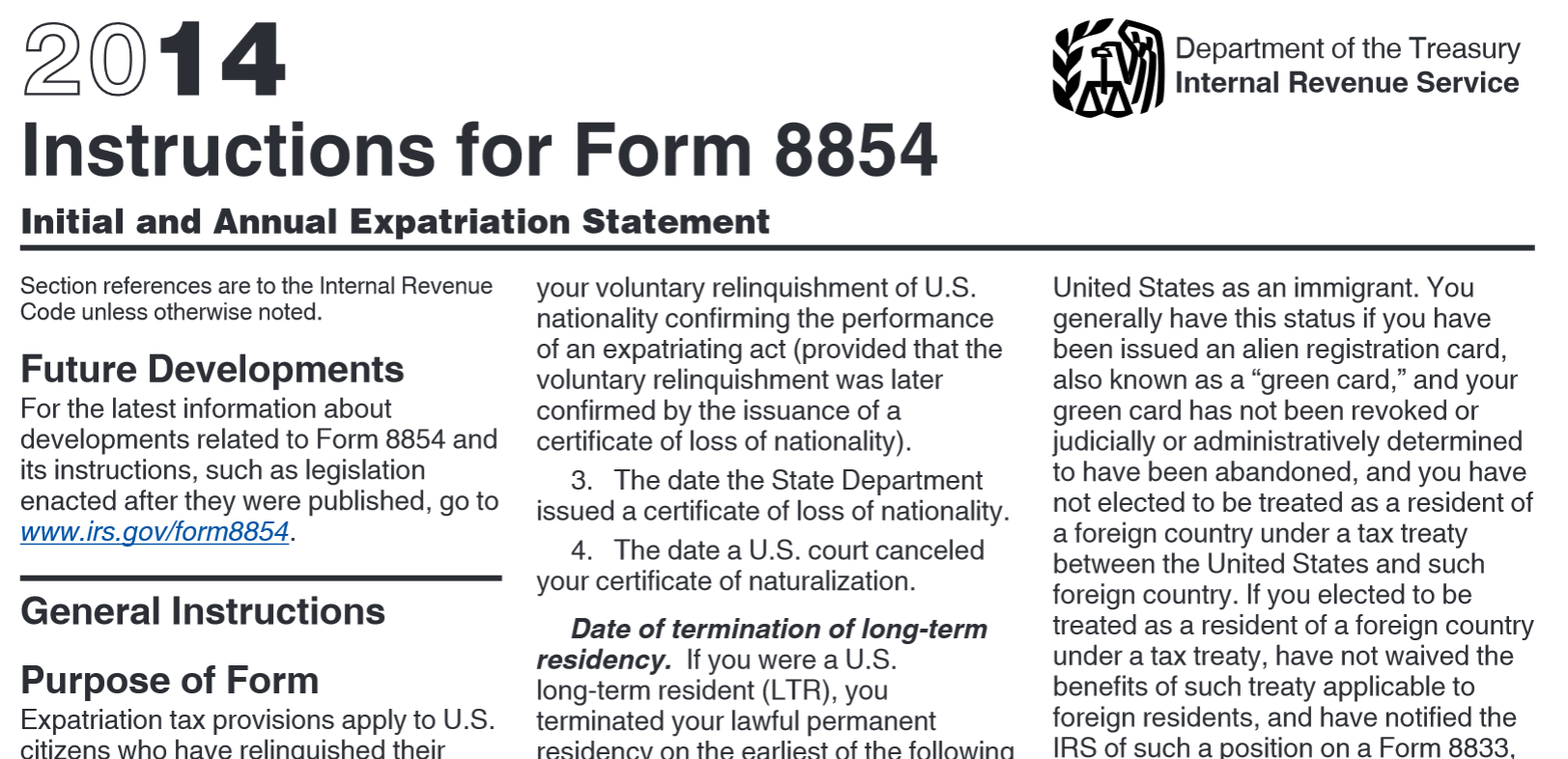
The IRS Form 8854has a specific penalty of perjury signature requirement independent of any U.S. federal income tax return to be filed. See the current language below:
See a prior post –
* Filing False Expatriation Tax Form – IRS Form 8854
Filing a false IRS Form 8854 . . . becomes problematic quickly for any individual who carelessly discloses inaccurate asset information (or no asset information at all). See, the 2016 indictment of a NY business professor discussed previously here: Expatriation Tax Form 8854 is Part of Criminal Tax Case
In addition to these cases, the Department of Justice has been actively involved in pursuing criminal charges against various individuals associated with tax expatriation cases. See the U.S. Supreme Court of last year to take up a criminal case – Regarding an Unnamed Law Firm that Advises International Tax & Expatriation Matters. A petition for a writ of certiorari to the U.S. Supreme Court was unsealed regarding the 9th Circuit case, In re Grand Jury, case Nos. 21-55085, 21-55145. In that case a law firm and a company was held in contempt of court: Re: a Grand Jury Subpoenas –
The panel affirmed the district court’s orders holding appellants, a company and a law firm, in contempt for failure to comply with grand jury subpoenas related to a criminal investigation, in a case in which the district court ruled that certain dual-purpose communications were not privileged because the “primary purpose” of the documents was to obtain tax advice, not legal advice.
Importantly, the IRS and the DOJ currently have extensive legal tools at their disposal to pursue taxpayers who may owe taxes as a result of becoming a “covered expatriate.” The above criminal cases reflect their interest and appetite in pursuing such cases.
In addition to criminal exposure, the civil tax exposure can be extensive and the IRS is not shy about assessing tax and international information penalties (even if the assessment for penalties such as not filing IRS Form 5471 are unlawful, as determined by the U.S. Tax Court recently – ). See April 3rd, 2023 decision by the United States Tax Court (the “Tax Court”) – Farhy,[6] stating that the IRS does not have statutory authority to assess penalties under section 6038(b).
The next Part II post will discuss the details of the Administration’s proposed change.
Spoiler Alert: The Author thinks its highly unlikely these changes will be adopted by Congress!
Russian Citizen who Expatriated from U.S. – Pleads Guilty to Tax Fraud – US$500M Penalty
I previously wrote about how this blog (with few posts on my part over the last couple of years) is not unlike Kipling’s observation –
” . . .Oh, East is East, and West is West, and never the twain shall meet. . . ”
. . . in that it addresses principally civil federal tax law [the East] but sometimes (not never 🙂 ) crosses over from civil to criminal [the West]. In that May 2020 post, I covered the indictment in the Northern District of California of a Russian citizen who had become a naturalized U.S. citizen (“NUSC”). As a NUSC he necessarily was a “covered expatriate” upon renunciation as has been explained here in other posts. See, When does “Covered Expatriate” Status -NOT- matter?
Mr. Oleg Tinkov was indicted in May 2020 under 26 U.S.C. § 7206(1) – for Making and Subscribing A False Tax Return, Statement, and Document (Two Counts). The Indictment was originally filed under seal and the docket can be reviewed here. His sentencing is set for October 29, 2021.
As explained therein, he renounced his U.S. citizenship many years prior to the indictment – nearly 7 years before he was even criminally indicted:
11. On or about October 28, 2013, TINKOV expatriated from the United States by renouncing his U.S. citizenship before a diplomatic and consular officer of the United States.
As a very wealthy individual, the value and accuracy of his assets reflected on his Form 8854 would have been significant factually in this case. Particularly, since as a NUSC he would necessarily have been a “covered expatriate” and hence subject to the “mark-to-market” tax on his worldwide income upon his expatriation. The amount of the tax is calculated upon the amount and fair market value of the assets on the ” . . . day before the expatriation date. . . ” 26 U.S. Code § 877A(a)(1).
* Filing False Expatriation Tax Form – IRS Form 8854
Filing a false IRS Form 8854 and therefore necessarily a false tax return, becomes problematic quickly for any individual who carelessly discloses inaccurate asset information (or no asset information at all). See, the 2016 indictment of a NY business professor discussed previously here: Expatriation Tax Form 8854 is Part of Criminal Tax Case
Importantly, this is true even when a naturalized citizen decides to go back to her home country and leave the U.S. – including on a permanent basis; even when the taxpayer’s assets are located outside the U.S. This was the case with Mr. Tinkov per the indictment and the DOJ press release. See the harsh words in the DOJ press release of the guilty plea yesterday, October 1, 2021 – Founder of Russian Bank Pleads Guilty to Tax Fraud
“Tinkov renounced his U.S. Citizenship shortly after receiving millions of dollars,” said Acting Special Agent in Charge Darrell J. Waldon of the IRS-CI Washington D.C. Field Office. “Despite his knowledge of U.S. tax reporting requirements, he substantially understated his wealth on filings with the IRS. International tax cheats remain a priority for my office and our agency; and as such, the International Tax and Financial Crimes D.C.-based group will continue to aggressively pursue those committing international tax crimes.”
If you are a tax professional assisting in the preparation of tax returns and IRS Form 8854 Initial and Annual Expatriation Statement what duty to inquire do you have as to the accuracy and information provided to you by your client? What duty do tax professionals have to reasonably inquire as to “knowledge of client’s omission” – “information to be furnished” and “diligence as to accuracy”? Must the tax professional make reasonable inquiries if any information furnished to you appears to be incorrect, incomplete or inconsistent with other facts or assumptions of the taxpayer or her circumstances? Treasury Circular No. 230 §10.20, §10.21, §10.22, §10.34(d).
Can and will the U.S. federal government deny the ability of Mr. Tinkov to ever return to the United States pursuant to Title 8, U.S.C. Section 1101(a)(43) for being convicted of an aggravated felony? This is probably all moot considering it has been reported that Mr. Tinkoff was diagnosed with leukemia in March 2020 and has changed his life focus. Arrested Billionaire Banker Tinkov Switches Focus to Cancer Foundation
Old News – Important News: U.S. Tax Court Rules IRS Rev. Rul. 91-32 is NOT the Law
The U.S. Tax Court ruled that the IRS’ interpretation of when sales of partnership interests by non-U.S. persons (in this case, it was a foreign corporate partner with an interest in a U.S. limited liability company) is subject to U.S. income taxation is wrong. See,Grecian Magnesite Mining vs. Comm’r (149 T.C. No. 3 – 2017).
The Court ruled that the gain from the partnership (which was not attributed to real estate – which itself was taxable under FIRPTA/Section 897) was capital gain and not U.S. source income. The Court said it would not follow the IRS’ interpretation in Rev. Ruling 91-32.
The significance for tax expatriation considerations is that IRS Revenue Rulings and other “administrative guidance” or IRS opinions of the law (such as private letter rulings, notices, technical advice memorandum, etc.) do not carry the weight of law. Let alone IRS instructions to forms. There are a number of IRS opinions of the law regarding “expatriation tax” matters – e.g., IRS Notice 97–34 for those former citizens or LPRs who may be “covered expatriates.”
This conclusion of the Tax Court was (until Congress changed the law overriding the case law) particularly important for non-resident aliens (who were previously U.S. citizens or lawful permanent residents); as the IRS in the past has relied upon Rev. Rul. 91-32 to impose taxation on non-residents who sell their U.S. partnership interests. See, for instance, the IRS Technical Memorandum where it states the law that ” . . . capital gains are not taxable under § 871(a)(2), unless an alien is present in the United States 183 days or more. . . ” yet still concluded the gain was “effectively connected income” (“ECI”) subject to U.S. taxation. Memorandum – Internal Revenue Service
A second blow for the government came when the U.S. Court of Appeals for the D.C. Circuit confirmed the U.S. Tax Court and ruled in favor of the taxpayer.
The government appealed the U.S. Tax Court opinion to the D.C. Circuit, which also ruled in favor of the taxpayer. See full 2019 opinion – here – The DOJ, tax division attorneys of course argued for the government and Michael J. Miller based in Manhattan, an exceptional international tax lawyer, litigated the case in the U.S. Tax Court also argued on appeal for the non-U.S. taxpayer.
While a win for the taxpayer, Congress repealed the result by amending IRC Section 864(c) as part of the major tax reform of 2017 (so-called Tax Cuts and Jobs Act of 2017). Now, such gain from the sale of a partnership interest is treated as “effectively connected” with a US trade or business (“ECI”) to the extent the seller of the partnership interest would have had ECI gain had the partnership itself sold all of its assets. The gain is measured by the fair market value as of the date of sale. Also a new 10% withholding tax was imposed with the same legislation under IRC Section 1446(f). It requires the buyer of a partnership interest to withhold a 10% tax on the “amount realized.”
“LPR Tax Limbo” – Formal Abandonment of LPR (Form I-407) – BIG GAP with Actual Emigration of LPRs
Millions of lawful permanent residents (LPRs) who have left the U.S. and not “formally abandoned” their LPR status (by filing Form I-407, Record of Abandonment of Lawful Permanent Resident) typically remain in some kind of “LPR U.S. tax limbo.” How many individuals worldwide are in this LPR U.S. tax limbo?
Why are these numbers important for the tax-expatriation analysis? See, a recent post, Why Most LPRs Residing Overseas Haven’t a Clue about the Labyrinth of U.S. Taxation and Bank and Financial Reporting of Worldwide Income and Assets (Part I). Indeed, most individuals probably do not think they are a U.S. federal income tax resident when they leave the U.S. to reside overseas back to their home country. Why would they? There is no tax training manual provided to LPRs who leave the U.S. and no tax advisories – reflected on the card itself (unlike the last page of the U.S. passport, paragraph D). More precisely, most are probably not giving much, if any thought, to the complex U.S. federal tax residency rules and their extraterritorial application.
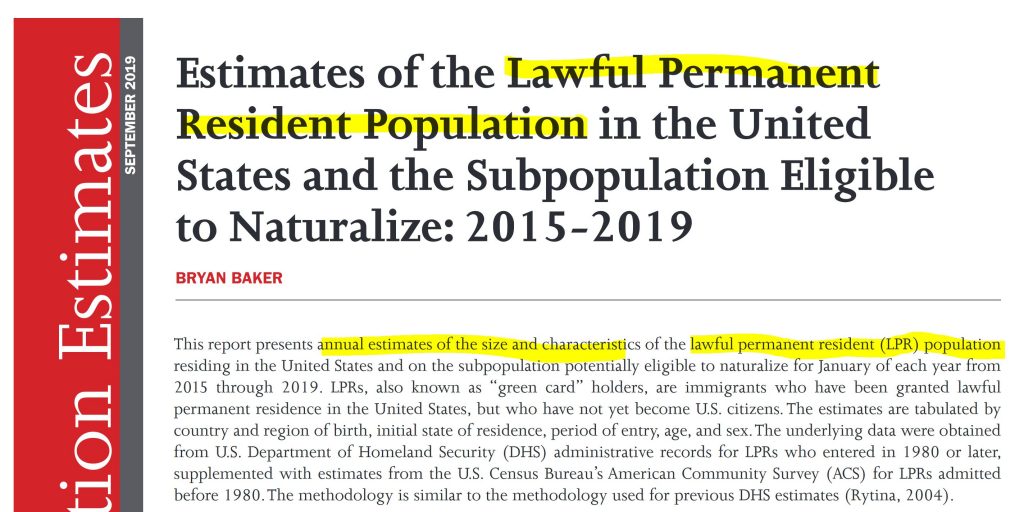
The “big gap” referred to above can be identified from the the Office of Immigration Statistics (OIS) report titled: Estimates of the Lawful Permanent Resident Population in the United States and the Subpopulation Eligible to Naturalize: 2015-2019. According to the report, more than 1 million individuals become LPRs each year. Between naturalization, mortality and emigration the report shows that the LPR population, year over year, has remained stable. In 2019 the total number of LPRs per this report was 13.6 million, up from just 13.0 million in 2015.
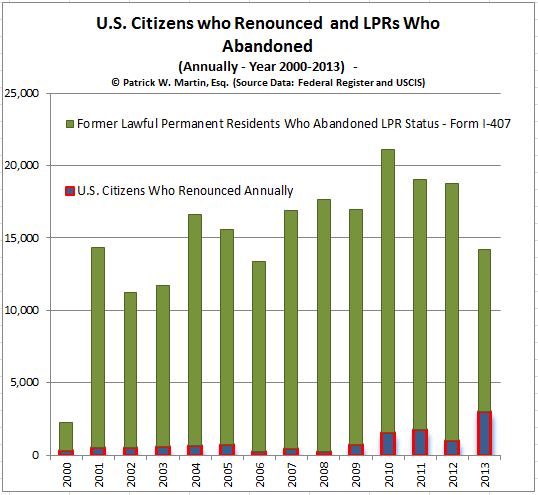
The “gap” is the difference between the numbers of LPRs who have left-emigrated the U.S. (some 3+ million) compared to something like an annual average of 15-19 thousand who have filed Form I-407. The gap is in the millions of persons who are in LPR U.S. tax limbo.
Mexico
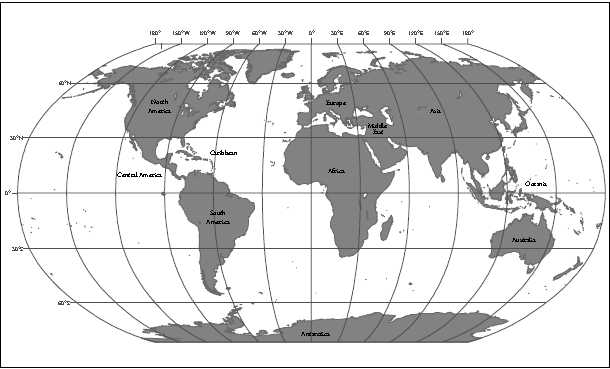
The report is also worth reading if you want to understand the demographics of the LPR population. Mexico has about 2.5 million (which is by far the greatest number) of the total 13+ million LPR population.
As the report points out there is no reliable direct measurements of LPR emigration. They do not exist. This lack of information is what drove me to file a FOIA request with the government to request information about the number USCIS Forms I-407 that are filed with the government. See, also quarterly statistics of the USCIS – Form I-407, Record of Abandonment of Lawful Permanent Resident Status (partial information for years 2016-2019).
The information I obtained in the FOIA response was surprising, since the government had records showing only 46,364 Forms I-407 were filed in the years 2013 through 2015, as follows:
SOURCE: Federal Government Response to FOIA Request: Office of Performance and Quality (OPQ), Performance Analysis and External Reporting (PAER), JJ
This represents an average of only 15,455 individuals who formally abandoned their LPR status. Contrasted with more than 3.6 million estimated to have emigrated in 2019 per the DHS report leaves a massive gap of well over 3 million persons who held a “green card” and have left. They are now in LPR U.S. tax limbo.
What about the tax consequences? How many of these LPRs who left the U.S. know, understand or have any idea whatsoever of the federal tax filing obligations regarding their status?
What is the takeaway from the DHS report and LPR – I-407 information provided to me by the FOIA response? There is a discrepancy in the millions of people. Millions of individuals who actually leave or have left the U.S. to reside somewhere else around the world; compared to only some tens of thousands of individuals who have formally filed Form I-407, Record of Abandonment of Lawful Permanent Resident.
What can these individuals do to get out of the LPR U.S. tax limbo?
Will Congress Repeal the Estate Tax? If so, will the “Inheritance Tax” for “Covered Expatriates” get Repealed too?
The current U.S. Treasury Secretary announced in an April 26, 2017 press briefing the intention of the current Administration to repeal the estate tax.
The current estate tax has been in existence for 101 years (with prior versions in the 19th century). Please see the following articles published some years ago for a history of the estate tax since its enactment with the Revenue Act of 1916; Patrick Fleenor, staff economist at the Tax Foundation, A History and Overview of Estate Taxes in the United States and The Estate Tax: Ninety Years and Counting, by Darien Jacobson, Brian Raub and Barry Johnson.
If Congress and the President do repeal a tax that has been in existince for over 100 years, it is hard to imagine that such a repeal will be permanent going forward in other administrations and congressional bodies? In contrast, the U.S. Treasury released its FACT SHEET: Administration’s FY2017 Budget Tax Proposals a little over a year ago where its then stated goal (under a very different Administration) was to increase the scope and amount of the estate and gift tax –
Restore the Estate, Gift, and Generation-Skipping Transfer (GST) Tax Parameters in Effect in 2009. This proposal would make permanent the estate, GST, and gift tax parameters as they applied during 2009. The top tax rate would be 45 percent and the exclusion amount would be $3.5 million per person for estate and GST taxes, and $1 million for gift taxes. The proposal would be effective for the estates of decedents dying, and for transfers made, after December 31, 2016.
The important question for “covered expatriates” (really for their future U.S. beneficiareis) is whether a repeal of the estate tax for U.S. persons will also include the repeal of the “inheritance tax” under Section 2801 that was newly adopted in 2008. See, prior posts relevant to Section 2801,
Will Treasury Ever Finalize the 2801 Regulations? Meanwhile – U.S. beneficiaries are exposed to tax on “covered gifts” and “covered bequests.”
Treasury has not yet finalized the 2801 regulations. The tax that is imposed under Section 2801 was passed into law in 2008, yet the collection of the tax has been suspended until the regulations are finalized.
First, the collection of the tax has been suspended until after guidance is issued along with IRS Form 708.
Second, this is the first U.S. federal tax of its kind as a true “inheritance” tax, in the case of bequests. It is also apparently the first tax of its kind on the recipient of gifts, which are otherwise exempt from income tax.
Third, the IRS has no way to help effectively track the tax, its application, collection and general enforcement.
Fourth, there is no basic guidance beyond the statute for “any United States citizen or resident” who receives such a gift or a bequest to make a host of decisions to properly determine or calculate the tax.
Fifth, presumably no “United States citizen or resident” has ever even paid such a tax, due to its suspension; although the law is now almost six years old.
Sixth, the statute imposes no time requirement for when the tax must be paid.
Seventh, since many of the assets likely to be gifted or bequeathed will be located outside the U.S. in different countries with different currencies and economic variables and legal systems compared to the U.S., there is a particular need to know the allowable methods of valuing the property gifted or bequeathed.
Eighth, Chapter 4 of Subtitle A, FATCA will bring greater awareness of U.S. tax law requirements for U.S. citizens and residents living outside the U.S., specifically including Section 2801.
Ninth and finally, there have been a record number of U.S. citizens who have renounced or relinquished their citizenship during the year 2013, which increases the number of affected taxpayers who might receive covered gifts or bequests.
Finally, there have been other thoughtful comments, including from ACTEC regarding the proposed 2801 proposed regulations – but still no final regulations and no statute of limitations periods running against the government to collect taxes which may be owing going back nearly 10 years!!
New Treasury Regulations Can Effect Some Long-Term Residents (“Green Card” Holders)
There have been numerous posts about how Lawful Permanent Residents (“LPRs”) who have not formally abandoned their green card might have adverse U.S. tax consequences as part of the U.S. “expatriation tax.”
The U.S. Treasury issued new Regulations that can impact LPRs who have previously filed U.S. 1040NR tax returns under an applicable income tax treaty. On December 13, 2016, the these final regulations require foreign-owned, single-member U.S. limited liability companies (“SM-LLCs”) that are treated as disregarded entities for U.S. tax purposes to file an information return to report certain transactions. These Treasury Regulations, 26 CFR § 1.6038A-1(c) require these foreign-owned SM LLCs to be treated as if they are a separate domestic “C” corporation specifically for reporting purposes.
Treasury Regulations, 26 CFR § 1.6038A-1(c) require foreign-owned SM LLCs to be treated as if they are a domestic “C” corporation for reporting purposes (Form 5472)
An individual who is a LPR can fall into this category in certain circumstances; namely where they cease to be a “U.S. person” under IRC Section 7701(b)(6). See, IRS Form 5472 directly here –
Part II: Who is a “long-term” lawful permanent resident (“LPR”) and why does it matter?
A post in August 2014 explained the basic rule of who is a “long-term resident” as that technical term is defined for tax purposes in IRC Section 877 (e)(2). There is much confusion about how the tax law defines a “lawful permanent resident” (“LPR”) versus how immigration law defines what is almost the same concept. The statutes are different and have definitions in two separate federal codes (Title 26, the federal tax provisions and Title 8, the immigration law provisions).
This follow-up comment is to highlight some key concepts about why it matters if you become a “long-term” resident as that term is defined in the tax law.
A LPR can reside for substantially shorter periods in the U.S. (shorter than the apparent 7 or 8 years identified in the statute), and still be a “long-term resident” per IRC Section 877 (e)(2) depending upon the facts of any particicular case.
There are far more LPRs who abandon their status (formally) than U.S. citizens who formally take the oath of renunciation. See the table above reflecting those who have formally renounced U.S. citizenship versus those who have formally abandoned their LPR status.
Plenty of LPRs informally abandon their LPR status for immigration purposes by moving and living permanently outside the U.S.
There are plenty of timing issues for LPRs surrounding how and when they have “abandoned” their LPR status for purposes of IRC Section 877 (e)(2). See –
A Rochester, New York emeritus professor of business administration pleaded guilty today to conspiring with others to defraud the United States and to submitting a false expatriation statement to the Internal Revenue Service (IRS), announced Principal Deputy Assistant Attorney General Caroline D. Ciraolo, head of the Justice Department’s Tax Division, and U.S. Attorney Dana J. Boente of the Eastern District of Virginia, after the plea was accepted by U.S. District Judge T.S. Ellis III.
The importance of a complete and accurate IRS Form 8854, is to enable a taxpayer (if they meet other statutory requirements) to avoid “covered expatriate” status. See, the Tax Court case earlier this year 2016, Topsnik v. Commissioner (2016), where the Court found the taxpayer had failed to meet the certification requirements and was necessarily a “covered expatriate.”
Maybe most important of all, it is crucial the taxpayer understands the full range of legal and tax consequences to them regarding the important steps that might lead to “tax expatriation.” The law is complex and fraught with potential minefields. It’s always advisable to have thoughtfully analyzed and considered the consequences of “tax expatriation” long before taking specific steps (pre as opposed to post-expatriation) of renunciation of U.S. citizenship or abandonment of lawful permanent residency.









 still are not final. See,
  systems compared to the U.S., there is a particular need to know the allowable methods of valuing the property gifted or bequeathed.
 how immigration law defines what is almost the same concept. The statutes are different and have definitions in two separate federal codes (Title 26, the federal tax provisions and Title 8, the immigration law provisions).

 Statement