The IRS Commissioner’s comments earlier this week may signal an important change in policy and approach to USCs and LPRs residing overseas? See, his full remarks set out in the paper presented at the OECD international tax conference:
This tax-expatriation.com website is largely dedicated to USCs and LPRs who reside outside the U.S. Those who are not living in the U.S.
In some of the more extreme cases, these USCs and LPRs are (i) renouncing (or proving prior relinquishment) of their U.S. citizenship, or (ii) formally abandoning their LPR or terminating the status by application of the tax law, respectively. See, The List is Out – and Its 1,001 Former U.S. Citizens for the 1st Quarter 2014
For further reading on USCs see, Why “covered expat” (“covered expatriate”) status matters, even if you have no assets! The “Forever Taint”!
For further reading on LPRs, see, Countries with U.S. Income Tax Treaties & Lawful Permanent Residents (“Oops – Did I Expatriate”?)
There are a multitude of reasons for taking this step, but a common theme for many individuals (especially with limited financial resources) arises from (1) the costs in time and resources – e.g., time required to collect financial information from banks in their country of residence, which cannot easily be converted for U.S. tax law purposes – professional fees to U.S. tax advisers for filing annual tax returns and information returns such as FBARs, and (2) the very high penalties assessed under the law for not filing such forms and information. See, USCs and LPRs Living Outside the U.S. – Key Tax and BSA Forms.
See, for instance, Nuances of FBAR – Foreign Bank Account Report Filings – for USCs and LPRs living outside the U.S.. See, When does the Statute of Limitations Run Against the U.S. Government Regarding FBAR Filings?
Also, see, “PFICs” – What is a PFIC – and their Complications for USCs and LPRs Living Outside the U.S. Plus, USCs and LPRs residing outside the U.S. – and IRS Form 8938. In addition, see, Taxpayer Advocate Report on Burdens of Benign Taxpayers who Make Mistakes 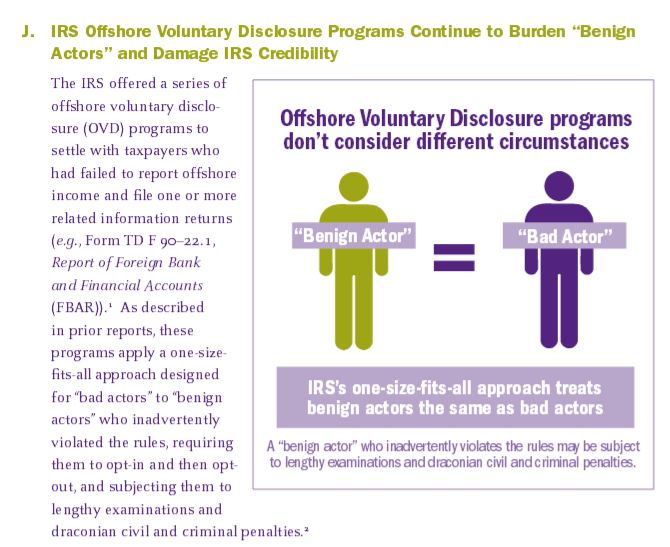
All of these complications for USCs and LPRs living outside the U.S., is a most compelling reason for the IRS Commissioner to provide a more sensible approach to how the government focuses their attention on USCs and LPRs residing overseas. How will they be treated?
How will the long-arm of the U.S. law that extends around the world be administered by IRS revenue agents?
Will the new policy announcements, which are apparently forthcoming, provide a genuine balance of allowing the IRS to enforce the law in a balanced and fair-minded approach with USCs and LPRs residing overseas? Will there be a clear distinction between those who are in good faith attempting to comply with the law (even if they have made numerous “technical foot faults” in how the law applies) versus those USCs and LPRs who have taken steps to hide assets and evade U.S. taxes?
Or will the IRS continue to “beat the drums” of non-compliance of these individuals and emphasize the penalties the government can assess under the law? See my earlier post, IRS Beats the Drums – Re: Foreign Assets, Just Days Before April 15,
It seems that only a fair-minded approach by the IRS and the Justice Department, will lead to better U.S. tax and FBAR compliance worldwide of USCs and LPRs residing overseas. This should be true, even in light of the vast treasure trove of FATCA foreign financial data which the IRS will begin collecting throughout the world for this calendar year 2014. See, The Importance of a Certificate of Loss of Nationality (“CLN”) and FATCA – Foreign Account Tax Compliance Act.