FBAR Penalties for USCs and LPRs Residing Overseas.
Can the Taxpayer have no knowledge of the law and still be liable for the willfulness penalty? The government says yes, in its memorandum of law filed in the Zwerner case.
The importance of the Zwerner case to USCs and LPRs living overseas, cannot be overestimated in my view. It’s a case where the USC, Mr. Zwerner, was cooperative with the IRS during their examination. This is a fact that both the government and the taxpayer acknowledged during the trial to enforce the collection and determination of the government of the 200% FBAR penalties.
Most troubling about this case, is the allegation that the IRS agent handling the case caused Mr. Zwerner to file and prepare a letter that expressly was an admission of his liability under Title 31. As part of the “undisputed facts”, the IRS agent actually drafted the letter for Mr. Zwerner. See the Motion of Mr. Zwerner in reply to the government’s Motion for Summary Judgment. In that case, Mr. Zwerner testified that the IRS agent had misled him.
Presumably, this letter would have been highly convincing evidence to the jury who heard the FBAR penalty case.
There is a cautionary tale in this case for USCs and LPRs residing overseas who have not filed FBARs. Communications to the government, how they are managed, what is said and what approach is taken, should be carefully considered in each case.
Next, another perplexing aspect of this case is that the government continues to persist in its argument that a mere preponderance of the evidence is the proof standard required. That will be left for another post and another discussion.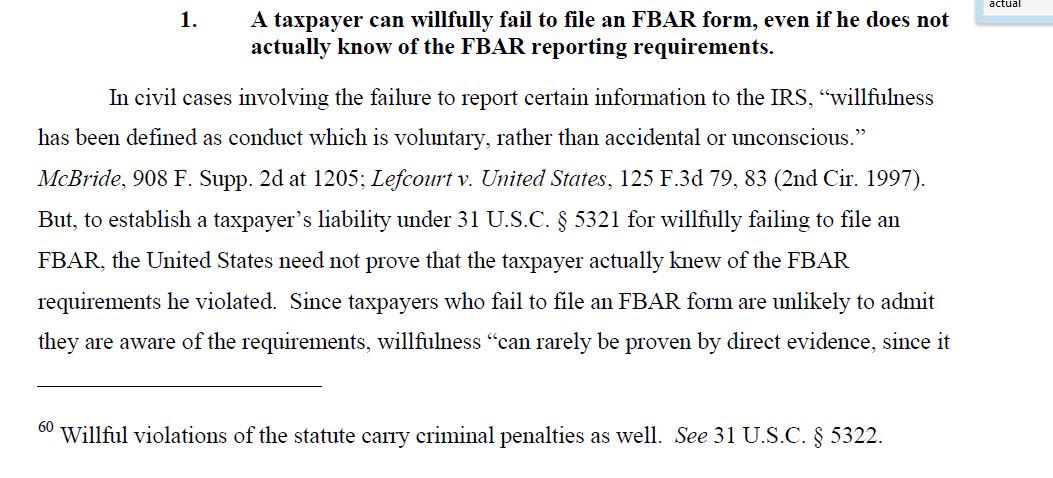
Finally, maybe the most troubling for USCs and LPRs who live outside the U.S., is the government’s assertion that an individual can be liable for the willfulness penalty, for “willfully failing to file a FBAR” – ” . . . even if the person does not actually know of the FBAR reporting requirements.” See, page 4 of the government’s motion for Summary Judgment in the Zwerner case. This is a position they have argued consistently in at least three different cases.
This leaves USCs and LPRs living overseas wondering, will the U.S. government assess willfulness penalties against me for having income and accounts in my home country during all of the years I have lived in “Country X” (particularly since I may have had no knowledge of the FBAR reporting requirements)? Under what circumstances am I at risk for such a claim by the government?
Another later post will explain how the government can collect the FBAR assessed penalties under the law and the problematic issues for them in collecting the amounts in a foreign country.